


Judges 3:7
Bible text: King James Version (1769 Blayney text) · Public domain
Bible text: Berean Standard Bible · Public domain
Bible text: American Standard Version (1901) · Public domain
Bible text: World English Bible, Messianic edition · Public domain
Bible text: Geneva Bible (1599) · Public domain
Bible text: Young's Literal Translation · Public domain
- וַיַּעֲשׂוּvai·ya·'a·Suand they didH6213Conj-w ¦ V-Qal-ConsecImperf-3mpVerb Qal Consecutive Imperfect 3rd Plural Masculineוַandיַּעֲשׂוּthey did
- בְנֵיve·nei[the] people ofH1121N-mpcNoun Plural Masculine Construct
- יִשְׂרָאֵלYis·ra·'ElIsraelH3478N-properNoun Proper Location
- אֶת'et<obj.>H853DirObjMParticle Object Indicator
- הָרַעha·Ra'the evilH7451Art ¦ Adj-msAdjective Singular Masculine Absoluteהָtheרַעevil
- בְּעֵינֵיbe·'ei·Neiin [the] eyes ofH5869Prep-b ¦ N-fdcNoun Dual Feminine Constructבְּinעֵינֵי[the] eyes of
- יְהוָהYah·wehYahwehH3068N-properNoun Proper Title
- וַיִּשְׁכְּחוּvai·yish·ke·Chuand they forgotH7911Conj-w ¦ V-Qal-ConsecImperf-3mpVerb Qal Consecutive Imperfect 3rd Plural Masculineוַandיִּשְׁכְּחוּthey forgot
- אֶת'et<obj.>H853DirObjMParticle Object Indicator
- יְהוָהYah·wehYahwehH3068N-properNoun Proper Title
- אֱלֹהֵיהֶם'e·lo·hei·Hemtheir GodH430N-mpc ¦ 3mpNoun Plural Masculine ConstructאֱלֹהֵיGodהֶםtheir
- וַיַּעַבְדוּvai·ya·'av·Duand they servedH5647Conj-w ¦ V-Qal-ConsecImperf-3mpVerb Qal Consecutive Imperfect 3rd Plural Masculineוַandיַּעַבְדוּthey served
- אֶת'et<obj.>H853DirObjMParticle Object Indicator
- הַבְּעָלִיםha·be·'a·Limthe BaalsH1168Art ¦ N-mpNoun Title Plural Masculine AbsoluteהַtheבְּעָלִיםBaals
- וְאֶתve·'Etand <obj.>H853Conj-w ¦ DirObjMParticle Object Indicatorוְandאֶת<obj.>
- הָאֲשֵׁרוֹתha·'a·she·Rotthe Asherah polesH842Art ¦ N-fpNoun Title Plural Feminine AbsoluteהָtheאֲשֵׁרוֹתAsherah poles
English is a literal word-by-word gloss of the Hebrew, not the KJV's wording. Why?
This is the original text the KJV's translators worked from — each Hebrew word with its own literal English meaning in this verse, prepared by scholars at Tyndale House, Cambridge. The KJV translates whole sentences, not word by word, so its wording differs: one Hebrew word can become several English words, and the KJV may choose “the LORD” where the gloss reads “Yahweh”. Both are faithful — they answer different questions. For the KJV's own rendering, switch to the KJV text.
Details
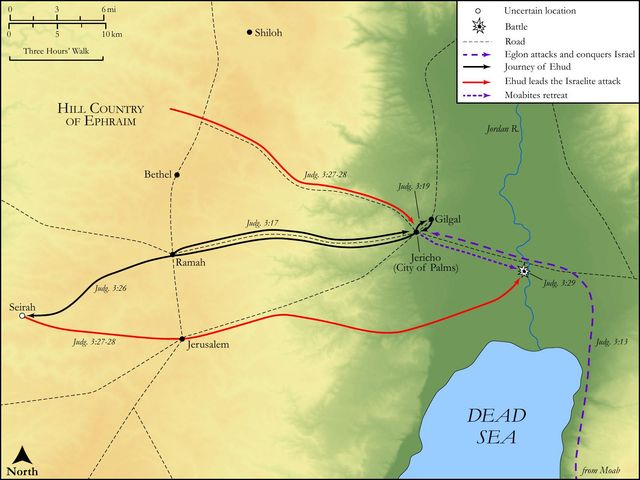
See on the biblical-era maps

Study this verse
Public-domain commentary
Matthew Henry
From his Commentary on the Whole Bible. Henry comments on passages, not single verses — this entry covers Judges 3:1–7. His two-level outline is real structure in the source text, so it is rendered as structure.
We are here told what remained of the old inhabitants of Canaan. 1. There were some of them that kept together in united bodies, unbroken (Jdg 3:3): The five lords of the Philistines, namely, Ashdod, Gaza, Askelon, Gath, and Ekron, Sa1 6:17. Three of these cities had been in part reduced (Jdg 1:18), but it seems the Philistines (probably with the help of the other two, which strengthened their confederacy with each other thenceforward) recovered the possession of them. These gave the greatest disturbance to Israel of any of the natives, especially in the latter times of the judges, and they were never quite reduced until David's time. There was a particular nation called Canaanites, that kept their ground with the Sidonians, upon the coast of the great sea. And in the north the Hivites held much of Mount Lebanon, it being a remote corner, in which perhaps they were supported by some of the neighbouring states. But, besides these, 2. There were every where in all parts of the country some scatterings of the nations (Jdg 3:5), Hittites, Amorites, etc., which, by Israel's foolish connivance and indulgence, were so many, so easy, and so insolent, that the children of Israel are said to dwell among them, as if the right had still remained in the Canaanites, and the Israelites had been taken in by their permission and only as tenants at will.
Now concerning these remnants of the natives observe,
I.How wisely God permitted them to remain.
It is mentioned in the close of the foregoing chapter as an act of God's justice, that he let them remain for Israel's correction. But here another construction is put upon it, and it appears to have been an act of God's wisdom, that he let them remain for Israel's real advantage, that those who had not known the wars of Canaan might learn war, Jdg 3:1, Jdg 3:2. It was the will of God that the people of Israel should be inured to war,
1.Because their country was exceedingly rich and fruitful, and abounded with dainties of all sorts, which, if they were not sometimes made to know hardship, would be in danger of sinking them into the utmost degree of luxury and effeminacy. They must sometimes wade in blood, and not always in milk and honey, lest even their men of war, by the long disuse of arms, should become as soft and as nice as the tender and delicate woman, that would not set so much as the sole of her foot to the ground for tenderness and delicacy, a temper as destructive to every thing that is good as it is to every thing that is great, and therefore to be carefully watched against by all God's Israel.
2.Because their country lay very much in the midst of enemies, by whom they must expect to be insulted; for God's heritage was a speckled bird; the birds round about were against her, Jer 12:9. It was therefore necessary they should be well disciplined, that they might defend their coasts when invaded, and might hereafter enlarge their coast as God had promised them. The art of war is best learnt by experience, which not only acquaints men with martial discipline, but (which is no less necessary) inspires them with a martial disposition. It was for the interest of Israel to breed soldiers, as it is the interest of an island to breed sea-men, and therefore God left Canaanites among them, that, by the less difficulties and hardships they met with in encountering them, they might be prepared for greater, and, by running with the footmen, might learn to contend with horses, Jer 12:5. Israel was a figure of the church militant, that must fight its way to a triumphant state. The soldiers of Christ must endure hardness, Ti2 2:3. Corruption is therefore left remaining in the hearts even of good Christians, that they may learn war, may keep on the whole armour of God, and stand continually upon their guard. The learned bishop Patrick offers another sense of Jdg 3:2 : That they might know to teach them war, that is, they shall know what it is to be left to themselves. Their fathers fought by a divine power. God taught their hands to war and their fingers to fight; but now that they have forfeited his favour let them learn what it is to fight like other men.
II.How wickedly Israel mingled themselves with those that did remain.
One thing God intended in leaving them among them was to prove Israel (Jdg 3:4), that those who were faithful to the God of Israel might have the honour of resisting the Canaanites' allurements to idolatry, and that those who were false and insincere might be discovered, and might fall under the shame of yielding to those allurements. Thus in the Christian churches there must needs be heresies, that those who are perfect may be made manifest, Co1 11:19. Israel, upon trial, proved bad.
1.They joined in marriage with the Canaanites (Jdg 3:6), though they could not advance either their honour or their estate by marrying with them. They would mar their blood instead of mending it, and sink their estates instead of raising them, by such marriages.
2.Thus they were brought to join in worship with them; they served their gods (Jdg 3:6), Baalim and the groves (Jdg 3:7), that is, the images that were worshipped in groves of thick trees, which were a sort of natural temples. In such unequal matches there is more reason to fear that the bad will corrupt the good than to hope that the good will reform the bad, as there is in laying two pears together, the one rotten and the other sound. When they inclined to worship other gods they forgot the Lord their God. In complaisance to their new relations, they talked of nothing by Baalim and the groves, so that by degrees they lost the remembrance of the true God, and forgot there was such a Being, and what obligations they lay under to him. In nothing is the corrupt memory of man more treacherous than in this, that it is apt to forget God; because out of sight, he is out of mind; and here begins all the wickedness that is in the world: they have perverted their way, for they have forgotten the Lord their God.
Continue studying Judges 3:7 across the web’s major study libraries — every link below opens this exact verse, chapter, or book on the destination site.
Read & Compare
 BibleGatewayThis verse in more than 200 translations and 70 languages.
 Bible.comThe YouVersion reader — hundreds of translations, reading plans, and highlights.
 ESV.orgCrossway's official English Standard Version reader.
 NET BibleThe NET translation with 60,000+ translators' notes on every rendering decision.
 STEP BibleTyndale House's free study tool — original text, vocabulary, and scholarly resources.
 BibliaLogos Bible Software's free web reader.
 USCCBThe New American Bible (Revised Edition) with the U.S. bishops' study notes.
Commentaries
 BibleHub CommentariesDozens of classic commentaries on this verse, gathered on one page.
 StudyLightMore than 100 commentary sets — the largest collection on the web.
 BibleRefPlain-English commentary on what this verse means, verse by verse.
 Enduring WordDavid Guzik's free commentary on this chapter, widely used by Bible teachers.
 Bible Study ToolsVerse commentary alongside Greek and Hebrew study aids.
Original Language & Research
- BibleHub InterlinearThe verse word by word — original language, transliteration, and English.
- BibleHub LexiconEvery word's original-language definition and Strong's entry.
 Blue Letter BibleDeep-study tools — Strong's numbers, concordance, and word studies.
 SefariaThe Hebrew text with Rashi and centuries of Jewish commentary.
Sermons, Hymns & Audio


TrulyRandomVerse is not affiliated with these sites and doesn’t control their content. They’re linked because they’re genuinely useful.
Summary
Judges 3:7 serves as a foundational verse, succinctly encapsulating the spiritual decline of the Israelites at the dawn of the Judges period. It details their deliberate turning away from the covenant relationship with Yahweh, their God, leading to a profound spiritual amnesia that manifested in the adoption of the idolatrous practices of the surrounding Canaanite nations, specifically the worship of Baalim and Asherah. This act of apostasy directly precipitates the cycles of oppression and divine deliverance that characterize the turbulent era chronicled in the Book of Judges.
Context
ShowHideLiterary Context
Judges 3:7 marks a critical turning point in the narrative of the Book of Judges. Following the death of Joshua and the elders who had witnessed God's mighty acts, a new generation arose that "did not know the LORD or the work that he had done for Israel" as described in Judges 2:10. The preceding verses in Judges 2 and Judges 3 establish God's judgment upon Israel for their failure to fully dispossess the Canaanites, leaving "nations to test Israel by them" as stated in Judges 3:4. This verse, therefore, initiates the first explicit cycle of sin, oppression, and deliverance, setting the pattern for the subsequent narratives of the judges. It highlights the direct consequence of Israel's covenant infidelity and their assimilation into the pagan cultures they were commanded to eradicate, acting as a pivotal transition from the conquest era to the chaotic period of the judges.
Historical & Cultural Context
The period of the Judges (roughly 1400-1050 BC) was a transitional time for Israel, moving from a nomadic confederacy to a settled agricultural society. They were surrounded by indigenous Canaanite peoples whose religious practices were deeply intertwined with agricultural fertility. The primary deities were Baal (a storm and fertility god, often depicted as a bull or with lightning) and Asherah (a mother goddess, consort of El or Baal, associated with fertility and often worshipped through wooden poles or sacred trees). Canaanite worship often involved ritual prostitution, child sacrifice, and ecstatic rites, which were abhorrent to Yahweh and directly violated the Mosaic Law. The Israelites, struggling with the challenges of settled life and influenced by the dominant cultural norms, found the allure of these fertility cults, promising abundant harvests and offspring, difficult to resist, leading to syncretism and outright apostasy. This cultural assimilation was a direct disobedience to God's commands to remain separate and holy.
Key Themes
ShowHideJudges 3:7 introduces several pervasive themes that resonate throughout the Book of Judges and the broader Old Testament narrative. Apostasy and Disobedience are central, as Israel's actions are explicitly labeled "evil in the sight of the LORD," signifying a deliberate rebellion against their covenant God. This is intricately linked with Spiritual Forgetfulness, where "forgat the LORD their God" implies a profound neglect and abandonment of God's past faithfulness, His deliverance from Egypt (as seen in Exodus 12), and His covenant promises at Sinai (detailed in Exodus 19-24). This spiritual amnesia inevitably leads to Idolatry, the serving of "Baalim and the groves," which is the ultimate violation of the First Commandment ("You shall have no other gods before me" in Exodus 20:3) and the Second Commandment ("You shall not make for yourself a carved image" in Exodus 20:4-6). The verse thus sets the stage for the recurring Cycle of Sin, Judgment, Repentance, and Deliverance that defines the entire book, demonstrating God's justice in judgment and His faithfulness in raising deliverers despite Israel's repeated failures.
Exposition and Analysis
ShowHideKey Word Analysis
ShowHideThis term signifies not merely a mistake or misfortune, but a moral and ethical wrong, an act of rebellion against God's established order and covenant. In the context of the LORD's "sight" (Hebrew, ʻayin), it emphasizes that Israel's actions were a direct affront to God's character and His holy standards. It implies a deliberate turning away from righteousness and a violation of the covenant relationship, bringing distress and calamity upon themselves.
More than a simple lapse of memory, shâkach here denotes a profound neglect, abandonment, or disregard. It implies that Israel actively chose to ignore God's past acts of deliverance, His commands, and His very presence. This spiritual amnesia was not passive but an active rejection of their identity as God's chosen people, leading directly to their embrace of foreign gods and a complete turning away from their covenant obligations.
"Baalim" is the plural of Baal, meaning "lord" or "master," indicating the worship of various local manifestations of the Canaanite storm and fertility god. "The groves" refers to the Asherim, which were cultic poles or sacred trees associated with Asherah, the Canaanite mother goddess of fertility. These terms represent the full embrace of Canaanite polytheism and its associated immoral and idolatrous practices, which stood in direct opposition to the monotheistic worship of Yahweh, the self-existent God (Hebrew, Yᵉhôvâh).
Verse Breakdown
ShowHide"And the children of Israel did evil in the sight of the LORD"
This opening clause immediately establishes the divine perspective on Israel's actions. Their conduct was not merely socially unacceptable but fundamentally offensive to God, a direct violation of the covenant they had made with Him. It underscores the moral and spiritual gravity of their choices, positioning God as the ultimate judge and standard of righteousness, highlighting their deliberate act of rebellion (Hebrew, ʻâsâh_ _raʻ).
"and forgat the LORD their God"
This phrase explains the underlying spiritual condition that led to their "evil." It's not just a failure to recall facts, but a profound neglect of their relationship with Yahweh (Hebrew, Yᵉhôvâh), who had delivered them from slavery and established them as His unique people (Hebrew, Yisrâʼêl). This "forgetting" (Hebrew, shâkach) implies a disregard for His commandments, His past faithfulness, and His very identity as their sovereign God (Hebrew, ʼĕlôhîym), paving the way for spiritual infidelity.
"and served Baalim and the groves"
This final clause specifies the concrete manifestation of their spiritual amnesia and evil: the adoption of idolatry. "Served" (Hebrew: ʻâbad) implies active worship, devotion, and submission. By turning to Baalim (Hebrew, Baʻal) and the Asherim (Hebrew, ʼăshêrâh), Israel directly violated the foundational tenets of the Mosaic covenant, exchanging the glory of the one true God for the false promises of pagan deities, thereby inviting divine judgment and demonstrating their complete spiritual apostasy.
Literary Devices
ShowHideJudges 3:7 employs several powerful literary devices. Repetition is a key structural element in Judges, and this verse initiates the first explicit instance of the recurring cycle of sin, oppression, and deliverance that will characterize the entire book. This repetition serves to emphasize Israel's persistent disobedience and God's consistent response. Symbolism is also prominent, with "Baalim and the groves" serving as potent symbols of spiritual adultery and the allure of worldly systems that draw people away from God. Their worship represents the antithesis of covenant faithfulness and the embrace of pagan fertility cults over the true God. Furthermore, the phrase "forgat the LORD their God" utilizes Metonymy or Synecdoche, where "forgetting" stands in for a deeper spiritual state of neglect, abandonment, and active rebellion against God's commands and covenant relationship. This highlights the profound internal spiritual decay that led to outward idolatry.
Theological and Thematic Connections
ShowHideJudges 3:7 is a microcosm of a recurring theological pattern throughout biblical history: humanity's propensity for idolatry and spiritual forgetfulness, and God's unwavering response of both judgment and redemptive grace. It underscores the critical importance of remembering God's past faithfulness and adhering to His covenant. The verse highlights the foundational truth that true worship is exclusive and demands absolute loyalty, as any deviation leads to spiritual decay and societal breakdown. It sets the stage for understanding the need for divine intervention, demonstrating that Israel's failures were not merely political or military but deeply spiritual, rooted in their relationship with God. This spiritual infidelity inevitably led to a loss of divine protection and the subsequent oppression they experienced, illustrating the direct consequences of covenant unfaithfulness.
Reflection and Application
ShowHideJudges 3:7 serves as a timeless cautionary tale for believers across all generations. The Israelites' "forgetting" of God is a profound warning against spiritual complacency and the insidious nature of drifting away from our relationship with the Creator. In our contemporary world, while literal idols of Baal and Asherah may not stand in our homes, the principle of idolatry remains acutely relevant. Anything that consumes our ultimate devotion, loyalty, and trust—whether it be career success, financial security, material possessions, social media validation, comfort, or even self-reliance and intellectual pride—can become a modern "Baal" or "grove." This verse calls us to a vigilant self-examination, urging us to constantly assess where our deepest affections and allegiances lie. It compels us to actively remember God's past faithfulness in our lives, to guard against the subtle encroachments of worldly values, and to intentionally cultivate a vibrant, exclusive relationship with Him through His Word, prayer, and community. Embracing this truth leads to a life of true freedom and purpose, rooted in unwavering devotion to the one true God.
Questions for Reflection
ShowHideFAQ
ShowHideWhat does "did evil in the sight of the LORD" truly mean in this context?
ShowHideIn the biblical context, "doing evil in the sight of the LORD" signifies a profound moral and spiritual offense against God's character and His covenant. It's not merely a human judgment of wrongdoing, but a divine assessment that Israel's actions were a direct affront to God's holiness and His established laws. For Israel, this meant violating the covenant they had willingly entered into at Mount Sinai, particularly the commands against idolatry and for exclusive worship of Yahweh, as detailed in Exodus 20:3-6. It implies a deliberate choice to rebel against God's authority and to deviate from the path of righteousness He had set for them. This phrase often precedes divine judgment in the Old Testament, indicating that God's justice is about to be enacted.
How is "forgat the LORD their God" more than just a lapse in memory?
ShowHideThe Hebrew word for "forgat" (shakach) in this context means much more than simply failing to recall information. It implies a deliberate neglect, abandonment, or disregard of God's person, His past acts of deliverance, and His covenant. It suggests a profound spiritual amnesia where Israel actively chose to ignore God's faithfulness (e.g., the Exodus from Egypt, as described in Exodus 12), His commands, and His very identity as their unique God. This "forgetting" was an active turning away from their covenant relationship, leading to a breakdown in their spiritual and moral life, and ultimately, to their embrace of idolatry. It's a failure of the heart and will, not just the mind, demonstrating a profound spiritual apathy and rebellion.
Why was serving "Baalim and the groves" such a serious sin for Israel?
ShowHideServing "Baalim and the groves" (Asherim) was an extremely serious sin for Israel because it represented a direct and egregious violation of the core tenets of their covenant with Yahweh. Yahweh had revealed Himself as the one true God, demanding exclusive worship. The First Commandment explicitly states, "You shall have no other gods before me" in Exodus 20:3. By worshipping Baal (a Canaanite storm and fertility god) and Asherah (a fertility goddess, often worshipped through sacred poles), Israel was engaging in syncretism and outright idolatry. This was not just a religious error; it was spiritual adultery, a betrayal of their divine Husband, as lamented in Jeremiah 3:8-9. Furthermore, Canaanite worship often involved immoral practices like ritual prostitution and even child sacrifice, which were abhorrent to God and corrupted Israel's moral fabric. This act of idolatry broke the covenant and severed the unique relationship between God and His chosen people, leading to His judgment.
Christ-Centered Fulfillment
ShowHideJudges 3:7, with its stark depiction of Israel's spiritual forgetfulness and idolatry, powerfully foreshadows the universal human condition and points to the ultimate necessity of Christ. Israel's repeated failure to remember and remain faithful to their covenant God underscores humanity's inherent inability to perfectly uphold God's law and resist the allure of false gods, whether literal or metaphorical. The cycle of sin and judgment in Judges reveals the deep need for a perfect deliverer, a true King who would not fail. Jesus Christ is the ultimate fulfillment of this need, the faithful Son who perfectly remembers and obeys the Father, as He declares in John 8:29. He is the one who breaks the cycle of sin and death, not through temporary judges, but through His once-for-all sacrifice on the cross, as affirmed in Hebrews 9:26. Through His atoning work, Christ delivers us from the power of sin and idolatry, enabling us to truly "remember" God by giving us a new heart and the indwelling Holy Spirit, as promised in Ezekiel 36:26-27. He is the true Lamb of God who takes away the sin of the world, as John the Baptist proclaimed in John 1:29, establishing a new and better covenant, one written not on stone tablets but on our hearts, as described in Hebrews 8:6-10. In Christ, we are empowered to turn from all forms of idolatry and to serve the living and true God exclusively, eagerly awaiting His Son from heaven, as seen in 1 Thessalonians 1:9-10.