


1 Samuel 10:9
Bible text: King James Version (1769 Blayney text) · Public domain
Bible text: Berean Standard Bible · Public domain
Bible text: American Standard Version (1901) · Public domain
Bible text: World English Bible, Messianic edition · Public domain
Bible text: Geneva Bible (1599) · Public domain
Bible text: Young's Literal Translation · Public domain
- וְהָיָהve·ha·Yahand it wasH1961Conj-w ¦ V-Qal-ConsecPerf-3msVerb Qal Consecutive Perfect 3rd Singular Masculineוְandהָיָהit was
- כְּהַפְנֹתוֹke·haf·no·Towhen he turnedH6437Prep-k ¦ V-Hiphil-Inf ¦ 3msVerb Hiphil Infinitive Constructכְּwhenהַפְנֹתturnedוֹhe
- שִׁכְמוֹshikh·Mohis shoulderH7926N-msc ¦ 3msNoun Singular Masculine Constructשִׁכְמshoulderוֹhis
- לָלֶכֶתla·Le·khetto goH1980Prep-l ¦ V-Qal-InfVerb Qal Infinitive Constructלָtoלֶכֶתgo
- מֵעִםme·'Imfrom withH5973Prep-m ¦ PrepPrepositionמֵfromעִםwith
- שְׁמוּאֵלshe·mu·'ElSamuelH8050N-proper-mNoun Proper Masculine
- וַיַּהֲפָךְvai·ya·ha·fokhand he changedH2015Conj-w ¦ V-Qal-ConsecImperf-3msVerb Qal Consecutive Imperfect 3rd Singular Masculineוַandיַּהֲפָךְhe changed
- לוֹlofor <the> himPrep-l ¦ 3msSuffix Personal 3rd Singular Masculineלfor <the>וֹhim
- אֱלֹהִים'E·lo·HimGodH430N-mpNoun Plural Masculine Absolute
- לֵבleva heartH3820N-msNoun Singular Masculine Absolute
- אַחֵר'a·CheranotherH312Adj-msAdjective Singular Masculine Absolute
- וַיָּבֹאוּvai·ya·Vo·'uand they cameH935Conj-w ¦ V-Qal-ConsecImperf-3mpVerb Qal Consecutive Imperfect 3rd Plural Masculineוַandיָּבֹאוּthey came
- כָּלkolallH3605N-mscNoun Singular Masculine Construct
- הָאֹתוֹתha·'o·Totthe signsH226Art ¦ N-fpNoun Plural Feminine Absoluteהָtheאֹתוֹתsigns
- הָאֵלֶּהha·'E·leh<the> theseH428Art ¦ PrtParticle Demonstrativeהָ<the>אֵלֶּהthese
- בַּיּוֹםbai·Yomon the dayH3117Prep-b ¦ N-msNoun Singular Masculine Absoluteבַּon theיּוֹםday
- הַהוּאha·Hu'<the> thatH1931Art ¦ Pro-3msPronoun Personal 3rd Singular Masculineהַ<the>הוּאthat
English is a literal word-by-word gloss of the Hebrew, not the KJV's wording. Why?
This is the original text the KJV's translators worked from — each Hebrew word with its own literal English meaning in this verse, prepared by scholars at Tyndale House, Cambridge. The KJV translates whole sentences, not word by word, so its wording differs: one Hebrew word can become several English words, and the KJV may choose “the LORD” where the gloss reads “Yahweh”. Both are faithful — they answer different questions. For the KJV's own rendering, switch to the KJV text.
Details
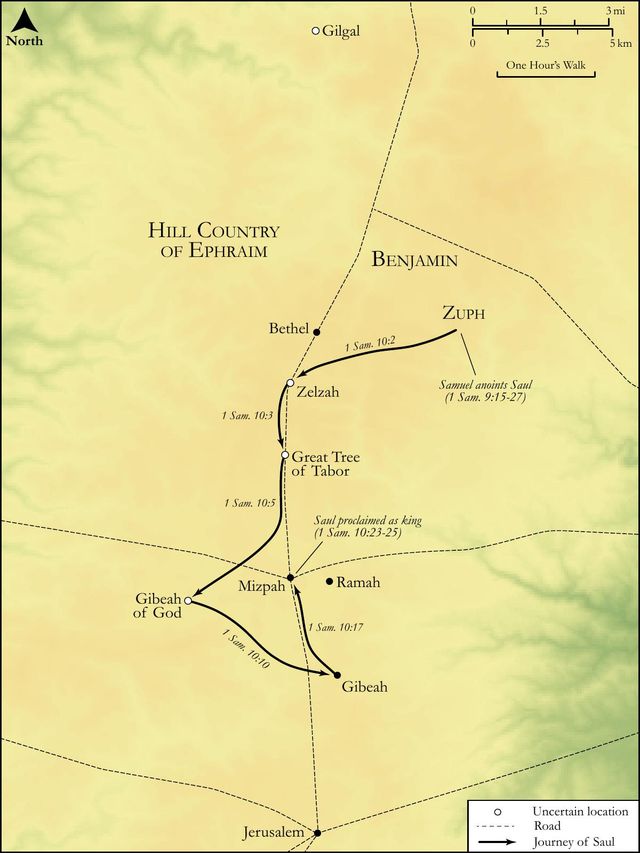
See on the biblical-era map
Study this verse
Public-domain commentary
Matthew Henry
From his Commentary on the Whole Bible. Henry comments on passages, not single verses — this entry covers 1 Samuel 10:9–16. His four-level outline is real structure in the source text, so it is rendered as structure.
Saul has now taken his leave of Samuel, much amazed, we may well suppose, at what has been done to him, almost ready to question whether he be awake or no, and whether it be not all a dream. Now here we are told,
I.What occurred by the way, Sa1 10:9.
Those signs which Samuel had given him came to pass very punctually; but that which gave him the greatest satisfaction of all was this, he found immediately that God had given him another heart. A new fire was kindled in his breast, such as he had never before been acquainted with: seeking the asses is quite out of his mind, and he thinks of nothing but fighting the Philistines, redressing the grievances of Israel, making laws, administering justice, and providing for the public safety; these are the things that now fill his head. He finds himself raised to such a pitch of boldness and bravery as he never thought he should be conscious of. He has no longer the heart of a husbandman, which is low, and mean, and narrow, and concerned only about his corn and cattle; but the heart of a statesman, a general, a prince. Whom God calls to any service he will make fit for it. If he advance to another station, he will give another heart, to those who sincerely desire to serve him with their power.
II.What occurred when he came near home.
They came to the hill (Sa1 10:10), that is, to Gibeah, or Geba, which signifies a hill, and so the Chaldee here takes it as a proper name; he met with the prophets as Samuel had told him, and the Spirit of God came upon him, strongly and suddenly (so the word signifies), but not so as to rest and abide upon him. It came on so as to go off quickly. However, for the present, it had a strange effect upon him; for he immediately joined with the prophets in their devotion, and that with as much decorum and as great a transport of affection as any of them: He prophesied among them. Now,
1.His prophesying was publicly taken notice of, Sa1 10:11, Sa1 10:12. He was now among his acquaintance, who, when they saw him among the prophets, called one another to come and see a strange sight. This would prepare them to accept him as a king, though one of themselves, when they had seen how God had advanced him to the honour of a prophet. The seventy elders prophesied before they were made judges, Num 11:25. Now,
(1.)They all wondered to see Saul among the prophets: What is this that has come to the son of Kish? Though this school of the prophets was near his father's house, yet he had never associated with them, nor shown them any respect, perhaps had sometimes spoken slightly of them; and now to see him prophesying among them was a surprise to them, as it was long after when his namesake, in the New Testament, preached that gospel which he had before persecuted, Act 9:21. Where God gives another heart it will soon show itself.
(2.)One of them, that was wiser than the rest, asked, "Who is their father, or instructor? Is is not God? Are they not all taught of him? Do they not all owe their gifts to him? And is he limited? Cannot he make Saul a prophet, as well as any of them, if he please?" Or, "Is not Samuel their father?" Under God, he was so; and Saul had now lately been with him, which, by his servant, he might know. No marvel for him to prophesy who lay last night under Samuel's roof.
(3.)It became a proverb, commonly used in Israel, when they would express their wonder at a bad man's either becoming good, or at least being found in good company, Is Saul among the prophets? Note, Saul among the prophets is a wonder to a proverb. Let not the worst be despaired of, yet let not an external show of devotion, and a sudden change for the present, be too much relied on; for Saul among the prophets was Saul still.
2.His being anointed was kept private. When he had done prophesying,
(1.)It should seem he uttered all his words before the Lord, and recommended the affair to his favour, for he went straight to the high place (Sa1 10:13), to give God thanks for his mercies to him and to pray for the continuance of those mercies. But,
(2.)He industriously concealed from his relations what had passed. His uncle, who met with him either at the high place or as soon as he came home, examined him, Sa1 10:14. Saul owned, for his servant knew it, that they had been with Samuel, and that he told them the asses were found, but said not a word of the kingdom, Sa1 10:14, Sa1 10:15. This was an instance,
[1.]Of his humility. Many a one would have been so elated with this surprising elevation as to proclaim it upon the house-top. But Saul, though he might please himself with it in his own breast, did not pride himself in it among his neighbours. The heirs of the kingdom of glory are well enough pleased that the world knows them not, Jo1 3:1.
[2.]Of his prudence. Had he been forward to proclaim it, he would have been envied, and he knew not what difficulty that might have created him. Samuel had communicated it to him as a secret, and he knows how to keep counsel. Thus it appears that he had another heart, a heart fit for government.
[3.]Of his dependence upon God. He does not go about to make an interest for himself, but leaves it to God to carry on his own work by Samuel, and, for his own part, sits still, to see how the matter will fall.
Historical interpretation
Historical reception
1 surviving comment on this verse from the historical church.
So then, when He turned His shoulder, etc. When the Lord went away from John, immediately obeying the command of paternal dispensation, He was changed in a new thought, so that He who hitherto had been subject to His parents and was considered like other mortals, from then on, by the clear proofs of virtues, would also be revealed as God. And all that John had spoken of Him, and what other prophets had predicted, were true.
Continue studying 1 Samuel 10:9 across the web’s major study libraries — every link below opens this exact verse, chapter, or book on the destination site.
Read & Compare
 BibleGatewayThis verse in more than 200 translations and 70 languages.
 Bible.comThe YouVersion reader — hundreds of translations, reading plans, and highlights.
 ESV.orgCrossway's official English Standard Version reader.
 NET BibleThe NET translation with 60,000+ translators' notes on every rendering decision.
 STEP BibleTyndale House's free study tool — original text, vocabulary, and scholarly resources.
 BibliaLogos Bible Software's free web reader.
 USCCBThe New American Bible (Revised Edition) with the U.S. bishops' study notes.
Commentaries
 BibleHub CommentariesDozens of classic commentaries on this verse, gathered on one page.
 StudyLightMore than 100 commentary sets — the largest collection on the web.
 BibleRefPlain-English commentary on what this verse means, verse by verse.
 Enduring WordDavid Guzik's free commentary on this chapter, widely used by Bible teachers.
 Bible Study ToolsVerse commentary alongside Greek and Hebrew study aids.
Original Language & Research
- BibleHub InterlinearThe verse word by word — original language, transliteration, and English.
- BibleHub LexiconEvery word's original-language definition and Strong's entry.
 Blue Letter BibleDeep-study tools — Strong's numbers, concordance, and word studies.
 SefariaThe Hebrew text with Rashi and centuries of Jewish commentary.
Sermons, Hymns & Audio


TrulyRandomVerse is not affiliated with these sites and doesn’t control their content. They’re linked because they’re genuinely useful.
Summary
This verse marks a pivotal moment in Saul's anointing as Israel's first king, detailing a profound, divinely initiated internal transformation. As Saul departed from Samuel, God supernaturally equipped him with a new disposition and capacity for leadership, a change essential for his impending royal duties. Simultaneously, the immediate and precise fulfillment of all the prophetic signs Samuel had given him served as irrefutable validation of God's active hand in establishing the monarchy and confirming His chosen leader.
Context
ShowHideLiterary Context
1 Samuel 10:9 is the climax of Samuel's private anointing and prophetic instruction to Saul. The preceding verses (1 Samuel 9 and 1 Samuel 10:1-8) meticulously chronicle Saul's unexpected journey to find his father's lost donkeys, his providential encounter with Samuel, and Samuel's secret anointing of him as "prince" (Hebrew: nagid) over God's inheritance. Crucially, Samuel provides Saul with three specific, verifiable prophetic signs that would confirm his divine appointment upon his departure. This verse signifies the immediate unfolding of these prophecies, underscoring God's direct and swift involvement in Saul's inauguration. The subsequent narrative, particularly Saul's encounter with the band of prophets and his own prophesying (1 Samuel 10:10-13), directly fulfills one of these signs and further demonstrates the "new heart" or divine empowerment mentioned here.
Historical & Cultural Context
The period described in 1 Samuel represents a monumental transition for Israel, moving from a decentralized tribal confederacy led by judges to a centralized monarchy. This shift was initiated by the people's demand for a king (1 Samuel 8:4-5), a request God viewed as a rejection of His direct rule (1 Samuel 8:7). The prevailing conditions included persistent Philistine oppression (1 Samuel 9:16), which necessitated a strong, unified leader. Kingship in Israel involved divine legitimation and endowment, as the law required of a king "whom the LORD thy God shall choose," and Saul's experience is an instance of that pattern within Israel's covenant. The "heart" (Hebrew: lêb) in ancient Hebrew thought was not merely the seat of emotions but the core of one's being, encompassing intellect, will, and moral character. Therefore, God giving Saul "another heart" implies a fundamental divine reorientation of his inner being, specifically equipping him for the immense demands of kingship.
Key Themes
ShowHideThis verse powerfully illustrates the theme of Divine Sovereignty and Initiative in establishing leadership, as God actively chooses and equips Saul for a role he did not seek. It emphasizes Divine Empowerment for Service, demonstrating that God provides the necessary disposition and abilities for those He calls, preparing Saul for the Spirit of the Lord to come upon him (1 Samuel 10:6). Furthermore, the immediate fulfillment of "all those signs" underscores the theme of Divine Confirmation and Validation, providing undeniable proof of God's hand in Saul's anointing and the legitimacy of Samuel's prophetic word. This sets the stage for the immense challenges and moral ambiguities of kingship, foreshadowing the critical importance of obedience and the tragic consequences of disobedience, a theme vividly portrayed later in 1 Samuel 15.
Exposition and Analysis
ShowHideKey Word Analysis
ShowHideWhile often translated as "gave" in this context, the root H2015 (hâphak) primarily means "to turn about or over" or "to change." This nuance is crucial, as it implies a divine act of reorientation or transformation. God didn't merely bestow something upon Saul; He fundamentally "changed" or "turned around" Saul's inner disposition, equipping him with a new capacity suitable for the demands of kingship. This emphasizes the active, transformative power of God in preparing His chosen instruments.
The Hebrew word H3820 (lêb) refers to the innermost being, encompassing the intellect, will, emotions, and moral character. It is the seat of thought, decision-making, and inner disposition. In this context, "another heart" (לֵב אֲחֵר, lêb ʼachêr) does not primarily denote a moral or spiritual regeneration (as understood in the New Testament or later prophetic contexts like Ezekiel 36:26), but rather a divine reorientation or endowment of Saul's inner capacity, making him suitable for the demands of leadership. It signifies a change in his disposition and capability for the kingly office, preparing him for the Spirit of the Lord.
The Hebrew word H226 (ʼôwth) refers to a signal, mark, token, or miraculous proof that serves to confirm a divine message or action. Samuel had given Saul three specific "signs" (1 Samuel 10:2-7) that would validate his anointing and assure him of God's presence and purpose. Their immediate and complete fulfillment here serves as undeniable, tangible evidence of God's active involvement and the truthfulness of Samuel's prophecy, confirming Saul's divine appointment to himself and to any witnesses.
Verse Breakdown
ShowHide"And it was [so], that when he had turned his back to go from Samuel"
This clause establishes the precise temporal and spatial context for the divine intervention. The moment Saul physically departs from Samuel's presence, signifying the conclusion of the prophetic instruction and the commencement of his journey as king-elect, God's action begins. This immediacy underscores the direct and swift nature of God's response to Samuel's anointing, indicating that the transformation was not a gradual process but an instantaneous divine work, contingent upon Saul's obedience in setting out as instructed.
"God gave him another heart"
This is the central theological declaration of the verse. It signifies a profound, divinely initiated internal transformation in Saul. This "new heart" (לֵב אֲחֵר, lêb ʼachêr) is not a moral change for salvation, but rather a dispositional, intellectual, and volitional empowerment specifically for the kingly office. It equipped Saul with the necessary courage, discernment, and capacity to lead Israel, aligning his inner being with the immense responsibilities of his new role and preparing him for the Spirit of the Lord to come mightily upon him, as foretold in 1 Samuel 10:6.
"and all those signs came to pass that day"
This final clause provides the external, observable confirmation of God's work in Saul. The three specific prophetic signs Samuel had given Saul (1 Samuel 10:2-7) were fulfilled precisely as foretold, and on the very same day. This immediate and complete fulfillment served as irrefutable validation of Saul's divine appointment and the authenticity of Samuel's prophetic word, bolstering Saul's confidence and demonstrating God's active hand to any who might witness or hear of these events, leaving no doubt about the divine sanction of his kingship.
Literary Devices
ShowHideThe verse employs Foreshadowing by hinting at the future transformation and divine empowerment of Saul, which will be further demonstrated when the Spirit of the Lord comes upon him and he prophesies (1 Samuel 10:10). Divine Intervention is a prominent and explicit theme, as God is directly stated as the active agent ("God gave him another heart"), emphasizing His absolute sovereignty in the establishment of the monarchy. The immediate and complete fulfillment of the signs serves as powerful Confirmation and Validation, reinforcing the authority of Samuel's prophecy and the legitimacy of Saul's anointing. The phrase "another heart" functions as a form of Metonymy, where "heart" represents the entirety of Saul's inner being—his intellect, will, and disposition—and his newly endowed capacity for leadership, rather than merely the physical organ, signifying a holistic reorientation for his new royal role.
Theological and Thematic Connections
ShowHideThis verse profoundly illustrates God's sovereign initiative in calling and equipping individuals for specific purposes, even before they fully comprehend or embrace their roles. The "new heart" signifies a divine enablement, demonstrating that God provides the necessary internal disposition and external confirmation for the tasks He appoints. It highlights that God's chosen leaders are not left to their own devices but are supernaturally prepared for their responsibilities. This divine empowerment, however, comes with the implicit expectation of obedience and faithfulness, a theme that will become tragically prominent in Saul's later reign, reminding us that divine gifts require faithful stewardship.
Reflection and Application
ShowHideThe account of Saul receiving "another heart" and witnessing the immediate fulfillment of prophetic signs offers profound encouragement and challenge for believers today. It reminds us that God is actively involved in our lives, not only calling us to serve but also supernaturally equipping us for the tasks He sets before us. When we feel inadequate, ill-equipped, or overwhelmed by the responsibilities God places on our shoulders, this verse assures us that His enablement is greater than our perceived limitations. Just as Saul was transformed for kingship, we are transformed by the Holy Spirit for Christ-like living and service, empowered to fulfill the unique callings on our lives. We are called to step out in faith, trusting that God will provide the necessary wisdom, strength, and discernment. Furthermore, God often provides confirmations and opens doors, not always through dramatic signs, but through circumstances, the wise counsel of other believers, or the clear leading of His Word, reinforcing His guidance in our lives. This divine empowerment, however, also carries a weighty responsibility: to steward God's gifts faithfully and to walk in obedience to His commands, remembering that true success in God's eyes is measured by faithfulness and humility, not merely by initial endowment or outward achievement.
Questions for Reflection
ShowHideFAQ
ShowHideDoes "God gave him another heart" mean Saul was regenerated or born again?
ShowHideNo, in this Old Testament context, "God gave him another heart" (לֵב אֲחֵר, lêb ʼachêr) does not imply spiritual regeneration or being "born again" in the New Testament sense, as described in passages like John 3:3 or the prophetic promise of a new covenant heart in Ezekiel 36:26. Instead, it refers to a divine endowment or a change in Saul's disposition, intellect, and capacity specifically for the kingly office. God supernaturally equipped him with the necessary mental and emotional framework to lead Israel, preparing him for the Spirit of the Lord to come upon him (1 Samuel 10:6). It was a functional transformation for a specific role, not a saving transformation of his moral nature. Saul's later disobedience and rejection by God (1 Samuel 15:23) confirm that this "new heart" was not equivalent to a permanent, saving change of heart.
What were "all those signs" that came to pass?
ShowHideThe "signs" refer to the three specific prophetic events that Samuel foretold to Saul immediately after anointing him (1 Samuel 10:2-7). These included:
The verse confirms that all these specific, detailed predictions came to pass on that very day, providing undeniable evidence of God's hand in Saul's anointing and the authenticity of Samuel's prophetic word, leaving no room for doubt about his divine appointment.
Christ-Centered Fulfillment
ShowHideWhile Saul's "new heart" was a temporary, functional empowerment for kingship, foreshadowing the need for divine enablement in leadership, it ultimately points to the radical and permanent heart transformation offered through Jesus Christ. Saul's anointing by Samuel, though divinely initiated, was for a flawed human king who would eventually fail due to disobedience and a lack of true spiritual renewal. In contrast, Jesus is the true and eternal King, anointed not with oil but with the Holy Spirit without measure (John 3:34). He is the one who truly gives a "new heart"—a spiritual regeneration that transforms the very core of our being, enabling us to obey God's laws and walk in His ways, as promised in the new covenant (Ezekiel 36:26-27). The signs that confirmed Saul's anointing pale in comparison to the countless miracles, the perfect life, the atoning death, and the ultimate resurrection of Christ, which serve as the irrefutable signs of His divine Sonship and His ultimate authority as King of kings and Lord of lords (Romans 1:4). Unlike Saul, whose "new heart" was for a specific task and did not prevent his spiritual decline, Christ offers a complete spiritual renewal that empowers believers for a life of righteousness and eternal fellowship with God, fulfilling the deepest longings for a transformed heart that Saul's experience only hinted at (2 Corinthians 5:17).