


1 Samuel 9:25
Bible text: King James Version (1769 Blayney text) · Public domain
Bible text: Berean Standard Bible · Public domain
Bible text: American Standard Version (1901) · Public domain
Bible text: World English Bible, Messianic edition · Public domain
Bible text: Geneva Bible (1599) · Public domain
Bible text: Young's Literal Translation · Public domain
- וַיֵּרְדוּvai·ye·re·Duand they went downH3381Conj-w ¦ V-Qal-ConsecImperf-3mpVerb Qal Consecutive Imperfect 3rd Plural Masculineוַandיֵּרְדוּthey went down
- מֵהַבָּמָהme·ha·ba·Mahfrom the high placeH1116Prep-m ¦ Art ¦ N-fsNoun Singular Feminine Absoluteמֵfromהַtheבָּמָהhigh place
- הָעִירha·'Irthe cityH5892Art ¦ N-fsNoun Singular Feminine Absoluteהָtheעִירcity
- וַיְדַבֵּרvay·da·Berand he spokeH1696Conj-w ¦ V-Piel-ConsecImperf-3msVerb Piel Consecutive Imperfect 3rd Singular Masculineוַandיְדַבֵּרhe spoke
- עִם'imwithH5973PrepPreposition
- שָׁאוּלsha·'UlSaulH7586N-proper-mNoun Proper Masculine
- עַל'alonH5921PrepPreposition
- הַגָּגha·Gagthe roofH1406Art ¦ N-msNoun Singular Masculine Absoluteהַtheגָּגroof
English is a literal word-by-word gloss of the Hebrew, not the KJV's wording. Why?
This is the original text the KJV's translators worked from — each Hebrew word with its own literal English meaning in this verse, prepared by scholars at Tyndale House, Cambridge. The KJV translates whole sentences, not word by word, so its wording differs: one Hebrew word can become several English words, and the KJV may choose “the LORD” where the gloss reads “Yahweh”. Both are faithful — they answer different questions. For the KJV's own rendering, switch to the KJV text.
Details
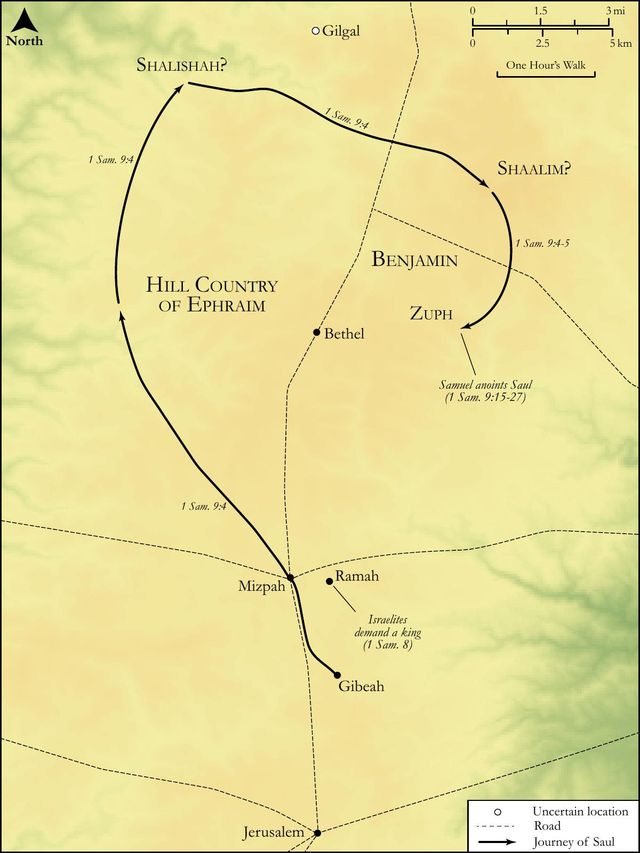
See on the biblical-era map
Study this verse
Public-domain commentary
Matthew Henry
From his Commentary on the Whole Bible. Henry comments on passages, not single verses — this entry covers 1 Samuel 9:18–27. His two-level outline is real structure in the source text, so it is rendered as structure.
Providence having at length brought Samuel and Saul together, we have here an account of what passed between them in the gate, at the feast, and in private.
I.In the gate of the city; passing through that, Saul found him (Sa1 9:18), and, little thinking that he was Samuel himself, asked him the way to Samuel's house: Tell me where the seer's house is; for there he expected to find him. See how mean a figure Samuel made, though so great a man: he took not any state, had no attendants, no ensigns of honour carried before him, nor any distinguishing habit, no, not when he went to church, but appeared, in all respects, so much a common person that Saul, though he was told he should meet him, never suspected that it was he, but, as if he looked more like a porter than a prophet, asked him the way to the seer's house. Thus is great worth oftentimes hidden under a very despicable appearance. Samuel knew that it was not the house, but the man, that he wanted, and therefore answered him, "I am the seer, the person you enquire for," Sa1 9:19. Samuel knew him before he knew Samuel; thus, though all that are called to the kingdom of glory are brought to know God, yet first they were known of him, Gal 4:9. Now,
1.Samuel obliges him to stay with him till the next day. The greatest part of this day had been spent in sacrificing, and the rest of it was to be spent in holy feasting, and therefore, "Tomorrow I will let thee go, and not sooner; now go up before me to the high place; let us pray together, and then we will talk together." Saul had nothing in his mind but to find his asses, but Samuel would take him off from that care, and dispose him to the exercises of piety; and therefore bids him go to the high place, and go before him, because, it may be, some business obliged Samuel to call by the way.
2.He satisfies him about his asses (Sa1 9:20): Set not thy mind on them, be not in further care about them; they are found. By this Saul might perceive that he was a prophet, that he could give him an answer to the enquiry which he had not yet made, and tell him what he thought; and thence he might infer, if a man of God can do this, much more doth God himself understand our thoughts afar off.
3.He surprises him with an intimation of preferment before him: "On whom is all the desire of Israel? Is it not a king that they are set upon, and there is never a man in Israel that will suit them as thou wilt." It does not appear that the country had as yet any eye upon him for the government, because they had left it wholly to God to choose for them; but such a one as he they wished for, and his advancement would be the advancement of his family and relations, as Abner, and others.
4.To this strange intimation Saul returns a very modest answer, Sa1 9:21. Samuel, he thought, did but banter him, because he was a tall man, but a very unlikely man to be a king; for, though the historian says (Sa1 9:1) his father was a mighty man of power, yet he himself speaks diminishingly of his tribe and family. "Benjamin, the youngest of Jacob's sons, when grown up to be a man, was called a little one (Gen 44:20); that tribe was diminished by the war of Gibeah; and I am a Benjamite, my family the least," probably a younger house, not in any place of honour or trust, no, not in their own tribe. Gideon had expressed himself thus, Jdg 6:15. A humble disposition is a good presage of preferment.
II.At the public feast; thither Samuel took him and his servant.
Though the advancement of Saul would be the deposing of Samuel, yet that good prophet was so far from envying him, or bearing him any ill-will for it, that he was the first and forwardest man to do him honour, in compliance with the will of God. If this be the man whom God has chosen, though he be none of Samuel's particular friends or confidants, yet he is heartily welcome to his table, nay, to his bosom. We may suppose it was no unseasonable kindness to Saul to give him a meal's meat, for it seems, by what he said (Sa1 9:7), that all their meat and money were spent. But this was not all. Samuel treats him not as a common person, but a person of quality and distinction, to prepare both him and the people for what was to follow. Two marks of honour he put upon him: - 1. He set him in the best place, as more honourable than any other of the guests, to whom he said, Give this man place, Luk 14:9. Though we may suppose the magistrates were there, who in their own city would claim precedency, yet the master of the feast made Saul and his servant too (who, if Saul was a king, must be respected as his prime minister of state) sit in the chief place, Sa1 9:22. Note, Civil respects must be paid to those who in civil things have the precedency given them by the divine providence. 2. He presented him with the best dish, which, having had notice from heaven the day before of his coming (Sa1 9:16), he had designed for him, and ordered the cook to secure for him, when he gave orders for inviting the guests and making preparation for them. And what should this precious dish be, which was so very carefully reserved for the king-elect? One would expect it should be something very nice and delicate. No, it was a plain shoulder of mutton (Sa1 9:23, Sa1 9:24). The right shoulder of the peace-offerings was to be given to the priests, who were God's receivers (Lev 7:32); the next in honour to that was the left shoulder, which probably was always allotted to those that sat at the upper end of the table, and was wont to be Samuel's mess at other times; so that his giving it to Saul now was an implicit resignation of his place to him. Some observe a significancy in this dish. The shoulder denotes strength, and the breast, which some think went with it, denotes affection: he that was king had the government upon his shoulder, for he must bear the weight of it; and the people in his bosom, for they must be dear to him.
III.What passed between them in private.
Both that evening and early the next morning Samuel communed with Saul upon the flat roof of the house, Sa1 9:25, Sa1 9:26. We may suppose Samuel now told him the whole story of the people's desire of a king, the grounds of their desire, and God's grant of it, to all which Saul, living very privately, was perhaps a stranger; he satisfied him that he was the person God had pitched upon for the government; and whereas Saul would object that Samuel was in possession, and he would not for all the world take it out of his hands, Samuel, we may suppose, gave him all the assurance he could desire of his willingness to resign. Early in the morning he sent him towards home, brought him part of the way, bade him send his servant before, that they might be private (Sa1 9:27), and there, as we find in the beginning of the next chapter, he anointed him, and therein showed him the word of the Lord, that is, gave him full satisfaction that he was the person chosen to be king, for he would not jest with that sacred rite. It is by the unction of the Holy Ghost that Christ, the great prophet, shows us the word of the Lord. Jo1 2:27, the same anointing teacheth you of all things.
Historical interpretation
Historical reception
2 surviving comments on this verse. Each one is dated, so this reads as a timeline rather than a list.
Select a marker to jump to its quote. Markers stagger vertically where authors wrote within a few decades of each other.
Whoever is received into the eminent office of dispensing pastoral care ought to have in the very sublimity of his rank both the true loftiness of his own life and compassion for the weaknesses of others. Therefore, Saul went with Samuel into the heights and then descended into the town. Let the ruler know how to conduct lofty things, but let him also know how to manage ordinary things. Let him say with Paul, “Our manner of living is in the heavens.” But let him also say with us, “Wretched man that I am! Who will free me from this mortal body? For I see another law in my members that fights against the law of my mind and takes me captive by the law of sin.” He is a true ruler, when he speaks wisdom among the perfect; he descends into the town when he arranges carnal matters and says, “Because of fornication let each man have his own wife and each woman her husband.” He is in the heights when he says, “No creature will be able to separate us from the love of God which is in Christ Jesus,” but he descends into the town when he says, “I became weak to the weak that I might win the weak. I became all things to all people.” Therefore, Samuel brought Saul to the heights and led him down into the town. For when the greatest men put in order the pinnacle of the holy church, namely, those whom they place at the very pinnacle of the church, they teach them to live in a distinguished manner, to preach clearly, to be strict with themselves but more gentle with those under their care, to attend to their own salvation so that they can be weak with the weak. I meant that they are weak by letting their mind feel compassion on the weak rather than by being idle due to some internal malady. For if a teacher suffers from idleness of mind, he is not able to encourage the spiritually feeble and bedridden.
And he spoke with Saul in the upper room, etc. John spoke with the Lord in the light of His known divinity. For certainly the upper room (which takes its name from the fact that by its height it first receives the rays of the rising sun before the lower buildings) signifies the hearts of those who, suspended from earthly desires by divine fear, the Sun of Righteousness rises more familiarly. For when both, namely the Lord and John, had begun the commencement of their mission for which they were sent, and the grace of the new light had just begun to shine in the world, the same John confessed that Jesus Christ was the Son of God, while he himself was sent before Him, desiring Him with his whole intent of mind to rise to the works of the divine in the flesh, and to rest at the appropriate time from the duty of forerunning.
Continue studying 1 Samuel 9:25 across the web’s major study libraries — every link below opens this exact verse, chapter, or book on the destination site.
Read & Compare
 BibleGatewayThis verse in more than 200 translations and 70 languages.
 Bible.comThe YouVersion reader — hundreds of translations, reading plans, and highlights.
 ESV.orgCrossway's official English Standard Version reader.
 NET BibleThe NET translation with 60,000+ translators' notes on every rendering decision.
 STEP BibleTyndale House's free study tool — original text, vocabulary, and scholarly resources.
 BibliaLogos Bible Software's free web reader.
 USCCBThe New American Bible (Revised Edition) with the U.S. bishops' study notes.
Commentaries
 BibleHub CommentariesDozens of classic commentaries on this verse, gathered on one page.
 StudyLightMore than 100 commentary sets — the largest collection on the web.
 BibleRefPlain-English commentary on what this verse means, verse by verse.
 Enduring WordDavid Guzik's free commentary on this chapter, widely used by Bible teachers.
 Bible Study ToolsVerse commentary alongside Greek and Hebrew study aids.
Original Language & Research
- BibleHub InterlinearThe verse word by word — original language, transliteration, and English.
- BibleHub LexiconEvery word's original-language definition and Strong's entry.
 Blue Letter BibleDeep-study tools — Strong's numbers, concordance, and word studies.
 SefariaThe Hebrew text with Rashi and centuries of Jewish commentary.
Sermons, Hymns & Audio


TrulyRandomVerse is not affiliated with these sites and doesn’t control their content. They’re linked because they’re genuinely useful.
Summary
1 Samuel 9:25 marks a pivotal transition in the narrative of Israel's first king, Saul. Following a special feast at a local sanctuary, the prophet Samuel brings Saul back to his home city, Ramah, and engages him in a deeply significant private conversation on the flat rooftop of his house. This intimate "communion" serves as a crucial prelude, preparing Saul for the momentous divine revelation and public anointing that will establish him as the chosen leader of Israel, setting the stage for the monarchy.
Context
ShowHideLiterary Context
This verse immediately follows Samuel's extraordinary hospitality towards Saul at the "high place," where Saul was given the place of honor and a special portion of the sacrificial meal, all orchestrated by divine instruction given to Samuel the day before, as detailed in 1 Samuel 9:15-24. The narrative has meticulously built suspense around Saul's unwitting arrival and Samuel's foreknowledge of God's plan. Verse 25 serves as the crucial bridge between the public, ceremonial meal and the private, revelatory conversation that directly precedes Saul's anointing as king the following morning, recorded in 1 Samuel 10:1. It signals a deliberate shift from an outward demonstration of honor to an inward impartation of divine purpose, moving the narrative from public ritual to private revelation.
Historical & Cultural Context
The "high place" (Hebrew: bâmâh) refers to a local cultic site, often on an elevated position, used for sacrifices and communal feasts. In this period before the centralized Temple worship in Jerusalem, such sites were legitimate and common places for worship and interaction with God, as seen in Samuel's own practice. The "city" is Ramah, Samuel's hometown and a significant center for his prophetic ministry. The "top of the house" refers to the flat rooftops characteristic of the homes of Israel. These rooftops served multiple purposes: for sleeping in hot weather, drying produce, and crucially, as private, elevated, and quiet spaces for reflection, prayer, and important discussions, away from the bustling activity of the street or courtyard. This specific setting underscores the weighty and confidential nature of the impending conversation between Samuel and Saul, emphasizing its privacy and solemnity.
Key Themes
ShowHideThis verse powerfully contributes to several key themes within 1 Samuel and the broader Old Testament narrative. It highlights Divine Sovereignty and Appointment, demonstrating that God, not human choice, initiates and directs the selection of leaders, even when Israel has demanded a king "like all the nations," as expressed in 1 Samuel 8:5. The private nature of the rooftop conversation emphasizes Preparation for Service, indicating that significant public ministry is often preceded by periods of personal instruction, revelation, and spiritual formation. It also underscores the theme of Revelation, particularly how God communicates His will through His chosen prophets, often in intimate settings, before its public manifestation. Finally, it sets the stage for the Transition from Theocracy to Monarchy, marking the precise moment just before the formal establishment of the kingship in Israel, a pivotal shift in the nation's governance.
Exposition and Analysis
ShowHideKey Word Analysis
ShowHideThe Hebrew verb דָּבַר (dâbar, H1696) means "to speak, to declare, to converse." While it can denote ordinary conversation, in this context, especially given Samuel's prophetic role and God's prior revelation concerning Saul, it carries a much weightier implication. It suggests a significant, purposeful, and authoritative declaration, likely involving the impartation of divine will and instruction concerning Saul's future as king. It is a dialogue of profound consequence, signifying a prophetic utterance or a deep, revelatory discussion, not merely casual chat.
The Hebrew word בָּמָה (bâmâh, H1116) refers to an elevation or an elevated place, often a local sanctuary or altar used for worship and sacrifice. In the period of the Judges and early Monarchy, these were legitimate cultic sites where people came to offer sacrifices and seek God, as opposed to later periods when they became associated with illicit worship in contrast to the Jerusalem Temple. Here, it signifies a place of communal religious activity and divine encounter that served as the initial setting for Samuel's interaction with Saul.
This phrase, גַּג הַבַּיִת (gâg habbayit, H1406), refers to the flat rooftop common in ancient Israelite architecture. Such rooftops were private, elevated, and often cooler spaces, ideal for quiet contemplation, prayer, or, as here, confidential and significant discussions. Its selection for this "communion" underscores the private, secluded, and crucial nature of the impending revelation, providing an intimate setting for a weighty conversation.
Verse Breakdown
ShowHide"And when they were come down from the high place into the city"
This clause describes the physical movement of Samuel and Saul from the site of the public feast and worship to the more private, residential area of Ramah. This descent signifies a deliberate transition from a communal, ceremonial setting to a personal, intimate one, setting the stage for a different kind of interaction—one of private instruction and revelation.
"[Samuel] communed with Saul"
This is the core action of the verse. The verb "communed" (as analyzed above) indicates a deep, significant conversation, far beyond mere pleasantries. It implies Samuel was imparting crucial, perhaps even revelatory, information to Saul, preparing him for the divine mandate that was about to be revealed. This was a foundational dialogue, establishing the prophetic authority over the nascent monarchy.
"upon the top of the house"
This specifies the precise location of their conversation. The rooftop, being a secluded and elevated space, emphasizes the privacy, solemnity, and importance of the discussion. It was a place where Samuel could speak freely and where Saul could receive the weighty words without interruption or public scrutiny, underscoring the confidential nature of God's unfolding plan.
Literary Devices
ShowHideThe verse effectively employs Setting as a key literary device. The deliberate shift from the public, communal "high place" where Saul was publicly honored to the private, secluded "top of the house" is highly symbolic. It underscores the transition from Saul's public recognition and feasting to the intimate, personal revelation of his divine calling. This change in setting also creates an atmosphere of Anticipation, as the reader, aware of Samuel's prior divine instruction, knows he possesses vital information about Saul's destiny, which is about to be unveiled in this private encounter. There is also an element of Irony, as Saul, who came seeking lost donkeys, is unknowingly being led to the highest office in the land, a stark contrast between his mundane objective and God's grand purpose. Furthermore, the narrative uses Foreshadowing, as this private "communion" directly precedes and sets the stage for the momentous public anointing of Saul as Israel's first king.
Theological and Thematic Connections
ShowHideThis private rooftop conversation between Samuel and Saul highlights God's meticulous and often personal method of preparing those He calls for significant service. It underscores that divine appointment is not merely a public declaration but often involves intimate, revelatory instruction and spiritual preparation. Before Saul could assume the public mantle of kingship, he needed to understand the divine origin and nature of his calling from God's chosen prophet. This emphasizes the importance of private counsel and mentorship in discerning and embracing God's will, ensuring that leadership flows from divine revelation rather than human ambition or popular demand. God often reveals His secrets to His servants before acting publicly.
Reflection and Application
ShowHideThe intimate "communion" between Samuel and Saul on the rooftop offers profound lessons for our own lives and callings. Just as God prepared Saul privately before his public anointing, He often provides seasons of personal instruction, reflection, and spiritual mentorship before entrusting us with significant responsibilities or revealing new directions. This reminds us of the invaluable role of wise counselors and spiritual mentors in our lives, whose guidance can help us discern God's voice and prepare us for His purposes. It also encourages us to cultivate humility and openness, recognizing that God's plans for us may unfold in unexpected ways and often begin in quiet, private moments of revelation, rather than grand public spectacles. Our willingness to listen and receive instruction in these intimate settings is crucial for our readiness to step into the public spheres God calls us to. It is in these moments of quiet communion that our hearts are shaped and our understanding of God's will is deepened, equipping us for whatever lies ahead.
Questions for Reflection
ShowHideFAQ
ShowHideWhy did Samuel choose the rooftop for this conversation instead of the high place or inside his house?
ShowHideSamuel likely chose the rooftop for its privacy and seclusion. Flat rooftops in ancient Israel were elevated, open-air spaces, offering a quiet environment away from the usual household bustle or public gaze. This setting would have allowed for a confidential and deeply significant conversation, free from interruption or eavesdropping, ensuring that the weighty divine revelation Samuel was about to impart to Saul could be received without distraction. It also provided a sense of solemnity and importance fitting for such a momentous discussion, emphasizing the sacred nature of the impending divine revelation.
What was the nature of the "communion" between Samuel and Saul? Was it just a friendly chat?
ShowHideNo, the "communion" was far more than a friendly chat. The Hebrew word dabar (דָּבַר) implies a weighty, purposeful declaration. Given Samuel's role as God's prophet and God's prior revelation to Samuel about Saul's kingship, as detailed in 1 Samuel 9:15-17, this conversation was undoubtedly where Samuel began to explain God's plan for Saul's life and the future of Israel. It was a foundational moment of divine instruction and preparation for Saul's impending anointing as king, setting the theological and practical groundwork for his reign.
Was the "high place" where they had been a legitimate place of worship in Samuel's time?
ShowHideYes, in the period of the Judges and early Monarchy, "high places" (bâmâh) were legitimate and common sites for worship, sacrifice, and communal religious feasts throughout Israel. Before the construction of the centralized Temple in Jerusalem, these local sanctuaries served as important centers for the worship of Yahweh. Samuel himself, as a prophet and judge, participated in and officiated at such sites. It was only later, with the establishment of the Temple as the singular place of worship, that high places became associated with idolatry or illicit worship, as seen in later prophetic condemnations.
Christ-Centered Fulfillment
ShowHideThe private "communion" between Samuel and Saul on the rooftop, preparing Saul for his public anointing as king, beautifully foreshadows the preparation and ultimate kingship of Jesus Christ. While Saul was chosen and prepared for an earthly throne that would eventually falter, Jesus, the true and eternal King, also underwent a period of divine preparation before His public ministry. His forty days in the wilderness, as recorded in Matthew 4:1-11, were a time of intense spiritual battle and communion with the Father, equipping Him for His redemptive mission. Furthermore, Jesus often withdrew to private places—mountains, gardens, or quiet rooms—to "commune" with His Father in prayer, as exemplified in Mark 1:35, and to impart crucial, foundational truths to His disciples before sending them out for public ministry, as seen when He appointed the twelve in Mark 3:13-19. Unlike Saul, who would eventually fail in his kingship due to disobedience, Jesus, the Lamb of God who takes away the sin of the world (John 1:29), perfectly fulfilled His divine calling, learning obedience through what He suffered (Hebrews 5:8-9) and establishing an eternal spiritual kingdom not of this world (John 18:36). He is the ultimate King, prepared by God, whose reign brings true salvation and eternal life to all who believe.