


2 Samuel 24:3
Bible text: King James Version (1769 Blayney text) · Public domain
Bible text: King James Version with Strong's numbers · Public domain
Bible text: Berean Standard Bible · Public domain
Bible text: American Standard Version (1901) · Public domain
Bible text: World English Bible, Messianic edition · Public domain
Bible text: Geneva Bible (1599) · Public domain
Bible text: Young's Literal Translation · Public domain
- וַיֹּאמֶרvai·Yo·merand he saidH559Conj-w ¦ V-Qal-ConsecImperf-3msVerb Qal Consecutive Imperfect 3rd Singular Masculineוַandיֹּאמֶרhe said
- יוֹאָבyo·'AvJoabH3097N-proper-mNoun Proper Masculine
- אֶל'eltoH413PrepPreposition
- הַמֶּלֶךְha·Me·lekhthe kingH4428Art ¦ N-msNoun Singular Masculine Absoluteהַtheמֶּלֶךְking
- וְיוֹסֵףve·yo·Sefand may he addH3254Conj-w ¦ V-Hiphil-Imperf-3msVerb Hiphil Imperfect 3rd Singular Masculineוְandיוֹסֵףmay he add
- יְהוָהYah·wehYahwehH3068N-properNoun Proper Title
- אֱלֹהֶיךָ'e·lo·Hei·khayour GodH430N-mpc ¦ 2msNoun Plural Masculine ConstructאֱלֹהֶיGodךָyour
- אֶל'eltoH413PrepPreposition
- הָעָםha·'Amthe peopleH5971Art ¦ N-msNoun Singular Masculine Absoluteהָtheעָםpeople
- כָּהֵםka·Hemlike themPrep-k ¦ 3mpSuffix Personal 3rd Plural Masculineכָּlikeהֵםthem
- וְכָהֵםve·kha·Hemand like <the> themConj-w ¦ Prep-k ¦ 3mpSuffix Personal 3rd Plural Masculineוְandכָlike <the>הֵםthem
- מֵאָהme·'Aha hundredH3967N-fsNoun Singular Feminine Absolute
- פְעָמִיםfe·'a·MimtimesH6471N-mpNoun Plural Masculine Absolute
- וְעֵינֵיve·'ei·Neiand [the] eyes ofH5869Conj-w ¦ N-fdcNoun Dual Feminine Constructוְandעֵינֵי[the] eyes of
- אֲדֹנִי'a·do·nimy lordH113N-msc ¦ 1csNoun Singular Masculine Constructאֲדֹנִlordיmy
- הַמֶּלֶךְha·Me·lekhthe kingH4428Art ¦ N-msNoun Singular Masculine Absoluteהַtheמֶּלֶךְking
- רֹאוֹתro·'ot[are] seeing [it]H7200V-Qal-Prtcpl-fpVerb Qal Participle Plural Feminine Absolute
- וַאדֹנִיva·do·Niand my lordH113Conj-w ¦ N-msc ¦ 1csNoun Singular Masculine Constructוַandאדֹנִlordיmy
- הַמֶּלֶךְha·Me·lekhthe kingH4428Art ¦ N-msNoun Singular Masculine Absoluteהַtheמֶּלֶךְking
- לָמָּהLa·mah<to> why?H4100Prep-l ¦ InterrogPronoun Interrogativeלָ<to>מָּהwhy?
- חָפֵץcha·Fetzdoes he delightH2654V-Qal-Perf-3msVerb Qal Perfect 3rd Singular Masculine
- בַּדָּבָרba·da·Varin the thingH1697Prep-b ¦ N-msNoun Singular Masculine Absoluteבַּin theדָּבָרthing
- הַזֶּהha·Zeh<the> thisH2088Art ¦ PrtParticle Demonstrativeהַ<the>זֶּהthis
English is a literal word-by-word gloss of the Hebrew, not the KJV's wording. Why?
This is the original text the KJV's translators worked from — each Hebrew word with its own literal English meaning in this verse, prepared by scholars at Tyndale House, Cambridge. The KJV translates whole sentences, not word by word, so its wording differs: one Hebrew word can become several English words, and the KJV may choose “the LORD” where the gloss reads “Yahweh”. Both are faithful — they answer different questions. For the KJV's own rendering, switch to the KJV text.
Details
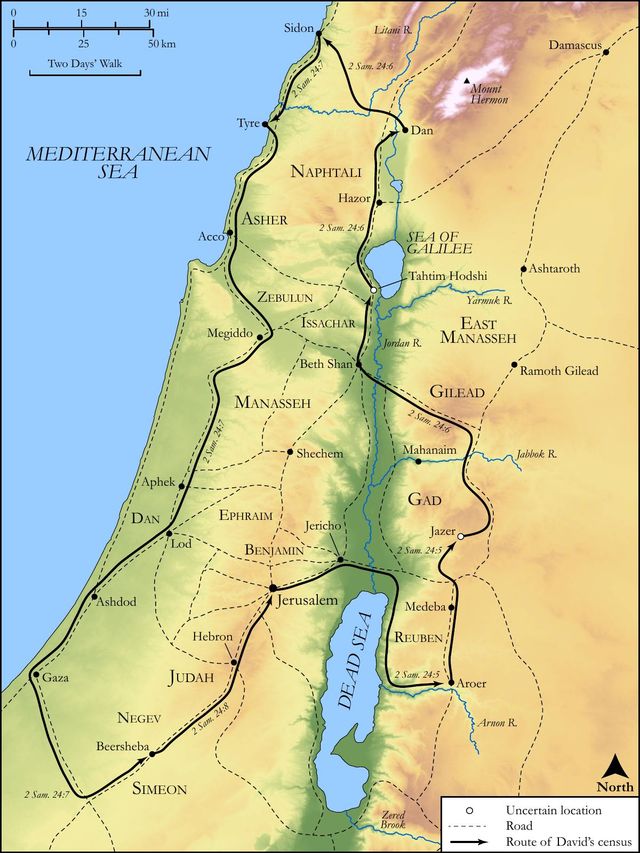
See on the biblical-era maps
Study this verse
Continue studying 2 Samuel 24:3 across the web’s major study libraries — every link below opens this exact verse, chapter, or book on the destination site.
Read & Compare
 BibleGatewayThis verse in more than 200 translations and 70 languages.
 Bible.comThe YouVersion reader — hundreds of translations, reading plans, and highlights.
 ESV.orgCrossway's official English Standard Version reader.
 NET BibleThe NET translation with 60,000+ translators' notes on every rendering decision.
 STEP BibleTyndale House's free study tool — original text, vocabulary, and scholarly resources.
 BibliaLogos Bible Software's free web reader.
 USCCBThe New American Bible (Revised Edition) with the U.S. bishops' study notes.
Commentaries
 BibleHub CommentariesDozens of classic commentaries on this verse, gathered on one page.
 StudyLightMore than 100 commentary sets — the largest collection on the web.
 BibleRefPlain-English commentary on what this verse means, verse by verse.
 Enduring WordDavid Guzik's free commentary on this chapter, widely used by Bible teachers.
 Bible Study ToolsVerse commentary alongside Greek and Hebrew study aids.
Original Language & Research
- BibleHub InterlinearThe verse word by word — original language, transliteration, and English.
- BibleHub LexiconEvery word's original-language definition and Strong's entry.
 Blue Letter BibleDeep-study tools — Strong's numbers, concordance, and word studies.
 SefariaThe Hebrew text with Rashi and centuries of Jewish commentary.
Sermons, Hymns & Audio


TrulyRandomVerse is not affiliated with these sites and doesn’t control their content. They’re linked because they’re genuinely useful.
Summary
2 Samuel 24:3 captures a pivotal and tension-filled exchange as Joab, King David's pragmatic commander, expresses profound concern and direct objection to the king's command for a nationwide census. Joab, displaying surprising spiritual discernment, offers a traditional blessing for the nation's continued growth while simultaneously challenging the king's underlying motivation, hinting at a dangerous pride or misplaced trust that would ultimately lead to divine judgment. This verse serves as a critical turning point, highlighting the clash between human ambition and divine will.
Context
ShowHideLiterary Context
This verse is strategically placed within the final chapter of 2 Samuel, which functions as a crucial appendix to the main narrative of David's reign. Chapter 24 immediately follows a series of supplementary accounts, including lists of David's mighty men and a famine. The census account in 2 Samuel 24 serves as a climactic narrative, depicting David's sin, God's subsequent judgment through a devastating plague, and David's act of atonement through the purchase of Araunah's threshing floor. This specific location would later become the revered site for Solomon's Temple (2 Chronicles 3:1), providing a crucial link to future redemptive history and the establishment of a permanent place of worship. The narrative parallels an account found in 1 Chronicles 21, which adds the significant detail that "Satan stood up against Israel and incited David to number Israel" (1 Chronicles 21:1), highlighting the spiritual forces at play behind human actions and temptations.
Historical & Cultural Context
Censuses were not inherently sinful in ancient Israel; they were conducted for various legitimate purposes, such as military conscription (e.g., Numbers 1) or taxation. However, the specific context and David's motivation for this census appear to be deeply problematic. At this point in David's reign, Israel was at peace and prosperous, having secured its borders and established a strong kingdom. This suggests the census was not for immediate military need, resource management, or a divinely commanded purpose. Instead, it is widely interpreted as an act of pride, a king's desire to boast in the strength of his numbers and military might rather than relying on God's covenant faithfulness and protection. This kind of self-reliance, valuing human strength and statistics over divine providence and promises, was a recurring temptation for Israelite kings and often led to divine displeasure, as seen in other instances of kings trusting in chariots and horses rather than the Lord (Psalm 20:7).
Key Themes
ShowHideThis verse contributes significantly to several major themes within 2 Samuel and the broader Old Testament narrative. Firstly, it highlights the theme of Divine Sovereignty vs. Human Pride, where God's ultimate control is evident even in allowing David's sinful inclination, which then leads to a demonstration of divine justice and the need for atonement. Secondly, it underscores the Consequences of Sin, showing that even a righteous king like David is not immune to the repercussions of disobedience, particularly when it stems from a heart of pride and self-sufficiency. This serves as a stark reminder that sin, even in leaders, has far-reaching consequences for the entire community. Thirdly, Joab's surprising interjection introduces the theme of Unexpected Wisdom and Discernment, demonstrating that even individuals with a reputation for ruthlessness can possess a spiritual sensitivity to God's will that surpasses that of the king. Joab's concern for the king's "delight" in the census points to the critical biblical principle that God examines not just actions, but the heart's motivations, a theme powerfully echoed in 1 Samuel 16:7, where the Lord tells Samuel, "For the LORD sees not as man sees: man looks on the outward appearance, but the LORD looks on the heart."
Exposition and Analysis
ShowHideKey Word Analysis
ShowHideThis primitive root means "to add or augment (often adverbial, to continue to do a thing)." Joab's opening statement is a sincere blessing, a prayer that the LORD would continue to multiply the people, even "an hundredfold." This reflects a desire for the nation's prosperity and growth, aligning with God's covenant promises to Abraham to make his descendants numerous (Genesis 12:2). Joab's concern is not with the growth itself, which is a sign of divine favor, but with the king's underlying motive for counting it.
This primitive root means "properly, to incline to; by implication (literally but rarely) to bend; figuratively, to be pleased with, desire." This is a crucial word, as Joab's question, "but why doth my lord the king delight in this thing?", probes beyond the mere action of the census to David's inner motivation and emotional inclination. It suggests that David's heart was set on something that was not pleasing to God, hinting at a deep-seated pride or misplaced confidence that Joab intuitively recognized. It implies David found personal satisfaction or self-glorification in the act, rather than seeking God's glory or genuine national benefit.
This word means "a word; by implication, a matter (as spoken of) or thing; adverbially, a cause." In this context, "this thing" refers specifically to the census that David has commanded. Joab's use of this general term highlights his disapproval of the entire "matter" or "affair" of the census, emphasizing that it is not merely a procedural act but a significant issue with spiritual implications. It's the "thing" that reveals David's problematic "delight."
Verse Breakdown
ShowHide"And Joab said unto the king"
This opening establishes the direct, confrontational nature of Joab's address. Despite David's absolute authority as king and Joab's position as his loyal, albeit ruthless, commander, Joab feels compelled to speak out. This indicates the gravity of the situation and his deep concern for the king and the nation. It is not a casual remark but a formal, weighty objection, demonstrating Joab's unusual spiritual sensitivity in this moment.
"Now the LORD thy God add unto the people, how many soever they be, an hundredfold, and that the eyes of my lord the king may see [it]:"
Joab begins with a respectful and loyal blessing, invoking the name of the "LORD thy God." He acknowledges divine sovereignty and expresses a fervent wish for the continued, immense multiplication of Israel's population, emphasizing "an hundredfold" as a hyperbolic expression of abundant blessing. This part of his statement demonstrates his loyalty to David and his genuine desire for the nation's prosperity, aligning with God's covenant promises of fruitfulness. It also subtly highlights that the issue is not population growth itself, which is a blessing, but the reason for counting it.
"but why doth my lord the king delight in this thing?"
This is the pivotal rhetorical question that sharply shifts the tone from blessing to challenge. The conjunction "but" signals a strong contrast, introducing Joab's profound concern. He directly questions David's inner motivation, probing beyond the mere command itself. Joab perceives that David's "delight" in the census stems from a source other than God's glory or true national benefit, likely from pride or a desire to rely on human strength. This Joab intuitively understands as displeasing to God, revealing a surprising spiritual insight from a man often characterized by pragmatism and violence.
Literary Devices
ShowHideThe verse effectively employs Juxtaposition, placing Joab's loyal blessing for the nation's multiplication directly against his challenging question regarding David's motivation. This stark contrast highlights the tension between outward appearance (a census, which could be legitimate) and inward intent (David's problematic "delight"). The phrase "but why doth my lord the king delight in this thing?" functions as a potent Rhetorical Question. It is not asked to elicit information, but to express strong disapproval, to force David to confront his own heart, and to underscore the impropriety of the king's command. This question also serves as a form of Foreshadowing, as Joab's clear unease and discernment hint at the negative consequences and divine judgment that will inevitably follow David's sinful act, setting the stage for the plague and atonement described later in the chapter.
Theological and Thematic Connections
ShowHideThis verse powerfully illustrates the profound biblical truth that God is concerned not merely with our actions, but with the underlying motives of our hearts. Joab's surprising discernment, challenging David's "delight" rather than just the command itself, echoes the prophetic voice that often called Israel's kings to account for their inner posture before God. It underscores that reliance on human strength, numbers, or achievements, when it supplants humble trust in divine provision, constitutes a grave spiritual misstep. This narrative serves as a cautionary tale against pride and self-sufficiency, reminding us that true security and blessing come from dependence on the Lord, not from impressive statistics or worldly power. It reveals that even the most outwardly successful actions can be corrupted if the heart's intention is not aligned with God's will and glory.
Reflection and Application
ShowHideJoab's courageous and discerning question to King David serves as a timeless reminder that our motives matter deeply to God. Even actions that appear neutral or beneficial on the surface can be tainted by pride, self-reliance, or a desire for human glory rather than God's. This passage calls us to a profound level of self-examination, urging us to ask ourselves, "Why do I delight in this thing?" when pursuing goals, whether in ministry, career, or personal life. Are we driven by a genuine desire to honor God and serve others, or by a subtle craving for recognition, control, or a sense of self-importance? Like David, we can be tempted to trust in our own resources, our numbers, or our achievements, rather than humbly depending on God's limitless power and provision. This verse challenges us to cultivate spiritual discernment, to listen to wise counsel even from unexpected sources, and to continually align our hearts with God's will, recognizing that true strength lies in humble reliance on Him alone. It prompts us to consider if our "delights" are truly God-honoring or if they subtly shift our trust from Him to ourselves.
Questions for Reflection
ShowHideFAQ
ShowHideWhy was David's census considered a sin?
ShowHideWhile censuses were conducted in Israel for legitimate purposes (e.g., military conscription in Numbers 1 and Numbers 26), David's census in 2 Samuel 24 was clearly portrayed as a sin. The text in 2 Samuel 24:1 states that "the anger of the LORD was again kindled against Israel, and he incited David against them to say, 'Go, number Israel and Judah.'" This suggests divine displeasure was already present, and the census became the vehicle for judgment. The sin was likely rooted in David's pride, a desire to boast in his vast kingdom and military strength, or a lack of trust in God's ability to protect and provide for Israel without reliance on human numbers. It represented a shift from humble dependence on God to self-reliance and a display of earthly power, which was an affront to the Lord who had promised to multiply and protect His people. The parallel account in 1 Chronicles 21:1 further clarifies that Satan incited David, indicating a spiritual battle behind David's sinful inclination.
What does Joab's reaction tell us about his character?
ShowHideJoab is often depicted as a ruthless, pragmatic, and sometimes morally ambiguous figure, known for his military prowess and decisive (often brutal) actions (e.g., his killing of Abner in 2 Samuel 3:27 and Amasa in 2 Samuel 20:10). However, in 2 Samuel 24:3, he displays a surprising and commendable spiritual insight. Despite his hardened nature, Joab recognizes the spiritual danger and impropriety of David's command, discerning that the king's "delight" in the census stemmed from a wrong motive. His willingness to challenge the king directly, even risking his position and the king's displeasure, reveals a deep loyalty to David and, more importantly, a profound concern for God's honor and the nation's well-being. This moment highlights Joab's complex character, demonstrating that even those less overtly spiritual or with a questionable moral record can sometimes perceive God's displeasure and offer wise counsel, serving as a reminder that God can use unexpected voices to speak truth.
Christ-Centered Fulfillment
ShowHideThe narrative of David's census, initiated by pride and leading to divine judgment and the need for atonement, ultimately points to humanity's profound need for a perfect King who would embody absolute trust in God. Unlike David, who succumbed to the temptation of relying on numbers and human strength, Jesus Christ, the Son of David and the King of kings, consistently demonstrated perfect humility and complete dependence on His Father. His kingdom is not built on earthly armies or impressive statistics, but on spiritual transformation and sacrificial love, as He Himself declared that His kingdom is "not of this world" (John 18:36). Jesus never sought His own glory or "delighted" in self-aggrandizement; rather, He came to serve and give His life as a ransom for many (Matthew 20:28). He perfectly fulfilled the trust in God that David lacked, becoming the ultimate Lamb of God who takes away the sin of the world, thereby providing the true and final atonement that David's sacrifice on Araunah's threshing floor merely foreshadowed. In Christ, God's people are truly numbered, not by human census for earthly power, but by divine grace, with their names eternally written in the Lamb's Book of Life, a testament to God's perfect and sufficient provision.