


2 Samuel 24:2
- וַיֹּאמֶרvai·Yo·merand he saidH559Conj-w ¦ V-Qal-ConsecImperf-3msVerb Qal Consecutive Imperfect 3rd Singular Masculineוַandיֹּאמֶרhe said
- הַמֶּלֶךְha·Me·lekhthe kingH4428Art ¦ N-msNoun Singular Masculine Absoluteהַtheמֶּלֶךְking
- אֶל'eltoH413PrepPreposition
- יוֹאָבyo·'AvJoabH3097N-proper-mNoun Proper Masculine
- שַׂרsar[the] commander ofH8269N-mscNoun Singular Masculine Construct
- הַחַיִלha·Cha·yilthe armyH2428Art ¦ N-msNoun Singular Masculine Absoluteהַtheחַיִלarmy
- אֲשֶׁר'a·SherwhoH834RelParticle Relative
- אִתּוֹ'i·To[was] with himH854Prep ¦ 3msPreposition Definiteאִתּ[was] withוֹhim
- שׁוּטshutgo aboutH7751V-Qal-Imp-2msVerb Qal Imperative 2nd Singular Masculine
- נָאna'pleaseH4994PrtParticle Interjection
- בְּכָלbe·kholin allH3605Prep-b ¦ N-mscNoun Singular Masculine Constructבְּinכָלall
- שִׁבְטֵיshiv·Tei[the] tribes ofH7626N-mpcNoun Plural Masculine Construct
- יִשְׂרָאֵלYis·ra·'ElIsraelH3478N-properNoun Proper Location
- מִדָּןmi·Danfrom DanH1835Prep-m ¦ N-properNoun Proper LocationמִfromדָּןDan
- וְעַדve·'adand toH5704Conj-w ¦ PrepPrepositionוְandעַדto
- בְּאֵרbe·'ErBeerH884N-properNoun Proper Location
- שֶׁבַעShe·va'ShebaH884N-properNoun Proper Location
- וּפִקְדוּu·fik·Duand enrollH6485Conj-w ¦ V-Qal-Imp-2mpVerb Qal Imperative 2nd Plural Masculineוּandפִקְדוּenroll
- אֶת'et<obj.>H853DirObjMParticle Object Indicator
- הָעָםha·'Amthe peopleH5971Art ¦ N-msNoun Singular Masculine Absoluteהָtheעָםpeople
- וְיָדַעְתִּיve·Ya·da'·Tiand I will knowH3045Conj-w ¦ V-Qal-ConsecPerf-1csVerb Qal Consecutive Perfect 1st Singular common genderוְandיָדַעְתִּיI will know
- אֵת'et<obj.>H853DirObjMParticle Object Indicator
- מִסְפַּרmis·Par[the] number ofH4557N-mscNoun Singular Masculine Construct
- הָעָםha·'Amthe peopleH5971Art ¦ N-msNoun Singular Masculine Absoluteהָtheעָםpeople
English is a literal word-by-word gloss of the Hebrew, not the KJV's wording. Why?
This is the original text the KJV's translators worked from — each Hebrew word with its own literal English meaning in this verse, prepared by scholars at Tyndale House, Cambridge. The KJV translates whole sentences, not word by word, so its wording differs: one Hebrew word can become several English words, and the KJV may choose “the LORD” where the gloss reads “Yahweh”. Both are faithful — they answer different questions. For the KJV's own rendering, switch to the KJV text.
Details
See on the biblical-era maps

Study this verse
Historical interpretation
Historical reception
1 surviving comment on this verse from the historical church.
You say these were the disgraceful acts of a few men and what was not done by all could not injure all. Indeed, I have said above quite often that the crime of one man was the destruction of many among the people of God, just as the people was ruined by Achan’s theft, just as pestilence arose from Saul’s jealousy, just as death came from the counting of the people by the holy David. The church of God is as the eye. As a speck of dirt, even though small, which falls into the eye blinds the sight completely, in the same way, if some, even though they are a few in the body of the church, commit filthy acts, they block almost all the light of the splendor of the church.
Continue studying 2 Samuel 24:2 across the web’s major study libraries — every link below opens this exact verse, chapter, or book on the destination site.
Read & Compare
 BibleGatewayThis verse in more than 200 translations and 70 languages.
 Bible.comThe YouVersion reader — hundreds of translations, reading plans, and highlights.
 ESV.orgCrossway's official English Standard Version reader.
 NET BibleThe NET translation with 60,000+ translators' notes on every rendering decision.
 STEP BibleTyndale House's free study tool — original text, vocabulary, and scholarly resources.
 BibliaLogos Bible Software's free web reader.
 USCCBThe New American Bible (Revised Edition) with the U.S. bishops' study notes.
Commentaries
 BibleHub CommentariesDozens of classic commentaries on this verse, gathered on one page.
 StudyLightMore than 100 commentary sets — the largest collection on the web.
 BibleRefPlain-English commentary on what this verse means, verse by verse.
 Enduring WordDavid Guzik's free commentary on this chapter, widely used by Bible teachers.
 Bible Study ToolsVerse commentary alongside Greek and Hebrew study aids.
Original Language & Research
- BibleHub InterlinearThe verse word by word — original language, transliteration, and English.
- BibleHub LexiconEvery word's original-language definition and Strong's entry.
 Blue Letter BibleDeep-study tools — Strong's numbers, concordance, and word studies.
 SefariaThe Hebrew text with Rashi and centuries of Jewish commentary.
Sermons, Hymns & Audio


TrulyRandomVerse is not affiliated with these sites and doesn’t control their content. They’re linked because they’re genuinely useful.
Summary
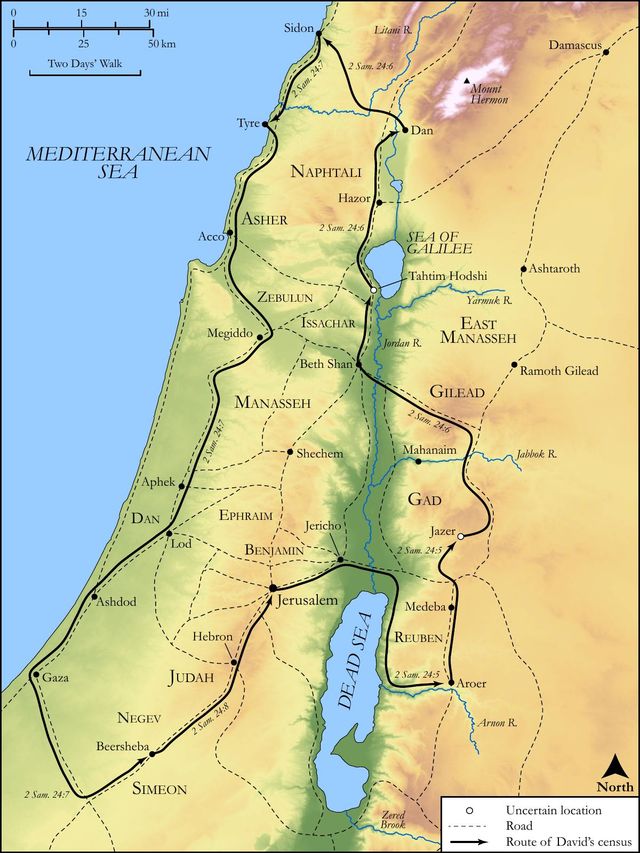
2 Samuel 24:2 records King David's direct and comprehensive command to Joab, the captain of his army, to conduct a census across the entirety of Israel, from its northernmost point, Dan, to its southernmost, Beersheba. This seemingly administrative directive, however, is presented within a narrative context that exposes a profound lapse in David's spiritual trust, leading to national judgment and ultimately paving the way for a pivotal act of atonement and the future site of the Temple in Jerusalem. The verse initiates a sequence of events that profoundly illustrates the consequences of human pride and reliance on quantifiable strength rather than divine providence.
Context
ShowHideLiterary Context
This verse is the direct articulation of the command mentioned in 2 Samuel 24:1, which states, "And again the anger of the LORD was kindled against Israel, and he moved David against them to say, Go, number Israel and Judah." This opening immediately establishes a complex theological tension, suggesting that while David initiates the census, his action is intertwined with God's displeasure, setting the stage for divine judgment. The narrative swiftly moves to 2 Samuel 24:3, where Joab, David's loyal but discerning commander, expresses strong reservations, recognizing the inherent sinfulness and potential harm of the king's order. Joab's protest serves as a narrative device to highlight the problematic nature of this specific census, distinguishing it from divinely sanctioned counts in other biblical accounts. The subsequent verses detail the arduous nine-month and twenty-day undertaking of the census, its completion, and David's immediate conviction of sin, which precipitates the devastating divine judgment of a plague upon the nation.
Historical & Cultural Context
Censuses in ancient Israel were not inherently sinful; indeed, God commanded them for specific, legitimate purposes, such as military conscription and tribal organization, as seen in Numbers 1 and Numbers 26. However, the moral permissibility of a census depended entirely on the motivation behind it. Censuses could be conducted for taxation, military assessment, or administrative purposes. In David's case, the sin likely lay in a fundamental shift of trust: from a humble reliance on God's power and provision to an over-reliance on human strength and quantifiable numbers. This act could signify a king's pride in his own achievements, a desire to boast in the size of his army, or a move towards self-sufficiency rather than acknowledging that true victory and security come solely from the Lord. The phrase "from Dan even to Beersheba" was a widely recognized biblical idiom, signifying the full geographical extent of the Israelite territory, from its northernmost city to its southernmost, emphasizing the comprehensive and national scope of David's ill-conceived command.
Key Themes
ShowHideThis passage profoundly contributes to several major theological and narrative themes within 2 Samuel and the broader Old Testament. Firstly, it starkly illuminates David's Sin of Pride and Self-Reliance. Unlike earlier, divinely authorized censuses, David's motivation here is portrayed as a significant lapse in faith, demonstrating a desire to quantify his kingdom's strength rather than trusting in God's unseen hand and sovereign protection. This incident powerfully reinforces the recurring biblical theme of human fallibility, even among God's most chosen and favored leaders. Secondly, the narrative grapples with the intricate and often mysterious relationship between Divine Sovereignty and Human Responsibility. While 2 Samuel 24:1 states the Lord "moved David," and the parallel account in 1 Chronicles 21:1 attributes it to Satan's provocation, both accounts unequivocally affirm David's ultimate culpability for his choice. This illustrates that God's overarching plan does not negate human free will or accountability for sinful actions. Thirdly, the chapter vividly portrays the Consequences of Disobedience, as David's personal sin results in a devastating plague upon the innocent people of Israel, underscoring the corporate impact of a leader's actions and the interconnectedness of the covenant community. Finally, the Geographical Scope "from Dan even to Beersheba" emphasizes the national scale of David's command and the subsequent judgment, affecting the entire covenant community.
Exposition and Analysis
ShowHideKey Word Analysis
ShowHideThis Hebrew verb (H6485) signifies "to visit," "to oversee," "to muster," "to charge," or "to count." While the act of counting itself is neutral, David's use of pâqad here, without divine authorization and seemingly driven by a desire to assess his own strength, transforms the act into an expression of pride and a lack of trust in God. It implies a shift from relying on God for national security and prosperity to depending on quantifiable human resources or military might, challenging God's unique sovereignty.
The verb yâdaʻ (H3045) means "to know," "to perceive," "to understand," or "to experience." In this context, David's stated desire, "that I may know the number of the people," reveals his personal ambition and perhaps a need for control or reassurance outside of divine provision. It points to an intellectual or statistical knowledge that, when pursued with a heart of pride and self-sufficiency, becomes an affront to God, who alone possesses ultimate knowledge and control over all things.
Verse Breakdown
ShowHide"For the king said to Joab the captain of the host, which [was] with him"
This opening clause establishes the direct and authoritative nature of the command emanating from King David to his most trusted and powerful military commander, Joab. The phrase "which [was] with him" emphasizes Joab's close proximity and constant presence by David's side, underscoring the personal and immediate delivery of this significant directive, highlighting Joab's unique position as the recipient of the king's will.
"Go now through all the tribes of Israel, from Dan even to Beersheba"
This is the core of David's command, delineating the expansive scope of the census. "All the tribes of Israel" indicates a comprehensive national count, encompassing the entire populace, not merely a specific region or military division. The idiomatic expression "from Dan even to Beersheba" precisely demarcates the full geographical expanse of the Israelite kingdom, from its northernmost city to its southernmost, emphatically underscoring the totalizing and all-encompassing nature of David's ambition.
"and number ye the people, that I may know the number of the people"
This concluding phrase reiterates the central purpose of the command: to count the populace. The repetition of "number of the people" emphasizes David's personal desire for this specific information. It reveals his intent to gain a precise understanding of his human resources, likely for military or administrative purposes, but crucially, without divine authorization or a pure heart, which ultimately rendered it an act of profound sin.
Literary Devices
ShowHideThe passage employs several potent literary devices that deepen its theological impact. The most prominent is Idiom, specifically the phrase "from Dan even to Beersheba," which is a well-established biblical expression signifying the entire geographical breadth of the land of Israel. Its use here emphasizes the comprehensive and national scope of David's census, highlighting that his ambition touched every corner of his kingdom. There is also a powerful Irony at play: David, often lauded as "a man after God's own heart," who had personally witnessed countless divine deliverances against overwhelming odds, now seeks reassurance and security in human numbers rather than in the Lord's omnipotent power. This act of quantifying his strength ironically leads to a severe weakening of his nation through a devastating plague. Furthermore, the narrative functions as Foreshadowing, as this seemingly isolated act of sin sets the stage for a divine judgment that ultimately leads to the purchase of the threshing floor of Araunah, which would providentially become the sacred site of Solomon's Temple, thus linking David's personal failing to a future act of divine grace and corporate worship.
Theological and Thematic Connections
ShowHideThis episode in 2 Samuel 24:2 serves as a profound theological statement on the insidious nature of human pride and the unwavering sovereignty of God. David's desire to count his people, though superficially innocuous, reveals a heart that momentarily shifted its fundamental trust from the invisible, omnipotent God to the visible, quantifiable strength of his kingdom. It underscores the timeless biblical truth that true security, lasting peace, and genuine success do not reside in human resources, military might, or meticulous planning alone, but in humble, unwavering reliance on God's divine provision and blessing. The narrative tension between God "moving" David and Satan "provoking" him (as seen in the parallel account in 1 Chronicles 21:1) highlights the mysterious interplay of divine sovereignty and human responsibility, illustrating that God can permit evil for His ultimate redemptive purposes, yet humanity remains fully accountable for its choices.
Reflection and Application
ShowHideDavid's census, initiated in 2 Samuel 24:2, offers a timeless and potent warning for all believers regarding the subtle yet destructive danger of pride and self-reliance. In our contemporary lives, we are perpetually tempted to count our achievements, quantify our resources, tally our followers, or assess our perceived strengths, often believing that these metrics define our security, validate our worth, or guarantee our success. Like David, we can inadvertently and subtly shift our trust from God's infinite power and unwavering faithfulness to our finite abilities and temporal possessions. This passage urgently calls us to a radical re-evaluation of our deepest motives. Are our actions, even those that appear good, necessary, or outwardly spiritual, truly rooted in a humble dependence on God, or are they covertly driven by a desire to glorify ourselves, secure our future through human means, or boast in our own accomplishments? True strength, lasting peace, and genuine fulfillment are found not in what we can count or control, but in the unquantifiable grace, boundless wisdom, and unwavering provision of the Almighty God.
Questions for Reflection
ShowHideFAQ
ShowHideWhy was David's census considered a sin, especially since God commanded censuses at other times?
ShowHideThe sin was not in the act of counting itself, but in David's underlying motive and the specific context. While God indeed commanded censuses in Numbers 1 and Numbers 26 for divinely authorized purposes (e.g., military readiness for a holy war, tribal organization for land distribution), David's census in 2 Samuel 24:2 appears to have stemmed from pride, a desire to boast in his military strength, or a profound lack of trust in God's protection and provision. It represented a dangerous shift from relying on God's unseen hand to relying on human numbers and quantifiable resources. Joab's strong objection in 2 Samuel 24:3 confirms that this particular census was understood by those closest to David to be problematic and not in line with God's will.
How can God "move" David to sin (2 Samuel 24:1) and Satan "provoke" him (1 Chronicles 21:1) at the same time?
ShowHideThis apparent contradiction highlights the complex and often mysterious biblical understanding of divine sovereignty and human responsibility. The Hebrew verb for "moved" in 2 Samuel 24:1 can imply permission or allowing. God, in His ultimate sovereignty, can permit or use the actions of evil (such as Satan's provocation, as explicitly stated in 1 Chronicles 21:1) to achieve His divine purposes. These purposes might include exposing latent sin in His people, bringing necessary judgment, or revealing a deeper spiritual truth. David remained fully responsible and morally culpable for his choice to conduct the census, but God's overarching plan allowed for his sinful inclination to manifest, leading to consequences that ultimately served a greater redemptive purpose, such as the establishment of the Temple site on the threshing floor of Araunah, as detailed in 2 Samuel 24:18-25.
Christ-Centered Fulfillment
ShowHideDavid's sin in commanding the census, as initiated in 2 Samuel 24:2, profoundly illustrates humanity's inherent tendency towards pride and self-reliance, even within the heart of a "man after God's own heart." This episode, leading to national judgment and a devastating plague, underscores the pervasive and destructive consequences of sin and the inherent inability of even the greatest human king to perfectly lead or atone for his people. In stark and glorious contrast stands Jesus Christ, the true and perfect King, who never relied on earthly numbers, military might, or human strength for His kingdom. His kingdom is not of this world, as He declared in John 18:36, and His power is manifested not in human strength but in divine humility, perfect obedience, and sacrificial love. Unlike David, whose sin brought a plague of death upon the people, Christ's perfect obedience and ultimate sacrifice on the cross became the propitiation for our sins, absorbing the judgment we deserved. He is the Lamb of God who truly takes away the sin of the world, as proclaimed by John the Baptist in John 1:29. Where David's census revealed human weakness and led to death, Christ's life, death, and resurrection offer eternal life and true security, not based on our numbers, achievements, or self-reliance, but solely on His finished work, inviting us to trust in Him alone, as Hebrews 12:2 encourages us to fix our eyes on "Jesus, the founder and perfecter of our faith."