


1 Chronicles 21:4
Bible text: King James Version (1769 Blayney text) · Public domain
Bible text: Berean Standard Bible · Public domain
Bible text: American Standard Version (1901) · Public domain
Bible text: World English Bible, Messianic edition · Public domain
Bible text: Geneva Bible (1599) · Public domain
Bible text: Young's Literal Translation · Public domain
- וּדְבַרu·de·varand [the] word ofH1697Conj-w ¦ N-mscNoun Singular Masculine Constructוּandדְבַר[the] word of
- הַמֶּלֶךְha·Me·lekhthe kingH4428Art ¦ N-msNoun Singular Masculine Absoluteהַtheמֶּלֶךְking
- חָזַקcha·Zakit prevailedH2388V-Qal-Perf-3msVerb Qal Perfect 3rd Singular Masculine
- עַל'aloverH5921PrepPreposition
- יוֹאָבyo·'AvJoabH3097N-proper-mNoun Proper Masculine
- וַיֵּצֵאvai·ye·Tze'and he went outH3318Conj-w ¦ V-Qal-ConsecImperf-3msVerb Qal Consecutive Imperfect 3rd Singular Masculineוַandיֵּצֵאhe went out
- יוֹאָבyo·'AvJoabH3097N-proper-mNoun Proper Masculine
- וַיִּתְהַלֵּךְvai·yit·ha·leKhand he went aboutH1980Conj-w ¦ V-Hithpael-ConsecImperf-3msVerb Hithpael Consecutive Imperfect 3rd Singular Masculineוַandיִּתְהַלֵּךְhe went about
- בְּכָלbe·kholin allH3605Prep-b ¦ N-mscNoun Singular Masculine Constructבְּinכָלall
- יִשְׂרָאֵלYis·ra·'ElIsraelH3478N-properNoun Proper Location
- וַיָּבֹאvai·ya·Vo'and he cameH935Conj-w ¦ V-Qal-ConsecImperf-3msVerb Qal Consecutive Imperfect 3rd Singular Masculineוַandיָּבֹאhe came
- יְרוּשָׁלִָםye·ru·sha·LimJerusalemH3389N-properNoun Proper Location
English is a literal word-by-word gloss of the Hebrew, not the KJV's wording. Why?
This is the original text the KJV's translators worked from — each Hebrew word with its own literal English meaning in this verse, prepared by scholars at Tyndale House, Cambridge. The KJV translates whole sentences, not word by word, so its wording differs: one Hebrew word can become several English words, and the KJV may choose “the LORD” where the gloss reads “Yahweh”. Both are faithful — they answer different questions. For the KJV's own rendering, switch to the KJV text.
Details
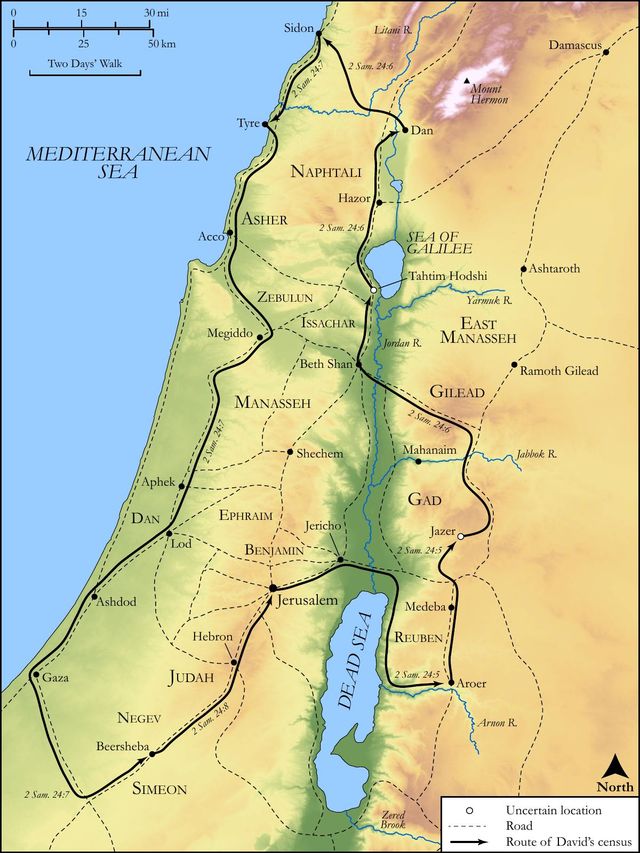
See on the biblical-era map
Study this verse
Public-domain commentary
Matthew Henry
From his Commentary on the Whole Bible. Henry comments on passages, not single verses — this entry covers 1 Chronicles 21:1–6. His three-level outline is real structure in the source text, so it is rendered as structure.
Numbering the people, one would think, was no bad thing. Why should not the shepherd know the number of his flock? But God sees not as man sees. It is plain it was wrong in David to do it, and a great provocation to God, because he did it in the pride of his heart; and there is no sin that has in it more of contradiction and therefore more of offence to God than pride. The sin was David's; he alone must bear the blame of it. But here we are told,
I.How active the tempter was in it (Ch1 21:1):
Satan stood up against Israel, and provoked David to do it. Is is said (Sa2 24:1) that the anger of the Lord was kindled against Israel, and he moved David to do it. The righteous judgments of God are to be observed and acknowledged even in the sins and unrighteousness of men. We are sure that God is not the author of sin - he tempts no man; and therefore, when it is said that he moved David to do it, it must be explained by what is intimated here, that, for wise and holy ends, he permitted the devil to do it. Here we trace this foul stream to its foundation. That Satan, the enemy of God and all good, should stand up against Israel, is not strange; it is what he aims at, to weaken the strength, diminish the numbers, and eclipse the glory of God's Israel, to whom he is Satan, a sworn adversary. But that he should influence David, the man of God's own heart to do a wrong thing, may well be wondered at. One would think him one of those whom the wicked one touches not. No, even the best saints, till they come to heaven, must never think themselves out of the reach of Satan's temptations. Now, when Satan meant to do Israel a mischief, what course did he take? He did not move God against them to destroy them (as Job, Job 2:3), but he provoked David, the best friend they had, to number them, and so to offend God, and set him against them. Note,
1.The devil does us more mischief by tempting us to sin against our God than he does by accusing us before our God. He destroys none but by their own hands,
2.The greatest spite he can do to the church of God is to tempt the rulers of the church to pride; for none can conceive the fatal consequences of that sin in all, especially in church-rulers. You shall not be so, Luk 22:26.
II.How passive the instrument was.
Joab, the person whom David employed, was an active man in public business; but to this he was perfectly forced, and did it with the greatest reluctance imaginable.
1.He put in a remonstrance against it before he began it. No man more forward that he in any thing that really tended to the honour of the king or the welfare of the kingdom; but in this matter he would gladly be excused. For,
(1.)It was a needless thing. there was not occasion at all for it. God had promised to multiply them, and he needed not question the accomplishment of that promise. They were all his servants, and he needed not doubt of their loyalty and affection to him. Their number was as much his strength as he could desire.
(2.)It was a dangerous thing. In doing it he might be a cause of trespass to Israel, and might provoke God against them. This Joab apprehended, and yet David himself did not. The most learned in the laws of God are not always the most quick-sighted in the application of those laws.
2.He was quite weary of it before he had done it; for the king's word was abominable to Joab, Ch1 21:6. Time was when whatever king David did pleased all the people, Sa2 3:36. But now there was a general disgust at these orders, which confirmed Joab in his dislike of them. so that, though the produce of this muster was really very great, yet he had no heart to perfect it, but left two tribes unnumbered (Ch1 21:5, Ch1 21:6), two considerable ones, Levi and Benjamin, and perhaps was not very exact in numbering the rest, because he did not do it with any pleasure, which might be one occasion of the difference between the sums here and Sa2 24:9.
Continue studying 1 Chronicles 21:4 across the web’s major study libraries — every link below opens this exact verse, chapter, or book on the destination site.
Read & Compare
 BibleGatewayThis verse in more than 200 translations and 70 languages.
 Bible.comThe YouVersion reader — hundreds of translations, reading plans, and highlights.
 ESV.orgCrossway's official English Standard Version reader.
 NET BibleThe NET translation with 60,000+ translators' notes on every rendering decision.
 STEP BibleTyndale House's free study tool — original text, vocabulary, and scholarly resources.
 BibliaLogos Bible Software's free web reader.
 USCCBThe New American Bible (Revised Edition) with the U.S. bishops' study notes.
Commentaries
 BibleHub CommentariesDozens of classic commentaries on this verse, gathered on one page.
 StudyLightMore than 100 commentary sets — the largest collection on the web.
 BibleRefPlain-English commentary on what this verse means, verse by verse.
 Enduring WordDavid Guzik's free commentary on this chapter, widely used by Bible teachers.
 Bible Study ToolsVerse commentary alongside Greek and Hebrew study aids.
Original Language & Research
- BibleHub InterlinearThe verse word by word — original language, transliteration, and English.
- BibleHub LexiconEvery word's original-language definition and Strong's entry.
 Blue Letter BibleDeep-study tools — Strong's numbers, concordance, and word studies.
 SefariaThe Hebrew text with Rashi and centuries of Jewish commentary.
Sermons, Hymns & Audio


TrulyRandomVerse is not affiliated with these sites and doesn’t control their content. They’re linked because they’re genuinely useful.
Summary
1 Chronicles 21:4 marks a pivotal moment in the tragic narrative of King David's census, recording the definitive instance where the king's unyielding command decisively overcame the wise and divinely-informed objections of his loyal military commander, Joab. This verse signifies the reluctant initiation of the census, a decision rooted in pride and displeasing to God, setting in motion a chain of events that would ultimately lead to severe divine judgment upon Israel. It powerfully underscores the absolute nature of royal authority in ancient Israel and the profound, far-reaching consequences of a leader's unchecked will.
Context
ShowHideLiterary Context
This verse is situated at the climax of a brief but intense confrontation between King David and his general, Joab, regarding the proposed census. The preceding verses establish the divine displeasure and the satanic incitement behind David's command, as seen in 1 Chronicles 21:1. Joab, demonstrating remarkable spiritual discernment and loyalty, vehemently advises against the census, articulating his concerns for both the king and the nation in 1 Chronicles 21:3. Verse 4 depicts David's stubborn resolve overriding Joab's counsel, effectively closing the door to further debate and initiating the fateful numbering. The subsequent narrative details Joab's reluctant execution of the census and the devastating divine judgment that follows, as described in 1 Chronicles 21:5-17. This verse is the critical turning point, moving from deliberation to irreversible action.
Historical & Cultural Context
In ancient Israel, a census was typically undertaken for legitimate military or taxation purposes, often at divine command, as exemplified in Numbers 1. However, a census undertaken out of human pride, a desire to boast in military strength rather than trust in God, or for purposes of national aggrandizement, was considered an affront to Yahweh, who alone was Israel's true strength and protector. Kings among the nations of that day held immense authority, and a direct royal command, once issued, was extremely difficult to oppose, even for a powerful figure like Joab, who served as the commander of David's army, as noted in 2 Samuel 8:16. Joab's role as a trusted advisor, coupled with his understanding of divine law and its implications, made his objection significant, yet the king's word, in this context, carried ultimate legal and practical weight, leaving Joab with no recourse but to obey.
Key Themes
ShowHideThe passage highlights several profound themes. Firstly, it showcases the tension between human will and divine will, where David's stubborn pride overrides God's unspoken disapproval, which Joab perceptively discerns. Secondly, it underscores the peril of unchecked authority, demonstrating how even a righteous king like David could abuse his power, leading to catastrophic consequences for his people. The theme of consequences of sin is central, as David's decision directly leads to divine judgment, emphasizing that actions have repercussions, both for individuals and the collective. Finally, the narrative implicitly touches on the nature of true leadership, contrasting David's flawed decision-making with Joab's wise, albeit ultimately unheeded, counsel, suggesting that true strength lies not in numbers but in obedience to God, a principle echoed throughout the historical books, such as in 1 Samuel 15:22.
Exposition and Analysis
ShowHideKey Word Analysis
ShowHideThis verb (H2388) carries the meaning "to be strong," "to be mighty," "to overcome," or "to prevail." Its use here signifies not merely that David's word was followed, but that it was decisively stronger and more influential than Joab's formidable opposition. It implies a victory of will, where David's resolve was so "strong" and "obstinate" that it "fastened upon" Joab, compelling his compliance and leaving no room for further argument or delay. This highlights the absolute nature of the king's command and the unyielding stubbornness of David in this instance.
The verb (H3318) means "to go out," "to go forth," or "to depart." In this context, it marks the physical and symbolic commencement of the census. Joab's "departure" from Jerusalem to begin the numbering signifies the transition from debate and objection to reluctant compliance and action. It is the point of no return, the moment the fateful command begins to be executed, setting in motion the events that will bring divine judgment upon the nation.
Verse Breakdown
ShowHide"Nevertheless the king's word prevailed against Joab."
This clause is the fulcrum of the verse, emphasizing David's unyielding authority and the ultimate futility of Joab's wise counsel. Despite Joab's strong and valid objections, rooted in an understanding of God's displeasure, David's royal decree held absolute sway. This highlights David's stubbornness and the dangerous power of a king's command, even when it is contrary to divine wisdom.
"Wherefore Joab departed, and went throughout all Israel, and came to Jerusalem."
This part details Joab's reluctant but obedient execution of the king's command. "Wherefore" (or "so") indicates the direct consequence of the king's word prevailing. Joab, despite his reservations, fulfills his duty as a military commander. His journey "throughout all Israel" signifies the comprehensive nature of the census, covering the entire nation, and his return to "Jerusalem" marks the completion of the task, bringing the results back to the king. This physical journey underscores the irreversible nature of the decision and the widespread impact of David's sin.
Literary Devices
ShowHideThe verse employs several literary devices to convey its profound message. Contrast is evident in the clash between Joab's discerning wisdom and David's stubborn will, highlighting a tragic inversion where the loyal subordinate possesses greater spiritual insight than the king. Foreshadowing is powerfully present, as Joab's reluctant departure and the commencement of the census ominously point towards the impending divine judgment that will befall Israel, creating a palpable sense of dread for the reader aware of the subsequent narrative events. The phrase "the king's word prevailed" also functions as Metonymy, where "the king's word" stands in for the king's absolute authority and unyielding will, emphasizing the power dynamic at play. The narrative also uses Irony, as Joab, often depicted as ruthless and pragmatic, is here the voice of spiritual caution, while David, the man after God's own heart, acts with uncharacteristic pride and disobedience.
Theological and Thematic Connections
ShowHide1 Chronicles 21:4 serves as a stark reminder of the dangers inherent in unchecked human authority and the profound consequences of prideful disobedience, even from those who are otherwise faithful. David's insistence on the census, despite Joab's clear and divinely-informed warning, illustrates a moment where human will overrides divine wisdom, leading to a national calamity. This episode underscores that true strength and security for God's people do not lie in human numbers or military might, but in trust and obedience to God. It highlights the principle that even leaders chosen by God are fallible and accountable for their actions, and their decisions can have far-reaching spiritual and physical repercussions for those under their charge. The narrative invites reflection on the importance of heeding wise counsel, especially when it aligns with divine principles, and the humility required to submit one's own will to God's.
Reflection and Application
ShowHideThe narrative of David's census, culminating in 1 Chronicles 21:4, offers profound lessons for contemporary believers and leaders. It challenges us to examine the motivations behind our actions: are they rooted in humble dependence on God, or in a desire for self-reliance, pride, or a misguided sense of control? David's refusal to listen to Joab, despite the general's clear and spiritually astute warning, serves as a cautionary tale about the perils of stubbornness and the importance of heeding wise counsel, especially when it challenges our preconceived notions or desires. For leaders, it underscores the immense responsibility that comes with authority and the necessity of cultivating humility, seeking godly wisdom, and being open to correction, even from subordinates. For individuals, it reminds us that even when we are in positions where our will can "prevail," we must consider the potential consequences of acting against better judgment or spiritual discernment. Ultimately, the verse calls us to a posture of humility and reliance on God, recognizing that true security and blessing come from aligning our will with His, rather than trusting in our own strength or numbers.
Questions for Reflection
ShowHideFAQ
ShowHideWhy did Joab obey David's command if he knew it was wrong and displeasing to God?
ShowHideJoab's obedience, despite his strong objections, highlights the complex dynamics of ancient kingship and military command. While Joab clearly understood the spiritual implications and attempted to dissuade David, as recorded in 1 Chronicles 21:3, the king's word was absolute. In the kingdoms of that day, direct disobedience to a king's command, especially from a high-ranking official, could be considered treasonous and carry severe penalties, including death. Joab, as David's loyal commander, was bound by duty and the chain of command. His actions reflect the difficult position of one who must execute a flawed order from a superior, demonstrating a reluctant compliance born of necessity rather than agreement. This also underscores the immense weight of responsibility that falls on a king, as his decisions, even when misguided, are binding on his subjects.
What was wrong with taking a census in ancient Israel?
ShowHideTaking a census was not inherently wrong; the Law of Moses even prescribed a census for military service, as seen in Numbers 1:2-3. The issue with David's census was its underlying motivation, which was displeasing to God, as stated in 1 Chronicles 21:7. While the text in Chronicles attributes the incitement to Satan in 1 Chronicles 21:1, the parallel account in 2 Samuel 24:1 states that "the anger of the Lord was again kindled against Israel, and he incited David against them, saying, 'Go, number Israel and Judah.'" This suggests that God allowed David's prideful inclination to manifest, perhaps as a means of judgment on Israel. David's sin was likely in taking the census out of a desire to boast in his military strength, relying on numbers rather than on God's power and provision, or perhaps for an unauthorized purpose. This act demonstrated a lack of trust in God and a reliance on human might, which was a recurring temptation for Israelite kings.
Christ-Centered Fulfillment
ShowHide1 Chronicles 21:4, with its depiction of a king's stubborn will leading to national judgment, powerfully foreshadows the ultimate King, Jesus Christ, who perfectly embodies obedience and self-sacrifice. Unlike David, whose word "prevailed" over wise counsel to his own and his people's detriment, Christ's will was always perfectly aligned with the Father's, even to the point of death on a cross. While David's pride led to a plague that required a costly sacrifice for atonement, detailed in 1 Chronicles 21:26-27, Jesus, the true Lamb of God, willingly offered Himself as the ultimate, perfect sacrifice, taking away the sin of the world, as proclaimed in John 1:29. David's census was an act of counting human strength; Christ's mission was to gather a people not by human might, but by divine grace and the power of His Spirit, as taught in Ephesians 2:8-9. The judgment that fell upon Israel because of David's sin highlights the severity of sin and the universal need for atonement, a need fully met in Christ, who bore the judgment we deserved, demonstrating God's profound love in Romans 5:8. Thus, this verse, while a somber account of human failure, ultimately points to the perfect King whose obedience brings life, not judgment, and whose authority is exercised in perfect love and redemption.