


2 Samuel 24:8
Bible text: King James Version (1769 Blayney text) · Public domain
Bible text: Berean Standard Bible · Public domain
Bible text: American Standard Version (1901) · Public domain
Bible text: World English Bible, Messianic edition · Public domain
Bible text: Geneva Bible (1599) · Public domain
Bible text: Young's Literal Translation · Public domain
- וַיָּשֻׁטוּvai·ya·Shu·tuand they went aboutH7751Conj-w ¦ V-Qal-ConsecImperf-3mpVerb Qal Consecutive Imperfect 3rd Plural Masculineוַandיָּשֻׁטוּthey went about
- בְּכָלbe·kholin allH3605Prep-b ¦ N-mscNoun Singular Masculine Constructבְּinכָלall
- הָאָרֶץha·'A·retzthe landH776Art ¦ N-fsNoun Singular Feminine Absoluteהָtheאָרֶץland
- וַיָּבֹאוּvai·ya·Vo·'uand they cameH935Conj-w ¦ V-Qal-ConsecImperf-3mpVerb Qal Consecutive Imperfect 3rd Plural Masculineוַandיָּבֹאוּthey came
- מִקְצֵהmik·Tzehfrom [the] end ofH7097Prep-m ¦ N-mscNoun Singular Masculine Constructמִfromקְצֵה[the] end of
- תִשְׁעָהtish·'AhnineH8672N-csNoun Singular common gender Absolute
- חֳדָשִׁיםcho·da·ShimmonthsH2320N-mpNoun Plural Masculine Absolute
- וְעֶשְׂרִיםve·'es·Rimand twentyH6242Conj-w ¦ N-mpNoun Plural Masculine Absoluteוְandעֶשְׂרִיםtwenty
- יוֹםYomday[s]H3117N-msNoun Singular Masculine Absolute
- יְרוּשָׁלִָםye·ru·sha·LimJerusalemH3389N-properNoun Proper Location
English is a literal word-by-word gloss of the Hebrew, not the KJV's wording. Why?
This is the original text the KJV's translators worked from — each Hebrew word with its own literal English meaning in this verse, prepared by scholars at Tyndale House, Cambridge. The KJV translates whole sentences, not word by word, so its wording differs: one Hebrew word can become several English words, and the KJV may choose “the LORD” where the gloss reads “Yahweh”. Both are faithful — they answer different questions. For the KJV's own rendering, switch to the KJV text.
Details
See on the biblical-era maps

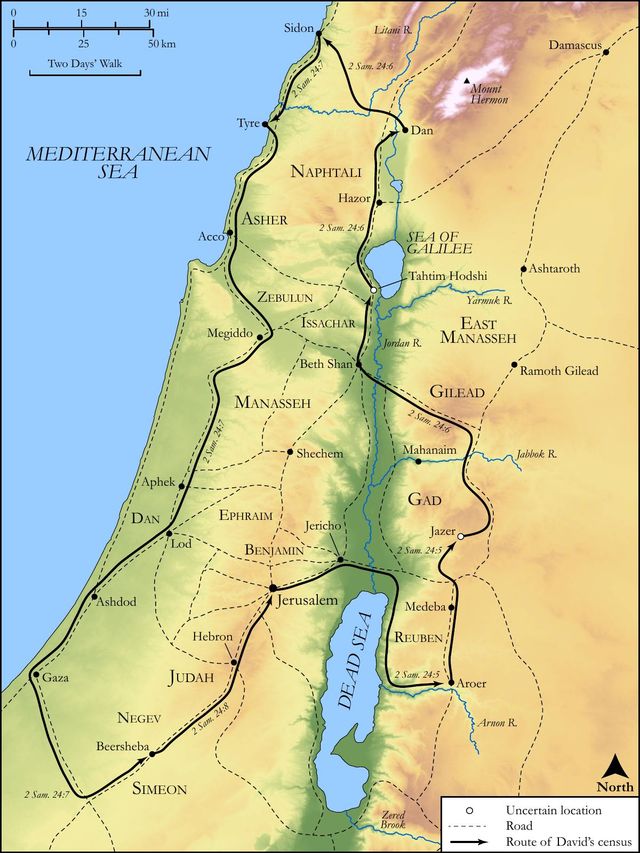
Study this verse
Continue studying 2 Samuel 24:8 across the web’s major study libraries — every link below opens this exact verse, chapter, or book on the destination site.
Read & Compare
 BibleGatewayThis verse in more than 200 translations and 70 languages.
 Bible.comThe YouVersion reader — hundreds of translations, reading plans, and highlights.
 ESV.orgCrossway's official English Standard Version reader.
 NET BibleThe NET translation with 60,000+ translators' notes on every rendering decision.
 STEP BibleTyndale House's free study tool — original text, vocabulary, and scholarly resources.
 BibliaLogos Bible Software's free web reader.
 USCCBThe New American Bible (Revised Edition) with the U.S. bishops' study notes.
Commentaries
 BibleHub CommentariesDozens of classic commentaries on this verse, gathered on one page.
 StudyLightMore than 100 commentary sets — the largest collection on the web.
 BibleRefPlain-English commentary on what this verse means, verse by verse.
 Enduring WordDavid Guzik's free commentary on this chapter, widely used by Bible teachers.
 Bible Study ToolsVerse commentary alongside Greek and Hebrew study aids.
Original Language & Research
- BibleHub InterlinearThe verse word by word — original language, transliteration, and English.
- BibleHub LexiconEvery word's original-language definition and Strong's entry.
 Blue Letter BibleDeep-study tools — Strong's numbers, concordance, and word studies.
 SefariaThe Hebrew text with Rashi and centuries of Jewish commentary.
Sermons, Hymns & Audio


TrulyRandomVerse is not affiliated with these sites and doesn’t control their content. They’re linked because they’re genuinely useful.
Summary
meticulously records the arduous completion of King David's controversial census, marking the culmination of a significant administrative undertaking that carried profound spiritual implications for both the king and the nation of Israel. This verse, with its precise temporal detail, signals the finality of an act born of questionable motives, setting the stage for the swift and severe divine judgment that immediately follows. It underscores the comprehensive scope of the census and the irreversible nature of David's decision, bringing a long process to its decisive end.
Context
ShowHideLiterary Context
This verse serves as the narrative climax of the census operation initiated by King David. Beginning in 2 Samuel 24:1, the text immediately establishes a context of divine displeasure, stating that "the anger of the Lord was again kindled against Israel." While the precise reason for God's anger is not explicitly detailed in 2 Samuel, it sets the stage for David's subsequent action. David's command for a census, despite the strong objections and warnings from his seasoned general Joab in 2 Samuel 24:3, highlights David's resolve and perhaps a lapse in his usual reliance on divine guidance. The preceding verses (2 Samuel 24:4-7) describe the extensive and challenging journey of Joab and his officers as they traversed the vast territories of Israel and Judah, counting the fighting men. Therefore, 2 Samuel 24:8 marks the successful, albeit ill-fated, conclusion of this nine-month and twenty-day endeavor, immediately preceding David's profound remorse and the subsequent divine judgment and plague detailed in 2 Samuel 24:10-17.
Historical & Cultural Context
Censuses among the nations were often conducted for military conscription, taxation, or forced labor. While the Mosaic Law permitted a census for military purposes, it required a "ransom" or atonement money to be paid by each person counted to avert a plague (Exodus 30:11-16). David's census, however, appears to have been undertaken without this prescribed atonement, suggesting a departure from covenantal practice. The scope of the census, covering the entire land "from Dan to Beersheba" (a common idiom for the full geographical extent of Israel), underscores the logistical challenge and the immense power wielded by David's administration. The duration of "nine months and twenty days" is a testament to the primitive travel and communication methods of the time, as well as the meticulous nature of the task. Culturally, a king's strength was often measured by the size of his army, and this census, in a sense, was a quantification of David's military might, potentially reflecting a reliance on human strength rather than divine protection, which was a recurring temptation for Israelite kings.
Key Themes
ShowHideThe completion of the census in 2 Samuel 24:8 contributes to several overarching themes within 2 Samuel and the broader Deuteronomistic History. Firstly, it highlights the theme of Human Pride vs. Divine Trust. David's decision to count his fighting men, despite Joab's warning, is often interpreted as an act of pride, a desire to boast in his military strength rather than trusting in the Lord, who had consistently given him victory. This contrasts sharply with earlier narratives where Israel's victories were attributed solely to God's intervention, not the size of their army, as seen in Judges 7:2-7. Secondly, the verse underscores the Consequences of Disobedience. The meticulous completion of the census inevitably leads to the severe judgment that follows, illustrating that even seemingly administrative acts can carry profound spiritual weight and incur divine displeasure when undertaken with wrong motives or outside of God's will. Thirdly, it touches on Divine Sovereignty and Human Responsibility. While 2 Samuel 24:1 states God's anger was kindled, and the parallel account in 1 Chronicles 21:1 attributes incitement to Satan, David remains fully responsible for his choice, demonstrating the complex interplay between divine will and human agency. Finally, the Thoroughness and Scope of the census, emphasized by the specific duration and geographical reach, highlights the comprehensive nature of David's kingdom and the pervasive impact of his actions.
Exposition and Analysis
ShowHideKey Word Analysis
ShowHideThis verb (שׁוּט, shûwṭ) implies extensive travel, a continuous movement to and fro across the land. It emphasizes the arduous and comprehensive nature of the census operation, indicating that Joab and his men meticulously traversed every region of Israel and Judah. This thoroughness underscores the deliberate and sustained effort involved in David's controversial undertaking, highlighting that the census was not a hasty or impulsive act but a prolonged and systematic endeavor.
The capital city (יְרוּשָׁלַיִם, Yᵉrûwshâlaim) serves as the central point of the kingdom, the seat of David's power, and the spiritual heart of Israel. The return of the census-takers to Jerusalem signifies the official conclusion of their mission, bringing the collected data to the king at the very center of his authority. The city's name, possibly meaning "founded peaceful," stands in ironic contrast to the turmoil and judgment that this census would bring upon it and the nation.
The term "end" (קָצֶה, qâtseh) here refers to the completion or culmination of the specified duration. In the context of "at the end of nine months and twenty days," it marks the precise temporal boundary when the census operation was fully executed. This word emphasizes the finality of the process, signaling that the action is now complete and irreversible, thereby setting the stage for the inevitable consequences and divine reckoning that follow David's prideful act.
Verse Breakdown
ShowHide"So when they had gone through all the land"
This clause describes the comprehensive nature of the census. Joab and his officers had meticulously covered every region and territory within David's kingdom, from the northernmost reaches to the southernmost, ensuring that the count of fighting men was exhaustive. This demonstrates the immense logistical effort and the king's determination to achieve a full accounting of his military potential.
"they came to Jerusalem"
Upon completing their extensive journey throughout the kingdom, the census-takers returned to Jerusalem, the capital city, the seat of David's power, and the spiritual center where the Ark of the Covenant resided. Their arrival in Jerusalem signifies the delivery of the final count to the king, bringing the entire operation to its official conclusion at the heart of the nation.
"at the end of nine months and twenty days"
This precise temporal marker emphasizes the duration and the arduousness of the task. It highlights that the census was a prolonged and deliberate undertaking, not a momentary lapse. The specificity of the time frame underscores the finality of the completed action, serving as a temporal boundary beyond which the consequences of the census would inevitably unfold.
Literary Devices
ShowHideThe seemingly straightforward statement in 2 Samuel 24:8 employs several subtle but powerful literary devices. Pacing is evident in the precise mention of "nine months and twenty days," which creates a sense of the slow, deliberate, and arduous march of time towards the census's completion. This detailed chronological marker builds a quiet Anticipation, as the reader, aware of the preceding verses detailing God's anger and Joab's objections, understands that the completion of this ill-advised task will inevitably lead to significant consequences. The verse also utilizes Understatement; it simply states the facts of the census's completion without explicit commentary on its moral or spiritual implications. However, given the narrative context of divine displeasure and Joab's warnings, this factual report carries immense dramatic weight, subtly foreshadowing the impending judgment. The very precision of the time and the comprehensive scope ("all the land") lend a sense of Finality to the action, implying that the die has been cast and the moment for divine reckoning has arrived.
Theological and Thematic Connections
ShowHideThe completion of David's census, as recorded in 2 Samuel 24:8, serves as a poignant reminder of the dangers of human self-reliance and pride, even in the lives of otherwise godly leaders. David's decision to count his fighting men, rather than trusting solely in God's provision and protection, represents a fundamental misstep in his walk of faith. This act, born from a desire to quantify and boast in his own strength, directly challenges the theological principle that true security and victory come from the Lord alone. The precise duration of the census underscores the deliberate nature of this transgression, highlighting that sin is often a process, not merely an isolated event, and its completion brings about inevitable consequences, revealing God's unwavering commitment to justice and righteousness within His covenant people.
Reflection and Application
ShowHideThe meticulous completion of David's census in 2 Samuel 24:8 offers profound lessons for contemporary believers and leaders. It challenges us to examine the underlying motives behind our actions, especially those that appear to be purely administrative or strategic. David's desire to count his army, while seemingly practical, stemmed from a heart that momentarily shifted its trust from divine provision to human strength. This reminds us that God is concerned not only with what we do, but why we do it. The long duration of the census, "nine months and twenty days," emphasizes that decisions, even those made in error, often have a long trajectory, and their consequences are not always immediate. This calls us to cultivate a posture of continuous discernment, seeking God's will and wisdom before embarking on significant undertakings, and to regularly assess whether our reliance is truly on God or on our own resources, statistics, or achievements. For leaders, it serves as a sober warning that authority, when exercised outside of humble dependence on God, can lead to devastating outcomes not only for themselves but for those they lead.
Questions for Reflection
ShowHideFAQ
ShowHideWhy was David's census considered a sin?
ShowHideDavid's census was considered a sin primarily because of its underlying motive and the context in which it was conducted. While censuses for military purposes were not inherently forbidden (as seen in Numbers 1:2-3), the specific circumstances suggest David's act stemmed from pride and a lack of trust in God. The text in 2 Samuel 24:1 states that "the anger of the Lord was again kindled against Israel," implying a preceding national sin that set the stage. David's census, then, may have been a manifestation of his own pride, a desire to boast in his military might and quantify his strength rather than relying on God for victory and security, as was consistent with Israel's covenant relationship. The parallel account in 1 Chronicles 21:1 explicitly states that "Satan stood up against Israel and incited David to number Israel," indicating a spiritual instigation behind David's flawed decision. Furthermore, the Mosaic Law required an atonement payment when a census was taken (Exodus 30:11-16), which David appears to have neglected, further highlighting his disregard for divine instruction.
What is the significance of the specific duration of "nine months and twenty days"?
ShowHideThe precise duration of "nine months and twenty days" (as stated in 2 Samuel 24:8) is significant for several reasons. Firstly, it underscores the immense logistical challenge and the arduous nature of the task. Covering the entire land of Israel, from Dan to Beersheba, was a massive undertaking in ancient times, requiring extensive travel and meticulous record-keeping. Secondly, the specificity highlights the thoroughness of the census. This was not a hasty or incomplete count, but a comprehensive survey that reached every corner of the kingdom. Thirdly, and most importantly from a theological perspective, this exact time frame emphasizes the deliberate and sustained nature of David's action. It was not a momentary lapse but a prolonged process, giving David ample time to reflect and reconsider, especially given Joab's strong objections (2 Samuel 24:3). The completion of this long duration marks the point of no return, the moment when the act is fully executed and ripe for its inevitable consequences, setting the stage for the divine judgment that immediately follows.
Christ-Centered Fulfillment
ShowHideThe narrative of David's census in 2 Samuel 24:8, culminating in a plague, powerfully foreshadows the need for a perfect King who would not succumb to pride or rely on human strength. David, though a man after God's own heart, failed here, demonstrating humanity's inherent inability to perfectly trust and obey God. His census, an act of self-reliance, brought judgment upon his people. In contrast, Jesus Christ, the true King of Israel, never relied on the strength of armies or the numbers of His followers. His kingdom is "not of this world" (John 18:36), built not on human statistics but on divine power and spiritual transformation. While David numbered his fighting men for earthly power, Christ allowed Himself to be "numbered with the transgressors" (Isaiah 53:12) on the cross, not for His own glory, but to bear the judgment for humanity's pride and sin. The plague that fell upon Israel because of David's sin points to the ultimate consequence of sin, which Christ, the Lamb of God, fully absorbed at Calvary (John 1:29). Through Him, we are not counted among the condemned but are "counted righteous" by faith, receiving a righteousness not our own (Romans 3:28), a fulfillment that transcends any earthly census or human achievement.