


Numbers 32:35
Bible text: King James Version (1769 Blayney text) · Public domain
Bible text: Berean Standard Bible · Public domain
Bible text: American Standard Version (1901) · Public domain
Bible text: World English Bible, Messianic edition · Public domain
Bible text: Geneva Bible (1599) · Public domain
Bible text: Young's Literal Translation · Public domain
- וְאֶתve·'Etand <obj.>H853Conj-w ¦ DirObjMParticle Object Indicatorוְandאֶת<obj.>
- עַטְרֹת'at·RotAtrothH5855N-properNoun Proper Location
- שׁוֹפָןsho·FanShophanH5855N-properNoun Proper Location
- וְאֶתve·'Etand <obj.>H853Conj-w ¦ DirObjMParticle Object Indicatorוְandאֶת<obj.>
- יַעְזֵרya'·ZerJazerH3270N-properNoun Proper Location
- וְיָגְבֳּהָהve·ya·ge·bo·Hahand JogbehahH3011Conj-w ¦ N-properNoun Proper LocationוְandיָגְבֳּהָהJogbehah
English is a literal word-by-word gloss of the Hebrew, not the KJV's wording. Why?
This is the original text the KJV's translators worked from — each Hebrew word with its own literal English meaning in this verse, prepared by scholars at Tyndale House, Cambridge. The KJV translates whole sentences, not word by word, so its wording differs: one Hebrew word can become several English words, and the KJV may choose “the LORD” where the gloss reads “Yahweh”. Both are faithful — they answer different questions. For the KJV's own rendering, switch to the KJV text.
Details
See on the biblical-era map
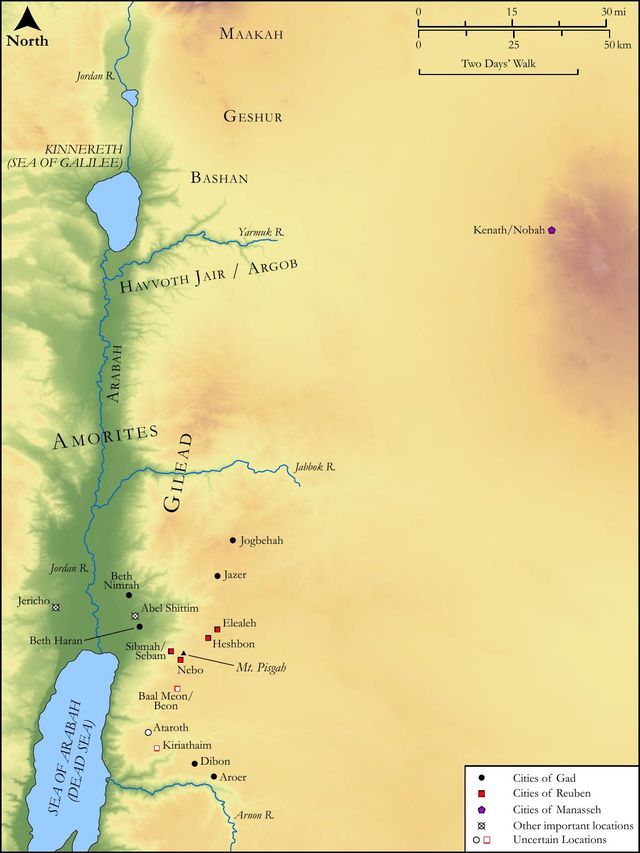
Study this verse
Continue studying Numbers 32:35 across the web’s major study libraries — every link below opens this exact verse, chapter, or book on the destination site.
Read & Compare
 BibleGatewayThis verse in more than 200 translations and 70 languages.
 Bible.comThe YouVersion reader — hundreds of translations, reading plans, and highlights.
 ESV.orgCrossway's official English Standard Version reader.
 NET BibleThe NET translation with 60,000+ translators' notes on every rendering decision.
 STEP BibleTyndale House's free study tool — original text, vocabulary, and scholarly resources.
 BibliaLogos Bible Software's free web reader.
 USCCBThe New American Bible (Revised Edition) with the U.S. bishops' study notes.
Commentaries
 BibleHub CommentariesDozens of classic commentaries on this verse, gathered on one page.
 StudyLightMore than 100 commentary sets — the largest collection on the web.
 BibleRefPlain-English commentary on what this verse means, verse by verse.
 Enduring WordDavid Guzik's free commentary on this chapter, widely used by Bible teachers.
 Bible Study ToolsVerse commentary alongside Greek and Hebrew study aids.
Original Language & Research
- BibleHub InterlinearThe verse word by word — original language, transliteration, and English.
- BibleHub LexiconEvery word's original-language definition and Strong's entry.
 Blue Letter BibleDeep-study tools — Strong's numbers, concordance, and word studies.
 SefariaThe Hebrew text with Rashi and centuries of Jewish commentary.
Sermons, Hymns & Audio


TrulyRandomVerse is not affiliated with these sites and doesn’t control their content. They’re linked because they’re genuinely useful.
Summary
Numbers 32:35 is a concise yet profoundly significant verse, meticulously listing four cities—Atroth, Shophan, Jaazer, and Jogbehah—that were rebuilt and fortified by the tribes of Gad and Reuben in the fertile Transjordan region. This enumeration serves as tangible evidence of these tribes fulfilling their solemn covenant with Moses, agreeing to settle east of the Jordan only after their armed men participated fully in the conquest of Canaan. The verse underscores the precise nature of Israel's land distribution and the practical establishment of their tribal inheritances, reflecting both human responsibility and divine providence in the unfolding of God's promises.
Context
ShowHideLiterary Context
Numbers 32:35 is situated within a pivotal narrative in Numbers chapter 32, which details the unique agreement between Moses and the tribes of Reuben and Gad. The chapter opens with these tribes, possessing vast livestock, recognizing the suitability of the Transjordan for their pastoral needs. Their initial request to settle there, rather than cross the Jordan, prompts Moses's strong rebuke, fearing a repeat of the disheartening report of the spies that led to Israel's wilderness wandering. However, their subsequent pledge to send their armed men across the Jordan to fight alongside their brethren until the entire land of Canaan was subdued appeases Moses. Verses 34-38 then meticulously enumerate the cities these tribes built or rebuilt, establishing secure dwelling places for their families and livestock. Verse 35 specifically continues this comprehensive inventory, primarily listing cities within the territory allocated to the tribe of Gad, thereby demonstrating the practical and concrete implementation of their agreement. It transitions from the general statement of building in Numbers 32:34 to a more specific list.
Historical & Cultural Context
In Israel, land ownership and inheritance were paramount, often viewed as a divine gift and central to identity, security, and blessing. For the Israelites, the land of Canaan represented the tangible fulfillment of God's covenant promise to Abraham (Genesis 12:7). The Transjordan region, though geographically distinct from the "land of Canaan" west of the Jordan, was highly prized for its rich grazing lands, essential for tribes like Reuben and Gad whose economy was livestock-based. The practice of "building" or "rebuilding" cities (which could involve fortifying existing structures, establishing new settlements, or repairing war-damaged towns) was crucial for securing territorial claims, protecting families and flocks, and establishing a permanent presence. The detailed naming of cities in verses like Numbers 32:35 reflects the historical reality of tribal movements and settlements, providing geographical anchors to the biblical narrative and underscoring the meticulous record-keeping of the ancient Israelites regarding their territorial claims and the fulfillment of their national mission.
Key Themes
ShowHideThough a simple list of names, Numbers 32:35 powerfully contributes to several overarching themes within the book of Numbers and the broader Pentateuch. Firstly, it exemplifies Covenant Faithfulness and Responsibility. The enumeration of these cities serves as concrete evidence that the tribes of Reuben and Gad were making good on their solemn pledge to Moses and the rest of Israel. Their actions demonstrate the vital importance of integrity and fulfilling one's obligations within the covenant community, a theme reinforced throughout the Mosaic Law. Secondly, the verse subtly highlights Divine Providence and the Fulfillment of Promise. The detailed allocation and settlement of land, even in the Transjordan, represents a tangible step in God's unwavering faithfulness to provide a homeland for His people, bringing to fruition the ancient promises made to the patriarchs. Thirdly, it speaks to Corporate Unity and Inter-tribal Solidarity. Despite their distinct geographical inheritance, the agreement ensures that these tribes remain united with their brethren in the national mission to conquer the land, emphasizing shared responsibility and mutual support for the common good of Israel. Finally, it embodies the theme of Settlement and Inheritance, marking the crucial transition from nomadic wandering to established dwelling, a foundational aspect of Israel's identity as a nation firmly rooted in their divinely appointed land.
Exposition and Analysis
ShowHideKey Word Analysis
ShowHideThis compound name (H5855) is derived from roots meaning "crowns" or "enclosures" (for Atroth) and "hidden" or "covered" (for Shophan). The phrase "crowns of Shophan" suggests a prominent or fortified settlement, possibly one that was strategically located or well-defended, or perhaps a place associated with a specific type of enclosure or hiding place. Its inclusion here indicates a significant location that the Gadites sought to secure, highlighting the importance of establishing strongholds in their newly acquired territory.
From the root meaning "to help" or "he will help" (H3270), Jaazer was a significant Amorite city east of the Jordan, previously conquered by Israel (Numbers 21:32). Its name might reflect its strategic importance as a place that provided aid or support to the surrounding region, or perhaps its capture was seen as a "help" to Israel's advance. Its inclusion in this list underscores its continued significance as a key urban center within Gad's inheritance, serving as a base or point of control.
Derived from a root meaning "to be high" or "elevated" (H3011), this name literally means "hillock" or "high place." Such elevated locations were naturally advantageous for defense and offered commanding views of the surrounding landscape. The fortification of Jogbehah by the Gadites demonstrates their strategic foresight in securing their borders and protecting their families and flocks, reinforcing the theme of establishing a firm and defensible presence in their new land.
Verse Breakdown
ShowHide"And Atroth, Shophan, and Jaazer, and Jogbehah,"
This clause functions as a direct and precise enumeration of four specific cities that the tribes of Gad and Reuben either built or, more likely, rebuilt and fortified. The opening conjunction "And" seamlessly connects this list to the preceding verse (Numbers 32:34). Verse 35 then continues and expands upon this detailed inventory, providing further tangible examples of the urban centers that were meticulously secured by these tribes. The listing of these distinct geographical names serves to concretize the abstract agreement made with Moses, providing irrefutable evidence of the tribes' commitment to establishing secure dwelling places for their families and fenced enclosures for their livestock, as stipulated in their covenant. It underscores the practical, ground-level fulfillment of their promise to settle and secure the Transjordan, demonstrating diligence and responsibility in the face of their new inheritance.
Literary Devices
ShowHideThe primary literary device employed in Numbers 32:35 is Enumeration, a technique used to provide a detailed and comprehensive account of the cities rebuilt by the tribes of Gad and Reuben. By naming specific locations like Atroth, Shophan, Jaazer, and Jogbehah, the text grounds the historical narrative in concrete geographical reality, lending authenticity and precision to the account of Israel's settlement. This use of Toponymy (the study and naming of places) is characteristic of biblical historical narratives, emphasizing that these events occurred in real places at a specific time, thereby strengthening the factual basis of the divine plan for Israel's inheritance. While not a direct literary device within this single verse, the broader context of Numbers chapter 32 also employs the narrative structure of Pledge and Fulfillment, where the initial request and solemn promise of Reuben and Gad (vv. 1-32) are meticulously followed by the detailed account of their actions (vv. 34-38), of which verse 35 is a crucial part, demonstrating the integrity of their word and the faithfulness of their commitment.
Theological and Thematic Connections
ShowHideNumbers 32:35, though seemingly a mere list of names, is deeply intertwined with the profound theological theme of God's faithfulness in fulfilling His covenant promises. The meticulous detail with which the land is described and distributed, even down to individual cities, speaks to God's precise and orderly providence in bringing His plans to fruition. Just as God promised Abraham a land for his descendants, this verse shows the tangible, step-by-step realization of that promise. It highlights that God's overarching plans are not vague or abstract but are worked out in specific times, places, and through the responsive actions of His people. The commitment of Reuben and Gad to diligently secure their inheritance while also aiding their brethren underscores the importance of human responsibility in cooperating with divine purposes, reflecting the biblical emphasis on integrity, keeping one's word, and communal solidarity. This act of "building" and "fortifying" also symbolizes the establishment of a secure foundation, both physically for the tribes and spiritually for the nation, as they settle into the land God meticulously provided.
Reflection and Application
ShowHideThe seemingly mundane list of cities in Numbers 32:35 offers profound insights for contemporary believers, reminding us that God's promises are not abstract ideals but are concretely fulfilled in the fabric of human history and individual lives. Just as the tribes of Reuben and Gad diligently built and fortified their cities, we are called to be diligent in "building" our lives upon the promises of God. This involves actively securing our spiritual inheritance, fortifying our faith against challenges, and establishing strong, godly foundations in our families and communities. The commitment of these tribes to their word, even when it meant delaying their full rest and engaging in a shared struggle, challenges us to consider the integrity of our own commitments—to God, to our families, and to our spiritual community. It prompts us to reflect on how we are actively participating in the "settlement" of God's kingdom in our spheres of influence, not merely passively waiting for blessings, but diligently working to establish and secure them for ourselves and for future generations, ensuring that our lives are built on the firm ground of God's truth and faithfulness.
Questions for Reflection
ShowHideFAQ
ShowHideWhy are these specific cities listed in Numbers 32:35, and what is their significance?
ShowHideThe listing of specific cities like Atroth, Shophan, Jaazer, and Jogbehah serves several crucial purposes within the biblical narrative. Firstly, it provides concrete, verifiable evidence that the tribes of Reuben and Gad were indeed fulfilling their solemn agreement with Moses to settle the Transjordan region. This detailed enumeration demonstrates that their promise was not an empty one, but was followed by tangible action—the building and fortifying of actual urban centers, as outlined in Numbers 32:34-38. Secondly, it grounds the biblical narrative in historical and geographical reality, emphasizing that these events were not mythical but occurred in specific, identifiable locations. This precision lends authenticity and credibility to the account of Israel's land distribution and settlement, underscoring the factual nature of God's dealings with His people. Finally, it highlights the meticulous nature of the biblical record, which often includes such detailed inventories to underscore the thoroughness of God's plan and the orderly establishment of His people in their promised inheritance, a characteristic seen throughout the book of Numbers and the Pentateuch. These names are not merely lists, but markers of a covenant fulfilled and a divine promise progressively realized.
Christ-Centered Fulfillment
ShowHideWhile Numbers 32:35 speaks of a physical inheritance and the establishment of earthly cities, it ultimately points forward to the spiritual inheritance and eternal dwelling found in Christ. The tribes' diligent work to secure their land and build their cities foreshadows the greater reality that believers are given a spiritual inheritance that is "imperishable, undefiled, and unfading, kept in heaven for you" (1 Peter 1:4). Just as these cities provided security and a measure of rest for the tribes, Christ provides the ultimate "rest" for the people of God, a Sabbath rest from striving and a secure dwelling in His presence (Hebrews 4:9-10). The meticulous detail of the land distribution in Numbers reflects God's precise and orderly plan for humanity's redemption, culminating in Christ, who is our true "place" of security and belonging. He is the one who has gone to "prepare a place for you" (John 14:2-3), an eternal city "whose builder and maker is God" (Hebrews 11:10). Thus, the earthly settlement of Reuben and Gad in the Transjordan serves as a tangible, albeit limited, picture of the glorious and eternal inheritance we receive through faith in Jesus, our King, our secure dwelling place, and the very foundation of our eternal hope.