


2 Samuel 24:6
Bible text: King James Version (1769 Blayney text) · Public domain
Bible text: Berean Standard Bible · Public domain
Bible text: American Standard Version (1901) · Public domain
Bible text: World English Bible, Messianic edition · Public domain
Bible text: Geneva Bible (1599) · Public domain
Bible text: Young's Literal Translation · Public domain
- וַיָּבֹאוּvai·ya·Vo·'uand they cameH935Conj-w ¦ V-Qal-ConsecImperf-3mpVerb Qal Consecutive Imperfect 3rd Plural Masculineוַandיָּבֹאוּthey came
- הַגִּלְעָדָהha·gil·'A·dah<the> Gilead towardsH1568Art ¦ N-proper ¦ SfxNoun Proper Locationהַ<the>גִּלְעָדָGileadהtowards
- וְאֶלve·'eland toH413Conj-w ¦ PrepPrepositionוְandאֶלto
- אֶרֶץ'E·retz[the] land ofH776N-fscNoun Singular Feminine Construct
- תַּחְתִּיםtach·TimTahtimH8483N-properNoun Proper Location
- חָדְשִׁיcha·de·ShiHodshiH8483N-properNoun Proper Location
- וַיָּבֹאוּvai·ya·Vo·'uand they cameH935Conj-w ¦ V-Qal-ConsecImperf-3mpVerb Qal Consecutive Imperfect 3rd Plural Masculineוַandיָּבֹאוּthey came
- דָּנָהDa·nahDan towardsH1835N-proper ¦ SfxNoun Proper LocationדָּנָDanהtowards
- יַּעַןYa·'anJaanH1842N-properNoun Proper Location
- וְסָבִיבve·sa·Vivand aroundH5439Conj-w ¦ N-csNoun Singular common gender Absoluteוְandסָבִיבaround
- אֶל'eltoH413PrepPreposition
- צִידוֹןtzi·DonSidonH6721N-properNoun Proper Location
English is a literal word-by-word gloss of the Hebrew, not the KJV's wording. Why?
This is the original text the KJV's translators worked from — each Hebrew word with its own literal English meaning in this verse, prepared by scholars at Tyndale House, Cambridge. The KJV translates whole sentences, not word by word, so its wording differs: one Hebrew word can become several English words, and the KJV may choose “the LORD” where the gloss reads “Yahweh”. Both are faithful — they answer different questions. For the KJV's own rendering, switch to the KJV text.
Details
See on the biblical-era maps
Study this verse
Continue studying 2 Samuel 24:6 across the web’s major study libraries — every link below opens this exact verse, chapter, or book on the destination site.
Read & Compare
 BibleGatewayThis verse in more than 200 translations and 70 languages.
 Bible.comThe YouVersion reader — hundreds of translations, reading plans, and highlights.
 ESV.orgCrossway's official English Standard Version reader.
 NET BibleThe NET translation with 60,000+ translators' notes on every rendering decision.
 STEP BibleTyndale House's free study tool — original text, vocabulary, and scholarly resources.
 BibliaLogos Bible Software's free web reader.
 USCCBThe New American Bible (Revised Edition) with the U.S. bishops' study notes.
Commentaries
 BibleHub CommentariesDozens of classic commentaries on this verse, gathered on one page.
 StudyLightMore than 100 commentary sets — the largest collection on the web.
 BibleRefPlain-English commentary on what this verse means, verse by verse.
 Enduring WordDavid Guzik's free commentary on this chapter, widely used by Bible teachers.
 Bible Study ToolsVerse commentary alongside Greek and Hebrew study aids.
Original Language & Research
- BibleHub InterlinearThe verse word by word — original language, transliteration, and English.
- BibleHub LexiconEvery word's original-language definition and Strong's entry.
 Blue Letter BibleDeep-study tools — Strong's numbers, concordance, and word studies.
 SefariaThe Hebrew text with Rashi and centuries of Jewish commentary.
Sermons, Hymns & Audio


TrulyRandomVerse is not affiliated with these sites and doesn’t control their content. They’re linked because they’re genuinely useful.
Summary
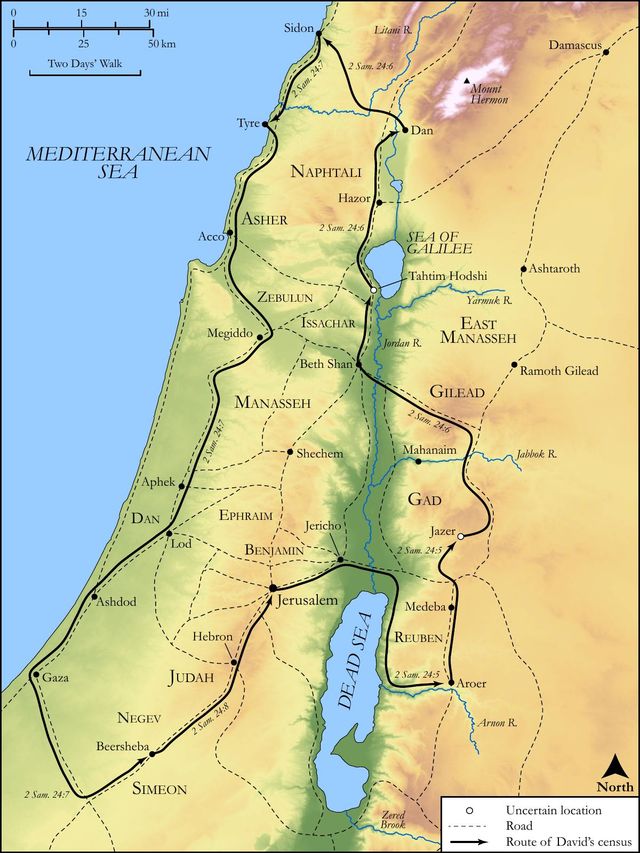
Second Samuel 24:6 provides a meticulous geographical itinerary of Joab's extensive journey as he conducted the census ordered by King David throughout Israel and Judah. This verse, situated within the climactic narrative of David's controversial census and its divine repercussions, underscores the vast territorial scope of David's united kingdom, tracing the route from the Transjordanian region of Gilead, through the less-known "land of Tahtimhodshi" and "Danjaan," before extending northward to the vicinity of the Phoenician city of Zidon. It vividly illustrates the thoroughness with which this administratively significant, yet spiritually problematic, task was executed across diverse and sometimes remote territories, highlighting the reach of David's power and the meticulousness of his administration.
Context
ShowHideLiterary Context
This verse is deeply embedded within the final, pivotal chapter of 2 Samuel, which recounts King David's decision to conduct a census of Israel and Judah, an act that ultimately displeased the Lord and led to severe divine judgment. The narrative commences with the Lord's anger against Israel, culminating in David's incitement to number the people—a complex theological statement that attributes both divine permission and human culpability to David's subsequent actions. Joab, David's loyal but discerning commander, initially voices strong objections to the census, recognizing its potential spiritual impropriety and the danger it posed to the kingdom (2 Samuel 24:3). Despite his reservations, Joab ultimately complies with the king's unwavering command, embarking on an arduous journey that spans nine months and twenty days (2 Samuel 24:8). Verse 6 specifically details a significant portion of this comprehensive itinerary, illustrating the painstaking nature of the survey before the final count is reported to David (2 Samuel 24:9). The entire chapter functions as a theological bridge, bringing David's reign in 2 Samuel to a somber close and setting the stage for the consequences of his actions that unfold in the subsequent book of 1 Kings.
Historical & Cultural Context
In ancient Israel, a census was far more than a mere administrative count; it often carried profound theological and cultural implications. While certain censuses were divinely commanded for specific purposes, such as military conscription or the equitable distribution of land (e.g., the census in Numbers 1), a census undertaken by a king for his own purposes could be perceived as an act of pride, a reliance on human strength, military might, and numerical superiority rather than on God's divine provision and protective power. At this juncture, David's kingdom had reached its zenith, having successfully consolidated power and significantly expanded its territorial borders. The explicit mention of diverse geographical locations such as Gilead (situated east of the Jordan River) and Zidon (a prominent Phoenician city to the northwest) vividly underscores the impressive territorial reach and political influence of David's burgeoning empire. The inclusion of more obscure locations like Tahtimhodshi and Danjaan further emphasizes the meticulousness and exhaustive nature of the census, reflecting an emerging bureaucratic capability within the Israelite monarchy, even if its application in this specific instance was spiritually flawed.
Key Themes
ShowHideThe primary themes illuminated by 2 Samuel 24:6 and its immediate narrative context include the Vast Scope of David's Kingdom and the Nature of Royal Authority and its Limits. The extensive geographical itinerary meticulously detailed in this verse vividly portrays the immense territorial expanse under David's dominion, stretching from the Transjordanian regions to the northern borders near Phoenicia. This impressive territorial reach, in some ways a fulfillment of God's covenant promises to Abraham regarding the land (e.g., Genesis 15:18), also subtly hints at the inherent human temptation for pride in such grand accomplishments. Furthermore, the verse powerfully illustrates the Thoroughness of the Census, reflecting the sophisticated administrative capacity of David's centralized monarchy. Joab's diligent and comprehensive execution of the king's command, despite his profound personal misgivings and spiritual discernment, underscores the absolute and often unquestioned nature of royal authority during this historical period. This meticulousness, however, stands in stark and tragic contrast to the profound spiritual implications of the census, which ultimately brought severe divine judgment upon the land, as dramatically seen in 2 Samuel 24:15.
Exposition and Analysis
ShowHideKey Word Analysis
ShowHideThis is a prominent geographical region located east of the Jordan River, renowned for its rugged terrain, fertile pastures, and strategic importance. It was historically inhabited by the tribes of Reuben, Gad, and the half-tribe of Manasseh. Its mention here signifies the eastern and southern Transjordanian starting point for this specific leg of the census, indicating the comprehensive nature of the survey across the entire breadth of the Israelite kingdom.
Derived from "Dan" and "purpose," this name likely means "judge of purpose." While its precise location remains uncertain, it is widely believed to be a place in the far north of Israel, possibly within or near the tribal territory of Dan, or a location close to the source of the Jordan River. Its inclusion signifies the extreme northern reach of the census, extending to what was traditionally considered the northern boundary of Israelite settlement, demonstrating the exhaustive nature of Joab's task.
An ancient and highly significant Phoenician city situated on the Mediterranean coast, directly north of Israel. Zidon was a major maritime and commercial center, known for its fishing and trade. Its mention here indicates that the census extended to the very borders of Israel's influence or territory in the northwest. While it is unlikely that the non-Israelite inhabitants of Zidon itself were counted, its proximity serves as a crucial geographical marker for the northernmost and westernmost extent of the surveyed area, delineating the full scope of David's kingdom.
Verse Breakdown
ShowHide"Then they came to Gilead"
This initial phrase marks the commencement of a specific and significant leg of Joab's extensive census journey, indicating his movement into the strategically important Transjordanian region. It establishes the primary geographical reference point for the detailed itinerary that follows, setting the stage for the comprehensive survey.
"and to the land of Tahtimhodshi"
Following their operations in Gilead, the census takers proceeded further north or northeast into this less-known and more obscure territory. The inclusion of this particular location, whose precise identification remains debated, serves to emphasize the thoroughness and painstaking effort involved in covering every single part of David's vast and diverse kingdom, leaving no area uncounted.
"and they came to Danjaan"
This clause signifies a continued and determined northward progression, reaching a point in the far northern reaches of Israelite territory. It underscores the extensive reach of the survey, penetrating deep into the northern frontier to ensure a truly comprehensive and accurate count of the population.
"and about to Zidon"
This final geographical marker in the verse indicates that the census reached the immediate vicinity of this major Phoenician city on the northwest coast. This demonstrates the wide sweep and impressive scope of the survey, encompassing the extreme northern and western boundaries of David's influence, effectively delineating the full territorial extent of the kingdom being numbered.
Literary Devices
ShowHideThe primary literary device at play in 2 Samuel 24:6 is Itinerary, as the verse meticulously functions as a geographical list detailing the precise route of Joab's census team. This exact enumeration of locations lends a profound sense of historical verisimilitude and authenticity to the narrative, firmly grounding the events in a tangible, real-world setting. Furthermore, the deliberate selection of locations, moving from Gilead (representing the east/south-east) to Zidon (representing the north-west), expertly employs a form of Merism. This powerful rhetorical device utilizes two contrasting or extreme parts to represent the entire whole, effectively implying that the census comprehensively covered the entire breadth and depth of David's kingdom, from one end to the other. The strategic inclusion of both well-known and prominent places (such as Gilead and Zidon) alongside more obscure ones (like Tahtimhodshi and Danjaan) also serves as Geographical Specificity, emphasizing the meticulous and exhaustive nature of the census, which reached into every corner and remote area of the land.
Theological and Thematic Connections
ShowHideWhile 2 Samuel 24:6 appears to be merely a geographical detail, it serves as a crucial narrative element in conveying the immense scope of David's kingdom at its zenith—a kingdom that was both a profound divine blessing and, in this specific instance, a dangerous source of human pride leading to severe divine judgment. The thoroughness of the census, as powerfully evidenced by the detailed itinerary, underscores the king's underlying desire for a comprehensive understanding of his military strength and human resources—a reliance on numbers and human might rather than on God's sovereign power and provision. This act, though seemingly administrative and politically expedient, reflects a deeper spiritual issue of self-sufficiency, a subtle but significant departure from unwavering trust in the Lord, which ultimately incurred divine wrath. The verse thus highlights the perennial tension between human ambition and divine sovereignty, reminding us that even seemingly neutral or pragmatic actions can carry profound spiritual weight and eternal consequences, calling us to examine the heart's true allegiance.
Reflection and Application
ShowHideThe meticulous geographical detail of 2 Samuel 24:6, though focused on ancient routes, invites us to deeply reflect on the nature of our own reliance and where we place our ultimate trust in contemporary life. David's census, while demonstrating the impressive reach and administrative capability of his kingdom, was ultimately an act that profoundly displeased the Lord, perhaps because it represented a dangerous shift from humble dependence on God to an arrogant confidence in human numbers and earthly strength. In our own lives, we are perpetually tempted to count, measure, and rely on visible metrics—whether it be our financial portfolios, our career achievements, our social influence, the size of our ministries, or even our physical health—as primary sources of security or pride. This verse challenges us to critically examine the underlying motives behind our pursuits and to discern with spiritual clarity whether our efforts are truly rooted in unwavering faith and obedient trust in God, or if they subtly betray a reliance on our own capabilities, external validations, or the fleeting applause of the world. The comprehensive nature of the census also serves as a poignant reminder that God sees and knows all, even the obscure "Tahtimhodshi" and "Danjaan" of our lives, calling us to live with unblemished integrity and surrendered trust in every corner and hidden aspect of our existence.
Questions for Reflection
ShowHideFAQ
ShowHideWhat was the purpose of David's census, and why was it considered a sin?
ShowHideThe precise purpose of David's census is not explicitly stated in 2 Samuel 24, but it is widely understood to be a count of fighting men, likely for military conscription, taxation purposes, or a display of national strength, as suggested by Joab's role in carrying it out. The sinfulness of the census is inferred from the Lord's immediate anger (2 Samuel 24:1) and the subsequent divine judgment. While censuses were sometimes commanded by God for specific purposes (e.g., Numbers 1), David's census was likely an act of pride, a reliance on the strength of his army and the size of his population rather than on God's power and provision. It may have indicated a profound lack of faith, a desire for self-sufficiency, or an inappropriate display of royal power that encroached upon God's supreme sovereignty over His people. The parallel account in 1 Chronicles 21:1 attributes the incitement to Satan, further highlighting its sinful and rebellious nature.
Are the locations "Tahtimhodshi" and "Danjaan" still identifiable today?
ShowHideThe exact modern-day identification of "Tahtimhodshi" and "Danjaan" remains highly uncertain and is a persistent subject of scholarly debate among biblical geographers and archaeologists. Unlike well-known and easily identifiable places like Gilead and Zidon, these two locations are obscure and mentioned only in this single biblical passage. "Tahtimhodshi" is often speculated to be in the northern Transjordan or southern Syria, with various interpretations suggesting its name means "lower Hodshi" or relates to the Hittites. "Danjaan" is generally thought to be in the far north of Israel, perhaps near the ancient city of Dan or in the vicinity of the Jordan River's source. Their very obscurity, rather than being a problem for the narrative, actually enhances its verisimilitude, emphasizing the meticulous and comprehensive nature of Joab's census, which covered even the less prominent and more remote corners of David's vast kingdom.
Christ-Centered Fulfillment
ShowHideDavid's census, as meticulously detailed in 2 Samuel 24:6, represents a human king's attempt to quantify his earthly kingdom and military might, an act rooted in human pride and ultimately leading to severe divine judgment. In profound contrast, the eternal kingdom of Christ is not built upon human numbers, military strength, or fleeting geographical boundaries, but upon spiritual transformation, divine grace, and the sovereign power of God. Jesus, the true and eternal King, did not conduct a census of earthly soldiers or territories; instead, He came to gather a people for Himself, a spiritual kingdom whose citizens are "born again" by the Spirit of God (John 3:3). While David's census brought a devastating plague and widespread death upon the land, Christ's "counting" involves the radical redemption and gracious inclusion of all who believe in Him, adding them by divine grace to His eternal family and body (Acts 2:47). His boundless dominion extends infinitely far beyond the limited geographical confines of David's ancient kingdom, encompassing "every tribe and language and people and nation" (Revelation 5:9), drawing them into His glorious reign. The comprehensive scope of David's census, reaching from Gilead to Zidon, thus foreshadows the infinitely more expansive and boundless reach of Christ's gospel, which is destined to be proclaimed "to the ends of the earth" (Acts 1:8), gathering a countless multitude that no one can number into His everlasting kingdom (Revelation 7:9).