


Numbers 32:29
Bible text: King James Version (1769 Blayney text) · Public domain
Bible text: King James Version with Strong's numbers · Public domain
Bible text: Berean Standard Bible · Public domain
Bible text: American Standard Version (1901) · Public domain
Bible text: World English Bible, Messianic edition · Public domain
Bible text: Geneva Bible (1599) · Public domain
Bible text: Young's Literal Translation · Public domain
- וַיֹּאמֶרvai·Yo·merand he saidH559Conj-w ¦ V-Qal-ConsecImperf-3msVerb Qal Consecutive Imperfect 3rd Singular Masculineוַandיֹּאמֶרhe said
- מֹשֶׁהmo·ShehMosesH4872N-proper-mNoun Proper Masculine
- אֲלֵהֶם'a·le·Hemto themH413Prep ¦ 3mpPreposition Definiteאֲלֵtoהֶםthem
- אִם'imifH518PrtParticle Conditional
- יַעַבְרוּya·'av·Ruthey will pass overH5674V-Qal-Imperf-3mpVerb Qal Imperfect 3rd Plural Masculine
- בְנֵיve·nei[the] descendants ofH1121N-mpcNoun Plural Masculine Construct
- גָדgadGadH1410N-proper-mNoun Proper Masculine
- וּבְנֵיu·ve·neiand [the] descendants ofH1121Conj-w ¦ N-mpcNoun Plural Masculine Constructוּandבְנֵי[the] descendants of
- רְאוּבֵןre·'u·VenReubenH7205N-proper-mNoun Proper Masculine
- אִתְּכֶם'I·te·khemwith youH854Prep ¦ 2mpPreposition Definiteאִתְּwithכֶםyou
- אֶת'et<obj.>H853DirObjMParticle Object Indicator
- הַיַּרְדֵּןhai·yar·Denthe JordanH3383Art ¦ N-properNoun Proper LocationהַtheיַּרְדֵּןJordan
- כָּלkoleveryH3605N-mscNoun Singular Masculine Construct
- חָלוּץcha·Lutzequipped [man]H2502V-Qal-PassPrtcpl-msVerb Qal Participle Passive Singular Masculine Absolute
- לַמִּלְחָמָהla·mil·cha·Mahfor <the> battleH4421Prep-l ¦ N-fsNoun Singular Feminine Absoluteלַfor <the>מִּלְחָמָהbattle
- לִפְנֵיlif·Nei<to> beforeH6440Prep-l ¦ N-mpcNoun Plural Masculine Constructלִ<to>פְנֵיbefore
- יְהוָהYah·wehYahwehH3068N-properNoun Proper Title
- וְנִכְבְּשָׁהve·nikh·be·Shahand it will be subduedH3533Conj-w ¦ V-Niphal-ConsecPerf-3fsVerb Niphal Consecutive Perfect 3rd Singular Feminineוְandנִכְבְּשָׁהit will be subdued
- הָאָרֶץha·'A·retzthe landH776Art ¦ N-fsNoun Singular Feminine Absoluteהָtheאָרֶץland
- לִפְנֵיכֶםlif·nei·Khem<to> before youH6440Prep-l ¦ N-mpc ¦ 2mpNoun Plural Masculine Constructלִ<to>פְנֵיbeforeכֶםyou
- וּנְתַתֶּםu·ne·ta·Temand you will giveH5414Conj-w ¦ V-Qal-ConsecPerf-2mpVerb Qal Consecutive Perfect 2nd Plural Masculineוּandנְתַתֶּםyou will give
- לָהֶםla·Hemto <the> themPrep-l ¦ 3mpSuffix Personal 3rd Plural Masculineלָto <the>הֶםthem
- אֶת'et<obj.>H853DirObjMParticle Object Indicator
- אֶרֶץ'E·retz[the] land ofH776N-fscNoun Singular Feminine Construct
- הַגִּלְעָדha·gil·'Ad<the> GileadH1568Art ¦ N-properNoun Proper Locationהַ<the>גִּלְעָדGilead
- לַאֲחֻזָּהla·'a·chu·Zahto a possessionH272Prep-l ¦ N-fsNoun Singular Feminine Absoluteלַtoאֲחֻזָּהa possession
English is a literal word-by-word gloss of the Hebrew, not the KJV's wording. Why?
This is the original text the KJV's translators worked from — each Hebrew word with its own literal English meaning in this verse, prepared by scholars at Tyndale House, Cambridge. The KJV translates whole sentences, not word by word, so its wording differs: one Hebrew word can become several English words, and the KJV may choose “the LORD” where the gloss reads “Yahweh”. Both are faithful — they answer different questions. For the KJV's own rendering, switch to the KJV text.
Details
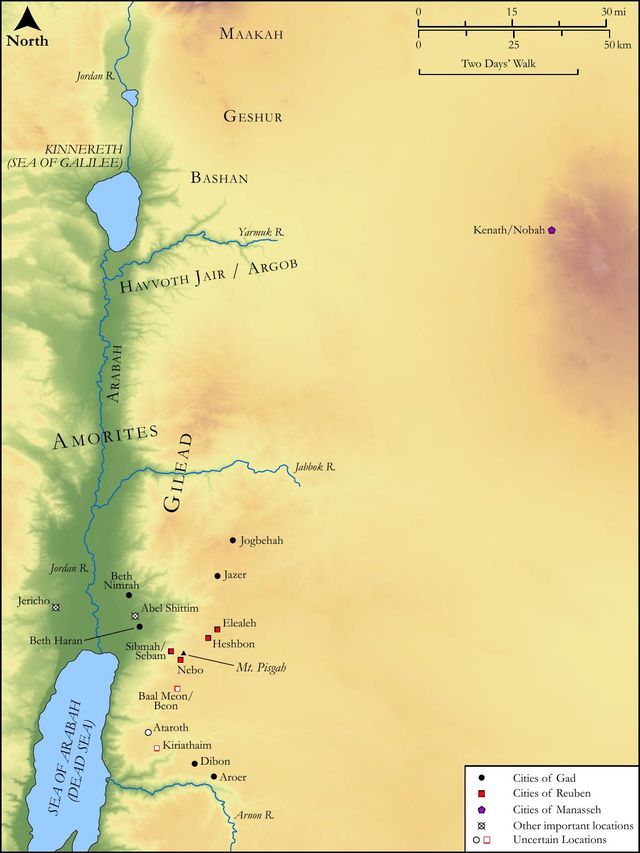
See on the biblical-era map
Study this verse
Continue studying Numbers 32:29 across the web’s major study libraries — every link below opens this exact verse, chapter, or book on the destination site.
Read & Compare
 BibleGatewayThis verse in more than 200 translations and 70 languages.
 Bible.comThe YouVersion reader — hundreds of translations, reading plans, and highlights.
 ESV.orgCrossway's official English Standard Version reader.
 NET BibleThe NET translation with 60,000+ translators' notes on every rendering decision.
 STEP BibleTyndale House's free study tool — original text, vocabulary, and scholarly resources.
 BibliaLogos Bible Software's free web reader.
 USCCBThe New American Bible (Revised Edition) with the U.S. bishops' study notes.
Commentaries
 BibleHub CommentariesDozens of classic commentaries on this verse, gathered on one page.
 StudyLightMore than 100 commentary sets — the largest collection on the web.
 BibleRefPlain-English commentary on what this verse means, verse by verse.
 Enduring WordDavid Guzik's free commentary on this chapter, widely used by Bible teachers.
 Bible Study ToolsVerse commentary alongside Greek and Hebrew study aids.
Original Language & Research
- BibleHub InterlinearThe verse word by word — original language, transliteration, and English.
- BibleHub LexiconEvery word's original-language definition and Strong's entry.
 Blue Letter BibleDeep-study tools — Strong's numbers, concordance, and word studies.
 SefariaThe Hebrew text with Rashi and centuries of Jewish commentary.
Sermons, Hymns & Audio


TrulyRandomVerse is not affiliated with these sites and doesn’t control their content. They’re linked because they’re genuinely useful.
Summary
Numbers 32:29 records Moses' definitive agreement with the tribes of Gad and Reuben, establishing the precise conditions under which they would receive their desired inheritance in the fertile lands of Gilead, east of the Jordan River. This pivotal verse stipulates that their fighting men must cross the Jordan fully armed and participate alongside the other Israelite tribes in the conquest of Canaan, serving "before the LORD" until the land is completely subdued. Only then would they be permitted to return and claim their promised possession, underscoring principles of communal responsibility, unwavering commitment, and divine oversight in the fulfillment of God's covenant promises to His people.
Context
ShowHideLiterary Context
Numbers 32:29 is situated within a critical and tense negotiation between Moses and the tribes of Gad and Reuben. The narrative begins with their initial request to settle in the rich pasturelands east of the Jordan, suitable for their extensive livestock (Numbers 32:1-5). Moses' immediate reaction is one of stern rebuke, fearing their desire for immediate settlement would mirror the faithless rebellion of the previous generation at Kadesh-Barnea, which resulted in forty years of wilderness wandering (Numbers 32:6-15). The tribes then propose a crucial compromise: their armed men would go ahead of the other tribes, assist diligently in the conquest of Canaan, and only return to their eastern inheritance once the land was fully subdued (Numbers 32:16-19). Verses 20-27 detail Moses' acceptance of this conditional arrangement, emphasizing the communal responsibility and the severe consequences of failing to uphold their pledge. Numbers 32:29, therefore, serves as the formal articulation of this covenant, reiterating the terms and the divine witness to the agreement, setting the stage for its eventual fulfillment later in the book of Joshua.
Historical & Cultural Context
The setting for this negotiation is the plains of Moab, on the eastern side of the Jordan River, with the Israelites poised to enter the Promised Land after four decades of wilderness wandering. The tribes of Gad and Reuben, along with half of Manasseh (mentioned later in the chapter), possessed significant herds of livestock, making the fertile, well-watered regions of Gilead and Bashan (east of the Jordan) particularly attractive for their pastoral economy. Tribal land inheritance was not merely an economic arrangement but a foundational aspect of Israelite identity and societal structure, directly tied to God's covenant promises to Abraham, Isaac, and Jacob. Moses' initial apprehension was deeply rooted in the traumatic national memory of the rebellion at Kadesh-Barnea (Numbers 13-14), where the people's lack of faith and refusal to enter Canaan led to a forty-year delay and the death of an entire generation. The phrase "before the LORD" was a significant cultural and theological marker, indicating that an oath, covenant, or agreement was made in the immediate presence of God, making it a sacred and binding commitment with profound divine implications for faithfulness and judgment.
Key Themes
ShowHideThis verse powerfully encapsulates several key themes central to the book of Numbers and the broader Pentateuch. First, Conditional Blessing and Covenant Faithfulness is paramount; the tribes' inheritance is explicitly contingent upon their active participation in the national conquest. This aligns with the broader Deuteronomic principle that blessings are tied to obedience and curses to disobedience, a theme extensively elaborated upon in Deuteronomy 28. Second, Corporate Solidarity and Unity of Purpose is highlighted. Despite their distinct tribal interests and desire for specific land, Gad and Reuben were required to prioritize the collective good of the entire nation, demonstrating that individual blessing is often intertwined with communal responsibility. This echoes the call for unity found throughout Israel's history, from the wilderness journey to the establishment of the monarchy. Third, the principle of Service Before Reward is vividly illustrated. Their personal gain (the land of Gilead) was deferred and made conditional upon their selfless contribution to the entire nation's mission. Finally, Divine Oversight and Accountability is emphasized by the phrase "before the LORD," signifying that this was not merely a human pact but a sacred oath, implying that God Himself was witness and would hold them accountable for their commitment, as Moses later warns in Numbers 32:23, "be sure your sin will find you out."
Exposition and Analysis
ShowHideKey Word Analysis
ShowHideThis word (H1121), translated as "children" in the KJV, literally means "a son (as a builder of the family name), in the widest sense (of literal and figurative relationship, including grandson, subject, nation, quality or condition, etc.)." In this context, it refers to the descendants and members of the tribes of Gad and Reuben, emphasizing their tribal identity and collective responsibility as "sons" of their respective patriarchs and, by extension, of Israel.
This primitive root (H2502) means "to pull off; hence (intensively) to strip, (reflex.) to depart; by implication, to deliver, equip (for fight); present, strengthen." When used in the context of battle, it signifies being "equipped" or "prepared" for military service. It conveys a readiness for active combat, implying a full commitment to the fight, not merely carrying weapons but being organized and dedicated as vanguard troops.
This word (H6440), often translated as "before" or "presence," comes from a root meaning "the face (as the part that turns)." It is used in a great variety of applications, literally and figuratively, often with a prepositional prefix to mean "before," "in the presence of," or "in the sight of." When combined with "the LORD," it signifies that the agreement or action is taking place in the immediate, watchful presence of God, elevating the human pact to a sacred covenant with divine witness and implications for accountability.
Verse Breakdown
ShowHide"And Moses said unto them,"
This introductory clause establishes Moses as the authoritative speaker, acting as God's mediator and the leader of Israel. It signals the formal declaration of the terms, confirming his acceptance of the tribes' proposal after their earlier negotiation and setting the stage for a binding covenant.
"If the children of Gad and the children of Reuben will pass with you over Jordan, every man armed to battle, before the LORD,"
This is the protasis (the "if" clause) of the conditional covenant, laying out the precise conditions for their inheritance. "Pass with you over Jordan" signifies their full participation in the crossing and the subsequent conquest. "Every man armed to battle" emphasizes the military commitment of their entire fighting force, ready for active combat. "Before the LORD" adds the divine witness and sacredness to their oath, indicating that this is a solemn, divinely observed commitment.
"and the land shall be subdued before you;"
This clause further specifies the duration and extent of their commitment. Their service is not merely to cross over, but to remain engaged in the conquest until the land of Canaan is fully "subdued" – conquered and brought under Israelite control. This highlights the comprehensive and unwavering nature of their obligation to the national mission.
"then ye shall give them the land of Gilead for a possession:"
This is the apodosis (the "then" clause), stating the consequence or reward for fulfilling the conditions. Only upon the complete fulfillment of their military obligation would their desired inheritance in Gilead be formally granted to them as a permanent possession. This clearly links blessing and the fulfillment of promises to obedient, communal service.
Literary Devices
ShowHideNumbers 32:29 employs several potent literary devices that enhance its meaning and impact. The most prominent is Conditional Covenant, where the promise of inheritance is explicitly tied to the fulfillment of specific actions. This structure underscores the legal and theological framework of divine-human interaction in the Old Testament, where blessings are contingent upon obedience and faithfulness. The phrase "before the LORD" functions as Divine Witness, imbuing the human agreement with sacred authority and elevating it to a solemn oath. This phrase also introduces an element of Theological Foreshadowing, as it implicitly warns of divine judgment should the tribes fail to uphold their end of the bargain, a theme explicitly stated by Moses later in the chapter. There is also an element of Narrative Foreshadowing, as this agreement sets up the future events in the book of Joshua, where the tribes of Gad, Reuben, and half-Manasseh indeed fulfill their promise and are later sent back to their inheritance (Joshua 22). The entire negotiation and its outcome serve as a Microcosm of Israel's larger covenant relationship with God: blessings are promised, but they require faithful participation and adherence to divine commands.
Theological and Thematic Connections
ShowHideNumbers 32:29 serves as a profound theological statement on the nature of covenant, corporate responsibility, and the interplay of divine promise and human obedience. It teaches that while God's promises are sure, their full realization often involves human participation, commitment, and a willingness to prioritize the collective good over immediate personal gratification. The agreement with Gad and Reuben illustrates that true faith is not passive reception but active engagement in God's redemptive purposes. It underscores the principle that blessings, particularly in the context of the Promised Land, are not merely entitlements but are often contingent upon faithful service and solidarity within the community of faith. This passage challenges us to consider our own commitments, not just to God, but to the body of Christ, recognizing that our individual blessings are often interwoven with our contribution to the larger Kingdom work.
Reflection and Application
ShowHideNumbers 32:29 offers powerful lessons for contemporary believers, challenging us to examine the nature of our commitment to God and to the community of faith. Just as the tribes of Gad and Reuben had to delay their personal gratification and actively participate in the national struggle before enjoying their individual inheritance, we are called to prioritize the advancement of God's Kingdom and serve the broader body of Christ before focusing solely on personal desires or comforts. This verse vividly illustrates that true discipleship often involves a willingness to put the common good ahead of immediate convenience, to fulfill our promises, and to contribute actively to the spiritual battles faced by the church. It reminds us that our blessings are often tied to our faithfulness in service and our solidarity with fellow believers. This passage compels us to ask: What promises have we made, implicitly or explicitly, to God or to our community, that require our active, even sacrificial, participation? Are we truly "armed to battle" for the Lord, or are we seeking our "possession" without contributing to the "subduing of the land"?
Questions for Reflection
ShowHideFAQ
ShowHideWhy was Moses initially so hesitant about the tribes of Gad and Reuben settling east of the Jordan?
ShowHideMoses' initial hesitation stemmed from a deep-seated fear that their request would discourage the rest of the Israelites from entering and conquering Canaan, echoing the catastrophic failure at Kadesh-Barnea. Forty years prior, after the spies gave a negative report, the entire generation rebelled against God's command to enter the land, leading to God's judgment of forty years of wandering in the wilderness (see Numbers 14:1-35). Moses was concerned that if two tribes opted out of the conquest, it would create a precedent of fear and disunity, undermining the entire national mission and potentially provoking God's wrath again. Their subsequent proposal to fight alongside their brethren alleviated this concern, demonstrating their commitment to the corporate mission.
Did the tribes of Gad and Reuben (and half-Manasseh) actually fulfill their promise to fight in Canaan?
ShowHideYes, they did. The book of Joshua records their faithful fulfillment of this commitment. After the conquest of Canaan was largely complete, Joshua commended them for their obedience and sent them back to their inheritance east of the Jordan. Joshua 22:1-6 recounts Joshua's words to them, acknowledging that they had "kept all that Moses the servant of the LORD commanded you, and have obeyed my voice in all that I commanded you." This historical fulfillment underscores the importance of keeping one's word, especially when given "before the LORD."
What is the significance of the phrase "before the LORD" in this context?
ShowHideThe phrase "before the LORD" (Hebrew: lifnei Adonai) is profoundly significant. It elevates the agreement from a mere human contract to a sacred covenant made in God's presence. It means that God Himself is the witness to their promise and the guarantor of its terms. This imbues the commitment with solemnity and makes it binding in a divine sense. It implies that unfaithfulness would not merely be a breach of human trust but an offense against God Himself, as Moses warns in Numbers 32:23, "But if ye will not do so, behold, ye have sinned against the LORD: and be sure your sin will find you out." It underscores the accountability that comes with making promises in God's sight and highlights the sacred nature of their pledge.
Christ-Centered Fulfillment
ShowHideNumbers 32:29, with its emphasis on conditional inheritance, corporate responsibility, and service before reward, finds its ultimate fulfillment and reinterpretation in Christ. While the tribes of Gad and Reuben had to earn their physical inheritance through military service, believers receive their spiritual inheritance in Christ not by works, but by grace through faith (see Ephesians 2:8-9). Yet, this unearned inheritance does not negate the call to active participation and selfless service. Just as the eastern tribes fought "before the LORD" for the good of all Israel, Christ Himself exemplified ultimate obedience and service, humbling Himself to the point of death on a cross (as described in Philippians 2:5-8), thereby subduing the powers of sin and death and securing our eternal possession. We, as co-heirs with Christ (see Romans 8:17), are called not to earn our salvation, but to live out of it, actively engaging in the spiritual battle against evil and participating in the expansion of His Kingdom. Our "land of Gilead" is the spiritual rest and abundant life found in Him, but it is also the mission field where we are "armed to battle" for the glory of God, serving others and advancing the gospel until the "land" of the world is subdued before our King (see Matthew 28:18-20).