


Numbers 32:28
Bible text: King James Version (1769 Blayney text) · Public domain
Bible text: King James Version with Strong's numbers · Public domain
Bible text: Berean Standard Bible · Public domain
Bible text: American Standard Version (1901) · Public domain
Bible text: World English Bible, Messianic edition · Public domain
Bible text: Geneva Bible (1599) · Public domain
Bible text: Young's Literal Translation · Public domain
- וַיְצַוvay·Tzavand he commandedH6680Conj-w ¦ V-Piel-ConsecImperf-3msVerb Piel Consecutive Imperfect 3rd Singular Masculineוַandיְצַוhe commanded
- לָהֶםla·Hemof <the> themPrep-l ¦ 3mpSuffix Personal 3rd Plural Masculineלָof <the>הֶםthem
- מֹשֶׁהmo·ShehMosesH4872N-proper-mNoun Proper Masculine
- אֵת'et<obj.>H853DirObjMParticle Object Indicator
- אֶלְעָזָר'el·'a·ZarEleazarH499N-proper-mNoun Proper Masculine
- הַכֹּהֵןha·ko·Henthe priestH3548Art ¦ N-msNoun Singular Masculine Absoluteהַtheכֹּהֵןpriest
- וְאֵתve·'Etand <obj.>H853Conj-w ¦ DirObjMParticle Object Indicatorוְandאֵת<obj.>
- יְהוֹשֻׁעַye·ho·Shu·a'JoshuaH3091N-proper-mNoun Proper Masculine
- בִּןbin[the] son ofH1121N-mscNoun Singular Masculine Construct
- נוּןNunNunH5126N-proper-mNoun Proper Masculine
- וְאֶתve·'Etand <obj.>H853Conj-w ¦ DirObjMParticle Object Indicatorוְandאֶת<obj.>
- רָאשֵׁיra·Shei[the] leaders ofH7218N-mpcNoun Plural Masculine Construct
- אֲבוֹת'a·Vot[the] fathers ofH1N-fpcNoun Plural Feminine Construct
- הַמַּטּוֹתha·ma·Totthe tribesH4294Art ¦ N-fpNoun Plural Feminine Absoluteהַtheמַּטּוֹתtribes
- לִבְנֵיliv·Neiof [the] people ofH1121Prep-l ¦ N-mpcNoun Plural Masculine Constructלִofבְנֵי[the] people of
- יִשְׂרָאֵלYis·ra·'ElIsraelH3478N-properNoun Proper Location
English is a literal word-by-word gloss of the Hebrew, not the KJV's wording. Why?
This is the original text the KJV's translators worked from — each Hebrew word with its own literal English meaning in this verse, prepared by scholars at Tyndale House, Cambridge. The KJV translates whole sentences, not word by word, so its wording differs: one Hebrew word can become several English words, and the KJV may choose “the LORD” where the gloss reads “Yahweh”. Both are faithful — they answer different questions. For the KJV's own rendering, switch to the KJV text.
Details
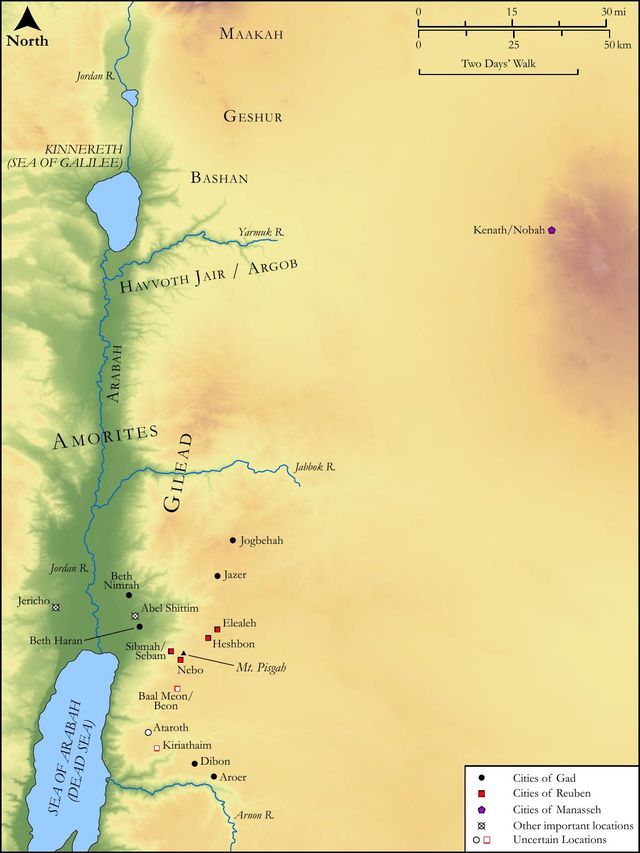
See on the biblical-era map
Study this verse
Continue studying Numbers 32:28 across the web’s major study libraries — every link below opens this exact verse, chapter, or book on the destination site.
Read & Compare
 BibleGatewayThis verse in more than 200 translations and 70 languages.
 Bible.comThe YouVersion reader — hundreds of translations, reading plans, and highlights.
 ESV.orgCrossway's official English Standard Version reader.
 NET BibleThe NET translation with 60,000+ translators' notes on every rendering decision.
 STEP BibleTyndale House's free study tool — original text, vocabulary, and scholarly resources.
 BibliaLogos Bible Software's free web reader.
 USCCBThe New American Bible (Revised Edition) with the U.S. bishops' study notes.
Commentaries
 BibleHub CommentariesDozens of classic commentaries on this verse, gathered on one page.
 StudyLightMore than 100 commentary sets — the largest collection on the web.
 BibleRefPlain-English commentary on what this verse means, verse by verse.
 Enduring WordDavid Guzik's free commentary on this chapter, widely used by Bible teachers.
 Bible Study ToolsVerse commentary alongside Greek and Hebrew study aids.
Original Language & Research
- BibleHub InterlinearThe verse word by word — original language, transliteration, and English.
- BibleHub LexiconEvery word's original-language definition and Strong's entry.
 Blue Letter BibleDeep-study tools — Strong's numbers, concordance, and word studies.
 SefariaThe Hebrew text with Rashi and centuries of Jewish commentary.
Sermons, Hymns & Audio


TrulyRandomVerse is not affiliated with these sites and doesn’t control their content. They’re linked because they’re genuinely useful.
Summary
Numbers 32:28 records Moses' authoritative delegation of responsibility to Eleazar the priest, Joshua the son of Nun, and the chief fathers of the Israelite tribes. This command formalizes the agreement made with the Transjordanian tribes of Reuben, Gad, and half-Manasseh, obligating them to participate in the conquest of Canaan before settling in their requested territories east of the Jordan. Moses' action underscores the critical importance of covenant integrity, national unity, and shared leadership as Israel stands poised to enter the Promised Land, ensuring accountability for a promise vital to the nation's future.
Context
ShowHideLiterary Context
Numbers 32 is situated at a crucial juncture in Israel's journey, immediately prior to their entry into the Promised Land. The chapter details the request by the tribes of Reuben and Gad, joined by half the tribe of Manasseh, to inherit land on the eastern side of the Jordan River, citing its suitability for their large herds. Moses initially reacts with strong apprehension, fearing a repetition of the faithless rebellion at Kadesh-Barnea that led to forty years of wandering, as recounted in Numbers 14. However, after the Transjordanian tribes commit to sending their armed men to fight alongside the other tribes until the entire land of Canaan is subdued, Moses agrees. Numbers 32:20-27 lays out the specific conditions of this agreement. Verse 28 then serves as the formal, public pronouncement of this charge, a crucial act of leadership and administrative foresight by Moses as he prepares for his impending death and the transfer of leadership to Joshua. This delegation ensures the covenant's enforcement and the nation's unified pursuit of God's promise.
Historical & Cultural Context
The Israelites are at the cusp of a new era, having completed their wilderness wanderings and preparing to cross the Jordan into Canaan. Moses, the revered leader and mediator of the covenant, is nearing the end of his life, making the issue of succession and the continuity of national purpose paramount. The request from the Transjordanian tribes, while practical for their pastoral economy, also presented a significant challenge to the unity and collective mission of Israel. In Israel, oaths and covenants were profoundly binding, often invoked with the LORD as witness and carrying severe consequences for breach. The "chief fathers" (heads of ancestral houses) played a vital role in tribal governance, judicial matters, and military organization, reflecting the patriarchal structure of Israelite society. Moses' command, therefore, is not merely an administrative directive but a solemn charge rooted in the covenantal relationship between Yahweh and Israel, emphasizing the sanctity of promises and the collective responsibility for fulfilling God's will for the land.
Key Themes
ShowHideNumbers 32:28 powerfully contributes to several overarching themes within the Pentateuch. The theme of Leadership Transition and Succession is central, as Moses formally prepares for his departure by entrusting the future leaders—Eleazar and Joshua—with a critical responsibility, a process further detailed in Deuteronomy 31. This highlights divine provision for continuity in leadership. Covenant Faithfulness and Integrity is another prominent theme, emphasizing the sanctity of promises made, both between God and Israel, and among the Israelites themselves. The agreement with the Transjordanian tribes tests their commitment to the national cause, reflecting the broader call to obedience and integrity found throughout the Law. Furthermore, the verse underscores Corporate Responsibility and Accountability, demonstrating that the burden of governance and the upholding of national commitments rests not solely on a single leader, but on a collective body comprising religious, military, and tribal authorities. This shared accountability ensures the unity and resilience of the community in pursuing God's purposes, as seen in the later account of the Transjordanian tribes fulfilling their pledge in Joshua 22.
Exposition and Analysis
ShowHideKey Word Analysis
ShowHideThis verb (H6680) is a primitive root meaning "to constitute, enjoin." It signifies an authoritative directive, a solemn injunction, or a binding order. Its use here conveys more than a mere suggestion; it carries the full weight of a legal or covenantal obligation, implying a non-negotiable instruction that demands obedience. Moses' use of this term underscores the gravity with which he viewed the agreement with the Transjordanian tribes and the solemnity of the charge given to the leaders responsible for its enforcement.
This name (H499) is derived from two Hebrew words meaning "God (is) helper." Eleazar, Aaron's son, succeeded his father as High Priest. His inclusion in this command highlights the sacred and spiritual dimension of the agreement, placing its oversight under the highest religious authority, emphasizing that the keeping of this promise was not just a military or administrative matter but a spiritual obligation before God.
This word (H7218) comes from an unused root meaning "to shake," referring to "the head (as most easily shaken)." Figuratively, it denotes the head in terms of rank, position, or leadership. Here, it signifies the "chief" or "head" of the fathers, indicating those who hold the principal or leading position within their respective ancestral houses or tribes. Their inclusion underscores the comprehensive nature of Moses' delegation, involving the foundational social and political authorities alongside religious and military leaders.
Verse Breakdown
ShowHide"¶ So concerning them Moses commanded Eleazar the priest"
This clause initiates the formal delegation of authority, clearly identifying the subject of the command ("them" referring to the Transjordanian tribes) and the first recipient of the charge. Moses, acting as God's appointed leader and mediator, issues a definitive instruction to Eleazar. As the High Priest, Eleazar represents the spiritual and religious authority of the nation, indicating the sacred and covenantal nature of the agreement and the priestly role in ensuring its fulfillment.
"and Joshua the son of Nun"
Joshua is presented as the second key recipient of Moses' command. He is explicitly identified by his lineage, "the son of Nun," emphasizing his identity as Moses' chosen successor in military and political leadership. By including Joshua, Moses ensures that the future military campaigns and the overall governance of Israel will be conducted with full awareness and enforcement of the agreement made with the Transjordanian tribes, highlighting the practical and strategic importance of their commitment to the conquest of Canaan.
"and the chief fathers of the tribes of the children of Israel"
This final part of the list broadens the scope of responsibility to include the collective leadership of the entire Israelite community. The "chief fathers" were the heads of the ancestral clans, representing the tribal structure and local authority. Their inclusion signifies that the responsibility for upholding the agreement was not solely on the high priest or the military leader, but on the entire leadership body, ensuring communal accountability and participation in this vital national undertaking.
Literary Devices
ShowHideThe verse primarily employs Enumeration by explicitly listing the three distinct categories of leaders entrusted with the command: Eleazar the priest, Joshua the son of Nun, and the chief fathers of the tribes. This precise listing serves to clearly define the chain of command and the shared responsibility for the covenant's fulfillment, leaving no ambiguity as to who is accountable. The use of Authoritative Language is evident in the verb "commanded" (tsâvâh), which conveys the solemnity and binding nature of Moses' directive, reinforcing the importance of the agreement as a non-negotiable obligation. Furthermore, the verse functions as a pivotal moment of Transition and Delegation, marking a critical point in Moses' leadership as he prepares for his succession, formally passing on crucial responsibilities to the next generation of leaders. This act of delegation is a literary foreshadowing of the leadership transfer that will fully unfold in the subsequent books of the Pentateuch and Joshua.
Theological and Thematic Connections
ShowHideNumbers 32:28 encapsulates profound theological principles related to divine order, human responsibility, and the nature of covenant. Moses' command underscores the importance of integrity in promises made, reflecting God's own faithfulness to His covenant with Israel. The delegation of authority to Eleazar, Joshua, and the tribal elders demonstrates God's design for distributed leadership and accountability within His people, ensuring that the burden of upholding national commitments is shared. This structure reflects the principle that the entire community, through its representatives, is responsible for adhering to the divine will and maintaining unity in purpose, particularly concerning the fulfillment of God's promises regarding the land. This shared responsibility is vital for the corporate witness and mission of God's people.
Reflection and Application
ShowHideThis verse offers timeless insights into the dynamics of leadership, accountability, and community integrity. Moses' foresight in formally delegating this crucial responsibility before his departure serves as a powerful model for effective succession planning in any organization, particularly within the church. It reminds us that true leadership involves not just exercising authority but also empowering others and ensuring continuity of mission through clear instruction and shared burden. For believers today, the emphasis on fulfilling promises made, especially those before God and community, speaks directly to our personal integrity and the health of our relationships. Whether it's a commitment to a spiritual discipline, a promise to a fellow believer, or a covenant within marriage or ministry, our word must be trustworthy. Furthermore, the shared responsibility among diverse leaders—spiritual, administrative, and communal—highlights the strength found in collaborative governance and mutual accountability, fostering a resilient and unified body capable of pursuing God's purposes effectively.
Questions for Reflection
ShowHideFAQ
ShowHideWhy was Moses so concerned about the Transjordanian tribes settling east of the Jordan?
ShowHideMoses' initial concern stemmed from the potential for discouragement and division within the Israelite community. He feared that if these tribes settled outside the main Promised Land before its conquest, it would demoralize the rest of the Israelites, causing them to lose heart and repeat the sin of their fathers at Kadesh-Barnea, where they refused to enter the land due to fear and unbelief, as detailed in Numbers 14:1-45. This could jeopardize the entire divine plan for Israel to inherit the land promised by God. His concern was for the unity, spiritual resolve, and corporate obedience of the nation to fulfill its God-given destiny.
Who were "the chief fathers of the tribes of the children of Israel" and what was their role?
ShowHideThe "chief fathers" (Hebrew: rashei avot) were the heads of the ancestral houses or clans within each tribe of Israel. They were significant patriarchal figures who held considerable authority and influence in the social, judicial, and administrative affairs of their respective tribes. Their role was to represent their clans, participate in tribal decisions, and ensure the well-being and order of their people. By including them in this command, Moses ensured that the agreement with the Transjordanian tribes had the full backing and oversight of the foundational leadership structure of all Israel, ensuring broad communal accountability and the integration of the agreement into the fabric of Israelite society.
Christ-Centered Fulfillment
ShowHideNumbers 32:28, while seemingly an administrative detail concerning ancient Israelite leadership, subtly points to the broader biblical narrative of God's faithfulness to His covenant and the ultimate leadership of Christ. Moses' act of delegating authority to Eleazar, Joshua, and the tribal elders foreshadows the comprehensive and multi-faceted leadership that Christ embodies and establishes in His church. Just as Moses, the great lawgiver, entrusted the continuity of the covenant and the pursuit of the promised land to a collective leadership, so Christ, the greater Moses, has commissioned His disciples to carry forward His mission. He is the ultimate High Priest, superior to Eleazar, who perfectly intercedes for His people and ensures the fulfillment of God's promises through His eternal sacrifice (Hebrews 4:14-16). He is also the greater Joshua, leading His people into their true spiritual inheritance, not a physical land, but the kingdom of God and eternal life found in Him (Hebrews 4:8-10). Furthermore, Christ empowers His church, a new "Israel," with diverse leadership gifts (apostles, prophets, evangelists, pastors, teachers) to equip the saints for ministry and build up the body of Christ until we all reach unity in the faith (Ephesians 4:11-13). The integrity and faithfulness demanded in Numbers 32:28 find their ultimate perfection in Christ, who perfectly fulfilled all covenant obligations and whose word is eternally trustworthy. His commission to His followers, the Great Commission, is the ultimate delegation, ensuring His global mission is carried out until His return (Matthew 28:18-20).