


Numbers 32:30
Bible text: King James Version (1769 Blayney text) · Public domain
Bible text: Berean Standard Bible · Public domain
Bible text: American Standard Version (1901) · Public domain
Bible text: World English Bible, Messianic edition · Public domain
Bible text: Geneva Bible (1599) · Public domain
Bible text: Young's Literal Translation · Public domain
- וְאִםve·'imand ifH518Conj-w ¦ PrtParticle Conditionalוְandאִםif
- לֹאlo'notH3808NegParticle Negative
- יַעַבְרוּya·'av·Ruthey will pass overH5674V-Qal-Imperf-3mpVerb Qal Imperfect 3rd Plural Masculine
- חֲלוּצִיםcha·lu·TzimequippedH2502V-Qal-PassPrtcpl-mpVerb Qal Participle Passive Plural Masculine Absolute
- אִתְּכֶם'i·te·Khemwith youH854Prep ¦ 2mpPreposition Definiteאִתְּwithכֶםyou
- וְנֹאחֲזוּve·no·cha·Zuand they will have possessionsH270Conj-w ¦ V-Niphal-ConsecPerf-3cpVerb Niphal Consecutive Perfect 3rd Plural common genderוְandנֹאחֲזוּthey will have possessions
- בְתֹכְכֶםve·to·khe·Khemin midst of youH8432Prep-b ¦ N-msc ¦ 2mpNoun Singular Masculine Constructבְinתֹכְmidst ofכֶםyou
- בְּאֶרֶץbe·'E·retzin [the] land ofH776Prep-b ¦ N-fscNoun Singular Feminine Constructבְּinאֶרֶץ[the] land of
- כְּנָעַןke·Na·'anCanaanH3667N-properNoun Proper Location
English is a literal word-by-word gloss of the Hebrew, not the KJV's wording. Why?
This is the original text the KJV's translators worked from — each Hebrew word with its own literal English meaning in this verse, prepared by scholars at Tyndale House, Cambridge. The KJV translates whole sentences, not word by word, so its wording differs: one Hebrew word can become several English words, and the KJV may choose “the LORD” where the gloss reads “Yahweh”. Both are faithful — they answer different questions. For the KJV's own rendering, switch to the KJV text.
Details
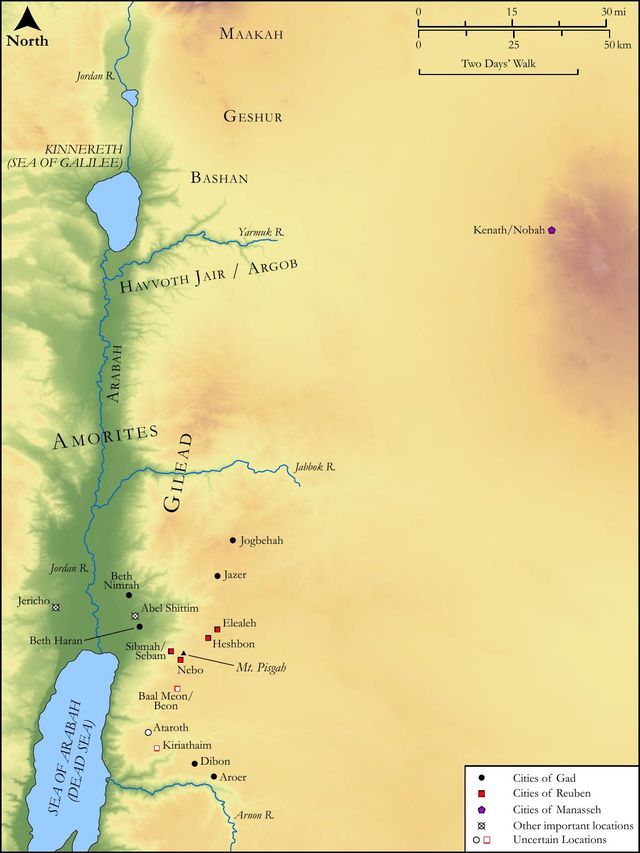
See on the biblical-era map
Study this verse
Continue studying Numbers 32:30 across the web’s major study libraries — every link below opens this exact verse, chapter, or book on the destination site.
Read & Compare
 BibleGatewayThis verse in more than 200 translations and 70 languages.
 Bible.comThe YouVersion reader — hundreds of translations, reading plans, and highlights.
 ESV.orgCrossway's official English Standard Version reader.
 NET BibleThe NET translation with 60,000+ translators' notes on every rendering decision.
 STEP BibleTyndale House's free study tool — original text, vocabulary, and scholarly resources.
 BibliaLogos Bible Software's free web reader.
 USCCBThe New American Bible (Revised Edition) with the U.S. bishops' study notes.
Commentaries
 BibleHub CommentariesDozens of classic commentaries on this verse, gathered on one page.
 StudyLightMore than 100 commentary sets — the largest collection on the web.
 BibleRefPlain-English commentary on what this verse means, verse by verse.
 Enduring WordDavid Guzik's free commentary on this chapter, widely used by Bible teachers.
 Bible Study ToolsVerse commentary alongside Greek and Hebrew study aids.
Original Language & Research
- BibleHub InterlinearThe verse word by word — original language, transliteration, and English.
- BibleHub LexiconEvery word's original-language definition and Strong's entry.
 Blue Letter BibleDeep-study tools — Strong's numbers, concordance, and word studies.
 SefariaThe Hebrew text with Rashi and centuries of Jewish commentary.
Sermons, Hymns & Audio


TrulyRandomVerse is not affiliated with these sites and doesn’t control their content. They’re linked because they’re genuinely useful.
Summary
Numbers 32:30 articulates Moses' firm decree to the tribes of Reuben and Gad, and the half-tribe of Manasseh, concerning their request to settle east of the Jordan River. It sets forth a critical condition: if they fail to fulfill their solemn pledge to cross over the Jordan fully armed and lead the conquest of Canaan, they will forfeit their desired Transjordanian inheritance. Instead, they will be compelled to receive their land portion within Canaan proper, alongside the other Israelite tribes. This verse powerfully underscores the severe consequences of reneging on a communal covenant and highlights the foundational principle of shared responsibility and corporate integrity in the divine mission to possess the Promised Land.
Context
ShowHideLiterary Context
Numbers 32:30 stands as the culminating conditional clause in Moses' negotiation with the tribes of Reuben, Gad, and the half-tribe of Manasseh. These tribes, possessing extensive livestock, recognized the suitability of the fertile lands of Gilead and Bashan east of the Jordan for their herds and requested to settle there, rather than crossing into Canaan. Moses initially reacted with sharp rebuke, fearing a repeat of the faithless rebellion that followed the spies' report (compare with Numbers 14:1-4). However, the tribes clarified their intent, promising to build fortified cities for their families and folds but then to go "armed before the children of Israel, until we have brought them unto their place" (Numbers 32:17). Moses, having received this solemn pledge, outlines the terms of the agreement. Verse 29 details the positive outcome if they fulfill their promise, granting them their desired land. Verse 30, then, starkly presents the negative consequence if they fail, emphasizing the gravity of their commitment and the imperative of corporate unity as Israel prepared to enter the Promised Land.
Historical & Cultural Context
In Israel, land ownership was inextricably linked to identity, security, and divine blessing. For Israel, a people transitioning from nomadic life to settled existence, the possession of the Promised Land was a foundational aspect of their covenant with Yahweh. The Jordan River served as a significant geographical and symbolic boundary, separating the wilderness from the land of promise. Military conquest was a recognized and often necessary means of establishing dominion and securing territory in this period. The concept of tribal solidarity was paramount; the success of the entire nation depended on collective effort and adherence to shared responsibilities. Furthermore, oaths and covenants were binding, carrying severe social and divine repercussions if broken. Moses' concern in this passage reflects the historical memory of past failures and the understanding that shirking military duty could undermine the entire national enterprise of settling Canaan, a task divinely mandated by God (Deuteronomy 1:8).
Key Themes
ShowHideNumbers 32:30 powerfully contributes to several key themes within the book of Numbers and the broader Pentateuch. Firstly, it underscores the theme of conditional covenant and obedience. While God's overarching promise of the land to Israel was unconditional (e.g., Genesis 12:7), the enjoyment and possession of that land by specific tribes or individuals were often contingent upon their faithfulness and obedience to God's commands and communal agreements. Secondly, it highlights corporate responsibility and unity. The conquest of Canaan was not a fragmented tribal endeavor but a unified national mission. The actions of one tribe had implications for the entire community, emphasizing the interconnectedness of God's people. Thirdly, the verse illustrates the consequences of disobedience and unfaithfulness. Moses' warning serves as a reminder that failing to uphold one's commitments, especially those made before God and the community, leads to undesirable and often punitive outcomes. This principle of cause and effect based on human action is a recurring motif throughout the Mosaic Law (e.g., Deuteronomy 28).
Exposition and Analysis
ShowHideKey Word Analysis
ShowHideA primitive root meaning "to pull off; hence (intensively) to strip, (reflex.) to depart; by implication, to deliver, equip (for fight); present, strengthen; arm (self), (go, ready) armed ([idiom] man, soldier), deliver, draw out, make fat, loose, (ready) prepared, put off, take away, withdraw self." In this context, châlats specifically refers to being "equipped for fight" or "armed." It signifies not merely a physical presence but a readiness for active military engagement, emphasizing the tribes' commitment to be the vanguard, the prepared fighting force leading the conquest.
A primitive root meaning "to seize (often with the accessory idea of holding in possession); [phrase] be affrighted, bar, (catch, lay, take) hold (back), come upon, fasten, handle, portion, (get, have or take) possess(-ion)." While the KJV translates it as "possessions," the underlying Hebrew root implies the act of "seizing" or "taking hold of" land. This highlights that their inheritance is not a given but must be actively taken, and if they fail in their duty, their "possession" will be a forced, less desirable one within Canaan, rather than their chosen Transjordanian territory.
A primitive root meaning "to cross over; used very widely of any transition (literal or figurative; transitive, intransitive, intensive, causative); specifically, to cover (in copulation); alienate, alter, [idiom] at all, beyond, bring (over, through), carry over, (over-) come (on, over), conduct (over), convey over, current, deliver, do away, enter, escape, fail, gender, get over, (make) go (away, beyond, by, forth, his way, in, on, over, through), have away (more), lay, meddle, overrun, make partition, (cause to, give, make to, over) pass(-age, along, away, beyond, by, -enger, on, out, over, through), (cause to, make) [phrase] proclaim(-amation), perish, provoke to anger, put away, rage, [phrase] raiser of taxes, remove, send over, set apart, [phrase] shave, cause to (make) sound, [idiom] speedily, [idiom] sweet smelling, take (away), (make to) transgress(-or), translate, turn away, (way-) faring man, be wrath." Here, ʻâbar refers to the literal act of crossing the Jordan River, symbolizing the transition from wilderness wandering to the active phase of inheriting the Promised Land. It signifies their physical participation in the conquest, a non-negotiable step for the entire nation.
Verse Breakdown
ShowHide"But if they will not pass over with you armed"
This initial clause establishes the negative condition, serving as a direct counterpoint to the positive scenario presented in the preceding verse (Numbers 32:29). It specifically addresses the tribes of Reuben, Gad, and the half-tribe of Manasseh, outlining their failure to uphold their solemn pledge. The phrase "pass over with you armed" emphasizes not merely their physical crossing of the Jordan, but their active, military participation as the vanguard of the Israelite forces in the conquest of Canaan. A failure to do so would constitute a breach of their covenant with Moses and the rest of the Israelite community, indicating a shirking of their corporate responsibility.
"they shall have possessions among you in the land of Canaan"
This clause articulates the direct and punitive consequence of their failure to fulfill their commitment. Instead of receiving their desired inheritance east of the Jordan, they would be compelled to take their land allotment "among you" (literally, "in your midst") within the main territory of Canaan. This outcome is presented as a less favorable alternative, signifying a loss of their preferred choice and a forced integration into the general land distribution of the other tribes. It implies a potentially smaller, less desirable, or already contested portion of land, certainly not the expansive, fertile pasturelands they initially sought. This consequence underscores the principle that neglecting one's contribution to the common good results in a less advantageous personal outcome, demonstrating the importance of integrity and shared burden within the community.
Literary Devices
ShowHideThe primary literary device employed in Numbers 32:30 is a Conditional Statement, structured as an "if-then" proposition, though the "then" is implied by the direct statement of consequence. The verse, beginning with "But if," clearly sets forth a negative condition (failure to go armed) and its corresponding negative consequence (forced settlement in Canaan). This device underscores the contingency of the tribes' inheritance on their obedience and commitment to the corporate mission. There is also a strong element of Contrast when this verse is read in conjunction with Numbers 32:29. Verse 29 presents the positive outcome of faithfulness, while verse 30 presents the negative outcome of unfaithfulness. This juxtaposition vividly highlights the clear choice before the tribes and the distinct consequences of upholding versus breaking their covenant. Furthermore, the passage employs Foreshadowing, hinting at the enduring importance of tribal unity and the potential for internal strife or divine judgment if covenant obligations are not met—themes that recur throughout Israel's history in the Promised Land.
Theological and Thematic Connections
ShowHideNumbers 32:30 serves as a powerful theological statement on the principle that covenant blessings, particularly the enjoyment of God's promises, are often contingent upon faithful obedience, not only to God's direct commands but also to the mutual agreements made within the community of faith. While God's overarching promise of the land to Israel was ultimately steadfast, the specific enjoyment and distribution of that inheritance were tied to the people's active participation in the divine plan and their adherence to corporate responsibilities. This verse underscores the corporate nature of Israel's identity and mission; no tribe was an isolated entity, and the success of the whole depended on the commitment of each part. It reminds us that shirking responsibility for the common good has tangible, often undesirable, consequences, reinforcing the divine expectation of integrity, shared burden, and unity among God's people.
Reflection and Application
ShowHideNumbers 32:30 offers profound lessons for contemporary believers on the nature of commitment, shared responsibility, and the consequences of our choices within a community. Just as the tribes of Reuben, Gad, and Manasseh were called to contribute actively to the corporate mission of conquering the Promised Land, so too are we, as members of God's new covenant community, called to participate in the advancement of His kingdom. This verse challenges us to examine our own promises—whether made to God, to our families, or to our church communities. Do we honor our word, even when it requires sacrifice or discomfort? Are we willing to bear the burden alongside our brothers and sisters, or do we seek personal advantage at the expense of the collective good? The "possessions among you in the land of Canaan" serves as a stark reminder that neglecting our duties can lead to less desirable outcomes, not only for the community but also for ourselves. True spiritual flourishing often comes through sacrificial service and faithful adherence to our commitments, contributing to the well-being and progress of the entire body of Christ.
Questions for Reflection
ShowHideFAQ
ShowHideWhat was the specific promise made by Reuben, Gad, and the half-tribe of Manasseh?
ShowHideThe tribes promised Moses that they would first build fortified cities for their families and folds in the Transjordan region. Crucially, they then pledged to go "armed before the children of Israel" (Numbers 32:17) and fight alongside the other tribes until the entire land of Canaan was conquered and every tribe had received its inheritance. Only after the completion of this corporate military mission would they return to their chosen land east of the Jordan. This was a solemn commitment to prioritize the national good and the collective divine mandate over their immediate personal settlement.
Why was Moses so concerned about their request to settle east of the Jordan?
ShowHideMoses' initial concern stemmed from the recent, painful history of Israel's rebellion and lack of faith. He feared that the tribes' request signaled a desire to avoid the difficult and dangerous task of conquering Canaan, reminiscent of how the previous generation had refused to enter the land after the spies' negative report, leading to 40 years of wilderness wandering and death for that generation (Numbers 14:1-4). He worried that their withdrawal would discourage the other tribes, undermine national unity, and ultimately jeopardize the entire divinely appointed mission to take possession of the Promised Land. His stern warning in Numbers 32:6-15 reflects this deep-seated fear of repeating past failures and incurring God's wrath.
Christ-Centered Fulfillment
ShowHideNumbers 32:30, with its emphasis on conditional inheritance and corporate responsibility, finds profound Christ-centered fulfillment in the New Covenant. While the Old Testament promise of physical land was conditional upon obedience and participation in a literal conquest, the New Testament speaks of a spiritual inheritance and a spiritual battle. Believers are "heirs of God and fellow heirs with Christ" (Romans 8:17), inheriting eternal life and a place in God's kingdom, not based on our works, but on Christ's perfect obedience and atoning sacrifice. However, just as the tribes were expected to "pass over... armed" and fight for the common good, so too are believers called to active participation in the spiritual warfare and the advancement of God's kingdom. We are not to "shirk" our duties but to "put on the whole armor of God" (Ephesians 6:11) and stand firm in the faith, contending for the gospel. If we fail to live out our calling, not only do we diminish our own spiritual fruitfulness, but we also hinder the collective witness and work of the Church, the body of Christ. The ultimate "possession" for us is not a physical land, but the fullness of life in Christ and the eternal kingdom, which we are called to pursue with diligence and shared commitment, empowered by the Holy Spirit who enables us to fulfill the "law of Christ" by bearing one another's burdens (Galatians 6:2). Our participation in God's mission, though not earning salvation, demonstrates our belonging and our commitment to the One who secured our inheritance.