


Revelation 2:28
Bible text: King James Version (1769 Blayney text) · Public domain
Bible text: Berean Standard Bible · Public domain
Bible text: American Standard Version (1901) · Public domain
Bible text: World English Bible, Messianic edition · Public domain
Bible text: Geneva Bible (1599) · Public domain
Bible text: Young's Literal Translation · Public domain
- καὶkaiAndG2532CONJConjunction
- δώσωdōsōI will giveG1325V-FAI-1SVerb Future Active Indicative 1st Singular
- αὐτῷautōto himG846P-DSMPersonal pronoun Dative Singular Masculine
- τὸνtontheG3588T-ASMDefinite article Accusative Singular Masculine
- ἀστέραasterastarG792N-ASMNoun Accusative Singular Masculine
- τὸνton<the>G3588T-ASMDefinite article Accusative Singular Masculine
- πρωϊνόνprōinonmorningG4407A-ASMAdjective Accusative Singular Masculine
English is a literal word-by-word gloss of the Greek, not the KJV's wording. Why?
This is the original text the KJV's translators worked from — each Greek word with its own literal English meaning in this verse, prepared by scholars at Tyndale House, Cambridge. The KJV translates whole sentences, not word by word, so its wording differs: one Greek word can become several English words, and the KJV may choose “charity” where the gloss reads “love”. Both are faithful — they answer different questions. For the KJV's own rendering, switch to the KJV text.
Details
See on the biblical-era maps

Study this verse
Public-domain commentary
Matthew Henry
From his Commentary on the Whole Bible. Henry comments on passages, not single verses — this entry covers Revelation 2:18–29. His three-level outline is real structure in the source text, so it is rendered as structure.
The form of each epistle is very much the same; and in this, as the rest, we have to consider the inscription, contents, and conclusion.
I.The inscription, telling us,
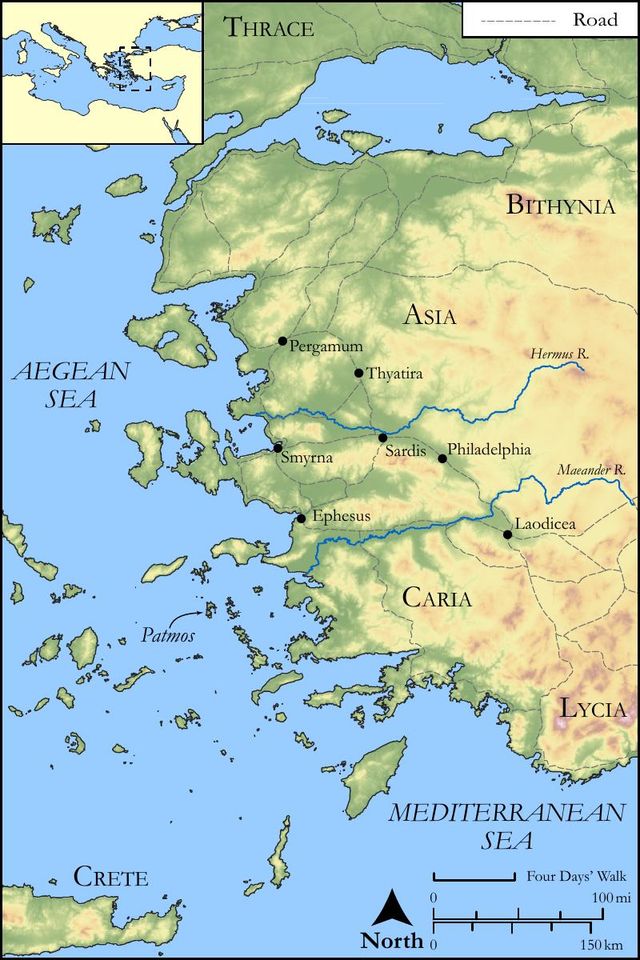
1.To whom it is directed: To the angel of the church of Thyatira, a city of the proconsular Asia, bordering upon Mysia on the north and Lydia on the south, a town of trade, whence came the woman named Lydia, a seller of purple, who, being at Philippi in Macedonia, probably about the business of her calling, heard Paul preach there, and God opened her heart, that she attended to the things that were spoken, and believed, and was baptized, and entertained Paul and Silas there. Whether it was by her means that the gospel was brought into her own city, Thyatira, is not certain; but that it was there, and successful to the forming of a gospel church, this epistle assures us.
2.By whom it was sent: by the Son of God, who is here described as having eyes like a flame of fire, and feet like as fine brass. His general title is here, the Son of God, that is, the eternal and only-begotten Son of God, which denotes that he has the same nature with the Father, but with a distinct and subordinate manner of subsistence. The description we have here of him is in two characters: - (1.) That his eyes are like a flame of fire, signifying his piercing, penetrating, perfect knowledge, a thorough insight into all persons and all things, one who searches the hearts and tries the reins of the children of men (Rev 2:23), and will make all the churches to know he does so. (2.) That his feet are like fine brass, that the outgoings of his providence are steady, awful, and all pure and holy. As he judges with perfect wisdom, so he acts with perfect strength and steadiness.
II.The contents or subject-matter of this epistle, which, as the rest, includes,
1.The honourable character and commendation Christ gives of this church, ministry, and people; and this given by one who was no stranger to them, but well acquainted with them and with the principles from which they acted. Now in this church Christ makes honourable mention,
(1.)Of their charity, either more general, a disposition to do good to all men, or more special, to the household of faith: there is no religion where there is no charity.
(2.)Their service, their ministration; this respects chiefly the officers of the church, who had laboured in the word and doctrine.
(3.)Their faith, which was the grace that actuated all the rest, both their charity and their service.
(4.)Their patience; for those that are most charitable to others, most diligent in their places, and most faithful, must yet expect to meet with that which will exercise their patience.
(5.)Their growing fruitfulness: their last works were better than the first. This is an excellent character; when others had left their first love, and lost their first zeal, these were growing wiser and better. It should be the ambition and earnest desire of all Christians that their last works may be their best works, that they may be better and better every day, and best at last.
2.A faithful reproof for what was amiss. This is not so directly charged upon the church itself as upon some wicked seducers who were among them; the church's fault was that she connived too much at them.
(1.)These wicked seducers were compared to Jezebel, and called by her name. Jezebel was a persecutor of the prophets of the Lord, and a great patroness of idolaters and false prophets. The sin of these seducers was that they attempted to draw the servants of God into fornication, and to offer sacrifices to idols; they called themselves prophets, and so would claim a superior authority and regard to the ministers of the church. Two things aggravated the sin of these seducers, who, being one in their spirit and design, are spoken of as one person: - [1.] They made use of the name of God to oppose the truth of his doctrine and worship; this very much aggravated their sin. [2.] They abused the patience of God to harden themselves in their wickedness. God gave them space for repentance, but they repented not. Observe, First, Repentance is necessary to prevent a sinner's ruin. Secondly, Repentance requires time, a course of time, and time convenient; it is a great work, and a work of time. Thirdly, Where God gives space for repentance, he expects fruits meet for repentance. Fourthly, Where the space for repentance is lost, the sinner perishes with a double destruction.
(2.)Now why should the wickedness of this Jezebel be charged upon the church of Thyatira? Because that church suffered her to seduce the people of that city. But how could the church help it? They had not, as a church, civil power to banish or imprison her; but they had ministerial power to censure and to excommunicate her: and it is probable that neglecting to use the power they had made them sharers in her sin.
3.The punishment of this seducer, this Jezebel, Rev 2:22, Rev 2:23, in which is couched a prediction of the fall of Babylon.
(1.)I will cast her into a bed, into a bed of pain, not of pleasure, into a bed of flames; and those who have sinned with her shall suffer with her; but this may yet be prevented by their repentance.
(2.)I will kill her children with death; that is, the second death, which does the work effectually, and leaves no hope of future life, no resurrection for those that are killed by the second death, but only to shame and everlasting contempt.
4.The design of Christ in the destruction of these wicked seducers, and this was the instruction of others, especially of his churches: All the churches shall know that I am he that searcheth the reins and the hearts; and I will give to every one of you according to your works. God is known by the judgments that he executes; and, by this revenge taken upon seducers, he would make known,
(1.)His infallible knowledge of the hearts of men, of their principles, designs, frame, and temper, their formality, their indifference, their secret inclinations to symbolize with idolaters.
(2.)His impartial justice, in giving every one according to his work, that the name of Christians should be no protection, their churches should be no sanctuaries for sin and sinners.
5.The encouragement given to those who keep themselves pure and undefiled: But to you I say, and unto the rest, etc., Rev 2:24. Observe,
(1.)What these seducers called their doctrines - depths, profound mysteries, amusing the people, and endeavouring to persuade them that they had a deeper insight into religion than their own ministers had attained to.
(2.)What Christ called them - depths of Satan, Satanical delusions and devices, diabolical mysteries; for there is a mystery of iniquity, as well and the great mystery of godliness. It is a dangerous thing to despise the mystery of God, and it is as dangerous to receive the mysteries of Satan.
(3.)How tender Christ is of his faithful servants: "I will lay upon you no other burden; but that which you have already hold fast till I come, Rev 2:24, Rev 2:25. I will not overburden your faith with any new mysteries, nor your consciences with any new laws. I only require your attention to what you have received. Hold that fast till I come, and I desire no more." Christ is coming to put an end to all the temptations of his people; and, if they hold fast faith and a good conscience till he come, all the difficulty and danger will be over.
III.We now come to the conclusion of this message, Rev 2:26-29. Here we have,
1.The promise of an ample reward to the persevering victorious believer, in two parts: - (1.) Very great power and dominion over the rest of the world: Power over the nations, which may refer either to the time when the empire should turn Christian, and the world be under the government of the Christian emperor, as in Constantine's time; or to the other world, when believers shall sit down with Christ on his throne of judgment, and join with him in trying, and condemning, and consigning over to punishment the enemies of Christ and the church. The upright shall have dominion in the morning. (2.) Knowledge and wisdom, suitable to such power and dominion: I will give him the morning-star. Christ is the morning-star. He brings day with him into the soul, the light of grace and of glory; and he will give his people that perfection of light and wisdom which is requisite to the state of dignity and dominion that they shall have in the morning of the resurrection.
2.This epistle ends with the usual demand of attention: He that hath an ear let him hear what the Spirit saith unto the churches. In the foregoing epistles, this demand of attention comes before the concluding promise; but in this, and all that follow, it comes after, and tells us that we should all attend to the promises as well as to the precepts that Christ delivers to the churches.
Historical interpretation
Seven Centuries of Reception
7 surviving comments on this verse. Each one is dated, so this reads as a timeline rather than a list.
Select a marker to jump to its quote. Markers stagger vertically where authors wrote within a few decades of each other.
The fourth class intimates the nobility of the faithful, who labour daily, and do greater works. But even among them also He shows that there are men of an easy disposition to grant unlawful peace, and to listen to new forms of prophesying; and He reproves and warns the others to whom this is not pleasing, who know the wickedness opposed to them: for which evils He purposes to bring upon the head of the faithful both sorrows and dangers; and therefore He says:-
"I will not put upon you any other burden." That is, I have not given you laws, observances, and duties, which is another burden.
"But that which ye have, hold fast until I come; and he that overcometh, to him will I give power over all peoples." That is, him I will appoint as judge among the rest of the saints.
"And I will give him the morning star." To wit, the first resurrection. He promised the morning star, which drives away the night, and announces the light, that is, the beginning of day.
It is appropriate that we understand the morning star to represent both Christ and the first resurrection, because his appearance scatters the darkness of error and the worldly shadows of the night are put to flight by the approaching resurrection. For, as this star brings an end to the night, so also does it mark the beginning of the day.
“And I will give him the morning star,” that is, the Lord Jesus Christ, whom evening never overtakes, but who is eternal light, and who is himself always in light. Or, another interpretation: He promises the morning star, namely, the first resurrection; [the resurrection is] the morning star which causes night to flee and announces the light.
By morning star he means either that one of whom Isaiah spoke: “How have you fallen from heaven, O Day Star, O Morning Star?” and of whom it is promised that he will be “crushed under the feet of the saints,” or the Lord means that one of whom the blessed Peter speaks, of the “morning star who rises in the hearts of the faithful,” clearly meaning the illumination of Christ. Both John the Baptist and Elijah the Tishbite were called light bringers. For the one foretold of the first rising of the “sun of righteousness,” and the other is known as the forerunner of the second [rising]. And after these, we believe that those who have conquered the devil will receive their inheritance. Nor is it surprising that we should interpret this in so opposite a fashion. For we learn from the Holy Scriptures that the “lion” from Judah is Christ, while the “lion” from Bashan is the antichrist, the same image signifying both. And so is noted the rising of the coming day, in which the darkness of the present life will be hidden, and the angel proclaims this. For this precedes the “sun of righteousness” which will shine upon the saints and dispel the gloom of the present life, by whose rays may also we be made bright, by the good pleasure of the Father with the all-holy Spirit, to whom be glory forever. Amen.
And I will give him the morning star. Christ is the morning star, who, after the night of the world has passed, promises and reveals to the saints the light of eternal life.
And he that shall overcome, and keep my works unto the end, I will give him power over the nations. And he shall rule them with a rod of iron, and as the vessel of a potter they shall be broken, as I also have received of my Father. The Son did not receive this power from the Father in his divinity, but in his humanity, in which he is inferior to the Father; whence this: All power is given to me in heaven and in earth; [Matt. 28:18] and since the elect are his limbs, they also receive this power in their Head, according to this: Whatsoever you shall bind upon earth, shall be bound also in heaven, etc. [Matt. 18:18] By the rod of iron is represented the authority of preachers; for a rod of iron has straightness without weakness: so are the holy preachers capable neither of sparing themselves nor others when it comes to fighting vices, but they only strive to build the path of justice in themselves and others; whence it is said to Christ: The rod of thy kingdom is a straight rod. [Variant of Ps. 44:7] It is appropriate for believers to be compared to earthen vessels, for they are vessels in that they bear the treasure hidden from eternity, and they are earthen because they are burdened by the decay of the flesh; whence the apostle: We have this treasure in earthen vessels. [2 Cor. 4:7] As for the fact that these vessels are said to be broken when touched by the rod, we should understand here a part of the vessels that is still being destroyed in order to be remoulded for the better. Hence it is said to the potter of mankind: Turn the wicked, and they shall not be, [Prov. 12:7] implying “they shall not be wicked, but good.” Now what is meant by the first words, he that shall overcome, and keep my works unto the end? Is no one ruling believers until he triumphs over the Devil by reaching the end? Or maybe he will rule afterwards? Therefore one should know that the Lord, using the future instead of the past, is indicating that those to whom he proclaims he will give power over the nations, have already overcome by the grace of predestination, and have already kept his works unto the end; as if he were saying, “I will rightly give the duty of ruling to the one who I find out for certain is victorious and will continue my works unto the end.” This is because for him the future is the present. And I will give him the morning star. In the sacred Scripture, the morning star in the singular signifies Christ (whence he says later, I am the morning star) [Rev. 22:16] and in the plural it signifies angels. So the Lord will give the morning star to those who overcome, when he remoulds the body of our humility, that is, when all those who are in the graves hear the voice of the Lord and come forth: [John 5:28-29] he will bring them to the perfect day [Prov. 4:18] when he shows them the brightness of his divinity.
And I will give him the morning star, says the prophet concerning the Assyrian or Satan, "How you have fallen from heaven, O morning star, son of the dawn!" (Isa. 14:12) He is still called the morning star; therefore, he says, I will give Satan into the hand of my servants. Similar to what is said by the apostle: "God will soon crush Satan under your feet." (Rom. 16:20) And, "on an asp and a basilisk you will tread, and you will trample a lion and a dragon." (Ps. 90:13)
Continue studying Revelation 2:28 across the web’s major study libraries — every link below opens this exact verse, chapter, or book on the destination site.
Read & Compare
 BibleGatewayThis verse in more than 200 translations and 70 languages.
 Bible.comThe YouVersion reader — hundreds of translations, reading plans, and highlights.
 ESV.orgCrossway's official English Standard Version reader.
 NET BibleThe NET translation with 60,000+ translators' notes on every rendering decision.
 STEP BibleTyndale House's free study tool — original text, vocabulary, and scholarly resources.
 BibliaLogos Bible Software's free web reader.
 USCCBThe New American Bible (Revised Edition) with the U.S. bishops' study notes.
Commentaries
 BibleHub CommentariesDozens of classic commentaries on this verse, gathered on one page.
 StudyLightMore than 100 commentary sets — the largest collection on the web.
 BibleRefPlain-English commentary on what this verse means, verse by verse.
 Enduring WordDavid Guzik's free commentary on this chapter, widely used by Bible teachers.
 Bible Study ToolsVerse commentary alongside Greek and Hebrew study aids.
Original Language & Research
- BibleHub InterlinearThe verse word by word — original language, transliteration, and English.
- BibleHub LexiconEvery word's original-language definition and Strong's entry.
 Blue Letter BibleDeep-study tools — Strong's numbers, concordance, and word studies.
 CNTR CollationThe earliest Greek manuscripts of this verse, collated letter by letter.
Sermons, Hymns & Audio


TrulyRandomVerse is not affiliated with these sites and doesn’t control their content. They’re linked because they’re genuinely useful.
Summary
Revelation 2:28 presents a profound promise from Jesus Christ to the faithful believers in Thyatira: the gift of "the morning star." This promise, extended to all who overcome spiritual compromise and remain steadfast in their commitment to Christ's works, signifies a unique and intimate share in Christ's own glorious identity, His future reign, and the dawning of His eternal kingdom, serving as a powerful incentive for perseverance and faithfulness amidst worldly pressures.
Context
ShowHideLiterary Context
This verse concludes the specific letter to the church in Thyatira, one of the seven churches of Asia Minor. The preceding verses (Revelation 2:18-29) describe Thyatira as a church commended for its love, faith, service, and perseverance, yet severely rebuked for tolerating the false prophetess "Jezebel." This individual, or group, was leading believers into immorality and idolatry, practices linked to the "deep things of Satan" (Revelation 2:24). The promises in Revelation 2:26-28 are specifically directed to those who "hold fast" and "overcome" these corrupting influences, distinguishing the faithful remnant from those who compromise. The "morning star" is the final, climactic reward, following the promise of authority over the nations.
Historical & Cultural Context
Thyatira was a prosperous commercial city known for its numerous trade guilds (e.g., dyers, weavers, tanners). Membership in these guilds was often essential for economic survival, but it typically required participation in guild feasts, which frequently involved idolatrous rituals and immoral practices, including eating meat sacrificed to idols. This presented a significant challenge for Christians, forcing a choice between economic livelihood and spiritual purity. The "Jezebel" figure likely represents a syncretistic movement within the church that advocated for compromise with these cultural pressures, arguing that believers could participate in pagan practices without spiritual harm. The stern warning and the subsequent promise highlight the intense spiritual battle faced by believers in Thyatira to remain undefiled by pagan idolatry and its economic demands.
Key Themes
ShowHideThe letter to Thyatira, and specifically the promise in Revelation 2:28, contributes to several major themes found throughout Revelation. Foremost is the theme of faithfulness and perseverance in the face of spiritual compromise and external pressures, echoing the call to "overcome" found in each of the seven letters. It also underscores Christ's sovereign authority and discerning judgment, as He sees both the good works and the hidden sins within the church (Revelation 2:23). The promise of the morning star further develops the theme of eschatological reward and shared glory with Christ, linking the believer's present faithfulness to their future participation in Christ's reign and the dawning of His kingdom, a theme also seen in Revelation 20:4-6.
Exposition and Analysis
ShowHideKey Word Analysis
ShowHideThis verb signifies a bestowal or grant, often implying a gift of authority, privilege, or possession. In this context, it emphasizes that the "morning star" is not earned but freely given by Christ as a divine promise and reward to those who prove faithful. The wide application of this word suggests the multifaceted nature of the gift.
Derived from the word for "dawn," this adjective specifically refers to that which pertains to the early morning or the dawning of a new day. It carries connotations of new beginnings, the breaking of darkness, and the arrival of light. Its inclusion here is crucial, as the "morning star" is the herald of the sun, symbolizing the end of night and the commencement of a new era.
This noun refers to a celestial body, often used figuratively in scripture to denote a person of prominence, a ruler, or a divine being. Here, it is used in conjunction with "morning" to form a specific symbolic title. Its literal meaning of being "strown over the sky" evokes the vastness and brilliance of the heavens, hinting at the eternal significance of the promise.
Verse Breakdown
ShowHide"And I will give him the morning star."
This concise statement is a powerful promise from Jesus Christ to the "overcomer" in Thyatira. The "him" refers to the individual believer who has remained faithful to Christ's works and resisted the corrupting influences of "Jezebel" and the "deep things of Satan." The core of the promise lies in the "morning star," which, as revealed in Revelation 22:16, is a self-designation of Jesus Christ Himself. Therefore, the promise is not merely a symbolic object but a profound bestowal of intimacy, shared identity, and participation in Christ's own glory and future reign. It signifies the dawning of God's new age, heralded by Christ, and the believer's unique place within it.
Literary Devices
ShowHideThe promise of the "morning star" is rich in Symbolism. The "morning star" (often identified with the planet Venus) is the last and brightest star visible before the sunrise, heralding the new day and the coming of the sun. In this context, it powerfully symbolizes Jesus Christ Himself, who is the "bright and morning star" (Revelation 22:16), the one who dispels the darkness of night (sin, death, evil) and ushers in the new day of God's eternal kingdom. The act of "giving" the morning star to the overcomer is a profound Metaphor for sharing in Christ's glory, His victory, and His kingly authority. It is not merely a reward but an intimate union and participation in Christ's own radiant identity and His role as the bringer of the ultimate dawn. This imagery contrasts sharply with the spiritual darkness and compromise prevalent in Thyatira, offering a vivid picture of divine light and hope.
Theological and Thematic Connections
ShowHideThe promise of the "morning star" in Revelation 2:28 is deeply theological, primarily serving as a profound revelation of Christ's identity and the believer's union with Him. By promising to give "the morning star," Jesus is essentially promising to give Himself, or a share in His own radiant glory and authority. This connects the faithful believer's perseverance to an ultimate, intimate relationship with the resurrected Christ, who is the harbinger of the new creation and the coming kingdom. It signifies a participation in His triumph over darkness and a share in the dawning of His eternal reign, assuring believers that their steadfastness will culminate in unparalleled glory and fellowship with the Lord.
Reflection and Application
ShowHideThe promise of the "morning star" in Revelation 2:28 serves as a powerful beacon of hope and a profound call to unwavering faithfulness for believers across all generations. In a world that constantly tempts us to compromise our convictions for comfort, acceptance, or material gain, this verse reminds us that our ultimate reward is not found in earthly accolades but in an intimate and glorious union with Christ Himself. It encourages us to discern carefully between true light and deceptive darkness, to resist the "deep things of Satan" in their various contemporary forms, and to hold fast to the pure teachings and works of Christ. Living with the anticipation of receiving the "morning star" transforms our perspective, enabling us to endure present trials with joy, knowing that a glorious new day, heralded by our Lord, awaits those who overcome. It challenges us to reflect Christ's light in a dark world, becoming, in a sense, "morning stars" ourselves, pointing others to the true source of all light and hope.
Questions for Reflection
ShowHideFAQ
ShowHideWhat is "the morning star" promised in Revelation 2:28?
ShowHideIn the immediate context of Revelation 2:28, "the morning star" is a profound symbol and a direct self-designation of Jesus Christ Himself. As explicitly stated in Revelation 22:16, Jesus declares, "I am the Root and the Offspring of David, and the bright and morning star." Therefore, the promise is not merely a literal star or a generic heavenly reward, but an intimate bestowal of Christ's own radiant identity, His glory, and a share in His kingly authority to those who overcome. It signifies the dawning of God's new age, with Christ as its herald and central figure.
Why is the "morning star" given specifically to "him that overcometh"?
ShowHideThe "morning star" is promised to the "overcomer" because it represents the ultimate victory over spiritual darkness and compromise, a victory achieved through steadfast faithfulness to Christ. In the letter to Thyatira, believers faced immense pressure to participate in idolatrous and immoral practices associated with trade guilds. Those who resisted these temptations and held fast to Christ's teachings were demonstrating true loyalty. The gift of the "morning star" is thus a reward for their perseverance, signifying their intimate union with Christ in His triumph over all evil and their participation in His glorious future reign, contrasting sharply with the spiritual darkness they resisted.
Christ-Centered Fulfillment
ShowHideThe promise of the "morning star" finds its ultimate and glorious fulfillment in Jesus Christ Himself. He is not merely the one who gives the morning star; He is the "bright and morning star" (Revelation 22:16). This title encapsulates His divine nature, His role as the bringer of light into a dark world, and His preeminence as the herald of God's new creation. Just as the morning star precedes the sunrise, Jesus' first coming brought the dawn of salvation, dispelling the darkness of sin and death (John 1:4-5). His second coming will be the full and final dawning of God's eternal kingdom, where He will reign in unblemished glory. Therefore, to be given the morning star means to be intimately united with Christ in His victory, to share in His radiant glory, and to participate in His eternal reign over the nations (Revelation 2:26-27). This promise assures believers that their perseverance in faithfulness will culminate in a profound, personal, and glorious fellowship with the Lord, who is the source and summation of all hope and light (2 Peter 1:19).