


2 Samuel 15:21
Bible text: King James Version (1769 Blayney text) · Public domain
Bible text: King James Version with Strong's numbers · Public domain
Bible text: Berean Standard Bible · Public domain
Bible text: American Standard Version (1901) · Public domain
Bible text: World English Bible, Messianic edition · Public domain
Bible text: Geneva Bible (1599) · Public domain
Bible text: Young's Literal Translation · Public domain
- וַיַּעַןvai·Ya·'anand he answeredH6030Conj-w ¦ V-Qal-ConsecImperf-3msVerb Qal Consecutive Imperfect 3rd Singular Masculineוַandיַּעַןhe answered
- אִתַּי'i·TaiIttaiH863N-proper-mNoun Proper Masculine
- אֶת'et<obj.>H853DirObjMParticle Object Indicator
- הַמֶּלֶךְha·Me·lekhthe kingH4428Art ¦ N-msNoun Singular Masculine Absoluteהַtheמֶּלֶךְking
- וַיֹּאמַרvai·yo·Marand he saidH559Conj-w ¦ V-Qal-ConsecImperf-3msVerb Qal Consecutive Imperfect 3rd Singular Masculineוַandיֹּאמַרhe said
- חַיchai[by] [the] lifeH2416Adj-msAdjective Singular Masculine Absolute
- יְהוָהYah·wehof YahwehH3068N-properNoun Proper Title
- וְחֵיve·Cheiand [by] [the] life ofH2416Conj-w ¦ Adj-mscAdjective Singular Masculine Constructוְandחֵי[by] [the] life of
- אֲדֹנִי'a·do·Nimy lordH113N-msc ¦ 1csNoun Singular Masculine Constructאֲדֹנִlordיmy
- הַמֶּלֶךְha·Me·lekhthe kingH4428Art ¦ N-msNoun Singular Masculine Absoluteהַtheמֶּלֶךְking
- כִּיkithatH3588PrtParticle Conditional
- אִם'imexceptH518PrtParticle Conditional
- בִּמְקוֹםbim·Komin [the] placeH4725Prep-b ¦ N-mscNoun Singular Masculine Constructבִּinמְקוֹם[the] place
- אֲשֶׁר'a·Sher<of> whereH834RelParticle Relative
- יִהְיֶהyih·yehhe will beH1961V-Qal-Imperf-3msVerb Qal Imperfect 3rd Singular Masculine
- שָּׁםshamthereH8033AdvAdverb
- אֲדֹנִי'a·do·Nimy lordH113N-msc ¦ 1csNoun Singular Masculine Constructאֲדֹנִlordיmy
- הַמֶּלֶךְha·Me·lekhthe kingH4428Art ¦ N-msNoun Singular Masculine Absoluteהַtheמֶּלֶךְking
- אִם'imwhetherH518PrtParticle Conditional
- לְמָוֶתle·Ma·vetfor deathH4194Prep-l ¦ N-msNoun Singular Masculine Absoluteלְforמָוֶתdeath
- אִם'imorH518PrtParticle Conditional
- לְחַיִּיםle·chai·Yimfor lifeH2416Prep-l ¦ N-mpNoun Plural Masculine Absoluteלְforחַיִּיםlife
- כִּיkiforH3588PrtParticle Conditional
- שָׁםshamthereH8033AdvAdverb
- יִהְיֶהyih·Yehhe will beH1961V-Qal-Imperf-3msVerb Qal Imperfect 3rd Singular Masculine
- עַבְדֶּךָ'av·De·khayour servantH5650N-msc ¦ 2msNoun Singular Masculine Constructעַבְדֶּservantךָyour
English is a literal word-by-word gloss of the Hebrew, not the KJV's wording. Why?
This is the original text the KJV's translators worked from — each Hebrew word with its own literal English meaning in this verse, prepared by scholars at Tyndale House, Cambridge. The KJV translates whole sentences, not word by word, so its wording differs: one Hebrew word can become several English words, and the KJV may choose “the LORD” where the gloss reads “Yahweh”. Both are faithful — they answer different questions. For the KJV's own rendering, switch to the KJV text.
Details
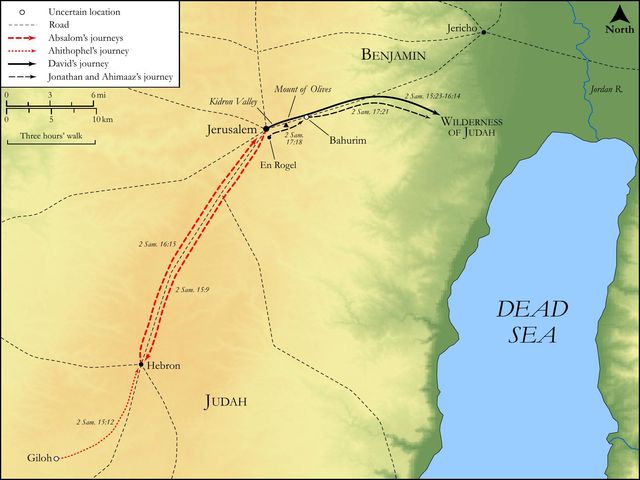
See on the biblical-era maps

Study this verse
Public-domain commentary
Matthew Henry
From his Commentary on the Whole Bible. Henry comments on passages, not single verses — this entry covers 2 Samuel 15:13–23. His three-level outline is real structure in the source text, so it is rendered as structure.
Here is, I. The notice brought to David of Absalom's rebellion, Sa2 15:13. The matter was bad enough, and yet it seems to have been made worse to him (as such things commonly are) than really it was; for he was told that the hearts of the men of Israel (that is, the generality of them, at least the leading men) were after Absalom. But David was the more apt to believe it because now he could call to mind the arts that Absalom had used to inveigle them, and perhaps reflected upon it with regret that he had not done more to counterwork him, and secure his own interest, which he had been too confident of. Note, It is the wisdom of princes to make sure of their subjects; for, if they have them, they have their purses, and arms, and all, at their service.
II.The alarm this gave to David, and the resolutions he came to thereupon.
We may well imagine him in a manner thunderstruck, when he heard that the son he loved so dearly, and had been so indulgent to, was so unnaturally and ungratefully in arms against him. Well might he say with Caesar, Kai su teknon - What, thou my son? Let not parents raise their hopes too high from their children, lest they be disappointed. David did not call a council, but, consulting only with God and his own heart, determined immediately to quit Jerusalem, Sa2 15:14. He took up this strange resolve, so disagreeable to his character as a man of courage, either,
1.As a penitent, submitting to the rod, and lying down under God's correcting hand. Conscience now reminded him of his sin in the matter of Uriah, and the sentence he was under for it, which was that evil should arise against him out of his own house. "Now," thinks he, "the word of God begins to be fulfilled, and it is not for me to contend with it or fight against it; God is righteous and I submit." Before unrighteous Absalom he could justify himself and stand it out; but before the righteous God he must condemn himself and yield to his judgments. Thus he accepts the punishment of his iniquity. Or,
2.As a politician. Jerusalem was a great city, but not tenable; it should seem, by David's prayer (Psa 51:18), that the walls of it were not built up, much less was it regularly fortified. It was too large to be garrisoned by so small a force as David had now with him, He had reason to fear that the generality of the inhabitants were too well affected to Absalom to be true to him. Should he fortify himself here, he might lose the country, in which, especially among those that lay furthest from Absalom's tampering, he hoped to have the most friends. And he had such a kindness for Jerusalem that he was loth to make it the seat of war, and expose it to the calamities of a siege; he will rather quit it tamely to the rebels. Note, Good men, when they suffer themselves, care not how few are involved with them in suffering.
III.His hasty flight from Jerusalem.
His servants agreed to the measures he took, faithfully adhered to him (Sa2 15:15), and assured him of their inviolable allegiance, whereupon,
1.He went out of Jerusalem himself on foot, while his son Absalom had chariots and horses. It is not always the best man, nor the best cause, that makes the best figure. See here, not only the servant, but the traitor, on horseback, while the prince, the rightful prince, walks as a servant upon the earth, Ecc 10:7. Thus he chose to do, to abase himself so much the more under God's hand, and in condescension to his friends and followers, with whom he would walk, in token that he would live and die with them.
2.He took his household with him, his wives and children, that he might protect them in this day of danger, and that they might be a comfort to him in this day of grief. Masters of families, in their greatest frights, must not neglect their households. Ten women, that were concubines, he left behind, to keep the house, thinking that the weakness of their sex would secure them from murder, and their age and relation to him would secure them from rape; but God overruled this for the fulfilling of his word.
3.He took his life-guard with him, or band of pensioners, the Cherethites and Pelethites, who were under the command of Benaiah, and the Gittites, who were under the command of Ittai, Sa2 15:18. These Gittites seem to have been, by birth, Philistines of Gath, who came, a regiment of them, 600 in all, to enter themselves in David's service, having known him at Gath, and being greatly in love with him for his virtue and piety, and having embraced the Jews' religion. David made them of his garde du corps - his body-guard, and they adhered to him in his distress. The Son of David found not such great faith in Israel as in a Roman centurion and a woman of Canaan.
4.As many as would, of the people of Jerusalem, he took with him, and made a halt at some distance from the city, to draw them up, Sa2 15:17. He compelled none. Those whose hearts were with Absalom, to Absalom let them go, and so shall their doom be: they will soon have enough of him. Christ enlists none but volunteers.
IV.His discourse with Ittai the Gittite, who commanded the Philistine-proselytes.
1.David dissuaded him from going along with him, Sa2 15:19, Sa2 15:20. Though he and his men might be greatly serviceable to him yet,
(1.)He would try whether he was hearty for him, and not inclined to Absalom. He therefore bids him return to his post in Jerusalem, and serve the new king. If he was no more than a soldier of fortune (as we say), he would be for that side which would pay and prefer him best; and to that side let him go.
(2.)If he was faithful to David, yet David would not have him exposed to the fatigues and perils he now counted upon. David's tender spirit cannot bear to think that a stranger and an exile, a proselyte and a new convert, who ought, by all means possible, to be encouraged and made easy, should, at his first coming, meet with such hard usage: "Should I make thee go up and down with us? No, return with thy brethren." Generous souls are more concerned at the share others have in their troubles than at their own. Ittai shall therefore be dismissed with a blessing: Mercy and truth be with thee, that is, God's mercy and truth, mercy according to promise, the promise made to those who renounce other gods and put themselves under the wings off the divine Majesty. This is a very proper pious farewell, when we part with a friend, "Mercy and truth be with thee, and then thou art safe, and mayest be easy, wherever thou art." David's dependence was upon the mercy and truth of God for comfort and happiness, both for himself and his friends; see Psa 61:7.
2.Ittai bravely resolved not to leave him, Sa2 15:21. Where David is, whether in life or death, safe or in peril, there will this faithful friend of his be; and he confirms this resolution with an oath, that he might not be tempted to break it. Such a value has he for David, not for the sake of his wealth and greatness (for then he would have deserted him now that he saw him thus reduced), but for the sake of his wisdom and goodness, which were still the same, that, whatever comes of it, he will never leave him. Note, That is a friend indeed who loves at all times, and will adhere to us in adversity. Thus should we cleave to the Son of David with full purpose of heart that neither life nor death shall separate us from his love.
V.The common people's sympathy with David in his affliction.
When he and his attendants passed over the brook Kidron (the very same brook that Christ passed over when he entered upon his sufferings, Joh 18:1), towards the way of the wilderness, which lay between Jerusalem and Jericho, all the country wept with a loud voice, Sa2 15:23. Cause enough there was for weeping,
1.To see a prince thus reduced, one that had lived so great forced from his palace and in fear of his life, with a small retinue seeking shelter in a desert, to see the city of David, which he himself won, built, and fortified, made an unsafe abode for David himself. It would move the compassion even of strangers to see a man fallen thus low from such a height, and this by the wickedness of his own son; a piteous case it was. Parents that are abused and ruined by their own children merit the tender sympathy of their friends as much as any of the sons or daughters of affliction. Especially,
2.To see their own prince thus wronged, who had been so great a blessing to their land, and had not done any thing to forfeit the affections of his people; to see him in this distress, and themselves unable to help him, might well draw floods of tears from their eyes.
Continue studying 2 Samuel 15:21 across the web’s major study libraries — every link below opens this exact verse, chapter, or book on the destination site.
Read & Compare
 BibleGatewayThis verse in more than 200 translations and 70 languages.
 Bible.comThe YouVersion reader — hundreds of translations, reading plans, and highlights.
 ESV.orgCrossway's official English Standard Version reader.
 NET BibleThe NET translation with 60,000+ translators' notes on every rendering decision.
 STEP BibleTyndale House's free study tool — original text, vocabulary, and scholarly resources.
 BibliaLogos Bible Software's free web reader.
 USCCBThe New American Bible (Revised Edition) with the U.S. bishops' study notes.
Commentaries
 BibleHub CommentariesDozens of classic commentaries on this verse, gathered on one page.
 StudyLightMore than 100 commentary sets — the largest collection on the web.
 BibleRefPlain-English commentary on what this verse means, verse by verse.
 Enduring WordDavid Guzik's free commentary on this chapter, widely used by Bible teachers.
 Bible Study ToolsVerse commentary alongside Greek and Hebrew study aids.
Original Language & Research
- BibleHub InterlinearThe verse word by word — original language, transliteration, and English.
- BibleHub LexiconEvery word's original-language definition and Strong's entry.
 Blue Letter BibleDeep-study tools — Strong's numbers, concordance, and word studies.
 SefariaThe Hebrew text with Rashi and centuries of Jewish commentary.
Sermons, Hymns & Audio


TrulyRandomVerse is not affiliated with these sites and doesn’t control their content. They’re linked because they’re genuinely useful.
Summary
Second Samuel 15:21 profoundly captures the unwavering loyalty of Ittai the Gittite, a Philistine foreigner, to King David during the tumultuous period of Absalom's rebellion. As David, forced to flee Jerusalem, compassionately urges Ittai to return to his homeland, Ittai responds with an extraordinary and solemn oath, pledging absolute and unconditional fidelity. His vow to remain with David "whether in death or life" exemplifies a rare and powerful commitment that transcends national identity, personal safety, and conventional expectations, standing in stark contrast to the widespread betrayal David experiences.
Context
ShowHideLiterary Context
This pivotal verse is situated amidst the dramatic and sorrowful narrative of Absalom's rebellion against his father, King David, as vividly detailed in 2 Samuel 15. David has been compelled to abandon Jerusalem, his capital, due to the swift and overwhelming support Absalom cunningly garnered through political intrigue and popular appeal, effectively "stealing the hearts of the men of Israel" (2 Samuel 15:6). As David and his loyal entourage embark on their mournful exodus from the city, they encounter Ittai the Gittite, a commander of six hundred men who had only recently joined David's ranks. David, displaying remarkable compassion and realism in his moment of distress, suggests that Ittai, being a foreigner and a recent arrival, should return to his own people rather than face the immense uncertainty and danger of following a king in exile (2 Samuel 15:19-20). Ittai's powerful declaration in 2 Samuel 15:21 is a direct, resolute, and deeply moving response to David's compassionate offer, showcasing an unexpected and profound devotion that stands in stark contrast to the betrayal David experiences from his own son and many Israelites.
Historical & Cultural Context
Ittai is specifically identified as a "Gittite," signifying his origin from Gath, one of the principal cities of the Philistines. The Philistines were Israel's long-standing, formidable, and often hostile enemies, a fact underscored by figures like Goliath of Gath (1 Samuel 17:4). This background makes Ittai's loyalty exceptionally remarkable and culturally significant. Philistines were typically viewed with suspicion and animosity by the Israelites, rendering Ittai's integration into David's inner circle and his subsequent unwavering commitment a testament to David's charismatic leadership and, ultimately, God's sovereign work. Oaths sworn "as the LORD liveth" were a common and extremely binding form of solemn promise in ancient Israelite culture, invoking God's very existence as a guarantee of truth and fidelity (1 Samuel 20:3). For a foreigner to use such an oath, especially one invoking Yahweh, the God of Israel, underscores a deep respect and perhaps even a nascent faith in the God of David, elevating his pledge beyond mere human allegiance to a sacred and unbreakable vow.
Key Themes
ShowHideThis verse powerfully contributes to several overarching themes within the book of 2 Samuel. Foremost is the theme of Loyalty and Betrayal, starkly contrasting Absalom's cunning treachery with Ittai's steadfastness. It highlights that true devotion can emerge from the most unexpected sources, challenging conventional expectations of kinship and nationality. The theme of Faithfulness in Adversity is also profoundly prominent, as Ittai's commitment is tested not in David's glory or prosperity but in his humiliation, weakness, and flight, demonstrating that genuine allegiance is revealed and proven in suffering. Furthermore, Ittai's oath, invoking both the LORD and the king, subtly introduces the theme of Divine Sovereignty and Human Responsibility, suggesting that even amidst human rebellion and political upheaval, God's hand is at work, inspiring faithfulness where it is least expected. Finally, Ittai's foreign origin yet profound commitment foreshadows the eventual inclusion of Gentiles into God's redemptive plan, a theme that becomes more explicit in later biblical narratives, such as the prophecy of Israel being a "light for the Gentiles" (Isaiah 49:6) and the New Testament's fulfillment in the church.
Exposition and Analysis
ShowHideKey Word Analysis
ShowHideVerse Breakdown
ShowHide"And Ittai answered the king, and said"
This introductory clause establishes the immediate context of Ittai's declaration as a direct and deliberate response. It highlights that Ittai's words are not impulsive but a considered reply to David's compassionate but testing offer for him to return home. This sets the stage for the profound weight and intentionality of his subsequent oath.
"[As] the LORD liveth, and [as] my lord the king liveth"
This is a solemn, double oath, characteristic of biblical vows, invoking the most sacred and binding authorities. By invoking the life of Yahweh (the God of Israel) first, Ittai places his promise under divine sanction, making it a sacred and unbreakable covenant. The subsequent invocation of "my lord the king liveth" binds his loyalty to David's very existence and authority. This dual oath emphasizes the absolute certainty, gravity, and seriousness of his commitment, demonstrating a profound reverence for both God and David.
"surely in what place my lord the king shall be, whether in death or life"
This clause articulates the comprehensive scope and extreme nature of Ittai's loyalty. The phrase "surely in what place" indicates an unconditional following, irrespective of location or circumstance. The powerful expression "whether in death or life" employs merism, signifying all possible circumstances, from the most dire to the most hopeful. It means his allegiance is unconditional and extends to the very end, pledging to follow David through any circumstance, no matter how perilous, even if it means facing his own demise alongside the king. This is a profound pledge of solidarity in the face of mortal danger and profound uncertainty.
"even there also will thy servant be"
This concluding declaration is the ultimate statement of Ittai's unwavering resolve and personal dedication. It reiterates his self-identification as David's "servant," emphasizing his chosen role of submission and devotion. This clause unequivocally states his intention to remain physically and spiritually present with David, sharing his fate and participating in his destiny. It is a vow of absolute, unwavering presence and participation, a stark and moving contrast to the widespread abandonment David was experiencing from his own people.
Literary Devices
ShowHideThe primary literary device at play in 2 Samuel 15:21 is the Oath or Vow. Ittai's declaration is a solemn, binding promise, underscored by the invocation of divine and royal life. This form of oath-taking was a powerful rhetorical and legal act in Israel, lending immense weight, credibility, and sacredness to the speaker's words. The phrase "whether in death or life" powerfully employs Merism, a figure of speech where two contrasting parts represent a complete whole (i.e., all possible circumstances, good or bad, from beginning to end). This intensifies the scope and totality of Ittai's commitment, making it all-encompassing and leaving no room for conditions. Furthermore, the verse exhibits clear Parallelism in the structure of the oath ("As the LORD liveth, and as my lord the king liveth"), which adds rhythmic emphasis, reinforces the dual nature of Ittai's allegiance, and underscores the solemnity of his pledge. The entire statement functions as a powerful moment of Dramatic Irony or Contrast, as the most profound loyalty and steadfastness comes from an unexpected foreigner, a Gittite, while David's own son and many Israelites betray him. This highlights the unexpected sources of faithfulness and divine providence in times of crisis.
Theological and Thematic Connections
ShowHideIttai's declaration of unwavering loyalty stands as a powerful testament to the nature of true commitment, echoing themes found throughout Scripture regarding covenant faithfulness and steadfast love. His pledge to remain with David "whether in death or life" transcends mere human allegiance, touching upon the very essence of devoted partnership and self-sacrificial fidelity. This profound commitment, offered by a foreigner when David's own people were abandoning him, highlights God's ability to raise up faithful individuals from unexpected places, demonstrating His sovereign hand at work even in times of deep distress and betrayal. Theologically, it reminds us that genuine devotion is proven not in prosperity but in adversity, reflecting a divine principle where true character and allegiance are forged and revealed under pressure. Ittai's unexpected faithfulness serves as a beautiful prefigurement of God's redemptive plan to include all nations in His covenant, drawing people from every tribe and tongue into His fold.
Reflection and Application
ShowHideIttai's steadfastness in 2 Samuel 15:21 serves as a timeless and challenging example of what it means to be truly committed. In a world often characterized by fair-weather friendships, conditional loyalties, and self-preservation, Ittai's declaration calls us to a higher standard of fidelity and self-giving. It prompts us to examine the depth of our own commitments—to God, to our spouses, to family, to friends, and to those we lead or follow. Are we willing to stand by others not just in their moments of triumph and ease, but especially when they face trials, humiliation, uncertainty, or public disgrace? Ittai chose to share David's uncertain and perilous fate, demonstrating that true allegiance is forged and proven in the crucible of adversity, not merely in shared success. This challenges us to cultivate a spirit of unwavering devotion, recognizing that the most profound and enduring bonds are often tested and strengthened in shared suffering, reflecting the very heart of Christ's sacrificial love for us.
Questions for Reflection
ShowHideFAQ
ShowHideWhy was Ittai the Gittite's loyalty so significant given his background?
ShowHideIttai's loyalty was profoundly significant precisely because he was a Gittite, meaning he hailed from Gath, a major Philistine city. The Philistines were the long-standing, bitter enemies of Israel, often engaged in warfare and conflict with David's people, as seen throughout 1 Samuel and 2 Samuel. For a commander of six hundred men from this traditional enemy territory to not only join David's ranks but also pledge such unwavering, unconditional loyalty during David's most vulnerable moment—his flight from Absalom's rebellion—was truly extraordinary. It defied all cultural and national expectations, highlighting David's unique and compelling leadership appeal, and perhaps even a recognition of the God of Israel by Ittai. This unexpected devotion underscored the depth of the crisis David faced, as his own son and many of his own people betrayed him, while a foreigner stood firm, choosing to share David's uncertain future "whether in death or life" (2 Samuel 15:21).
Christ-Centered Fulfillment
ShowHideIttai's extraordinary loyalty to King David, pledging to be with him "whether in death or life," serves as a powerful Old Testament shadow of the ultimate fidelity demonstrated by Jesus Christ. Just as Ittai, a foreigner, chose to align himself completely with David in his suffering and exile, so too does Christ, the ultimate faithful Servant, identify completely with humanity in its fallen state, even unto death on the cross (Philippians 2:5-8). While Ittai swore an oath to follow his king, Jesus' commitment to His Father's will and to His people was not an oath but an inherent, perfect obedience, a divine loyalty that led Him to lay down His life for His friends (John 15:13). Ittai's willingness to share David's uncertain fate foreshadows the call for believers to "take up their cross daily and follow" Christ, regardless of the cost or uncertainty, knowing that following Him leads to true life (Luke 9:23). Ultimately, Ittai's unwavering presence with David in his darkest hour points to Christ's eternal promise to never leave nor forsake His people, remaining with them always, even to the end of the age (Matthew 28:20). He is the King who, unlike David, never flees in defeat but conquers death, ensuring that all who are "in Him" will share in His eternal life, not just His suffering, for we are "united with him in a death like his" and "we will certainly also be united with him in a resurrection like his" (Romans 6:5-8).