


2 Chronicles 13:15
- וַיָּרִיעוּvai·ya·Ri·'uand they sounded [the] battle signalH7321Conj-w ¦ V-Hiphil-ConsecImperf-3mpVerb Hiphil Consecutive Imperfect 3rd Plural Masculineוַandיָּרִיעוּthey sounded [the] battle signal
- אִישׁ'ish[the] man ofH376N-mscNoun Singular Masculine Construct
- יְהוּדָהye·hu·DahJudahH3063N-properNoun Proper Location
- וַיְהִיvay·Hiand it wasH1961Conj-w ¦ V-Qal-ConsecImperf-3msVerb Qal Consecutive Imperfect 3rd Singular Masculineוַandיְהִיit was
- בְּהָרִיעַbe·ha·Ri·a'when sounded [the] battle signalH7321Prep-b ¦ V-Hiphil-InfVerb Hiphil Infinitive Constructבְּwhenהָרִיעַsounded [the] battle signal
- אִישׁ'ish[the] man ofH376N-mscNoun Singular Masculine Construct
- יְהוּדָהye·hu·DahJudahH3063N-properNoun Proper Location
- וְהָאֱלֹהִיםve·ha·'E·lo·Himand <the> GodH430Conj-w ¦ Art ¦ N-mpNoun Plural Masculine Absoluteוְandהָ<the>אֱלֹהִיםGod
- נָגַףna·Gafhe defeatedH5062V-Qal-Perf-3msVerb Qal Perfect 3rd Singular Masculine
- אֶת'et<obj.>H853DirObjMParticle Object Indicator
- יָרָבְעָםya·ra·ve·'AmJeroboamH3379N-proper-mNoun Proper Masculine
- וְכָלve·kholand allH3605Conj-w ¦ N-mscNoun Singular Masculine Constructוְandכָלall
- יִשְׂרָאֵלYis·ra·'ElIsraelH3478N-properNoun Proper Location
- לִפְנֵיlif·Nei<to> beforeH6440Prep-l ¦ N-mpcNoun Plural Masculine Constructלִ<to>פְנֵיbefore
- אֲבִיָּה'a·vi·YahAbijahH29N-proper-mNoun Proper Masculine
- וִיהוּדָהvi·hu·Dahand JudahH3063Conj-w ¦ N-properNoun Proper LocationוִandיהוּדָהJudah
English is a literal word-by-word gloss of the Hebrew, not the KJV's wording. Why?
This is the original text the KJV's translators worked from — each Hebrew word with its own literal English meaning in this verse, prepared by scholars at Tyndale House, Cambridge. The KJV translates whole sentences, not word by word, so its wording differs: one Hebrew word can become several English words, and the KJV may choose “the LORD” where the gloss reads “Yahweh”. Both are faithful — they answer different questions. For the KJV's own rendering, switch to the KJV text.
Details
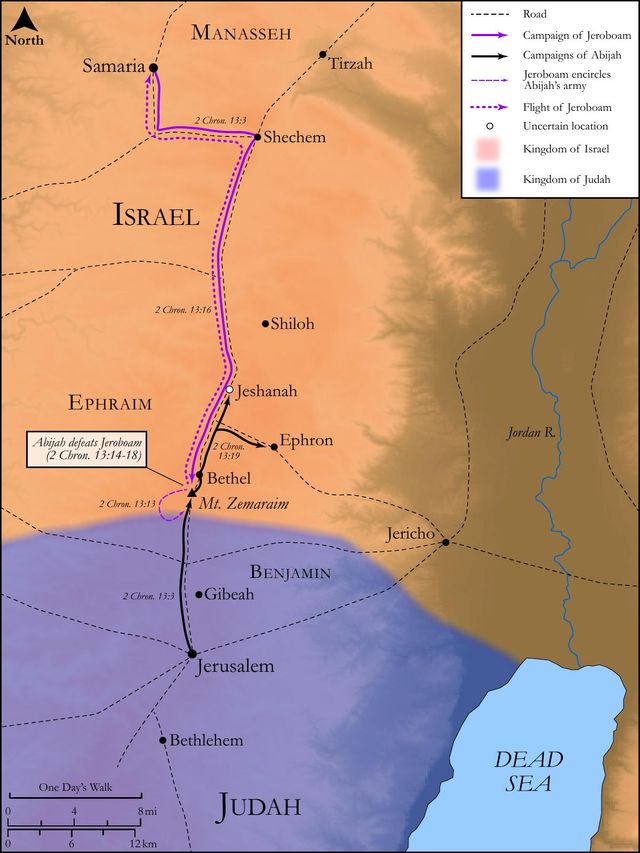
See on the biblical-era map
Study this verse
Public-domain commentary
Matthew Henry
From his Commentary on the Whole Bible. Henry comments on passages, not single verses — this entry covers 2 Chronicles 13:13–22. His three-level outline is real structure in the source text, so it is rendered as structure.
We do not find that Jeroboam offered to make any answer at all to Abijah's speech. Though it was much to the purpose, he resolved not to heed it, and therefore he heard it as though he heard it not. He came to fight, not to dispute. The longest sword, he thought, would determine the matter, not the better cause. Let us therefore see the issue, whether right and religion carried the day or no.
I.Jeroboam, who trusted to his politics, was beaten.
He was so far from fair reasoning that he was not for fair fighting. We may suppose that he felt a sovereign contempt for Abijah's harangue. "One stratagem," thinks he, "is worth twenty such speeches; we will soon give him an answer to all his arguments; he shall soon find himself overpowered with numbers, surrounded on every side with the instruments of death, and then let him boast of his religion and his title to the crown." A parley, it is probable, was agreed on, yet Jeroboam basely takes the advantage of it, and, while he was treating, laid his ambushment behind Judah, against all the laws of arms. What honour could be expected in a servant when he reigned? Abijah was for peace, but, when he spoke, they were for war, Psa 120:7.
II.Abijah and his people, who trusted in their God, came off conquerors, notwithstanding the disproportion of their strength and numbers.
1.They were brought into a great strait, put into a great fright, for the battle was before and behind. A good cause, and one which is designed to be victorious, may for a season be involved in embarrassment and distress. It was David's case. They compassed me about like bees, Psa 118:10-12.
2.In their distress, when danger was on every side, which way should they look but upwards for deliverance? It is an unspeakable comfort that no enemy (not the most powerful or politic), no stratagem or ambushment, can cut off our communication with heaven; our way thitherward is always open.
(1.)They cried unto the Lord, Ch2 13:14. We hope they did this before they engaged in this war, but the distress they were in made them renew their prayers and quickened them to be importunate. God brings his people into straits, that he may teach them to cry unto him. Earnest praying is crying.
(2.)They relied on the God of their fathers, depended upon his power to help them and committed themselves to him, Ch2 13:18. The prayer of faith is the prevailing prayer, and this is that by which we overcome the world, even our faith, Jo1 5:4.
(3.)The priests sounded the trumpets to animate them by giving them an assurance of God's presence with them. It was not only a martial but a sacred sound, and put life into their faith.
(4.)They shouted in confidence of victory: "The day is our own, for God is with us." To the cry of the prayer they added the shout of faith, and so became more than conquerors.
3.Thus they obtained a complete victory: As the men of Judah shouted for joy in God's salvation, God smote Jeroboam and his army with such terror and amazement that they could not strike a stroke, but fled with the greatest precipitation imaginable, and the conquerors gave no quarter, so that they put to the sword 500,000 chosen men (Ch2 13:17), more, it is said, than ever we read of in any history to have been killed in one battle; but the battle was the Lord's, who would thus chastise the idolatry of Israel and own the house of David. But see the sad effect of division: it was the blood of Israelites that was thus shed like water by Israelites, while the heathen, their neighbours, to whom the name of Israel had formerly been a terror, cried, Aha! so would we have it.
4.The consequence of this was that the children of Israel, though they were not brought back to the house of David (which by so great a blow surely they would have been had not the determinate counsel of God been otherwise), yet, for that time, were brought under, Ch2 13:18. Many cities were taken, and remained in the possession of the kings of Judah; as Bethel particularly, Ch2 13:19. What became of the golden calf there, when it came into the hands of the king of Judah, we are not told; perhaps it was removed to some place of greater safety, and at length to Samaria (Hos 8:5); yet in Jehu's time we find it at Bethel, Kg2 10:29. Perhaps Abijah, when it was in his power to demolish it, suffered it to stand, for his heart was not perfect with God; and, not improving what he had got for the honour of God, he soon lost it all again.
Lastly, The death of both of the conquered and of the conqueror, not long after. 1. Jeroboam never looked up after this defeat, though he survived it two or three years. He could not recover strength again, Ch2 13:20. The Lord struck him either with some bodily disease, of which he languished, or with melancholy and trouble of mind; his heart was broken, and vexation at his loss brought his head, probably by this time a hoary head, with sorrow to the grave. He escaped the sword of Abijah, but God struck him: and there is no escaping his sword. 2. Abijah waxed mighty upon it. What number of wives and children he had before does not appear; but now he multiplied his wives to fourteen in all, by whom he had thirty-eight children, Ch2 13:21. Happy is the man that hath his quiver full of those arrows. It seems, he had ways peculiar to himself, and sayings of his own, which were recorded with his acts in the history of those times, Ch2 13:22. But the number of his months was cut off in the midst, and, soon after his triumphs, death conquered the conqueror. Perhaps he was too much lifted up with his victories, and therefore God would not let him live long to enjoy the honour of them.
Continue studying 2 Chronicles 13:15 across the web’s major study libraries — every link below opens this exact verse, chapter, or book on the destination site.
Read & Compare
 BibleGatewayThis verse in more than 200 translations and 70 languages.
 Bible.comThe YouVersion reader — hundreds of translations, reading plans, and highlights.
 ESV.orgCrossway's official English Standard Version reader.
 NET BibleThe NET translation with 60,000+ translators' notes on every rendering decision.
 STEP BibleTyndale House's free study tool — original text, vocabulary, and scholarly resources.
 BibliaLogos Bible Software's free web reader.
 USCCBThe New American Bible (Revised Edition) with the U.S. bishops' study notes.
Commentaries
 BibleHub CommentariesDozens of classic commentaries on this verse, gathered on one page.
 StudyLightMore than 100 commentary sets — the largest collection on the web.
 BibleRefPlain-English commentary on what this verse means, verse by verse.
 Enduring WordDavid Guzik's free commentary on this chapter, widely used by Bible teachers.
 Bible Study ToolsVerse commentary alongside Greek and Hebrew study aids.
Original Language & Research
- BibleHub InterlinearThe verse word by word — original language, transliteration, and English.
- BibleHub LexiconEvery word's original-language definition and Strong's entry.
 Blue Letter BibleDeep-study tools — Strong's numbers, concordance, and word studies.
 SefariaThe Hebrew text with Rashi and centuries of Jewish commentary.
Sermons, Hymns & Audio


TrulyRandomVerse is not affiliated with these sites and doesn’t control their content. They’re linked because they’re genuinely useful.
Summary
2 Chronicles 13:15 powerfully narrates the pivotal moment in the battle between King Abijah of Judah and King Jeroboam of Israel. Faced with overwhelming odds, the men of Judah cried out to the Lord, and as their collective shout ascended, God supernaturally intervened, decisively striking down Jeroboam and the entire army of Israel before Abijah and Judah. This verse stands as a profound testament to God's direct sovereignty, His unwavering faithfulness to His covenant people, and the truth that ultimate victory is secured not by human might or numerical superiority, but by divine power.
Context
ShowHideLiterary Context
This verse serves as the dramatic climax of the conflict detailed in 2 Chronicles 13, a narrative meticulously crafted by the Chronicler to underscore theological truths. The chapter opens by establishing the immense numerical disparity between Judah (400,000 men) and Israel (800,000 men) in 2 Chronicles 13:3, immediately setting the stage for a divinely orchestrated victory. Abijah's impassioned speech to Jeroboam and Israel in 2 Chronicles 13:4-12, delivered just before the battle, articulates Judah's reliance on the Lord, the enduring nature of the Davidic covenant, and the legitimacy of their worship in Jerusalem, starkly contrasting it with Jeroboam's apostasy. Despite this theological appeal, Jeroboam attempts a cunning ambush, surrounding Judah's forces in 2 Chronicles 13:13. This dire situation prompts Judah's desperate cry to the Lord and the priests' trumpet blasts in 2 Chronicles 13:14, directly preceding the divine intervention described in verse 15. The immediate aftermath, chronicled in 2 Chronicles 13:16-18, confirms the catastrophic defeat of Israel and the subsequent strengthening of Judah, solidifying the theological message of divine vindication.
Historical & Cultural Context
The conflict between the southern kingdom of Judah and the northern kingdom of Israel was a direct consequence of the division of the united monarchy following the death of King Solomon. Jeroboam, the first king of Israel, led the ten northern tribes in rebellion against the Davidic dynasty, establishing his own idolatrous golden calf cults in Bethel and Dan to prevent his people from returning to Jerusalem for true worship (1 Kings 12:28-30). This historical backdrop is crucial, as it transforms the military engagement into a theological battle over legitimate worship, covenant fidelity, and the rightful heir to God's promises. Culturally, the "shout" (Hebrew: teruah) was a multifaceted practice in ancient Near Eastern warfare. While often a battle cry, in Israelite tradition, it frequently carried profound spiritual significance, serving as a signal for divine intervention or an expression of faith. This is notably seen in the miraculous fall of Jericho, where the collective shout of the people, combined with trumpet blasts, preceded God's direct action (Joshua 6:20). Thus, Judah's shout in 2 Chronicles 13:15 was not merely a military maneuver but a deeply spiritual act of reliance on Yahweh.
Key Themes
ShowHideThe overarching theme of 2 Chronicles 13:15 is Divine Intervention and God's Sovereignty. Despite Judah's significant numerical disadvantage (400,000 against 800,000, as stated in 2 Chronicles 13:3), the Chronicler explicitly attributes the victory to God: "God smote Jeroboam and all Israel." This highlights that the outcome was not determined by human strength, strategy, or numbers, but by the direct, powerful hand of God, emphasizing His active involvement in the affairs of His people. Another critical theme is Faithfulness to the Covenant and its Consequences. Abijah's preceding speech champions Judah's adherence to the Davidic covenant and the legitimate worship centered in Jerusalem, contrasting it sharply with Jeroboam's apostasy and idolatry. Israel's devastating defeat serves as a stark reminder of the dire consequences of rebellion against God and His established order, while Judah's victory vindicates God's covenant promises to David (2 Samuel 7:12-16). Finally, the Power of Prayer and Worship in Warfare is vividly portrayed. Judah's collective "shout" and the priests' trumpet blasts are presented as direct precursors to God's intervention, underscoring the spiritual dimension of their conflict and the efficacy of crying out to the Lord in times of crisis.
Exposition and Analysis
ShowHideKey Word Analysis
ShowHideThis term (H7321) describes a loud cry, often a battle cry, or a trumpet blast. In a military context, it can signify the initiation of an attack or a call to arms. However, in this specific narrative, especially when read in conjunction with the priests' trumpet blasts in 2 Chronicles 13:14, it carries a profound spiritual and liturgical connotation. It represents Judah's collective cry to God, an act of desperate faith, and a signal for divine intervention in the face of overwhelming odds. It is an expression of their reliance not on their own strength, but on the Lord.
This plural noun (H430), used here with the article, specifically refers to the supreme God, Yahweh. Its explicit mention as the subject of the verb "smote" is crucial. It unequivocally identifies the divine agent behind the decisive victory. The Chronicler leaves no room for ambiguity: the defeat of Jeroboam and Israel was not a matter of military strategy or human prowess, but a direct, supernatural act of the one true God, demonstrating His absolute power, sovereignty, and justice.
This primitive root (H5062) is a strong verb frequently used to describe a decisive, often fatal, blow or defeat. Its application here, with "God" as the subject, emphasizes that the defeat of Jeroboam and Israel was not merely a result of Judah's renewed strength or tactical superiority, but a direct, supernatural act of divine judgment and intervention. God Himself was the agent of their downfall, inflicting a devastating blow that led to the rout and immense casualties, underscoring His active and decisive involvement in the battle.
Verse Breakdown
ShowHide"Then the men of Judah gave a shout"
This opening clause details the immediate, collective action of Judah's army. Following their cry to the Lord and the priests blowing the trumpets in the preceding verse, this "shout" is presented not merely as a human battle cry, but as a deeply spiritual and collective expression of faith, desperation, and perhaps a liturgical act. It signifies their profound trust in God's imminent intervention, acknowledging their own inadequacy in the face of the enemy.
"and as the men of Judah shouted, it came to pass, that God smote Jeroboam and all Israel"
This central and most impactful clause reveals the direct cause-and-effect relationship between Judah's act of faith and God's powerful response. The phrase "it came to pass" emphasizes the immediate and direct consequence of their spiritual action and prayer. The explicit declaration "God smote Jeroboam and all Israel" attributes the victory entirely to divine agency. The verb "smote" (Hebrew: nâgaph) conveys a decisive, overwhelming blow, indicating a supernatural intervention that debilitated the Israelite forces, leading to their complete rout and massive casualties. This highlights God's sovereignty over the battlefield.
"before Abijah and Judah"
This concluding phrase clarifies the beneficiaries and witnesses of God's mighty action. The devastating defeat of Israel occurred "before," or in the presence of, Abijah and the entire army of Judah. This not only confirms their vindication but also underscores the divine favor bestowed upon them. It emphasizes that the victory was a sovereign gift granted to them by God, rather than something achieved by them through their own strength or military prowess.
Literary Devices
ShowHideThe verse employs several impactful literary devices to convey its profound theological message. Divine Intervention is the most prominent, as the text explicitly states "God smote Jeroboam and all Israel," making the Almighty the direct agent of the decisive blow. This is not a subtle suggestion but a clear, unambiguous declaration of supernatural involvement, emphasizing God's active and personal role in human history and warfare. A strong sense of Cause and Effect is also evident, directly linking Judah's "shout"—an act of faith, prayer, and worship—to God's immediate and powerful response. The narrative structure creates a powerful sense of divine immediacy, demonstrating that God responds swiftly to the faithful cries of His people. Furthermore, the use of Hyperbole or Synecdoche in the phrase "all Israel" emphasizes the totality and devastating nature of the defeat, signifying the complete rout and decimation of Jeroboam's forces, even if not every single Israelite soldier literally perished. Finally, the stark Contrast between Judah's numerically inferior yet faithful army and Israel's numerically superior yet apostate army powerfully underscores the central theological message: victory ultimately belongs to God, not to human strength, numbers, or strategic advantage, but to those who align themselves with His covenant and truth.
Theological and Thematic Connections
ShowHideThis verse powerfully articulates the theological principle that God is intimately and actively involved in the affairs of His people, especially when they humble themselves, cry out to Him in faith, and remain faithful to His covenant. It demonstrates God's unwavering commitment to His promises, particularly the Davidic covenant, even when His people are numerically or militarily disadvantaged. The decisive defeat of Jeroboam's Israel serves as a stark and sobering reminder of the dire consequences of apostasy, rebellion against God's established order, and the abandonment of true worship. God's intervention here is a profound vindication of His name and His covenant, unequivocally showing that He defends and upholds those who remain loyal to Him and His truth, even in the face of seemingly insurmountable opposition. This event underscores that ultimate power, authority, and victory belong to God alone, not to human might, strategic brilliance, or numerical superiority, compelling believers to place their trust entirely in Him.
Reflection and Application
ShowHide2 Chronicles 13:15 offers profound encouragement and timeless lessons for believers navigating the complexities of life today. When confronted with overwhelming challenges—be they personal struggles, spiritual battles against temptation, or societal pressures that seem insurmountable—this passage serves as a powerful reminder that our ultimate reliance must be on God, not on our own strength, finite resources, or limited wisdom. Judah's "shout" was an act born of desperate faith, a profound recognition that human effort alone was utterly insufficient. In our own lives, crying out to God in fervent prayer, trusting implicitly in His sovereign power, and remaining steadfastly faithful to His revealed truth can unlock divine intervention that transcends all human capabilities and expectations. This verse challenges us to honestly examine where our trust truly lies and to remember that the Lord actively fights for His people. It also serves as a solemn warning: just as Jeroboam's apostasy led to a crushing defeat, turning away from God's truth, embracing spiritual idolatry, or living in deliberate disobedience inevitably leads to spiritual barrenness, defeat, and a forfeiture of divine blessing. Our unwavering faithfulness to God's covenant and His commands is paramount, for He alone is the one who ultimately determines the outcome of all battles, both seen and unseen.
Questions for Reflection
ShowHideFAQ
ShowHideWhat was the significance of Judah's "shout" in this battle?
ShowHideThe "shout" in 2 Chronicles 13:15 was far more than a mere battle cry; it was a deeply spiritual act. Following the priests blowing trumpets and Judah crying out to the Lord in 2 Chronicles 13:14, the shout likely signified a collective expression of desperate faith, a fervent plea for divine intervention, and an act of worship and trust. It echoed earlier instances in Israelite history, such as the miraculous fall of Jericho (Joshua 6:20), where a shout, combined with divine command, preceded a miraculous victory. It powerfully demonstrated Judah's profound reliance on God rather than their own military might, recognizing their severe numerical disadvantage.
How did God "smite" Jeroboam and Israel? Was it a literal physical blow?
ShowHideThe text states "God smote Jeroboam and all Israel," indicating a direct, supernatural intervention by God. While the exact mechanism is not detailed, the Hebrew word "smote" (nakah) implies a decisive, devastating, and often fatal blow or defeat. This divine action could have manifested in various ways: perhaps through supernatural panic, confusion, internal discord, or a sudden, inexplicable loss of strength and morale among the Israelite forces, leading to their complete rout and the massive casualties mentioned in 2 Chronicles 13:17. The crucial point is that the defeat was divinely orchestrated and not simply a result of Judah's military prowess or tactical superiority.
Does this story suggest that God always intervenes militarily for His faithful people?
ShowHideThis story powerfully demonstrates God's sovereign power and His willingness to intervene for His people, especially when they are faithful to His covenant and cry out to Him in times of crisis. However, it does not establish a universal guarantee of military intervention in every conflict. Throughout biblical history, God's people also faced defeat, exile, and suffering due to their disobedience or for other divine purposes. The primary lesson of this passage is God's unwavering faithfulness to His covenant promises and the severe consequences of apostasy and rebellion against Him. For believers today, the application is often spiritual: God fights our spiritual battles, provides strength in our weakness, and ultimately secures victory over sin, death, and the powers of darkness (Romans 8:37). While God's methods and timing of intervention may vary, His ultimate victory and faithfulness remain constant.
Christ-Centered Fulfillment
ShowHideThe divine intervention in 2 Chronicles 13:15, where God "smote" Israel and secured a decisive victory for Judah, powerfully foreshadows the ultimate and eternally decisive victory achieved by Jesus Christ. Just as Judah faced an overwhelming physical enemy in Jeroboam's vast army, humanity faces an infinitely more formidable spiritual foe in sin, death, and the principalities and powers of darkness (Ephesians 6:12). The "shout" of Judah, an act of desperate faith and complete reliance on God, points to the ultimate cry of humanity for a deliverer from this spiritual bondage. Jesus, the true Son of David and the rightful King of kings, entered the ultimate spiritual battle not with an earthly army, but through His sacrificial death on the cross and His glorious resurrection. On the cross, He disarmed the spiritual rulers and authorities, triumphing over them by it (Colossians 2:15). His resurrection from the dead is God's ultimate "smite" against the power of death and the grave, securing an eternal victory for all who put their faith in Him (1 Corinthians 15:54-57). Through Christ, believers are empowered to overcome spiritual adversaries, knowing that the battle ultimately belongs to the Lord (1 Samuel 17:47). The victory granted to Abijah and Judah was temporal and physical; the victory secured by Christ is eternal, spiritual, and redemptive, establishing His kingdom forever and offering true salvation to all who believe in the Lamb of God who takes away the sin of the world (John 1:29).