


2 Chronicles 14:12
- וַיִּגֹּףvai·yi·Gofand he defeatedH5062Conj-w ¦ V-Qal-ConsecImperf-3msVerb Qal Consecutive Imperfect 3rd Singular Masculineוַandיִּגֹּףhe defeated
- יְהוָהYah·wehYahwehH3068N-properNoun Proper Title
- אֶת'et<obj.>H853DirObjMParticle Object Indicator
- הַכּוּשִׁיםha·ku·Shimthe CushitesH3569Art ¦ N-mpNoun Gentilic Plural Masculine AbsoluteהַtheכּוּשִׁיםCushites
- לִפְנֵיlif·Nei<to> beforeH6440Prep-l ¦ N-mpcNoun Plural Masculine Constructלִ<to>פְנֵיbefore
- אָסָא'a·Sa'AsaH609N-proper-mNoun Proper Masculine
- וְלִפְנֵיve·lif·Neiand <to> beforeH6440Conj-w ¦ Prep-l ¦ N-mpcNoun Plural Masculine Constructוְandלִ<to>פְנֵיbefore
- יְהוּדָהye·hu·DahJudahH3063N-properNoun Proper Location
- וַיָּנֻסוּvai·ya·Nu·suand they fledH5127Conj-w ¦ V-Qal-ConsecImperf-3mpVerb Qal Consecutive Imperfect 3rd Plural Masculineוַandיָּנֻסוּthey fled
- הַכּוּשִׁיםha·ku·Shimthe CushitesH3569Art ¦ N-mpNoun Gentilic Plural Masculine AbsoluteהַtheכּוּשִׁיםCushites
English is a literal word-by-word gloss of the Hebrew, not the KJV's wording. Why?
This is the original text the KJV's translators worked from — each Hebrew word with its own literal English meaning in this verse, prepared by scholars at Tyndale House, Cambridge. The KJV translates whole sentences, not word by word, so its wording differs: one Hebrew word can become several English words, and the KJV may choose “the LORD” where the gloss reads “Yahweh”. Both are faithful — they answer different questions. For the KJV's own rendering, switch to the KJV text.
Details
See on the biblical-era map
Study this verse
Public-domain commentary
Matthew Henry
From his Commentary on the Whole Bible. Henry comments on passages, not single verses — this entry covers 2 Chronicles 14:9–15. His three-level outline is real structure in the source text, so it is rendered as structure.
Here is, I. Disturbance given to the peace of Asa's kingdom by a formidable army of Ethiopians that invaded them, Ch2 14:9, Ch2 14:10. Though still they sought God, yet this fear came upon them, that their faith in God might be tried, and that God might have an opportunity of doing great things for them. It was a vast number that the Ethiopians brought against him: 1,000,000 men; and now he found the benefit of having an army ready raised against such a time of need. That provision which we thought needless may soon appear to be of great advantage.
II.The application Asa made to God on occasion of the threatening cloud which now hung over his head, Ch2 14:11.
He that sought God in the day of his peace and prosperity could with holy boldness cry to God in the day of his trouble, and call him his God. His prayer is short, but has much in it. 1. He gives to God the glory of his infinite power and sovereignty: It is nothing with thee to help and save by many or few, by those that are mighty or by those that have no power. See Sa1 14:6. God works in his own strength, not in the strength of instruments (Psa 21:13), nay, it is his glory to help the weakest and to perfect strength out of the mouth of babes and sucklings. "We do not say, Lord, take our part, for we have a good army for thee to work by; but, take our part, for without thee we have no power." 2. He takes hold of their covenant-relation to God as theirs. O Lord, our God! and again, "Thou art our God, whom we have chosen and cleave to as ours, and who hast promised to be ours." 3. He pleads their dependence upon God, and the eye they had to him in this expedition. he was well prepared for it, yet trusted not to his preparations; but, "Lord, we rest on thee, and in thy name we go against this multitude, by warrant from thee, aiming at thy glory, and trusting to thy strength." 4. He interests God in their cause: "Let not man" (mortal man, so the word is) "prevail against thee. If he prevail against us, it will be said that he prevails against thee, because thou art our God, and we rest on thee and go forth in thy name, which thou hast encouraged us to do. The enemy is a mortal man; make it to appear what an unequal match he is for an immortal God. Lord, maintain thy own honour; hallowed by thy name."
III.The glorious victory God gave him over his enemies.
1.God defeated the enemy, and put their forces into disorder (Ch2 14:12): The Lord smote the Ethiopians, smote them with terror, and an unaccountable consternation, so that they fled, and knew neither why nor whither.
2.Asa and his soldiers took the advantage God gave them against the enemy.
(1.)They destroyed them. They fell before the Lord (for who can stand before him?) and before his host, either an invisible host of angels that were employed to destroy them or the host of Israel, called God's host because owned by him.
(2.)They took the plunder of their camp, carried away very much spoil from the slain and from the baggage.
(3.)They smote the cities that were in league with them, to which they fled for shelter, and carried off the spoil of them (Ch2 14:14); and they were not able to make any resistance, for the fear of the Lord came upon them, that is, a fear which God struck them with to such a degree that they had no heart to withstand the conquerors.
(4.)They fetched away the cattle out of the enemy's country, in vast numbers, Ch2 14:15. Thus the wealth of the sinner is laid up for the just.
Historical interpretation
Historical reception
1 surviving comment on this verse from the historical church.
Asa prayed, and his prayer manifested great power: when Zerah the Indian [Ethiopian] went out against him with an army of one million with him, Asa then prayed, saying, “By this shall your power be known, O our God, when you finish off a vast people by means of a small people.” God heard his prayer and sent his angel to rout them. Thus the vast army was defeated by the power of Asa’s prayer.
Continue studying 2 Chronicles 14:12 across the web’s major study libraries — every link below opens this exact verse, chapter, or book on the destination site.
Read & Compare
 BibleGatewayThis verse in more than 200 translations and 70 languages.
 Bible.comThe YouVersion reader — hundreds of translations, reading plans, and highlights.
 ESV.orgCrossway's official English Standard Version reader.
 NET BibleThe NET translation with 60,000+ translators' notes on every rendering decision.
 STEP BibleTyndale House's free study tool — original text, vocabulary, and scholarly resources.
 BibliaLogos Bible Software's free web reader.
 USCCBThe New American Bible (Revised Edition) with the U.S. bishops' study notes.
Commentaries
 BibleHub CommentariesDozens of classic commentaries on this verse, gathered on one page.
 StudyLightMore than 100 commentary sets — the largest collection on the web.
 BibleRefPlain-English commentary on what this verse means, verse by verse.
 Enduring WordDavid Guzik's free commentary on this chapter, widely used by Bible teachers.
 Bible Study ToolsVerse commentary alongside Greek and Hebrew study aids.
Original Language & Research
- BibleHub InterlinearThe verse word by word — original language, transliteration, and English.
- BibleHub LexiconEvery word's original-language definition and Strong's entry.
 Blue Letter BibleDeep-study tools — Strong's numbers, concordance, and word studies.
 SefariaThe Hebrew text with Rashi and centuries of Jewish commentary.
Sermons, Hymns & Audio


TrulyRandomVerse is not affiliated with these sites and doesn’t control their content. They’re linked because they’re genuinely useful.
Summary
Second Chronicles 14:12 vividly recounts the miraculous victory granted to King Asa and the kingdom of Judah, demonstrating God's sovereign and decisive intervention against an overwhelming Cushite (Ethiopian) army. This verse encapsulates the immediate, powerful outcome of King Asa's profound faith and desperate prayer, revealing how Judah, facing a seemingly insurmountable force, witnessed the Lord Himself "smite" their enemies, leading to their complete rout and panicked flight. It stands as a powerful testament to the Chronicler's central theological message: that God actively responds to the sincere dependence, obedience, and fervent prayers of His people, demonstrating His unparalleled power on their behalf.
Context
ShowHideLiterary Context
This verse serves as the dramatic climax and pivotal turning point in the narrative of King Asa's early reign. The preceding verses establish Asa's commendable piety, detailing his initial reforms where he diligently removed idolatry, purged foreign altars, and restored true worship of the Lord. This period of faithful obedience ushered in an era of peace and prosperity, during which Asa wisely strengthened Judah's defenses and army (2 Chronicles 14:6-8). The narrative then abruptly shifts with the arrival of Zerah the Cushite, leading an immense army of a million men and three hundred chariots against Judah's comparatively smaller force (2 Chronicles 14:9-10). Faced with this existential and humanly impossible threat, Asa did not rely on his military preparations but instead cried out to the Lord in a fervent and humble prayer, acknowledging Judah's utter helplessness and God's omnipotence. Verse 12 immediately follows this prayer, presenting God's direct and miraculous response, thereby setting the stage for Judah's subsequent pursuit, plunder, and the complete destruction of the Cushite forces (2 Chronicles 14:13-15).
Historical & Cultural Context
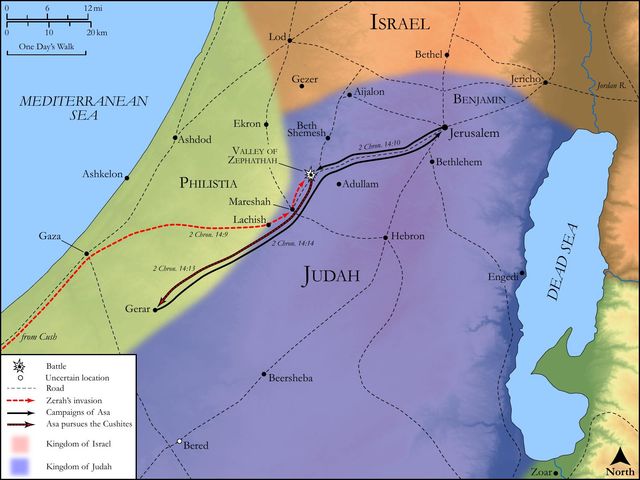
The "Ethiopians" referenced in this verse are the Cushites, inhabitants of the ancient kingdom of Cush (Nubia), located south of Egypt. Cush was a formidable power in the ancient Near East, renowned for its military prowess, particularly its skilled chariotry and large armies. Zerah, identified as "the Cushite," was likely a significant military commander or even a king, leading this vast invasion force. The reported size of the Cushite army—a million men and three hundred chariots—is often interpreted by scholars as either a hyperbolic expression to underscore the overwhelming odds Judah faced, or a reflection of the vast, diverse forces that could be mustered by a major ancient empire, potentially including numerous allied contingents. For Judah, a relatively small kingdom, confronting such a powerful and distant empire represented an unparalleled existential threat. The battle took place in the Valley of Zephathah, near Mareshah, a strategically important location in the Shephelah (lowlands) of Judah, indicating that the Cushite invasion had penetrated deep into Judahite territory. This historical confrontation vividly illustrates the extreme vulnerability of Judah and highlights the extraordinary nature of their deliverance, which, within the cultural and theological framework of ancient Israel, would have been attributed solely to direct divine intervention.
Key Themes
ShowHideThe central theme powerfully underscored by 2 Chronicles 14:12 is Divine Intervention in direct response to human faith and obedience. The Chronicler consistently emphasizes God's active involvement in the affairs of His people, especially when they seek Him wholeheartedly and walk in His ways. This verse vividly illustrates that it was God who "smote" the enemy, not Asa or Judah, thereby emphasizing God's absolute sovereignty over nations and His willingness to fight for those who trust Him. Closely related is the profound theme of The Power of Faith and Prayer. Asa's desperate, humble, and faith-filled prayer in 2 Chronicles 14:11 is explicitly presented as the direct catalyst for God's miraculous action, demonstrating that true strength and victory do not lie in human numbers, military might, or strategic genius, but in absolute reliance on God. This echoes timeless biblical truths found in passages like Psalm 20:7 and Psalm 33:16-17. Finally, the narrative powerfully reinforces the Chronicler's pervasive Retribution Theology, where obedience to God and wholehearted seeking of Him lead directly to blessing, protection, and deliverance, while disobedience inevitably leads to judgment or hardship. Asa's earlier reforms and commitment to God's covenant set the stage for this extraordinary divine favor.
Exposition and Analysis
ShowHideKey Word Analysis
ShowHideThis verb (H5062) carries significant theological weight, often describing a divine striking, plague, or a supernatural defeat directly inflicted by God. As per the Ground Truth Strong's Data, it means "to push, gore, defeat, stub (the toe), inflict (a disease); beat, dash, hurt, plague, slay, smite (down), strike, stumble, [idiom] surely, put to the worse." Its use here emphatically states that the victory was not a result of Judah's military prowess or strategic brilliance, but a direct, powerful, and decisive act of God's hand, demonstrating His judgment and overwhelming power against the enemy.
This term (H3569) refers to the Cushites, inhabitants of ancient Cush (Nubia), a powerful kingdom south of Egypt, consistently associated with formidable military strength and vast armies in ancient Near Eastern accounts. As per the Ground Truth Strong's Data, it is "patronymically from כּוּשׁ; a Cushite, or descendant of Cush; Cushi, Cushite, Ethiopian(-s)." Their defeat by divine intervention, rather than by human might, highlights the omnipotence of the God of Israel, who can overcome even the most imposing earthly powers, regardless of their size or reputation.
This verb (H5127) describes a rapid, panicked flight, indicating a complete rout and utter disarray. As per the Ground Truth Strong's Data, it means "to flit, i.e. vanish away (subside, escape; causatively, chase, impel, deliver); [idiom] abate, away, be displayed, (make to) flee (away, -ing), put to flight, [idiom] hide, lift up a standard." It signifies not merely a retreat but a decisive and irreversible defeat. The fact that the mighty Cushite army "fled" before a much smaller Judahite force, immediately after God "smote" them, emphasizes the supernatural nature of their collapse and the completeness of God's victory.
Verse Breakdown
ShowHide"So the LORD smote the Ethiopians"
This opening clause immediately attributes the decisive victory to divine agency. The conjunction "So" (וַיִּגַּף, vayyiggaph) serves as a direct link, establishing a clear cause-and-effect relationship between Asa's fervent prayer in the preceding verse and God's powerful intervention. The use of "smote" (נָגַף, nagaph) underscores the supernatural, devastating blow delivered by God Himself, not by human hands or military strategy. It was a direct, overwhelming act of divine judgment and power against the invading army, demonstrating God's absolute sovereignty over the outcome of battles.
"before Asa, and before Judah;"
This phrase signifies that the miraculous victory was publicly witnessed and experienced by both the king and his people. The preposition "before" (לִפְנֵי, lipnêy) implies that the utter defeat of the Cushites occurred in their presence, making God's intervention undeniable and serving as a powerful, visible demonstration of His covenant faithfulness. This public display of divine power validated Asa's leadership, affirmed his faith, and profoundly strengthened the faith of Judah, assuring them that their God actively fights for them.
"and the Ethiopians fled."
This final clause describes the immediate, complete, and humiliating consequence of God's "smiting." The powerful Cushite army, which had advanced with such confidence and overwhelming numbers, was utterly broken, dispersed, and fled in disarray. This flight was not a strategic retreat but a panicked, chaotic rout, signifying their decisive and irreversible defeat. The brevity and directness of this statement powerfully convey the suddenness and totality of their collapse, directly brought about by the Lord's hand.
Literary Devices
ShowHideThe Chronicler masterfully employs several literary devices in 2 Chronicles 14:12 to amplify its profound theological message. Divine Intervention is the overarching and most prominent theme, explicitly stated with the declarative phrase "the LORD smote the Ethiopians," leaving no doubt that God is the primary actor and source of victory. This divine action stands in stark Contrast to the overwhelming numerical superiority of the Cushite army (a million men against Judah's much smaller force), thereby highlighting the vast disparity between human weakness and divine omnipotence. The narrative also utilizes Hyperbole in describing the immense size of the Cushite army, which serves to magnify the miraculous nature of God's deliverance and underscore the utter impossibility of a human victory. The swiftness and completeness of the Cushites' flight ("and the Ethiopians fled") create a sense of Dramatic Irony, as the mighty invaders, who expected an easy conquest, are suddenly reduced to panicked refugees by an unseen divine force. Furthermore, this passage functions as a Theophany in action, where God's power and presence are revealed not through a visible manifestation but through His direct, tangible, and devastating impact on the battlefield, demonstrating His active rule over human affairs.
Theological and Thematic Connections
ShowHideThe victory recounted in 2 Chronicles 14:12 stands as a powerful and enduring theological statement about God's active sovereignty, His unwavering faithfulness, and His profound responsiveness to the genuine faith of His people. It teaches us that true security, deliverance, and ultimate triumph come not from human strength, military might, or numerical superiority, but from absolute and humble dependence on the Lord. When faced with seemingly impossible odds or overwhelming adversaries, the appropriate and most effective response for God's people is fervent, humble prayer and unwavering trust, for God delights in demonstrating His limitless power through their weakness and helplessness. This extraordinary event underscores God's character as a covenant-keeping God who actively fights for His own, fulfilling His promises of protection and blessing to those who walk in obedience and seek Him with all their heart. It serves as a timeless reminder that no adversary is too great, no challenge too insurmountable, for the God who smites nations and delivers His chosen.
Reflection and Application
ShowHideThe narrative of Asa's miraculous victory in 2 Chronicles 14:12 offers profound encouragement and vital practical guidance for believers navigating the complexities of life today. We frequently encounter "Cushite armies" in our own lives—overwhelming challenges, seemingly insurmountable obstacles, or formidable adversaries that threaten to consume us. These can manifest as crippling financial crises, debilitating health struggles, intractable relational conflicts, intense spiritual attacks, or overwhelming societal pressures. Like King Asa, our natural inclination might be to first assess our own limited resources, meticulously strategize based on human wisdom, or even succumb to despair. However, this verse powerfully redirects our gaze from our inherent limitations and finite capabilities to the limitless, omnipotent power of God. It issues a profound call to cultivate a radical dependence on Him, to bring our impossible situations before Him in humble, fervent, and persistent prayer, and to trust with unwavering faith that He is truly able to "smite" our enemies and deliver us. This spiritual posture does not negate the importance of wise planning, diligent effort, or responsible action, but it unequivocally prioritizes seeking God's divine intervention above all else. It serves as a timeless and comforting reminder that the ultimate battle belongs to the Lord, and He delights in demonstrating His power through our weakness, all to His glory.
Questions for Reflection
ShowHideFAQ
ShowHideWas the Cushite army really a million strong?
ShowHideThe figure of a million men for Zerah's army (2 Chronicles 14:9) is indeed exceptionally large and has been a subject of considerable scholarly discussion. While ancient texts, particularly historical narratives, sometimes employed numbers hyperbolically to emphasize the sheer magnitude of a threat or the miraculous nature of a victory, it is also plausible that "a million" represents a vast coalition of forces, including various allied contingents from different regions, or a rounded-up, generalized estimate of an incredibly large host. Regardless of the precise literal count, the Chronicler's theological intention is abundantly clear: to portray an army so overwhelmingly massive that Judah's subsequent victory could only be attributed to a miraculous, direct divine intervention, thereby powerfully underscoring God's ability to save "whether with many, or with them that have no power" (2 Chronicles 14:11).
What was the significance of Asa's prayer in 2 Chronicles 14:11 for this victory?
ShowHideAsa's prayer was absolutely pivotal and of paramount significance. It served as a profound demonstration of his deep faith and complete dependence on God in the face of insurmountable odds. In his prayer, Asa humbly acknowledged Judah's utter helplessness ("we have no might against this great company") and simultaneously declared God's omnipotence ("it is nothing with You to help, whether with many, or with them that have no power"). This prayer was not a last-ditch effort born of desperation, but a bold declaration of trust, aligning Asa's will and Judah's fate with God's sovereign power. The Chronicler explicitly links God's "smiting" the Cushites in 2 Chronicles 14:12 as a direct and immediate response to this specific, faith-filled prayer, highlighting the enduring biblical principle that God actively responds to the sincere faith, humble cries, and obedient seeking of His people. It powerfully underscores that spiritual victory and reliance on God often precede and enable military or physical triumph.
How does this event relate to God's character?
ShowHideThis extraordinary event profoundly reveals several crucial aspects of God's character. First, it showcases His sovereignty and omnipotence, demonstrating unequivocally that He is able to overcome any earthly power, no matter how formidable or numerous, with effortless ease. Second, it highlights His unwavering faithfulness to His covenant with His people; when they seek Him wholeheartedly and walk in obedience to His commands (as King Asa had diligently done through his reforms), He acts decisively on His behalf. Third, it reveals His profound compassion and willingness to intervene for those who humble themselves, acknowledge their weakness, and place their trust entirely in Him, even when they are weak, outnumbered, and seemingly helpless. Finally, and perhaps most importantly, it emphasizes His glory, as the victory is so clearly His alone, ensuring that all praise, honor, and adoration are directed solely to Him, rather than to human strength, strategic brilliance, or military might.
Christ-Centered Fulfillment
ShowHideThe dramatic victory of 2 Chronicles 14:12, where the Lord "smote" the overwhelming Cushite army in direct response to King Asa's faith and prayer, serves as a powerful and compelling foreshadowing of the ultimate and decisive victory achieved by Jesus Christ. King Asa, as a righteous king who faithfully led his people in seeking God, functions as a type of the greater King, Jesus, who not only leads His people in faith but is the very embodiment of God's saving power and divine intervention. Just as God intervened to deliver Judah from a physical, military enemy, Christ, through His perfect life, atoning death, and glorious resurrection, has delivered humanity from a far greater, spiritual enemy: the dominion of sin, the sting of death, and the power of the devil. The "smiting" of the Cushites finds its ultimate and complete fulfillment in Christ's triumph over the spiritual powers of darkness on the cross, where He disarmed the rulers and authorities and put them to open shame, by triumphing over them in Him. Believers, much like ancient Judah, often face overwhelming spiritual battles that are impossible to win in their own strength (Ephesians 6:12). However, through faith in Christ, we are supernaturally united with Him and participate in His already-won victory. Our "prayer" is our complete reliance on His finished work on the cross and His ongoing, eternal intercession for us as our great High Priest at the right hand of God. The panicked flight and utter rout of the Cushites before God's power prefigures the ultimate and eternal defeat of all God's enemies, and indeed, the casting down of Satan himself, the accuser of the brethren (Revelation 12:10). Thus, 2 Chronicles 14:12 powerfully points us to Jesus, the Lamb of God who takes away the sin of the world and the conquering Lion of Judah who has definitively overcome all, assuring us that in Him, the victory is always, eternally ours.