


Psalms 60:12
Bible text: King James Version (1769 Blayney text) · Public domain
Bible text: Berean Standard Bible · Public domain
Bible text: American Standard Version (1901) · Public domain
Bible text: World English Bible, Messianic edition · Public domain
Bible text: Geneva Bible (1599) · Public domain
Bible text: Young's Literal Translation · Public domain
- בֵּאלֹהִיםbe·lo·Himin GodH430Prep-b ¦ N-mpNoun Plural Masculine AbsoluteבֵּinאלֹהִיםGod
- נַעֲשֶׂהna·'a·sehwe will doH6213V-Qal-Imperf-1cpVerb Qal Imperfect 1st Plural common gender
- חָיִלCha·yilstrengthH2428N-msNoun Singular Masculine Absolute
- וְהוּאve·Hu'and heH1931Conj-w ¦ Pro-3msPronoun Personal 3rd Singular Masculineוְandהוּאhe
- יָבוּסya·Vushe will tread downH947V-Qal-Imperf-3msVerb Qal Imperfect 3rd Singular Masculine
- צָרֵינוּtza·Rei·nuour opponentsH6862N-mpc ¦ 1cpNoun Plural Masculine Constructצָרֵיopponentsנוּour
English is a literal word-by-word gloss of the Hebrew, not the KJV's wording. Why?
This is the original text the KJV's translators worked from — each Hebrew word with its own literal English meaning in this verse, prepared by scholars at Tyndale House, Cambridge. The KJV translates whole sentences, not word by word, so its wording differs: one Hebrew word can become several English words, and the KJV may choose “the LORD” where the gloss reads “Yahweh”. Both are faithful — they answer different questions. For the KJV's own rendering, switch to the KJV text.
Details
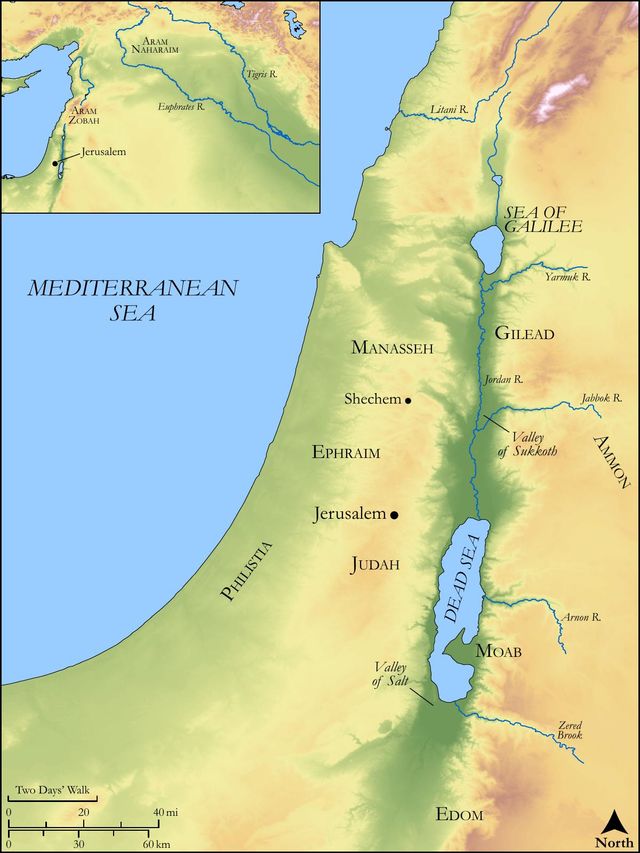
See on the biblical-era map
Study this verse
Public-domain commentary
Matthew Henry
From his Commentary on the Whole Bible. Henry comments on passages, not single verses — this entry covers Psalms 60:6–12. His three-level outline is real structure in the source text, so it is rendered as structure.
David is here rejoicing in hope and praying in hope; such are the triumphs of the saints, not so much upon the account of what they have in possession as of what they have in prospect (Psa 60:6): "God has spoken in his holiness (that is, he has given me his word of promise, has sworn by his holiness, and he will not lie unto David, Psa 89:35), therefore I will rejoice, and please myself with the hopes of the performance of the promise, which was intended for more than a pleasing promise," Note, God's word of promise, being a firm foundation of hope, is a full fountain of joy to all believers.
I.David here rejoices; and it is in prospect of two things: -
1.The perfecting of this revolution in his own kingdom. God having spoken in his holiness that David shall be king, he doubts not but the kingdom is all his own, as sure as if it were already in his hand: I will divide Shechem (a pleasant city in Mount Ephraim) and mete out the valley of Succoth, as my own. Gilead is mine, and Manasseh is mine, and both are entirely reduced, Psa 60:7. Ephraim would furnish him with soldiers for his life-guards and his standing forces; Judah would furnish him with able judges for his courts of justice; and thus Ephraim would be the strength of his head and Judah his lawgiver. Thus may an active believer triumph in the promises, and take the comfort of all the good contained in them; for they are all yea and amen in Christ. "God has spoken in his holiness, and then pardon is mine, peace mine, grace mine, Christ mine, heaven mine, God himself mine." All is yours, for you are Christ's, Co1 3:22, Co1 3:23.
2.The conquering of the neighbouring nations, which had been vexatious to Israel, were still dangerous, and opposed the throne of David, Psa 60:8. Moab shall be enslaved, and put to the meanest drudgery. The Moabites became David's servants, Sa2 8:2. Edom shall be made a dunghill to throw old shoes upon; at least David shall take possession of it as his own, which was signified by drawing off his shoe over it, Rut 4:7. As for the Philistines, let them, if they dare, triumph over him as they had done; he will soon force them to change their note. Rather let those that know their own interest triumph because of him; for it would be the greatest kindness imaginable to them to be brought into subjection to David and communion with Israel. But the war is not yet brought to an end; there is a strong city, Rabbah (perhaps) of the children of Ammon, which yet holds out; Edom is not yet subdued. Now,
(1.)David is here enquiring for help to carry on the ark: "Who will bring me into the strong city? What allies, what auxiliaries, can I depend upon, to make me master of the enemies' country and their strongholds?" Those that have begun a good work cannot but desire to make a thorough work of it, and to bring it to perfection.
(2.)He is expecting it from God only: "Wilt not thou, O God? For thou hast spoken in thy holiness; and wilt not thou be as good as thy word?" He takes notice of the frowns of Providence they had been under: Thou hadst, in appearance, cast us off; thou didst not go forth with our armies. When they were defeated and met with disappointments, they owned it was because they wanted (that is, because they had forfeited) the gracious presence of God with them; yet they do not therefore fly off from him, but rather take so much the faster hold of him; and the less he has done for them of late the more they hoped he would do. At the same time that they own God's justice in what was past they hope in his mercy for what was to come: "Though thou hadst cast us off, yet thou wilt not contend for ever, thou wilt not always chide; though thou hadst cast us off, yet thou hast begun to show mercy; and wilt thou not perfect what thou hast begun?" The Son of David, in his sufferings, seemed to be cast off by his Father when he cried out, Why hast thou forsaken me? and yet even then he obtained a glorious victory over the powers of darkness and their strong city, a victory which will undoubtedly be completed at last; for he has gone forth conquering and to conquer. The Israel of God, his spiritual Israel, are likewise, through him, more than conquerors. Though sometimes they may be tempted to think that God has cast them off, and may be foiled in particular conflicts, yet God will bring them into the strong city at last. Vincimur in praelio, sed non in bello - We are foiled in a battle, but not in the whole war. A lively faith in the promise will assure us, not only that the God of peace shall tread Satan under our feet shortly, but that it is our Father's good pleasure to give us the kingdom.
II.He prays in hope.
His prayer is, Give us help from trouble, Psa 60:11. Even in the day of their triumph they see themselves in trouble, because still in war, which is troublesome even to the prevailing side. None therefore can delight in war but those that love to fish in troubled waters. The help from trouble they pray for is preservation from those they were at war with. Though now they were conquerors, yet (so uncertain are the issues of war), unless God gave them help in the next engagement, they might be defeated; therefore, Lord, send us help from the sanctuary. Help from trouble is rest from war, which they prayed for, as those that contended for equity, not for victory. Sic quaerimus pacem - Thus we seek for peace. The hope with which they support themselves in this prayer has two things in it: - 1. A diffidence of themselves and all their creature-confidences: Vain is the help of man. Then only we are qualified to receive help from God when we are brought to own the insufficiency of all creatures to do that for us which we expect him to do. 2. A confidence in God, and in his power and promise (Psa 60:12): "Through God we shall do valiantly, and so we shall do victoriously; for he it is, and he only, that shall tread down our enemies, and shall have the praise of doing it." Note, (1.) Our confidence in God must be so far from superseding that it must encourage and quicken our endeavours in the way of our duty. Though it is God that performs all things for us, yet there is something to be done by us. (2.) Hope in God is the best principle of true courage. Those that do their duty under his conduct may afford to do it valiantly; for what need those fear who have God on their side? (3.) It is only through God, and by the influence of his grace, that we do valiantly; it is he that puts strength into us, and inspires us, who of ourselves are weak and timorous, with courage and resolution. (4.) Though we do ever so valiantly, the success must be attributed entirely to him; for he it is that shall tread down our enemies, and not we ourselves. All our victories, as well as our valour, are from him, and therefore at his feet all our crown must be cast.
Historical interpretation
Two Centuries of Reception
4 surviving comments on this verse. Each one is dated, so this reads as a timeline rather than a list.
Select a marker to jump to its quote. Markers stagger vertically where authors wrote within a few decades of each other.
Would a man who was only a man say this of himself? For if a person says this, he blasphemes, and “God does not hear sinners.” But indeed Christ says that God hears him. He is therefore neither sinner nor mere man. It has also been said, “Vain is the hope in man.” And it is said, “As for us we hope in our God.”Christ is therefore God, not coming from any other substance; “the Father is living, and I live because of the Father,” and, “I am the bread of life; the one who eats this will live for all time.” All the statements signify one substance. And that is why Jesus says that he is from above who says this: “If therefore you will see the Son of man ascending, where was he before?”
Therefore, let the church of God be saluted and let it be taught to say what we were just saying: “Give us help from trouble; for the help of people is worthless.” So, perhaps, the meaning of the psalm does not at all permit us to allege weakness, if indeed affliction is a patron of help and not an occasion of infirmity. To those, then, who were rejected through sin but then received again through the kindness of God, it is appropriate to say, “O God, you have cast us off and have destroyed us; you have been angry and have had mercy on us.”
"In God we will do valour, and Himself to nothing shall bring down our enemies." We will not do valour with the sword, not with horses, not with breastplates, not with shields, not in the mightiness of an army, not abroad. But where? Within, where we are not seen. Where within? "In God we will do virtue:" and as if abjects, and as if trodden down, men as if of no consideration we shall be, but "Himself to nothing shall bring down our enemies." In a word, this thing has been done to our enemies. Trodden down have been the Martyrs: by suffering, by enduring, by persevering even unto the end, in God they have done valour. Himself also has done that which follows: to nothing He has brought down the enemies of them. Where are now the enemies of the Martyrs, except perchance that now drunken men with their cups do persecute those whom at that time frenzied men did use with stones to persecute?
For the Spirit of the Lord did not say, he who does the truth, that his works be clearly seen as done in the Holy Spirit but “as done in God,” which we say are done not in the Father alone, or in the Son alone or in the Holy Spirit alone. But we confess that the truth is done by a human being in the holy Trinity itself, which is one God, in whom the blessed David indicates is the power of what is done by the faithful, saying, “With God we shall do valiantly; it is he who will tread down our foes.” For he is the one God concerning whom the blessed apostle says, “For from him and through him and for him are all things. To him be glory forever.”
Continue studying Psalms 60:12 across the web’s major study libraries — every link below opens this exact verse, chapter, or book on the destination site.
Read & Compare
 BibleGatewayThis verse in more than 200 translations and 70 languages.
 Bible.comThe YouVersion reader — hundreds of translations, reading plans, and highlights.
 ESV.orgCrossway's official English Standard Version reader.
 NET BibleThe NET translation with 60,000+ translators' notes on every rendering decision.
 STEP BibleTyndale House's free study tool — original text, vocabulary, and scholarly resources.
 BibliaLogos Bible Software's free web reader.
 USCCBThe New American Bible (Revised Edition) with the U.S. bishops' study notes.
Commentaries
 BibleHub CommentariesDozens of classic commentaries on this verse, gathered on one page.
 StudyLightMore than 100 commentary sets — the largest collection on the web.
 BibleRefPlain-English commentary on what this verse means, verse by verse.
 Enduring WordDavid Guzik's free commentary on this chapter, widely used by Bible teachers.
 Bible Study ToolsVerse commentary alongside Greek and Hebrew study aids.
Original Language & Research
- BibleHub InterlinearThe verse word by word — original language, transliteration, and English.
- BibleHub LexiconEvery word's original-language definition and Strong's entry.
 Blue Letter BibleDeep-study tools — Strong's numbers, concordance, and word studies.
 SefariaThe Hebrew text with Rashi and centuries of Jewish commentary.
Sermons, Hymns & Audio


TrulyRandomVerse is not affiliated with these sites and doesn’t control their content. They’re linked because they’re genuinely useful.
Summary
Psalms 60:12 stands as a profound declaration of unwavering faith and a pivotal turning point within a psalm that transitions from deep national lament to resolute hope. This verse encapsulates the Psalmist's ultimate trust in God's sovereign ability to deliver and grant decisive victory, even in the aftermath of military defeat and humiliation. It proclaims that true strength, valor, and triumph over adversaries are found not in human might or strategic prowess, but solely through divine empowerment and the direct intervention of the Almighty.
Context
ShowHideLiterary Context
Psalm 60 is a communal lament, commencing with a vivid portrayal of national distress, divine abandonment, and military defeat (verses 1-5). The initial verses paint a stark picture of Israel's brokenness, describing God's apparent rejection ("You have rejected us, O God; you have broken our defenses") and the resulting societal upheaval ("You have made the land quake; you have torn it open"). However, the psalm undergoes a remarkable theological and emotional transformation. Following a remembrance of God's past covenant promises and sovereign claims over the nations (verses 6-8), and a renewed, desperate plea for divine intervention against their current foes (verses 9-11), verse 12 bursts forth as a climactic declaration of confident resolution. This verse marks the psalm's triumphant pivot, transforming its tone from despair and supplication to an assured expectation of victory, demonstrating the dynamic journey of faith from lament to confident trust in God's ultimate power.
Historical & Cultural Context
The superscription of Psalm 60 provides crucial historical context, attributing it to David "when he fought with Mesopotamia and Aram-zobah, and Joab returned, and smote of Edom in the valley of salt twelve thousand." This situates the psalm during a period of intense military conflict and national vulnerability for Israel. The "Valley of Salt" (likely a rift valley near the Dead Sea) was the site of a significant and humiliating defeat for Israel against Edom, a long-standing adversary. Among the nations, a people's military success or failure was often interpreted as a direct reflection of the power and favor of its gods. Thus, a defeat like the one at the Valley of Salt would have led to profound theological questioning, a sense of divine abandonment, and deep national shame. Against this backdrop of perceived divine rejection and military humiliation, the declaration of faith in verse 12 is all the more striking, serving as a powerful reassertion of Yahweh's ultimate sovereignty and an act of defiant trust in His redemptive power, despite the dire circumstances.
Key Themes
ShowHidePsalms 60:12 contributes significantly to several overarching themes within the Psalter and the broader biblical narrative. The primary theme is Divine Empowerment, asserting that genuine strength, valor, and the ability to "do valiantly" originate solely "through God," not human prowess or military might. This aligns with the pervasive biblical principle that God is the ultimate source of all power and victory, as powerfully illustrated in the Lord's miraculous deliverance of Israel from Egypt at the Red Sea or the supernatural strength granted to Samson to defeat his enemies in Judges 15:14-15. Another key theme is Unwavering Faith in Adversity. Despite the initial lament and the historical context of a devastating defeat, the Psalmist expresses resolute confidence that God will intervene and "tread down our enemies," exemplifying a faith that perseveres and declares victory even when circumstances appear bleak. This echoes the profound sentiment found in Habakkuk 3:17-19, where the prophet finds joy in the Lord even amidst utter desolation. Finally, the verse underscores God as the Sovereign Conqueror, emphasizing His active, personal, and decisive role in subduing adversaries. He is not merely assisting human efforts but performing the ultimate act of victory Himself, a divine initiative that is a recurring motif from God's promise to fight for Israel in Exodus 14:14 to the ultimate triumph over spiritual foes.
Exposition and Analysis
ShowHideKey Word Analysis
ShowHideThis plural noun, used here with a singular verbal agreement, refers specifically to the supreme God, Yahweh. Its usage underscores His absolute sovereignty, power, and uniqueness as the true Deity, in contrast to the false gods of surrounding nations. In this context, it emphasizes that the source of Israel's strength and victory is none other than the one, true, omnipotent God, not human armies or strategies.
This rich Hebrew term denotes strength, might, valor, effectiveness, and even prosperity or wealth. In a military context, as here, it signifies the ability to perform mighty deeds, to act with decisive power, and to achieve success. Paired with "through God," it signifies a divinely endowed capability to overcome obstacles and achieve victory, implying not just bravery but actual, effective, and triumphant power. It speaks to a divinely enabled capacity for heroic action and successful outcome.
This primitive root means to trample, to tread underfoot, or to crush. It is a strong, vivid image often used in the Old Testament to depict the complete subjugation, humiliation, and destruction of enemies, much like grapes are trodden in a winepress or dirt beneath one's feet. It implies a decisive, overwhelming, and utterly conclusive victory where the enemy is rendered powerless, brought to nothing, and utterly disgraced.
Verse Breakdown
ShowHide"Through God we shall do valiantly"
This opening clause immediately identifies the singular, indispensable source of all strength, valor, and success. The "we" refers to the community of Israel, who, despite their recent crushing defeat, boldly declare their future capability to act with valor and achieve victory. The crucial preposition "through" (בְּ, be) signifies instrumentality – it is by means of, in the power of, or in union with God that they will accomplish great deeds. This is a profound declaration of absolute dependence and divine empowerment, shifting the focus entirely from human weakness and past failures to God's limitless omnipotence. It is a faith statement that anticipates future triumph based on God's character.
"for he [it is that] shall tread down our enemies"
This second clause provides the foundational reason and absolute assurance for the first. The causal conjunction "for" (כִּי, ki) introduces the ground of their confidence. The emphatic "he [it is that]" underscores God's personal, active, and decisive involvement. It is not merely that God will assist them in their fight, but that He Himself will perform the ultimate, decisive act of crushing their adversaries. The future tense "shall tread down" expresses certainty and prophetic assurance, promising a complete, overwhelming, and irreversible victory over all opposition, reinforcing God as the active agent of triumph.
Literary Devices
ShowHideThe verse employs several potent literary devices that amplify its message. Contrast is profoundly evident in its placement within Psalm 60, moving from the deep lament and sense of divine abandonment in the opening verses to this bold, confident declaration of assured victory. This stark shift highlights the transformative power of faith that reorients perspective from human failure to divine sovereignty. The phrase "shall tread down our enemies" utilizes vivid Imagery, evoking a powerful visual of complete subjugation and decisive triumph, akin to trampling grapes in a winepress or crushing an opponent underfoot. This imagery also functions as a Metaphor for God's overwhelming power to utterly defeat all opposition. Furthermore, the entire verse functions as a powerful Declaration of faith, a confident assertion of future reality based entirely on God's character and power, serving as a rallying cry for a disheartened nation and a testament to the unwavering hope of the Psalmist.
Theological and Thematic Connections
ShowHidePsalms 60:12 is a profound theological statement on divine sovereignty and the nature of true strength. It teaches that human capability, especially in the face of overwhelming odds and apparent defeat, is not inherent but ultimately derived from God. This principle transcends the specific military context of the psalm, applying to all forms of struggle—personal spiritual battles, communal challenges, or societal injustices. It underscores that God is not merely an ally or a helper, but the ultimate source of victory, actively engaging to subdue all that opposes His people and His righteous purposes. This truth empowers believers across generations to face formidable challenges with courage, knowing that their ultimate triumph rests in God's hands, who fights on their behalf and through them.
Reflection and Application
ShowHidePsalms 60:12 offers immense encouragement and a vital lesson for believers navigating life's myriad battles. It calls us to shift our focus from the daunting magnitude of our problems or the apparent strength of our adversaries to the omnipotence of God. When we feel overwhelmed, defeated, or abandoned by circumstances, this verse reminds us that our capacity to "do valiantly" in any sphere of life—whether it's overcoming persistent sin, enduring profound hardship, faithfully pursuing a divine calling, or confronting pervasive injustice—is not predicated on our own limited strength but on the limitless, enabling power of God working through us. It invites us to declare victory by faith even before it is visibly manifested, trusting that God Himself will decisively "tread down" every spiritual, emotional, and circumstantial enemy that stands in the way of His perfect will for our lives. This perspective transforms despair into hopeful expectation, enabling us to act with courage, conviction, and perseverance, knowing that the ultimate triumph in every battle belongs to Him.
Questions for Reflection
ShowHideFAQ
ShowHideHow can the Psalmist declare such confidence in God's victory immediately after describing a national defeat?
ShowHideThe shift from lament to confident declaration in Psalms 60:12 is a hallmark of many psalms and reflects a profound theological journey rather than a denial of reality. It is not an expression of naive optimism but an act of faith that transcends current, painful circumstances. Despite the historical setback at the "Valley of Salt" (mentioned in the superscription, Psalms 60), the Psalmist remembers God's covenant promises and His past faithfulness (as alluded to in Psalms 60:6-8). This remembrance fuels a renewed trust in God's unchanging character as a deliverer and a warrior for His people. The declaration in verse 12 is a prophetic utterance, an affirmation that God's ultimate power and purpose will prevail, regardless of temporary setbacks. It's a testament to the transformative power of faith, moving from a truthful acknowledgment of pain to a resolute expectation of divine intervention, echoing the profound sentiment of Job 13:15.
Christ-Centered Fulfillment
ShowHidePsalms 60:12 finds its ultimate and most profound fulfillment in the person and work of Jesus Christ. The declaration "Through God we shall do valiantly" points forward to the new covenant reality where believers are empowered by the Holy Spirit, enabling them to "do valiantly" not in physical warfare, but in the spiritual battle against sin, death, and the devil. Christ Himself is the embodiment of God's power made manifest, allowing His followers to "do all things through Christ who strengthens" them, as powerfully affirmed in Philippians 4:13. Furthermore, the promise that God "shall tread down our enemies" is definitively fulfilled in Christ's victory on the cross and His glorious resurrection. Through His atoning sacrifice, Jesus decisively triumphed over the ultimate enemies of humanity: sin (Hebrews 9:26), death (1 Corinthians 15:54-57), and Satan (Colossians 2:15). Believers, united with Christ through faith, now participate in this already-won victory, living in the assurance that the "God of peace will soon crush Satan under your feet" (Romans 16:20), signifying the spiritual triumph over all opposing forces through the power of the resurrected Lord.