


1 Kings 22:47
- וּמֶלֶךְu·Me·lekhand [was] a kingH4428Conj-w ¦ N-msNoun Singular Masculine Absoluteוּandמֶלֶךְ[was] a king
- אֵין'einthere notH369N-mscNoun Singular Masculine Construct
- בֶּאֱדוֹםbe·'e·Domin EdomH123Prep-b ¦ N-proper-mNoun Proper MasculineבֶּinאֱדוֹםEdom
- נִצָּבni·Tzava deputyH5324V-Niphal-Prtcpl-msVerb Niphal Participle Singular Masculine Absolute
- מֶלֶךְMe·lekh[was] kingH4428N-msNoun Singular Masculine Absolute
English is a literal word-by-word gloss of the Hebrew, not the KJV's wording. Why?
This is the original text the KJV's translators worked from — each Hebrew word with its own literal English meaning in this verse, prepared by scholars at Tyndale House, Cambridge. The KJV translates whole sentences, not word by word, so its wording differs: one Hebrew word can become several English words, and the KJV may choose “the LORD” where the gloss reads “Yahweh”. Both are faithful — they answer different questions. For the KJV's own rendering, switch to the KJV text.
Details
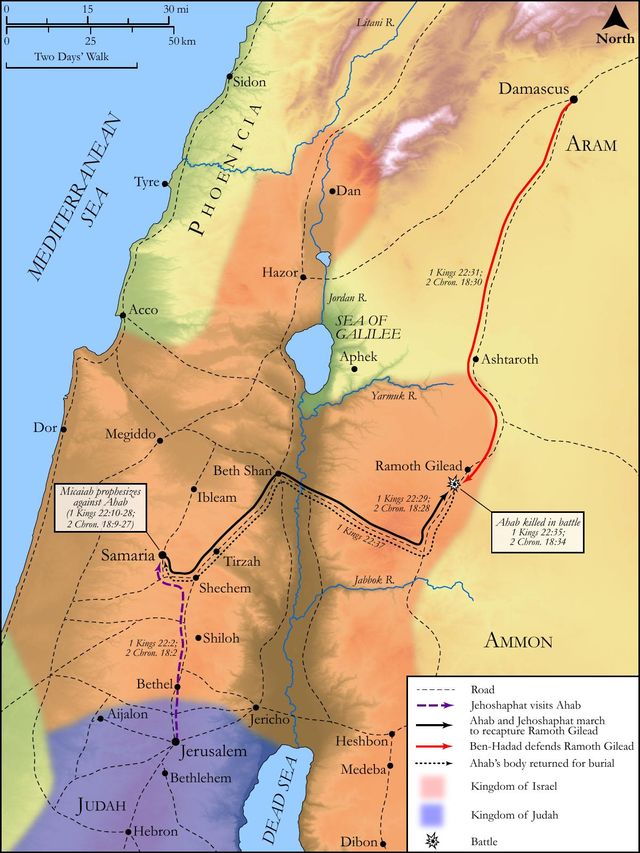
See on the biblical-era maps

Study this verse
Public-domain commentary
Matthew Henry
From his Commentary on the Whole Bible. Henry comments on passages, not single verses — this entry covers 1 Kings 22:41–53.
Here is, I. A short account of the reign of Jehoshaphat king of Judah, of which we shall have a much fuller narrative in the book of Chronicles, and of the greatness and goodness of that prince, neither of which was lessened or sullied by any thing but his intimacy with the house of Ahab, which, upon several accounts, was a diminution to him. His confederacy with Ahab in war we have already found dangerous to him, and his confederacy with Ahaziah his son in trade sped no better. He offered to go partner with him in a fleet of merchant-ships, that should fetch gold from Ophir, as Solomon's navy did, Kg1 22:49. See Ch2 20:35, Ch2 20:36. But, while they were preparing to set sail, they were exceedingly damaged and disabled by a storm (broken at Ezion-geber), which a prophet gave Jehoshaphat to understand was a rebuke to him for his league with wicked Ahaziah (Ch2 20:37); and therefore, as we are told here (Kg1 22:49), when Ahaziah desired a second time to be a partner with him, or, if that could not be obtained, that he might but send his servants with some effects of board Jehoshaphat's ships, he refused: Jehoshaphat would not. The rod of God, expounded by the word of God, had effectually broken him off from his confederacy with that ungodly unhappy prince. Better buy wisdom dear than be without it; but experience is therefore said to be the mistress of fools because those are fools that will not learn till they are taught by experience, and particularly till they are taught the danger of associating with wicked people. Now Jehoshaphat's reign appears here to have been none of the longest, but one of the best. 1. It was none of the longest, for he reigned but twenty-five years (Kg1 22:42), but then it was in the prime of his time, between thirty-five and sixty, and these twenty-five, added to his father's happy forty-one, give us a grateful idea of the flourishing condition of the kingdom of Judah, and of religion in it, for a great while, even when things were very bad, upon all accounts, in the kingdom of Israel. If Jehoshaphat reigned not so long as his father, to balance this he had not those blemishes on the latter end of his reign that his father had (Ch2 16:9, Ch2 16:10, Ch2 16:12), and it is better for a man that has been in reputation for wisdom and honour to die in the midst of it than to outlive it. 2. Yet is was one of the best, both in respect of piety and prosperity. (1.) He did well: He did that which was right in the eyes of the Lord (Kg1 22:43), observed the commands of his God, and trod in the steps of his good father; and he persevered therein: He turned not aside from it. Yet every man's character has some but or other, so had his; the high places were not taken away, no not out of Judah and Benjamin, though those tribes lay so near Jerusalem that they might easily bring their offerings and incense to the altar there, and could not pretend, as some other of the tribes, the inconveniency of lying remote. But old corruptions are with difficulty rooted out, especially when they have formerly had the patronage of those that were good, as the high places had of Samuel, Solomon, and some others. (2.) His affairs did well. He prevented the mischiefs which had attended their wars with the kingdom of Israel, establishing a lasting peace (Kg1 22:44), which would have been a greater blessing if he had contented himself with a peace, and not carried it on to an affinity with Israel; he put a deputy, or viceroy, in Edom, so that the kingdom was tributary to him (Kg1 22:47), and therein the prophecy concerning Esau and Jacob was fulfilled, that the elder should serve the younger. And, in general, mention is made of his might and his wars, Kg1 22:45. He pleased God, and God blessed him with strength and success. His death is spoken of (Kg1 22:50), to shut up his story, yet, in the history of the kings of Israel, we find mention of him afterwards, Kg2 3:7.
II.The beginning of the story of Ahaziah the son of Ahab, Kg1 22:51-53.
His reign was very short, not two years. Some sinners God makes quick work with. It is a very bad character that is here given him. He not only kept up Jeroboam's idolatry, but the worship of Baal likewise; though he had heard of the ruin of Jeroboam's family, and had seen his own father drawn into destruction by the prophets of Baal, who had often been proved false prophets, yet he received no instruction, took no warning, but followed the example of his wicked father and the counsel of his more wicked mother Jezebel, who was still living. Miserable are the children that not only derive a stock of corruption from their parents, but are thus taught by them to trade with it; and unhappy, most unhappy parents, are those that help to damn their children's souls.
Continue studying 1 Kings 22:47 across the web’s major study libraries — every link below opens this exact verse, chapter, or book on the destination site.
Read & Compare
 BibleGatewayThis verse in more than 200 translations and 70 languages.
 Bible.comThe YouVersion reader — hundreds of translations, reading plans, and highlights.
 ESV.orgCrossway's official English Standard Version reader.
 NET BibleThe NET translation with 60,000+ translators' notes on every rendering decision.
 STEP BibleTyndale House's free study tool — original text, vocabulary, and scholarly resources.
 BibliaLogos Bible Software's free web reader.
 USCCBThe New American Bible (Revised Edition) with the U.S. bishops' study notes.
Commentaries
 BibleHub CommentariesDozens of classic commentaries on this verse, gathered on one page.
 StudyLightMore than 100 commentary sets — the largest collection on the web.
 BibleRefPlain-English commentary on what this verse means, verse by verse.
 Enduring WordDavid Guzik's free commentary on this chapter, widely used by Bible teachers.
 Bible Study ToolsVerse commentary alongside Greek and Hebrew study aids.
Original Language & Research
- BibleHub InterlinearThe verse word by word — original language, transliteration, and English.
- BibleHub LexiconEvery word's original-language definition and Strong's entry.
 Blue Letter BibleDeep-study tools — Strong's numbers, concordance, and word studies.
 SefariaThe Hebrew text with Rashi and centuries of Jewish commentary.
Sermons, Hymns & Audio


TrulyRandomVerse is not affiliated with these sites and doesn’t control their content. They’re linked because they’re genuinely useful.
Summary
First Kings 22:47 serves as a concise yet profoundly significant editorial note, illuminating the geopolitical landscape of the ancient Near East during the reign of King Jehoshaphat of Judah. It reveals that Edom, a long-standing rival and descendant of Esau, was not governed by its own independent monarch but by a "deputy" appointed by Judah. This seemingly minor detail powerfully underscores Judah's continued regional dominion, reflecting the enduring legacy of David's conquests and subtly hinting at the unfolding of divine promises concerning the relationship between the descendants of Jacob and Esau. It highlights the ebb and flow of earthly power, always within the overarching framework of God's sovereign control.
Context
ShowHideLiterary Context
This verse appears as an important parenthetical comment or editorial interjection within the broader narrative of 1 Kings. It immediately follows the detailed account of King Ahab of Israel's death in battle at Ramoth-Gilead, where King Jehoshaphat of Judah had allied with him. The preceding verses 1 Kings 22:41-46 provide a summary of Jehoshaphat's righteous reign, contrasting it with the wickedness of Ahab. Verse 47, therefore, acts as a concluding political observation about Judah's sphere of influence before the narrative transitions to Jehoshaphat's death and the succession of his son, Jehoram 1 Kings 22:50. It offers a snapshot of Judah's stable and dominant position, particularly concerning its southern neighbor, Edom, before subsequent events would challenge this control.
Historical & Cultural Context
Edom, located southeast of Judah, was a mountainous kingdom inhabited by the descendants of Esau, Jacob's brother, establishing a deep-seated, often contentious, familial and national rivalry (Genesis 25:23). Historically, Edom had been subjugated by King David, who placed garrisons throughout the land and installed governors, effectively integrating it into the Israelite empire (see 2 Samuel 8:14). This verse confirms that during Jehoshaphat's reign, approximately a century and a half after David, Edom remained a vassal state. The term "deputy" (Hebrew: nâtsab) signifies an appointed official, a governor, or a military commissioner, rather than an independent, hereditary king. This arrangement ensured tribute, access to trade routes (especially via Elath on the Red Sea, though Jehoshaphat's attempt to revive this failed, as noted in 1 Kings 22:48-49), and strategic control for Judah over a vital border region.
Key Themes
ShowHideThe primary theme highlighted by this verse is Judah's Sovereignty and Dominion over its neighbors, a direct legacy of the Davidic empire. The absence of an independent Edomite king unequivocally signals their subordinate status, underscoring Judah's regional power and influence under Jehoshaphat, a king who "walked in the ways of David his father" (1 Kings 22:43). This political control also contributed to Judah's Political Stability, securing its southern flank and potentially ensuring the flow of resources or tribute. Furthermore, this subjugation of Edom by Judah subtly reinforces the ancient prophecy given to Rebekah concerning her twin sons, Jacob and Esau: "the elder shall serve the younger" (Genesis 25:23), suggesting a Fulfillment of Divine Pronouncement in the historical unfolding of the two nations' destinies, even if not a direct, explicit prophecy for this specific period.
Exposition and Analysis
ShowHideKey Word Analysis
ShowHideThis term (H4428) refers to a sovereign ruler, one who holds independent authority and hereditary right to govern a kingdom. The declaration "no king in Edom" is a direct statement of Edom's lack of independent sovereignty. It signifies that the traditional, indigenous line of Edomite kings had been suppressed or removed, and their national autonomy was curtailed. This absence of a native monarch is the very indicator of their subjugated status.
This crucial term (H5324), derived from a root meaning "to station" or "to appoint," denotes an appointed official, a governor, or a prefect. Unlike a "king," a nâtsab does not rule by inherent right or hereditary succession but by delegation from a superior power. In this context, the nâtsab in Edom was an administrator or military commander installed by the king of Judah, serving Judah's interests and ensuring Edom's continued vassalage. This word powerfully conveys the reality of Judah's imperial control over Edom at this time.
Verse Breakdown
ShowHide"[There was] then no king in Edom"
This clause definitively states the political condition of Edom during Jehoshaphat's reign. It communicates that Edom, once an independent kingdom with its own line of kings (Genesis 36:31), had lost its national autonomy. Its indigenous monarchy had been dismantled or suppressed, a direct consequence of its subjugation by the Israelite kingdom, particularly during the reign of King David (as seen in 2 Samuel 8:13-14). This absence of a native king is the primary indicator of Edom's vassal status.
"a deputy [was] king"
This second clause clarifies who was exercising authority in Edom. The term "deputy" (Hebrew: nâtsab) indicates that the ruler was not an independent sovereign but an appointed official. This individual governed on behalf of the controlling power, which in this case was Judah. The phrase "was king" in this context does not imply independent kingship but rather that the deputy functioned as the de facto ruler, exercising royal authority, albeit as a proxy. This further reinforces the complete lack of Edomite self-governance and the extent of Judah's administrative and political reach.
Literary Devices
ShowHideThe verse primarily functions as an Editorial Note or a Parenthetical Comment, providing crucial background information that clarifies the political landscape without directly advancing the main narrative of Jehoshaphat's reign. It stands as an authorial interjection, offering insight into the geopolitical realities of the time. There is also a clear Contrast established between the concept of an independent "king" (which Edom lacked) and a "deputy" (who was in place), highlighting the diminished status of Edom. This contrast underscores the theme of dominion and subjugation. Furthermore, the verse subtly employs Foreshadowing, as this period of Judahite control over Edom would not last indefinitely, setting the stage for future rebellions and shifts in power, such as Edom's successful revolt during the reign of Jehoram, Jehoshaphat's son (as recorded in 2 Kings 8:20-22).
Theological and Thematic Connections
ShowHideThis brief verse, while seemingly a mere historical detail, carries significant theological weight. It speaks to the transient nature of human power and the enduring reality of divine sovereignty over nations. The rise and fall of kingdoms, the subjugation of one people by another, are not random occurrences but often unfold within the larger tapestry of God's providential plan. The historical dominance of Jacob's descendants (Israel/Judah) over Esau's (Edom) is a recurring motif in biblical history, echoing the prophetic word given to Rebekah before the birth of her twins. This demonstrates God's ability to orchestrate the affairs of nations to fulfill His purposes, whether through the ascendancy of His chosen people or the judgment of those who oppose Him. It reminds us that all earthly authority is ultimately derived from and subject to the supreme authority of God.
Reflection and Application
ShowHideFirst Kings 22:47, though a historical footnote, offers profound insights for contemporary believers. It underscores the impermanence of earthly power and the shifting sands of political control. Nations rise and fall, empires expand and contract, but God's sovereign hand remains constant throughout history. For us, this means that our ultimate trust should never be placed in political systems, national strength, or human leaders, but solely in the unchanging character and eternal reign of God. It encourages us to discern God's activity even in the seemingly mundane details of history, recognizing that He is working out His purposes across generations and nations. This verse invites us to cultivate a worldview that acknowledges God's ultimate authority over all earthly powers, fostering a spirit of humility, dependence, and hopeful expectation in His unfolding plan, regardless of the political climate we find ourselves in.
Questions for Reflection
ShowHideFAQ
ShowHideWhy is this brief verse included in the biblical narrative?
ShowHideThis verse, though brief, serves multiple important purposes. Firstly, it acts as an editorial note providing crucial geopolitical context for Jehoshaphat's reign, highlighting Judah's continued strength and influence over its traditional rival, Edom. Secondly, it underscores the fulfillment of ancient prophecies regarding the subjugation of Esau's descendants (Edom) by Jacob's (Israel/Judah), emphasizing the long-term outworking of God's divine plan (Genesis 25:23). Lastly, it sets the stage for future events, as Edom would later rebel and regain its independence, demonstrating the transient nature of human dominion compared to God's eternal sovereignty (see 2 Kings 8:20-22).
What does the term "deputy" signify about Edom's status?
ShowHideThe term "deputy" (Hebrew: nâtsab) is highly significant. It indicates that Edom was not an independent kingdom ruled by its own hereditary monarch, but rather a vassal state under the control of Judah. The "deputy" was an appointed official, a governor or commissioner, who exercised authority on behalf of the Judahite king. This arrangement meant that Edom lacked true sovereignty; its resources, strategic locations, and political decisions were ultimately subject to Jerusalem. It vividly illustrates the extent of Judah's imperial reach during Jehoshaphat's time, a legacy of King David's earlier conquests (2 Samuel 8:13-14).
Did Edom remain under Judahite control indefinitely?
ShowHideNo, Edom's subjugation by Judah was not permanent. While 1 Kings 22:47 describes their vassal status during Jehoshaphat's reign, the historical record indicates that Edom eventually rebelled and regained its independence. This significant event occurred during the reign of Jehoshaphat's son, Jehoram, as detailed in 2 Kings 8:20-22). This later rebellion highlights the cyclical nature of power in the ancient Near East and serves as a reminder that all human kingdoms and dominions are temporary, ultimately yielding to God's overarching plan and eternal kingdom.
Christ-Centered Fulfillment
ShowHideThe political reality described in 1 Kings 22:47, where an earthly king (Jehoshaphat) exercises dominion over a neighboring nation through an appointed deputy, foreshadows and ultimately points to the far greater, eternal kingship of Jesus Christ. While Jehoshaphat's reign, like all human reigns, was temporary and limited, Christ's dominion is everlasting and universal. The Davidic covenant promised an eternal throne and kingdom through David's lineage (2 Samuel 7:12-16), a promise ultimately fulfilled in Jesus, the Son of David. He is the true King, not merely a deputy, whose authority extends over all nations and all creation (Matthew 28:18). Unlike the temporary subjugation of Edom, Christ's reign involves a spiritual conquest, where He defeats the powers of sin and death, establishing a kingdom that "shall never be destroyed" and will "break in pieces and consume all these kingdoms, and it shall stand forever" (Daniel 2:44). The earthly dominion of Judah, though a reflection of God's favor, was a mere shadow of the perfect and eternal reign of the Lamb of God, who is King of kings and Lord of lords). Through His atoning work and resurrection, Christ reigns supreme, gathering a people from every tribe and nation into His unshakeable kingdom, where He rules not through deputies, but by His direct, sovereign presence and authority (Revelation 11:15).