


Genesis 36:31
- וְאֵלֶּהve·'E·lehand theseH428Conj-w ¦ PrtParticle Demonstrativeוְandאֵלֶּהthese
- הַמְּלָכִיםha·me·la·Khim[were] the kingsH4428Art ¦ N-mpNoun Plural Masculine Absoluteהַ[were] theמְּלָכִיםkings
- אֲשֶׁר'a·SherwhoH834RelParticle Relative
- מָלְכוּmal·Khuthey reignedH4427V-Qal-Perf-3cpVerb Qal Perfect 3rd Plural common gender
- בְּאֶרֶץbe·'E·retzin [the] land ofH776Prep-b ¦ N-fscNoun Singular Feminine Constructבְּinאֶרֶץ[the] land of
- אֱדוֹם'e·DomEdomH123N-proper-mNoun Proper Masculine
- לִפְנֵיlif·Nei<to> beforeH6440Prep-l ¦ N-mpcNoun Plural Masculine Constructלִ<to>פְנֵיbefore
- מְלָךְme·lokhreignedH4427V-Qal-InfVerb Qal Infinitive Construct
- מֶלֶךְMe·lekha kingH4428N-msNoun Singular Masculine Absolute
- לִבְנֵיliv·Neiof [the] people ofH1121Prep-l ¦ N-mpcNoun Plural Masculine Constructלִofבְנֵי[the] people of
- יִשְׂרָאֵלYis·ra·'ElIsraelH3478N-properNoun Proper Location
English is a literal word-by-word gloss of the Hebrew, not the KJV's wording. Why?
This is the original text the KJV's translators worked from — each Hebrew word with its own literal English meaning in this verse, prepared by scholars at Tyndale House, Cambridge. The KJV translates whole sentences, not word by word, so its wording differs: one Hebrew word can become several English words, and the KJV may choose “the LORD” where the gloss reads “Yahweh”. Both are faithful — they answer different questions. For the KJV's own rendering, switch to the KJV text.
Details
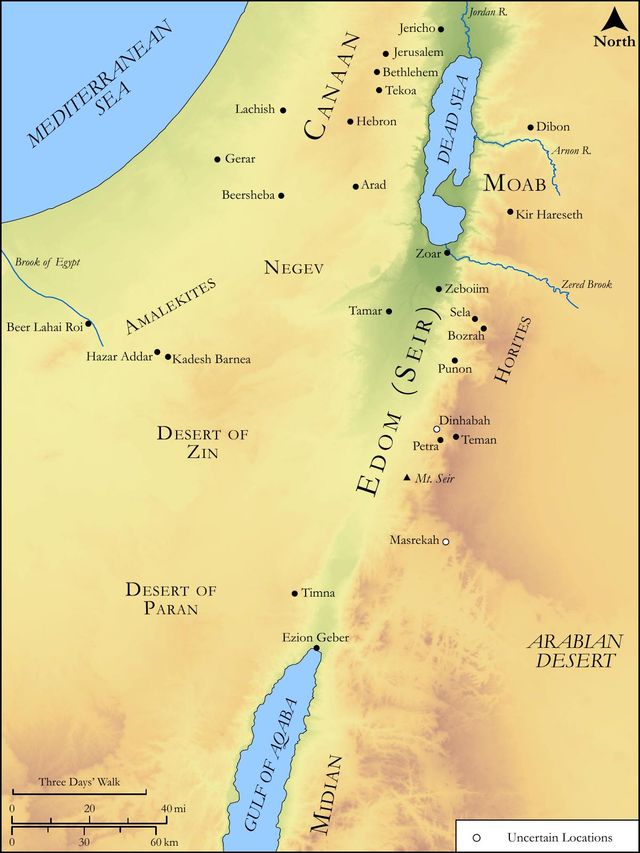
See on the biblical-era maps


Study this verse
Public-domain commentary
Matthew Henry
From his Commentary on the Whole Bible. Henry comments on passages, not single verses — this entry covers Genesis 36:31–43.
By degrees, it seems, the Edomites wormed out the Horites, obtained full possession of the country, and had a government of their own. 1. They were ruled by kings, who governed the whole country, and seem to have come to the throne by election, and not by lineal descent; so bishop Patrick observes. These kings reigned in Edom before there reigned any king over the children of Israel, that is, before Moses's time, for he was king in Jeshurun, Gen 36:3. God had lately promised Jacob that kings should come out of his loins (Gen 35:11), yet Esau's blood becomes royal long before any of Jacob's did. Note, In external prosperity and honour, the children of the covenant are often cast behind, and those that are out of covenant get the start. The triumphing of the wicked may be quick, but it is short; soon ripe, and as soon rotten: but the products of the promise, though they are slow, are sure and lasting; at the end it shall speak, and not lie. We may suppose it was a great trial to the faith of God's Israel to hear of the pomp and power of the kings of Edom, while they were bond-slaves in Egypt; but those that look for great things from God must be content to wait for them; God's time is the best time. 2. They were afterwards governed by dukes, again here named, who, I suppose, ruled all at the same time in several places in the country. Either they set up this form of government in conformity to the Horites, who had used it (Gen 36:29), or God's providence reduced them to it, as some conjecture, to correct them for their unkindness to Israel, in refusing them a passage though their country, Num 20:18. Note, When power is abused, it is just with God to weaken it, by turning it into divers channels. For the transgression of a land, many are the princes thereof. Sin brought Edom from kings to dukes, from crowns to coronets. We read of the dukes of Edom (Exo 15:15), yet, long afterwards, of their kings again. 3. Mount Seir is called the land of their possession, Gen 36:43. While the Israelites dwelt in the house of bondage, and their Canaan was only the land of promise, the Edomites dwelt in their own habitations, and Seir was in their possession. Note, The children of this world have their all in hand, and nothing in hope (Luk 16:25); while the children of God have their all in hope, and next to nothing in hand. But, all things considered, it is better to have Canaan in promise than mount Seir in possession.
Continue studying Genesis 36:31 across the web’s major study libraries — every link below opens this exact verse, chapter, or book on the destination site.
Read & Compare
 BibleGatewayThis verse in more than 200 translations and 70 languages.
 Bible.comThe YouVersion reader — hundreds of translations, reading plans, and highlights.
 ESV.orgCrossway's official English Standard Version reader.
 NET BibleThe NET translation with 60,000+ translators' notes on every rendering decision.
 STEP BibleTyndale House's free study tool — original text, vocabulary, and scholarly resources.
 BibliaLogos Bible Software's free web reader.
 USCCBThe New American Bible (Revised Edition) with the U.S. bishops' study notes.
Commentaries
 BibleHub CommentariesDozens of classic commentaries on this verse, gathered on one page.
 StudyLightMore than 100 commentary sets — the largest collection on the web.
 BibleRefPlain-English commentary on what this verse means, verse by verse.
 Enduring WordDavid Guzik's free commentary on this chapter, widely used by Bible teachers.
 Bible Study ToolsVerse commentary alongside Greek and Hebrew study aids.
Original Language & Research
- BibleHub InterlinearThe verse word by word — original language, transliteration, and English.
- BibleHub LexiconEvery word's original-language definition and Strong's entry.
 Blue Letter BibleDeep-study tools — Strong's numbers, concordance, and word studies.
 SefariaThe Hebrew text with Rashi and centuries of Jewish commentary.
Sermons, Hymns & Audio


TrulyRandomVerse is not affiliated with these sites and doesn’t control their content. They’re linked because they’re genuinely useful.
Summary
Genesis 36:31 serves as a pivotal historical marker within the genealogy of Esau (Edom), introducing a list of kings who reigned in Edom. Its primary significance lies in the explicit statement that Edom established a centralized monarchy "before there reigned any king over the children of Israel." This declaration highlights God's distinct sovereign timing and plan for the national development of Esau's descendants, contrasting sharply with the later, divinely appointed path for Jacob's lineage to transition from a tribal confederation to a kingdom.
Context
ShowHideLiterary Context
Genesis 36 is primarily a genealogical register, meticulously detailing the descendants of Esau, also known as Edom. Following the detailed accounts of Esau's wives, sons, and chiefs, verse 31 introduces a list of eight Edomite kings who reigned prior to the establishment of Israel's monarchy. This placement is strategic, serving not merely as a historical record but as a narrative device to underscore the divergent paths of the two brother nations. The chapter's exhaustive nature regarding Esau's lineage stands in stark contrast to the often more selective genealogies of Jacob's line, emphasizing the complete fulfillment of God's promise to Abraham that "kings shall come out of thee" (Genesis 17:6) through both his descendants, albeit with different timings and purposes.
Historical & Cultural Context
In the ancient Near East (ANE), the transition from tribal structures to centralized monarchies was a common developmental trajectory for emerging nations. Edom, situated in a strategically important region south and east of the Dead Sea, was well-positioned to control trade routes, which often spurred the need for more organized political structures. The establishment of kingship in Edom, as noted in this verse, reflects a relatively early state formation compared to other regional entities. In contrast, the descendants of Jacob, who would become Israel, remained a tribal confederation, governed by judges and elders, for several centuries after their exodus from Egypt, only requesting a king much later, as recorded in 1 Samuel 8. This highlights a unique aspect of Israel's early political and spiritual identity, rooted in a direct covenant relationship with God as their King.
Key Themes
ShowHideThis verse contributes to several overarching themes within Genesis and the Pentateuch. Firstly, it emphasizes God's sovereign timing in the unfolding of national destinies, demonstrating that His plans for Israel differ from those for surrounding nations, even those related by blood. Secondly, it highlights the distinct paths of Esau and Jacob, underscoring the divine election of Jacob's line for the covenant promises, even as Esau's descendants also prospered in their own way. Thirdly, the retrospective nature of the statement subtly introduces the theme of Israel's future monarchy, a development that, while not yet realized in the Genesis narrative, is clearly anticipated by the narrator. This foreshadowing reinforces the idea of a divinely guided history, where God's purposes for His people, including their eventual leadership structure, are woven into the fabric of the narrative from its earliest stages, as seen in the promise to Jacob that "a company of nations shall be from you, and kings shall come from your body" (Genesis 35:11).
Exposition and Analysis
ShowHideGenesis 36:31 states, "¶ And these [are] the kings that reigned in the land of Edom, before there reigned any king over the children of Israel." This concise declaration carries significant historical and theological weight, setting the stage for understanding the distinct paths of Esau's and Jacob's lineages.
Key Word Analysis
ShowHideFrom the root H4427 (mâlak), this term (H4428) refers to a sovereign ruler, a monarch. Its use here immediately signals a centralized, organized political structure in Edom. The repeated use of "king" and "reigned" emphasizes the establishment of a formal, hereditary, or at least sequential, system of governance, distinct from tribal chieftainships.
This primitive root (H4427) means "to reign" or, inceptively, "to ascend the throne." It signifies the exercise of royal authority and the establishment of a kingdom. The perfect tense used here indicates a completed action, confirming that a succession of kings had indeed taken power in Edom, implying a stable and established monarchical system.
While literally meaning "face" or "presence" (H6440), when used with a prepositional prefix as it is here, it functions as a temporal indicator, meaning "before," "prior to," or "in the presence of." In this context, it is crucial for establishing the chronological priority of Edomite kingship over that of Israel, serving as a direct temporal comparison.
Verse Breakdown
ShowHide"And these [are] the kings that reigned in the land of Edom,"
This opening clause serves as an immediate introduction to the list of Edomite kings that follows in the subsequent verses. It clearly states that Edom, the nation descended from Esau, had already established a system of kingship. This signifies a level of political organization and state formation that had been achieved by Esau's descendants, indicating a settled and structured society capable of sustaining a monarchy.
"before there reigned any king over the children of Israel."
This crucial comparative clause provides the historical and theological punch of the verse. It establishes a clear chronological marker: the Edomite monarchy predated the Israelite monarchy. This statement is a retrospective observation, written from a vantage point after Israel had indeed established its own kingship (e.g., Saul). It highlights the distinct developmental paths of the two nations – Edom quickly adopting a centralized government, while Israel remained a tribal confederation for centuries under the leadership of judges, awaiting God's specific timing for their own king.
Literary Devices
ShowHideThe primary literary device at play in Genesis 36:31 is Retrospection or Anachronism. The narrator explicitly states a fact about Edomite kingship relative to Israelite kingship, which could only be known and stated from a vantage point after the events of Genesis. This implies that the text, or at least this particular verse, was compiled or edited at a later date, likely during or after the period of the Israelite monarchy. This device serves to provide a broader historical context for the reader, linking the patriarchal narratives to later national developments. Additionally, there is a strong element of Juxtaposition or Contrast, as the verse directly compares the political development of Edom with that of Israel, highlighting their divergent timelines and structures. This contrast subtly underscores God's unique and sovereign plan for His covenant people, Israel, distinct from the patterns of surrounding nations.
Theological and Thematic Connections
ShowHideGenesis 36:31 offers profound theological insights into God's sovereign governance over nations and His distinct purposes for His covenant people. The contrasting timelines for the establishment of monarchy in Edom and Israel underscore God's sovereign control over the destinies of nations and His perfect timing for the unfolding of His plans. While Esau's descendants quickly formed a centralized kingdom, Jacob's descendants remained a collection of tribes for centuries, demonstrating that God's purposes are not always aligned with immediate human expectations or political trends. This verse serves as a subtle foreshadowing of Israel's eventual kingship, a development that, though delayed, was part of God's overarching plan for His chosen nation, leading ultimately to the Davidic covenant and the promise of an eternal King.
Reflection and Application
ShowHideGenesis 36:31 provides valuable insight into the intricate tapestry of God's sovereign plan and timing for nations. It reminds us that God's plans are long-term, encompassing various peoples and their destinies, unfolding according to His perfect timetable, not necessarily according to human expectations or immediate societal trends. For the modern believer, this verse encourages profound trust in God's sovereign timing, even when our own circumstances or the world around us seem to follow a different path than what we anticipate. It highlights that God's ways are higher than our ways, and His wisdom dictates the perfect moment for every development, whether personal or global. Furthermore, it underscores the Bible's remarkable historical depth and its consistent focus on God's covenant relationship with His chosen people, Israel, even when other nations are highlighted, reminding us that God's ultimate purposes are always centered on His redemptive plan.
Questions for Reflection
ShowHideFAQ
ShowHideWhy is this verse included in a genealogical chapter of Genesis?
ShowHideThis verse serves as a crucial historical and chronological marker within the genealogical record of Esau. Its inclusion highlights the distinct developmental paths of Esau's and Jacob's descendants, emphasizing that Edom quickly established a monarchy while Israel remained a tribal confederation for centuries. It provides important context for understanding the broader biblical narrative of God's dealings with both nations, setting the stage for future interactions and the unique role of Israel in God's covenant plan.
Does the phrase "before there reigned any king over the children of Israel" imply a later authorship for this part of Genesis?
ShowHideYes, the phrase strongly suggests a retrospective observation, meaning it was likely written or compiled from a perspective after the establishment of the Israelite monarchy (which began with Saul, centuries after the events of Genesis). This is a common scholarly observation, indicating that the Pentateuch, while rooted in ancient traditions, was shaped and edited over time, incorporating later historical understanding under divine inspiration. This does not diminish its authority but rather speaks to the comprehensive and divinely guided nature of its composition, weaving together various traditions and historical perspectives into a cohesive narrative.
What is the significance of Edom having kings before Israel?
ShowHideThe significance lies in highlighting God's distinct and sovereign timing for each nation. While human logic might expect Jacob's descendants, the covenant people, to establish a kingdom first, God's plan for Israel involved a period of tribal confederation and direct leadership through judges before a monarchy was instituted. Edom's earlier monarchy demonstrates that God works according to His own timetable and purposes, not necessarily following the patterns of surrounding nations for His chosen people. It underscores that God's covenant with Israel was not contingent on their immediate political structures mimicking their neighbors, but on His unique redemptive plan.
Christ-Centered Fulfillment
ShowHideWhile Genesis 36:31 primarily focuses on the historical development of Edom and Israel's early stages, it subtly points towards the ultimate King. The mention of kingship, even in a contrasting context, foreshadows the eventual establishment of a monarchy in Israel, a lineage that would ultimately lead to the King of Kings. God's promise to Abraham and Jacob included the coming of kings, a promise that finds its perfect and eternal fulfillment not in the flawed earthly kings of Israel, but in Jesus Christ, the Messiah. He is the true and eternal King, the Son of David, whose kingdom is "not of this world" (John 18:36), yet it is the culmination of God's sovereign plan for humanity, a kingdom that will never end (Luke 1:33). The precise timing of God's plans, as seen in the delay of Israel's monarchy compared to Edom's, ultimately points to the perfect timing of Christ's first advent to establish His spiritual reign and His future return to establish His eternal, visible reign, when He will reign forever and ever.