


2 Kings 16:2
Bible text: King James Version (1769 Blayney text) · Public domain
Bible text: King James Version with Strong's numbers · Public domain
Bible text: Berean Standard Bible · Public domain
Bible text: American Standard Version (1901) · Public domain
Bible text: World English Bible, Messianic edition · Public domain
Bible text: Geneva Bible (1599) · Public domain
Bible text: Young's Literal Translation · Public domain
- בֶּןben[was] a son ofH1121N-mscNoun Singular Masculine Construct
- עֶשְׂרִים'es·RimtwentyH6242N-mpNoun Plural Masculine Absolute
- שָׁנָהsha·Nahyear[s]H8141N-fsNoun Singular Feminine Absolute
- אָחָז'a·ChazAhazH271N-proper-mNoun Proper Masculine
- בְּמָלְכוֹbe·ma·le·Khowhen he became kingH4427Prep-b ¦ V-Qal-Inf ¦ 3msVerb Qal Infinitive Constructבְּwhenמָלְכbecame kingוֹhe
- וְשֵׁשׁve·sheshand six-H8337Conj-w ¦ N-csNoun Singular common gender Absoluteוְandשֵׁשׁsix-
- עֶשְׂרֵה'es·RehteenH6240N-csNoun Singular common gender Absolute
- שָׁנָהsha·Nahyear[s]H8141N-fsNoun Singular Feminine Absolute
- מָלַךְma·Lakhhe reignedH4427V-Qal-Perf-3msVerb Qal Perfect 3rd Singular Masculine
- בִּירוּשָׁלִָםbi·ru·sha·Limin JerusalemH3389Prep-b ¦ N-properNoun Proper LocationבִּinירוּשָׁלִָםJerusalem
- וְלֹאve·lo'and notH3808Conj-w ¦ NegParticle Negativeוְandלֹאnot
- עָשָׂה'a·Sahhe didH6213V-Qal-Perf-3msVerb Qal Perfect 3rd Singular Masculine
- הַיָּשָׁרhai·ya·Sharthe rightH3477Art ¦ Adj-msAdjective Singular Masculine Absoluteהַtheיָּשָׁרright
- בְּעֵינֵיbe·'ei·Neiin [the] eyes ofH5869Prep-b ¦ N-fdcNoun Dual Feminine Constructבְּinעֵינֵי[the] eyes of
- יְהוָהYah·wehYahwehH3068N-properNoun Proper Title
- אֱלֹהָיו'e·lo·Havhis GodH430N-mpc ¦ 3msNoun Plural Masculine ConstructאֱלֹהָיGodוhis
- כְּדָוִדke·da·Vidlike DavidH1732Prep-k ¦ N-proper-mNoun Proper MasculineכְּlikeדָוִדDavid
- אָבִיו'a·Vivhis ancestorH1N-msc ¦ 3msNoun Singular Masculine Constructאָבִיancestorוhis
English is a literal word-by-word gloss of the Hebrew, not the KJV's wording. Why?
This is the original text the KJV's translators worked from — each Hebrew word with its own literal English meaning in this verse, prepared by scholars at Tyndale House, Cambridge. The KJV translates whole sentences, not word by word, so its wording differs: one Hebrew word can become several English words, and the KJV may choose “the LORD” where the gloss reads “Yahweh”. Both are faithful — they answer different questions. For the KJV's own rendering, switch to the KJV text.
Details
See on the biblical-era maps
Study this verse
Public-domain commentary
Matthew Henry
From his Commentary on the Whole Bible. Henry comments on passages, not single verses — this entry covers 2 Kings 16:1–4.
We have here a general character of the reign of Ahaz. Few and evil were his days - few, for he died at thirty-six - evil, for we are here told, 1. That he did not that which was right like David (Kg2 16:2), that is, he had none of that concern and affection for the instituted service and worship of God for which David was celebrated. He had no love for the temple, made no conscience of his duty to God, nor had any regard to his law. Herein he was unlike David; it was his honour that he was of the house and lineage of David, and it was owing to God's ancient covenant with David that he was now upon the throne, which aggravated his wickedness; for he was a reproach to that honourable name and family, which therefore was really a reproach to him (Degeneranti genus opprobrium - A good extraction is a disgrace to him who degenerates from it), and though he enjoyed the benefit of David's piety he did not tread in the steps of it. 2. That he walked in the way of the kings of Israel (Kg2 16:3), who all worshipped the calves. He was not joined in any affinity with them, as Jehoram and Ahaziah were with the house of Ahab, but, ex mero motu - without any instigation, walked in their way. The kings of Israel pleaded policy and reasons of state for their idolatry, but Ahaz had no such pretence: in him it was the most unreasonable impolitic thing that could be. They were his enemies, and had proved enemies to themselves too by their idolatry; yet he walked in their way. 3. That he made his sons to pass through the fire, to the honour of his dunghill-deities. He burnt them, so it is expressly said of him (Ch2 28:3), burnt some of them, and perhaps made others of them (Hezekiah himself not excepted, though afterwards he was never the worse for it) to pass between two fires, or to be drawn through a flame, in token of their dedication to the idol. 4. That he did according to the abominations of the heathen whom the Lord had cast out. it was an instance of his great folly that he would be guided in his religion by those whom he saw fallen into the ditch before his eyes, and follow them; and it was an instance of his great impiety that he would conform to those usages which God had declared to be abominable to him, and set himself to write after the copy of those whom God had cast out, thus walking directly contrary to God. 5. That he sacrificed in the high places, Kg2 16:4. If his father had but had zeal enough to take them away, the debauching of his sons might have been prevented; but those that connive at sin know not what dangerous snares they lay for those that come after them. He forsook God's house, was weary of that place where, in his father's time, he had often been detained before the Lord, and performed his devotions on high hills, where he had a better prospect, and under green trees, where he had a more pleasant shade. It was a religion little worth, which was guided by fancy, not by faith.
Historical interpretation
Historical reception
1 surviving comment on this verse from the historical church.
Do you see that demons dwell in their souls and that these demons are more dangerous than the ones of old? And this is very reasonable. In the old days the Jews acted impiously toward the prophets; now they outrage the Master of the prophets. Tell me this. Do you not shudder to come into the same place with people possessed, who have so many unclean spirits, who have been reared amid slaughter and bloodshed? Must you share a greeting with them and exchange a bare word? Must you not turn away from them since they are the common disgrace and infection of the whole world? Have they not come to every form of wickedness? Have not all the prophets spent themselves making many and long speeches of accusation against them? What tragedy, what manner of lawlessness have they not eclipsed by their blood guilt? They sacrificed their own sons and daughters to demons. They refused to recognize nature, they forgot the pangs of birth, they trod underfoot the rearing of their children, they overturned from their foundations the laws of kinship, they became more savage than any wild beast.
Continue studying 2 Kings 16:2 across the web’s major study libraries — every link below opens this exact verse, chapter, or book on the destination site.
Read & Compare
 BibleGatewayThis verse in more than 200 translations and 70 languages.
 Bible.comThe YouVersion reader — hundreds of translations, reading plans, and highlights.
 ESV.orgCrossway's official English Standard Version reader.
 NET BibleThe NET translation with 60,000+ translators' notes on every rendering decision.
 STEP BibleTyndale House's free study tool — original text, vocabulary, and scholarly resources.
 BibliaLogos Bible Software's free web reader.
 USCCBThe New American Bible (Revised Edition) with the U.S. bishops' study notes.
Commentaries
 BibleHub CommentariesDozens of classic commentaries on this verse, gathered on one page.
 StudyLightMore than 100 commentary sets — the largest collection on the web.
 BibleRefPlain-English commentary on what this verse means, verse by verse.
 Enduring WordDavid Guzik's free commentary on this chapter, widely used by Bible teachers.
 Bible Study ToolsVerse commentary alongside Greek and Hebrew study aids.
Original Language & Research
- BibleHub InterlinearThe verse word by word — original language, transliteration, and English.
- BibleHub LexiconEvery word's original-language definition and Strong's entry.
 Blue Letter BibleDeep-study tools — Strong's numbers, concordance, and word studies.
 SefariaThe Hebrew text with Rashi and centuries of Jewish commentary.
Sermons, Hymns & Audio


TrulyRandomVerse is not affiliated with these sites and doesn’t control their content. They’re linked because they’re genuinely useful.
Summary
Second Kings 16:2 introduces Ahaz, the twelfth king of Judah, by immediately establishing the duration of his reign and, critically, his profound spiritual failure. This succinct evaluation sets the tone for his entire kingship, declaring that his actions were not aligned with God's will, a stark contrast to the standard of righteousness exemplified by his revered ancestor, King David. This opening verse foreshadows a period of deep apostasy and political instability for the Southern Kingdom under Ahaz's leadership, marking a significant downturn in Judah's spiritual history.
Context
ShowHideLiterary Context
This verse serves as the standard introductory formula for a new king in the Books of Kings, providing essential regnal data (age at accession, duration of reign, capital city) before delivering a crucial theological verdict. Following the reign of his father Jotham, who "did what was right in the sight of the LORD" as recorded in 2 Kings 15:34, Ahaz's immediate condemnation in 2 Kings 16:2 signals a dramatic and tragic shift in Judah's spiritual trajectory. The subsequent verses and chapters, particularly 2 Kings 16 and 2 Chronicles 28, detail the specific idolatrous practices and political missteps that substantiate this initial negative assessment, including his infamous and disastrous alliance with Assyria against the explicit counsel of the prophet Isaiah. This introductory formula thus acts as a theological compass, guiding the reader's understanding of the king's subsequent actions.
Historical & Cultural Context
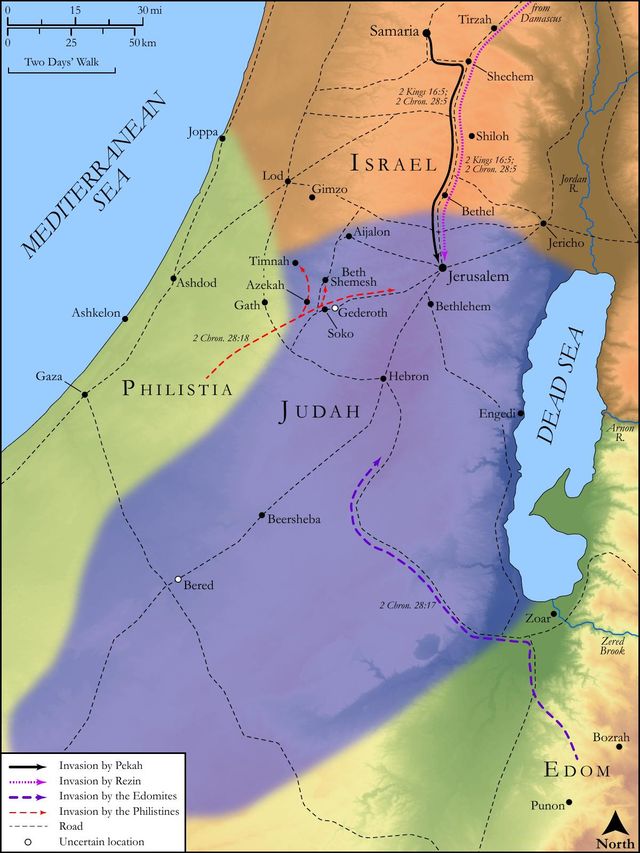
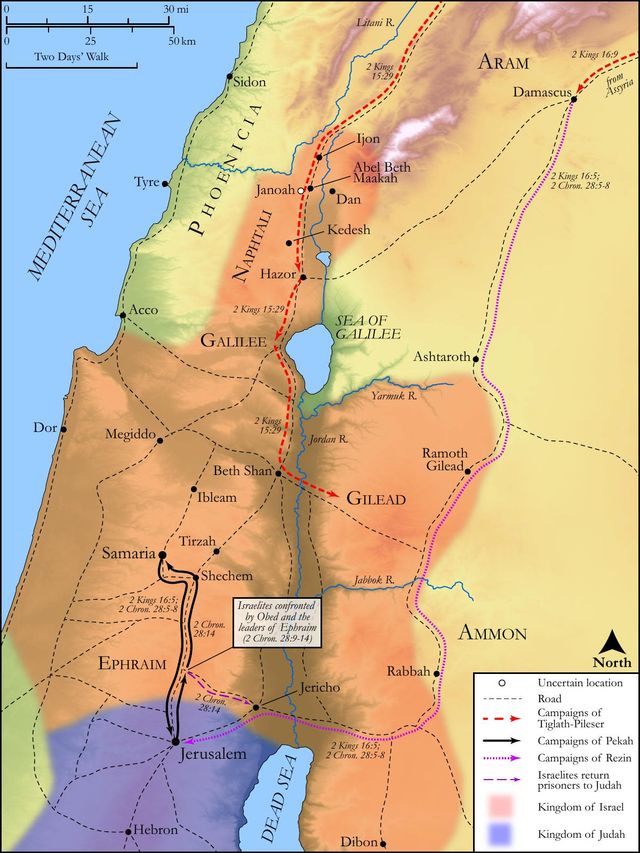
Ahaz ascended the throne of Judah during a period of immense geopolitical tension, primarily the Syro-Ephraimite War (c. 735-732 BC). Judah was caught between the rising, formidable power of the Neo-Assyrian Empire to the north and the immediate threat from a coalition of the Northern Kingdom of Israel (under Pekah) and Aram (Syria, under Rezin). This precarious position demanded wise and faithful leadership. Culturally, this era saw increasing syncretism, with foreign deities and worship practices infiltrating Judah, often through political alliances or as a perceived means of gaining power and prosperity. The covenant between Yahweh and Israel, established at Sinai, demanded exclusive worship and obedience, making Ahaz's deviation from "that which was right in the sight of the LORD" a direct violation of the foundational principles of his nation's identity, well-being, and very existence.
Key Themes
ShowHideThe verse immediately highlights the pervasive theme of Divine Evaluation of Kingship, where each monarch is judged not by human standards of political success or military prowess, but by their fidelity to the covenant with Yahweh. Ahaz's failure to do "that which was right in the sight of the LORD his God" underscores the critical theme of Covenant Faithfulness vs. Apostasy. Unlike his ancestor David, who, despite his personal failings, maintained a heart generally devoted to God and the covenant, as affirmed in 1 Kings 15:3-5, Ahaz actively embraced idolatry and rejected Yahweh's exclusive claim. This sets the stage for the recurring theme of Consequences of Disobedience, as Ahaz's unrighteousness leads to national suffering, military defeats, and further spiritual decline, illustrating the direct and often immediate link between a king's spiritual state and the welfare of his people, a principle articulated throughout the Deuteronomic history.
Exposition and Analysis
ShowHideKey Word Analysis
ShowHideFrom the root אָחַז (ʼâchaz), meaning "to grasp" or "to possess," the name Ahaz (אָחָז) means "possessor." Ironically, despite his name suggesting possession or control, Ahaz's reign was marked by a loss of control, both politically and spiritually, as he surrendered Judah's autonomy to Assyria and its spiritual integrity to foreign gods. His name stands in stark contrast to his actions, highlighting the tragic nature of his kingship.
The Hebrew word יָשָׁר (yâshâr) means "straight," "upright," "just," or "correct." When applied to human conduct, especially in the context of kingship, it signifies moral integrity and adherence to divine law. It implies not merely outward conformity but an inner disposition aligned with God's will. For a king, doing what was "right" meant governing according to the Torah, upholding justice, and promoting the exclusive worship of Yahweh. Ahaz's failure to be "right" indicates a fundamental deviation from these covenantal expectations, a crooked path rather than a straight one.
The Hebrew word אָב (ʼâb) refers to a "father" in a literal, immediate, or figurative sense, often denoting a progenitor, ancestor, or source. In the phrase "like David his father," it emphasizes David's role as the foundational and ideal ancestor for the Judahite kings. This term highlights the concept of legacy and the expectation that subsequent kings would emulate David's fundamental devotion to Yahweh, even if they were not his direct son. Ahaz's failure to live up to this ancestral standard underscores the severity of his spiritual rebellion.
Verse Breakdown
ShowHide"Twenty years old [was] Ahaz when he began to reign, and reigned sixteen years in Jerusalem"
This opening clause provides the standard chronological and geographical details for a new monarch in the Books of Kings. It grounds the narrative in historical fact, informing the reader of Ahaz's age at accession (20), the duration of his reign (16 years), and his capital city (Jerusalem). These facts set the stage for the subsequent, crucial theological evaluation, providing the framework within which his spiritual performance is to be understood.
"and did not [that which was] right in the sight of the LORD his God"
This is the central theological indictment of the verse and the overarching verdict on Ahaz's reign. It declares his kingship as fundamentally unrighteous from God's perspective. The phrase "in the sight of the LORD his God" (בְּעֵינֵי יְהוָה אֱלֹהָיו) emphasizes that God is the ultimate judge, and His perfect standard of righteousness is the benchmark, not human opinion or political expediency. Ahaz's failure here signifies a profound breach of covenant and a rejection of Yahweh's commands.
"like David his father"
This concluding phrase provides the specific, damning standard against which Ahaz is measured and found profoundly wanting. It is a severe condemnation, highlighting Ahaz's stark deviation from the spiritual legacy of David, the paradigmatic "good" king who, despite his personal flaws, was characterized by a heart fundamentally devoted to Yahweh and the establishment of true worship in Jerusalem. This comparison immediately alerts the reader to the severity and intentionality of Ahaz's apostasy, distinguishing his failures from those of other kings.
Literary Devices
ShowHideThe verse employs several significant literary devices to convey its powerful message. Most prominently, there is Juxtaposition and Contrast between King Ahaz and his revered ancestor David. David is presented as the ideal standard of kingship, a "man after God's own heart," while Ahaz is explicitly stated to not measure up to this benchmark. This stark contrast immediately sets a negative tone for Ahaz's reign and highlights the depth of his spiritual failure. The use of a Formulaic Evaluation ("did not that which was right in the sight of the LORD his God") is also a key device throughout the Books of Kings, providing a consistent theological framework for judging each monarch and reinforcing the narrative's emphasis on covenant fidelity as the ultimate criterion for leadership. Finally, the verse functions as Foreshadowing, hinting at the extensive idolatry, ungodly actions, and national suffering that will characterize Ahaz's reign, as detailed in the subsequent verses and chapters of 2 Kings 16 and 2 Chronicles 28.
Theological and Thematic Connections
ShowHideThe theological significance of 2 Kings 16:2 lies in its clear articulation of divine judgment and the unwavering standard for righteous leadership within God's covenant people. It underscores that true kingship, in the biblical sense, is not merely about political acumen or military success, but fundamentally about moral and spiritual alignment with God's revealed will. Ahaz's failure to do "that which was right in the sight of the LORD" highlights the persistent tension between human autonomy and divine sovereignty, and the tragic consequences when leaders choose idolatry and self-reliance over covenant faithfulness. This verse serves as a sober reminder that God is the ultimate evaluator of all human endeavors, especially those in positions of authority, and that deviation from His righteous path leads inevitably to spiritual decay and national peril.
Reflection and Application
ShowHideAhaz's story is a profound cautionary tale, reminding us that lineage, position, or even a privileged heritage (like being a descendant of King David) does not automatically confer righteousness or guarantee spiritual success. The critical factor, then as now, is our personal posture and actions before God. The phrase "did not that which was right in the sight of the LORD his God" challenges us to consider whose "sight" we are living for. Are our choices and priorities shaped by human approval, cultural trends, or personal gain, or are they genuinely aligned with God's revealed will and character? This verse calls us to a deep introspection, urging us to cultivate a heart that truly seeks to please God in all things, not merely in external conformity but in the inner motivations and intentions that God alone sees. Our ultimate standard is not the world's shifting values, but the unchanging righteousness of God, to which we are called to conform our lives daily, recognizing that true flourishing comes from obedience to Him.
Questions for Reflection
ShowHideFAQ
ShowHideWhy is David used as the standard for kings, given his own sins?
ShowHideWhile David certainly committed grievous sins, such as his adultery with Bathsheba and the murder of Uriah, the biblical narrative consistently emphasizes that his heart remained fundamentally devoted to the LORD. Unlike many kings who actively promoted idolatry or abandoned Yahweh, David consistently sought God's will, repented genuinely when confronted with his sin, and maintained the exclusive worship of Yahweh as the national religion. His failures were personal moral lapses, not a rejection of the covenant or the worship of God. Thus, he served as the benchmark for a king whose fundamental orientation was towards God, even if imperfectly executed. 1 Kings 15:3-5 explicitly states that David "did that which was right in the eyes of the LORD, and turned not aside from any thing that he commanded him all the days of his life, save only in the matter of Uriah the Hittite."
What specific "wrong" things did Ahaz do that this verse foreshadows?
ShowHideThis introductory verse provides the overall spiritual assessment, and the subsequent narrative in 2 Kings 16 and 2 Chronicles 28 details his specific abominations. These included sacrificing his own son in the fire to pagan deities, a horrific act condemned in 2 Kings 16:3, engaging in high-place worship and other idolatrous practices, and even altering the temple of the LORD in Jerusalem to accommodate foreign altars and rituals, as described in 2 Kings 16:10-18. His reign was marked by a profound and active rejection of Yahweh, leading to immense suffering for Judah.
Christ-Centered Fulfillment
ShowHideThe tragic failure of King Ahaz to do "that which was right in the sight of the LORD his God, like David his father," powerfully highlights humanity's desperate need for a truly righteous King. The Davidic covenant promised an eternal dynasty, a king who would perfectly embody God's will and rule in righteousness. While many of David's descendants, like Ahaz, fell short, this longing for a perfect king finds its ultimate and complete fulfillment in Jesus Christ. Jesus, the Son of David according to the flesh, as affirmed in Matthew 1:1, is the only King who perfectly and consistently did "that which was right in the sight of the LORD." His entire life, from His perfect obedience in the wilderness temptation described in Matthew 4:1-11 to His ultimate submission to the Father's will on the cross, declaring "It is finished" in John 19:30, was an unbroken demonstration of righteousness. He is the King who not only perfectly models obedience but also, through His atoning sacrifice, enables His subjects to be declared righteous in God's sight, as taught in Romans 5:19. Unlike Ahaz, whose reign brought spiritual darkness and national decline, Christ's reign brings light, life, and true righteousness to all who trust in Him, establishing an eternal kingdom that will never fail, as promised in Luke 1:33.