


2 Kings 3:20
Bible text: King James Version (1769 Blayney text) · Public domain
Bible text: King James Version with Strong's numbers · Public domain
Bible text: Berean Standard Bible · Public domain
Bible text: American Standard Version (1901) · Public domain
Bible text: World English Bible, Messianic edition · Public domain
Bible text: Geneva Bible (1599) · Public domain
Bible text: Young's Literal Translation · Public domain
- וַיְהִיvay·Hiand it wasH1961Conj-w ¦ V-Qal-ConsecImperf-3msVerb Qal Consecutive Imperfect 3rd Singular Masculineוַandיְהִיit was
- בַבֹּקֶרva·Bo·kerin the morningH1242Prep-b ¦ N-msNoun Singular Masculine Absoluteבַin theבֹּקֶרmorning
- כַּעֲלוֹתka·'a·Lotwhen went upH5927Prep-k ¦ V-Hiphil-InfVerb Hiphil Infinitive Constructכַּwhenעֲלוֹתwent up
- הַמִּנְחָהha·min·Chahthe offeringH4503Art ¦ N-fsNoun Singular Feminine Absoluteהַtheמִּנְחָהoffering
- וְהִנֵּהve·hi·nehand there!H2009Conj-w ¦ PrtParticle Interjectionוְandהִנֵּהthere!
- מַיִםMa·yimwatersH4325N-mpNoun Plural Masculine Absolute
- בָּאִיםba·'Im[were] comingH935V-Qal-Prtcpl-mpVerb Qal Participle Plural Masculine Absolute
- מִדֶּרֶךְmi·De·rekhfrom [the] direction ofH1870Prep-m ¦ N-cscNoun Singular common gender Constructמִfromדֶּרֶךְ[the] direction of
- אֱדוֹם'e·DomEdomH123N-proper-mNoun Proper Masculine
- וַתִּמָּלֵאva·ti·ma·Le'and it was filledH4390Conj-w ¦ V-Niphal-ConsecImperf-3fsVerb Niphal Consecutive Imperfect 3rd Singular Feminineוַandתִּמָּלֵאit was filled
- הָאָרֶץha·'A·retzthe landH776Art ¦ N-fsNoun Singular Feminine Absoluteהָtheאָרֶץland
- אֶת'et<obj.>H853DirObjMParticle Object Indicator
- הַמָּיִםha·Ma·yimthe watersH4325Art ¦ N-mpNoun Plural Masculine Absoluteהַtheמָּיִםwaters
English is a literal word-by-word gloss of the Hebrew, not the KJV's wording. Why?
This is the original text the KJV's translators worked from — each Hebrew word with its own literal English meaning in this verse, prepared by scholars at Tyndale House, Cambridge. The KJV translates whole sentences, not word by word, so its wording differs: one Hebrew word can become several English words, and the KJV may choose “the LORD” where the gloss reads “Yahweh”. Both are faithful — they answer different questions. For the KJV's own rendering, switch to the KJV text.
Details
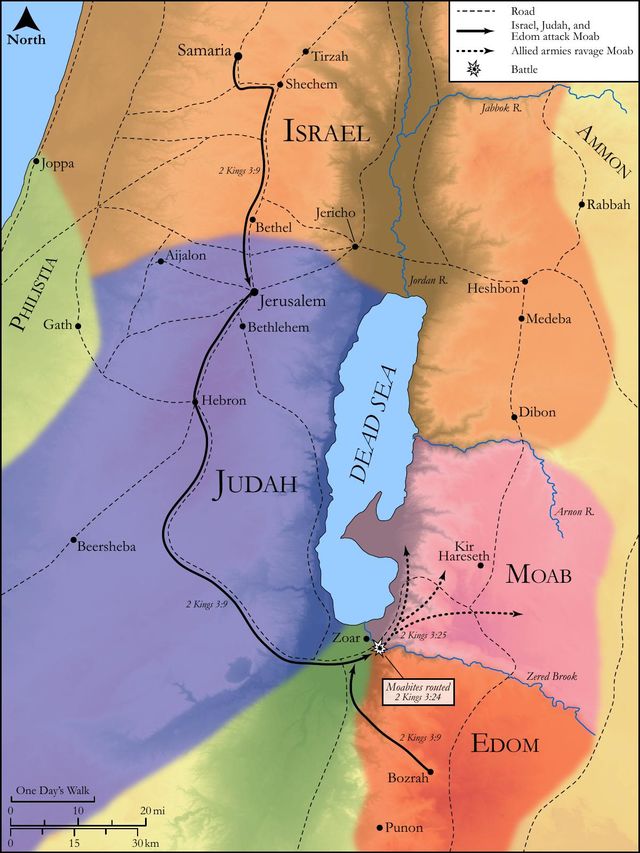
See on the biblical-era map
Study this verse
Public-domain commentary
Matthew Henry
From his Commentary on the Whole Bible. Henry comments on passages, not single verses — this entry covers 2 Kings 3:20–27. His four-level outline is real structure in the source text, so it is rendered as structure.
I.We have here the divine gift of both those things which God had promised by Elisha - water and victory, and the former not only a pledge of the latter, but a means of it. God, who created, and commands, all the waters, both above and beneath the firmament, sent them an abundance of water on a sudden, which did them double service.
1.It relieved their armies, which were ready to perish, Kg2 3:20. And, which was very observable, this relief came just at the time of the offering of the morning sacrifice upon the altar at Jerusalem, a certain time, and universally known. That time Elisha chose for his hour of prayer (it is likely looking towards the temple, for so there were to do in their prayers when they were going out to battle and encamped at a distance, Kg1 8:44), in token of his communion with the temple-service, and his expectation of success by virtue of the great sacrifice. We now cannot pitch upon any hour more acceptable than another, because our high priest is always appearing for us, to present and plead his sacrifice. That time God chose for the hour of mercy to put an honour upon the daily sacrifice, which had been despised. God answered Daniel's prayer just at the time of the evening sacrifice (Dan 9:21); for he will acknowledge his own institutions.
2.It deceived their enemies, who were ready to triumph, into the destruction. Notice was given to the Moabites of the advances of the confederate army, to oppose which all that were able to put on armour were posted upon the frontiers, where they were ready to give the Israelites a warm reception (v. 21), promising themselves that it would be easy dealing with an army fatigued by so long a march through the wilderness of Edom. But see here,
(1.)How easily they were drawn into their own delusions. Observe the steps of their self-deceit.
[1.]They saw the water in the valley where the army of Israel encamped, and conceited it was blood (Kg2 3:22), because they knew the valley to be dry, and (there having been no rain) could not imagine it should be water. The sun shone upon it, and probably the sky was red and lowering, a presage of foul weather that day (Mat 16:3), and so it proved to them. But, this making the water look red, their own fancies, which made them willing to believe what made for them, suggested, This is blood, God permitting them thus to impose upon themselves.
[2.]If their camp was thus full of blood, they conclude, "Certainly the kings have fallen out (as confederates of different interests are apt to do) and they have slain one another (Kg2 3:23), for who else should slay them?" And, [3.] "If the armies have slain one another, we have nothing to do but to divide the prey. Now therefore, Moab, to the spoil." These were the gradual suggestions of some sanguine spirits among them, that thought themselves wiser and happier in their conjectures than their neighbours; and the rest, being desirous it should be so, were forward to believe it was so. Quod volumus facile credimus - What we wish we readily believe. Thus those that are to be destroyed are first deceived (Rev 20:8), and none are so effectually deceived as those that deceive themselves.
(2.)How fatally they thereby ran upon their own destruction. They rushed carelessly into the camp of Israel, to plunder it, but were undeceived when it was too late. The Israelites, animated by the assurances Elisha had given them of victory, fell upon them with the utmost fury, routed them, and pursued them into their own country (Kg2 3:24), which they laid waste (Kg2 3:25), destroyed the cities, marred the ground, stopped up the wells, felled the timber, and left only the royal city standing, in the walls of which they made great breaches with their battering engines. This they got by rebelling against Israel. Who ever hardened his heart against God and prospered?
II.In the close of the chapter we are told what the king of Moab did when he found himself reduced to the last extremity by the besiegers, and that his capital city was likely to fall into their hands.
1.He attempted that which was bold and brave. he got together 700 choice men, and with them sallied out upon the intrenchments of the king of Edom, who, being but a mercenary in this expedition, would not, he hoped, make any great resistance if vigorously attacked, and so he might make his escape that way. But it would not do; even the king of Edom proved too hard for him, and obliged him to retire, Kg2 3:26.
2.This failing, he did that which was brutish and barbarous; he took his own son, his eldest son, that was to succeed him, than whom nothing could be more dear to himself and his people, and offered him for a burnt-offering upon the wall, Kg2 3:27. He designed by this,
(1.)To obtain the favour of Chemosh his god, which, being a devil, delighted in blood and murder, and the destruction of mankind. The dearer any thing was to them the more acceptable those idolaters thought it must needs be if offered in sacrifice to their gods, and therefore burnt their children in the fire to their honour.
(2.)To terrify the besiegers, and oblige them to retire. Therefore he did it upon the wall, in their sight, that they might see what desperate courses he resolved to take rather than surrender, and how dearly he would sell his city and life. He intended hereby to render them odious, and to exasperate and enrage his own subjects against them. This effect it had: There was great indignation against Israel for driving him to this extremity, whereupon they raised the siege and returned. Tender and generous spirits will not do that, though just, which will drive any man distracted, or make him desperate.
Continue studying 2 Kings 3:20 across the web’s major study libraries — every link below opens this exact verse, chapter, or book on the destination site.
Read & Compare
 BibleGatewayThis verse in more than 200 translations and 70 languages.
 Bible.comThe YouVersion reader — hundreds of translations, reading plans, and highlights.
 ESV.orgCrossway's official English Standard Version reader.
 NET BibleThe NET translation with 60,000+ translators' notes on every rendering decision.
 STEP BibleTyndale House's free study tool — original text, vocabulary, and scholarly resources.
 BibliaLogos Bible Software's free web reader.
 USCCBThe New American Bible (Revised Edition) with the U.S. bishops' study notes.
Commentaries
 BibleHub CommentariesDozens of classic commentaries on this verse, gathered on one page.
 StudyLightMore than 100 commentary sets — the largest collection on the web.
 BibleRefPlain-English commentary on what this verse means, verse by verse.
 Enduring WordDavid Guzik's free commentary on this chapter, widely used by Bible teachers.
 Bible Study ToolsVerse commentary alongside Greek and Hebrew study aids.
Original Language & Research
- BibleHub InterlinearThe verse word by word — original language, transliteration, and English.
- BibleHub LexiconEvery word's original-language definition and Strong's entry.
 Blue Letter BibleDeep-study tools — Strong's numbers, concordance, and word studies.
 SefariaThe Hebrew text with Rashi and centuries of Jewish commentary.
Sermons, Hymns & Audio


TrulyRandomVerse is not affiliated with these sites and doesn’t control their content. They’re linked because they’re genuinely useful.
Summary
Vividly recounts the dramatic, divinely orchestrated fulfillment of Elisha's prophecy, as water miraculously appeared from the direction of Edom, instantaneously filling the parched valley and providing crucial, life-sustaining relief to the allied armies of Israel, Judah, and Edom. This profound event powerfully underscores God's sovereign power to provide abundantly in dire circumstances, His unwavering faithfulness to His prophetic word, and His ability to work through unexpected and supernatural means, even in response to the faith of one righteous king amidst widespread unfaithfulness.
Context
ShowHideLiterary Context
This verse is strategically placed within the narrative of a desperate military campaign involving King Jehoram of Israel, King Jehoshaphat of Judah, and the king of Edom, who had united to suppress Moab's rebellion against Israelite tribute. After a grueling seven-day journey through the arid wilderness, the allied armies face a catastrophic water shortage, threatening the lives of both soldiers and animals. In this existential crisis, the pious King Jehoshaphat, known for his devotion to Yahweh, proposes seeking divine counsel through a prophet. They approach Elisha, who, despite his disdain for the idolatrous King Jehoram, agrees to inquire of the Lord for Jehoshaphat's sake. Elisha then delivers a remarkable dual prophecy: water will miraculously appear without visible rain or wind, and God will subsequently deliver Moab into their hands (2 Kings 3:17-18). Verse 20 marks the immediate, awe-inspiring fulfillment of the first part of this prophecy, providing the essential resource for survival and setting the stage for the subsequent divine victory over Moab, which unfolds in the verses that follow.
Historical & Cultural Context
The historical backdrop for this event is the tumultuous period of the Divided Monarchy in ancient Israel. King Jehoram, son of the infamous Ahab and Jezebel, ruled Israel, perpetuating some of his parents' idolatrous practices, though notably removing the pillar of Baal (2 Kings 3:2). In stark contrast, King Jehoshaphat of Judah was celebrated for his righteousness and steadfast devotion to Yahweh, consistently seeking divine guidance. The military campaign against Moab was a common occurrence, as Moab had rebelled against the king of Israel following King Ahab's death (2 Kings 3:4-5). Water scarcity was a perpetual and deadly threat for armies traversing the dry lands of Judah, Edom and Moab, making divine provision not merely desirable but absolutely essential for survival. The "meat offering" mentioned in the verse refers to the minchah, a daily grain offering typically presented in the morning and evening, signifying a regular, prescribed time of worship and devotion within Israelite religious practice. Edom, situated to the southeast of Judah, is a mountainous and often barren region characterized by numerous wadis (dry riverbeds) that are highly susceptible to rapid flash floods from distant rainfall, making the "way of Edom" a geographically plausible, yet divinely orchestrated, source for the miraculous water.
Key Themes
ShowHideThe most prominent and overarching theme in this passage is God's direct, supernatural intervention to meet a desperate and seemingly impossible need. The miraculous appearance of water from an unseen source, without local rain or wind, powerfully demonstrates God's absolute sovereignty over creation and His boundless ability to provide abundantly in the most dire circumstances. This echoes and reinforces earlier instances of God's miraculous provision for His people in the wilderness, such as providing water from a rock (Exodus 17:6 and Numbers 20:11). The immediate and precise arrival of the water serves as a powerful validation of Elisha's prophetic word, confirming his role as God's authentic messenger and underscoring God's unwavering reliability and control over all events. This event profoundly reinforces the trustworthiness of God's word spoken through His prophets. Despite the presence of the ungodly King Jehoram, God honored the faith of Jehoshaphat and faithfully kept His promise, illustrating that His faithfulness endures even when surrounded by widespread unfaithfulness. This highlights God's profound grace and His willingness to act for the sake of even a remnant of righteousness (Genesis 18:22-33). The water coming "by the way of Edom" implies a distant, possibly unseen source or a flash flood orchestrated by God from afar, rather than direct rainfall over their location. This emphasizes God's boundless creativity and His ability to work in ways that transcend human expectations or natural processes, demonstrating His absolute control over creation and His capacity to provide in astonishing and unexpected ways.
Exposition and Analysis
ShowHideKey Word Analysis
ShowHideProperly meaning "dawn (as the break of day)," and generally referring to "morning." The mention of "morning" here is a precise temporal marker, anchoring the miracle to a specific time of day. It is significant because it aligns with the customary hour for the daily "meat offering" (grain offering), suggesting that God's miraculous intervention arrived precisely at a time associated with worship and divine appointment, highlighting God's punctuality and responsiveness.
This term in the King James Version is an archaic translation for the Hebrew word minchah, which refers specifically to a grain or meal offering, not an animal sacrifice. These bloodless offerings were typically presented daily in the morning and evening as a regular act of worship, devotion, and dependence on God (e.g., Exodus 29:38-42). Its inclusion in this verse emphasizes that God's dramatic intervention occurred at a moment consecrated to worship, suggesting a divine response aligned with a posture of devotion or expectation.
This word refers to "water" in its literal sense. In this context, it signifies the miraculous provision that directly addresses the armies' dire thirst. The repetition of "water" (came water... filled with water) emphasizes the abundance and completeness of the divine supply, transforming a parched landscape into one overflowing with life-sustaining liquid, a direct fulfillment of Elisha's prophecy.
Verse Breakdown
ShowHide"And it came to pass in the morning, when the meat offering was offered"
This opening clause establishes the precise timing of the miracle. The "morning" (Hebrew: bôqer) signifies the break of day, a time often associated with new beginnings and divine activity. The "meat offering" (Hebrew: minchâh, a grain offering) was a daily ritual in Israelite worship, signifying devotion and dependence on God. Its mention here suggests that God's intervention occurred at a divinely appointed moment, perhaps in response to the faith of Jehoshaphat, or simply to underscore God's perfect timing in aligning His supernatural provision with the rhythms of His people's worship.
"that, behold, there came water by the way of Edom"
The interjection "behold" (KJV) serves as a dramatic literary marker, drawing the reader's attention to the sudden, unexpected, and awe-inspiring nature of the event. The water's arrival "by the way of Edom" (Hebrew: derekh 'edōm) is crucial. It indicates the geographical direction from which the water flowed, implying a flash flood originating from distant rainfall in the mountainous region of Edom, channeled through dry riverbeds directly to the valley where the armies were encamped. This underscores the non-local and miraculous nature of the event, as no rain was observed by the armies themselves, fulfilling Elisha's prophecy that water would come "without wind or rain" (2 Kings 3:17).
"and the country was filled with water."
This concluding phrase emphatically confirms the complete and abundant fulfillment of Elisha's prophecy. The parched land, which had been devoid of water for seven days, was now entirely inundated, providing not just enough, but ample supply for the men and animals. This dramatic transformation from desolation to abundance sets the stage for the next phase of God's plan, demonstrating His overwhelming power to provide and His faithfulness to His word.
Literary Devices
ShowHideThe verse effectively employs several literary devices to heighten its impact. Dramatic Irony is subtly present in the contrast between the armies' desperate, life-threatening thirst and the sudden, abundant, and unexpected divine provision. This irony is further amplified in the subsequent verses where the Moabites tragically mistake the sun-reflected water for blood, leading to their fatal miscalculation and defeat (2 Kings 3:22-23). The narrative also utilizes Divine Intervention as a central plot device, where God directly alters natural circumstances (orchestrating a distant flash flood) to achieve His purposes, emphasizing His omnipotence and unwavering faithfulness. The phrase "behold" acts as a Literary Marker or an exclamation, serving to draw the reader's immediate attention to the sudden, astonishing, and miraculous nature of the event, underscoring its significance within the narrative. Furthermore, the miraculous provision of water functions as Foreshadowing, not only saving the armies but also directly contributing to the subsequent victory over Moab, as the water itself becomes a key element in the enemy's downfall.
Theological and Thematic Connections
ShowHideThis passage powerfully illustrates God's sovereign control over all creation and His unwavering faithfulness to His promises, even when His people are in dire straits and some among them are unfaithful. The miraculous provision of water demonstrates that God is not limited by natural circumstances, human limitations, or the visible absence of solutions; He can provide in ways utterly beyond our comprehension and expectation. It underscores the profound principle that God often works in response to the faith of His servants, as seen in Jehoshaphat's insistence on seeking a prophet and trusting God's word. The precise timing of the miracle, "in the morning, when the meat offering was offered," subtly connects divine provision to the rhythms of worship and dependence on God, reminding us that God is attentive to the cries and customs of His people. This event serves as a powerful testament to God's character as the ultimate Provider, Deliverer, and Fulfiller of His prophetic word.
Reflection and Application
ShowHideThe account in 2 Kings 3:20 offers profound and enduring lessons for believers navigating the "wildernesses" of their own lives. Just as the allied armies faced a seemingly insurmountable crisis of thirst, we too encounter situations where resources seem depleted, solutions are invisible, and hope dwindles. This verse profoundly encourages us to trust in God's unseen and unconventional provision, reminding us that His power is not constrained by our natural expectations or the visible circumstances of our lives. It calls us to cultivate a posture of expectant faith, believing that God can work in extraordinary, even unconventional, ways to meet our deepest needs, often when we least expect it. Furthermore, King Jehoshaphat's insistence on seeking godly counsel through Elisha highlights the critical importance of spiritual wisdom, prophetic guidance, and seeking God's will in times of crisis, rather than relying solely on human strategies. The precise timing of the miracle, at the hour of the morning offering, also serves as a gentle yet powerful reminder of the significance of consistent devotion, faithful worship, and seeking God's presence, for it is often in these moments of faithful waiting and spiritual discipline that God chooses to reveal His mighty hand and unleash His miraculous provision.
Questions for Reflection
ShowHideFAQ
ShowHideWhy did the water come "by the way of Edom" and not from direct rain?
ShowHideThe phrase "by the way of Edom" (Hebrew: derekh 'edōm) indicates the geographical direction from which the water flowed, implying a source distant from the armies' immediate location. This was likely a flash flood originating from heavy rainfall in the mountainous region of Edom, to the southeast of the armies' position. God orchestrated this meteorological event, channeling the water through wadis (dry riverbeds) directly to the valley where the armies were encamped. This method highlights God's supernatural power and creativity, demonstrating that His provision is not limited to conventional means (like direct rainfall over their camp) but can come from unexpected sources and directions. This unique approach emphasizes the miraculous nature of the event, precisely as Elisha prophesied that water would come "without wind or rain" (2 Kings 3:17), underscoring God's absolute control over creation.
What is the significance of the "meat offering" being offered at the time the water came?
ShowHideIn the King James Version, "meat offering" is an archaic translation for the Hebrew minchah, which refers to a grain or meal offering, not an animal sacrifice. These were part of the daily temple rituals, offered both in the morning and evening (e.g., Exodus 29:38-42). The mention of the morning offering here is significant for several reasons. First, it grounds the miracle in a specific, known time, adding to its historical veracity and demonstrating God's precise timing. Second, it suggests God's intervention occurred at a customary time of worship and devotion, perhaps implying a divine response to the spiritual posture of Jehoshaphat and the armies, or simply marking a divinely appointed moment. It underscores God's perfect timing and His attentiveness to the rhythms of His people's worship and their expressions of dependence upon Him.
Christ-Centered Fulfillment
ShowHideThe miraculous provision of water in 2 Kings 3:20, saving a desperate army from perishing in the wilderness, powerfully foreshadows the ultimate spiritual provision found in Jesus Christ. Just as the physical water came from an unexpected source "by the way of Edom" to satisfy a dire thirst, so too does Christ offer living water to quench the deepest spiritual thirst of humanity. He declared, "If anyone thirsts, let him come to me and drink," and promised that "whoever drinks of the water that I will give him will never be thirsty again". This divine intervention, orchestrated by God for the sake of His people, points to God's ultimate act of provision in sending His Son, the Lamb of God who takes away the sin of the world. Christ is the true "meat offering" (grain offering), the Bread of Life, who offers Himself as the complete and sufficient sacrifice, satisfying our spiritual hunger and thirst, leading us to eternal life (John 6:51). The water filling the country symbolizes the overflowing grace and life that flow from Christ, bringing life and renewal to a parched and dying world, demonstrating that God's ultimate and most profound provision is always found in His Son, who is the source of eternal life and spiritual satisfaction.