


2 Kings 3:21
Bible text: King James Version (1769 Blayney text) · Public domain
Bible text: King James Version with Strong's numbers · Public domain
Bible text: Berean Standard Bible · Public domain
Bible text: American Standard Version (1901) · Public domain
Bible text: World English Bible, Messianic edition · Public domain
Bible text: Geneva Bible (1599) · Public domain
Bible text: Young's Literal Translation · Public domain
- וְכָלve·kholand allH3605Conj-w ¦ N-mscNoun Singular Masculine Constructוְandכָלall
- מוֹאָבmo·'AvMoabH4124N-properNoun Proper Location
- שָׁמְעוּsha·me·'Uthey had heardH8085V-Qal-Perf-3cpVerb Qal Perfect 3rd Plural common gender
- כִּיkithatH3588PrtParticle Conditional
- עָלוּ'a·Luthey had come upH5927V-Qal-Perf-3cpVerb Qal Perfect 3rd Plural common gender
- הַמְּלָכִיםha·me·la·Khimthe kingsH4428Art ¦ N-mpNoun Plural Masculine Absoluteהַtheמְּלָכִיםkings
- לְהִלָּחֶםle·hi·La·chemto fightH3898Prep-l ¦ V-Niphal-InfVerb Niphal Infinitive Constructלְtoהִלָּחֶםfight
- בָּםBamagainst themPrep-b ¦ 3mpSuffix Personal 3rd Plural Masculineבָּagainstםthem
- וַיִּצָּעֲקוּvai·yi·tza·'a·Kuand they were summonedH6817Conj-w ¦ V-Niphal-ConsecImperf-3mpVerb Niphal Consecutive Imperfect 3rd Plural Masculineוַandיִּצָּעֲקוּthey were summoned
- מִכֹּלmi·Kolfrom everyH3605Prep-m ¦ N-mscNoun Singular Masculine Constructמִfromכֹּלevery
- חֹגֵרcho·Ger[one who] girds onH2296V-Qal-Prtcpl-msVerb Qal Participle Singular Masculine Construct
- חֲגֹרָהcha·go·Raha beltH2290N-fsNoun Singular Feminine Absolute
- וָמַעְלָהva·Ma'·lahand up -wardsH4605Conj-w ¦ Adj-cs ¦ SfxAdjective Numerical Singular common gender Absoluteוָandמַעְלָupה-wards
- וַיַּעַמְדוּvai·ya·'am·Duand they took their standH5975Conj-w ¦ V-Qal-ConsecImperf-3mpVerb Qal Consecutive Imperfect 3rd Plural Masculineוַandיַּעַמְדוּthey took their stand
- עַל'alatH5921PrepPreposition
- הַגְּבוּלha·ge·Vulthe borderH1366Art ¦ N-msNoun Singular Masculine Absoluteהַtheגְּבוּלborder
English is a literal word-by-word gloss of the Hebrew, not the KJV's wording. Why?
This is the original text the KJV's translators worked from — each Hebrew word with its own literal English meaning in this verse, prepared by scholars at Tyndale House, Cambridge. The KJV translates whole sentences, not word by word, so its wording differs: one Hebrew word can become several English words, and the KJV may choose “the LORD” where the gloss reads “Yahweh”. Both are faithful — they answer different questions. For the KJV's own rendering, switch to the KJV text.
Details
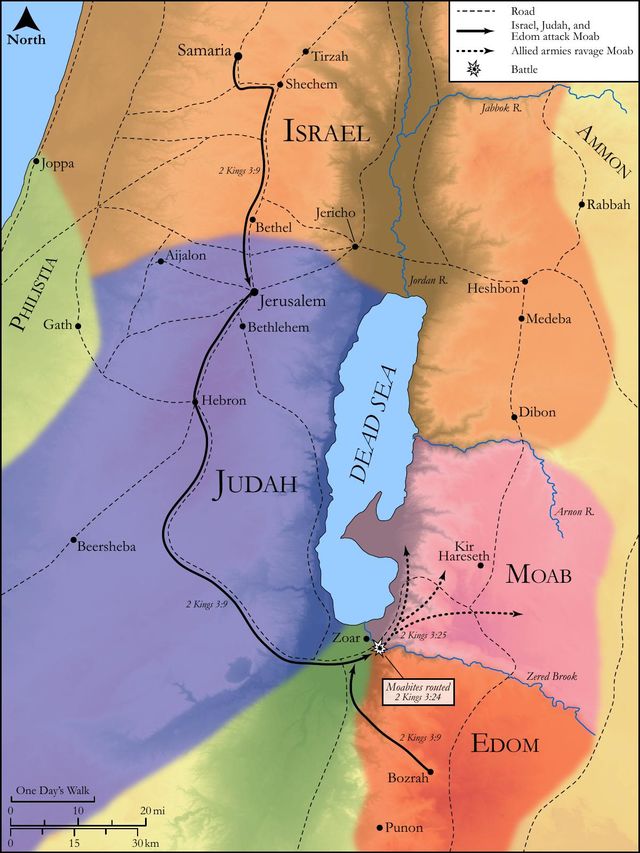
See on the biblical-era map
Study this verse
Public-domain commentary
Matthew Henry
From his Commentary on the Whole Bible. Henry comments on passages, not single verses — this entry covers 2 Kings 3:20–27. His four-level outline is real structure in the source text, so it is rendered as structure.
I.We have here the divine gift of both those things which God had promised by Elisha - water and victory, and the former not only a pledge of the latter, but a means of it. God, who created, and commands, all the waters, both above and beneath the firmament, sent them an abundance of water on a sudden, which did them double service.
1.It relieved their armies, which were ready to perish, Kg2 3:20. And, which was very observable, this relief came just at the time of the offering of the morning sacrifice upon the altar at Jerusalem, a certain time, and universally known. That time Elisha chose for his hour of prayer (it is likely looking towards the temple, for so there were to do in their prayers when they were going out to battle and encamped at a distance, Kg1 8:44), in token of his communion with the temple-service, and his expectation of success by virtue of the great sacrifice. We now cannot pitch upon any hour more acceptable than another, because our high priest is always appearing for us, to present and plead his sacrifice. That time God chose for the hour of mercy to put an honour upon the daily sacrifice, which had been despised. God answered Daniel's prayer just at the time of the evening sacrifice (Dan 9:21); for he will acknowledge his own institutions.
2.It deceived their enemies, who were ready to triumph, into the destruction. Notice was given to the Moabites of the advances of the confederate army, to oppose which all that were able to put on armour were posted upon the frontiers, where they were ready to give the Israelites a warm reception (v. 21), promising themselves that it would be easy dealing with an army fatigued by so long a march through the wilderness of Edom. But see here,
(1.)How easily they were drawn into their own delusions. Observe the steps of their self-deceit.
[1.]They saw the water in the valley where the army of Israel encamped, and conceited it was blood (Kg2 3:22), because they knew the valley to be dry, and (there having been no rain) could not imagine it should be water. The sun shone upon it, and probably the sky was red and lowering, a presage of foul weather that day (Mat 16:3), and so it proved to them. But, this making the water look red, their own fancies, which made them willing to believe what made for them, suggested, This is blood, God permitting them thus to impose upon themselves.
[2.]If their camp was thus full of blood, they conclude, "Certainly the kings have fallen out (as confederates of different interests are apt to do) and they have slain one another (Kg2 3:23), for who else should slay them?" And, [3.] "If the armies have slain one another, we have nothing to do but to divide the prey. Now therefore, Moab, to the spoil." These were the gradual suggestions of some sanguine spirits among them, that thought themselves wiser and happier in their conjectures than their neighbours; and the rest, being desirous it should be so, were forward to believe it was so. Quod volumus facile credimus - What we wish we readily believe. Thus those that are to be destroyed are first deceived (Rev 20:8), and none are so effectually deceived as those that deceive themselves.
(2.)How fatally they thereby ran upon their own destruction. They rushed carelessly into the camp of Israel, to plunder it, but were undeceived when it was too late. The Israelites, animated by the assurances Elisha had given them of victory, fell upon them with the utmost fury, routed them, and pursued them into their own country (Kg2 3:24), which they laid waste (Kg2 3:25), destroyed the cities, marred the ground, stopped up the wells, felled the timber, and left only the royal city standing, in the walls of which they made great breaches with their battering engines. This they got by rebelling against Israel. Who ever hardened his heart against God and prospered?
II.In the close of the chapter we are told what the king of Moab did when he found himself reduced to the last extremity by the besiegers, and that his capital city was likely to fall into their hands.
1.He attempted that which was bold and brave. he got together 700 choice men, and with them sallied out upon the intrenchments of the king of Edom, who, being but a mercenary in this expedition, would not, he hoped, make any great resistance if vigorously attacked, and so he might make his escape that way. But it would not do; even the king of Edom proved too hard for him, and obliged him to retire, Kg2 3:26.
2.This failing, he did that which was brutish and barbarous; he took his own son, his eldest son, that was to succeed him, than whom nothing could be more dear to himself and his people, and offered him for a burnt-offering upon the wall, Kg2 3:27. He designed by this,
(1.)To obtain the favour of Chemosh his god, which, being a devil, delighted in blood and murder, and the destruction of mankind. The dearer any thing was to them the more acceptable those idolaters thought it must needs be if offered in sacrifice to their gods, and therefore burnt their children in the fire to their honour.
(2.)To terrify the besiegers, and oblige them to retire. Therefore he did it upon the wall, in their sight, that they might see what desperate courses he resolved to take rather than surrender, and how dearly he would sell his city and life. He intended hereby to render them odious, and to exasperate and enrage his own subjects against them. This effect it had: There was great indignation against Israel for driving him to this extremity, whereupon they raised the siege and returned. Tender and generous spirits will not do that, though just, which will drive any man distracted, or make him desperate.
Continue studying 2 Kings 3:21 across the web’s major study libraries — every link below opens this exact verse, chapter, or book on the destination site.
Read & Compare
 BibleGatewayThis verse in more than 200 translations and 70 languages.
 Bible.comThe YouVersion reader — hundreds of translations, reading plans, and highlights.
 ESV.orgCrossway's official English Standard Version reader.
 NET BibleThe NET translation with 60,000+ translators' notes on every rendering decision.
 STEP BibleTyndale House's free study tool — original text, vocabulary, and scholarly resources.
 BibliaLogos Bible Software's free web reader.
 USCCBThe New American Bible (Revised Edition) with the U.S. bishops' study notes.
Commentaries
 BibleHub CommentariesDozens of classic commentaries on this verse, gathered on one page.
 StudyLightMore than 100 commentary sets — the largest collection on the web.
 BibleRefPlain-English commentary on what this verse means, verse by verse.
 Enduring WordDavid Guzik's free commentary on this chapter, widely used by Bible teachers.
 Bible Study ToolsVerse commentary alongside Greek and Hebrew study aids.
Original Language & Research
- BibleHub InterlinearThe verse word by word — original language, transliteration, and English.
- BibleHub LexiconEvery word's original-language definition and Strong's entry.
 Blue Letter BibleDeep-study tools — Strong's numbers, concordance, and word studies.
 SefariaThe Hebrew text with Rashi and centuries of Jewish commentary.
Sermons, Hymns & Audio


TrulyRandomVerse is not affiliated with these sites and doesn’t control their content. They’re linked because they’re genuinely useful.
Summary
Second Kings 3:21 powerfully depicts the immediate and total mobilization of the Moabite forces upon learning of the invading allied armies of Israel, Judah, and Edom. This verse serves as a pivotal moment, transitioning from the allied kings' divinely provided sustenance to Moab's desperate and comprehensive call to arms, gathering every able-bodied individual, and strategically positioning them at their border to confront the perceived existential threat.
Context
ShowHideLiterary Context
This verse is strategically placed within the narrative of the joint military campaign against Moab, detailed in 2 Kings 3. Immediately preceding 2 Kings 3:21, the text recounts the arduous journey of the allied kings through the wilderness of Edom, their dire need for water, and the miraculous divine intervention orchestrated through the prophet Elisha. Elisha had not only prophesied abundant water but also assured a decisive victory over Moab, specifying that the Moabites would be delivered into their hands (2 Kings 3:6-20). Verse 21 marks the crucial shift from the allied forces' preparation and divine provision to Moab's direct and urgent response to the impending invasion. It sets the stage for the dramatic fulfillment of Elisha's prophecy concerning the Moabites' defeat and their subsequent desperate actions, culminating in the horrific sacrifice of their crown prince (2 Kings 3:22-27).
Historical & Cultural Context
The conflict narrated in 2 Kings 3 is rooted in Moab's rebellion against Israel after the death of King Ahab, specifically their refusal to pay the substantial tribute of 100,000 lambs and 100,000 rams with their wool, as recorded in 2 Kings 3:4-5. Moab, an ancient kingdom situated east of the Dead Sea, possessed a long and often contentious history with Israel. Archaeological evidence, such as the "Mesha Inscription" (also known as the Moabite Stone), a contemporary artifact, corroborates certain aspects of this biblical account from Moab's perspective, detailing King Mesha's successful rebellion against Israelite dominance and his efforts to reassert Moabite sovereignty. The phrase "all that were able to put on armour, and upward" vividly illustrates a desperate national conscription, a common practice in the wars of that day when a nation faced an existential threat. Such measures often extended military service beyond the typical age range, encompassing older men or even younger, physically capable individuals. "Standing in the border" signifies a standard defensive strategy to meet invaders at the frontier, aiming to prevent deeper incursions and protect the heartland.
Key Themes
ShowHideThis verse significantly contributes to several overarching themes within 2 Kings 3 and the broader narrative of the Books of Kings. It powerfully highlights the theme of National Mobilization and Defense in the face of an overwhelming external threat, showcasing the immediate, comprehensive, and desperate human response to perceived danger. It underscores the profound Consequences of Rebellion and Warfare, demonstrating how political defiance can rapidly escalate into full-scale military conflict with devastating societal impact. Furthermore, 2 Kings 3:21 subtly establishes a stark contrast with the theme of Divine Sovereignty and Intervention. While Moab's formidable human preparations appear exhaustive and logical, the reader, aware of Elisha's preceding prophecy, understands that these human efforts will ultimately prove insufficient against a divinely empowered force, thereby foreshadowing the miraculous and decisive victory promised to the allied kings (2 Kings 3:18-19).
Exposition and Analysis
ShowHideKey Word Analysis
ShowHideMeaning "to hear intelligently (often with implication of attention, obedience, etc.; causatively, to tell, etc.)". In this context, it signifies that the news of the invading armies was not merely perceived but understood with full comprehension of its implications, prompting an immediate and decisive national response. It implies an attentive and impactful reception of critical information.
Meaning "to shriek; (by implication) to proclaim (an assembly); [idiom] at all, call together, cry (out), gather (selves) (together)". This verb denotes a fervent, urgent call or proclamation, leading to a comprehensive assembly or mobilization. It suggests a desperate, almost panicked, summoning of forces rather than a calm, organized conscription, reflecting the dire emergency.
Meaning "properly, the upper part, used only adverbially with prefix upward, above, overhead, from the top, etc." In this military context, when paired with "all that were able to put on armour," it indicates that the conscription extended beyond the typical fighting age, including individuals older than the conventional military age or even younger, capable individuals. This emphasizes the extreme urgency and the all-encompassing, desperate nature of Moab's defensive preparations.
Verse Breakdown
ShowHide"And when all the Moabites heard"
This clause highlights the widespread and immediate dissemination of the news throughout the entire nation of Moab. The impending invasion was not a localized threat but a universally known and alarming fact, prompting a unified and urgent response from every corner of the kingdom.
"that the kings were come up to fight against them"
This identifies the specific and formidable nature of the threat: a powerful coalition of three kings (Israel, Judah, and Edom). The phrase "come up" suggests an ascent, which could refer to a geographical advance into Moabite territory or metaphorically, an escalation of conflict to a critical level.
"they gathered all that were able to put on armour, and upward"
This describes the unprecedented scale and desperation of Moab's mobilization. It signifies a total national effort, conscripting not only the standard military-aged men but virtually every male physically capable of bearing arms, regardless of typical age limits. This underscores the dire emergency and the perceived existential threat to their sovereignty.
"and stood in the border"
This details their strategic defensive posture. Rather than passively waiting for the invaders to penetrate deep into their territory and cause widespread destruction, the Moabites proactively met them at the frontier. This demonstrates their determination to prevent further incursion and to defend their land from the very first point of contact, signifying a resolute commitment to national defense.
Literary Devices
ShowHideThe verse employs several potent literary devices to convey the gravity and urgency of the situation. The immediate and comprehensive response of the Moabites underscores the theme of Urgency and National Unity in the face of a common, overwhelming enemy. The phrase "all that were able to put on armour, and upward" functions as a form of Merism or Hyperbole, emphasizing the totality and desperation of the mobilization by encompassing the entire spectrum of potential fighters, from the youngest capable to the oldest. There is also a strong element of Dramatic Irony at play; while Moab's human preparations are formidable and seemingly exhaustive, the reader, having just witnessed Elisha's prophecy of divine victory for Israel (2 Kings 3:18-19), understands that these human efforts will ultimately prove futile against God's sovereign plan. This sets up a profound Contrast between human strength and divine power, foreshadowing the inevitable outcome.
Theological and Thematic Connections
ShowHideThe Moabites' swift and comprehensive mobilization in 2 Kings 3:21 vividly illustrates a universal human response to perceived threats: the instinct to defend what is cherished and to prepare for conflict with every available resource. While this is a military account, it carries broader theological implications concerning human agency, preparedness, and the ultimate sovereignty of God. The verse showcases the diligence and determination of a people facing an existential crisis, highlighting their reliance on their own strength and numbers, a common human tendency. However, within the larger narrative of 2 Kings 3, this formidable human effort stands in stark contrast to the divine intervention that ultimately determines the outcome, reminding us that while human preparation is often necessary and prudent, ultimate victory and deliverance belong to the Lord, who can work through or despite human efforts.
Reflection and Application
ShowHideThe Moabites' response in 2 Kings 3:21 serves as a powerful illustration of vigilance and comprehensive preparedness in the face of an imminent threat. They did not passively wait for the enemy to penetrate deep into their heartland; instead, they mobilized every available person and strategically positioned themselves at the border. For believers, this ancient military account offers profound spiritual lessons. We are called to be spiritually vigilant, acutely aware of the unseen battles that rage for our souls, for the integrity of our faith, and for the advancement of God's kingdom. Just as Moab marshaled its forces with extreme urgency, we are exhorted to "put on the full armor of God" (Ephesians 6:11) and to stand firm against the cunning schemes of the enemy. Our "border" might be the boundary of our faith, the purity of our hearts, the sanctity of our families, the truth of the Gospel, or the witness of our lives. This verse challenges us to consider the seriousness with which we approach spiritual warfare and our readiness to defend the territory God has entrusted to us, not in our own strength, but in reliance upon His power and provision.
Questions for Reflection
ShowHideFAQ
ShowHideWhy did Moab gather "all that were able to put on armour, and upward"?
ShowHideThe phrase "and upward" indicates an unusually comprehensive and desperate conscription. In ancient warfare, armies typically consisted of men within a specific age range (e.g., 20-50 years old). By including those "and upward," it implies that the Moabites were mobilizing not only their standard fighting force but also older men who might otherwise be exempt, or even younger individuals who were physically capable of bearing arms. This highlights the extreme urgency and the perceived existential threat posed by the allied kings of Israel, Judah, and Edom. It was a total national effort, demonstrating their resolve to defend their sovereignty at all costs, even if it meant deploying every possible combatant. This desperate measure underscores the gravity of the situation and their determination to resist the invasion.
What was the significance of the Moabites "standing in the border"?
ShowHide"Standing in the border" signifies a proactive and strategic defensive posture. Rather than allowing the invading armies to penetrate deep into their territory, causing widespread destruction and demoralization, the Moabites chose to meet them at the frontier. This served several crucial purposes: it aimed to prevent the enemy from devastating their heartland, to demonstrate their unwavering resolve and deter further advance, and to engage the enemy on ground that might be more advantageous for defense. It reflects a determined and immediate response to protect their national integrity and sovereignty from the very first point of contact, underscoring the gravity of the invasion and their commitment to national defense.
Christ-Centered Fulfillment
ShowHideWhile 2 Kings 3:21 describes a human military mobilization, its underlying themes find profound Christ-centered fulfillment. The Moabites gathered every able-bodied person, relying on their own strength and numbers to defend against an overwhelming threat. This mirrors humanity's fallen tendency to rely on its own efforts, wisdom, and strength in the face of the ultimate enemies: sin, death, and the spiritual forces of evil. However, unlike Moab's ultimately futile human efforts against a divinely empowered force, Christ's victory is absolute and complete. He is the true "Lamb of God, who takes away the sin of the world!" (John 1:29), who, by His perfect life, sacrificial death on the cross (Philippians 2:8), and glorious resurrection (Romans 4:25), has decisively disarmed the spiritual rulers and authorities (Colossians 2:15) and triumphed over death itself (1 Corinthians 15:57). We, as believers, are not called to "gather all that are able to put on armour" in our own strength to fight for salvation or to earn God's favor, but rather to stand firm in the victory Christ has already secured for us (Ephesians 2:8-9). Our "armor" is not of human making, but the spiritual armor of God (Ephesians 6:10-18), which is put on by faith in Him and enables us to stand in the triumph He has already achieved, guarding the "border" of our lives with His truth, righteousness, and peace, empowered by His Spirit.