


2 Kings 4:1
- וְאִשָּׁהve·'i·Shahand a womanH802Conj-w ¦ N-fsNoun Singular Feminine Absoluteוְandאִשָּׁהa woman
- אַחַת'a·ChatoneH259N-fsNoun Singular Feminine Absolute
- מִנְּשֵׁיmi·ne·Sheifrom [the] wives ofH802Prep-m ¦ N-mpcNoun Plural Masculine Constructמִfromנְּשֵׁי[the] wives of
- בְנֵיve·nei[the] sons ofH1121N-mpcNoun Plural Masculine Construct
- הַנְּבִיאִיםHa·ne·vi·'imthe prophetsH5030Art ¦ N-mpNoun Plural Masculine Absoluteהַtheנְּבִיאִיםprophets
- צָעֲקָהtza·'a·Kahshe cried outH6817V-Qal-Perf-3fsVerb Qal Perfect 3rd Singular Feminine
- אֶל'eltoH413PrepPreposition
- אֱלִישָׁע'e·li·Sha'ElishaH477N-proper-mNoun Proper Masculine
- לֵאמֹרle·Mor<to> sayingH559Prep-l ¦ V-Qal-InfVerb Qal Infinitive Constructלֵ<to>אמֹרsaying
- עַבְדְּךָ'av·de·Khayour servantH5650N-msc ¦ 2msNoun Singular Masculine Constructעַבְדְּservantךָyour
- אִישִׁי'i·Shimy husbandH376N-msc ¦ 1csNoun Singular Masculine Constructאִישִׁhusbandיmy
- מֵתMethe is deadH4191V-Qal-Perf-3msVerb Qal Perfect 3rd Singular Masculine
- וְאַתָּהve·'a·Tahand youH859Conj-w ¦ Pro-2msPronoun Personal 2nd Singular Masculineוְandאַתָּהyou
- יָדַעְתָּya·Da'·tayou knowH3045V-Qal-Perf-2msVerb Qal Perfect 2nd Singular Masculine
- כִּיkithatH3588PrtParticle Conditional
- עַבְדְּךָ'av·de·Khayour servantH5650N-msc ¦ 2msNoun Singular Masculine Constructעַבְדְּservantךָyour
- הָיָהha·Yahhe wasH1961V-Qal-Perf-3msVerb Qal Perfect 3rd Singular Masculine
- יָרֵאya·Re'fearingH3373V-Qal-Prtcpl-msVerb Qal Participle Singular Masculine Absolute
- אֶת'et<obj.>H853DirObjMParticle Object Indicator
- יְהוָהYah·wehYahwehH3068N-properNoun Proper Title
- וְהַנֹּשֶׁהve·Ha·no·Shehand the creditorH5383Conj-w ¦ Art ¦ V-Qal-Prtcpl-msVerb Qal Participle Singular Masculine Absoluteוְandהַtheנֹּשֶׁהcreditor
- בָּאBa'[is] about to comeH935V-Qal-Perf-3msVerb Qal Perfect 3rd Singular Masculine
- לָקַחַתla·Ka·chatto takeH3947Prep-l ¦ V-Qal-InfVerb Qal Infinitive Constructלָtoקַחַתtake
- אֶת'et<obj.>H853DirObjMParticle Object Indicator
- שְׁנֵיshe·Nei[the] twoH8147N-cdcNoun Dual common gender Construct
- יְלָדַיye·la·Daimy childrenH3206N-mpc ¦ 1csNoun Plural Masculine Constructיְלָדַchildrenיmy
- לוֹlofor himselfPrep-l ¦ 3msSuffix Personal 3rd Singular Masculineלforוֹhimself
- לַעֲבָדִיםla·'a·va·Dimto slavesH5650Prep-l ¦ N-mpNoun Plural Masculine Absoluteלַtoעֲבָדִיםslaves
English is a literal word-by-word gloss of the Hebrew, not the KJV's wording. Why?
This is the original text the KJV's translators worked from — each Hebrew word with its own literal English meaning in this verse, prepared by scholars at Tyndale House, Cambridge. The KJV translates whole sentences, not word by word, so its wording differs: one Hebrew word can become several English words, and the KJV may choose “the LORD” where the gloss reads “Yahweh”. Both are faithful — they answer different questions. For the KJV's own rendering, switch to the KJV text.
Details
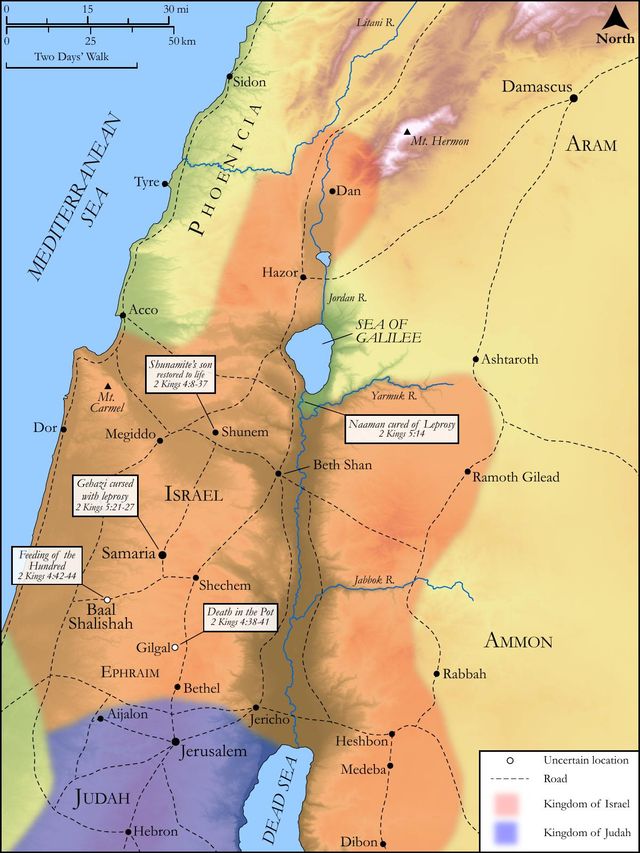
See on the biblical-era map
Study this verse
Public-domain commentary
Matthew Henry
From his Commentary on the Whole Bible. Henry comments on passages, not single verses — this entry covers 2 Kings 4:1–7. His four-level outline is real structure in the source text, so it is rendered as structure.
Elisha's miracles were for use, not for show; this recorded here was an act of real charity. Such also were the miracles of Christ, not only great wonders, but great favours to those for whom they were wrought. God magnifies his goodness with his power.
I.Elisha readily receives a poor widow's complaint.
She was a prophet's widow; to whom therefore should she apply, but to him that was a father to the sons of the prophets, and concerned himself in the welfare of their families? It seems, the prophets had wives as well as the priests, though prophecy went not by entail, as the priesthood did. Marriage is honourable in all, and not inconsistent with the most sacred professions. Now, by the complaint of this poor woman (Kg2 4:1), we are given to understand,
1.That her husband, being one of the sons of the prophets, was well know to Elisha. Ministers of eminent gifts and stations should make themselves familiar with those that are every way their inferiors, and know their character and state.
2.That he had the reputation of a godly man. Elisha knew him to be one that feared the Lord, else he would have been unworthy of the honour and unfit for the work of a prophet. He was one that kept his integrity in a time of general apostasy, one of the 7000 that had not bowed the knee to Baal.
3.That he was dead, though a good man, a good minister. The prophets - do they live for ever? Those that were clothed with the Spirit of prophecy were not thereby armed against the stroke of death.
4.That he died poor, and in debt more than he was worth. He did not contract his debts by prodigality, and luxury, and riotous living, for he was one that feared the Lord, and therefore durst not allow himself in such courses: nay, religion obliges men not to live above what they have, nor to spend more than what God gives them, no, not in expenses otherwise lawful; for thereby, of necessity, they must disable themselves, at last, to give every one his own, and so prove guilty of a continued act of injustice all along. Yet it may be the lot of those that fear God to be in debt, and insolvent, through afflictive providences, losses by sea, or bad debts, or their own imprudence, for the children of light are not always wise for this world. Perhaps this prophet was impoverished by persecution: when Jezebel ruled, prophets had much ado to live, and especially if they had families.
5.That the creditors were very severe with her Two sons she had to be the support of her widowed state, and their labour is reckoned assets in her hand; that must go therefore, and they must be bondmen for seven years (Exo 21:2) to work out this debt. Those that leave their families under a load of debt disproportionable to their estates know not what trouble they entail. In this distress the poor widow goes to Elisha, in dependence upon the promise that the seed of the righteous shall not be forsaken. The generation of the upright may expect help from God's providence and countenance from his prophets.
II.He effectually relieves this poor widow's distress, and puts her in a way both to pay her debt and to maintain herself and her family.
He did not say, Be warmed, be filled, but gave her real help. He did not give her some small matter for her present provision, but set her up in the world to sell oil, and put a stock into her hand to begin with. This was done by miracle, but it is an indication to us what is the best method of charity, and the greatest kindness one can do to poor people, which is, if possible, to help them into a way of improving what little they have by their own industry and ingenuity.
1.He directed her what to do, considered her case: What shall I do for thee? The sons of the prophets were poor, and it would signify little to make a collection for her among them: but the God of the holy prophets is able to supply all her need; and, if she has a little committed to her management, her need must be supplied by his blessing and increasing that little. Elisha therefore enquired what she had to make money of, and found she had nothing to sell but one pot of oil, Kg2 4:2. If she had had any plate or furniture, he would have bidden her part with it, to enable her to be just to her creditors. We cannot reckon any thing really, nor comfortably, our own, but what is so when all our debts are paid. If she had not had this pot of oil, the divine power could have supplied her; but, having this, it will work upon this, and so teach us to make the best of what we have. The prophet, knowing her to have credit among her neighbours, bids her borrow of them empty vessels (Kg2 4:3), for, it seems, she had sold her own, towards the satisfying of her creditors. He directs her to shut the door upon herself and her sons, while she filled all those vessels out of that one. She must shut the door, to prevent interruptions from the creditors, and others while it was in the doing, that they might not seem proudly to boast of this miraculous supply, and that they might have opportunity for prayer and praise to God upon this extraordinary occasion. Observe,
(1.)The oil was to be multiplied in the pouring, as the other widow's meal in the spending. The way to increase what we have is to use it; to him that so hath shall be given. It is not hoarding the talents, but trading with them, that doubles them.
(2.)It must be poured out by herself, not by Elisha nor by any of the sons of the prophets, to intimate that it is in connexion with our own careful and diligent endeavours that we may expect the blessing of God to enrich us both for this world and the other. What we have will increase best in our own hand.
2.She did it accordingly. She did not tell the prophet he designed to make a fool of her; but firmly believing the divine power and goodness, and in pure obedience to the prophet, she borrowed vessels large and many of her neighbours, and poured out her oil into them. One of her sons was employed to bring her empty vessels, and the other carefully to set aside those that were full, while they were all amazed to find their pot, like a fountain of living water, always flowing, and yet always full. They saw not the spring that supplied it, but believed it to be in him in whom all our springs are. Job's metaphor was now verified in the letter (Job 29:6), The rock poured me out rivers of oil. Perhaps this was in the tribe of Asher, part of whose blessing it was that he should dip his foot in oil, Deu 33:24.
3.The oil continued flowing as long as she had any empty vessels to receive it; when every vessel was full the oil stayed (Kg2 4:6), for it was not fit that this precious liquor should run over, and be as water spilt on the ground, which cannot be gathered up again. Note, We are never straitened in God, in his power and bounty, and the riches of his grace; all our straitness is in ourselves. It is our faith that fails, not his promise. He gives above what we ask: were there more vessels, there is enough in God to fill them - enough for all, enough for each. Was not this pot of oil exhausted as long as there were any vessels to be filled from it? And shall we fear lest the golden oil which flows from the very root and fatness of the good olive should fail, as long as there are any lamps to be supplied from it? Zac 4:12.
4.The prophet directed her what to do with the oil she had, Kg2 4:7. She must not keep it for her own use, to make her face to shine. Those whom Providence has made poor must be content with poor accommodations for themselves (this is knowing how to want), and must not think, when they get a little of that which is better than ordinary, to feed their own luxury: no,
(1.)She must sell the oil to those that were rich, and could afford to bestow it on themselves. We may suppose, being produced by miracle, it was the best of its kind, like the wine (Joh 2:10), so that she might have both a good price and a good market for it. Probably the merchants bought it to export, for oil was one of the commodities that Israel traded in, Eze 27:17.
(2.)She must pay her debt with the money she received for her oil. Though her creditors were too rigorous with her, yet they must not therefore lose their debt. Her first care, now that she has wherewithal to do so, must be to discharge that, even before she makes any provision for her children. It is one of the fundamental laws of our religion that we render to all their due, pay every just debt, give every one his own, though we leave ever so little for ourselves; and this, not of constraint but willingly and without grudging; not only for wrath, to avoid being sued, but also for conscience' sake. Those that possess an honest mind cannot with pleasure eat their daily bread, unless it be their own bread.
(3.)The rest must not be laid up, but she and her children must live upon it, not upon the oil, but upon the money received from it, with which they must put themselves into a capacity of getting an honest livelihood. No doubt she did as the man of God directed; and hence,
[1.]Let those that are poor and in distress be encouraged to trust God for supply in the way of duty. Verily thou shalt be fed, though not feasted. It is true we cannot now expect miracles, yet we may expect mercies, if we wait on God and seek to him. Let widows particularly, and prophets' widows in a special manner, depend upon him to preserve them and their fatherless children alive, for to them he will be a husband, a father.
[2.]Let those whom God has blessed with plenty use it for the glory of God and under the direction of his word: let them do justly with it, as this widow did, and serve God cheerfully in the use of it, and as Elisha, be ready to do good to those that need them, be eyes to the blind, and feet to the lame.
Historical interpretation
Two Centuries of Reception
2 surviving comments on this verse. Each one is dated, so this reads as a timeline rather than a list.
Select a marker to jump to its quote. Markers stagger vertically where authors wrote within a few decades of each other.
It is said that this woman was the wife of Obadiah, the treasurer of Ahab and a secret disciple of Elijah, who had taken one hundred prophets away from the rage of Jezebel and had fed them when they were hungry. It seems that in this affair he was entrusted with the gold of the royal house, but after his death his wife was left with a huge debt to be paid to his masters. But since she could not pay, and the taxmen of the king pressed her and wanted to sell her children, the mother implored Elisha, because she knew he was the father of orphans and the defender of widows, and she thought he would have not drawn back his hands [when asked to help] the sons of a righteous man who had served his companions the prophets. Among other things, the taxmen of the king, who had lent money to Obadiah, in justice, according to the law of the Hebrews, had moved against his children; and this is what our Lord suggested to us in the parable of the creditor king who ordered the children to be sold for the debt of their father, even though he was still alive and only needed some time to pay his debt.
Just as we said concerning blessed Elijah that he typified our Lord and Savior, dearly beloved, so we assert with confidence and assurance that holy Elisha was an image of our Savior. As you heard in the sacred lesson, a certain widow cried to blessed Elisha, beseeching him with tearful voice, “My husband is dead, and behold, the creditors are come and want to take away my sons.” Then he asked her what she had in the house. The woman replied, “As the Lord lives, I have nothing but a little oil to anoint me.” Then Elisha said, “Borrow vessels of your neighbors, and pour out of that oil into all the vessels, and when the vessels are full, sell, and pay your creditors.” This widow typified the church, beloved brothers, just like the one who merited to receive blessed Elijah. This widow, that is, the church, had contracted a heavy debt of sins, not of material substance. She had a debt, and she endured a most cruel creditor, because she had made herself subject to the devil by many sins. Thus, indeed, the prophet foretold, “It was for your sins that you were sold, for your crimes that your mother was dismissed.” For this reason the widow was held captive for such a heavy debt. She was a captive because the Redeemer had not yet come, but after Christ our Lord the true Redeemer visited the widow, he freed her from all debts. Now let us see how that widow was freed—how, except by an increase of oil? In the oil we understand mercy. Notice, brothers: the oil failed, and the debt increased; the oil was increased, and the debt disappeared. Avarice had grown, and charity was lost; charity returned, and iniquity perished. Thus, at the coming of the true Elisha, Christ our Lord, the widow or the church was freed from the debt of sin by an increase of oil, that is, by the gift of grace and mercy or the richness of charity.
Continue studying 2 Kings 4:1 across the web’s major study libraries — every link below opens this exact verse, chapter, or book on the destination site.
Read & Compare
 BibleGatewayThis verse in more than 200 translations and 70 languages.
 Bible.comThe YouVersion reader — hundreds of translations, reading plans, and highlights.
 ESV.orgCrossway's official English Standard Version reader.
 NET BibleThe NET translation with 60,000+ translators' notes on every rendering decision.
 STEP BibleTyndale House's free study tool — original text, vocabulary, and scholarly resources.
 BibliaLogos Bible Software's free web reader.
 USCCBThe New American Bible (Revised Edition) with the U.S. bishops' study notes.
Commentaries
 BibleHub CommentariesDozens of classic commentaries on this verse, gathered on one page.
 StudyLightMore than 100 commentary sets — the largest collection on the web.
 BibleRefPlain-English commentary on what this verse means, verse by verse.
 Enduring WordDavid Guzik's free commentary on this chapter, widely used by Bible teachers.
 Bible Study ToolsVerse commentary alongside Greek and Hebrew study aids.
Original Language & Research
- BibleHub InterlinearThe verse word by word — original language, transliteration, and English.
- BibleHub LexiconEvery word's original-language definition and Strong's entry.
 Blue Letter BibleDeep-study tools — Strong's numbers, concordance, and word studies.
 SefariaThe Hebrew text with Rashi and centuries of Jewish commentary.
Sermons, Hymns & Audio


TrulyRandomVerse is not affiliated with these sites and doesn’t control their content. They’re linked because they’re genuinely useful.
Summary
This verse introduces a poignant narrative of a widow, whose deceased husband was a devout servant of the Lord, facing an immediate and dire crisis: a creditor is coming to seize her two sons to be bondmen due to an unpaid debt. Her desperate cry to the prophet Elisha sets the stage for a miraculous divine intervention, highlighting the severe social and economic vulnerabilities of the time and God's compassionate response to the cries of the afflicted, thereby initiating a series of accounts showcasing Elisha's ministry of provision.
Context
ShowHideLiterary Context
This account in 2 Kings 4 marks a significant shift in Elisha's ministry from public, national-level miracles (such as healing the waters of Jericho in 2 Kings 2:19-22 or the judgment on the disrespectful youths in 2 Kings 2:23-25) to more personal, domestic interventions. It is the first in a series of narratives (extending through 2 Kings 8) that demonstrate Elisha's role as a prophet of provision, restoration, and compassion, often for the vulnerable and overlooked. The immediate narrative flow establishes a pattern where human desperation leads to divine intervention through the prophet, setting a precedent for God's active involvement in the lives of individuals.
Historical & Cultural Context
Ancient Israelite society was largely patriarchal, and widows, lacking a male provider, were among the most vulnerable groups, often facing extreme economic hardship and neglect. The "sons of the prophets" were members of prophetic guilds or communities, likely students or associates of leading prophets like Elisha. These groups often lived simply, and their members were not necessarily wealthy, which explains the husband's debt. Debt slavery was a legal, though often harsh, reality in the ancient Near East, including Israel, where individuals could sell themselves or their children into temporary servitude to repay debts. While Mosaic Law included provisions for the humane treatment and eventual release of Hebrew servants (Exodus 21:2; Leviticus 25:39-41), the threat of losing one's children to servitude was a devastating prospect, as vividly illustrated in Nehemiah 5:5, representing the ultimate familial and social breakdown.
Key Themes
ShowHideThis verse introduces several profound themes that resonate throughout biblical narrative. Firstly, it highlights Divine Compassion for the Vulnerable, echoing the biblical mandate for God's people to care for widows, orphans, and sojourners, reflecting God's own character as a defender of the defenseless (Deuteronomy 10:18; Psalm 68:5). Secondly, the widow's "cry" (Hebrew: tsa'aq) underscores the Power of a Desperate Plea, demonstrating that God hears and responds to the urgent cries of His people in distress, recalling Israel's cries under Egyptian bondage in Exodus 2:23-24. Thirdly, the detail that the husband "did fear the LORD" emphasizes Piety Amidst Poverty, showing that genuine faith does not exempt one from hardship, but it does draw divine attention and intervention. Finally, the verse serves as an Anticipation of Miracle, setting the stage for God's supernatural provision through Elisha, which will resolve an otherwise impossible human situation, reinforcing the theme of God's sovereignty and faithfulness.
Exposition and Analysis
ShowHideKey Word Analysis
ShowHideThis word signifies a strong, urgent, and often desperate cry for help, typically in a situation of distress, oppression, or danger. It implies a loud, public outcry, more than just a quiet lament; it's a plea for immediate intervention, often directed towards God or an authority figure. Its use here immediately conveys the widow's extreme anguish and her urgent need for relief, mirroring the cries of Israel under Egyptian bondage in Exodus 2:23, underscoring the severity of her plight and her profound desperation.
While literally meaning "son," this term, in the context of "sons of the prophets," refers to members of prophetic guilds or schools that flourished during the time of Elijah and Elisha. These were communities of individuals dedicated to the prophetic ministry, often living communally and sharing resources. They were disciples or associates of the leading prophets, engaged in studying God's word and serving Him. The use of "sons" here implies a familial or communal bond within these prophetic groups, highlighting their shared identity and purpose.
This is a profound theological concept in the Old Testament, denoting not mere fright, but a deep reverence, awe, respect, and obedient submission to God. It is a hallmark of true piety and righteousness, signifying a life lived in conscious awareness of God's sovereignty, holiness, and moral demands. The widow's assertion that her husband "did fear the LORD" serves as a powerful appeal to Elisha, implying that a faithful servant of God, despite his death and the resulting debt, should not have his family suffer such a devastating fate.
Verse Breakdown
ShowHide"Now there cried a certain woman of the wives of the sons of the prophets unto Elisha"
This opening establishes the protagonist as an overlooked woman, identified by her deceased husband's association with the prophetic community. Her immediate action—a desperate "cry" to Elisha—underscores her recognition of his spiritual authority and her belief in his ability to intercede on her behalf, indicating her dire need and trust in the prophetic office as a conduit for divine help.
"saying, Thy servant my husband is dead; and thou knowest that thy servant did fear the LORD"
Her plea begins with the stark reality of her widowhood, which is the root of her vulnerability and economic instability. She then appeals to Elisha's personal knowledge of her husband's piety, highlighting his genuine devotion to God. This detail is crucial; it suggests that despite his humble circumstances and the tragic debt, he was a righteous man, implying a moral claim for divine intervention on behalf of his family, appealing to God's covenant faithfulness to those who honor Him.
"and the creditor is come to take unto him my two sons to be bondmen"
This clause reveals the immediate and devastating threat. The creditor's legal right to seize her children as collateral for the debt represents the ultimate horror for a mother in that society. This impending loss of her sons to servitude, a fate that would tear her family apart and condemn her children to a life of labor, underscores the extreme desperation that drives her to Elisha, making her situation utterly unbearable and demanding urgent intervention.
Literary Devices
ShowHideThe verse effectively employs several literary devices to convey its powerful message and evoke a strong emotional response. Pathos is immediately established through the widow's "cry" and the dire threat to her children, evoking a profound sense of pity and sympathy in the reader. The simple, direct language used to describe her plight emphasizes her vulnerability and the severity of her situation, making her desperation palpable. There is also a subtle yet significant contrast drawn between the husband's piety ("did fear the LORD") and the harsh material consequences (death, debt, potential enslavement of his sons), setting up a tension that implicitly appeals to divine justice and anticipates a miraculous intervention that will reconcile this apparent incongruity. Furthermore, the verse functions as a powerful foreshadowing device, hinting at the miraculous solution that Elisha, as God's instrument, will bring to this seemingly impossible human crisis, thereby building narrative suspense and expectation for the subsequent verses.
Theological and Thematic Connections
ShowHideThe plight of the widow in 2 Kings 4:1 resonates deeply with a consistent theological theme throughout Scripture: God's profound and active concern for the vulnerable, particularly widows, orphans, and the poor. This narrative is a powerful demonstration of God's character as a compassionate deliverer who hears the cries of the oppressed and intervenes through His chosen servants. It underscores the biblical mandate for justice and mercy, reminding us that true faith is expressed not only in personal piety but also in actively caring for those who cannot care for themselves, reflecting God's own heart for the lowly and His commitment to upholding righteousness in the face of human suffering.
Reflection and Application
ShowHideThe desperate cry of the widow in 2 Kings 4:1 serves as a timeless reminder that even those who earnestly "fear the LORD" can face overwhelming hardships and seemingly insurmountable challenges. Her immediate and desperate appeal to Elisha models a crucial spiritual principle: in moments of extreme need, our first and most vital response should be to turn to God and His appointed channels of grace, whether through prayer, seeking wise counsel, or engaging with the community of faith. This account encourages us to bring our deepest fears, our most impossible situations, and our most vulnerable moments before the Lord with unwavering trust, confident that He hears the cries of His people and is abundantly able to provide in ways far beyond our human comprehension. Moreover, this narrative challenges us, as believers, to embody God's compassion in our own lives, actively seeking out and supporting the vulnerable, the indebted, and the lowly in our communities, recognizing that we are called to be instruments of God's justice, mercy, and provision in a broken world, reflecting His character to a world in need.
Questions for Reflection
ShowHideFAQ
ShowHideWhat was the "sons of the prophets" group, and why might the husband have been poor?
ShowHideThe "sons of the prophets" were members of prophetic guilds or schools that emerged during the time of Elijah and Elisha. These were communities of individuals dedicated to the prophetic ministry, often living communally and sharing resources. They were disciples or associates of the leading prophets, studying God's word and serving Him. Their poverty might stem from their chosen lifestyle, which often involved detachment from material pursuits, a lack of inherited land (as prophets often did not have tribal land allotments), or dedication to a calling that did not yield significant material riches. The fact that the husband "did fear the LORD" suggests his poverty was not due to idleness or sin, but perhaps the humble and sacrificial nature of his prophetic service, relying on God's provision and occasional support from the community, which unfortunately was insufficient to prevent this specific debt.
Was debt slavery common in ancient Israel, and how did it work?
ShowHideYes, debt slavery was a recognized, though regulated, practice in ancient Israel and the broader ancient Near East. If a person could not repay a debt, they might sell themselves or their children into temporary servitude to work off the debt. The Mosaic Law, while permitting this practice, also included significant provisions to prevent perpetual bondage and ensure humane treatment. For instance, Hebrew servants were to be released in the Sabbatical year (Exodus 21:2) and certainly in the Year of Jubilee (Leviticus 25:39-41). However, the immediate threat of losing one's children to servitude, as seen in this account and vividly illustrated in Nehemiah 5:5, was a severe and desperate situation for families, underscoring the deep societal vulnerability faced by the poor and indebted.
Christ-Centered Fulfillment
ShowHideThe desperate cry of the widow in 2 Kings 4:1, facing the crushing burden of debt and the imminent enslavement of her sons, powerfully foreshadows the ultimate plight of humanity. We, too, are born into a state of spiritual debt—the insurmountable debt of sin—which leads to spiritual bondage and ultimately, spiritual death (Romans 6:23). Just as the prophet Elisha intervened with miraculous provision, so too does Christ, the greater Prophet, intervene on our behalf. He is the one who pays the ultimate price, not with oil, but with His own precious blood, to redeem us from the bondage of sin and death (1 Peter 1:18-19). In Christ, the "creditor" (sin and its eternal consequences) has no claim over those who are His, for He has set us free from the law of sin and death (Romans 8:2). His profound compassion for the vulnerable, so vividly demonstrated throughout His earthly ministry to the sick, the poor, and the outcast (Matthew 9:36), mirrors and infinitely surpasses God's care for the widow, offering not just temporary relief but eternal liberation and abundant life (John 10:10). He is our true Kinsman-Redeemer, who buys us back from the slavery of sin and brings us into the glorious freedom of the children of God, fulfilling the deepest human need for rescue and restoration.