


2 Kings 4:3
- וַיֹּאמֶרvai·Yo·merand he saidH559Conj-w ¦ V-Qal-ConsecImperf-3msVerb Qal Consecutive Imperfect 3rd Singular Masculineוַandיֹּאמֶרhe said
- לְכִיle·KhigoH1980V-Qal-Imp-2fsVerb Qal Imperative 2nd Singular Feminine
- שַׁאֲלִיsha·'a·liaskH7592V-Qal-Imp-2fsVerb Qal Imperative 2nd Singular Feminine
- לָךְlakhfor yourselfPrep-l ¦ 2fsSuffix Personal 2nd Singular Feminineלָforךְyourself
- כֵּלִיםke·LimvesselsH3627N-mpNoun Plural Masculine Absolute
- מִןminfromH4480PrepPreposition
- הַחוּץha·Chutzthe outsideH2351Art ¦ N-msNoun Singular Masculine Absoluteהַtheחוּץoutside
- מֵאֵתme·'Etfrom withH854Prep-m ¦ PrepPrepositionמֵfromאֵתwith
- כָּלkolallH3605N-mscNoun Singular Masculine Construct
- שְׁכֵנָיִךְshikh·ni·kheyour neighborsH7934N-mpc ¦ 2fsNoun Plural Masculine Constructשְׁכֵנָיִneighborsךְyour
- כֵּלִיםke·LimvesselsH3627N-mpNoun Plural Masculine Absolute
- רֵקִיםre·KimemptyH7386Adj-mpAdjective Plural Masculine Absolute
- אַל'almay notH408NegParticle Negative
- תַּמְעִיטִיtam·'I·tiyou make fewH4591V-Hiphil-Imperf-2fsVerb Hiphil Imperfect 2nd Singular Feminine
English is a literal word-by-word gloss of the Hebrew, not the KJV's wording. Why?
This is the original text the KJV's translators worked from — each Hebrew word with its own literal English meaning in this verse, prepared by scholars at Tyndale House, Cambridge. The KJV translates whole sentences, not word by word, so its wording differs: one Hebrew word can become several English words, and the KJV may choose “the LORD” where the gloss reads “Yahweh”. Both are faithful — they answer different questions. For the KJV's own rendering, switch to the KJV text.
Details
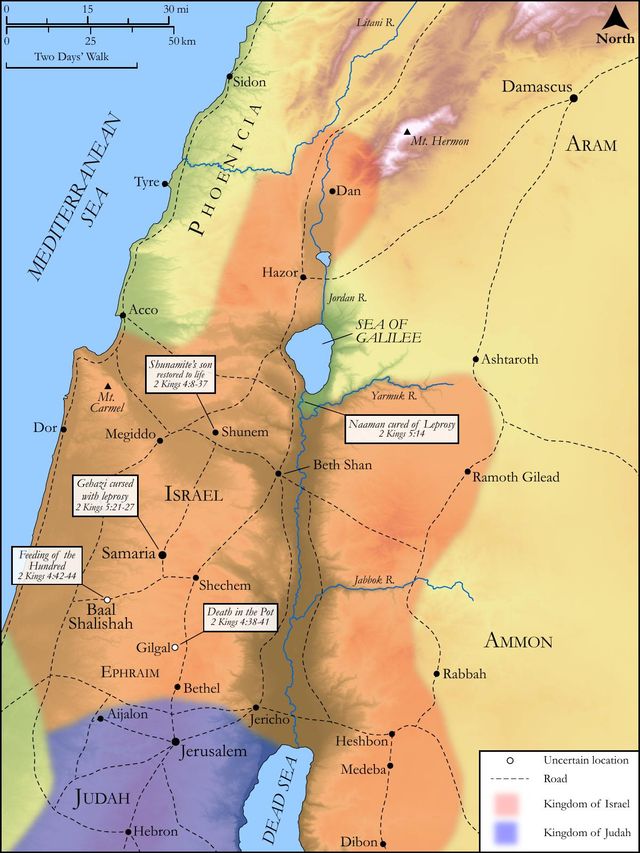
See on the biblical-era map
Study this verse
Public-domain commentary
Matthew Henry
From his Commentary on the Whole Bible. Henry comments on passages, not single verses — this entry covers 2 Kings 4:1–7. His four-level outline is real structure in the source text, so it is rendered as structure.
Elisha's miracles were for use, not for show; this recorded here was an act of real charity. Such also were the miracles of Christ, not only great wonders, but great favours to those for whom they were wrought. God magnifies his goodness with his power.
I.Elisha readily receives a poor widow's complaint.
She was a prophet's widow; to whom therefore should she apply, but to him that was a father to the sons of the prophets, and concerned himself in the welfare of their families? It seems, the prophets had wives as well as the priests, though prophecy went not by entail, as the priesthood did. Marriage is honourable in all, and not inconsistent with the most sacred professions. Now, by the complaint of this poor woman (Kg2 4:1), we are given to understand,
1.That her husband, being one of the sons of the prophets, was well know to Elisha. Ministers of eminent gifts and stations should make themselves familiar with those that are every way their inferiors, and know their character and state.
2.That he had the reputation of a godly man. Elisha knew him to be one that feared the Lord, else he would have been unworthy of the honour and unfit for the work of a prophet. He was one that kept his integrity in a time of general apostasy, one of the 7000 that had not bowed the knee to Baal.
3.That he was dead, though a good man, a good minister. The prophets - do they live for ever? Those that were clothed with the Spirit of prophecy were not thereby armed against the stroke of death.
4.That he died poor, and in debt more than he was worth. He did not contract his debts by prodigality, and luxury, and riotous living, for he was one that feared the Lord, and therefore durst not allow himself in such courses: nay, religion obliges men not to live above what they have, nor to spend more than what God gives them, no, not in expenses otherwise lawful; for thereby, of necessity, they must disable themselves, at last, to give every one his own, and so prove guilty of a continued act of injustice all along. Yet it may be the lot of those that fear God to be in debt, and insolvent, through afflictive providences, losses by sea, or bad debts, or their own imprudence, for the children of light are not always wise for this world. Perhaps this prophet was impoverished by persecution: when Jezebel ruled, prophets had much ado to live, and especially if they had families.
5.That the creditors were very severe with her Two sons she had to be the support of her widowed state, and their labour is reckoned assets in her hand; that must go therefore, and they must be bondmen for seven years (Exo 21:2) to work out this debt. Those that leave their families under a load of debt disproportionable to their estates know not what trouble they entail. In this distress the poor widow goes to Elisha, in dependence upon the promise that the seed of the righteous shall not be forsaken. The generation of the upright may expect help from God's providence and countenance from his prophets.
II.He effectually relieves this poor widow's distress, and puts her in a way both to pay her debt and to maintain herself and her family.
He did not say, Be warmed, be filled, but gave her real help. He did not give her some small matter for her present provision, but set her up in the world to sell oil, and put a stock into her hand to begin with. This was done by miracle, but it is an indication to us what is the best method of charity, and the greatest kindness one can do to poor people, which is, if possible, to help them into a way of improving what little they have by their own industry and ingenuity.
1.He directed her what to do, considered her case: What shall I do for thee? The sons of the prophets were poor, and it would signify little to make a collection for her among them: but the God of the holy prophets is able to supply all her need; and, if she has a little committed to her management, her need must be supplied by his blessing and increasing that little. Elisha therefore enquired what she had to make money of, and found she had nothing to sell but one pot of oil, Kg2 4:2. If she had had any plate or furniture, he would have bidden her part with it, to enable her to be just to her creditors. We cannot reckon any thing really, nor comfortably, our own, but what is so when all our debts are paid. If she had not had this pot of oil, the divine power could have supplied her; but, having this, it will work upon this, and so teach us to make the best of what we have. The prophet, knowing her to have credit among her neighbours, bids her borrow of them empty vessels (Kg2 4:3), for, it seems, she had sold her own, towards the satisfying of her creditors. He directs her to shut the door upon herself and her sons, while she filled all those vessels out of that one. She must shut the door, to prevent interruptions from the creditors, and others while it was in the doing, that they might not seem proudly to boast of this miraculous supply, and that they might have opportunity for prayer and praise to God upon this extraordinary occasion. Observe,
(1.)The oil was to be multiplied in the pouring, as the other widow's meal in the spending. The way to increase what we have is to use it; to him that so hath shall be given. It is not hoarding the talents, but trading with them, that doubles them.
(2.)It must be poured out by herself, not by Elisha nor by any of the sons of the prophets, to intimate that it is in connexion with our own careful and diligent endeavours that we may expect the blessing of God to enrich us both for this world and the other. What we have will increase best in our own hand.
2.She did it accordingly. She did not tell the prophet he designed to make a fool of her; but firmly believing the divine power and goodness, and in pure obedience to the prophet, she borrowed vessels large and many of her neighbours, and poured out her oil into them. One of her sons was employed to bring her empty vessels, and the other carefully to set aside those that were full, while they were all amazed to find their pot, like a fountain of living water, always flowing, and yet always full. They saw not the spring that supplied it, but believed it to be in him in whom all our springs are. Job's metaphor was now verified in the letter (Job 29:6), The rock poured me out rivers of oil. Perhaps this was in the tribe of Asher, part of whose blessing it was that he should dip his foot in oil, Deu 33:24.
3.The oil continued flowing as long as she had any empty vessels to receive it; when every vessel was full the oil stayed (Kg2 4:6), for it was not fit that this precious liquor should run over, and be as water spilt on the ground, which cannot be gathered up again. Note, We are never straitened in God, in his power and bounty, and the riches of his grace; all our straitness is in ourselves. It is our faith that fails, not his promise. He gives above what we ask: were there more vessels, there is enough in God to fill them - enough for all, enough for each. Was not this pot of oil exhausted as long as there were any vessels to be filled from it? And shall we fear lest the golden oil which flows from the very root and fatness of the good olive should fail, as long as there are any lamps to be supplied from it? Zac 4:12.
4.The prophet directed her what to do with the oil she had, Kg2 4:7. She must not keep it for her own use, to make her face to shine. Those whom Providence has made poor must be content with poor accommodations for themselves (this is knowing how to want), and must not think, when they get a little of that which is better than ordinary, to feed their own luxury: no,
(1.)She must sell the oil to those that were rich, and could afford to bestow it on themselves. We may suppose, being produced by miracle, it was the best of its kind, like the wine (Joh 2:10), so that she might have both a good price and a good market for it. Probably the merchants bought it to export, for oil was one of the commodities that Israel traded in, Eze 27:17.
(2.)She must pay her debt with the money she received for her oil. Though her creditors were too rigorous with her, yet they must not therefore lose their debt. Her first care, now that she has wherewithal to do so, must be to discharge that, even before she makes any provision for her children. It is one of the fundamental laws of our religion that we render to all their due, pay every just debt, give every one his own, though we leave ever so little for ourselves; and this, not of constraint but willingly and without grudging; not only for wrath, to avoid being sued, but also for conscience' sake. Those that possess an honest mind cannot with pleasure eat their daily bread, unless it be their own bread.
(3.)The rest must not be laid up, but she and her children must live upon it, not upon the oil, but upon the money received from it, with which they must put themselves into a capacity of getting an honest livelihood. No doubt she did as the man of God directed; and hence,
[1.]Let those that are poor and in distress be encouraged to trust God for supply in the way of duty. Verily thou shalt be fed, though not feasted. It is true we cannot now expect miracles, yet we may expect mercies, if we wait on God and seek to him. Let widows particularly, and prophets' widows in a special manner, depend upon him to preserve them and their fatherless children alive, for to them he will be a husband, a father.
[2.]Let those whom God has blessed with plenty use it for the glory of God and under the direction of his word: let them do justly with it, as this widow did, and serve God cheerfully in the use of it, and as Elisha, be ready to do good to those that need them, be eyes to the blind, and feet to the lame.
Historical interpretation
Two Centuries of Reception
3 surviving comments on this verse. Each one is dated, so this reads as a timeline rather than a list.
Select a marker to jump to its quote. Markers stagger vertically where authors wrote within a few decades of each other.
Here the Scripture relates the other miracle that Elisha performed in order to help the widow. He made flow into the vessels an amount of oil sufficient to pay the debt of her husband and abundantly multiplied it for the nourishment of her children.From the symbolic point of view three aspects must be observed here: first of all it is said that the widow filled the vessels of her neighbors with an oil that gushed out in her house thanks to a gift of God, because the holy church resembles the widow. In fact, she was not abandoned when her husband ascended to heaven, but she filled the hearts of the Gentiles with the oil of the knowledge of salvation which has multiplied and become abundant in her house thanks to the presence of the Holy Spirit. Moreover, the Gentiles, who were separated before, after being filled with that fat oil, glorified with their lips of cheerfulness that God whom they had ignored before.
In the second place, the widow asked for empty vessels and filled with oil those that her children brought to her, both small and large vessels. This signifies the saints who have rejected any worldly passion and are filled with the fat of the holy ointment and the oil of happiness. So their mother, that is, the grace of God gives oil to each of them, both to the great and the little. For God gives his gifts as he likes, so that everything may be ours, as the apostle says: “We must grow up in Christ according to his gift.” But those who are weighed down by their intemperance, drunkenness and worldly interests, those who, as the apostle says, walk in the vanity of their spirit and are obscured in their intelligence, those who have lost their hope and have given themselves to the practice of every sort of paganism and covetousness are deprived of this grace. In fact, they do not desire this oil, and if they desire it, they prepare no vessel to be filled with it.
In the third place, the rest of the oil, which the dead husband had left to his widow, signifies the mercy that [Christ] had shown to the saints while he lived on earth. Solomon says that he who associates himself with the Lord has mercy for the poor, and [the Lord] will reward him according to his works.
Notice, dearly beloved: as long as that widow had oil in her own vessel, it was not enough for her, and she could not pay her debt. It is true, brothers. If a person loves only himself, he does not suffice for himself, and he does not pay the debt of his sins; but when he begins to pour out the oil of charity on all his friends and neighbors and in fact on all people, then he is able to suffice for himself and can free himself from all debts. Truly brothers, such is the nature of holy love and true charity that it increases by being spent, and the more it is paid out to others, the more abundantly it is accumulated in oneself. If you want to give bodily food to the needy, at present you cannot keep what you have given him; but if you offer the bread of charity to one hundred people, it still remains whole. Even if you give it to a thousand, it stays undiminished for you. In fact, if you want to lavish it on the whole world, you will still lose nothing of it; or rather, not only does it not increase, but also the gain of all those on whom you bestowed it increases manifold for you. For example, you had a single loaf of charity; if you had given it to no one you would have it alone, but if you gave it to a thousand you would have acquired a thousand loaves. So great is the possession of charity that it remains entire for each individual and still can be undiminished for them all. Therefore, if you have given to others, you have lost nothing at all; or rather, not only did you not lose anything but also, as I already said, whatever you have conferred on others you have acquired a hundredfold. For this reason, beloved brothers, realize that the widow was freed from her creditors by nothing else than oil; know also that the Catholic church has been freed from its offenses by no other means than the oil of God’s mercy.
Let us now consider what blessed Elisha said to her: “Borrow many vessels of your neighbors and your friends, shut your door, and pour out of that oil into the vessels of your neighbors.” Who were those neighbors, except the Gentiles? Although that widow typified the church, she was still a widow, and so those neighbors from whom she borrowed vessels prefigured the Gentiles. They offered empty vessels in order that they might merit to receive the oil of mercy, because before obtaining the gift of grace all the Gentiles are known to have been without faith, charity and all good works. Finally, all who are offered to the church to receive salutary baptism receive the chrism and oil of benediction, so that they may no longer merit to be empty vessels but full of God as his temples.
Continue studying 2 Kings 4:3 across the web’s major study libraries — every link below opens this exact verse, chapter, or book on the destination site.
Read & Compare
 BibleGatewayThis verse in more than 200 translations and 70 languages.
 Bible.comThe YouVersion reader — hundreds of translations, reading plans, and highlights.
 ESV.orgCrossway's official English Standard Version reader.
 NET BibleThe NET translation with 60,000+ translators' notes on every rendering decision.
 STEP BibleTyndale House's free study tool — original text, vocabulary, and scholarly resources.
 BibliaLogos Bible Software's free web reader.
 USCCBThe New American Bible (Revised Edition) with the U.S. bishops' study notes.
Commentaries
 BibleHub CommentariesDozens of classic commentaries on this verse, gathered on one page.
 StudyLightMore than 100 commentary sets — the largest collection on the web.
 BibleRefPlain-English commentary on what this verse means, verse by verse.
 Enduring WordDavid Guzik's free commentary on this chapter, widely used by Bible teachers.
 Bible Study ToolsVerse commentary alongside Greek and Hebrew study aids.
Original Language & Research
- BibleHub InterlinearThe verse word by word — original language, transliteration, and English.
- BibleHub LexiconEvery word's original-language definition and Strong's entry.
 Blue Letter BibleDeep-study tools — Strong's numbers, concordance, and word studies.
 SefariaThe Hebrew text with Rashi and centuries of Jewish commentary.
Sermons, Hymns & Audio


TrulyRandomVerse is not affiliated with these sites and doesn’t control their content. They’re linked because they’re genuinely useful.
Summary
In 2 Kings 4:3, the prophet Elisha delivers a precise and pivotal command to a desperate widow: she is to go out and gather a multitude of empty vessels from all her neighbors, explicitly instructing her to "borrow not a few." This seemingly mundane, yet profoundly significant, instruction sets the stage for a remarkable miracle of divine provision, where her meager pot of oil will be supernaturally multiplied to pay her debts and sustain her family, demonstrating God's boundless capacity to meet needs when met with faith and obedience.
Context
ShowHideLiterary Context
This verse is deeply embedded within the narrative of Elisha's prophetic ministry, specifically within a series of miracles recorded in 2 Kings 4. The chapter opens with the dire plight of a widow of one of the "sons of the prophets" (a student or member of a prophetic guild), whose husband has died, leaving her and her two sons in severe debt. Her creditors are on the verge of taking her sons as bondservants, a devastating practice in ancient Israel (Nehemiah 5:5). In her desperation, she cries out to Elisha for help (2 Kings 4:1). Elisha's initial response is a probing question designed to ascertain her remaining resources: "What shall I do for thee? tell me, what hast thou in the house?" (2 Kings 4:2). Her reply, "Thine handmaid hath not any thing in the house, save a pot of oil," becomes the single, seemingly insignificant resource that God will use. Elisha's command in this verse is the first, crucial step in God's miraculous intervention, emphasizing the widow's active participation and obedience as a prerequisite for the divine outpouring that follows in 2 Kings 4:4-7.
Historical & Cultural Context
The socio-economic reality of ancient Israel often placed widows in extremely vulnerable positions, as they typically lacked male protectors and providers. The Mosaic Law included provisions for their care (e.g., Deuteronomy 24:17), yet debt could still lead to dire consequences, including the sale of children into servitude to satisfy creditors. This practice, though regulated, was a harsh reality (Exodus 21:7). The "sons of the prophets" were part of a prophetic community, often living in simple conditions, and their families were not immune to financial hardship. Oil, particularly olive oil, was a staple commodity with significant economic value, used for food, light, anointing, and trade. The widow's "pot of oil" would have represented her last, most basic asset. Elisha's instruction to "borrow vessels abroad of all thy neighbours" reflects a communal aspect of ancient life, where neighbors would typically share resources, albeit in this case, for an unusual purpose. The sheer number of vessels requested underscores the extraordinary nature of the impending miracle, signaling that God's provision would exceed all human expectation and capacity.
Key Themes
ShowHideThe narrative of the widow's oil, initiated by Elisha's command in 2 Kings 4:3, powerfully illustrates several enduring biblical themes. Foremost is Divine Provision, demonstrating God's sovereign ability to supply abundantly, even from the most meager resources, turning scarcity into overflowing plenty (Philippians 4:19). This miracle underscores that God's power is not limited by human lack. Secondly, Faith and Obedience are paramount; the widow's willingness to obey Elisha's seemingly strange and demanding instruction, gathering numerous empty vessels, is crucial. Her faith is active, demonstrated through her actions, preparing for a blessing she could not yet comprehend (Hebrews 11:6). Thirdly, the theme of Preparation for Blessing is highlighted by the command to "borrow not a few" vessels. The extent of the miracle was limited not by God's power, but by the capacity of the containers provided by the widow, suggesting that God's blessings often require us to make room or prepare ourselves to receive them. Finally, the story powerfully showcases God's Compassion for the vulnerable. He intervenes directly to save the widow's sons from servitude and restore her family's dignity and livelihood, reflecting His consistent concern for the poor, widows, and orphans throughout Scripture (Psalm 68:5).
Exposition and Analysis
ShowHideKey Word Analysis
ShowHideA primitive root; to say (used with great latitude); answer, appoint, avouch, bid, boast self, call, certify, challenge, charge, [phrase] (at the, give) command(-ment), commune, consider, declare, demand, [idiom] desire, determine, [idiom] expressly, [idiom] indeed, [idiom] intend, name, [idiom] plainly, promise, publish, report, require, say, speak (against, of), [idiom] still, [idiom] suppose, talk, tell, term, [idiom] that is, [idiom] think, use (speech), utter, [idiom] verily, [idiom] yet. In this context, "said" (H559) indicates Elisha's authoritative and direct communication of God's will, initiating the miraculous process.
From כָּלָה; something prepared, i.e. any apparatus (as an implement, utensil, dress, vessel or weapon); armour(-bearer), artillery, bag, carriage, [phrase] furnish, furniture, instrument, jewel, that is made of, [idiom] one from another, that which pertaineth, pot, [phrase] psaltery, sack, stuff, thing, tool, vessel, ware, weapon, [phrase] whatsoever. The Hebrew word kᵉlîy (H3627), appearing in its plural form here, is a broad term referring to any kind of implement, article, or container. In this context, it specifically denotes receptacles or jars. Their "emptiness" is crucial; they represent a state of need and readiness to be filled, symbolizing the human condition of emptiness before divine provision.
Or שָׁאֵל; a primitive root; to inquire; by implication, to request; by extension, to demand; ask (counsel, on), beg, borrow, lay to charge, consult, demand, desire, [idiom] earnestly, enquire, [phrase] greet, obtain leave, lend, pray, request, require, [phrase] salute, [idiom] straitly, [idiom] surely, wish. The verb shâʼal (H7592) means "to ask," "to borrow," or "to request." Here, it implies an active seeking and gathering from others. This act of borrowing underscores the community's role, as well as the widow's humility and dependence on her neighbors, even for empty containers.
A primitive root; properly, to pare off, i.e. lessen; intransitively, to be (or causatively, to make) small or few (or figuratively, ineffective); suffer to decrease, diminish, (be, [idiom] borrow a, give, make) few (in number, -ness), gather least (little), be (seem) little, ([idiom] give the) less, be minished, bring to nothing. In the phrase "borrow not a few," the negative imperative form of this root (אַל־תַּמְעִיטִי, 'al-tam'iṭi) emphatically commands the widow to not gather a small number, but rather to gather as many vessels as possible. This highlights the divine expectation of superabundant provision, limited only by the capacity prepared to receive it.
Verse Breakdown
ShowHide"Then he said, Go, borrow thee vessels abroad of all thy neighbours,"
This opening clause establishes Elisha's direct, authoritative instruction, conveying God's specific will to the widow. The command to "go" implies active participation and initiative on her part, requiring her to step out in faith. "Borrow... of all thy neighbours" highlights the communal aspect and the public nature of her need, requiring her to humble herself and seek help from those around her. The act of borrowing empty vessels, rather than something of value, also subtly points to the extraordinary nature of the impending miracle – it is not about human resources, but divine filling.
"[even] empty vessels;"
The explicit mention of "empty vessels" is critically important. It underscores that the miracle would not involve transforming existing resources but creating something from nothing (or next to nothing, given her single pot of oil) to fill a void. The emptiness of the vessels symbolizes the widow's own emptiness and desperate need, as well as the principle that God often fills what is available and prepared, even if it seems utterly insufficient. It also removes any ambiguity about the source of the future abundance—it would be a divine act, not a human contribution.
"borrow not a few."
This final, emphatic instruction is a powerful statement of divine abundance and a test of the widow's faith. "Not a few" (or "do not get little") is a strong negative imperative, meaning "do not diminish the number" or "do not gather only a small amount." It is a call to prepare for an overwhelming outpouring, implying that the extent of the blessing would be directly proportional to the capacity she made available. This command challenges human limitations and invites a radical trust in God's limitless provision, urging her to think beyond her immediate scarcity and anticipate a superabundant supply.
Literary Devices
ShowHideThe verse employs several significant literary devices that amplify its message. Symbolism is prominent, with the "empty vessels" representing both the widow's profound need and the human capacity (or lack thereof) that God chooses to fill. The oil, though only mentioned in the preceding verse, symbolizes divine provision, blessing, and anointing. The command to "borrow not a few" functions as a form of hyperbole, emphasizing the vastness of the impending miracle and challenging the widow to prepare for an extraordinary, almost unbelievable, abundance. There is also an element of foreshadowing, as this specific instruction sets up the miraculous multiplication of oil that will follow, building anticipation for God's powerful intervention and demonstrating His limitless power. The simple, direct language of Elisha's command, characteristic of prophetic speech, lends it an authoritative and urgent tone, compelling immediate and complete obedience.
Theological and Thematic Connections
ShowHideThe command in 2 Kings 4:3 encapsulates profound theological truths about God's character and His interaction with humanity. It reveals a God who is intimately aware of the suffering of His people, particularly the vulnerable, and who intervenes with practical, miraculous provision. This is not merely a story of financial relief, but a demonstration of divine sovereignty over creation and resources, and an affirmation of God's covenant faithfulness. The requirement for the widow's active participation—gathering the vessels—highlights the biblical principle that while God provides, human faith and obedience often serve as the channel through which His power flows. The "empty vessels" symbolize our own spiritual emptiness and need, which God is eager to fill with His grace and abundance, often in ways that defy human logic and expectation.
Cross-references that illuminate these themes include:
Reflection and Application
ShowHideThe seemingly simple instruction in 2 Kings 4:3 holds profound lessons for contemporary believers. It calls us to examine our own "vessels"—our capacities, our expectations, our willingness to trust—in the face of our needs and God's promises. Often, we limit God's potential work in our lives by our small thinking, our fear of appearing needy, or our reluctance to take a seemingly illogical step of faith. Like the widow, we are invited to prepare for a blessing that may seem disproportionate to our current reality or resources. This preparation involves active obedience, even when the path is unclear or the instruction seems unusual. It reminds us that God often uses our "nothing" to demonstrate His "everything," transforming our emptiness into overflowing abundance. The story encourages us to cultivate a posture of radical trust, believing that God's provision is limitless and that He delights in filling the empty spaces we make available for Him. It challenges us to ask: "Am I truly preparing for God's abundance, or am I limiting His work by my lack of faith or effort?"
Questions for Reflection
ShowHideFAQ
ShowHideWhy did Elisha tell the widow to borrow "empty vessels" and "not a few"?
ShowHideElisha's instruction for "empty vessels" was crucial because it underscored that the miracle would be a divine act of creation and multiplication, not a transformation of existing resources. The vessels were to be receptacles for God's supernatural provision, emphasizing that the source of the abundance was entirely God. The command to borrow "not a few" (meaning "many" or "as many as possible") served two primary purposes: first, it was a test of the widow's faith and obedience, requiring her to actively prepare for an extraordinary blessing that defied her current reality; second, it demonstrated the limitless nature of God's provision. The miracle would only stop when there were no more vessels to fill (2 Kings 4:6). This highlights that God's power is boundless, and the extent of His blessing is often limited only by our capacity to receive and prepare for it.
Does this story mean God will always provide financial miracles if I just "prepare" for them?
ShowHideWhile this story powerfully illustrates God's ability and willingness to provide miraculously, it's important to interpret it within the broader biblical context. God's provision takes many forms, not always financial or immediate. This narrative is a specific account of God's compassionate intervention for a vulnerable widow through a prophet. The principle is that God is our ultimate provider, and He often calls for faith and obedience as we wait for His provision. Sometimes, His provision comes through natural means, through the generosity of others, or by equipping us with wisdom and strength to overcome challenges. The core message is to trust God's sovereignty and goodness, to obey His specific leading, and to be open to His miraculous work, recognizing that His ways are higher than ours (Isaiah 55:8-9). The "empty vessels" can also symbolize our spiritual emptiness that God desires to fill with His Spirit and grace, which is a deeper, more consistent form of provision.
Christ-Centered Fulfillment
ShowHideThe narrative of the widow's oil, initiated by Elisha's command in 2 Kings 4:3, finds its ultimate and most profound fulfillment in Jesus Christ. Just as the empty vessels were prepared to receive an overflowing, life-sustaining oil, humanity is inherently empty and in desperate need of a divine filling. Christ is the ultimate and inexhaustible "pot of oil," the source of all spiritual abundance. He declared, "I am the bread of life; whoever comes to me shall not hunger, and whoever believes in me shall never thirst" (John 6:35). Our spiritual "debt" of sin, which once threatened to enslave us (Romans 6:23), has been fully paid by the sacrificial work of the Lamb of God on the cross. The call to "borrow not a few" empty vessels can be seen as an invitation to come to Christ with the full measure of our need and emptiness, for He promises to fill us to overflowing with His Spirit (John 7:38) and His abundant life (John 10:10). In Him, we find not just temporary relief from debt, but eternal salvation and an endless supply of grace, peace, and righteousness, transforming our spiritual destitution into an inheritance of immeasurable riches (Ephesians 1:7-8).