


2 Kings 3:16
Bible text: King James Version (1769 Blayney text) · Public domain
Bible text: Berean Standard Bible · Public domain
Bible text: American Standard Version (1901) · Public domain
Bible text: World English Bible, Messianic edition · Public domain
Bible text: Geneva Bible (1599) · Public domain
Bible text: Young's Literal Translation · Public domain
- וַיֹּאמֶרvai·Yo·merand he saidH559Conj-w ¦ V-Qal-ConsecImperf-3msVerb Qal Consecutive Imperfect 3rd Singular Masculineוַandיֹּאמֶרhe said
- כֹּהkohthusH3541AdvAdverb
- אָמַר'a·Marhe saysH559V-Qal-Perf-3msVerb Qal Perfect 3rd Singular Masculine
- יְהוָהYah·wehYahwehH3068N-properNoun Proper Title
- עָשֹׂה'a·SohmakeH6213V-Qal-InfAbsVerb Qal Infinitive Absolute
- הַנַּחַלha·Na·chalthe wadiH5158Art ¦ N-msNoun Singular Masculine Absoluteהַtheנַּחַלwadi
- הַזֶּהha·Zeh<the> thisH2088Art ¦ PrtParticle Demonstrativeהַ<the>זֶּהthis
- גֵּבִיםge·VimditchesH1356N-mpNoun Plural Masculine Absolute
- גֵּבִיםge·VimditchesH1356N-mpNoun Plural Masculine Absolute
English is a literal word-by-word gloss of the Hebrew, not the KJV's wording. Why?
This is the original text the KJV's translators worked from — each Hebrew word with its own literal English meaning in this verse, prepared by scholars at Tyndale House, Cambridge. The KJV translates whole sentences, not word by word, so its wording differs: one Hebrew word can become several English words, and the KJV may choose “the LORD” where the gloss reads “Yahweh”. Both are faithful — they answer different questions. For the KJV's own rendering, switch to the KJV text.
Details
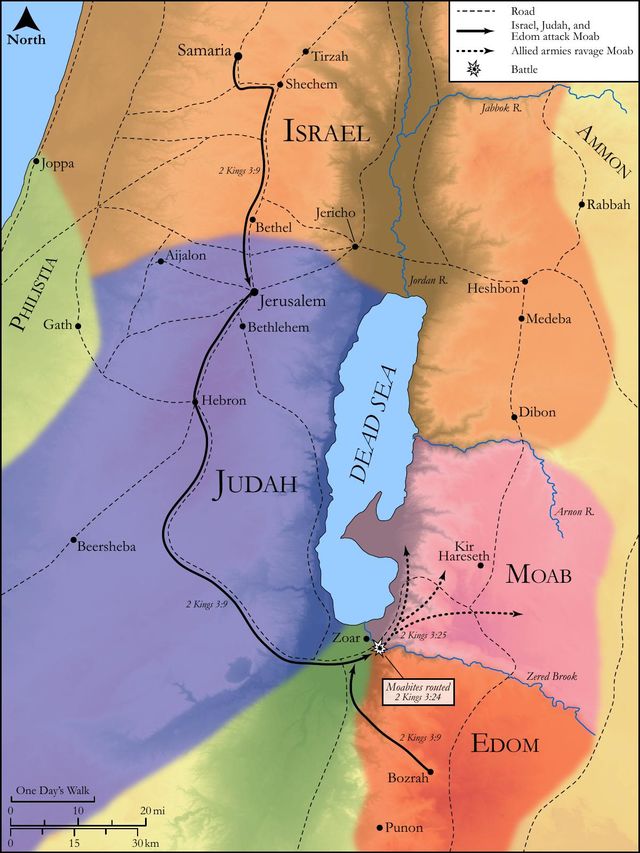
See on the biblical-era map
Study this verse
Public-domain commentary
Matthew Henry
From his Commentary on the Whole Bible. Henry comments on passages, not single verses — this entry covers 2 Kings 3:6–19. His three-level outline is real structure in the source text, so it is rendered as structure.
Jehoram has no sooner got the sceptre into his hand than he takes the sword into his hand, to reduce Moab. Crowns bring great cares and perils to the heads that wear them; no sooner in honour than in war. Now here we have,
I.The concerting of this expedition between Jehoram king of Israel and Jehoshaphat king of Judah.
Jehoram levied an army (Kg2 3:6), and such an opinion he had of the godly king of Judah that,
1.He courted him to be his confederate: Wilt thou go with me against Moab? And he gained him. Jehoshaphat said, I will go up. I am as thou art, Kg2 3:7. Judah and Israel, though unhappily divided from each other, yet can unite against Moab a common enemy. Jehoshaphat upbraids them not with their revolt from the house of David, nor makes it an article of their alliance that they shall return to their allegiance, though he had good reason to insist upon it, but treats with Israel as a sister-kingdom. Those are no friends to their own peace and strength who can never find in their hearts to forgive and forget an old injury, and unite with those that have formerly broken in upon their rights. Quod initio non vulvit, tractu temporis invalescit - That which was originally destitute of authority in the progress of time acquires it.
2.He consulted him as his confidant, Kg2 3:8. He took advice of Jehoshaphat, who had more wisdom and experience than himself, which way they should make their descent upon the country of Moab; and he advised that they should not march against them the nearest way, over Jordan, but go round through the wilderness of Edom, that they might take the king of Edom (who was tributary to him) and his forces along with them If two be better than one, much more will not a three-fold cord be easily broken. Jehoshaphat had like to have paid dearly for joining with Ahab, yet he joined with his son, and this expedition also had like to have been fatal to him. There is nothing got by being yoked with unbelievers.
II.The great straits that the army of the confederates was reduced to in this expedition.
Before they saw the face of an enemy they were all in danger of perishing for want of water, Kg2 3:9. This ought to have been considered before they ventured a march through the wilderness, the same wilderness (or very near it) where their ancestors wanted water, Num 20:2. God suffers his people, by their own improvidence, to bring themselves into distress, that the wisdom, power, and goodness of his providence may be glorified in their relief. What is more cheap and common than water? It is drink to every beast of the field, Psa 104:11. Yet the want of it will soon humble and ruin kings and armies. The king of Israel sadly lamented the present distress, and the imminent danger it put them in of falling into the hands of their enemies the Moabites, to whom, when weakened by thirst, they would be an easy prey, Kg2 3:10. it was he that had called these kings together; yet he charges it upon Providence, and reflects upon that as unkind: The Lord has called them together. Thus the foolishness of man perverteth his way, and then his heart fretteth against the Lord, Pro 19:3.
III.Jehoshaphat's good motion to ask counsel of God in this exigency, Kg2 3:11.
The place they were now in could not but remind them of the wonders of which their fathers told them, the waters fetched out of the rock for Israel's seasonable supply. The thought of this, we may suppose, encouraged Jehoshaphat to ask, Is there not here a prophet of the Lord, like unto Moses? He was the more concerned because it was by his advice that they fetched this compass through the wilderness, Kg2 3:8. It was well that Jehoshaphat enquired of the Lord now, but it would have been much better if he had done it sooner, before he engaged in this war, or steered this course; so the distress might have been prevented. Good men are sometimes remiss and forgetful, and neglect their duty till necessity and affliction drive them to it.
IV.Elisha recommended as a proper person for them to consult with Kg2 3:11. And here we may wonder,
1.That Elisha should follow the camp, especially in such a tedious march as this, as a volunteer, unasked, unobserved, and in no post of honour at all; not in the office of priest of the war (Deu 20:2) or president of the council of war, but in such obscurity that none of the kings knew they had such a jewel in the treasures of their camp, nor so good a friend in their retinue. We may suppose it was by special direction from heaven that Elisha attended the war, as the chariot of Israel and the horsemen thereof. Thus does God anticipate his people with the blessings of his goodness and provide his oracles for those that provide them not for themselves. It would often be bad with us if God did not take more care of us, both for soul and body, than we take for ourselves.
2.That a servant of the king of Israel knew of his being there when the king himself did not. Probably it was such a servant as Obadiah was to his father Ahab, one that feared the Lord; to such a one Elisha made himself known, not to the kings. The account he gives of him is that it was he that poured water on the hands of Elijah, that is, he was his servant, and particularly attended him when he washed his hands. He that will be great, let him learn to minister: he that will rise high, let him begin low.
V.The application which the kings made to Elisha.
They went down to him to his quarters, Kg2 3:12. Jehoshaphat had such an esteem for a prophet with whom the word of the Lord was that he would condescend to visit him in his own person and not send for him up to him. The other two were moved by the straits they were in to make their court to the prophet. He that humbled himself was thus exalted, and looked great, when three kings came to knock at his door, and beg his assistance; see Rev 3:9.
VI.The entertainment which Elisha gave them.
1.He was very plain with the wicked king of Israel (Kg2 3:13): "What have I to do with thee? How canst thou expect an answer of peace from me? Get thee to the prophets of thy father and mother, whom thou hast countenanced and maintained in thy prosperity, and let them help thee now in thy distress." Elisha was not imposed upon, as Jehoshaphat was, by his partial and hypocritical reformation; he knew that, though he had put away the image of Baal, Baal's prophets were still dear to him, and perhaps some of the were now in his camp. "Go," said he, "go to them. Get you to the gods whom you have served, Jdg 10:14. The world and the flesh have ruled you, let them help you; why should God be enquired of by you?" Eze 14:3. Elisha tells him to his face, in a holy indignation at his wickedness, that he can scarcely find in his heart to look towards him or to see him, Kg2 3:14. Jehoram is to be respected as a prince, but as a wicked man he is a vile person, and is to be condemned, Psa 15:4. Elisha, as a subject, will honour him, but as a prophet he will cause him to know his iniquity. For those that had such an extraordinary commission it was fit (though not for a common person) to say to a king, Thou art wicked, Job 34:18. Jehoram has so much self-command as to take this plain dealing patiently; he cares not now for hearing of the prophets of Baal, but is a humble suitor to the God of Israel and his prophet, representing the present case as very deplorable and humbly recommending it to the prophet's compassionate consideration. In effect, he owns himself unworthy, but let not the other kings be ruined for his sake.
2.Elisha showed a great respect to the godly king of Judah, regarded his presence, and, for his sake, would enquire of the Lord for them all. It is good being with those that have God's favour and his prophet's love. Wicked people often fare the better for the friendship and society of those that are godly.
3.He composed himself to receive instructions from God. His mind was somewhat ruffled and disturbed at the sight of Jehoram; though he was not put into a sinful heat or passion, nor had spoken unadvisedly, yet his zeal for the present indisposed him for prayer and the operations of the Spirit, which required a mind very calm and sedate. He therefore called for a musician (Kg2 3:15), a devout musician, one accustomed to play upon his harp and sign psalms to it. To hear God's praises sweetly sung, as David had appointed, would cheer his spirits, and settle his mind, and help to put him into a right frame both to speak to him and to hear from him. We find a company of prophets prophesying with a psaltery and a tabret before them, Sa1 10:5. Those that desire communion with God must keep their spirits quiet and serene. Elisha being refreshed, and having the tumult of his spirits laid by this divine music, the hand of the Lord came upon him, and his visit did him more honour than that of three kings.
4.God, by him, gave them assurance that the issue of the present distress would be comfortable and glorious.
(1.)They should speedily be supplied with water, Kg2 3:16, Kg2 3:17. To try their faith and obedience, he bids them make the valley full of ditches to receive the water. Those that expect God's blessings must prepare room for them, dig the pools for the rain to fill, as they did in the valley of Baca, and so made even that a well, Psa 84:6. To raise the wonder, he tells them they shall have water enough, and yet there shall be neither wind nor rain. Elijah, by prayer, obtained water out of the clouds, but Elisha fetches it nobody knows whence. The spring of these waters shall be as secret as the head of the Nile. God is not tied to second causes. Ordinarily it is by a plentiful rain that God confirms his inheritance (Psa 68:9), but here it is done without rain, at least without rain in that place. Some of the fountains of the great deep, it is likely, were broken up on this occasion; and, to increase the miracle, that valley only (as it should seem) was filled with water, and no other place had any share of it.
(2.)That supply should be an earnest of victory (Kg2 3:18): "This is but a light thing in the sight of the Lord; you shall not only be saved from perishing, but shall return in triumph." As God gives freely to the unworthy, so he gives richly, like himself, more than we are able to ask or think. His grants out-do our requests and expectations. Those that sincerely seek for the dew of God's grace shall have it, and by it be made more than conquerors. It is promised that they shall be masters of the rebellious country, and they are permitted to lay it waste and ruin it, Kg2 3:19. The law forbade them to fell fruit-trees to be employed in their sieges (Deu 20:19), but not when it was intended, in justice, for the starving of a country that had forfeited its fruits, by denying tribute to those to whom tribute was due.
Historical interpretation
Historical reception
1 surviving comment on this verse from the historical church.
“The harpist played, and the water flowed to the bed of the streams.” Through this figure the voice of Christ is conveniently foreshadowed, because he kept the harp of the spirit on the cross. Indeed, our Lord cried twice and gave up his spirit with a loud voice. And immediately the pagan centurion gave glory to the Lord, and in this manner the conversion of the Gentiles was clearly highlighted. After the Christ had brought to perfection on the wood of the cross the new glory of our Savior, the sources were immediately opened and rivers of living water flowed on the nations of the Gentiles, who are symbolized by the “wadi,” as Jesus had said before his passion: “Let the one who believes in me drink. As the Scripture has said, ‘Out of the believer’s heart shall flow rivers of living water.’ ” In this way the word of the prophet might be fulfilled: He who has played the harp will play for the Gentiles in the name of the Lord.
Continue studying 2 Kings 3:16 across the web’s major study libraries — every link below opens this exact verse, chapter, or book on the destination site.
Read & Compare
 BibleGatewayThis verse in more than 200 translations and 70 languages.
 Bible.comThe YouVersion reader — hundreds of translations, reading plans, and highlights.
 ESV.orgCrossway's official English Standard Version reader.
 NET BibleThe NET translation with 60,000+ translators' notes on every rendering decision.
 STEP BibleTyndale House's free study tool — original text, vocabulary, and scholarly resources.
 BibliaLogos Bible Software's free web reader.
 USCCBThe New American Bible (Revised Edition) with the U.S. bishops' study notes.
Commentaries
 BibleHub CommentariesDozens of classic commentaries on this verse, gathered on one page.
 StudyLightMore than 100 commentary sets — the largest collection on the web.
 BibleRefPlain-English commentary on what this verse means, verse by verse.
 Enduring WordDavid Guzik's free commentary on this chapter, widely used by Bible teachers.
 Bible Study ToolsVerse commentary alongside Greek and Hebrew study aids.
Original Language & Research
- BibleHub InterlinearThe verse word by word — original language, transliteration, and English.
- BibleHub LexiconEvery word's original-language definition and Strong's entry.
 Blue Letter BibleDeep-study tools — Strong's numbers, concordance, and word studies.
 SefariaThe Hebrew text with Rashi and centuries of Jewish commentary.
Sermons, Hymns & Audio


TrulyRandomVerse is not affiliated with these sites and doesn’t control their content. They’re linked because they’re genuinely useful.
Summary
Second Kings 3:16 presents a pivotal prophetic directive from Elisha to the allied kings of Israel, Judah, and Edom, who faced imminent destruction from thirst in the wilderness. This verse encapsulates God's unconventional yet powerful methods of provision, demanding an active demonstration of faith and obedience from His people before the miraculous intervention unfolds. It sets the stage for a dramatic display of divine power, where human effort in preparation precedes supernatural supply.
Context
ShowHideLiterary Context
This verse is situated within a critical military campaign where the kings of Israel (Jehoram), Judah (Jehoshaphat), and Edom have united against Moab. Their strategic detour through the wilderness of Edom, however, leads to a severe water shortage, jeopardizing the entire expedition and the lives of their armies and livestock. King Jehoshaphat, known for his piety and reliance on God, wisely suggests seeking divine counsel from a prophet. They approach Elisha, who, despite initial reluctance due to King Jehoram's idolatry, agrees to inquire of the LORD for Jehoshaphat's sake. Elisha's command in 2 Kings 3:16 is the direct divine instruction given, preceding the miraculous provision of water and subsequent victory detailed in 2 Kings 3:17-25.
Historical & Cultural Context
The narrative unfolds in the 9th century BCE, a period marked by frequent conflicts between Israel and its neighbors, particularly Moab, which had rebelled against Israelite tribute. The journey through the wilderness of Edom highlights the harsh realities of ancient warfare and travel, where access to water was a matter of life and death. Wadis (dry riverbeds or valleys) like the one mentioned were common geographical features in the region, typically remaining dry for much of the year, only filling with water during rare, heavy rains. The practice of seeking a prophet for divine guidance in times of national crisis was a common cultural and religious norm in ancient Israel, underscoring the prophet's role as God's direct mouthpiece.
Key Themes
ShowHide2 Kings 3, and specifically this verse, contributes to several overarching themes. It powerfully illustrates Divine Provision, showcasing God's ability to supply needs in seemingly impossible circumstances, a theme echoed throughout the Old Testament, such as in the wilderness wanderings where God provided manna and water from a rock (e.g., Exodus 16 and Exodus 17:6). The command to dig ditches emphasizes Faith and Obedience, requiring an active response from the kings and their armies before the miracle. This principle, that faith often precedes sight, is a cornerstone of biblical teaching (Hebrews 11:6). Furthermore, the seemingly illogical nature of the command underscores God's Unconventional Methods, demonstrating that His ways are often beyond human comprehension or expectation (Isaiah 55:8-9). Finally, the phrase "Thus saith the LORD" highlights Prophetic Authority, confirming Elisha's role as a true prophet delivering a direct, authoritative message from God.
Exposition and Analysis
ShowHideKey Word Analysis
ShowHideThis is the sacred covenant name of God, often translated as "Jehovah" or "the LORD" in English Bibles. Derived from a verb meaning "to be," it signifies God's self-existence, eternal nature, and faithfulness to His promises. The use of this specific name here emphasizes that the command comes from the sovereign, unchanging God who has a personal relationship with His people, underscoring the absolute authority and reliability of the prophecy.
This term refers to a wadi, a dry riverbed or ravine common in arid regions. While it can become a torrent during flash floods, it is typically parched and barren. The mention of a "valley" highlights the extreme desolation and lack of natural water, making the divine command to prepare it for water even more remarkable and a testament to God's ability to provide in the most unlikely of places.
This word denotes a pit, well, or cistern, specifically something dug out of the ground. The command to make the valley "full of ditches" signifies a collective, laborious effort to dig numerous trenches or receptacles. This act, performed in a dry wadi without any visible source of water, was a profound demonstration of anticipatory faith, requiring the kings and their armies to actively participate in preparing for a supernatural supply.
Verse Breakdown
ShowHide"And he said"
This refers to the prophet Elisha, who is serving as the mouthpiece for God's divine message. His words are not his own, but a direct utterance from the LORD.
"Thus saith the LORD"
This is the quintessential prophetic formula, signifying that the subsequent command originates directly from Yahweh, the covenant God of Israel. It establishes the absolute authority and divine origin of the instruction, demanding unquestioning obedience.
"Make this valley full of ditches"
This is the specific, seemingly illogical, yet divinely ordained command. It calls for a significant, collective effort from the allied armies to dig numerous trenches or pits in the dry wadi. This act of preparation, in the absence of any visible water source, required immense faith and obedience, serving as a prerequisite for the miraculous provision that God was about to unleash.
Literary Devices
ShowHideThe verse employs several powerful literary devices. Prophecy is central, as Elisha delivers a direct message from God, underscoring the divine origin and certainty of the command. The phrase "Thus saith the LORD" is the hallmark of prophetic utterance, establishing the absolute authority of the words. There is a profound sense of Irony in the command to dig ditches for water in a parched, dry valley. Human logic would dictate searching for water or praying for rain, not expending energy on seemingly futile preparation. This irony highlights God's unconventional methods and challenges human reliance on visible evidence. Furthermore, the act of digging the ditches serves as powerful Symbolism. The ditches represent an act of active faith and obedience, a preparation of the heart and environment to receive God's blessing. They symbolize human cooperation with divine power, demonstrating that while God performs the miracle, He often calls for human participation and trust.
Theological and Thematic Connections
ShowHideThe command in 2 Kings 3:16 profoundly illustrates God's sovereignty over creation and His unique methods of working in human history. It underscores that divine provision is often contingent upon human faith and obedience, even when the required actions seem illogical or counter-intuitive. God's power is not limited by natural circumstances, and He often chooses to work through means that defy human expectation, thereby magnifying His glory. This narrative serves as a timeless reminder that true faith is not passive belief but active, anticipatory obedience to God's revealed will, preparing for what only He can accomplish.
Reflection and Application
ShowHideThe command to "Make this valley full of ditches" is a profound metaphor for our spiritual lives. Often, we find ourselves in "dry valleys"—situations of scarcity, hopelessness, or overwhelming need where human solutions seem absent. In such moments, God may not immediately provide the desired outcome but instead issue a seemingly illogical command that requires our active participation and trust. This verse challenges us to move beyond passive waiting and engage in "ditch-digging"—acts of faith, obedience, and preparation, even when the "water" (the solution, the blessing, the breakthrough) is not yet visible. It teaches us that our obedience, no matter how small or illogical it seems, positions us to receive God's supernatural provision. It cultivates a posture of active anticipation, reminding us that God's ways are higher than our ways, and His timing and methods are perfect, even when they defy our understanding.
Questions for Reflection
ShowHideFAQ
ShowHideWhy did God require them to dig ditches if He was going to provide water miraculously?
ShowHideGod required the digging of ditches for several profound reasons. First, it was a test of faith and obedience. The kings and their armies had to act on God's word without any visible evidence of impending water, demonstrating their trust in His promise. Second, it was an act of preparation. While God provides miraculously, He often calls for human cooperation and readiness to receive His blessings. The ditches served as receptacles for the water, signifying that God's abundance requires a prepared space. Third, it underscored God's glory. By commanding an seemingly illogical act and then providing in an unexpected way (not rain, but a flash flood from unseen sources, 2 Kings 3:17), God ensured that the miracle was clearly attributed to Him, not to natural phenomena or human ingenuity.
Christ-Centered Fulfillment
ShowHideThe prophetic command in 2 Kings 3:16 finds its ultimate fulfillment and deeper meaning in Jesus Christ. Just as God provided miraculous water in a desolate valley, Jesus declares Himself to be the Living Water, offering spiritual sustenance to a humanity parched by sin and spiritual emptiness. The seemingly illogical command to dig ditches foreshadows the call to faith and repentance that precedes receiving Christ's salvation. We are called to "prepare the way of the Lord" in our hearts, to dig spiritual "ditches" of humility and confession, creating space for the transformative power of the Holy Spirit, which Jesus promised would flow like "rivers of living water" from those who believe in Him (John 7:37-38). Furthermore, God's unconventional method of providing water in 2 Kings 3 points to the ultimate "foolishness" of God's plan of salvation through the cross, which to the world seems weak and illogical, yet is the very power and wisdom of God (1 Corinthians 1:18 and 1 Corinthians 1:23-25). Christ's obedience, even to death on a cross, is the ultimate act of "ditch-digging," preparing the way for the outpouring of God's grace and eternal life for all who believe.