


2 Kings 3:14
Bible text: King James Version (1769 Blayney text) · Public domain
Bible text: King James Version with Strong's numbers · Public domain
Bible text: Berean Standard Bible · Public domain
Bible text: American Standard Version (1901) · Public domain
Bible text: World English Bible, Messianic edition · Public domain
Bible text: Geneva Bible (1599) · Public domain
Bible text: Young's Literal Translation · Public domain
- וַיֹּאמֶרvai·Yo·merand he saidH559Conj-w ¦ V-Qal-ConsecImperf-3msVerb Qal Consecutive Imperfect 3rd Singular Masculineוַandיֹּאמֶרhe said
- אֱלִישָׁע'e·li·Sha'ElishaH477N-proper-mNoun Proper Masculine
- חַיchai[by] [the] lifeH2416Adj-msAdjective Singular Masculine Absolute
- יְהוָהYah·wehof YahwehH3068N-properNoun Proper Title
- צְבָאוֹתtze·va·'Otof hostsH6635N-fpNoun Plural Feminine Absolute
- אֲשֶׁר'a·SherwhomH834RelParticle Relative
- עָמַדְתִּי'a·Mad·tiI standH5975V-Qal-Perf-1csVerb Qal Perfect 1st Singular common gender
- לְפָנָיוle·fa·Nav<to> before himH6440Prep-l ¦ N-mpc ¦ 3msNoun Plural Masculine Constructלְ<to>פָנָיbeforeוhim
- כִּיKiforH3588PrtParticle Conditional
- לוּלֵיlu·Leiif notH3884PrtParticle Conditional
- פְּנֵיpe·Nei[the] face ofH6440N-mpcNoun Plural Masculine Construct
- יְהוֹשָׁפָטye·ho·sha·FatJehoshaphatH3092N-proper-mNoun Proper Masculine
- מֶלֶךְMe·lekh[the] king ofH4428N-mscNoun Singular Masculine Construct
- יְהוּדָהye·hu·DahJudahH3063N-properNoun Proper Location
- אֲנִי'a·NiIH589Pro-1csPronoun Personal 1st Singular common gender
- נֹשֵׂאno·Se'[am] lifting upH5375V-Qal-Prtcpl-msVerb Qal Participle Singular Masculine Absolute
- אִם'imifH518PrtParticle Conditional
- אַבִּיט'a·BitI will lookH5027V-Hiphil-Imperf-1csVerb Hiphil Imperfect 1st Singular common gender
- אֵלֶיךָ'e·Lei·khato youH413Prep ¦ 2msPrepositionאֵלֶיtoךָyou
- וְאִםve·'imand ifH518Conj-w ¦ PrtParticle Conditionalוְandאִםif
- אֶרְאֶךָּ'er·'E·kaI will see youH7200V-Qal-Imperf-1cs ¦ 2msVerb Qal Imperfect 1st Singular common genderאֶרְאֶI will seeךָּyou
English is a literal word-by-word gloss of the Hebrew, not the KJV's wording. Why?
This is the original text the KJV's translators worked from — each Hebrew word with its own literal English meaning in this verse, prepared by scholars at Tyndale House, Cambridge. The KJV translates whole sentences, not word by word, so its wording differs: one Hebrew word can become several English words, and the KJV may choose “the LORD” where the gloss reads “Yahweh”. Both are faithful — they answer different questions. For the KJV's own rendering, switch to the KJV text.
Details
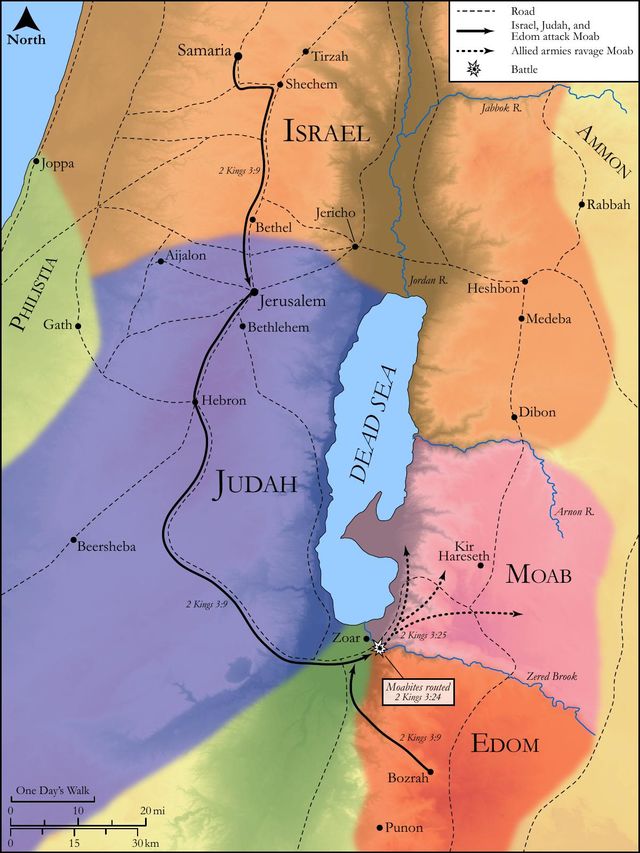
See on the biblical-era map
Study this verse
Public-domain commentary
Matthew Henry
From his Commentary on the Whole Bible. Henry comments on passages, not single verses — this entry covers 2 Kings 3:6–19. His three-level outline is real structure in the source text, so it is rendered as structure.
Jehoram has no sooner got the sceptre into his hand than he takes the sword into his hand, to reduce Moab. Crowns bring great cares and perils to the heads that wear them; no sooner in honour than in war. Now here we have,
I.The concerting of this expedition between Jehoram king of Israel and Jehoshaphat king of Judah.
Jehoram levied an army (Kg2 3:6), and such an opinion he had of the godly king of Judah that,
1.He courted him to be his confederate: Wilt thou go with me against Moab? And he gained him. Jehoshaphat said, I will go up. I am as thou art, Kg2 3:7. Judah and Israel, though unhappily divided from each other, yet can unite against Moab a common enemy. Jehoshaphat upbraids them not with their revolt from the house of David, nor makes it an article of their alliance that they shall return to their allegiance, though he had good reason to insist upon it, but treats with Israel as a sister-kingdom. Those are no friends to their own peace and strength who can never find in their hearts to forgive and forget an old injury, and unite with those that have formerly broken in upon their rights. Quod initio non vulvit, tractu temporis invalescit - That which was originally destitute of authority in the progress of time acquires it.
2.He consulted him as his confidant, Kg2 3:8. He took advice of Jehoshaphat, who had more wisdom and experience than himself, which way they should make their descent upon the country of Moab; and he advised that they should not march against them the nearest way, over Jordan, but go round through the wilderness of Edom, that they might take the king of Edom (who was tributary to him) and his forces along with them If two be better than one, much more will not a three-fold cord be easily broken. Jehoshaphat had like to have paid dearly for joining with Ahab, yet he joined with his son, and this expedition also had like to have been fatal to him. There is nothing got by being yoked with unbelievers.
II.The great straits that the army of the confederates was reduced to in this expedition.
Before they saw the face of an enemy they were all in danger of perishing for want of water, Kg2 3:9. This ought to have been considered before they ventured a march through the wilderness, the same wilderness (or very near it) where their ancestors wanted water, Num 20:2. God suffers his people, by their own improvidence, to bring themselves into distress, that the wisdom, power, and goodness of his providence may be glorified in their relief. What is more cheap and common than water? It is drink to every beast of the field, Psa 104:11. Yet the want of it will soon humble and ruin kings and armies. The king of Israel sadly lamented the present distress, and the imminent danger it put them in of falling into the hands of their enemies the Moabites, to whom, when weakened by thirst, they would be an easy prey, Kg2 3:10. it was he that had called these kings together; yet he charges it upon Providence, and reflects upon that as unkind: The Lord has called them together. Thus the foolishness of man perverteth his way, and then his heart fretteth against the Lord, Pro 19:3.
III.Jehoshaphat's good motion to ask counsel of God in this exigency, Kg2 3:11.
The place they were now in could not but remind them of the wonders of which their fathers told them, the waters fetched out of the rock for Israel's seasonable supply. The thought of this, we may suppose, encouraged Jehoshaphat to ask, Is there not here a prophet of the Lord, like unto Moses? He was the more concerned because it was by his advice that they fetched this compass through the wilderness, Kg2 3:8. It was well that Jehoshaphat enquired of the Lord now, but it would have been much better if he had done it sooner, before he engaged in this war, or steered this course; so the distress might have been prevented. Good men are sometimes remiss and forgetful, and neglect their duty till necessity and affliction drive them to it.
IV.Elisha recommended as a proper person for them to consult with Kg2 3:11. And here we may wonder,
1.That Elisha should follow the camp, especially in such a tedious march as this, as a volunteer, unasked, unobserved, and in no post of honour at all; not in the office of priest of the war (Deu 20:2) or president of the council of war, but in such obscurity that none of the kings knew they had such a jewel in the treasures of their camp, nor so good a friend in their retinue. We may suppose it was by special direction from heaven that Elisha attended the war, as the chariot of Israel and the horsemen thereof. Thus does God anticipate his people with the blessings of his goodness and provide his oracles for those that provide them not for themselves. It would often be bad with us if God did not take more care of us, both for soul and body, than we take for ourselves.
2.That a servant of the king of Israel knew of his being there when the king himself did not. Probably it was such a servant as Obadiah was to his father Ahab, one that feared the Lord; to such a one Elisha made himself known, not to the kings. The account he gives of him is that it was he that poured water on the hands of Elijah, that is, he was his servant, and particularly attended him when he washed his hands. He that will be great, let him learn to minister: he that will rise high, let him begin low.
V.The application which the kings made to Elisha.
They went down to him to his quarters, Kg2 3:12. Jehoshaphat had such an esteem for a prophet with whom the word of the Lord was that he would condescend to visit him in his own person and not send for him up to him. The other two were moved by the straits they were in to make their court to the prophet. He that humbled himself was thus exalted, and looked great, when three kings came to knock at his door, and beg his assistance; see Rev 3:9.
VI.The entertainment which Elisha gave them.
1.He was very plain with the wicked king of Israel (Kg2 3:13): "What have I to do with thee? How canst thou expect an answer of peace from me? Get thee to the prophets of thy father and mother, whom thou hast countenanced and maintained in thy prosperity, and let them help thee now in thy distress." Elisha was not imposed upon, as Jehoshaphat was, by his partial and hypocritical reformation; he knew that, though he had put away the image of Baal, Baal's prophets were still dear to him, and perhaps some of the were now in his camp. "Go," said he, "go to them. Get you to the gods whom you have served, Jdg 10:14. The world and the flesh have ruled you, let them help you; why should God be enquired of by you?" Eze 14:3. Elisha tells him to his face, in a holy indignation at his wickedness, that he can scarcely find in his heart to look towards him or to see him, Kg2 3:14. Jehoram is to be respected as a prince, but as a wicked man he is a vile person, and is to be condemned, Psa 15:4. Elisha, as a subject, will honour him, but as a prophet he will cause him to know his iniquity. For those that had such an extraordinary commission it was fit (though not for a common person) to say to a king, Thou art wicked, Job 34:18. Jehoram has so much self-command as to take this plain dealing patiently; he cares not now for hearing of the prophets of Baal, but is a humble suitor to the God of Israel and his prophet, representing the present case as very deplorable and humbly recommending it to the prophet's compassionate consideration. In effect, he owns himself unworthy, but let not the other kings be ruined for his sake.
2.Elisha showed a great respect to the godly king of Judah, regarded his presence, and, for his sake, would enquire of the Lord for them all. It is good being with those that have God's favour and his prophet's love. Wicked people often fare the better for the friendship and society of those that are godly.
3.He composed himself to receive instructions from God. His mind was somewhat ruffled and disturbed at the sight of Jehoram; though he was not put into a sinful heat or passion, nor had spoken unadvisedly, yet his zeal for the present indisposed him for prayer and the operations of the Spirit, which required a mind very calm and sedate. He therefore called for a musician (Kg2 3:15), a devout musician, one accustomed to play upon his harp and sign psalms to it. To hear God's praises sweetly sung, as David had appointed, would cheer his spirits, and settle his mind, and help to put him into a right frame both to speak to him and to hear from him. We find a company of prophets prophesying with a psaltery and a tabret before them, Sa1 10:5. Those that desire communion with God must keep their spirits quiet and serene. Elisha being refreshed, and having the tumult of his spirits laid by this divine music, the hand of the Lord came upon him, and his visit did him more honour than that of three kings.
4.God, by him, gave them assurance that the issue of the present distress would be comfortable and glorious.
(1.)They should speedily be supplied with water, Kg2 3:16, Kg2 3:17. To try their faith and obedience, he bids them make the valley full of ditches to receive the water. Those that expect God's blessings must prepare room for them, dig the pools for the rain to fill, as they did in the valley of Baca, and so made even that a well, Psa 84:6. To raise the wonder, he tells them they shall have water enough, and yet there shall be neither wind nor rain. Elijah, by prayer, obtained water out of the clouds, but Elisha fetches it nobody knows whence. The spring of these waters shall be as secret as the head of the Nile. God is not tied to second causes. Ordinarily it is by a plentiful rain that God confirms his inheritance (Psa 68:9), but here it is done without rain, at least without rain in that place. Some of the fountains of the great deep, it is likely, were broken up on this occasion; and, to increase the miracle, that valley only (as it should seem) was filled with water, and no other place had any share of it.
(2.)That supply should be an earnest of victory (Kg2 3:18): "This is but a light thing in the sight of the Lord; you shall not only be saved from perishing, but shall return in triumph." As God gives freely to the unworthy, so he gives richly, like himself, more than we are able to ask or think. His grants out-do our requests and expectations. Those that sincerely seek for the dew of God's grace shall have it, and by it be made more than conquerors. It is promised that they shall be masters of the rebellious country, and they are permitted to lay it waste and ruin it, Kg2 3:19. The law forbade them to fell fruit-trees to be employed in their sieges (Deu 20:19), but not when it was intended, in justice, for the starving of a country that had forfeited its fruits, by denying tribute to those to whom tribute was due.
Historical interpretation
Historical reception
1 surviving comment on this verse from the historical church.
After the death of Ahab, his son Ahaziah died too, and since he had no children, his brother Jehoram took his place. Therefore the Scripture reports that he moved with his army against the king of Moab. He went to war because Mesha, king of Moab, had refused to pay his tribute to the kings of Israel and had not paid both Hezekiah and Jehoram, that is, [he had not paid] one hundred thousand fat lambs and one hundred thousand unshorn rams. The word noqdo, which the Scripture mentions here, derives from Hebrew and can be translated as “king of the shepherds of rams,” that is, he reared huge herds of them. So Jehoram, who had resolved to assert the rights that his brother had renounced, summoned the kings of the inhabitants of Judea and Edom and marched with them through the territories of the children of Moab. But they found themselves on a barren and arid land, and they had no water for the army. The three kings went to see Elisha, following the advice of righteous Jehoshaphat, and implored him to rescue the suffering people, who were overwhelmed with thirst. The prophet protested and harshly reproached Jehoram but was pleased with Jehoshaphat and gave him hope of salvation. At the same time, he promised that through his mediation, he and his companions would soon obtain the victory through the agency of the Lord.
Continue studying 2 Kings 3:14 across the web’s major study libraries — every link below opens this exact verse, chapter, or book on the destination site.
Read & Compare
 BibleGatewayThis verse in more than 200 translations and 70 languages.
 Bible.comThe YouVersion reader — hundreds of translations, reading plans, and highlights.
 ESV.orgCrossway's official English Standard Version reader.
 NET BibleThe NET translation with 60,000+ translators' notes on every rendering decision.
 STEP BibleTyndale House's free study tool — original text, vocabulary, and scholarly resources.
 BibliaLogos Bible Software's free web reader.
 USCCBThe New American Bible (Revised Edition) with the U.S. bishops' study notes.
Commentaries
 BibleHub CommentariesDozens of classic commentaries on this verse, gathered on one page.
 StudyLightMore than 100 commentary sets — the largest collection on the web.
 BibleRefPlain-English commentary on what this verse means, verse by verse.
 Enduring WordDavid Guzik's free commentary on this chapter, widely used by Bible teachers.
 Bible Study ToolsVerse commentary alongside Greek and Hebrew study aids.
Original Language & Research
- BibleHub InterlinearThe verse word by word — original language, transliteration, and English.
- BibleHub LexiconEvery word's original-language definition and Strong's entry.
 Blue Letter BibleDeep-study tools — Strong's numbers, concordance, and word studies.
 SefariaThe Hebrew text with Rashi and centuries of Jewish commentary.
Sermons, Hymns & Audio


TrulyRandomVerse is not affiliated with these sites and doesn’t control their content. They’re linked because they’re genuinely useful.
Summary
In 2 Kings 3:14, the prophet Elisha delivers a profoundly severe and unvarnished declaration to King Jehoram of Israel, who, alongside King Jehoshaphat of Judah and the King of Edom, desperately seeks divine intervention during a military campaign against Moab. Stranded in the wilderness without water, the allied kings turn to Elisha for a prophetic word. Elisha's words reveal his profound disdain for Jehoram's persistent idolatry and spiritual compromise, making it unequivocally clear that his willingness to engage or offer any assistance is solely out of respect for the righteous King Jehoshaphat, underscoring the gravity of Jehoram's unworthiness in the eyes of God.
Context
ShowHideLiterary Context
This verse is strategically placed within the broader narrative of 2 Kings 3, which chronicles a military alliance between Israel (under Jehoram), Judah (under Jehoshaphat), and Edom, united against Moab, who had rebelled against Israelite tribute. The allied armies find themselves in a dire, life-threatening situation, facing severe dehydration in the wilderness after a seven-day march. Earlier in the chapter, Jehoram, despite having removed a pillar of Baal (a partial reform from his parents' extreme idolatry, as noted in 2 Kings 3:2-3), still "clung to the sins of Jeroboam son of Nebat" (the calf worship at Dan and Bethel). When he seeks Elisha's counsel, the prophet initially rebuffs him with cutting sarcasm, suggesting he consult the prophets of his father and mother (2 Kings 3:10-13). Elisha's harsh words in verse 14 serve as a direct, powerful response to Jehoram's spiritual hypocrisy and a stark contrast to his respectful demeanor towards Jehoshaphat, setting the stage for the miraculous provision of water and subsequent victory, which highlights God's selective favor and omnipotent power.
Historical & Cultural Context
The period of the Omride dynasty in Israel (including Ahab, Ahaziah, and Jehoram) was historically marked by deep-seated and state-sanctioned idolatry, particularly the worship of Baal and Asherah, largely influenced by Jezebel, Ahab's Phoenician wife. This pervasive religious apostasy frequently led to divine judgment, national instability, and prophetic confrontation. Judah, under kings like Jehoshaphat (H3092), generally maintained a more faithful adherence to Yahweh (H3068), the God of Israel, though not without its own challenges and compromises, such as the alliance with the Omrides. The military alliance described in 2 Kings 3 reflects the complex dealings between the kings of that day, who formed temporary alliances for strategic advantage. Prophets like Elisha (H477) served as crucial conduits of divine will, often challenging royal authority and rebuking the powerful, even at great personal risk. The concept of "standing before" a king or deity (H5975) signified a position of intimate service, readiness to receive and execute commands, and unwavering loyalty, emphasizing Elisha's direct accountability to God alone.
Key Themes
ShowHideThe passage powerfully articulates several key themes. Firstly, it underscores Prophetic Authority and Integrity, as Elisha, much like his predecessor Elijah (1 Kings 17:1), asserts his unwavering allegiance to the "LORD of hosts" (H3068, H6635) above any earthly monarch. This demonstrates that true prophets derive their authority solely from God, not from human appointment or approval. Secondly, the verse vividly illustrates Divine Disfavor Towards Idolatry and Hypocrisy, powerfully conveying God's profound contempt for Israel's persistent spiritual unfaithfulness under the Omride kings, even when faced with national crisis. Elisha's refusal to acknowledge Jehoram directly apart from Jehoshaphat's presence serves as a potent symbol of the spiritual barrier that sin creates between humanity and God's favor, a theme echoed throughout the prophetic literature concerning Israel's apostasy, such as in Isaiah 59:2. Lastly, the verse emphasizes the Value of Godliness and Righteousness, as Jehoshaphat's genuine piety—he "walked in the first ways of his father David" (2 Chronicles 17:3)—is the sole reason Elisha (and thus God) agrees to intervene. This demonstrates that God honors those who honor Him, and that the presence of righteous individuals can indeed mediate divine attention and blessing, even in the midst of unrighteous company.
Exposition and Analysis
ShowHideKey Word Analysis
ShowHideThis majestic and highly significant title for God combines H3068 (Yᵉhôvâh, "the self-Existent or Eternal; Jehovah, Jewish national name of God") with H6635 (Tsâbâʼ, "a mass of persons... especially reg. organized for war (an army); by implication, a campaign, hardship, worship"). It emphasizes God's supreme sovereignty and power, referring to Him as the commander of celestial armies (angels) and, by extension, all the forces of creation. When Elisha swears by "the LORD of hosts," he is invoking the God who commands all power, underscoring the absolute truth and divine authority of his words and signifying God's universal dominion as the divine warrior.
Meaning "to stand, in various relations (literal and figurative, intransitive and transitive); abide... be employed, endure, establish, leave, make, ordain, be (over), place, (be) present (self), raise up, remain, repair, [phrase] serve, set... (make to, make to be at a, with-) stand (by, fast, firm, still, up), (be at a) stay (up), tarry." This phrase, "before whom I stand," is a powerful declaration of Elisha's prophetic identity and subservience. It signifies his position as a faithful servant and messenger, always in the immediate presence of God, ready to receive and deliver His word. It implies a direct, intimate relationship with the Almighty, reinforcing that Elisha is not speaking his own opinion but delivering a divine oracle, and his loyalty is exclusively to God.
Meaning "to lift, in a great variety of applications, literal and figurative, absolute and relative; accept, advance, arise, (able to, (armor), suffer to) bear(-er, up), bring (forth), burn, carry (away), cast, contain, desire, ease, exact, exalt (self), extol, fetch, forgive, furnish, further, give, go on, help, high, hold up, honorable ([phrase] man), lade, lay, lift (self) up, lofty, marry, magnify, [idiom] needs, obtain, pardon, raise (up), receive, regard, respect, set (up), spare, stir up, [phrase] swear, take (away, up), [idiom] utterly, wear, yield." In this context, "regard" signifies Elisha's act of showing respect, favor, or consideration. It highlights that his willingness to interact with the unrighteous King Jehoram is a direct result of his deference to the righteous King Jehoshaphat, emphasizing the profound spiritual distinction between the two monarchs in Elisha's, and implicitly God's, eyes.
Verse Breakdown
ShowHide"And Elisha said, As the LORD of hosts liveth, before whom I stand"
This opening clause functions as a solemn, binding oath, a common and weighty prophetic formula (cf. Elijah in 1 Kings 17:1). By swearing by the living God, Elisha affirms the absolute truth and divine origin of his subsequent declaration. His statement "before whom I stand" underscores his direct accountability and subservience to God alone, establishing his prophetic authority and integrity independent of any earthly king. It sets a tone of divine judgment and unwavering commitment to God's will.
"surely, were it not that I regard the presence of Jehoshaphat the king of Judah"
Here, Elisha introduces the critical and singular condition for his willingness to engage with the allied kings. His profound disdain for King Jehoram's idolatry and spiritual compromise is so immense that only the presence of the righteous King Jehoshaphat, who walked in the ways of the Lord (H3068), compels Elisha to offer any assistance or even acknowledge their request. This clause powerfully highlights God's favor towards the righteous and His willingness to extend mercy or attention through them, even to the undeserving. It also serves as a public and stinging rebuke to Jehoram, emphasizing his spiritual unworthiness and the spiritual chasm his sin had created.
"I would not look toward thee, nor see thee"
This final, stark declaration expresses Elisha's utter contempt and complete refusal to acknowledge King Jehoram. The dual phrasing "not look toward thee, nor see thee" is a strong idiom for complete disregard, rejection, and a refusal to grant an audience or show any respect whatsoever. It signifies Elisha's abhorrence of Jehoram's persistent idolatry and spiritual compromise, making it unequivocally clear that Jehoram's presence alone would have been utterly insufficient to elicit a prophetic response. This statement underscores the severity of God's disfavor towards those who persist in rebellion against Him, even in times of national crisis.
Literary Devices
ShowHideThe verse is rich in literary devices that amplify its impact and convey Elisha's profound message. Elisha employs a powerful Oath Formula ("As the LORD of hosts liveth, before whom I stand"), which immediately lends immense weight and divine authority to his words, signaling that what follows is not merely human opinion but a divinely sanctioned declaration. This is immediately followed by a stark Conditional Statement ("surely, were it not that I regard the presence of Jehoshaphat"), which dramatically contrasts the spiritual standing of the two kings and reveals the true, singular motivation behind Elisha's action. The use of Hyperbole or extreme language in "I would not look toward thee, nor see thee" powerfully conveys Elisha's profound disdain and the depth of God's displeasure with Jehoram's idolatry and spiritual compromise. This dramatic Contrast between Jehoram's spiritual state and Jehoshaphat's righteousness serves to highlight the severe consequences of apostasy versus the blessings of faithfulness, making the divine favor shown through Jehoshaphat even more pronounced. The entire interaction is framed within the context of Divine Authority, as Elisha functions as God's mouthpiece, demonstrating that God's favor is not dispensed indiscriminately but according to His righteous character and covenant faithfulness.
Theological and Thematic Connections
ShowHideThis verse profoundly illustrates the principle that God's favor is not automatically extended to all, but is often mediated through the righteous and withheld from the persistently unrighteous. Elisha's disdain for Jehoram, rooted in God's own abhorrence of idolatry and spiritual compromise, underscores the seriousness of spiritual unfaithfulness and the barriers it erects between humanity and divine blessing. Conversely, Jehoshaphat's genuine piety serves as a conduit for divine attention and intervention, demonstrating God's faithfulness to those who honor Him, even when they are in compromised company. This passage reveals a God who is holy and just, whose presence cannot be presumed upon by those who disregard His commands, yet who is also gracious to respond to the faithful, often for the benefit of others.
Reflection and Application
ShowHideElisha's bold declaration in 2 Kings 3:14 serves as a timeless reminder of the profound importance of spiritual integrity and the severe consequences of compromising one's faith. For believers today, this passage challenges us to examine our own allegiances: do we truly stand "before the LORD of hosts," prioritizing His will, character, and commands above all else, or do we allow worldly influences, personal convenience, or the pursuit of comfort to dilute our devotion? The prophet's refusal to acknowledge Jehoram highlights God's unchanging nature—He is holy, righteous, and cannot be trifled with or taken for granted. While we are called to love and serve all people, this verse subtly teaches us the spiritual weight of the company we keep and the profound impact of genuine righteousness, which can draw divine favor and intervention even into desperate situations. It calls us to cultivate a life of authentic piety, recognizing that our walk with God not only blesses us personally but can also, in His sovereign plan, become a channel of blessing and even salvation for others, even those who may be far from Him. Our integrity and unwavering commitment to God matter, not just for our own sake, but for the sake of God's testimony and redemptive work in the world.
Questions for Reflection
ShowHideFAQ
ShowHideWhy did Elisha treat King Jehoram so harshly?
ShowHideElisha's harshness towards King Jehoram stemmed from Jehoram's profound spiritual hypocrisy and persistent idolatry. While Jehoram had taken a superficial step of removing a pillar of Baal worship (2 Kings 3:2-3), he still "clung to the sins of Jeroboam son of Nebat," meaning he maintained the calf worship established in Israel, which was a direct violation of God's law and the first commandment. Elisha, as a prophet of the true God, could not tolerate such a divided heart or compromised devotion, especially from a king who was meant to lead the nation in righteousness. His strong words were not personal animosity but a prophetic denunciation of sin, reflecting God's own righteous anger and judgment against apostasy. He was essentially telling Jehoram that he was unworthy of God's attention or a prophetic word, and only the presence of the righteous King Jehoshaphat made him willing to engage with the situation.
What is the significance of Elisha saying "before whom I stand"?
ShowHideThe phrase "before whom I stand" is a powerful declaration of Elisha's prophetic identity and his direct, unmediated relationship with God. It signifies that he is a faithful servant, always in the immediate presence of the "LORD of hosts" (H3068, H6635), ready to receive and execute divine commands. This phrase establishes his authority as a true prophet, emphasizing that his words are not his own opinions but come directly from God Himself. It also contrasts sharply with Jehoram's spiritual state, highlighting that Elisha's allegiance is solely to the Almighty, not to any earthly king, especially one who is unfaithful and spiritually compromised. This echoes similar declarations by his predecessor Elijah, such as in 1 Kings 17:1, reinforcing the continuity of prophetic authority and divine commission that transcends human power structures.
Christ-Centered Fulfillment
ShowHideElisha's stern declaration in 2 Kings 3:14, where he refuses to acknowledge Jehoram apart from the presence of the righteous Jehoshaphat, profoundly foreshadows the ultimate mediation of divine favor found in Jesus Christ. Just as Jehoshaphat's righteousness made it possible for God's prophet to engage with an undeserving king, so too does the perfect, imputed righteousness of Christ make it possible for sinful humanity to approach a holy God. We, like Jehoram, are inherently unworthy and our sin creates a chasm that no human effort or partial reform can bridge. However, through Christ, who perfectly "stands before" God as our great High Priest and mediator (Hebrews 4:14-16), we gain access to divine grace and mercy. He is the true "Lamb of God who takes away the sin of the world" (John 1:29), whose sacrifice and perfect obedience reconcile us to God. Elisha's conditional response underscores humanity's desperate need for a righteous intercessor; in Christ, we find that perfect intercessor, through whom God not only looks upon us but welcomes us into His very presence, not based on our merit, but solely on the merit of His beloved Son (Ephesians 1:6). He is our only access to the Father (John 14:6), the one through whom God's face shines upon us.