


Nehemiah 5:2
- וְיֵשׁve·Yeshand thereH3426Conj-w ¦ Adj-csAdjective Numerical Singular common gender Absoluteוְandיֵשׁthere
- אֲשֶׁר'a·Sher[were those] whoH834RelParticle Relative
- אֹמְרִים'o·me·Rim[were] sayingH559V-Qal-Prtcpl-mpVerb Qal Participle Plural Masculine Absolute
- בָּנֵינוּba·Nei·nuour sonsH1121N-mpc ¦ 1cpNoun Plural Masculine Constructבָּנֵיsonsנוּour
- וּבְנֹתֵינוּu·ve·no·Tei·nuand our daughtersH1323Conj-w ¦ N-fpc ¦ 1cpNoun Plural Feminine Constructוּandבְנֹתֵיdaughtersנוּour
- אֲנַחְנוּ'a·Nach·nuweH587Pro-1cpPronoun Personal 1st Plural common gender
- רַבִּיםra·Bim[are] manyH7227Adj-mpAdjective Plural Masculine Absolute
- וְנִקְחָהve·nik·Chahand let us getH3947Conj-w ¦ V-Qal-Imperf-1cpVerb Qal Imperfect 1st Plural common genderוְandנִקְחָהlet us get
- דָגָןda·GangrainH1715N-msNoun Singular Masculine Absolute
- וְנֹאכְלָהve·no·khe·Lahso we may eatH398Conj-w ¦ V-Qal-Imperf-1cpVerb Qal Imperfect 1st Plural common genderוְsoנֹאכְלָהwe may eat
- וְנִחְיֶהve·nich·Yehand we may liveH2421Conj-w ¦ V-Qal-ConjImperf-1cpVerb Qal Conjunction+Imperfect 1st Plural common genderוְandנִחְיֶהwe may live
English is a literal word-by-word gloss of the Hebrew, not the KJV's wording. Why?
This is the original text the KJV's translators worked from — each Hebrew word with its own literal English meaning in this verse, prepared by scholars at Tyndale House, Cambridge. The KJV translates whole sentences, not word by word, so its wording differs: one Hebrew word can become several English words, and the KJV may choose “the LORD” where the gloss reads “Yahweh”. Both are faithful — they answer different questions. For the KJV's own rendering, switch to the KJV text.
Details
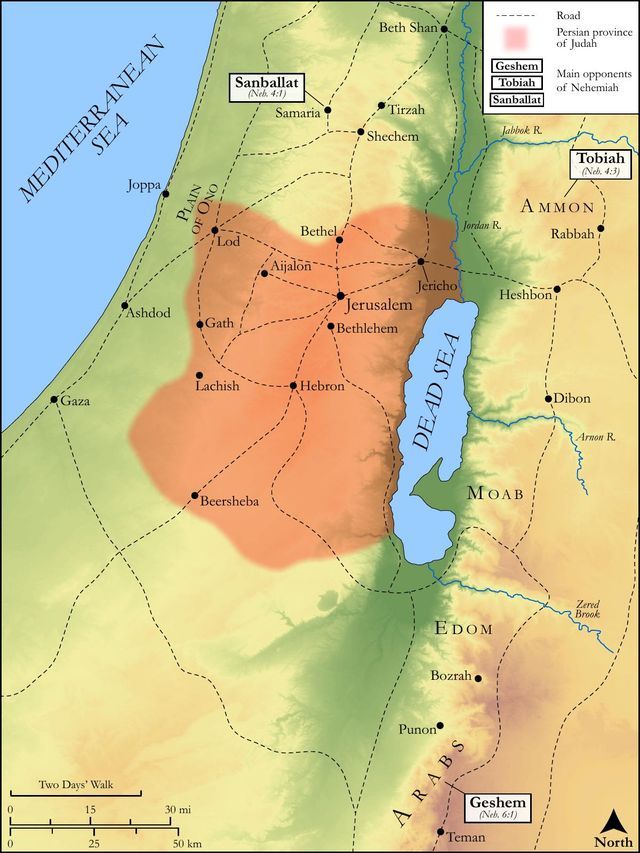
See on the biblical-era map
Study this verse
Public-domain commentary
Matthew Henry
From his Commentary on the Whole Bible. Henry comments on passages, not single verses — this entry covers Nehemiah 5:1–5. His two-level outline is real structure in the source text, so it is rendered as structure.
We have here the tears of the oppressed, which Solomon considered, Ecc 4:1. Let us consider them as here they are dropped before Nehemiah, whose office it was, as governor, to deliver the poor and needy, and rid them out of the hand of the wicked oppressors, Psa 82:4. Hard times and hard hearts made the poor miserable.
I.The times they lived in were hard.
There was a dearth of corn (Neh 5:3), probably for want of rain, with which God had chastised their neglect of his house (Hag 1:9-11) and the non-payment of their church-dues, Mal 3:9, Mal 3:10. Thus foolish sinful men bring God's judgments upon themselves, and then fret and complain of them. When the markets are high, and provisions scarce and dear, the poor soon feel from it, and are pinched by it. Blessed be God for the mercy, and God deliver us from the sin, of fulness of bread, Eze 16:49. That which made the scarcity here complained of the more grievous was that their sons and their daughters were many, Neh 5:2. The families that were most necessitous were most numerous; here were the mouths, but where was the meat? Some have estates and no children to inherit them; others have children and no estates to leave them. Those who have both have reason to be thankful; those who have neither may the more easily be content. Those who have great families and little substance must learn to live by faith in God's providence and promise; and those who have little families and great substance must make their abundance a supply for the wants of others. But this was not all: as corn was dear, so the taxes were high; the king's tribute must be paid, Neh 5:4. This mark of their captivity still remained upon them. Perhaps it was a poll-money that was required, and then, their sons and their daughters being many, it rose the higher. The more they had to maintain (a hard case!) the more they had to pay. Now, it seems, they had not wherewithal of their own to buy corn and pay taxes, but were necessitated to borrow. Their families came poor out of Babylon; they had been at great expense in building them houses, and had not yet got up their strength when these new burdens came upon them. The straits of poor housekeepers who make hard shift to get an honest livelihood, and sometimes want what is fitting for them and their families, are well worthy the compassionate consideration of those who either with their wealth or with their power are in a capacity to help them.
II.The persons they dealt with were hard.
Money must be had, but it must be borrowed; and those that lent them money, taking advantage of their necessity, were very hard upon them and made a prey of them.
1.They exacted interest from them at twelve per cent, the hundredth part every month, Neh 5:11. If men borrow large sums to trade with, to increase their stocks, or to purchase land, there is no reason why the lender should not share with the borrower in his profit; or if to spend upon their lusts, or repair what they have so spent, why should they not pay for their extravagances? But if the poor borrow to maintain their families, and we be able to help them, it is certain we ought either to lend freely what they have occasion for, or (if they be not likely to repay it) to give freely something towards it. Nay,
2.They forced them to mortgage to them their lands and houses for the securing of the money (Neh 5:3), and not only so, but took the profits of them for interest (Neh 5:5, compare Neh 5:11), that by degrees they might make themselves masters of all they had. Yet this was not the worst.
3.They took their children for bond-servants, to be enslaved or sold at pleasure, Neh 5:5. This they complain of most sensibly, as that which touched them in a tender part, and they aggravate it with this: "Our children are as their children, as dear to us as theirs are to them; not only of the same human nature, and entitled to the honours and liberties of that (Mal 2:10; Job 31:15), but of the same holy nation, free-born Israelites, and dignified with the same privileges. Our flesh carries in it the sacred seal of the covenant of circumcision, as well as the flesh of our brethren; yet our heirs must be their slaves, and it is not in our power to redeem them." This they made a humble remonstrance of to Nehemiah, not only because they saw he was a great man that could relieve them, but a good man that would. Whither should the injured poor flee for succour but to the shields of the earth? Whither but to the chancery, to the charity, in the royal breast, and those deputed by it for relief against the summum jus - the extremity of the law?
Lastly, We will leave Nehemiah hearing the complaint, and enquiring into the truth of the complainants' allegations (for the clamours of the poor are not always just), while we sit down and look, (1.) With a gracious compassion upon the oppressed, and lament the hardships which many in the world are groaning under; putting our souls into their souls' stead, and remembering in our prayers and succours those that are burdened, as burdened with them. (2.) With a gracious indignation at the oppressors, and abhorrence of their pride and cruelty, who drink the tears, the blood, of those they have under their feet. But let those who show no mercy expect judgment without mercy. It was an aggravation of the sin of these oppressing Jews that they were themselves so lately delivered out of the house of bondage, which obliged them in gratitude to undo the heavy burdens, Isa 58:6.
Continue studying Nehemiah 5:2 across the web’s major study libraries — every link below opens this exact verse, chapter, or book on the destination site.
Read & Compare
 BibleGatewayThis verse in more than 200 translations and 70 languages.
 Bible.comThe YouVersion reader — hundreds of translations, reading plans, and highlights.
 ESV.orgCrossway's official English Standard Version reader.
 NET BibleThe NET translation with 60,000+ translators' notes on every rendering decision.
 STEP BibleTyndale House's free study tool — original text, vocabulary, and scholarly resources.
 BibliaLogos Bible Software's free web reader.
 USCCBThe New American Bible (Revised Edition) with the U.S. bishops' study notes.
Commentaries
 BibleHub CommentariesDozens of classic commentaries on this verse, gathered on one page.
 StudyLightMore than 100 commentary sets — the largest collection on the web.
 BibleRefPlain-English commentary on what this verse means, verse by verse.
 Enduring WordDavid Guzik's free commentary on this chapter, widely used by Bible teachers.
 Bible Study ToolsVerse commentary alongside Greek and Hebrew study aids.
Original Language & Research
- BibleHub InterlinearThe verse word by word — original language, transliteration, and English.
- BibleHub LexiconEvery word's original-language definition and Strong's entry.
 Blue Letter BibleDeep-study tools — Strong's numbers, concordance, and word studies.
 SefariaThe Hebrew text with Rashi and centuries of Jewish commentary.
Sermons, Hymns & Audio


TrulyRandomVerse is not affiliated with these sites and doesn’t control their content. They’re linked because they’re genuinely useful.
Summary
Nehemiah 5:2 vividly portrays the desperate plight of the Jewish community in Jerusalem during the arduous task of rebuilding the city walls. This verse articulates the raw cry of families overwhelmed by the burden of their numbers and the crushing reality of food scarcity. It exposes a profound economic crisis where basic sustenance was a daily struggle, forcing people into debt and even servitude to acquire grain, thus laying bare the social and economic injustices that threatened to derail the entire restoration effort and the very survival of the returnees.
Context
ShowHideLiterary Context
Nehemiah 5 opens with a stark interruption to the narrative of wall-building, shifting focus from external threats to internal strife. Verses 1-5 detail a "great outcry" from various segments of the Jewish populace against their wealthier countrymen. This lament is not merely a grumble but a desperate appeal, highlighting three primary grievances: lack of food (v. 2), mortgaging of property (v. 3), and enslavement of children due to debt and taxes (v. 4). Nehemiah 5:2 specifically introduces the most immediate and visceral concern: sheer hunger. This complaint serves as the catalyst for Nehemiah's righteous indignation and his subsequent decisive actions to address the pervasive exploitation, culminating in his confrontation with the nobles and rulers in Nehemiah 5:7 and his call for restitution in Nehemiah 5:11. The passage underscores that spiritual and physical rebuilding must go hand-in-hand with justice and internal integrity.
Historical & Cultural Context
The events of Nehemiah 5 unfold in Jerusalem around 445 BC, during the post-exilic period under Persian rule. The returning exiles faced immense challenges: a ruined city, hostile neighbors, and the immense labor of reconstruction. Economically, the region was vulnerable to famine, often caused by drought or poor harvests, which could quickly plunge a subsistence-based society into crisis. Furthermore, the Persian Empire levied taxes, adding to the financial burden. Jewish law (Torah) had provisions against usury (charging interest on loans to fellow Israelites) and for the release of debts and slaves (e.g., Deuteronomy 15:1-11), but these laws were often disregarded in practice. The wealthy elite, seizing on the desperation of their impoverished brethren, exploited their need by charging exorbitant interest rates on grain loans, leading to the loss of land, vineyards, and even the enslavement of children. This cultural backdrop of economic vulnerability, coupled with the violation of covenantal ethics, sets the stage for the deep distress expressed in Nehemiah 5:2.
Key Themes
ShowHideNehemiah 5:2 introduces several critical themes that resonate throughout the book and the broader biblical narrative. Firstly, it highlights Poverty and Food Insecurity, underscoring the fundamental human struggle for survival when basic needs are unmet. The "many" mouths to feed amplify this dire situation, emphasizing the burden on large families in times of scarcity. Secondly, it lays the groundwork for the theme of Oppression and Exploitation. While not explicitly stating the oppressors, the verse's cry for food obtained through desperate means ("take up corn") implicitly points to the exploitative practices that forced people into such binds, a theme fully developed in Nehemiah's subsequent actions against usury and debt slavery (e.g., Nehemiah 5:6-13). Thirdly, it touches upon Community Solidarity and Leadership Responsibility. The crisis revealed in this verse demands a leader who prioritizes the well-being of the people over personal gain or the completion of the physical project alone. Nehemiah's righteous anger and decisive intervention (as seen in Nehemiah 5:7-13) exemplify a leadership deeply committed to justice and the flourishing of God's people, even when it means confronting internal corruption.
Exposition and Analysis
ShowHideKey Word Analysis
ShowHideThe King James Version's "corn" here refers to grain in general, specifically wheat or barley, which were the staple food crops of the ancient Near East. It does not refer to maize (corn as known in the Americas), which was unknown in the Old World at this time. This term signifies the most basic form of sustenance, highlighting that the people's struggle was not for luxuries but for the very means of survival. The scarcity of this fundamental commodity indicates a severe famine or extreme economic hardship that made even basic food inaccessible without resorting to desperate measures.
This word signifies abundance in quantity or number. In the context of "We, our sons, and our daughters, are many," it highlights the demographic reality of large families. While traditionally seen as a blessing and a sign of prosperity in ancient Israel, in times of scarcity, a large family became an immense burden. Each additional child represented another mouth to feed, amplifying the pressure on already meager resources and exacerbating the family's financial distress, pushing them further into desperation.
This primitive root means "to take" in a wide variety of applications, including to buy, fetch, or receive. In this context, "we take up corn" implies the act of acquiring grain, often through borrowing or mortgaging. It suggests that the people were forced to obtain this essential commodity by incurring debt, which frequently involved pledging land, vineyards, or even the personal liberty of family members as collateral. This phrase captures the desperate measures the people were forced to undertake, indicating they had exhausted all other options and were now resorting to arrangements that would further entangle them in debt and potential servitude.
Verse Breakdown
ShowHide"For there were that said"
This introductory phrase immediately signals that the verse records a direct complaint or outcry from a segment of the population. It emphasizes the collective voice of distress, indicating that this was not an isolated incident but a widespread grievance among the common people, likely those who were poorer and more vulnerable. It sets the stage for the raw, unvarnished expression of their suffering.
"We, our sons, and our daughters, are many"
This clause articulates the core problem from the perspective of the suffering families. The phrase "are many" highlights the demographic reality of large families, which, while often seen as a blessing and a sign of prosperity in ancient Israel, became an immense burden during times of scarcity. Each child represented another mouth to feed, amplifying the pressure on already meager resources and exacerbating the family's financial distress, making their situation even more dire.
"therefore we take up corn [for them], that we may eat, and live"
This final clause reveals the desperate action taken and its ultimate purpose. "Therefore we take up corn" directly links their large families and lack of resources to the necessity of acquiring grain, often through debt or mortgaging. The phrase "that we may eat, and live" underscores the fundamental, existential nature of their struggle. It was not about comfort or prosperity, but about bare survival—to simply have enough food to sustain life. This highlights the severity of the crisis, where the very existence of families was at stake, forcing them into arrangements that threatened their freedom and future.
Literary Devices
ShowHideNehemiah 5:2 employs several literary devices to convey the profound distress of the people. The most prominent is Pathos, as the verse evokes deep sympathy for the suffering community. The direct, unadorned statement of their plight—"We, our sons, and our daughters, are many: therefore we take up corn [for them], that we may eat, and live"—is a powerful appeal to emotion, highlighting their vulnerability and the existential threat they faced. The mention of "sons, and our daughters" uses Synecdoche, where a part (children) represents the whole (the entire dependent family unit), emphasizing the specific burden of feeding the most vulnerable members. Furthermore, the simple, direct language serves as a form of Understatement regarding the full extent of their suffering; the "taking up corn" implicitly points to the far more complex and oppressive rule of debt and potential servitude that is elaborated in subsequent verses. The verse functions as a Cry of Lament, a common biblical form expressing deep sorrow and distress, setting the tone for Nehemiah's indignant response and foreshadowing the deeper issues of oppression.
Theological and Thematic Connections
ShowHideNehemiah 5:2 serves as a poignant reminder of God's enduring concern for the poor and the vulnerable, a theme woven throughout the biblical narrative. The distress of the people in Jerusalem underscores the theological principle that true worship and community flourishing are inseparable from justice. God's covenant with Israel included explicit commands to care for the poor, the widow, and the orphan, and to prohibit exploitative practices like usury. The outcry in this verse highlights the painful reality when God's people fail to live up to these covenantal obligations, leading to internal oppression even amidst a grand spiritual project like rebuilding the temple and walls. It challenges believers to consider how disparities between rich and poor and food insecurity within their own communities reflect or contradict God's heart for justice and compassion. The verse implicitly calls for a just economic order where basic needs are met and exploitation is condemned, echoing the prophetic tradition that consistently linked righteousness with care for the lowly.
Reflection and Application
ShowHideNehemiah 5:2 offers a timeless mirror for reflection on the human condition and the responsibilities of faith communities. It compels us to look beyond grand spiritual projects and consider the immediate, tangible needs of those around us. The cry for "corn... that we may eat, and live" is a universal plea for basic sustenance that resonates deeply in a world still grappling with widespread poverty and food insecurity. This verse challenges us to cultivate empathy for those trapped in cycles of debt and destitution, recognizing that their struggle for survival can be as consuming as any external threat. It calls us to examine our own economic systems and personal practices, asking if we are contributing to justice or inadvertently perpetuating exploitation. For leaders, it serves as a powerful reminder that true leadership involves not only vision and execution but also a profound commitment to the well-being and equitable treatment of all members of the community, even if it means confronting uncomfortable truths and challenging established norms. Our faith should move us to action, advocating for and participating in efforts that ensure everyone has access to the basic necessities of life, reflecting God's heart for justice and compassion for the vulnerable.
Questions for Reflection
ShowHideFAQ
ShowHideWhat does "corn" mean in Nehemiah 5:2, and why was it so vital?
ShowHideIn the King James Version, "corn" refers to grain in general, such as wheat or barley, which were the primary staple foods in the ancient Near East. It is not maize (the corn we know today), which was unknown in that part of the world at the time. Grain was vital because it was the fundamental source of nutrition, providing the calories and sustenance necessary for survival. Without access to "corn," families faced starvation, which is why the people's desperate cry in Nehemiah 5:2 highlights their struggle to simply "eat, and live." Their inability to secure this basic commodity without going into debt or mortgaging their assets indicated a severe economic crisis, likely exacerbated by famine, heavy taxes, and exploitative lending practices.
Christ-Centered Fulfillment
ShowHideNehemiah 5:2, with its raw depiction of human desperation for basic sustenance and justice, finds profound Christ-centered fulfillment. The cries of the hungry and oppressed in Nehemiah's day echo through the centuries, ultimately pointing to the one who perfectly embodies God's heart for the poor and overlooked. Jesus, the Lamb of God, came not only to address spiritual poverty but also to identify with and minister to the physically destitute. His ministry was characterized by compassion for the hungry, as seen in His miraculous feedings of the multitudes (e.g., Matthew 14:13-21). He taught extensively about honest dealing and the dangers of wealth accumulation at the expense of the poor, famously stating that it is harder for a rich man to enter the kingdom of heaven than for a camel to go through the eye of a needle (Matthew 19:23-24). Moreover, Jesus Himself became the ultimate "bread of life," offering eternal sustenance that transcends physical hunger (John 6:35). The pervasive injustice that forced families to "take up corn" foreshadows the ultimate sacrifice of Christ, who, though rich, became poor for our sake, that we through His poverty might become rich (2 Corinthians 8:9). He is the one who truly takes away the sin of the world, including the sin of exploitation and indifference, and promises a future where hunger and injustice will be no more (Revelation 7:16).