


2 Chronicles 21:9
Bible text: King James Version (1769 Blayney text) · Public domain
Bible text: King James Version with Strong's numbers · Public domain
Bible text: Berean Standard Bible · Public domain
Bible text: American Standard Version (1901) · Public domain
Bible text: World English Bible, Messianic edition · Public domain
Bible text: Geneva Bible (1599) · Public domain
Bible text: Young's Literal Translation · Public domain
- וַיַּעֲבֹרvai·ya·'a·Vorand he passed overH5674Conj-w ¦ V-Qal-ConsecImperf-3msVerb Qal Consecutive Imperfect 3rd Singular Masculineוַandיַּעֲבֹרhe passed over
- יְהוֹרָםye·ho·RamJehoramH3088N-proper-mNoun Proper Masculine
- עִם'imwithH5973PrepPreposition
- שָׂרָיוsa·Ravhis commandersH8269N-mpc ¦ 3msNoun Plural Masculine Constructשָׂרָיcommandersוhis
- וְכָלve·kholand allH3605Conj-w ¦ N-mscNoun Singular Masculine Constructוְandכָלall
- הָרֶכֶבha·Re·khevthe chariotryH7393Art ¦ N-msNoun Singular Masculine Absoluteהָtheרֶכֶבchariotry
- עִמּוֹi·Mowith himH5973Prep ¦ 3msPrepositionעִמּwithוֹhim
- וַיְהִיvay·Hiand it wasH1961Conj-w ¦ V-Qal-ConsecImperf-3msVerb Qal Consecutive Imperfect 3rd Singular Masculineוַandיְהִיit was
- קָםkamhe aroseH6965V-Qal-Prtcpl-msVerb Qal Participle Singular Masculine Absolute
- לַיְלָהLay·lahnightH3915N-msNoun Singular Masculine Absolute
- וַיַּךְvai·Yakhand he struck downH5221Conj-w ¦ V-Hiphil-ConsecImperf-3msVerb Hiphil Consecutive Imperfect 3rd Singular Masculineוַandיַּךְhe struck down
- אֶת'et<obj.>H853DirObjMParticle Object Indicator
- אֱדוֹם'e·dOmEdomH123N-proper-mNoun Proper Masculine
- הַסּוֹבֵבha·so·Vevwhich was surroundingH5437Art ¦ V-Qal-Prtcpl-msVerb Qal Participle Singular Masculine Absoluteהַwhichסּוֹבֵבwas surrounding
- אֵלָיו'e·Lav<to> himH413Prep ¦ 3msPrepositionאֵלָי<to>וhim
- וְאֵתve·'Etand <obj.>H853Conj-w ¦ DirObjMParticle Object Indicatorוְandאֵת<obj.>
- שָׂרֵיsa·Rei[the] commanders ofH8269N-mpcNoun Plural Masculine Construct
- הָרָכֶבha·Ra·khevthe chariotryH7393Art ¦ N-msNoun Singular Masculine Absoluteהָtheרָכֶבchariotry
English is a literal word-by-word gloss of the Hebrew, not the KJV's wording. Why?
This is the original text the KJV's translators worked from — each Hebrew word with its own literal English meaning in this verse, prepared by scholars at Tyndale House, Cambridge. The KJV translates whole sentences, not word by word, so its wording differs: one Hebrew word can become several English words, and the KJV may choose “the LORD” where the gloss reads “Yahweh”. Both are faithful — they answer different questions. For the KJV's own rendering, switch to the KJV text.
Details
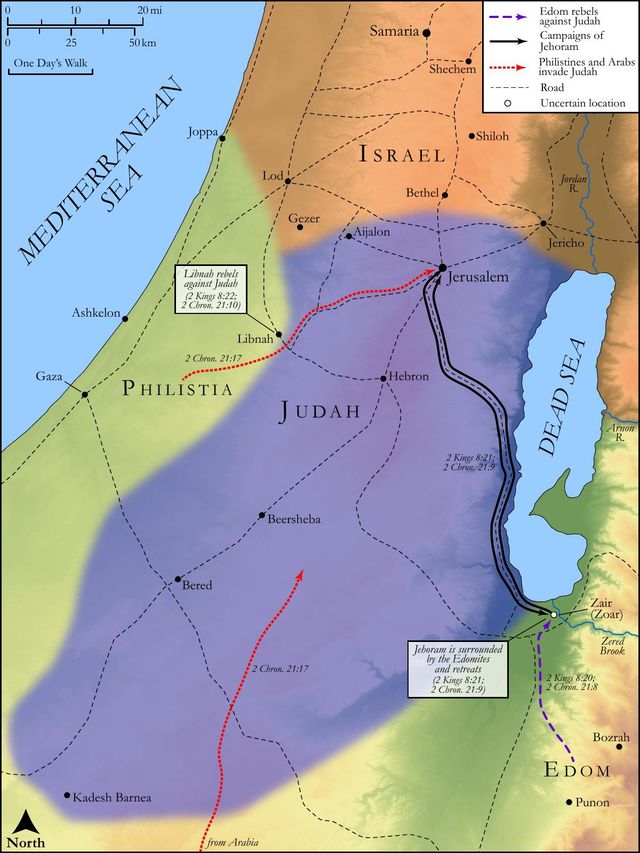
See on the biblical-era map
Study this verse
Public-domain commentary
Matthew Henry
From his Commentary on the Whole Bible. Henry comments on passages, not single verses — this entry covers 2 Chronicles 21:1–11. His two-level outline is real structure in the source text, so it is rendered as structure.
We find here,
I.That Jehoshaphat was a very careful indulgent father to Jehoram.
He had many sons, who are here named (Ch2 21:2), and it is said (Ch2 21:13) that they were better than Jehoram, had a great deal more wisdom and virtue, and lived up to their education, which he went counter to. They were very hopeful, and any of them more fit for the crown than he; and yet, because he was the first-born (Ch2 21:3), his father secured the kingdom to him, and portioned his brethren and disposed of them so as that they would be easy and give him no disturbance; as Abraham, when he made Isaac his heir, dismissed his other children with gifts. Herein Jehoshaphat was very kind and fair to his son, which might have obliged him to be respectful to him, and tread in the steps of so good a father. But it is no new thing for the children that have been most indulged by their parents to be least dutiful to them. Whether in doing this he acted wisely and well for his people, and was just to them, I cannot say. His birthright entitled him to a double portion of his father's estate, Deu 21:17. But if he appeared utterly unfit for government (the end of which is the good of the people), and likely to undo all that his father had done, it would have been better perhaps to have set him aside, and taken the next that was hopeful, and not inclined as he was to idolatry. Power is a sacred thing, with which men may either do much good or much hurt; and therefore Detur digniori - Let him that deserves it have it. Salus populi suprema lex - The security of the people is the first consideration.
II.That Jehoram was a most barbarous brother to his father's sons.
As soon as he had settled himself in the throne he slew all his brethren with the sword, either by false accusation, under colour of law, or rather by assassination. By some wicked hand or other he got them all murdered, pretending (it is likely) that he could not think himself safe in the government till they were taken out of the way. Those that mean ill themselves are commonly, without cause, jealous of those about them. The wicked fear where no fear is, or pretend to do so, in order to conceal their malice. Jehoram, it is likely, hated his brethren and slew them for the same reason that Cain hated Abel and slew him, because their piety condemned his impiety and won them that esteem with the people which he had lost. With them he slew divers of the princes of Israel, who adhered to them, or were likely to avenge their death. The princes of Judah, those who had taught the good knowledge of the Lord (Ch2 17:7), are here called princes of Israel, as before fathers of Israel (Ch2 19:8), because they were Israelites indeed, men of integrity. The sword which the good father had put into their hands this wicked son sheathed in their bowels. Woe unto him that thus foundeth a kingdom in blood (Hab 2:12); it will prove a foundation that will sink the superstructure.
III.That Jehoram was a most wicked king, who corrupted and debauched his kingdom, and ruined the reformation that his good father and grandfather had carried on: He walked in the way of the house of Ahab (Ch2 21:6), made high places, which the people were of themselves too forward to make, and did his utmost to set up idolatry again, Ch2 21:11.
1.As for the inhabitants of Jerusalem, where he kept his court, he easily drew them into his spiritual whoredom: He caused them to commit fornication, seducing them to eat things sacrificed to idols, Rev 2:20.
2.The country people seem to have been brought to it with more difficulty; but those that would not be corrupted by flatteries were driven by force to partake in his abominable idolatries: He compelled Judah thereto. He used that power for the destruction of the church which was given him for the edification of it.
IV.That when he forsook God and his worship his subjects withdrew from their allegiance to him.
1.Some of the provinces abroad that were tributaries to him did so. The Edomites revolted (Ch2 21:8), and, though he chastised them (Ch2 21:9), yet he could not reduce them, Ch2 21:10.
2.One of the cities of his own kingdom did so. Libnah revolted (Ch2 21:10) and set up for a free state, as of old it had a king of its own, Jos 12:15. And the reason is here given, not only why God permitted it, but why they did it; they shook off his government because he had forsaken the Lord God of his fathers, had become an idolater and a worshipper of false gods, and they could not continue subject to him without some danger of being themselves also drawn away from God and their duty. While he adhered to God they adhered to him; but, when he cast God off, they cast him off. Whether this reason will justify them in their revolt of no, it will justify God's providence which ordered it so.
V.That yet God was tender of his covenant with the house of David, and therefore would not destroy the royal family, though it was so wretchedly corrupted and degenerated, Ch2 21:7. These things we had before, Kg2 8:19-22. The tenour of the covenant was that David's seed should be visited for their transgressions, but the covenant should never be broken, Psa 89:30, etc.
Continue studying 2 Chronicles 21:9 across the web’s major study libraries — every link below opens this exact verse, chapter, or book on the destination site.
Read & Compare
 BibleGatewayThis verse in more than 200 translations and 70 languages.
 Bible.comThe YouVersion reader — hundreds of translations, reading plans, and highlights.
 ESV.orgCrossway's official English Standard Version reader.
 NET BibleThe NET translation with 60,000+ translators' notes on every rendering decision.
 STEP BibleTyndale House's free study tool — original text, vocabulary, and scholarly resources.
 BibliaLogos Bible Software's free web reader.
 USCCBThe New American Bible (Revised Edition) with the U.S. bishops' study notes.
Commentaries
 BibleHub CommentariesDozens of classic commentaries on this verse, gathered on one page.
 StudyLightMore than 100 commentary sets — the largest collection on the web.
 BibleRefPlain-English commentary on what this verse means, verse by verse.
 Enduring WordDavid Guzik's free commentary on this chapter, widely used by Bible teachers.
 Bible Study ToolsVerse commentary alongside Greek and Hebrew study aids.
Original Language & Research
- BibleHub InterlinearThe verse word by word — original language, transliteration, and English.
- BibleHub LexiconEvery word's original-language definition and Strong's entry.
 Blue Letter BibleDeep-study tools — Strong's numbers, concordance, and word studies.
 SefariaThe Hebrew text with Rashi and centuries of Jewish commentary.
Sermons, Hymns & Audio


TrulyRandomVerse is not affiliated with these sites and doesn’t control their content. They’re linked because they’re genuinely useful.
Summary
This verse recounts a pivotal moment in the tumultuous reign of King Jehoram of Judah, detailing his strategic military maneuver against the rebellious Edomites. Despite his profound spiritual apostasy and the overall decline of his kingdom, Jehoram demonstrates surprising tactical acumen, leading his princes and chariots in a daring night assault. This swift and decisive action allowed him to break through the Edomite encirclement and inflict a significant defeat upon their forces, specifically targeting their chariot captains, showcasing a temporary military success amidst a reign otherwise marked by unfaithfulness and divine judgment.
Context
ShowHideLiterary Context
This verse is situated within the grim narrative of King Jehoram's reign, immediately following the declaration of Edom's successful rebellion against Judah and their establishment of their own king (2 Chronicles 21:8). The Chronicler presents Jehoram's rule as a stark contrast to his righteous father, Jehoshaphat, emphasizing his deviation into idolatry and violence, including the murder of his own brothers (2 Chronicles 21:4). The military action described in 2 Chronicles 21:9 is Jehoram's immediate, albeit ultimately unsuccessful in the long term, attempt to suppress this significant challenge to Judah's authority. The verses that follow reveal further rebellions and the severe divine judgment that eventually befalls Jehoram, underscoring that this military "victory" was merely a temporary reprieve in a reign defined by spiritual decline and its dire consequences.
Historical & Cultural Context
Edom, located southeast of Judah, was a strategically important neighbor, controlling vital trade routes. Descendants of Esau, they had a long, often contentious, relationship with Israel, marked by periods of subjugation and rebellion. King David had previously brought Edom under Judah's control (2 Chronicles 8:14), and during Jehoshaphat's reign, Edom was ruled by a deputy king appointed by Judah (1 Kings 22:47). The rebellion described in 2 Chronicles 21:8-10 was a direct challenge to Judah's hegemony, likely emboldened by Jehoram's wickedness and the perceived weakness of his kingdom. The use of chariots in battle was a common military strategy of the time, signifying a powerful and mobile fighting force, while night attacks were risky but could offer a crucial element of surprise against a besieging or encamped enemy, exploiting the reduced visibility and vigilance of the enemy.
Key Themes
ShowHideThis verse, while depicting a military engagement, contributes to several overarching themes in 2 Chronicles and the broader biblical narrative. It highlights the theme of consequences for unfaithfulness, as Edom's rebellion is presented as a direct result of Jehoram's abandonment of the Lord (2 Chronicles 21:10). Despite Jehoram's personal wickedness, the verse also subtly introduces the theme of God's sovereignty even over unrighteous rulers, allowing for temporary human success or failure according to His broader purposes. Furthermore, it underscores the persistent struggle between Judah and its neighbors, particularly Edom, a conflict rooted in ancient prophecies concerning the descendants of Jacob and Esau (Genesis 27:40). The narrative here serves as a cautionary tale: human strength and tactical brilliance, while capable of achieving short-term gains, cannot ultimately avert the divine judgment that accompanies sustained disobedience and a turning away from the covenant God.
Exposition and Analysis
ShowHideKey Word Analysis
ShowHideFrom H6965, this primitive root means "to rise" in various applications, including literal and figurative, intensive and causative. In this context, it denotes a decisive and active movement, indicating Jehoram's initiative in leading his forces into battle. It suggests a sudden, purposeful action, emphasizing the element of surprise in his night attack.
From H5221, this primitive root means "to strike," ranging from a light touch to a severe blow, often implying a decisive defeat or even killing in a military context. Here, it signifies a significant, forceful military blow that routed the Edomite forces, indicating that Jehoram's night attack was successful in inflicting casualties and breaking their encirclement.
From H5437, this primitive root means "to revolve, surround, or border." It vividly describes the precarious situation Jehoram and his forces found themselves in, indicating that the Edomites had successfully besieged or trapped them. This detail heightens the tension of the narrative and underscores the necessity of Jehoram's desperate night attack to break free from their encirclement.
Verse Breakdown
ShowHide"Then Jehoram went forth with his princes, and all his chariots with him:"
This clause sets the stage for the military engagement, detailing Jehoram's leadership and the composition of his forces. The presence of "princes" indicates the involvement of key military and political leaders, signifying a full-scale royal expedition. The inclusion of "all his chariots" highlights the significant military might at Jehoram's disposal, as chariots were elite, impactful units in ancient warfare, suggesting a serious and well-equipped counter-offensive.
"and he rose up by night, and smote the Edomites which compassed him in,"
This segment describes the core action and its immediate objective. Jehoram's decision to "rise up by night" reveals a strategic, surprise maneuver, aiming to exploit the cover of darkness to gain an advantage. The target was "the Edomites which compassed him in," meaning those who had surrounded or besieged his forces, indicating that Jehoram's primary goal was to break free from their encirclement and neutralize the immediate threat. The verb "smote" signifies a decisive and successful military strike, indicating a significant defeat of the enemy.
"and the captains of the chariots."
This final phrase specifies a key target of Jehoram's attack, emphasizing the strategic nature of his victory. By specifically targeting "the captains of the chariots," Jehoram aimed to cripple the most effective and mobile units of the Edomite army. This detail suggests a well-executed plan that focused on decapitating the enemy's command structure and neutralizing their most potent military asset, contributing significantly to the success of his night assault and the breaking of the siege.
Literary Devices
ShowHideThe verse employs several literary devices to convey its message. Military Imagery is central, with vivid descriptions of "chariots," "princes," and the act of "smoting" an enemy, painting a clear picture of ancient warfare and Jehoram's tactical response. The narrative creates Narrative Tension by placing Jehoram in a desperate situation ("compassed him in"), which is then dramatically resolved by his daring night attack. There is also a subtle layer of Irony present: despite Jehoram's profound wickedness and the divine judgment looming over his reign, he achieves a temporary military victory through human cunning and strength. This success, however, is fleeting, as the broader narrative of 2 Chronicles 21 demonstrates that Edom ultimately regained its independence, and Jehoram's reign continued its downward spiral, highlighting that human prowess does not equate to divine favor or lasting peace.
Theological and Thematic Connections
ShowHideThis seemingly straightforward account of a military engagement carries profound theological implications. While Jehoram achieves a tactical victory through human ingenuity and military might, the broader context of his reign in 2 Chronicles 21 unequivocally portrays him as a wicked king, estranged from God. This temporary success serves as a stark reminder that God's sovereignty extends even to unrighteous rulers, allowing for short-term human achievements that do not necessarily signify divine approval or negate the consequences of unfaithfulness. The narrative implicitly teaches that true and lasting security, prosperity, and victory are not found in military strength or clever strategy alone, but in faithfulness to the Lord. Jehoram's success here is an isolated moment of human capability, overshadowed by the subsequent divine judgments and the ultimate failure of his reign, which saw further rebellions and his own inglorious end. It underscores the biblical principle that while "the horse is prepared for the day of battle, but victory belongs to the Lord!" (Proverbs 21:31).
Reflection and Application
ShowHideThe account of Jehoram's military success, juxtaposed against his spiritual depravity, offers a potent lesson for believers today. It challenges the simplistic notion that outward success, whether in business, relationships, or personal endeavors, is always a sign of divine blessing or spiritual alignment. Jehoram's temporary triumph over the Edomites demonstrates that human skill, strategy, and power can indeed achieve results, even when one is walking in direct opposition to God's will. This prompts us to look beyond superficial outcomes and examine the true source and nature of our "victories." Are our successes built on God's principles, or are they merely the product of our own strength and cunning, potentially masking a deeper spiritual rot? The lasting legacy of Jehoram's reign was not this military win, but widespread suffering and divine judgment. For us, this means cultivating a heart that prioritizes faithfulness to God above all else, understanding that genuine, enduring prosperity and peace flow from His favor, not from our own fleeting achievements. We are called to discern the difference between a temporary reprieve and true, God-given flourishing, always seeking to align our efforts with His righteous character and purposes, recognizing that genuine success is measured by spiritual integrity and obedience, not merely by temporal accomplishments.
Questions for Reflection
ShowHideFAQ
ShowHideIf King Jehoram was so wicked, why did he achieve a military victory against the Edomites?
ShowHideJehoram's military victory, while real, was a temporary tactical success achieved through human strategy (a surprise night attack) and military might (chariots). It does not signify divine approval of his reign or a reversal of God's judgment against him. The Bible often shows that God, in His sovereignty, allows both righteous and unrighteous individuals to experience various outcomes, sometimes for reasons beyond immediate human comprehension, or to fulfill His broader purposes. In Jehoram's case, this brief military success was quickly overshadowed by further rebellions and severe divine judgment, including Edom's eventual lasting independence (2 Chronicles 21:10) and Jehoram's own painful death (2 Chronicles 21:18-19). This highlights that human strength and cleverness, while effective in the short term, cannot ultimately thwart God's justice or secure lasting well-being apart from His favor.
Christ-Centered Fulfillment
ShowHideWhile Jehoram's victory was a fleeting, earthly triumph achieved through human strength and cunning against a physical foe, it ultimately points to the infinitely greater and eternal victory of Jesus Christ. Jehoram "rose up by night" to "smote" his enemies, but his rule was marked by self-interest and spiritual darkness. In contrast, Christ, the true King, rose from the grave not by night, but at dawn, conquering not a temporal army but the ultimate enemies of humanity: sin, death, and the devil (Colossians 2:15). Jehoram's victory was temporary and did not secure lasting peace for Judah; Edom eventually regained its freedom. Christ's victory on the cross and resurrection, however, secured an eternal peace and freedom for all who believe, disarming the spiritual powers that held humanity captive (Hebrews 2:14-15). Unlike Jehoram, whose reign brought judgment, Christ's kingship brings grace, redemption, and a lasting kingdom that will never be defeated (Revelation 19:11-16). His "smoting" of evil was not through physical chariots or cunning night attacks, but through His sacrificial love and perfect obedience, establishing a spiritual victory that far transcends any earthly military success, offering true and eternal liberation.