


Jeremiah 49:14
- שְׁמוּעָהshe·mu·'Aha reportH8052N-fsNoun Singular Feminine Absolute
- שָׁמַעְתִּיsha·Ma'·tiI have heardH8085V-Qal-Perf-1csVerb Qal Perfect 1st Singular common gender
- מֵאֵתme·'Etfrom withH854Prep-m ¦ PrepPrepositionמֵfromאֵתwith
- יְהוָהYah·wehYahwehH3068N-properNoun Proper Title
- וְצִירve·Tzirand an envoyH6735Conj-w ¦ N-msNoun Singular Masculine Absoluteוְandצִירan envoy
- בַּגּוֹיִםba·go·Yimamong the nationsH1471Prep-b ¦ N-mpNoun Plural Masculine Absoluteבַּamong theגּוֹיִםnations
- שָׁלוּחַsha·Lu·ach[has been] sentH7971V-Qal-PassPrtcpl-msVerb Qal Participle Passive Singular Masculine Absolute
- הִתְקַבְּצוּhit·ka·be·Tzugather togetherH6908V-Hithpael-Imp-2mpVerb Hithpael Imperative 2nd Plural Masculine
- וּבֹאוּu·Vo·'uand comeH935Conj-w ¦ V-Qal-Imp-2mpVerb Qal Imperative 2nd Plural Masculineוּandבֹאוּcome
- עָלֶיהָ'a·Lei·haon itH5921Prep ¦ 3fsPreposition Definiteעָלֶיonהָit
- וְקוּמוּve·Ku·muand rise upH6965Conj-w ¦ V-Qal-Imp-2mpVerb Qal Imperative 2nd Plural Masculineוְandקוּמוּrise up
- לַמִּלְחָמָהla·mil·cha·Mahfor <the> battleH4421Prep-l ¦ N-fsNoun Singular Feminine Absoluteלַfor <the>מִּלְחָמָהbattle
English is a literal word-by-word gloss of the Hebrew, not the KJV's wording. Why?
This is the original text the KJV's translators worked from — each Hebrew word with its own literal English meaning in this verse, prepared by scholars at Tyndale House, Cambridge. The KJV translates whole sentences, not word by word, so its wording differs: one Hebrew word can become several English words, and the KJV may choose “the LORD” where the gloss reads “Yahweh”. Both are faithful — they answer different questions. For the KJV's own rendering, switch to the KJV text.
Details
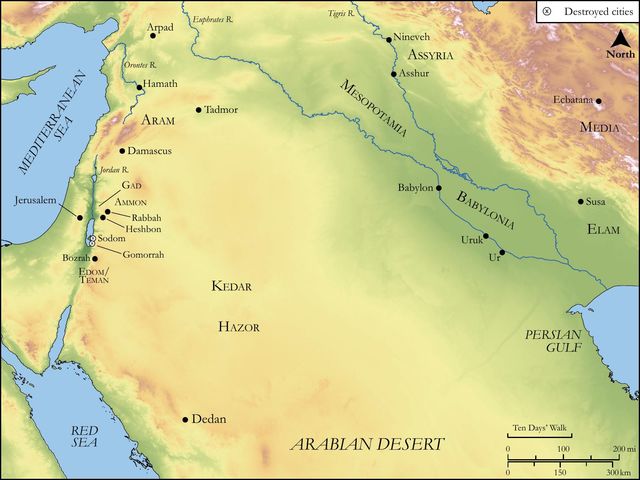
See on the biblical-era map
Study this verse
Public-domain commentary
Matthew Henry
From his Commentary on the Whole Bible. Henry comments on passages, not single verses — this entry covers Jeremiah 49:7–22. His two-level outline is real structure in the source text, so it is rendered as structure.
The Edomites come next to receive their doom from God, by the mouth of Jeremiah: they also were old enemies to the Israel of God; but their day will come to be reckoned with, and it is now at hand, and is foretold, not only for warning to them, but for comfort to the Israel of God, whose afflictions were very much aggravated by their triumphs over them and joy in their calamity, Psa 137:7. Many of the expressions used in this prophecy concerning Edom are borrowed from the prophecy of Obadiah, which is concerning Edom; for, all the prophets being inspired by one and the same Spirit, there must needs be a wonderful harmony and agreement in their predictions. Now here it is foretold,
I.That the country of Edom should be all wasted and made desolate, that the calamity of Esau should be brought upon him, the calamity he has deserved, and God has long designed him, for his old sins, Jer 49:8. The time is at hand when God will visit him, and call him to an account, and then they shall flee from the sword, turn back from the battle, and dwell deep in some close caverns, where they shall hide themselves. All they have shall be carried off by the conqueror; whereas grape-gatherers will leave some gleanings, and even thieves know when they have enough and will destroy no further, those that destroy them shall never be satiated, (Jer 49:9, Jer 49:10); they shall make Esau quite bare, shall strip the Edomites of all they have, shall find out ways and means to come at their most hidden treasure, shall discover even the secret places where they thought to secure their wealth, and rifle them, so that they shall none of them save their wealth, no, nor save themselves nor their children, that might be concealed in a little room: He shall not be able to hide himself, and his seed too is spoiled. His brethren the Moabites, and his neighbours the Philistines, whom he might have expected succours from, or at least shelter with, are spoiled as well as he and disabled to do him any service. And he is not, or there is not he, there is none to him, none left him, that may say what follows (Jer 49:11), Leave thy fatherless children, I will preserve them alive. When they are flying, or dying, there shall be none left, no relation, no friend, no, not so much as any parish officers to take care of their wives and children that they leave behind. Edom is not, he is cut off and gone; nor is there any to say, Leave me thy orphans. If the master of a family be cut off, or forced away, it is some comfort if he have a friend to leave his family with, whom he can confide in; but they shall have none such, for they shall all be involved in the same calamity. The Chaldee makes these to be the words of God to his people, distinguishing them from the Edomites in this calamity; and they read it, "But you, O house of Israel! you shall not leave your orphans; I will secure them, and let your widows rest on my word. Whatever becomes of the widows and fatherless of the Edomites, I will take care of yours." Note, it is an unspeakable comfort to the people of God, when they are dying, that they may leave their surviving relations with God, may, in faith, commit them to him and encourage them to trust in him; and, though they cannot promise themselves great things in the world for them, yet they may hope that he will preserve them alive, always, provided that they trust in him. Let the Edomites, for their part, count upon no other than to be made a desolation and a reproach; for the decree has gone forth; God hath sworn it by himself (Jer 49:13), that their cities shall be wasted, nay, they shall be perpetual wastes, they shall be made mean and despicable; they had made a mighty figure, but God will make them small among the heathen; and those that despised God's people shall themselves be despised among men (Jer 49:15, Oba 1:2), nay, they shall be made monstrous, and even a prodigy (Jer 49:17): Edom shall be such a desolation that every one who goes by shall be astonished; nay, worse yet, they shall be made a terror; Edom shall be made like Sodom and Gomorrah, none shall care for coming near the ruins of it, no man shall abide there (Jer 49:18), such a frightful place shall it be made.
II.That the instruments of this destruction should be very resolute and formidable.
They have their commission from God; he summons them into this service (Jer 49:14): I have heard a rumour, or report, from the Lord, heard it by the prophecy of Obadiah, heard it by a whisper to myself, that an ambassador, or herald, or messenger, is sent to the Gentiles, who are to lay Edom waste, saying, Gather you together, muster all the forces you can, and come against her; for (Jer 49:20) this is the counsel that he hath taken against Edom. The matter is settled, the decree has gone forth, and there is no resisting it. God has determined that Edom shall be laid waste, and then he that is to be employed in wasting it shall come swiftly and strongly. Nebuchadnezzar is he or whom it is here foretold,
1.That he shall come up like a lion, with fierceness and fury, like a lion enraged by the swelling of Jordan overflowing his banks, which forces him out of his covert by the water-side into the higher grounds, Jer 49:19. He shall come roaring, come to devour all that come in his way. He shall come against the habitation of the strong, the forts and castles; and I will cause him to come suddenly into the land (so the next words might well be read), so as to find them unprovided with necessaries for a defence; for I will look out a chosen man to appoint over her, to do this execution, a man fit for the purpose, one chosen out of the people; for when God has work to do he will find out the fittest instruments to be employed in doing it: "Who is like me for choosing the instruments, and spiriting them for the work? And who will appoint me the time? Who will challenge me, and fix a time and place to meet me? Who will join issue with me in battle? And, when I send a lion into the flock, who is that shepherd that can, or dare, stand before me, or against me, to oppose that lion, and think to rescue any of the flock?" Note, When God has work to do of any kind he will soon find those that are able to engage in it, and all the world cannot find those that are able to engage against it. Nay, if God will have Edom destroyed, and their peopled dislodged, there needs not a lion, a fierce lion to do it: Even the least of the flock shall draw them out (Jer 49:20); the meanest servant in Nebuchadnezzar's retinue, the weakest of all that follow his camp, shall draw them out for the slaughter, shall force them to flee, or to surrender, and make their habitations desolate with them. God can bring to pass the greatest works by instruments least likely. When the Chaldean army comes against the Edomites all hands shall be employed and the poorest soldier in it shall have a pluck at them.
2.Nebuchadnezzar shall come, not only like a lion, the king of beasts, but like an eagle, the king of birds (Jer 49:22): He shall fly as the eagle upon his prey, so swiftly, so strongly, shall clap his wings upon Bozrah, to secure it for himself (as before, Jer 48:40), and immediately the hearts of the mighty men shall fail them, for they shall see he is an enemy that it is in vain to struggle with.
III.That the Edomites' confidences should all fail them in the day of their distress.
1.They trusted to their wisdom, but that shall stand them in no stead. This is the first thing fastened upon in this prophecy against Edom, Jer 49:7. That nation used to be famous for wisdom, and their statesmen were thought to excel in politics; and yet now they shall take such wrong measures in all their counsels, and be so baffled in all their designs, that people shall ask, with wonder, What is the matter with the Edomites? Is wisdom no more in Teman? Have the wise men of the east country (Kg1 4:30) become fools? Are those at their wits' end that were thought to have the monopoly of prudence? Has counsel perished from the understanding men? It is so, when God is designing the ruin of a people; for whom he will destroy he infatuates. See Job 12:20. Has their wisdom vanished? Is it tired? (so some); is it worn out? (so others); has it become useless? so others. Yes, it will do them no service when God comes forth to contend with them.
2.They trusted to their strength, but neither shall that avail them, Jer 49:16. They had been a terror to all their neighbours; every body feared them and truckled to them, and this made them proud and conceited of themselves and their own strength, and very secure; because no neighbouring nation durst meddle with them, they thought no nation in the world durst. Their country was much of it mountainous, having many passes which they thought themselves able to make good against any invader; but this terribleness of theirs deceived them, and so did their imaginary inaccessibleness; they did not prove so strong as they were formidable, nor so safe as they were secure. High as they are, God will bring them down; for, as there is no wisdom, so there is no might against the Lord, See these expressions, Oba 1:3, Oba 1:4, Oba 1:8.
IV.That their destruction should be inevitable and very remarkable.
1.God hath determined it (Jer 49:12); he hath said it; nay (Jer 49:13), he hath sworn it, that the Edomites shall not go unpunished, but that they shall drink the cup of trembling, which is put into the hands of all their neighbours; even those whose judgment, or doom, was not to drink of the cup, who had not so well deserved it as they had done, nations that had not been such enemies to Israel as they had been, or Israel itself, that was God's peculiar people, and among whom there were many, very many, who kept his ordinances, upon which account they might have expected an exemption; and yet they had been made to drink of the bitter cup; and shall the Edomites think to pass it? No; they shall surely drink of it. Note, When God punishes the less guilty it is folly for the more guilty to promise themselves impunity; and when judgment begins at God's house it will reach the strangers.
2.All the world shall take notice of it (Jer 49:21): The earth is moved, and all the nations are put into a concern, at the noise of their fall; the news of it shall make them tremble. The noise of the outcry is heard to the Red Sea, which flowed upon the coasts of Edom. So loud shall be the shouts of the conquerors and the shrieks of the conquered, and such a mighty noise shall the news of this destruction of Idumea make in the nations, that is shall be heard among the ships that lie in the Red Sea to take in lading (Kg1 9:26), and then they shall carry the news of it to the remotest shore. Note, The fall of those who have affected to make a noise with their pomp and power will make so much the greater noise.
Historical interpretation
Historical reception
1 surviving comment on this verse from the historical church.
He used the phrase “he sent messengers to the nations” to mean “command.” It is also likely that by divine command ministering angels stirred up the enemy. Remember that the divine David also says, “He sent forth on them the wrath of his anger; anger, wrath and distress, a dispatch by means of wicked angels.” He calls them “wicked,” not as such by nature but as communicating punishment as a benefit. We, too, are in the habit of calling the calamities that befall us evil. Likewise an angel wiped out the firstborn of the Egyptians. In the same way, other calamities were sent against Israel when David took a census of the people. There are many other such examples you could find in the divine Scripture.
Continue studying Jeremiah 49:14 across the web’s major study libraries — every link below opens this exact verse, chapter, or book on the destination site.
Read & Compare
 BibleGatewayThis verse in more than 200 translations and 70 languages.
 Bible.comThe YouVersion reader — hundreds of translations, reading plans, and highlights.
 ESV.orgCrossway's official English Standard Version reader.
 NET BibleThe NET translation with 60,000+ translators' notes on every rendering decision.
 STEP BibleTyndale House's free study tool — original text, vocabulary, and scholarly resources.
 BibliaLogos Bible Software's free web reader.
 USCCBThe New American Bible (Revised Edition) with the U.S. bishops' study notes.
Commentaries
 BibleHub CommentariesDozens of classic commentaries on this verse, gathered on one page.
 StudyLightMore than 100 commentary sets — the largest collection on the web.
 BibleRefPlain-English commentary on what this verse means, verse by verse.
 Enduring WordDavid Guzik's free commentary on this chapter, widely used by Bible teachers.
 Bible Study ToolsVerse commentary alongside Greek and Hebrew study aids.
Original Language & Research
- BibleHub InterlinearThe verse word by word — original language, transliteration, and English.
- BibleHub LexiconEvery word's original-language definition and Strong's entry.
 Blue Letter BibleDeep-study tools — Strong's numbers, concordance, and word studies.
 SefariaThe Hebrew text with Rashi and centuries of Jewish commentary.
Sermons, Hymns & Audio


TrulyRandomVerse is not affiliated with these sites and doesn’t control their content. They’re linked because they’re genuinely useful.
Summary
Jeremiah 49:14 delivers a profound prophetic declaration concerning God's impending and certain judgment upon Edom, a nation characterized by its deep-seated pride and historical animosity toward Israel. The verse reveals that the sovereign Lord Himself has initiated this divine decree, a "rumour" or authoritative message, and has dispatched an "ambassador" to rally the "heathen" nations. This divine emissary is tasked with inciting these foreign powers to assemble and launch a decisive military campaign against Edom, signaling a divinely orchestrated and inescapable downfall that will humble their arrogance and shatter their perceived invulnerability.
Context
ShowHideLiterary Context
Jeremiah 49:14 is embedded within a significant collection of prophecies against foreign nations (Jeremiah 46-51), demonstrating God's universal sovereignty beyond Israel. Specifically, it forms a crucial part of the detailed oracle directed at Edom (Jeremiah 49:7-22). The preceding verses in this section vividly portray Edom's renowned wisdom being rendered futile, its strategic strongholds being plundered, and its inhabitants forced into desperate flight, thereby setting the dire stage for the divine call to arms articulated in verse 14. This oracle against Edom functions as a powerful testament to God's justice, emphasizing that He holds all nations accountable for their actions and pride, serving as a stark illustration of His righteous judgment.
Historical & Cultural Context
Edom, a mountainous kingdom situated southeast of Judah, traced its lineage back to Esau, Jacob's brother, establishing a distant kinship with Israel. Despite this familial tie, their relationship was consistently fraught with animosity, notably Edom's refusal to grant Israel passage during the Exodus and their later, more grievous participation in the plundering of Jerusalem during its fall (a betrayal vividly condemned in Obadiah's prophecy). Edom's capital, Petra, with its formidable rock-hewn fortresses, fostered a profound national pride and a dangerous sense of invulnerability, a hubris explicitly challenged in Obadiah 1:3. The "heathen" or "nations" referenced in Jeremiah 49:14 would most likely refer to the rising imperial power of Babylon, or other regional forces, whom God would providentially employ as instruments of His judgment against Edom, reflecting the common ancient Near Eastern practice of empires serving as divine agents of conquest and subjugation.
Key Themes
ShowHideThis verse powerfully underscores several foundational theological themes. Firstly, it highlights Divine Sovereignty, emphasizing that the "rumour" originates directly from the LORD, signifying that this is not a human conspiracy but a direct, authoritative decree from God, who orchestrates world events and uses nations as instruments of His will, as seen in Isaiah 10:5. Secondly, it speaks to Prophetic Certainty, as the "rumour" or "report" is a divinely revealed and immutable plan, not mere speculation, ensuring that what God declares will undoubtedly come to pass. Thirdly, the broader context of prophecies against Edom, including Obadiah's entire book, consistently points to Judgment on Pride as a primary catalyst for Edom's downfall. God actively opposes the arrogant and self-sufficient, as their pride is an affront to His supremacy. Finally, the sending of an "ambassador" to the "heathen" to rally them against Edom vividly illustrates God's Active Role in History, demonstrating His direct intervention to execute His purposes and justice among the nations.
Exposition and Analysis
ShowHideKey Word Analysis
ShowHideThis term signifies "something heard," an "announcement," "news," or "report." In this prophetic context, it does not imply uncertainty or speculation, but rather a definitive, divinely revealed message or decree that has been heard directly from the LORD. It carries the weight of a certain and authoritative pronouncement from God Himself, underscoring the absolute certainty of the impending judgment.
This word denotes a "hinge," a "throe," or a "herald/erranddoer." Here, it specifically refers to an emissary or messenger. In the context of Jeremiah 49:14, this "ambassador" is not an envoy from Edom, but rather a divinely appointed or providentially moved agent—perhaps a human messenger, a prophetic vision, or even an abstract force—sent by God to stir up other nations. This highlights God's active and direct role in orchestrating the events leading to Edom's judgment.
This term refers to a "foreign nation," hence a "Gentile." It can also figuratively denote a "troop of animals" or a "flight of locusts," emphasizing a mass or multitude. In this verse, it specifically refers to the non-Israelite nations, indicating that God will use external, non-covenant peoples as instruments to execute His judgment against Edom, demonstrating His universal dominion and ability to leverage any entity for His purposes.
Verse Breakdown
ShowHide"I have heard a rumour from the LORD"
This opening clause immediately establishes the divine origin and absolute certainty of the ensuing prophecy. The prophetic voice, likely Jeremiah himself, is receiving a direct, authoritative message, a revealed decree from YHWH, the sovereign God of Israel. The use of "rumour" here is ironic, as it conveys not uncertainty, but a divinely confirmed and unalterable plan, indicating that God's judgment is fixed and will be executed.
"and an ambassador is sent unto the heathen, [saying]"
This clause unveils the mechanism through which God's divine decree will be executed. God is actively dispatching a messenger or agent—the "ambassador"—to the "heathen" nations. This "ambassador" serves as God's instrument to communicate His will and to incite these foreign nations to action. The parenthetical "saying" introduces the direct, imperative command that this ambassador will deliver to these nations.
"Gather ye together, and come against her, and rise up to the battle"
This is the explicit, threefold divine command delivered through the ambassador, with "her" unequivocally referring to Edom. The command is a series of urgent imperatives for military action: "Gather ye together" (mobilize and assemble forces), "come against her" (advance and launch an attack), and "rise up to the battle" (engage in full-scale, decisive warfare). This demonstrates God's direct orchestration of a military campaign against Edom, ensuring its inevitable and total downfall.
Literary Devices
ShowHideJeremiah 49:14 masterfully employs several potent literary devices to convey its message of divine judgment with dramatic force. The phrase "I have heard a rumour from the LORD" utilizes Divine Revelation and Prophetic Authority, emphasizing that the message is not human speculation but a direct communication from God. The "rumour" itself, though often implying uncertainty, functions here as a powerful Irony, signifying the absolute certainty and public nature of God's decree, as if it is already circulating and known in the divine realm. The "ambassador" serves as a Divine Emissary, a Metaphor for God's active will and providential working in history, showing His direct involvement in stirring up nations. The entire verse functions as a Divine Fiat or Prophetic Decree, a declaration of God's absolute will that is presented as already set in motion, underscoring the Inescapability of the prophecy. Finally, the direct commands ("Gather ye together, and come against her, and rise up to the battle") are examples of powerful Imperative Language, which conveys the urgency, non-negotiable nature, and divine authority of God's decree.
Theological and Thematic Connections
ShowHideJeremiah 49:14 profoundly illustrates God's absolute sovereignty over all nations and His unwavering commitment to justice. It teaches that no nation, however proud or seemingly secure in its natural defenses, is beyond the reach of divine accountability. God's word, once declared, is certain to be fulfilled, and He is fully capable of raising up and directing even "heathen" nations to accomplish His purposes, whether for judgment or for the protection of His people. This verse serves as a powerful reminder that history is not a chaotic series of random events, but rather a stage upon which the Lord actively works out His eternal plans, often using unexpected instruments to humble the proud and execute righteous judgment. It underscores the biblical principle that pride precedes destruction, and that true security lies only in humility and reliance upon the Almighty God, who orchestrates the rise and fall of kingdoms according to His perfect will.
Reflection and Application
ShowHideJeremiah 49:14, though an ancient prophecy against a specific nation, offers timeless truths for contemporary believers and global citizens. It calls us to recognize and trust in God's ultimate and unshakeable sovereignty over all global affairs. In a world often characterized by political instability, international conflicts, and the dramatic rise and fall of nations, this verse assures us that God is not a passive observer but an active orchestrator, working out His purposes even through the actions of seemingly autonomous powers. It challenges us to examine our own hearts and the collective posture of our communities and nations, warning against the insidious nature of pride and self-sufficiency, which often lead to spiritual and societal downfall. We are reminded that humility before God is paramount, as He consistently resists the proud but generously gives grace to the humble. Furthermore, it encourages us to pray for our leaders and nations, recognizing that God can turn the hearts of kings and use them for His sovereign will, whether for judgment or for blessing, and that our ultimate hope and security rest in Him alone, not in earthly powers or defenses.
Questions for Reflection
ShowHideFAQ
ShowHideWhy is Edom singled out for such harsh judgment in Jeremiah and other prophetic books?
ShowHideEdom, descended from Esau, was a neighboring nation to Israel, but their relationship was consistently marked by deep-seated hostility and treachery. Edom's primary sin, as highlighted in various prophecies (especially Obadiah), was its profound pride, its reliance on its seemingly impregnable mountain strongholds, and its gleeful participation in the downfall of Judah. When Jerusalem fell to Babylon, Edomites reportedly cheered and even helped plunder the city, demonstrating a severe lack of brotherly compassion (see Psalm 137:7 and Obadiah 1:10-14). God's judgment on Edom, therefore, was a righteous response to their persistent animosity, their self-exalting pride, and their active opposition to His covenant people, demonstrating that God holds even distant relatives accountable for their actions against His chosen.
Does God still use nations to execute His judgment today, as implied in this verse?
ShowHideThe Bible consistently presents God as sovereign over all nations and human history, actively working out His purposes. While the specific historical context of ancient Near Eastern empires being used as "rods" of God's wrath (e.g., Assyria and Babylon) is unique to that era, the theological principle remains profoundly true. God continues to work out His purposes in the world, and He can use various means—including the rise and fall of nations, economic shifts, geopolitical events, and even natural disasters—to bring about His will, to humble the proud, to call humanity to repentance, and to execute His righteous judgment. The ultimate and final judgment, however, is reserved for the end times, when Christ will return to judge the living and the dead (2 Timothy 4:1). Believers are called to discern God's hand in history, to pray for justice and peace among nations, and to recognize His ultimate control over all earthly powers.
Christ-Centered Fulfillment
ShowHideWhile Jeremiah 49:14 speaks of a specific historical judgment on Edom, its underlying themes find profound Christ-centered fulfillment and eschatological resonance. The concept of a "rumour from the LORD" and an "ambassador" being sent points to God's definitive word and His ultimate, perfect messenger. In the New Testament, Jesus Christ is revealed as the very Word of God made flesh, the ultimate and final "ambassador" sent from the Father, not merely to declare judgment but to accomplish redemption and reconcile a lost world (John 1:14). He is the one through whom God has spoken His final and most complete revelation, embodying divine authority and truth (Hebrews 1:1-2). The call for nations to "gather ye together, and come against her, and rise up to the battle" foreshadows the ultimate spiritual battle against sin, death, and the forces of evil, a battle that Christ decisively won through His crucifixion and resurrection, disarming and triumphing over all hostile powers (Colossians 2:15). Furthermore, while Jeremiah's prophecy brought judgment upon a proud nation, Christ's first coming was primarily not to condemn the world but to save it, offering grace and salvation to all who believe (John 3:17). Yet, this verse also points to Christ's second coming, when He will return as the righteous judge, leading the armies of heaven to execute final and just judgment upon all who stubbornly oppose God's rule, fulfilling the ultimate "battle" against the "heathen" who refuse to bow the knee to the Lamb of God (Revelation 19:11-16). Thus, Jeremiah 49:14, with its emphasis on divine sovereignty, certain judgment, and God's active intervention through a sent messenger, ultimately points to the greater work of Christ, who perfectly embodies God's word, executes His judgment, and offers His eternal salvation.