


Isaiah 30:4
Bible text: King James Version (1769 Blayney text) · Public domain
Bible text: Berean Standard Bible · Public domain
Bible text: American Standard Version (1901) · Public domain
Bible text: World English Bible, Messianic edition · Public domain
Bible text: Geneva Bible (1599) · Public domain
Bible text: Young's Literal Translation · Public domain
- כִּיkiforH3588PrtParticle Conditional
- הָיוּha·Yuthey have beenH1961V-Qal-Perf-3cpVerb Qal Perfect 3rd Plural common gender
- בְצֹעַןve·Tzo·'anin ZoanH6814Prep-b ¦ N-properNoun Proper LocationבְinצֹעַןZoan
- שָׂרָיוsa·Ravits officialsH8269N-mpc ¦ 3msNoun Plural Masculine Constructשָׂרָיofficialsוits
- וּמַלְאָכָיוu·mal·'a·Khavand its messengersH4397Conj-w ¦ N-mpc ¦ 3msNoun Plural Masculine Constructוּandמַלְאָכָיmessengersוits
- חָנֵסcha·NesHanesH2609N-properNoun Proper Location
- יַגִּיעוּya·Gi·'uthey have reachedH5060V-Hiphil-Imperf-3mpVerb Hiphil Imperfect 3rd Plural Masculine
English is a literal word-by-word gloss of the Hebrew, not the KJV's wording. Why?
This is the original text the KJV's translators worked from — each Hebrew word with its own literal English meaning in this verse, prepared by scholars at Tyndale House, Cambridge. The KJV translates whole sentences, not word by word, so its wording differs: one Hebrew word can become several English words, and the KJV may choose “the LORD” where the gloss reads “Yahweh”. Both are faithful — they answer different questions. For the KJV's own rendering, switch to the KJV text.
Details
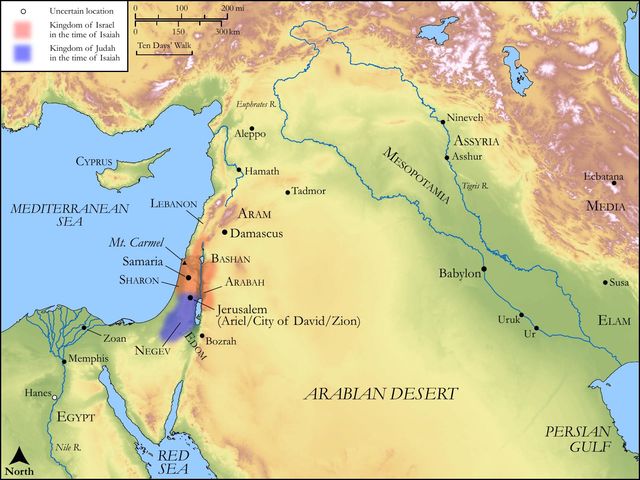
See on the biblical-era map
Study this verse
Public-domain commentary
Matthew Henry
From his Commentary on the Whole Bible. Henry comments on passages, not single verses — this entry covers Isaiah 30:1–7. His three-level outline is real structure in the source text, so it is rendered as structure.
It was often the fault and folly of the people of the Jews that, when they were insulted by their neighbours on one side, they sought for succour from their neighbours on the other side, instead of looking up to God and putting their confidence in him. Against the Israelites they sought to the Syrians, Ch2 16:2, Ch2 16:3. Against the Syrians they sought to the Assyrians, Kg2 16:7. Against the Assyrians they here sought to the Egyptians, and Rabshakeh upbraided them with so doing, Kg2 18:21. Now observe here,
I.How this sin of theirs is described, and what there was in it that was provoking to God.
When they saw themselves in danger and distress, 1. They would not consult God. They would do things of their own heads, and not advise with God, though they had a ready and certain way of doing it by Urim or prophets. They were so confident of the prudence of their own measures that they thought it needless to consult the oracle; nay, they were not willing to put it to that issue: "They take counsel among themselves, and one from another; but they do not ask counsel, much less will they take counsel, of me. They cover with a covering" (they think to secure themselves with one shelter or other, which may serve to cover them from the violence of the storm), "but not of my Spirit" (not such as God by his Spirit, in the mouth of his prophets, directed them to), "and therefore it will prove too short a covering, and a refuge of lies." 2. They could not confide in God. They did not think it enough to have God on their side, nor were they at all solicitous to make him their friend, but they strengthened themselves in the strength of Pharaoh; they thought him a powerful ally, and doubted not but to be able to cope with the Assyrian while they had him for them. The shadow of Egypt (and it was but a shadow) was the covering in which they wrapped themselves.
II.What was the evil of this sin.
1.It bespoke them rebellious children; and a woe is here denounced against them under that character, Isa 30:1. They were, in profession, God's children; but, not trusting in him, they were justly stigmatized as rebellious; for, if we distrust God's providence, we do in effect withdraw ourselves from our allegiance.
2.They added sin to sin. It was sin that brought them into distress; and then, instead of repenting, they trespassed yet more against the Lord, Ch2 28:22. And those that had abused God's mercies to them, making them the fuel of their lusts, abused their afflictions too, making them an excuse for their distrust of God; and so they make bad worse, and add sin to sin; and those that do so, as they make their own chain heavy, so it is just with God to make their plagues wonderful. Now that which aggravated their sin was,
(1.)That they took so much pains to secure the Egyptians for their allies: They walk to go down to Egypt, travel up and down to find an advantageous road thither; but they have not asked at my mouth, never considered whether God would allow and approve of it or no.
(2.)That they were at such a vast expense to do it, Isa 30:6. They load the beasts of the south (horses fetched from Egypt, which lay south from Judea) with their riches, fancying, as it is common with people in a fright, that they were safer any where than where they were. Or they sent their riches thither as bribes to Pharaoh's courtiers, to engage them in their interests, or as pay for their army. God would have helped them gratis; but, if they will have help from the Egyptians, they must pay dearly for it, and they seem willing to do so. The riches that are so spent will turn to a bad account. They carried their effects to Egypt through a land (so it may be read) of trouble and anguish, that vast howling wilderness which lay between Canaan and Egypt, whence come the lion and fiery serpent, Deu 8:15. They would venture through that dangerous wilderness, to bring what they had to Egypt. Or it may be meant of Egypt itself, which had been to Israel a house of bondage and therefore a land of trouble and anguish, and which abounded in ravenous and venomous creatures. See what dangers men run into that forsake God, and what dangers they will run into in pursuance of their carnal confidences and their expectations from the creature.
III.What would be the consequence of it.
1.The Egyptians would receive their ambassadors, would address them very respectfully, and be willing to treat with them (Isa 30:4): His princes were at Zoan, at Pharaoh's court there, and had their audience of the king, who encouraged them to depend upon his friendship and the succours he would send them. But,
2.They would not answer their expectation: They could not profit them, Isa 30:5. For God says, They shall not profit them (Isa 30:6), and every creature is that to us (and no more) which he makes it to be. The forces they were to furnish them with could not be raised in time; or, when they were raised, they were not fit for service, and they would not venture any of their veteran troops in the expedition; or the march was so long that they could not come up when they had occasion for them; or the Egyptians would not be cordial to Israel, but would secretly incline to the Assyrians, upon some account or other: The Egyptians shall help in vain, and to no purpose, Isa 30:7. They shall hinder and hurt, instead of helping. And therefore,
3.These people, that were now so fond of the Egyptians, would at length be ashamed of them, and of all their expectations from them and confidence in them (Isa 30:3): "The strength of Pharaoh, which was your pride, shall be your shame; all your neighbours will upbraid you, and you will upbraid yourselves, with your folly in trusting to it. And the shadow of Egypt, that land shadowing with wings (Isa 18:1), which was your confidence, shall be your confusion; it will not only disappoint you, and be the matter of your shame, but it will weaken all your other supports, and be an occasion of mischief to you." God afterwards threatens the ruin of Egypt for this very thing, because they had dealt treacherously with Israel and been a staff of a reed to them, Eze 29:6, Eze 29:7. The princes and ambassadors of Israel, who were so forward to court an alliance with them, when they come among them shall see so much of their weakness, or rather of their baseness, that they shall all be ashamed of a people that could not be a help or profit to them, but a shame and reproach, Isa 30:5. Those that trust in God, in his power, providence, and promise, are never made ashamed of their hope; but those that put confidence in any creature will sooner or later find it a reproach to them. God is true, and may be trusted, but every man a liar, and must be suspected. The Creator is a rock of ages, the creature a broken reed. We cannot expect too little from man nor too much from God.
IV.The use and application of all this (Isa 30:7):
"Therefore have I cried concerning this matter, this project of theirs. I have published it, that all might take notice of it. I have pressed it as one in earnest. Their strength is to sit still, in a humble dependence upon God and his goodness and a quiet submission to his will, and not to wander about and put themselves to great trouble to seek help from this and the other creature." If we sit still in a day of distress, hoping and quietly waiting for the salvation of the Lord, and using only lawful regular methods for our own preservation, this will be the strength of our souls both for services and sufferings, and it will engage divine strength for us. We weaken ourselves, and provoke God to withdraw from us, when we make flesh our arm, for then our hearts depart from the Lord. When we have tired ourselves by seeking for help from creatures we shall find it the best way of recruiting ourselves to repose in the Creator. Here I am, let him do with me as he pleases.
Historical interpretation
Historical reception
1 surviving comment on this verse from the historical church.
(Chapter 30, Verse 1 and following) Woe to the rebellious children, says the Lord, who make plans that are not from me, who weave a web without my Spirit, adding sin upon sin. You who walk to go down to Egypt, without consulting me, hoping for help from Pharaoh's strength and relying on the protection of Egypt's shadow. But Pharaoh's strength will be your shame, and the trust in Egypt's shadow will bring you disgrace. For there will be princes in Tanis, and your messengers have reached Hanes. All are confounded over a people that cannot profit them: they were not a help, but for confusion and for a reproach. Woe to the rebellious children, saith the Lord, who have taken counsel, and not of me; and have made a league, but not by my spirit, that they might add sin to sin: Who walk to go down into Egypt, and have not asked at my mouth; to strengthen themselves in the strength of Pharaoh, and to trust in the shadow of Egypt. There will be protection from Pharaoh for you, but it will lead to confusion; and those who trust in Egypt will be put to shame. For there are princes in Zoan, and their messengers are evil. They will labor in vain to help the people, for it will not benefit them. Instead, it will bring confusion and shame. After the prophecy against Ariel and everything that has been discussed up to this point, now begins another prophecy, which is proven to have been fulfilled after one hundred and fifty years between Isaiah and Jeremiah. For he predicts that story which we read in the volume of Jeremiah (Jer. XLI), when Jerusalem was overthrown and all its wealth and princes were transferred to Babylon, a leader of royal descent was appointed over those who remained in Judah, Godolias son of Ahicam. But after he was killed by trickery with the help of the Chaldean allies, all the leaders of the warriors, and Johanan son of Carai, and Jechoniah son of Hosea, and the rest of the people from small to great, approached the Prophet Jeremiah and said to him: Let our plea fall before you, and pray to the Lord your God for all these remaining ones. Because we are few out of many, as your eyes look upon us; and let the Lord your God announce to us the way by which we must go, and the word that we must do (Jeremiah 42:2, 3). And after ten days Jeremiah responded to the word of the Lord, saying: Thus says the Lord God of Israel: If you remain quiet in this land, I will build you up and not tear you down, I will plant you and not uproot you, for I am appeased by the evil that I have done to you. Do not be afraid of the face of the king of Babylon, whom you fear in your cowardice (Ibid., X, 11). And after a little while: But if you say, 'We will not dwell in this land,' and you set your face to go to Egypt and go to live there, the sword that you fear will overtake you there, and the famine about which you are anxious will cling to you in Egypt, and there you shall die (Ibid., XLII, 13, 15, 16). The proud men answered, saying to Jeremiah: You speak lies: the Lord our God did not send you, saying: Do not go to Egypt, to live there; but Baruch the son of Neriah incites you against us, to deliver us into the hands of the Chaldeans, to kill us and make us be carried away to Babylon (Jeremiah 43:2, 3). In the end, all the leaders of the people, gathering together with the women and the little ones and the daughters of the king, not heeding the voice of the Lord, entered Egypt, taking Jeremiah and Baruch with them, and they came to Tahpanhes, so that Jeremiah prophesied as a sign of the future captivity against the disobedient people, the things contained in his book. Therefore, what was going to happen afterwards, many years before, was predicted, and they are called deserters and betrayers, the sons who, abandoning God's counsel that they had received through Jeremiah, followed their own will, and they wove a web, not by the spirit of God, which resounded through Jeremiah's mouth. But he metaphorically placed the woven web, in order to demonstrate the wicked counsel, and they did this in order to increase their past sins with the sin of contention and pride. He said, 'You who go down to Egypt, and have not asked my advice. Not that they have not asked, but that they have not wanted to listen to the counsel of the Prophet, hoping for assistance in the strength of Pharaoh, and having confidence in the protection, or shadow, of Egypt. Regarding the strength of Pharaoh, which is mentioned twice in this passage, it is written as 'Maoz' in Hebrew. We make this note so that when we read in the book of Daniel (Dan. II) about the vision of God as 'Maozim', we understand it to mean not as Porphyry imagines, the God of the village of Modim, but rather a mighty and powerful God. But Pharaoh among the Egyptians is the name of royal power; and each one is called by a special name, like Pharaoh Nechao, and Pharaoh Vafres (or Vafre): just as we use the proper names of kings for Caesar and Augustus. And it shall be, he says, that the strength of Pharaoh will be to you for confusion, and the confidence in the shadow of Egypt for shame. The same Jeremiah writes that in the city of Taphnis in Egypt he buried stones in the gateway of Pharaoh's house, and said to the men of Judah: Thus says the Lord God of hosts, the God of Israel: Behold, I will send and take Nebuchadnezzar the king of Babylon, my servant, and I will set his throne upon these stones which I have hidden, and he shall set his throne upon them. And it shall happen, as he strikes the land of Egypt, those destined for death, to death; those destined for captivity, to captivity; and those destined for the sword, to the sword. And he shall kindle a fire in the temples of the gods of Egypt, and he shall burn them, and he shall lead captives away. And the land of Egypt shall be made desolate, as a shepherd wraps himself in his cloak and departs from there in peace. And what follows: Your princes will be in Tanis, and your messengers have reached Hanes, to be read with mockery and emphasis, because they have rejected God's counsel and sent their princes to the city of Tanis in Egypt, where the royal house of Pharaoh was, and under Moses many signs and wonders were performed, as the Psalmist says: He did miracles in the land of Egypt, in the field of Tanis (Ps. LXXVII, 43). And the same Isaiah speaks against Egypt: Where are your wise men now? They will announce to you and say what the Lord of hosts has planned against Egypt. The princes of Tanis have failed, as Isaiah mentions that they failed at that time when the Lord entered Egypt on a light cloud. However, we do not read about the city of Hanes in any other place in Egypt, but from what is said: Your messengers have reached Hanes, we understand that it is the farthest city in Egypt near the Ethiopians and Blemmyas (also known as Blembas), for which the Septuagint translates as: The worst messengers will labor in vain, those who trusted in the Egyptian people, who could not help them, and became an eternal disgrace. Some people think that this place, contrary to the ten tribes in Samaria, was written because when they asked for help from the Egyptians, they were captured by the Assyrians. According to tropology: All those who, despising the religion of God, return to their own vomit, and with the name of children lost, are called shameless dogs, they make a plan, not through the Lord, and they make a pact, not through the spirit of the Lord, and they add sins to sins: so that, being overcome by enticing vices, they also receive the corruption of dogmas, and they descend into the darkness of Egypt, seeking help from Pharaoh, who reigns in Egypt, whose protection leads to everlasting disgrace and reproach. For indeed there are in Tanis, to be sure in a humble and dejected command, its worst messengers, who labor in vain over a people who cannot benefit them. For just as the salvation of the disciples helps the holy teachers, so the perdition of the seduced ones destroys their patriarchs who have turned to the aid of Egypt.
The burden of the beasts of the south. In Hebrew it is called Massa Beemoth (Al. Behemoth) of the Negeb, which the Septuagint translated as 'The Vision of the Quadrupeds in the Desert'. The superior explanation, which we have extensively explained through the replication of the historical text, is the interpretation of this place, according to the prophetic custom, that the burden, that is, the weight and burden of torment and punishment, not only came upon Babylon and the Philistines, and Moab, and Damascus, and Egypt, and the desert sea, but also upon Edom and Arabia, and the valley of Zion, and finally Tyre; but it also came upon the beasts of the south, which the Septuagint translated as quadrupeds in the desert. But the tribe of Judah, which is situated in the southern part, is bordering the wilderness; and those who rejected Jeremiah's prophecy, upon the capture of Jerusalem, refused to dwell in Judah; but they fled to the Egyptians through the desert. And rightly are they called the beasts of the South, or the quadrupeds in the wilderness, because they rejected the knowledge of God, and despising His command, fled to the idols of Egypt, having hope in Pharaoh, to whom whoever leans on, is like one leaning on a reed, which, if broken, will wound the hand of the one leaning on it. Concerning these kinds of animals, the sons of Korah spoke in the psalm: When a man is in honor, he does not understand; he is compared to the foolish animals and becomes like them (Ps. 49:13). And what follows: This is their way; their folly leads them astray, which can rightly be understood in relation to the present chapter, that their way through the desert led to their ruin. I have read, I know, that the animals of the south and the quadrupeds in the desert, who left the borders of Judah and fled into the darkness of Egypt, are referring to the spiritual wickedness in heavenly places; and the rulers of these darknesses, who lost all the wealth and former riches of Egypt in their desire. He said this. We say, according to tropology, that all those who, having abandoned the Creator, have given themselves to the errors of the world, are like quadrupeds in the desert of this age, from which they hope in vain for help, since they have abandoned the true help of God.
Continue studying Isaiah 30:4 across the web’s major study libraries — every link below opens this exact verse, chapter, or book on the destination site.
Read & Compare
 BibleGatewayThis verse in more than 200 translations and 70 languages.
 Bible.comThe YouVersion reader — hundreds of translations, reading plans, and highlights.
 ESV.orgCrossway's official English Standard Version reader.
 NET BibleThe NET translation with 60,000+ translators' notes on every rendering decision.
 STEP BibleTyndale House's free study tool — original text, vocabulary, and scholarly resources.
 BibliaLogos Bible Software's free web reader.
 USCCBThe New American Bible (Revised Edition) with the U.S. bishops' study notes.
Commentaries
 BibleHub CommentariesDozens of classic commentaries on this verse, gathered on one page.
 StudyLightMore than 100 commentary sets — the largest collection on the web.
 BibleRefPlain-English commentary on what this verse means, verse by verse.
 Enduring WordDavid Guzik's free commentary on this chapter, widely used by Bible teachers.
 Bible Study ToolsVerse commentary alongside Greek and Hebrew study aids.
Original Language & Research
- BibleHub InterlinearThe verse word by word — original language, transliteration, and English.
- BibleHub LexiconEvery word's original-language definition and Strong's entry.
 Blue Letter BibleDeep-study tools — Strong's numbers, concordance, and word studies.
 SefariaThe Hebrew text with Rashi and centuries of Jewish commentary.
Sermons, Hymns & Audio


TrulyRandomVerse is not affiliated with these sites and doesn’t control their content. They’re linked because they’re genuinely useful.
Summary
Isaiah 30:4 vividly portrays Judah's desperate diplomatic efforts to secure an alliance with Egypt against the formidable Assyrian threat. This verse, a specific detail within a broader prophetic condemnation, highlights the extent of Judah's reliance on human strength and political maneuvering rather than divine providence. It underscores the nation's profound spiritual misstep in seeking refuge and assistance from a worldly power, a decision that God, through Isaiah, consistently warns will lead only to shame and futility.
Context
ShowHideLiterary Context
Isaiah 30:4 is embedded within a powerful prophetic oracle against Judah's alliance with Egypt, spanning from Isaiah 30:1 to Isaiah 30:7. The chapter opens with a "Woe" pronounced upon the "rebellious children" who "go down into Egypt, and have not asked at my mouth" (Isaiah 30:2). This verse specifically details the destination of Judah's high-level envoys, emphasizing the official and extensive nature of their mission. The preceding verses establish the divine disapproval of this alliance, while the subsequent verses (Isaiah 30:3 and Isaiah 30:5) immediately predict the shame and futility that will result from such misplaced trust. The entire chapter functions as a stark contrast between reliance on human power and dependence on the Lord, culminating in a call to repentance and a promise of divine deliverance for those who wait on God (Isaiah 30:15-18).
Historical & Cultural Context
The late 8th century BCE was a period of immense geopolitical instability for the kingdom of Judah. The dominant power, Assyria, under kings like Sennacherib, was aggressively expanding its empire, threatening smaller nations like Judah. In response, many nations in the Levant sought alliances with Egypt, a traditional regional power, to counter Assyrian aggression. Judah, under King Hezekiah, despite Isaiah's repeated warnings, engaged in such diplomatic efforts. The mention of Zoan (Greek: Tanis) and Hanes (identified with Heracleopolis Magna) is historically significant. Zoan was a major capital city in the eastern Nile Delta, a prominent center of Egyptian power and diplomacy, often serving as a royal residence. Hanes, located further south in Middle Egypt, was also a significant administrative and religious center. The fact that Judah's "princes" and "ambassadors" traveled to both these key locations underscores the depth of their desperation and the official, high-level nature of their mission to secure military aid and protection from Pharaoh, bypassing God's explicit command to trust in Him alone.
Key Themes
ShowHideThis verse powerfully contributes to several overarching themes in Isaiah and the broader prophetic literature. The most prominent is Misplaced Trust, where Judah's actions exemplify a profound error in relying on human alliances and worldly power (Egypt) rather than the omnipotent God of Israel. This act demonstrated a severe lack of faith in God's ability and willingness to protect His people, a recurring motif throughout the book of Isaiah and other prophetic books (e.g., Jeremiah 17:5). Closely related is the Futility of Human Schemes. Isaiah's prophecy consistently declares that this alliance with Egypt would ultimately prove worthless and bring only shame and disappointment (Isaiah 30:3, Isaiah 30:5, Isaiah 30:7). Human strategies, however well-conceived or diplomatically executed, are destined to fail if they contradict divine counsel and are not rooted in faithful dependence on God. This highlights God's Sovereignty over nations and human affairs, asserting that true security comes only from Him.
Exposition and Analysis
ShowHideKey Word Analysis
ShowHideThis term, derived from a root meaning "to rule," denotes a "head person (of any rank or class)," encompassing various leadership roles such as captain, chief, governor, or ruler. In this context, it signifies high-ranking officials or nobles, indicating that Judah sent its most esteemed representatives, not mere messengers, to negotiate with Egypt. This underscores the gravity and official nature of the diplomatic mission.
From an unused root meaning "to despatch as a deputy," this word primarily means "messenger." While it can refer to an angel or a prophet, here it specifically denotes a diplomatic envoy or representative sent on a mission. The use of both "princes" and "ambassadors" emphasizes the comprehensive and serious nature of Judah's attempt to forge an alliance, deploying both political leadership and skilled negotiators.
Of Egyptian derivation, Zoan was a significant ancient Egyptian city in the Nile Delta, often serving as a capital or royal residence during various dynasties. Its mention points to a primary center of Egyptian power and diplomacy, indicating that Judah's delegation sought to engage with the highest echelons of Pharaoh's government.
Verse Breakdown
ShowHide"For his princes were at Zoan,"
This clause reveals that Judah's highest-ranking officials, the "princes," had already arrived or were stationed in Zoan, a major Egyptian capital. This signifies the official and high-level nature of Judah's desperate plea for help, indicating that the nation's political leadership was directly involved in seeking this forbidden alliance. Their presence in a prominent Egyptian city underscores the extent to which Judah was willing to go to secure external aid.
"and his ambassadors came to Hanes."
Complementing the first clause, this part states that Judah's "ambassadors" or special envoys also reached Hanes, another significant Egyptian city further south. This detail suggests a comprehensive diplomatic offensive, possibly involving multiple delegations or a deeper penetration into Egyptian territory to solidify the alliance. The movement of these representatives highlights the active and widespread nature of Judah's reliance on Egypt, demonstrating a broad national commitment to this strategy of human self-reliance rather than trusting in God.
Literary Devices
ShowHideIsaiah 30:4 employs several literary devices to convey its message. Metonymy is evident in the use of "princes" and "ambassadors" to represent the entire nation of Judah and its misguided foreign policy. These individuals are not merely acting on their own but embody the nation's collective decision to seek help from Egypt. There is also a subtle Irony at play: while Judah's leaders are diligently traveling to powerful Egyptian cities in pursuit of security, the very act of their journey demonstrates a profound spiritual insecurity and a rejection of God's promised protection, which Isaiah consistently presents as the only true source of safety. The geographical names, Zoan and Hanes, function as Synecdoche, where these specific cities stand in for the entire nation of Egypt and its perceived strength, which Judah mistakenly believes can provide refuge.
Theological and Thematic Connections
ShowHideIsaiah 30:4 serves as a poignant illustration of a recurring theological principle throughout Scripture: the danger and futility of placing trust in human power and worldly alliances over the sovereign God. Judah's dispatch of princes and ambassadors to Egypt was not merely a political miscalculation but a profound act of spiritual rebellion, demonstrating a lack of faith in Yahweh's ability and willingness to deliver His people. This verse, therefore, is a testament to the divine demand for exclusive trust and reliance, reminding us that true security is found only in God's provision and protection, not in the strength of horses, chariots, or foreign armies. It foreshadows the consistent biblical message that human strength is ultimately weakness when pitted against divine purpose.
Reflection and Application
ShowHideIsaiah 30:4 offers a timeless and challenging reflection for believers today. Just as Judah sought security in the political and military might of Egypt, we too are often tempted to place our ultimate trust in human systems, financial stability, professional networks, or personal abilities when facing life's challenges. This verse calls us to examine the true source of our confidence and security. Do we, like Judah, diligently send our "princes" and "ambassadors" (our best efforts, our deepest hopes, our most strategic plans) to worldly "Zoans" and "Haneses," believing they hold the key to our deliverance? Or do we first and foremost turn to the Lord, seeking His counsel and relying on His unfailing strength? True wisdom and peace are found not in the fleeting shadows of human alliances but in the steadfast light of God's presence and promises.
Questions for Reflection
ShowHideFAQ
ShowHideWhy was Judah's alliance with Egypt forbidden by God?
ShowHideJudah's alliance with Egypt was forbidden primarily because it demonstrated a profound lack of faith in God's ability and willingness to protect His people. Throughout the Old Testament, God repeatedly commanded Israel not to rely on foreign nations or their military might, but to trust in Him alone for deliverance (e.g., Deuteronomy 17:16). Such alliances often led to idolatry, as they involved interactions with pagan cultures and their gods, and they diverted the nation's spiritual focus from Yahweh. Isaiah emphasizes that true strength and salvation come from quietness and trust in God (Isaiah 30:15), not from the "strength of Pharaoh" (Isaiah 30:2-3).
What was the significance of Zoan and Hanes in this context?
ShowHideZoan (Tanis) and Hanes (Heracleopolis Magna) were significant Egyptian cities, serving as centers of political and administrative power. Their mention in Isaiah 30:4 underscores the high-level and extensive nature of Judah's diplomatic mission. By sending "princes" and "ambassadors" to these prominent locations, Judah was making a serious, official appeal to the highest echelons of Egyptian authority. This detail highlights the depth of Judah's desperation and its full commitment to seeking a worldly solution, rather than trusting in God's promised deliverance from the Assyrian threat.
Christ-Centered Fulfillment
ShowHideIsaiah 30:4, with its depiction of Judah's misplaced trust in Egypt, finds profound Christ-centered fulfillment in the New Testament's revelation of Jesus Christ as the ultimate and exclusive source of salvation and security. While Judah sought refuge in the "shadow of Egypt" (Isaiah 30:2), a refuge that would ultimately prove to be "shame" and "confusion" (Isaiah 30:3), Christ offers an unshakeable and eternal refuge. He is the true "strong tower" (Proverbs 18:10) to whom we are called to run, unlike the futile reliance on human strength or political alliances. The futility of Judah's efforts to save itself through worldly means points to humanity's inherent inability to save itself from sin and its consequences. Jesus, by contrast, is the Lamb of God who takes away the sin of the world, offering a salvation that is complete and divinely secured, not dependent on human "princes" or "ambassadors." He is the one in whom "all the promises of God find their Yes" (2 Corinthians 1:20), inviting us to cast all our anxieties on Him (1 Peter 5:7) rather than seeking security in transient worldly powers. In Christ, we find the true and lasting peace that Judah desperately, yet wrongly, sought in Egypt, for He is our peace (Ephesians 2:14) and our only hope of glory (Colossians 1:27).