


Jeremiah 49:13
- כִּיkiforH3588PrtParticle Conditional
- בִיviby <the> myselfPrep-b ¦ 1csSuffix Personal 1st Singular common genderבִby <the>יmyself
- נִשְׁבַּעְתִּיnish·Ba'·tiI swearH7650V-Niphal-Perf-1csVerb Niphal Perfect 1st Singular common gender
- נְאֻםne·'um[the] utterance ofH5002N-mscNoun Singular Masculine Construct
- יְהוָהYah·wehYahwehH3068N-properNoun Proper Title
- כִּיkithatH3588PrtParticle Conditional
- לְשַׁמָּהle·sha·Mah<into> a wasteH8047Prep-l ¦ N-fsNoun Singular Feminine Absoluteלְ<into>שַׁמָּהa waste
- לְחֶרְפָּהle·cher·Pah<into> a reproachH2781Prep-l ¦ N-fsNoun Singular Feminine Absoluteלְ<into>חֶרְפָּהa reproach
- לְחֹרֶבle·Cho·rev<into> a desolationH2721Prep-l ¦ N-msNoun Singular Masculine Absoluteלְ<into>חֹרֶבa desolation
- וְלִקְלָלָהve·lik·la·Lahand <into> a curseH7045Conj-w ¦ Prep-l ¦ N-fsNoun Singular Feminine Absoluteוְandלִ<into>קְלָלָהa curse
- תִּהְיֶהtih·Yehit will becomeH1961V-Qal-Imperf-3fsVerb Qal Imperfect 3rd Singular Feminine
- בָצְרָהva·tze·RahBozrahH1224N-properNoun Proper Location
- וְכָלve·kholand allH3605Conj-w ¦ N-mscNoun Singular Masculine Constructוְandכָלall
- עָרֶיהָ'a·Rei·haits citiesH5892N-mpc ¦ 3fsNoun Plural Masculine Constructעָרֶיcitiesהָits
- תִהְיֶינָהtih·Yei·nahthey will becomeH1961V-Qal-Imperf-3fpVerb Qal Imperfect 3rd Plural Feminine
- לְחָרְבוֹתle·cha·re·Vot<into> ruins ofH2723Prep-l ¦ N-fpcNoun Plural Feminine Constructלְ<into>חָרְבוֹתruins of
- עוֹלָםo·LamperpetuityH5769N-msNoun Singular Masculine Absolute
English is a literal word-by-word gloss of the Hebrew, not the KJV's wording. Why?
This is the original text the KJV's translators worked from — each Hebrew word with its own literal English meaning in this verse, prepared by scholars at Tyndale House, Cambridge. The KJV translates whole sentences, not word by word, so its wording differs: one Hebrew word can become several English words, and the KJV may choose “the LORD” where the gloss reads “Yahweh”. Both are faithful — they answer different questions. For the KJV's own rendering, switch to the KJV text.
Details
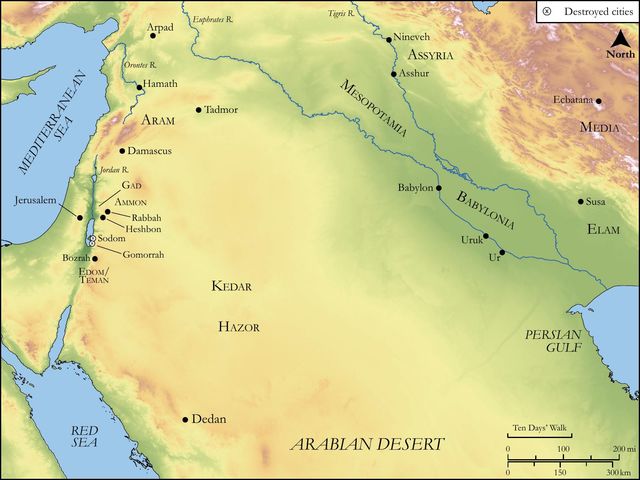
See on the biblical-era map
Study this verse
Public-domain commentary
Matthew Henry
From his Commentary on the Whole Bible. Henry comments on passages, not single verses — this entry covers Jeremiah 49:7–22. His two-level outline is real structure in the source text, so it is rendered as structure.
The Edomites come next to receive their doom from God, by the mouth of Jeremiah: they also were old enemies to the Israel of God; but their day will come to be reckoned with, and it is now at hand, and is foretold, not only for warning to them, but for comfort to the Israel of God, whose afflictions were very much aggravated by their triumphs over them and joy in their calamity, Psa 137:7. Many of the expressions used in this prophecy concerning Edom are borrowed from the prophecy of Obadiah, which is concerning Edom; for, all the prophets being inspired by one and the same Spirit, there must needs be a wonderful harmony and agreement in their predictions. Now here it is foretold,
I.That the country of Edom should be all wasted and made desolate, that the calamity of Esau should be brought upon him, the calamity he has deserved, and God has long designed him, for his old sins, Jer 49:8. The time is at hand when God will visit him, and call him to an account, and then they shall flee from the sword, turn back from the battle, and dwell deep in some close caverns, where they shall hide themselves. All they have shall be carried off by the conqueror; whereas grape-gatherers will leave some gleanings, and even thieves know when they have enough and will destroy no further, those that destroy them shall never be satiated, (Jer 49:9, Jer 49:10); they shall make Esau quite bare, shall strip the Edomites of all they have, shall find out ways and means to come at their most hidden treasure, shall discover even the secret places where they thought to secure their wealth, and rifle them, so that they shall none of them save their wealth, no, nor save themselves nor their children, that might be concealed in a little room: He shall not be able to hide himself, and his seed too is spoiled. His brethren the Moabites, and his neighbours the Philistines, whom he might have expected succours from, or at least shelter with, are spoiled as well as he and disabled to do him any service. And he is not, or there is not he, there is none to him, none left him, that may say what follows (Jer 49:11), Leave thy fatherless children, I will preserve them alive. When they are flying, or dying, there shall be none left, no relation, no friend, no, not so much as any parish officers to take care of their wives and children that they leave behind. Edom is not, he is cut off and gone; nor is there any to say, Leave me thy orphans. If the master of a family be cut off, or forced away, it is some comfort if he have a friend to leave his family with, whom he can confide in; but they shall have none such, for they shall all be involved in the same calamity. The Chaldee makes these to be the words of God to his people, distinguishing them from the Edomites in this calamity; and they read it, "But you, O house of Israel! you shall not leave your orphans; I will secure them, and let your widows rest on my word. Whatever becomes of the widows and fatherless of the Edomites, I will take care of yours." Note, it is an unspeakable comfort to the people of God, when they are dying, that they may leave their surviving relations with God, may, in faith, commit them to him and encourage them to trust in him; and, though they cannot promise themselves great things in the world for them, yet they may hope that he will preserve them alive, always, provided that they trust in him. Let the Edomites, for their part, count upon no other than to be made a desolation and a reproach; for the decree has gone forth; God hath sworn it by himself (Jer 49:13), that their cities shall be wasted, nay, they shall be perpetual wastes, they shall be made mean and despicable; they had made a mighty figure, but God will make them small among the heathen; and those that despised God's people shall themselves be despised among men (Jer 49:15, Oba 1:2), nay, they shall be made monstrous, and even a prodigy (Jer 49:17): Edom shall be such a desolation that every one who goes by shall be astonished; nay, worse yet, they shall be made a terror; Edom shall be made like Sodom and Gomorrah, none shall care for coming near the ruins of it, no man shall abide there (Jer 49:18), such a frightful place shall it be made.
II.That the instruments of this destruction should be very resolute and formidable.
They have their commission from God; he summons them into this service (Jer 49:14): I have heard a rumour, or report, from the Lord, heard it by the prophecy of Obadiah, heard it by a whisper to myself, that an ambassador, or herald, or messenger, is sent to the Gentiles, who are to lay Edom waste, saying, Gather you together, muster all the forces you can, and come against her; for (Jer 49:20) this is the counsel that he hath taken against Edom. The matter is settled, the decree has gone forth, and there is no resisting it. God has determined that Edom shall be laid waste, and then he that is to be employed in wasting it shall come swiftly and strongly. Nebuchadnezzar is he or whom it is here foretold,
1.That he shall come up like a lion, with fierceness and fury, like a lion enraged by the swelling of Jordan overflowing his banks, which forces him out of his covert by the water-side into the higher grounds, Jer 49:19. He shall come roaring, come to devour all that come in his way. He shall come against the habitation of the strong, the forts and castles; and I will cause him to come suddenly into the land (so the next words might well be read), so as to find them unprovided with necessaries for a defence; for I will look out a chosen man to appoint over her, to do this execution, a man fit for the purpose, one chosen out of the people; for when God has work to do he will find out the fittest instruments to be employed in doing it: "Who is like me for choosing the instruments, and spiriting them for the work? And who will appoint me the time? Who will challenge me, and fix a time and place to meet me? Who will join issue with me in battle? And, when I send a lion into the flock, who is that shepherd that can, or dare, stand before me, or against me, to oppose that lion, and think to rescue any of the flock?" Note, When God has work to do of any kind he will soon find those that are able to engage in it, and all the world cannot find those that are able to engage against it. Nay, if God will have Edom destroyed, and their peopled dislodged, there needs not a lion, a fierce lion to do it: Even the least of the flock shall draw them out (Jer 49:20); the meanest servant in Nebuchadnezzar's retinue, the weakest of all that follow his camp, shall draw them out for the slaughter, shall force them to flee, or to surrender, and make their habitations desolate with them. God can bring to pass the greatest works by instruments least likely. When the Chaldean army comes against the Edomites all hands shall be employed and the poorest soldier in it shall have a pluck at them.
2.Nebuchadnezzar shall come, not only like a lion, the king of beasts, but like an eagle, the king of birds (Jer 49:22): He shall fly as the eagle upon his prey, so swiftly, so strongly, shall clap his wings upon Bozrah, to secure it for himself (as before, Jer 48:40), and immediately the hearts of the mighty men shall fail them, for they shall see he is an enemy that it is in vain to struggle with.
III.That the Edomites' confidences should all fail them in the day of their distress.
1.They trusted to their wisdom, but that shall stand them in no stead. This is the first thing fastened upon in this prophecy against Edom, Jer 49:7. That nation used to be famous for wisdom, and their statesmen were thought to excel in politics; and yet now they shall take such wrong measures in all their counsels, and be so baffled in all their designs, that people shall ask, with wonder, What is the matter with the Edomites? Is wisdom no more in Teman? Have the wise men of the east country (Kg1 4:30) become fools? Are those at their wits' end that were thought to have the monopoly of prudence? Has counsel perished from the understanding men? It is so, when God is designing the ruin of a people; for whom he will destroy he infatuates. See Job 12:20. Has their wisdom vanished? Is it tired? (so some); is it worn out? (so others); has it become useless? so others. Yes, it will do them no service when God comes forth to contend with them.
2.They trusted to their strength, but neither shall that avail them, Jer 49:16. They had been a terror to all their neighbours; every body feared them and truckled to them, and this made them proud and conceited of themselves and their own strength, and very secure; because no neighbouring nation durst meddle with them, they thought no nation in the world durst. Their country was much of it mountainous, having many passes which they thought themselves able to make good against any invader; but this terribleness of theirs deceived them, and so did their imaginary inaccessibleness; they did not prove so strong as they were formidable, nor so safe as they were secure. High as they are, God will bring them down; for, as there is no wisdom, so there is no might against the Lord, See these expressions, Oba 1:3, Oba 1:4, Oba 1:8.
IV.That their destruction should be inevitable and very remarkable.
1.God hath determined it (Jer 49:12); he hath said it; nay (Jer 49:13), he hath sworn it, that the Edomites shall not go unpunished, but that they shall drink the cup of trembling, which is put into the hands of all their neighbours; even those whose judgment, or doom, was not to drink of the cup, who had not so well deserved it as they had done, nations that had not been such enemies to Israel as they had been, or Israel itself, that was God's peculiar people, and among whom there were many, very many, who kept his ordinances, upon which account they might have expected an exemption; and yet they had been made to drink of the bitter cup; and shall the Edomites think to pass it? No; they shall surely drink of it. Note, When God punishes the less guilty it is folly for the more guilty to promise themselves impunity; and when judgment begins at God's house it will reach the strangers.
2.All the world shall take notice of it (Jer 49:21): The earth is moved, and all the nations are put into a concern, at the noise of their fall; the news of it shall make them tremble. The noise of the outcry is heard to the Red Sea, which flowed upon the coasts of Edom. So loud shall be the shouts of the conquerors and the shrieks of the conquered, and such a mighty noise shall the news of this destruction of Idumea make in the nations, that is shall be heard among the ships that lie in the Red Sea to take in lading (Kg1 9:26), and then they shall carry the news of it to the remotest shore. Note, The fall of those who have affected to make a noise with their pomp and power will make so much the greater noise.
Continue studying Jeremiah 49:13 across the web’s major study libraries — every link below opens this exact verse, chapter, or book on the destination site.
Read & Compare
 BibleGatewayThis verse in more than 200 translations and 70 languages.
 Bible.comThe YouVersion reader — hundreds of translations, reading plans, and highlights.
 ESV.orgCrossway's official English Standard Version reader.
 NET BibleThe NET translation with 60,000+ translators' notes on every rendering decision.
 STEP BibleTyndale House's free study tool — original text, vocabulary, and scholarly resources.
 BibliaLogos Bible Software's free web reader.
 USCCBThe New American Bible (Revised Edition) with the U.S. bishops' study notes.
Commentaries
 BibleHub CommentariesDozens of classic commentaries on this verse, gathered on one page.
 StudyLightMore than 100 commentary sets — the largest collection on the web.
 BibleRefPlain-English commentary on what this verse means, verse by verse.
 Enduring WordDavid Guzik's free commentary on this chapter, widely used by Bible teachers.
 Bible Study ToolsVerse commentary alongside Greek and Hebrew study aids.
Original Language & Research
- BibleHub InterlinearThe verse word by word — original language, transliteration, and English.
- BibleHub LexiconEvery word's original-language definition and Strong's entry.
 Blue Letter BibleDeep-study tools — Strong's numbers, concordance, and word studies.
 SefariaThe Hebrew text with Rashi and centuries of Jewish commentary.
Sermons, Hymns & Audio


TrulyRandomVerse is not affiliated with these sites and doesn’t control their content. They’re linked because they’re genuinely useful.
Summary
Jeremiah 49:13 delivers a profound and unalterable divine judgment against Bozrah, the formidable capital of Edom. The Lord, swearing by His own immutable being, declares that Bozrah and all its surrounding cities will be utterly and perpetually transformed into symbols of desolation, reproach, waste, and a curse. This solemn prophecy powerfully underscores God's absolute sovereignty over all nations and His unwavering commitment to execute righteous judgment against pride, injustice, and hostility directed toward His people.
Context
ShowHideLiterary Context
Jeremiah 49 is situated within a significant prophetic block in the Book of Jeremiah (chapters 46-51), often referred to as "Oracles Against the Nations." This section systematically pronounces God's judgment upon various foreign powers that interacted with or oppressed Israel, including Egypt, Philistia, Moab, Ammon, Edom, Damascus, Kedar, Hazor, and Elam. Specifically, Jeremiah 49:7-22 focuses on Edom, a nation with a deep-seated, often adversarial, relationship with Israel, rooted in their common ancestry through Jacob and Esau. This particular oracle on Edom follows prophecies against Ammon and precedes those against Damascus, Kedar, Hazor, and Elam, positioning Edom's fate within a broader divine reckoning with global powers. The verses immediately preceding verse 13 detail Edom's overconfidence in its wisdom and strength, setting the stage for the specific, severe pronouncement against its prominent city, Bozrah.
Historical & Cultural Context
Edom, located southeast of Judah in a rugged, mountainous region, was renowned for its seemingly impenetrable rock fortresses carved into the landscape, particularly in the area of Seir. Bozrah (identified with modern Buseirah in Jordan) was a key city, possibly its capital or a major stronghold, serving as a powerful symbol of Edomite strength, self-reliance, and strategic advantage. Historically, Edom consistently exhibited animosity towards Israel, notably refusing them passage during the Exodus (Numbers 20:14-21). Later, they actively participated in and gloated over Jerusalem's destruction by Babylon, as vividly recounted in Psalm 137:7 and Obadiah 1:10-14. Their profound trust in their own wisdom and fortifications, explicitly mentioned in Jeremiah 49:16, made them a prime target for a divine demonstration of Yahweh's supreme sovereignty. Culturally, an oath taken "by myself" was the strongest possible affirmation, signifying that the one swearing invoked their very being as the guarantee, making the judgment against Bozrah absolutely certain and irreversible.
Key Themes
ShowHideJeremiah 49:13 powerfully contributes to several overarching themes prevalent in Jeremiah and the broader prophetic corpus. Firstly, it emphatically underscores the Divine Sovereignty and Unquestionable Judgment of Yahweh. This verse demonstrates that God is not confined to Israel's borders but is the supreme ruler over all nations, holding them accountable for their actions. His oath "by myself" highlights the immutability of His word and His decrees, a concept affirmed in Hebrews 6:13-18. Secondly, the passage illustrates the dire Consequences of Pride and Injustice. While not exhaustively detailed in this single verse, the broader oracle against Edom, particularly Jeremiah 49:16 and Obadiah 1:3-4, reveals that Edom's downfall was a direct result of their arrogance, their misplaced trust in their own strength, and their malicious actions against Judah. Finally, the repeated terms of ruin—"desolation, a reproach, a waste, and a curse"—emphasize the theme of Utter and Perpetual Desolation, signifying a complete and lasting reversal of fortune, a common prophetic motif for nations under divine judgment.
Exposition and Analysis
ShowHideKey Word Analysis
ShowHideThis verb, meaning "to seven oneself," implies taking an oath, as if by repeating a declaration seven times for emphasis and certainty. When God swears by Himself, it signifies the highest possible assurance and the absolute immutability of His word and purpose, as there is no higher authority by whom He can swear. It underscores the divine resolve and unchangeable nature behind the coming judgment.
This is the sacred covenant name of God, Yahweh, emphasizing His self-existence, eternal nature, and His active, sovereign presence in history. The use of "LORD" here reinforces that the judgment is not a mere human prediction but an authoritative decree from the supreme God who controls all nations and their destinies. It highlights the divine source and unchallengeable authority of the prophecy.
This specific place name refers to a prominent city in Edom, likely its capital or a major fortress. Naming Bozrah specifically signifies that the judgment is not a vague threat but a targeted, concrete destruction against the very heart and symbol of Edomite strength and pride. Its downfall represents the complete and devastating collapse of the nation's perceived invulnerability.
Verse Breakdown
ShowHide"For I have sworn by myself, saith the LORD"
This opening clause establishes the divine authority, certainty, and unchangeable nature of the prophecy. The phrase "I have sworn by myself" is the strongest possible divine oath, indicating God's absolute commitment to fulfill His word. It means there is no higher power or principle by which God could swear, making the declaration utterly certain and irreversible. "Saith the LORD" further reinforces that this is a direct, authoritative revelation from Yahweh, the sovereign covenant God.
"that Bozrah shall become a desolation, a reproach, a waste, and a curse"
This segment details the multifaceted and comprehensive nature of the impending judgment on Bozrah. "Desolation" (Hebrew shammâh) implies ruin, emptiness, and consternation, a state of utter devastation. "Reproach" (Hebrew cherpâh) signifies shame, disgrace, and ignominy, stripping away any former glory or honor. "Waste" (Hebrew chôreb) denotes barrenness, dryness, and utter destruction, rendering the land uninhabitable. "Curse" (Hebrew qᵉlâlâh) indicates divine abandonment and disfavor, bringing about complete ruin and misfortune. Together, these terms paint a vivid and horrifying picture of complete and devastating ruin, both physical and reputational, for Bozrah.
"and all the cities thereof shall be perpetual wastes."
This concluding phrase extends the judgment beyond Bozrah to encompass the entirety of Edomite territory. The phrase "perpetual wastes" (Hebrew chorbâh and ʻôwlâm) emphasizes the long-lasting, enduring, and irreversible nature of the destruction. It signifies that the desolation will not be temporary but will endure for an indefinite, seemingly eternal, period, ensuring that Edom will not recover its former status or power.
Literary Devices
ShowHideJeremiah 49:13 employs several potent literary devices to convey the certainty, severity, and comprehensive nature of God's judgment. The most prominent is the Divine Oath, expressed in the powerful declaration, "I have sworn by myself, saith the LORD." This rhetorical device emphatically underscores the absolute truth and immutability of the prophecy, as God's very character and being serve as the ultimate guarantee. The verse also utilizes Accumulation and Synonymia through the string of synonymous or near-synonymous terms: "desolation, a reproach, a waste, and a curse." This piling up of destructive descriptors amplifies the comprehensive nature of Bozrah's ruin, emphasizing its complete and utter downfall from every conceivable aspect—physical, social, and spiritual. Furthermore, the phrase "perpetual wastes" serves as a form of Hyperbole or intense emphasis, conveying the enduring and irreversible nature of the desolation, highlighting the finality of God's judgment against Edom. Finally, Bozrah itself functions as a powerful Synecdoche or Symbolism for the entire nation of Edom; its downfall represents the complete collapse of Edomite pride, power, and perceived invulnerability.
Theological and Thematic Connections
ShowHideJeremiah 49:13 profoundly illustrates God's absolute sovereignty over all nations and His unwavering commitment to righteous judgment. It reveals that no nation, regardless of its perceived strength, strategic location, or historical prominence, is beyond the reach of His divine decree. The Lord's oath "by myself" underscores His immutability and the absolute certainty of His word, whether in promise or in judgment. This passage serves as a powerful reminder that national or personal pride, injustice, and hostility towards God's people ultimately incur divine wrath. The complete and perpetual desolation prophesied for Bozrah and Edom signifies a total reversal of fortune, a divine response to their arrogance and their malicious actions against Judah, demonstrating that God sees and will act to bring about perfect justice in His time.
Reflection and Application
ShowHideJeremiah 49:13 offers profound and enduring lessons for contemporary believers and societies alike. It powerfully reminds us that God's word is utterly reliable and true, whether it declares judgment or promises salvation. Just as His prophecies against Edom were meticulously fulfilled in history, so too will all His promises and warnings come to pass with absolute certainty. This truth should instill in us both a healthy, reverent fear of the Lord and an unwavering confidence in His faithfulness and power. The tragic fate of Bozrah serves as a timeless warning against the insidious dangers of national or personal pride, self-reliance, and hostility towards others, especially those aligned with God's purposes. It teaches us that true security is found not in human strength, accumulated wealth, or strategic geopolitical positioning, but in humble submission to God's supreme authority and His righteous ways. Moreover, this verse offers a measure of comfort and hope to those who witness rampant injustice and oppression in the world, affirming that God is sovereign over all earthly powers and will ultimately bring about perfect justice, ensuring that all wrongdoing will be addressed and all pride will be humbled in due time.
Questions for Reflection
ShowHideFAQ
ShowHideWhat was the significance of Bozrah to Edom?
ShowHideBozrah was a city of immense significance for Edom, widely considered its capital or a major fortress. Its strategic location within the rugged, mountainous region of Seir made it appear impregnable, symbolizing Edom's strength, wealth, and perceived invulnerability. Therefore, the prophecy of Bozrah's utter destruction was a direct, devastating blow to the heart of Edomite pride and security, signifying the complete and irreversible downfall of the entire nation, not just a single city.
Why did God swear "by myself" in this prophecy?
ShowHideWhen God swears "by myself," it constitutes the strongest possible divine oath, indicating the absolute certainty and immutability of His word. As there is no higher authority or greater being than God Himself, He swears by His own eternal character and essence. This emphasizes that the judgment against Bozrah and Edom is not a conditional threat or a mere possibility, but an unchangeable, divinely determined decree that will assuredly come to pass. This powerful form of oath is seen elsewhere in Scripture, such as God's oath to Abraham in Genesis 22:16.
How does this prophecy relate to other prophecies against Edom in the Bible?
ShowHideJeremiah 49:13 is entirely consistent with other biblical prophecies against Edom, which frequently highlight their excessive pride, their deep-seated animosity towards Israel, and their ultimate, complete downfall. For example, Obadiah 1:3-4 speaks of Edom's pride in their seemingly secure rocky dwelling places and God's promise to bring them down from their lofty perch. Ezekiel 25:12-14 also condemns Edom for their vengeful actions against Judah and foretells their desolation. These prophecies collectively demonstrate God's righteous judgment against nations that oppose His people and elevate themselves in arrogant self-sufficiency, confirming a consistent divine decree against Edom.
Christ-Centered Fulfillment
ShowHideWhile Jeremiah 49:13 directly concerns God's historical judgment on the ancient nation of Edom, its underlying theological principles find profound and ultimate Christ-centered fulfillment. The divine oath, "For I have sworn by myself, saith the LORD," points to the unchangeable nature of God's word and His eternal commitment, a foundational truth for understanding the absolute certainty of Christ's redemptive work. Just as God's judgment on Bozrah was certain and irreversible, so too is the fulfillment of His covenant promises in Jesus Christ. The ultimate "desolation, reproach, waste, and curse" that humanity deserved due to its sin was borne by Christ on the cross, as He willingly "became a curse for us" (Galatians 3:13). He took upon Himself the full weight of divine judgment, transforming our deserved spiritual desolation into reconciliation, new life, and righteousness in Him (2 Corinthians 5:21). Furthermore, this passage foreshadows Christ's ultimate authority as the righteous Judge of all nations, who will one day bring all human pride and rebellion to nothing and establish His eternal, unshakeable kingdom (Revelation 19:11-16). The "perpetual wastes" of Edom serve as a stark warning of the eternal consequences for those who reject God's sovereign rule and refuse the salvation offered through Christ, who is the only way to escape the ultimate and eternal judgment that awaits the unrepentant (John 3:18).