


Amos 6:8
- נִשְׁבַּעnish·Ba'he has swornH7650V-Niphal-Perf-3msVerb Niphal Perfect 3rd Singular Masculine
- אֲדֹנָי'a·do·Nai[the] LordH136N-properNoun Proper Title
- יְהוִהYah·wehYahwehH3069N-properNoun Proper Title
- בְּנַפְשׁוֹbe·naf·Shoby his selfH5315Prep-b ¦ N-fsc ¦ 3msNoun Singular Feminine Constructבְּbyנַפְשׁselfוֹhis
- נְאֻםne·'um[the] utterance ofH5002N-mscNoun Singular Masculine Construct
- יְהוָהYah·wehYahwehH3068N-properNoun Proper Title
- אֱלֹהֵי'e·lo·HeiGod ofH430N-mpcNoun Plural Masculine Construct
- צְבָאוֹתtze·va·'othostsH6635N-fpNoun Plural Feminine Absolute
- מְתָאֵבme·ta·'Ev[am] loathingH8374V-Piel-Prtcpl-msVerb Piel Participle Singular Masculine Absolute
- אָנֹכִי'a·no·KhiIH595Pro-1csPronoun Personal 1st Singular common gender
- אֶת'et<obj.>H853DirObjMParticle Object Indicator
- גְּאוֹןge·'on[the] pride ofH1347N-mscNoun Singular Masculine Construct
- יַעֲקֹבya·'a·KoJacobH3290N-proper-mNoun Proper Masculine
- וְאַרְמְנֹתָיוve·'ar·me·no·Tavand his fortressesH759Conj-w ¦ N-fpc ¦ 3msNoun Plural Feminine Constructוְandאַרְמְנֹתָיfortressesוhis
- שָׂנֵאתִיsa·Ne·tiI hateH8130V-Qal-Perf-1csVerb Qal Perfect 1st Singular common gender
- וְהִסְגַּרְתִּיve·his·gar·Tiand I will deliver upH5462Conj-w ¦ V-Hiphil-ConsecPerf-1csVerb Hiphil Consecutive Perfect 1st Singular common genderוְandהִסְגַּרְתִּיI will deliver up
- עִיר'ir[the] cityH5892N-fsNoun Singular Feminine Absolute
- וּמְלֹאָהּu·me·lo·'Ahand what fills itH4393Conj-w ¦ N-msc ¦ 3fsNoun Singular Masculine Constructוּandמְלֹאָwhat fillsהּit
English is a literal word-by-word gloss of the Hebrew, not the KJV's wording. Why?
This is the original text the KJV's translators worked from — each Hebrew word with its own literal English meaning in this verse, prepared by scholars at Tyndale House, Cambridge. The KJV translates whole sentences, not word by word, so its wording differs: one Hebrew word can become several English words, and the KJV may choose “the LORD” where the gloss reads “Yahweh”. Both are faithful — they answer different questions. For the KJV's own rendering, switch to the KJV text.
Details
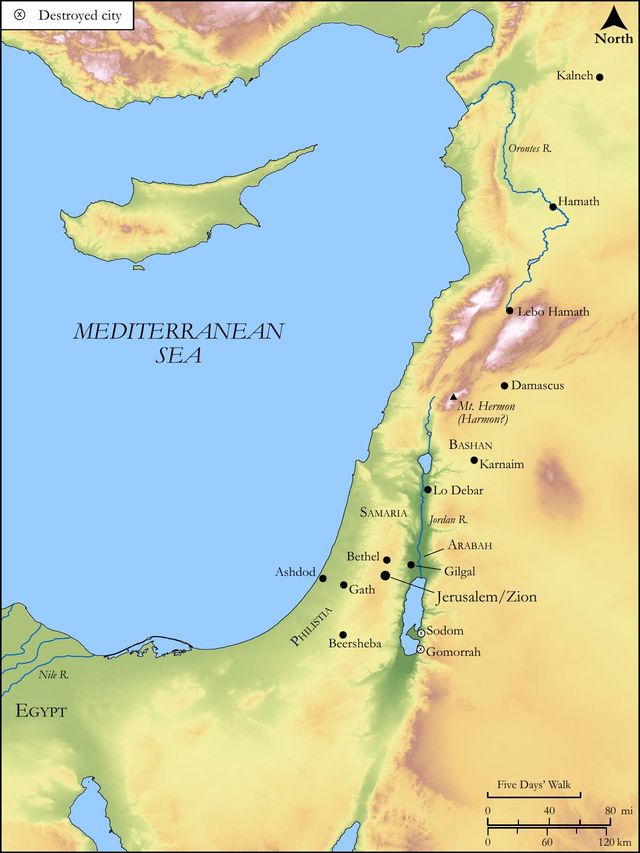
See on the biblical-era map
Study this verse
Public-domain commentary
Matthew Henry
From his Commentary on the Whole Bible. Henry comments on passages, not single verses — this entry covers Amos 6:8–14. His two-level outline is real structure in the source text, so it is rendered as structure.
In the former part of the chapter we had these secure Israelites loading themselves with pleasures, as if they could never be made merry enough; here we have God loading them with punishments, as if they could never be made miserable enough. And observe,
I.How strongly this burden is bound on, not to be shaken off by their presumption and security; for it is bound by the Lord the God of hosts, by his mighty, his almighty, hand, which none can resist; it is bound with an oath, which puts the sentence past revocation: The Lord God has sworn, and he will not repent, and, since he could swear by no greater, he has sworn by himself. How dreadful, how miserable, is the case of those whose ruin, whose eternal ruin, God himself has sworn, who can execute his purpose and cannot alter it!
II.How heavily this burden lies! Let us see the particulars.
1.God will abhor and abandon them, and that implies misery enough, all misery: I abhor the excellency of Jacob, all that which they are proud of, and value themselves upon, and for which they call and count themselves the chief of nations. Their visible church-membership, and the privileges of that, their temple, altar, and priesthood, these were, more than any thing, the excellencies of Jacob; but, when these were profaned and polluted by sin, God abhorred them; he hated and despised them, Amo 5:21. Note, God abhors that form of godliness which hypocrites keep up, while they abhor the power of it. And if he abhors their temple, for the iniquity of that, no marvel that he hates their palaces, for the injustices and oppression he finds there. Note, that creature which we take such a complacency and put such a confidence in as to make it a rival with God is thereby made abominable to him. He hates the palaces of sinners, for the sake of wickedness of those that dwell therein. Pro 3:33, The curse of the Lord is in the house of the wicked. And, if God abhor them, immediately it follows, He will deliver up the city with all that is therein, deliver it up into the hands of the enemy, that will lay it waste, and make a prey of all its wealth. Note, Those that are abhorred and abandoned of God are undone to all intents and purposes.
2.There shall be a great and general mortality among them (Amo 6:9): If there remain ten men in one house, that have escaped the sword of the enemy, yet they shall be met with another way; they shall all die by famine or pestilence. In the most sickly times, if there be ten in a house, one may hope that at least the one-half of them will escape, according to the proportion of two in a bed, one taken and the other left; but here not one of ten shall live to bury the rest. Another instance of the greatness of the mortality is (Amo 6:10) that the nearest relations of the dead shall be forced with their own hands to wind up their bodies, and bury them, for want of other hands to be employed in it; that is all that the next of kin, to whom the right of redemption belongs, can do for them, and with great reluctance will they do that. It intimates that the young people shall be cut off soonest; for the uncle that survives is, ordinarily, the senior relation. "When the uncle comes with the sexton (or him that burns), to bring out the bones out of the house, he shall say to him that he sees next about the house, 'Is there any yet with thee? Are there any left alive?' And he shall say, 'No, this is the last; now the whole family is cut off by death, and neither root nor branch remains."' But that which makes the judgment the more grievous is that their hearts seem to be hardened under it. "When he that is found by the sides of the house begin to enter into discourse with those that are carrying off the dead, they shall say, 'Hold thy tongue; do not stand preaching to us about the hand of Providence in this calamity, for we may not make mention of the name of the Lord; God is so angry with us that there is no speaking to him; he is so extreme to mark what we do amiss that we dare not so much as make mention of his name."' Thus the foolishness of men perverts their way, and brings them into distress, and then their heart frets against the Lord. Even then they will not take notice of his hand, nor suffer those about them to do it. Perhaps it was forbidden by some of the idolatrous kings to make mention of the name of Jehovah, as by the law of Moses it was forbidden to make mention of the names of the heathen-gods: "We may not do it without incurring the penalty." Note, Those hearts are wretchedly hardened indeed that will not be brought to make mention of God's name, and to worship him, when the hand of God has gone out against them, and when, as here, sickness and death are in their families. Thus those heap up wrath who cry not when God binds them.
3.Their houses shall be destroyed, Amo 6:11. God will smite the great house with breaches, and the little house with clefts; they shall both be cracked so as to lose their beauty and strength, and to be hastening towards a fall. The princes' palaces are not above the rebuke of divine justice, nor the poor men's cottages beneath it; neither shall escape. When sin has marked them for ruin God will find ways to bring it about. It is by order from him that breaches are made.
III.How justly they are thus burdened. If we understand the matter aright, we shall say, The Lord is righteous.
1.The methods used for their reformation had been all fruitless and ineffectual (Amo 6:12): Shall horses run upon the rock, to hurl or harrow the ground there? Or will one plough there with oxen? No, for there will be no profit to countervail the pains. God has sent them his prophets, to break up their fallow-ground; but they found them as hard and inflexible as the rock, rough and rugged, and they could do no good with them, nor work upon them, and therefore they shall not attempt it any more. They will not be reclaimed, and therefore shall not be reproved, but quite abandoned. Note, Those who will not be cultivated as fields and vineyards shall be rejected as barren rocks and deserts, Heb 6:7, Heb 6:8.
2.They had abused their power to the wrong and oppression of many, whose injured cause the sovereign Judge would not only right, but revenge: You have turned judgment into gall, which is nauseous, and the fruit of righteousness into hemlock, which is noxious; it would make one sick to see how those that were entrusted with the administration of public justice bore down equity with that power which they out to have defended and supported it, and so turned its own artillery against itself. Note, When our services of God are soured with sin his providences will justly be embittered to us.
3.They had set the judgments of God at defiance, and, confiding in their own strength, thought themselves a match for Omnipotence, Amo 6:13. They rejoiced in a thing of nought, pleased themselves with a fancy that no evil should befal them, though they had no ground at all for that confidence, nothing to trust to that would bear any weight. They said, "Have we not taken to us horns; have we not arrived to great dignity and dominion, have we not pushed down our enemies and pushed on our victories, and this by our own strength, our own skill and courage, our own wealth and military force? Who then need we be afraid of? Who then need we make court to? Not God himself." Note, Prosperity and success commonly make men secure and haughty; and those that have done much think they can do any thing, any thing without God, nay, any thing against him. But those who trust in their own strength rejoice in a thing of nought, and so they will find. Probably they did not say this with their lips, totidem verbis - in so many words, but it was the language of their hearts and of their actions, both which God understands.
IV.How easily and effectually this burden shall be brought upon them, Amo 6:14.
He that brings it upon them is the Lord the God of hosts, who both may do and can do what he pleases, who has all creatures at his command, and who, when he has work to do, will not be at a loss for instruments to do it with; though they are the house of Israel, yet he will raise up against them a nation which they feared not, but had many a time hoped in, even the Assyrians, and this nation shall afflict them, bring them into straits, and put them to pain, from the entering in of Hamath, in the north, to the river of the wilderness, the river of Egypt, Sihor or Nile, in the south. The whole nation has shared in the iniquity, and therefore must expect to share in the calamity. Note, When men are in any way instruments of affliction to us we must see God raising them up against us, for they are in his hand - the rod, the sword, in his hand. The Lord has bidden Shimei curse David.
Historical interpretation
Historical reception
1 surviving comment on this verse from the historical church.
(Vers. 7 seqq.) Therefore now they will migrate to the head of the transmigrants, and the faction of the revelers will be removed. The Lord God has sworn by his own soul, says the Lord God of hosts: I detest the pride of Jacob, and I hate his houses, and I will deliver the city with its inhabitants: and if there are ten men left in one house, they shall die; and their close relative shall take them, and burn them, to carry out the bones from the house; and he who is in the innermost chambers of the house shall say: Is there still anyone with you? And he will answer: It is the end; and he will say to him: Be silent, and do not remember the name of the Lord. LXX: Therefore now the strong ones will be captives from the beginning, and the noise of horses will be taken away from Ephraim; because the Lord has sworn by himself, says the Lord God of hosts: because I will abhor all the reproach of Jacob, and I will hate his regions, and I will take away the city with all its inhabitants. And it shall come to pass, if ten men remain in one house, and they die; and the household members shall take them, and they shall make an effort to remove their bones from the house; and those who are in charge of the house shall say: Are there still any with you? And he shall say, by no means; and he shall say, Be silent, and do not mention the name of the Lord. Because of the higher causes that the prophetic discourse describes (of those who sleep on ivory beds, and revel on couches, and eat lambs from the flock, and calves from the midst of the herd, and sing to the sound of the harp and drink from bowls, and are anointed with the finest ointment, and yet suffer nothing in the destruction of their people, who are descended from Joseph), now the Lord threatens, and says: Because they have done these things and these things, now they shall migrate at the head of the exiles. And the meaning is this: Punishment is never delayed for the future, nor is it prophesied for long centuries to come. What is now imminent, is now coming, my words predict, that they will go in the beginning of the transmigration, namely the rulers and the powerful, of whom he said above: Hear this word, you fat cows, who are in the mountain of Samaria (Above, IV, 1). And again: Woe to you who are wealthy in Zion, and trust in the mountain of Samaria: you nobles, heads of the people, who enter pompously into the house of Israel. You who are the first in wealth, will be the first to endure the yoke of captivity, according to what is written in Ezekiel: 'Begin from my sanctuary' (Ezek. IX, 6). Not from the saints, as many think; but from the destruction of the temple, which was holy. For the powerful will endure torments powerfully (Wisdom VI), and to whom much is entrusted, much will be demanded from him (Luke XII). And as it is said, the faction of the indulgent will be taken away, those who had one consent in taking pleasure and engaging in feasts and revelry: they will be taken away together, so that for those whose unity was in luxury, their punishment will also be united. As for why the LXX translated it, the neighing of the horse of Ephraim shall be taken away: which is not found in the Hebrew, and will be discussed by us as unnecessary when we begin to weave the tropology. The Lord has sworn by himself, or as we read in Hebrew, by his soul, according to what is written in Isaiah: My soul hates your new moons and your Sabbaths and your feast days (Isa. I, 13): not that God has a soul, but in order to speak in human terms. It is not surprising if it is said to have a soul, since even the other parts, which are less valuable than the soul, such as the feet, hands, stomach, and other organs, attest to having themselves. But if those who deny that Christ had a human soul oppose us, saying that God was in the human body instead of a soul, let them hear that in Christ the substance of the soul is demonstrated: just as the members of his body had substance. In God the Father, however, the head, feet, and other things that are said to be, are not members, but the diversity of efficient acts is indicated by the words used to describe them: similarly, the soul is not substantial, but the seat of the inner mind and the place where thoughts reside, through which God reveals His will. Therefore the Lord, the God of hosts, that is, Sabaoth (which the Seventy translated as powers), swore that he detests the pride of Jacob and hates his dwellings. This is Jacob according to the previous chapter, where it is written: And they allowed nothing to prevail over the affliction of Joseph, or the ten tribes, or certainly the entire house of the twelve tribes. And he will deliver the city with its inhabitants; either Samaria, or certainly Jerusalem, or both in common. As for the time of the Lord Savior, after whose coming and passion God detested all the pride and injury of Jacob, because they cried out against him, the son of a carpenter and a Samaritan and possessed by a demon (Matthew 13; John 8): therefore Jerusalem was handed over to the Roman armies with its inhabitants. And to such an extent did the wrath of God rage against them, that even if ten men were to remain in one house, they would also die, and the neighbor or neighbor would burn the corpses of the dead to remove the bones from his house, because they are not able to remove the whole bodies due to the crowds of the dying. And when he has become tired from carrying [the body], let him ask the person who is in the innermost part of the house if there are any bodies left for him to hand over, and let that person respond: It is over, I no longer have anyone to give to you for burial; and before he swears that he does not have [any bodies], let that person, who asked the question and was outside, and did not know [that there were no bodies], order him and say: Be silent, and do not remember the name of the Lord. But he mentions this in order to show that even those who are not compelled by the weight and necessity of evil do not want to confess the name of the Lord, and that the name of God has come into such great oblivion among the people of Israel that it does not even deign to be heard in a simple oath. We have drawn fine lines of history, now let us imprint the hand of allegory. The leaders of heretics, who devoured my people because of their pleasures, and allowed nothing to stand in the way of Joseph's torment, will be led first to punishment, and the neighing of the horse will be taken away from Ephraim: which is understood in holy scriptures in two ways, either in the pride and power of those who neigh, or in the magnitude of lust. In the pride and consent of evil people, as it is written: Some trust in chariots and some in horses (Psalm 20:7). And: A deceitful horse for salvation (Ps. XXXII, 17). And to the kings of Israel, it is commanded that they not multiply horses for themselves (Deut. XVII). And in the book of Job, the voice of the horse is compared to the sound of the trumpet (Job. XXXIX). In Zachariah also we read, which is confirmed by the testimony of the Gospel, and it is referred to the presence of the Savior: Rejoice greatly, O daughter of Zion: proclaim, O daughter of Jerusalem. Behold, your King comes to you righteous and Savior: He is gentle, and riding on a donkey and the foal of a donkey: and he will destroy the chariots from Ephraim, and the horses from Jerusalem (Zach. IX, 9). But the magnitude of lust and unrestrained desire for sexual intercourse, as Jeremiah, describing the luxurious adulterers, declared: Each one neighs over the wife of his neighbor (Jer. V, 8). The coming of Christ subdues such horses, as does the wrath of God. And the Lord swears by Himself (since He has no one greater to swear by) that He abhors all heretical blasphemies and hates all their regions (Heb. VI). For whatever they speak is injustice, and worthy of God's hatred. And He will take away their city and their assemblies with those who dwell in it, and the people indeed, and the leaders, even if there were ten men left (for if they had been in Sodom and Gomorrah, no fire would have come down upon them), they will all die the same death that leads to Tartarus, of which Ezekiel writes: The soul that sins, it shall die. Their relatives and domestics bury the bones of these people, of whom it is said: Let the dead bury their own dead (Luke 9:60). And the one who is outside and does not enter the house of the dead; but rather casts out the dead outside, the one who burns the dead gives orders, and reduces them to ashes, and breaks their bones, so that he may remain silent; and the most pure name of God not be defiled by the mouth of the dead. For to the sinner, God says: Why do you declare my righteousness, and take my covenant in your mouth? (Psalm 50). Wherefore, we also must provide, that we may not bury the dead dead, but rather, that as living, we may bring forth to life those who are dead. And if we do not do this, it is commanded to us and it is said: Be silent, for we are judged unworthy of the name of God.
Continue studying Amos 6:8 across the web’s major study libraries — every link below opens this exact verse, chapter, or book on the destination site.
Read & Compare
 BibleGatewayThis verse in more than 200 translations and 70 languages.
 Bible.comThe YouVersion reader — hundreds of translations, reading plans, and highlights.
 ESV.orgCrossway's official English Standard Version reader.
 NET BibleThe NET translation with 60,000+ translators' notes on every rendering decision.
 STEP BibleTyndale House's free study tool — original text, vocabulary, and scholarly resources.
 BibliaLogos Bible Software's free web reader.
 USCCBThe New American Bible (Revised Edition) with the U.S. bishops' study notes.
Commentaries
 BibleHub CommentariesDozens of classic commentaries on this verse, gathered on one page.
 StudyLightMore than 100 commentary sets — the largest collection on the web.
 BibleRefPlain-English commentary on what this verse means, verse by verse.
 Enduring WordDavid Guzik's free commentary on this chapter, widely used by Bible teachers.
 Bible Study ToolsVerse commentary alongside Greek and Hebrew study aids.
Original Language & Research
- BibleHub InterlinearThe verse word by word — original language, transliteration, and English.
- BibleHub LexiconEvery word's original-language definition and Strong's entry.
 Blue Letter BibleDeep-study tools — Strong's numbers, concordance, and word studies.
 SefariaThe Hebrew text with Rashi and centuries of Jewish commentary.
Sermons, Hymns & Audio


TrulyRandomVerse is not affiliated with these sites and doesn’t control their content. They’re linked because they’re genuinely useful.
Summary
Amos 6:8 delivers a profound and solemn declaration of divine judgment against the Northern Kingdom of Israel, identified as Jacob. The Lord God, having sworn by His own being, expresses His utter detestation for the nation's arrogant pride and the opulent, unjustly acquired wealth symbolized by their palaces. This powerful oath seals the fate of Samaria, the capital city, prophesying its complete surrender and destruction along with all its inhabitants and possessions, as a direct consequence of their spiritual complacency and social corruption.
Context
ShowHideLiterary Context
Amos 6:8 stands as a climactic declaration within a series of "woes" pronounced by the prophet against Israel's elite. The preceding verses (Amos 6:1-7) vividly describe the luxurious and complacent lifestyle of the wealthy in Samaria, who indulged in extravagant feasts, music, and fine oils, all while ignoring the spiritual decay and oppression plaguing their nation. They are "at ease in Zion" and "secure in Samaria," oblivious to the impending doom. This verse, therefore, is God's direct, sworn response to their self-indulgent arrogance, serving as a solemn pronouncement of the inevitable judgment that will befall them. It transitions into the consequences of this judgment, detailing the desolation and exile that will follow (Amos 6:9-11).
Historical & Cultural Context
The prophecy of Amos was delivered during the reign of Jeroboam II in the Northern Kingdom of Israel (c. 793-753 BC), a period marked by significant economic prosperity and territorial expansion. This wealth, however, was often gained through oppression of the poor and a widening gap between the rich and the impoverished. Religiously, while outward worship continued, it was devoid of true righteousness and justice, reflecting a deep spiritual apathy. Samaria, as the capital, was the epicenter of this affluence and corruption, characterized by grand houses and a culture of luxury. The "palaces" mentioned in the verse were actual structures that symbolized the nation's pride and the ill-gotten gains of its ruling class. The looming threat of the Assyrian Empire, though not explicitly named here, provides the historical backdrop against which this judgment would ultimately be fulfilled (2 Kings 17:6).
Key Themes
ShowHideAmos 6:8 contributes significantly to several overarching themes in the book of Amos. Firstly, it underscores the theme of Divine Judgment as an inevitable consequence of unrepentant sin, particularly oppression and spiritual complacency. God's "abhorrence" highlights His righteous indignation against moral corruption and the abuse of power, a theme echoed in Amos's earlier pronouncements against surrounding nations and Judah (e.g., Amos 1:3-15 and Amos 2:1-16). Secondly, the verse emphasizes God's Sovereignty and Unchangeable Word, demonstrated by His swearing "by himself," signifying the absolute certainty and irreversibility of His decree. This reinforces the idea that God's warnings are not empty threats but expressions of His holy character and commitment to justice, a truth found throughout the prophetic literature (e.g., Numbers 23:19). Finally, it highlights the theme of Pride and Materialism as Spiritual Dangers, showing how the "excellency of Jacob" had devolved from a divinely bestowed privilege into a source of arrogant self-reliance and injustice, leading to divine rejection. The contrast between Israel's perceived glory and God's actual view of their corruption is a central tension in Amos (Amos 5:21-24).
Exposition and Analysis
ShowHideKey Word Analysis
ShowHideThis primitive root means "to loathe (morally)." It signifies a strong, visceral disgust or detestation, indicating God's profound moral revulsion at the spiritual and social state of Israel. It's not merely a dislike but an utter rejection based on a violation of His holy character and covenant standards.
This word denotes "arrogance or majesty; by implication, (concretely) ornament." While it can refer to true majesty or glory (e.g., God's excellency), in this context, it carries a negative connotation, pointing to the inflated self-importance, pomp, and arrogant pride of Jacob (Israel). It's their self-perceived greatness, often tied to their material wealth and political power, which God finds detestable because it has replaced reliance on Him and led to injustice.
This primitive root means "to seven oneself, i.e. swear (as if by repeating a declaration seven times)." It implies taking an oath, making a solemn declaration. When God swears by Himself, it underscores the absolute certainty, immutability, and inviolability of the pronouncement, as there is no higher authority by whom He could swear (Hebrews 6:13).
Verse Breakdown
ShowHide"¶ The Lord GOD hath sworn by himself, saith the LORD the God of hosts,"
This opening clause establishes the absolute authority and certainty of the ensuing declaration. The repetition of divine titles ("The Lord GOD," "the LORD the God of hosts") emphasizes God's supreme power and sovereignty over all creation, including nations and armies. The act of swearing "by himself" highlights the immutable nature of the divine decree; it is a self-attestation that guarantees the fulfillment of the word spoken, signifying that God's character and being are staked on this pronouncement.
"I abhor the excellency of Jacob,"
Here, God expresses His profound moral revulsion. "Jacob" represents the Northern Kingdom of Israel. Their "excellency" refers not to their true, God-given glory but to their arrogant pride, their self-sufficiency, and the pomp and splendor derived from their material wealth and perceived strength. This "excellency" had become a source of sin, leading to injustice and a turning away from God, making it an object of divine loathing.
"and hate his palaces:"
This phrase further specifies the object of God's hatred. The "palaces" symbolize the luxurious, often ill-gotten wealth, the centers of power, and the opulent lifestyle of Israel's elite. These grand structures were built and maintained through oppression, exploitation, and injustice, making them tangible representations of the very sin that God abhorred. God's hatred is directed at the corrupt system and the attitudes it fostered, not at the physical structures themselves in isolation.
"therefore will I deliver up the city with all that is therein."
This is the consequence of God's abhorrence and hatred. "The city" primarily refers to Samaria, the capital of the Northern Kingdom, which was the hub of this decadence and corruption. To "deliver up" means to surrender or hand over. This declares that Samaria, along with all its inhabitants and possessions ("all that is therein"), would be given over to destruction and exile, a prophecy historically fulfilled by the Assyrian conquest. It signifies a complete and devastating judgment.
Literary Devices
ShowHideAmos 6:8 is rich in Divine Oath and Solemn Declaration, as God "swears by himself," lending immense weight and certainty to the pronouncement. This is a powerful rhetorical device to underscore the immutability of the divine word. Personification is evident in God expressing emotions like "abhor" and "hate," conveying His righteous indignation and moral revulsion against Israel's sin. The phrase "the excellency of Jacob" employs Metonymy, where "excellency" stands for the pride, arrogance, and self-sufficiency of the nation. Similarly, "his palaces" serve as Symbolism, representing not just physical buildings but the entire system of unjust wealth, luxury, and the oppressive power structures that characterized Israel's elite. The stark contrast between Israel's self-perception of "excellency" and God's "abhorrence" creates a powerful Irony, highlighting the spiritual blindness of the nation.
Theological and Thematic Connections
ShowHideAmos 6:8 profoundly articulates God's unwavering commitment to justice and righteousness, revealing His character as one who cannot tolerate pride, oppression, and spiritual apathy. The divine oath underscores that God's word of judgment is as certain as His promises of salvation, rooted in His immutable nature. This verse serves as a stark reminder that outward prosperity or religious observance cannot mask inward corruption from the all-seeing God. His abhorrence for Israel's "excellency" and "palaces" demonstrates that true glory is found not in material wealth or human achievement, but in humility, obedience, and the pursuit of justice for the vulnerable. This divine judgment is not arbitrary but a necessary consequence of a covenant people's persistent rebellion and neglect of their divine calling to reflect God's holiness and justice to the world.
Reflection and Application
ShowHideAmos 6:8 calls believers to a profound self-examination regarding where we place our trust and what we truly value. In a world that often equates success with material accumulation and outward displays of achievement, this verse serves as a powerful corrective. It challenges us to consider whether our own "excellency"—our talents, achievements, possessions, or even our spiritual gifts—has become a source of pride or self-reliance, rather than an opportunity for humble service to God and others. Are we, like ancient Israel, comfortable in our spiritual and material ease, while ignoring the cries of the poor, the demands of justice, or the spiritual needs of those around us? This passage urges us to cultivate a heart that aligns with God's, abhorring injustice and valuing righteousness above all else. It reminds us that true security and lasting peace are found not in our earthly "palaces" or human strength, but in a repentant heart, a commitment to justice, and an unwavering reliance on the Lord, the God of hosts.
Questions for Reflection
ShowHideFAQ
ShowHideWhat does it mean that God "abhor[s] the excellency of Jacob"?
ShowHideWhen God declares, "I abhor the excellency of Jacob," it signifies His profound moral disgust and rejection of Israel's arrogant pride and self-sufficiency. The term "excellency" (Hebrew: gâʼôwn) here refers not to true glory or divine blessing, but to the nation's inflated sense of importance, their pomp, and their boastful display of wealth and power, which had become detached from their covenant relationship with God and led to widespread injustice. God's abhorrence is directed at their sinful attitude and the corrupt system it produced, not at their inherent identity as His chosen people. It's a statement of divine judgment against spiritual arrogance and the misuse of prosperity.
Why does God "hate his palaces"?
ShowHideGod's hatred for "his palaces" is not a literal hatred for buildings, but a symbolic condemnation of what those palaces represented. They were the tangible manifestations of Israel's ill-gotten wealth, luxury, and the oppressive power of the elite. These grand residences were often built through exploitation, bribery, and neglect of the poor, symbolizing a lifestyle of self-indulgence and injustice that directly violated God's covenant commands for social righteousness. Therefore, God's hatred targets the pervasive corruption and the heart attitude of those who built and inhabited them, particularly as described in the preceding verses of Amos 6:1-7.
Was this prophecy of judgment fulfilled, and how?
ShowHideYes, the prophecy of God delivering up "the city with all that is therein" was historically fulfilled. "The city" primarily refers to Samaria, the capital of the Northern Kingdom of Israel. Approximately 30-40 years after Amos's prophecy, the Assyrian Empire, a powerful and ruthless military force, conquered Samaria in 722 BC. The city was indeed "delivered up," its inhabitants were exiled, and its wealth plundered, as recorded in 2 Kings 17:6 and 2 Kings 17:18. This event marked the end of the Northern Kingdom of Israel as an independent entity, serving as a stark historical testament to the certainty of God's sworn judgment against unrepentant sin.
Christ-Centered Fulfillment
ShowHideAmos 6:8, with its solemn declaration of God's abhorrence for pride and injustice, finds its ultimate fulfillment and profound counterpoint in the person and work of Jesus Christ. While Amos prophesied judgment on a nation steeped in self-exaltation and oppression, Jesus came not to condemn the world, but to save it (John 3:17). Yet, His ministry also brought a radical redefinition of "excellency" and "palaces." Jesus consistently condemned the pride and hypocrisy of the religious elite (e.g., Matthew 23:1-36), who, like ancient Israel, valued outward show and personal gain over true righteousness and compassion for the poor. He taught that true greatness is found in humble service (Matthew 20:26-28), not in earthly "palaces" or accumulated wealth, which can be a snare (Matthew 19:23-24). Furthermore, the "city" that God delivered up in Amos 6:8 foreshadows the ultimate judgment that will fall upon all who reject God's rule, culminating in the final judgment of sin and the establishment of Christ's eternal kingdom, where true justice and righteousness dwell (Revelation 21:1-4). Jesus, the Lamb of God (John 1:29), became the ultimate sacrifice, taking upon Himself the judgment due to humanity's pride and sin, offering a path to reconciliation and a new life founded on humility and love, rather than the "excellency of Jacob."