


Amos 4:2
Bible text: King James Version (1769 Blayney text) · Public domain
Bible text: King James Version with Strong's numbers · Public domain
Bible text: Berean Standard Bible · Public domain
Bible text: American Standard Version (1901) · Public domain
Bible text: World English Bible, Messianic edition · Public domain
Bible text: Geneva Bible (1599) · Public domain
Bible text: Young's Literal Translation · Public domain
- נִשְׁבַּעnish·Ba'he has swornH7650V-Niphal-Perf-3msVerb Niphal Perfect 3rd Singular Masculine
- אֲדֹנָי'a·do·Nai[the] LordH136N-properNoun Proper Title
- יְהוִהYah·wehYahwehH3069N-properNoun Proper Title
- בְּקָדְשׁוֹbe·ka·de·Shoby his holinessH6944Prep-b ¦ N-msc ¦ 3msNoun Singular Masculine Constructבְּbyקָדְשׁholinessוֹhis
- כִּיkiforH3588PrtParticle Conditional
- הִנֵּהhi·Nehhere!H2009PrtParticle Interjection
- יָמִיםya·MimdaysH3117N-mpNoun Plural Masculine Absolute
- בָּאִיםba·'Im[are] comingH935V-Qal-Prtcpl-mpVerb Qal Participle Plural Masculine Absolute
- עֲלֵיכֶם'a·lei·Khemon youH5921Prep ¦ 2mpPrepositionעֲלֵיonכֶםyou
- וְנִשָּׂאve·ni·Sa'and someone will take awayH5375Conj-w ¦ V-Piel-ConsecPerf-3msVerb Piel Consecutive Perfect 3rd Singular Masculineוְandנִשָּׂאsomeone will take away
- אֶתְכֶם'et·Khem<obj.> youH853DirObjM ¦ 2mpParticle Object Indicatorאֶתְ<obj.>כֶםyou
- בְּצִנּוֹתbe·tzi·Notwith barbsH6793Prep-b ¦ N-fpNoun Plural Feminine Absoluteבְּwithצִנּוֹתbarbs
- וְאַחֲרִיתְכֶןve·'a·cha·ri·te·Khenand your posterityH319Conj-w ¦ N-fsc ¦ 2fpNoun Singular Feminine Constructוְandאַחֲרִיתְposterityכֶןyour
- בְּסִירוֹתbe·si·Rotwith hooks ofH5518Prep-b ¦ N-fpcNoun Plural Feminine Constructבְּwithסִירוֹתhooks of
- דּוּגָהdu·GahfishingH1729N-fsNoun Singular Feminine Absolute
English is a literal word-by-word gloss of the Hebrew, not the KJV's wording. Why?
This is the original text the KJV's translators worked from — each Hebrew word with its own literal English meaning in this verse, prepared by scholars at Tyndale House, Cambridge. The KJV translates whole sentences, not word by word, so its wording differs: one Hebrew word can become several English words, and the KJV may choose “the LORD” where the gloss reads “Yahweh”. Both are faithful — they answer different questions. For the KJV's own rendering, switch to the KJV text.
Details
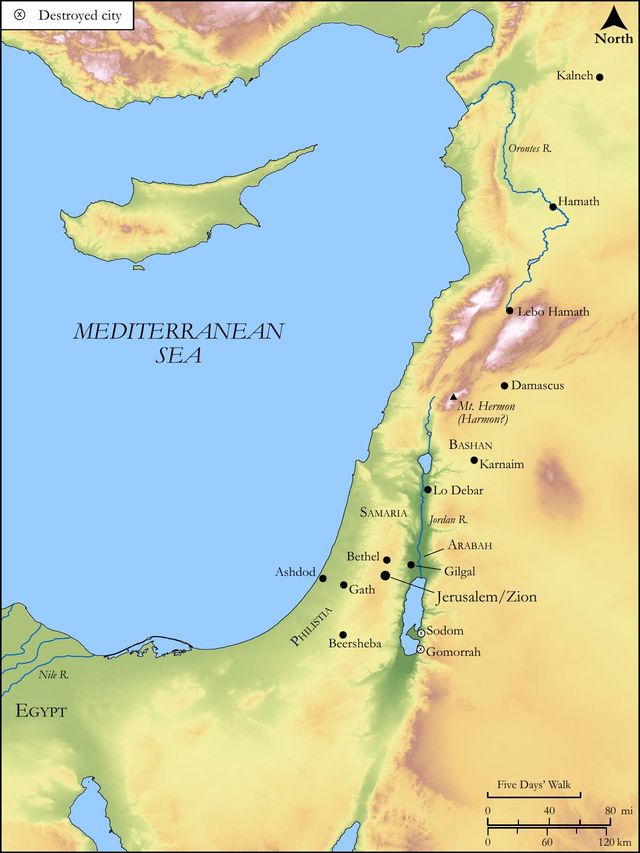
See on the biblical-era map
Study this verse
Public-domain commentary
Matthew Henry
From his Commentary on the Whole Bible. Henry comments on passages, not single verses — this entry covers Amos 4:1–5. His three-level outline is real structure in the source text, so it is rendered as structure.
It is here foretold, in the name of God, that oppressors shall be humbled and idolaters shall be hardened.
I.That proud oppressors shall be humbled for their oppressions:
for he that does wrong shall receive according to the wrong that he has done. Now observe,
1.How their sin is described, Amo 4:1. They are compared to the kine of Bashan, which were a breed of cattle very large and strong, especially if, though bred there, they were fed upon the mountain of Samaria, where the pastures were extraordinarily fat. Amos had been a herdsman, and he speaks in a dialect of his calling, comparing the rich and great men, that lived in luxury and wantonness, to the kine of Bashan, which were wanton and unruly, would not be kept within the bounds of their own pasture, But broke through the hedges, broke down all the fences, and trespassed upon the neighboring grounds; and not only so, but pushed and gored the smaller cattle that were not a match for them. Those that had their summer-houses upon the mountains of Samaria when they went thither for fresh air were as mischievous as the kine upon the mountains of Bashan and as injurious to those about them.
(1.)They oppress the poor and needy themselves; they crush them, to squeeze something to themselves out of them. They took advantage of their poverty, and necessity, and inability to help themselves, to make them poorer and more necessitous than they were. They made use of their power as judges and magistrates for the invading of men's rights and properties, the poor not excepted; for they made no conscience of robbing even the hospital.
(2.)They are in confederacy with those that do so. They say to their masters (to the masters of the poor, that abuse them and violently take from them what they have, when they ought to relieve them), "Bring, and let us drink; let us feast with you upon the gains of our oppression, and then we will protect you, and stand by you in it, and reject the appeals of the poor against you." Note, What is got by extortion is commonly made use of as provisions for the flesh, to fulfil the lusts thereof; and therefore men are tyrants to the poor because they are slaves to their appetites. Bring, and let us drink, is the language of those that crush the needy, as if the tears of the oppressed, mingled with their wine, made it drink the better. And by their associations for drinking and reveling, and an excess of riot, they strengthen their combinations for persecution and oppression, and harden the hearts of one another in it.
2.How their punishment is described, Amo 4:2, Amo 4:3. God will take them away with hooks, and their posterity with fish-hooks; he will send the Assyrian army upon them, that shall make a prey of them, shall not only enclose the body of the nation in their net, but shall angle for particular persons, and take them prisoners and captives as with hooks and fish-hooks, shall draw them out of their own land as fish are drawn out of the water, which is their element, them and their children with them, or, They in their day shall be drawn out by one victorious enemy, and their posterity in their day by another, so that by a succession of destroying judgments they shall at length be wholly extirpated. These kine of Bashan thought they could no more be drawn out with a hook and a cord than the Leviathan can, Job 41:1, Job 41:2. But God will make them know that he has a hook for their nose and a bridle for their jaws, Isa 37:29. The enemy shall take them away as easily as the fisherman takes away the little fish, and shall make it their sport and recreation. When the enemy has made himself master of Samaria, then,
(1.)Some shall attempt to escape by flight: You shall go out at the breaches made in the wall of the city, every cow at that which is before her, to shift for her own safety, and make the best of her way; and now the unruly kine of Bashan are tamed, and are themselves crushed, as they crushed the poor and needy. Note, Those to whom God has given a good pasture, if they are wanton in it, will justly be turned out of it; and those who will not be kept within the hedge of God's precept forfeit the benefit of the hedge of God's protection, and will be forced in vain to flee through the breaches they have themselves fearfully made in that hedge.
(2.)Others shall think to shelter themselves, or at least their best effects, in the palace, because it is a castle well fortified and a garrison well manned: You shall throw yourselves (so some read it), or throw them (that is, your posterity, your children, or whatever is dear to you), into the palace, where the enemy will find it ready to be seized. Note, What is got by oppression cannot long be enjoyed with satisfaction.
3.How their sentence to this punishment is ratified: The Lord God has sworn it by his holiness. He had often said it, and they regarded it not; they thought God and his prophets did but jest with them; therefore he swears it in his wrath, and what he has sworn he will not revoke. He swears by his holiness, that attribute of his which is so much his glory, and which is so much glorified in the punishment of wicked people; for, as sure as God is a holy God, those that plough iniquity and sow wickedness shall reap the same.
II.That obstinate idolaters shall be hardened in their idolatries (Amo 4:4, Amo 4:5):
Come to Bethel, and transgress. It is spoken ironically: "Do so; take your course; multiply your transgressions by multiplying your sacrifices, for this liketh you; but what will you do in the end hereof?" Here we see,
1.How intent they were upon the service of their idols, and how willing they were to be at cost upon them; they brought their sacrifices, and their tithes, and their free-will offerings, hoping that therein they should be accepted of God, but it was all an abomination to him. The profuseness of idolaters in the service of their false gods may shame our strait-handedness in the service of the true and living God.
2.How they mimicked God's institutions. They had their daily sacrifice at the altar of Bethel, as God had at his altar; they had their thank-offerings as God had, only they allowed leaven in them, which God had forbidden, because their priests did not like to have the bread to heavy and tasteless as it would be if it had not leaven in it, for something to ferment it. Holy bread would not serve them, unless it were pleasant bread.
3.How well pleased they were with these services themselves: This liketh you, O you children of Israel! So you love. What was their own invention they were fond of and wedded to, and thought it must be pleasing to God because it was agreeable to their own fancy.
4.How they upbraided with it: "Come to Bethel, to Gilgal; bring the sacrifices and tithes yourselves; proclaim and publish to the nation the free-offerings, pressing them to bring in abundance of such; go on in this way;" that is, (1.) "It is plain that you are resolved to do it, whatever God and conscience say to the contrary." (2.) "Your prophets shall let you alone in it, and not admonish you as they have done, for it is to no purpose. Let no man strive nor rebuke his neighbour." (3.) "Your foolish hearts shall be more and more darkened and besotted, and you shall be quite given up to these strong delusions, to believe a lie." (4.) "What will you get by it? Come to Bethel and multiply your sacrifices, and see what the better you will be, what returns you will have to your sacrifices, what stead they will stand you in in the day of distress. You shall be ashamed of Bethel your confidence," Jer 48:13. (5.) "Come, and transgress, come, and multiply your transgression, that you may fill up the measure of your iniquity and be ripened for ruin." Thus Christ said to Judas, What thou doest do quickly; and to the Jews, Fill you up the measure of your fathers, Mat 23:32.
Historical interpretation
Historical reception
1 surviving comment on this verse from the historical church.
(Chapter 4, Verse 1 onwards) Hear this word, you fat cows of Samaria, who oppress the poor, who crush the needy, who say to your husbands, 'Bring us something to drink!' The Lord God has sworn by his holiness: behold, days are coming upon you when they will take you away with hooks, even the last of you with fishhooks. And you will go out through breaches, each one straight ahead, and you will be cast out into Harmon, declares the Lord. LXX: Hear this word, you cows of Bashan ((Or Bashanites)), who are on the mountain of Samaria, who oppress the poor, and crush the needy, who say to your lords: 'Give us something to drink.' The Lord has sworn by his holiness, behold, days are coming upon you when they will take you away with hooks, even those with you in pots, you pestilent merchants, and you will be thrown naked one against another, and cast upon the mountain of Remmon, says the Lord. For the fat cattle, the Seventy interpreted it as Basan's; Aquila and Theodotio interpreted the Hebrew word Basan itself (); we followed the interpretation of Symmachus, who says, 'the well-nourished cows,' that is, fatted cows, we have interpreted as fat cattle. However, he speaks to the leaders of Israel and the best men of the ten tribes, who were occupied with pleasures and rapine, that they may hear the word of God, and know that they are not plowmen's oxen, but fat cattle of the herd, or those nourished in the pastures of Basan, which are the most fertile places for herbs: and by this he signifies that they are prepared not for agriculture, but for sacrifice and eating. You fat cows of Samaria are on the mountain, and you humble ones are crushed. And you say to your lords, that is, to the shepherds through whom we understand the kings, 'Give us, and we will drink,' that is, command and we will destroy everything. But from what he said, 'Give us, and we will drink,' and he did not say, 'Give us, and we will eat,' he signifies their drunkenness in wine and luxury, which overthrow the state of the mind. Therefore, the Lord God swore in His sanctuary, either in Himself, or in the Son, or in the Temple, or in every one who is holy and called the Temple of God, that the day is coming not far off and after many ages, but now imminent, the day of captivity and distress, in which the cows will be led with hooks, and the remains of them in boiling pots, for which it is also written in Hebrew and by Aquila, 'in the bowls of the fisherman.' Furthermore, those shields that are called Sannoth in Hebrew, Aquila interpreted as clypeos; Symmachus and the LXX [interpret as] weapons; only Theodotion [interprets as] dorata, which we have followed and interpreted as contos or hastas. However, this signifies that they are captured in battle, and are carried and taken away by the right of victory; still preserving the metaphor of cows that he had begun, so that just as he had said the cows were fat, he states that their flesh should be carried in contis velscutis. And just as a boiling pot wraps up small fish, so the cows of Basan are to be oppressed with no order of captivity. And what follows: And through the openings you will go out one against another, can be explained thus: The way of captivity is open to you, and when your pots are burned up, you will go out one against another, according to the Hebrew idiom, which for that which we mutually or reciprocally, woman and woman, that is, one against another, call. And he said, 'You will be cast into the places of Armenia, which are called Armona.' Finally, Symmachus interpreted it as follows: 'And you will be cast into Armenia, in place of which the Septuagint has the mountain of Remma, Aquila [has] the mountain of Armona, Theodotion [has] the mountain of Mona; but the fifth edition has translated it as the lofty mountain.' But the word of the Lord which commands the cows of Bashan to listen, according to the begun tropology, commands the heretics, who serve their belly and throat, and are rightly called very fat cows or disgraceful cows. For Basan, in fact, translates to 'shame,' which if we want to say means 'confusion,' we will interpret it more as Babylon than Basan. These fat cows, or rather dishonorable and dry ones, are located on the mountain of Samaria, which is also referred to in Hosea: Take away your calf, Samaria. And again in the same [book], Because your calf has led you astray, Samaria (Hos. VIII, 5, 6): and therefore on the mountain of Samaria, because they are always lifted up in pride and promise themselves lofty things. Samaria is also called a custodian, not because they guard the words of the Lord, but because they boast of being guardians of his precepts. They falsely accuse the needy and crush the poor. By the needy and poor, understand the ecclesiastical man who is content with the simplicity of truth and does not seek the wealth of heretical arguments or the brilliance of eloquence. These cows say to their masters: Bring us and let us drink. We can call their masters or leaders of perverse doctrines, Valentine, and Marcion, and Arius, and Eunomius, or those who support their wrongly invented teachings through multiple books. These Basanite cows say: Bring us, and let us drink. For if they do not give them, they do not have what they devour, indeed what they drink to become drunk. But in order that we may know that waters and cups signify doctrine, the Lord speaks to the Samaritan woman: Everyone who drinks from this water will thirst again; but whoever drinks from the water that I will give him will not thirst forever (John 4:13). Therefore, those who drink from the waters of the Samaritan, that is, of heretics, will always be thirsty and will not be able to refresh the heat of their dry throats, as Isaiah proclaims: As one dreams of drinking when thirsty, and when he arises, he is still thirsty, and his soul has hoped in vain; so will all the nations that fight against Jerusalem (Isaiah 29:8). For truly, he who drinks from the waters of heretics, and fights against the Church of God in Jerusalem, drinks in his dreams and his soul is deceived by empty images. And when he considers himself satisfied, then he will have the beginning of thirst. Hence it is said to the religious man: Drink the waters from your vessels, and let your own waters flow from the fountains of wells, and let them be for you alone (Prov. 5:15). And the Lord your God swears in his sanctuary against the fattened cows and the feasts that serve them, whether he swears by his saints, that the days of judgment and punishment will come upon them, to carry them in their arms, and to cast those who are with them into stewpots, or to carry them as well. And let those cows themselves be pestilent merchants, or let those who come to carry them be thrown out naked, seeing each other: let them be cast upon Mount Remman, says the Lord God. For we must say, according to the Septuagint, so that we do not seem to have proposed them in vain. When the day of judgment and vengeance comes against the heretics, then they will be taken away in arms, that is, with their weapons with which they fought against the Church; or, having been conquered by the armor of God and overcome by His warriors, they will be thrown into boiling pots to be burned and cooked, who were previously pestilent merchants; for they engaged in this trade in order to deliver those whom they had deceived to death. These are the ones of whom it is said: the sons of Heli, the sons of pestilence (1 Samuel II), who sat in the chair of pestilence (alternatively, pestilences). And when they have been sifted and burned, they will go out naked, having nothing of what they had previously presumed. And they will see their shame, and they will be cast upon the mountain of Remman, which is translated as sublimity, so that they may be crushed in their pride. Some interpret Remman as the sight of someone, that is, the vision of someone. For they could not see everything; but they promised themselves knowledge of a certain part, so that they might be projected into it, because they believed they knew it. We can, according to the letter, understand that when the days of captivity come upon the cows of Samaria, they will prevail over them in battle, and oppress them with their weapons, and in the encounter compel the defeated to go to fortified cities, which will be compared to boiling pots: just as Jerusalem, having its people shut in and besieged, is likened to a boiling pot full of meat; so the cities of Samaria will be compared to boiling pots, which will force the shut-in people to leave due to famine and plague, and to go into captivity seeing each other mutually, and be transferred to the mountains of Armenia, which are adjacent to Media and Persia.
Continue studying Amos 4:2 across the web’s major study libraries — every link below opens this exact verse, chapter, or book on the destination site.
Read & Compare
 BibleGatewayThis verse in more than 200 translations and 70 languages.
 Bible.comThe YouVersion reader — hundreds of translations, reading plans, and highlights.
 ESV.orgCrossway's official English Standard Version reader.
 NET BibleThe NET translation with 60,000+ translators' notes on every rendering decision.
 STEP BibleTyndale House's free study tool — original text, vocabulary, and scholarly resources.
 BibliaLogos Bible Software's free web reader.
 USCCBThe New American Bible (Revised Edition) with the U.S. bishops' study notes.
Commentaries
 BibleHub CommentariesDozens of classic commentaries on this verse, gathered on one page.
 StudyLightMore than 100 commentary sets — the largest collection on the web.
 BibleRefPlain-English commentary on what this verse means, verse by verse.
 Enduring WordDavid Guzik's free commentary on this chapter, widely used by Bible teachers.
 Bible Study ToolsVerse commentary alongside Greek and Hebrew study aids.
Original Language & Research
- BibleHub InterlinearThe verse word by word — original language, transliteration, and English.
- BibleHub LexiconEvery word's original-language definition and Strong's entry.
 Blue Letter BibleDeep-study tools — Strong's numbers, concordance, and word studies.
 SefariaThe Hebrew text with Rashi and centuries of Jewish commentary.
Sermons, Hymns & Audio


TrulyRandomVerse is not affiliated with these sites and doesn’t control their content. They’re linked because they’re genuinely useful.
Summary
Amos 4:2 delivers a severe prophetic warning from the Lord GOD to the people of Israel, particularly the affluent women of Samaria, announcing an inescapable and humiliating judgment. This verse, sworn by God's own unblemished holiness, declares that the Israelites will be forcibly taken into exile, likened to fish caught with hooks, emphasizing the certainty and brutality of their impending deportation by an invading power. It serves as a stark reminder of the divine consequences for persistent oppression, moral corruption, and spiritual apostasy.
Context
ShowHideLiterary Context
Amos 4:2 is part of a series of oracles of judgment delivered by the prophet Amos against the northern kingdom of Israel. This specific verse follows Amos's scathing rebuke of the "cows of Bashan" (Amos 4:1), a metaphor for the wealthy and oppressive women of Samaria who indulged in luxury at the expense of the poor and vulnerable. The preceding verses establish a pattern of Israel's spiritual deafness and moral blindness, despite God's repeated attempts to discipline them through famine, drought, blight, pestilence, and war (Amos 4:6-11). The judgment pronounced in Amos 4:2, therefore, is not an isolated threat but the culmination of God's patient yet ultimately firm response to a nation that refused to repent and return to Him. The imagery of hooks directly contrasts with the luxurious ease described in the opening verse of the chapter, highlighting a dramatic reversal of fortune.
Historical & Cultural Context
Amos prophesied during the reigns of Uzziah of Judah and Jeroboam II of Israel (circa 760-750 BC). This was a period of significant economic prosperity for Israel, particularly the northern kingdom, due to Jeroboam II's military successes and expansion of territory. However, this prosperity led to rampant oppression, with the wealthy exploiting the poor, widespread idolatry (especially the worship of Baal and calves at Bethel and Dan), and a general decay of covenant faithfulness. The imagery of "hooks" and "fishhooks" in Amos 4:2 would have been particularly chilling to the Israelites, as it directly alluded to the brutal deportation tactics employed by the rising Assyrian Empire. The Assyrians were notorious for leading captives away with ropes or hooks inserted through their noses or lips, treating them like animals destined for slaughter or enslavement. This prophecy foreshadows the eventual fall of Samaria and the exile of the northern kingdom by Assyria in 722 BC, a historical event that would fulfill Amos's dire warnings.
Key Themes
ShowHideAmos 4:2 powerfully contributes to several overarching themes within the book of Amos and the broader prophetic literature. Foremost is the theme of Divine Judgment for Injustice and Idolatry. God's holiness (mentioned explicitly in the verse) demands a response to sin, especially the pervasive oppression of the vulnerable and the abandonment of true worship for pagan practices. This verse underscores the Certainty and Inescapability of God's Word, as the Lord GOD swears by His own essence, making the prophecy an unchangeable decree. The imagery of hooks emphasizes the Humiliation and Helplessness of the Condemned, portraying Israel as utterly powerless before the divine judgment, much like fish caught in a net. This reflects the broader prophetic message that true security lies not in military might or economic prosperity, but in covenant fidelity and seeking justice (as called for in Amos 5:24). The verse also highlights the Sovereignty of God over Nations, demonstrating His control even over the actions of foreign empires like Assyria, whom He uses as instruments of His righteous judgment, a theme echoed in other prophetic books like Isaiah 10:5-6.
Exposition and Analysis
ShowHideKey Word Analysis
ShowHideThis term (H3069), a variation of YHWH (the personal name of God), is specifically used after "Adonai" (H136) to avoid repeating the same sound, as Jews would pronounce YHWH as Adonai. Its presence here, coupled with "Adonai," emphasizes the absolute sovereignty, covenant authority, and personal involvement of the one true God in delivering this solemn oath and its accompanying judgment.
From a root meaning "to be complete" or "to seven oneself" (H7650), this verb signifies making a solemn oath or vow, often by invoking a divine name or attribute. When God "swears by his holiness," it denotes an unchangeable, immutable decree, binding Himself by His very nature. This makes the fulfillment of the prophecy absolutely certain and irreversible, underscoring the gravity of the impending judgment.
This word (H6944) denotes separateness, purity, and sacredness. When God swears by His "holiness," it means He is binding Himself by His perfect, unblemished character, which cannot tolerate unrighteousness or injustice. His very essence compels Him to act against sin, making His judgment a righteous and necessary response to Israel's profound moral and spiritual corruption.
Verse Breakdown
ShowHide"The Lord GOD hath sworn by his holiness"
This opening clause establishes the divine authority and unwavering certainty of the prophecy. The combination of "Lord" (Adonai) and "GOD" (YHWH, here Yᵉhôvih) emphasizes God's sovereign power and covenant faithfulness. The act of swearing "by his holiness" signifies that the decree is rooted in God's intrinsic nature—His perfect purity, moral rectitude, and absolute separation from sin. This makes the coming judgment not an arbitrary act, but a necessary expression of His righteous character.
"that, lo, the days shall come upon you"
This phrase serves as a solemn declaration of inevitability. "Lo" (behold) draws immediate attention to the impending reality. "The days shall come upon you" indicates a definite future event, a specific period of time when the judgment will be executed. It highlights that the prophecy is not a mere warning that can be averted by superficial repentance, but a fixed decree due to the depth of Israel's unfaithfulness.
"that he will take you away with hooks, and your posterity with fishhooks"
This vivid and brutal imagery describes the manner of the impending judgment. The "hooks" (Hebrew: tsinnâh, H6793, a hook or large shield, here likely a hook) and "fishhooks" (Hebrew: dûgâh, H1729, a fishing hook, and çîyr, H5518, a pot, also by implication a hook) symbolize a merciless and humiliating capture. The people of Israel, including their descendants ("posterity"), will be led away like helpless fish or animals, stripped of their dignity and freedom. This directly foreshadows the Assyrian deportation tactics, where captives were often led by hooks through their noses or lips, signifying their absolute subjugation and the complete loss of their national identity and land.
Literary Devices
ShowHideAmos 4:2 employs several powerful literary devices to convey its message of impending judgment. The most prominent is Metaphor, where the people of Israel are implicitly compared to fish or animals being caught and led away. The "hooks" and "fishhooks" are not literal fishing implements for humans, but metaphorical tools of capture and subjugation, vividly illustrating the helpless and undignified manner of their forced exile. This Imagery is highly visceral and evokes a sense of dread and humiliation, contrasting sharply with the luxurious lifestyle condemned in the preceding verse. The phrase "The Lord GOD hath sworn by his holiness" is an example of Anthropomorphism, attributing a human action (swearing an oath) to God, but it serves to emphasize the absolute certainty and unchangeable nature of the divine decree. The Repetition of the concept of "hooks" ("hooks" and "fishhooks") further reinforces the inescapable nature of the judgment and the complete capture that awaits both the current generation and their descendants. The entire verse functions as a Prophetic Oracle, a divine pronouncement of future events, delivered with solemn authority and unmistakable clarity.
Theological and Thematic Connections
ShowHideAmos 4:2 profoundly underscores the unwavering justice of God, a central tenet of biblical theology. By swearing by His holiness, God affirms that His character is the very foundation of His judgments; He cannot tolerate sin indefinitely without compromising His own nature. This verse reveals that divine judgment is not arbitrary but a righteous response to a nation's persistent rebellion, oppression, and idolatry. It serves as a stark reminder that covenant blessings are conditional upon obedience, and severe consequences await those who continually spurn God's grace and warnings. The humiliation depicted by the "hooks" highlights the reversal of fortune for a proud and prosperous nation, demonstrating God's sovereignty over all human affairs and His ability to use even pagan empires as instruments of His will.
Reflection and Application
ShowHideAmos 4:2, while a prophecy of ancient judgment, carries profound and timeless implications for believers today. It compels us to confront the unchanging nature of God's holiness and justice. Just as God could not overlook the pervasive injustice and idolatry of Israel, He does not overlook sin in our lives or in society today. This verse serves as a powerful call to humility and self-examination, reminding us that prosperity can often mask spiritual decay and lead to a false sense of security. The image of being taken away with hooks underscores the helplessness of humanity before divine judgment, urging us to recognize our dependence on God's mercy rather than our own strength or perceived righteousness. Ultimately, it motivates us to live lives that reflect God's justice and righteousness, actively pursuing compassion for the lowly and turning away from anything that compromises our devotion to Him. It is a sobering reminder that accountability is an inescapable reality for all.
Questions for Reflection
ShowHideFAQ
ShowHideWhat is the significance of "The Lord GOD hath sworn by his holiness" in Amos 4:2?
ShowHideThis phrase is profoundly significant because it underscores the absolute certainty and immutability of the prophecy. When God swears by His "holiness" (Hebrew: qôdesh), He is binding Himself by His very nature—His perfect purity, moral integrity, and absolute separation from sin. This means the judgment pronounced is not a conditional threat that might be averted, but an unchangeable decree rooted in God's essential character. It signifies that God's justice is not arbitrary but flows directly from who He is, making the fulfillment of the prophecy inevitable due to Israel's persistent unrighteousness. It is a divine oath, the highest form of assurance, leaving no doubt about the coming judgment.
What do the "hooks" and "fishhooks" symbolize in this verse?
ShowHideThe "hooks" and "fishhooks" in Amos 4:2 are powerful and grim symbols of the brutal and humiliating manner in which the people of Israel, including their "posterity," would be taken into exile. This imagery directly alludes to the cruel deportation tactics of the Assyrian Empire, who were known to lead captives away with ropes or hooks inserted through their noses or lips, much like animals or fish being caught. The symbolism emphasizes the complete helplessness, lack of control, and utter degradation that the Israelites would experience. Their capture would be inescapable, undignified, and thorough, signifying the complete reversal of their prosperous and secure lives. It highlights their vulnerability before the overwhelming power of the invading force, which God would use as an instrument of His judgment, as seen in passages like 2 Kings 17:6.
Christ-Centered Fulfillment
ShowHideWhile Amos 4:2 pronounces a severe judgment upon ancient Israel, its underlying theological principles find their ultimate fulfillment and transformation in Christ. The holiness of God, by which He swears, is perfectly revealed in Jesus Christ, who is the radiance of God's glory and the exact imprint of His nature. The judgment for sin, so certain and inescapable in Amos, is fully borne by Christ on the cross. Humanity, caught in the "hooks" of sin and death, finds liberation not through escape from judgment, but through the substitutionary sacrifice of the Lamb of God, who takes away the sin of the world. The humiliation and suffering depicted for Israel foreshadow the ultimate humiliation of Christ, who was led away like a lamb to the slaughter, bearing the full weight of divine wrath so that those who believe might be set free from the hooks of condemnation. In Christ, God's holiness is satisfied, His justice is upheld, and His mercy is extended, offering a new covenant where the "days shall come" not for judgment, but for redemption and eternal life for all who are found in Him.