


Exodus 14:4
Bible text: King James Version (1769 Blayney text) · Public domain
Bible text: King James Version with Strong's numbers · Public domain
Bible text: Berean Standard Bible · Public domain
Bible text: American Standard Version (1901) · Public domain
Bible text: World English Bible, Messianic edition · Public domain
Bible text: Geneva Bible (1599) · Public domain
Bible text: Young's Literal Translation · Public domain
- וְחִזַּקְתִּיve·chi·zak·Tiand I will make strongH2388Conj-w ¦ V-Piel-ConsecPerf-1csVerb Piel Consecutive Perfect 1st Singular common genderוְandחִזַּקְתִּיI will make strong
- אֶת'et<obj.>H853DirObjMParticle Object Indicator
- לֵבlev[the] heart ofH3820N-mscNoun Singular Masculine Construct
- פַּרְעֹהpar·'OhPharaohH6547N-msNoun Title Singular Masculine Absolute
- וְרָדַףve·ra·Dafand he will pursueH7291Conj-w ¦ V-Qal-ConsecPerf-3msVerb Qal Consecutive Perfect 3rd Singular Masculineוְandרָדַףhe will pursue
- אַחֲרֵיהֶם'a·cha·rei·Hemafter themH310Adj-mpc ¦ 3mpAdjective Numerical Plural Masculine Constructאַחֲרֵיafterהֶםthem
- וְאִכָּבְדָהve·'i·ka·ve·Dahand I will gain honorH3513Conj-w ¦ V-Niphal-Imperf-1csVerb Niphal Imperfect 1st Singular common genderוְandאִכָּבְדָהI will gain honor
- בְּפַרְעֹהbe·far·'Ohby PharaohH6547Prep-b ¦ N-msNoun Title Singular Masculine AbsoluteבְּbyפַרְעֹהPharaoh
- וּבְכָלu·ve·Kholand by allH3605Conj-w ¦ Prep-b ¦ N-mscNoun Singular Masculine Constructוּandבְbyכָלall
- חֵילוֹchei·Lohis armyH2428N-msc ¦ 3msNoun Singular Masculine Constructחֵילarmyוֹhis
- וְיָדְעוּve·ya·de·'Uand they will knowH3045Conj-w ¦ V-Qal-ConsecPerf-3cpVerb Qal Consecutive Perfect 3rd Plural common genderוְandיָדְעוּthey will know
- מִצְרַיִםmitz·Ra·yimEgyptH4713N-properNoun Proper Location
- כִּיkithatH3588PrtParticle Conditional
- אֲנִי'a·NiIH589Pro-1csPronoun Personal 1st Singular common gender
- יְהוָהYah·weh[am] YahwehH3068N-properNoun Proper Title
- וַיַּעֲשׂוּvai·ya·'a·suand they didH6213Conj-w ¦ V-Qal-ConsecImperf-3mpVerb Qal Consecutive Imperfect 3rd Plural Masculineוַandיַּעֲשׂוּthey did
- כֵןKhensoH3651AdvAdverb
English is a literal word-by-word gloss of the Hebrew, not the KJV's wording. Why?
This is the original text the KJV's translators worked from — each Hebrew word with its own literal English meaning in this verse, prepared by scholars at Tyndale House, Cambridge. The KJV translates whole sentences, not word by word, so its wording differs: one Hebrew word can become several English words, and the KJV may choose “the LORD” where the gloss reads “Yahweh”. Both are faithful — they answer different questions. For the KJV's own rendering, switch to the KJV text.
Details
See on the biblical-era maps

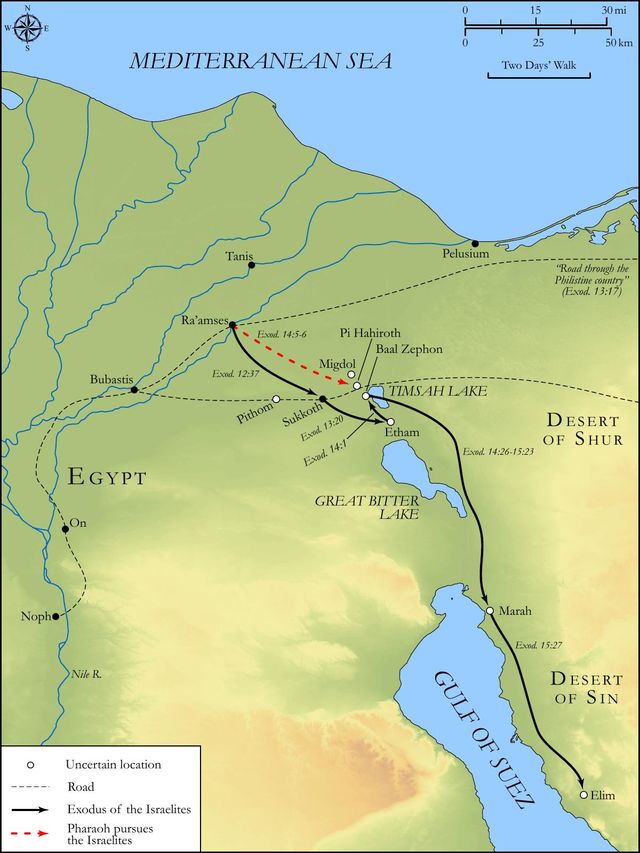
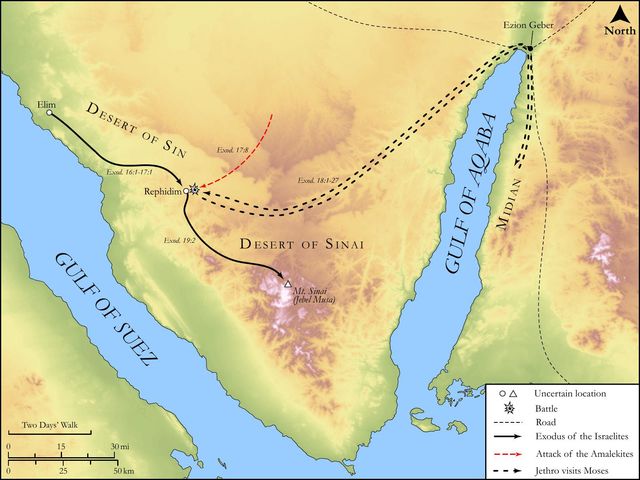
Study this verse
Public-domain commentary
Matthew Henry
From his Commentary on the Whole Bible. Henry comments on passages, not single verses — this entry covers Exodus 14:1–9. His four-level outline is real structure in the source text, so it is rendered as structure.
We have here,
I.Instructions given to Moses concerning Israel's motions and encampments, which were so very surprising that if Moses had not express orders about them before they would scarcely have been persuaded to follow the pillar of cloud and fire. That therefore there might be no scruple nor dissatisfaction about it, Moses is told before,
1.Whither they must go, Exo 14:1, Exo 14:2. They had got to the edge of the wilderness (Exo 13:20), and a stage or two more would have brought them to Horeb, the place appointed for their serving God; but, instead of going forward, they are ordered to turn short off, on the right hand from Canaan, and to march towards the Red Sea. Where they were, at Etham, there was no sea in their way to obstruct their passage: but God himself orders them into straits, which might give them an assurance that when his purposes were served he would without fail bring them out of those straits. Note, God sometimes raises difficulties in the way of the salvation of his people, that he may have the glory of subduing them, and helping his people over them.
2.What God designed in these strange orders. Moses would have yielded an implicit obedience, though God had given him no reason; but shall he hide from Moses the thing that he does? No, Moses shall know,
(1.)That Pharaoh has a design to ruin Israel, Exo 14:3.
(2.)That therefore God has a design to ruin Pharaoh, and he takes this way to effect it, Exo 14:4. Pharaoh's sagacity would conclude that Israel was entangled in the wilderness and so would become an easy prey to him; and, that he might be the more apt to think so, God orders them into yet greater entanglements; also, by turning them so much out of their road, he amazes him yet more, and gives him further occasion to suppose that they were in a state of embarrassment and danger. And thus (says God) I will be honoured upon Pharaoh. Note,
[1.]All men being made for the honour of their Maker, those whom he is not honoured by he will be honoured upon.
[2.]What seems to tend to the church's ruin is often overruled to the ruin of the church's enemies, whose pride and malice are fed by Providence, that they may be ripened for destruction.
II.Pharaoh's pursuit of Israel, in which, while he gratifies his own malice and revenge, he is furthering the accomplishment of God's counsels concerning him. It was told him that the people fled, Exo 14:5. Such a fright was he in, when he gave them leave to go, that when the fright was a little over he either forgot, or would not own, that they departed with his consent, and therefore was willing that it should be represented to him as a revolt from their allegiance. Thus what may easily be justified is easily condemned, by putting false colours upon it. Now, hereupon,
1.He reflects upon it with regret that he had connived at their departure. He and his servants, though it was with the greatest reason in the world that they had let Israel go, yet were now angry with themselves for it: Why have we done thus?
(1.)It vexed them that Israel had their liberty, that they had lost the profit of their labours, and the pleasure of chastising them. It is meat and drink to proud persecutors to trample upon the saints of the Most High, and say to their souls, Bow down, that we may go over; and therefore it vexes them to have their hands tied. Note, The liberty of God's people is a heavy grievance to their enemies, Est 5:12, Est 5:13; Act 5:17, Act 5:33.
(2.)It aggravated the vexation that they themselves had consented to it, thinking now that they might have hindered it, and that they needed not to have yielded, though they had stood it out to the last extremity. Thus God makes men's envy and rage against his people a torment to themselves, Psa 112:10. It was well done to let Israel go, and what they would have reflected on with comfort if they had done it from an honest principle; but doing it by constraint, they called themselves a thousand fools for doing it, and passionately wished it undone again. Note, It is very common, but very absurd and criminal, for people to repent of their good deeds; their justice and charity, and even their repentance, are repented of. See an instance somewhat like this, Jer 34:10, Jer 34:11.
2.He resolves, if possible, either to reduce them or to be revenged on them; in order to this, he levies an army, musters all his force of chariots and horsemen, Exo 14:17, Exo 14:18 (for, it should seem, he took no foot with him, because the king's business required haste), and thus he doubts not but he shall re-enslave them, Exo 14:6, Exo 14:7. It is easy to imagine what a rage Pharaoh was now in, roaring like a lion disappointed of his prey, how his proud heart aggravated the affront, swelled with indignation, scorned to be baffled, longed to be revenged: and now all the plagues are as if they had never been. He has quite forgotten the sorrowful funerals of his firstborn, and can think of nothing but making Israel feel his resentments; now he thinks he can be too hard for God himself; for, otherwise, could he have hoped to conquer a people so dear to him? God gave him up to these passions of his own heart, and so hardened it. It is said (Exo 14:8), The children of Israel went out with a high hand, that is, with a great deal of courage and bravery, triumphing in their release, and resolved to break through the difficulties that lay in their way. But the Egyptians (Exo 14:9) pursued after them. Note, Those that in good earnest set their faces heaven-ward, and will live godly in Christ Jesus, must expect to be set upon by Satan's temptations and terrors. He will not tamely part with any out of his service, nor go out without raging, Mar 9:26.
Continue studying Exodus 14:4 across the web’s major study libraries — every link below opens this exact verse, chapter, or book on the destination site.
Read & Compare
 BibleGatewayThis verse in more than 200 translations and 70 languages.
 Bible.comThe YouVersion reader — hundreds of translations, reading plans, and highlights.
 ESV.orgCrossway's official English Standard Version reader.
 NET BibleThe NET translation with 60,000+ translators' notes on every rendering decision.
 STEP BibleTyndale House's free study tool — original text, vocabulary, and scholarly resources.
 BibliaLogos Bible Software's free web reader.
 USCCBThe New American Bible (Revised Edition) with the U.S. bishops' study notes.
Commentaries
 BibleHub CommentariesDozens of classic commentaries on this verse, gathered on one page.
 StudyLightMore than 100 commentary sets — the largest collection on the web.
 BibleRefPlain-English commentary on what this verse means, verse by verse.
 Enduring WordDavid Guzik's free commentary on this chapter, widely used by Bible teachers.
 Bible Study ToolsVerse commentary alongside Greek and Hebrew study aids.
Original Language & Research
- BibleHub InterlinearThe verse word by word — original language, transliteration, and English.
- BibleHub LexiconEvery word's original-language definition and Strong's entry.
 Blue Letter BibleDeep-study tools — Strong's numbers, concordance, and word studies.
 SefariaThe Hebrew text with Rashi and centuries of Jewish commentary.
Sermons, Hymns & Audio


TrulyRandomVerse is not affiliated with these sites and doesn’t control their content. They’re linked because they’re genuinely useful.
Summary
Exodus 14:4 unveils God's explicit and sovereign intention to strengthen Pharaoh's resolve, orchestrating a final, decisive confrontation. This divine act is not arbitrary but a strategic move designed to lure Pharaoh into pursuit, thereby setting the stage for God's ultimate purpose: to display His absolute sovereignty and unparalleled glory over the most powerful earthly ruler and his formidable army. Through this climactic event, both Egyptians and Israelites would experientially "know" Yahweh as the one true and supreme LORD.
Context
ShowHideLiterary Context
This verse serves as a crucial divine declaration, immediately following Israel's initial departure from Egypt after the tenth plague and Pharaoh's reluctant release of them, detailed in Exodus 12, Exodus 13. It provides the divine rationale for Pharaoh's subsequent, seemingly irrational decision to pursue the Israelites, thus setting the stage for the dramatic parting of the Red Sea and the subsequent destruction of the Egyptian army. The preceding chapters meticulously chronicle the ten plagues, a series of escalating divine judgments that progressively revealed God's power and Pharaoh's increasing obstinacy, often noting both Pharaoh hardening his own heart (e.g., Exodus 8:15) and God hardening it (e.g., Exodus 7:3), demonstrating a complex interplay of human will and divine sovereignty.
Historical & Cultural Context
In Hebrew thought, the "heart" (לֵבָב, levav) of a king was understood as the seat of his intellect, will, and emotions—the very core of his being and the source of his decisions and intentions. Pharaoh, in particular, was revered as a divine king, a living god, and the embodiment of Egypt's power and stability. The plagues were not merely natural disasters but a profound collision of kingdoms between Yahweh, the God of Israel, and the pantheon of Egyptian gods, personified by Pharaoh himself. God's hardening of Pharaoh's heart, therefore, was a direct and audacious challenge to Pharaoh's perceived divine authority and an unequivocal assertion of Yahweh's supreme control over all human and spiritual powers. It ensured that the final, miraculous deliverance of Israel would be undeniably God's doing, leaving no ambiguity regarding His identity and unparalleled power.
Key Themes
ShowHideExodus 14:4 contributes significantly to several major theological and narrative themes woven throughout the book of Exodus. Foremost among these is the theme of Divine Sovereignty, demonstrating God's absolute control over all creation, including human rulers and their wills, to accomplish His purposes. It also underscores the theme of God's Glory and Self-Revelation, as the entire episode is framed as a means for God to make His name known and His power evident, not only to Israel but also to the Egyptians and surrounding nations. This ties into the broader theme of Judgment and Deliverance, where God's righteous judgment upon the oppressors (Egypt) is inextricably linked to the miraculous deliverance of His chosen people (Israel), a pattern seen throughout the biblical narrative, from the flood in Genesis to the eschatological judgments in Revelation.
Exposition and Analysis
ShowHideThe KJV text of Exodus 14:4 states: "And I will harden Pharaoh's heart, that he shall follow after them; and I will be honoured upon Pharaoh, and upon all his host; that the Egyptians may know that I [am] the LORD. And they did so."
Key Word Analysis
ShowHideWhile often translated "harden" in this context, the Hebrew root H2388 (châzaq) primarily means "to fasten upon," "to seize," "to be strong," or "to strengthen." In the context of Pharaoh's heart, it implies God strengthening or making firm Pharaoh's existing inclination toward resistance, defiance, and obstinacy, rather than coercing him against his inherent will. God did not implant evil in Pharaoh but empowered Pharaoh's own stubbornness to persist for a divine purpose. This strengthening allowed Pharaoh to fully manifest his rebellion, thereby providing the perfect stage for God's power to be displayed.
The Hebrew word H3513 (kâbad) carries the primary sense of "to be heavy," which extends to concepts of "weight," "glory," "honor," "significance," or "dignity." When God declares He will be "honoured," it means He will reveal His inherent glory, majesty, and supreme authority in a weighty and undeniable manner. It speaks to God's reputation and intrinsic worth being demonstrated and acknowledged by all, particularly through the overwhelming display of His power in both judgment and salvation.
The term H2428 (chayil) refers to "a force," encompassing "men, means or other resources." It denotes an "army," "wealth," "virtue," "valor," or "strength." In this verse, "all his host" specifically refers to Pharaoh's formidable military power—his chariots, cavalry, and soldiers—representing the pinnacle of ancient military might. God's intention to be honored "upon all his host" signifies that His glory will be demonstrated through the decisive defeat and destruction of Egypt's entire military strength, proving His supremacy over all earthly powers.
The Hebrew root H3045 (yâdaʻ) signifies "to know," but not merely intellectual apprehension. It implies a deep, experiential, and relational knowledge gained through observation, encounter, and direct experience of God's mighty acts. When the Egyptians "know" that God is the LORD, it means they will be forced to acknowledge His unique identity, power, and sovereignty through undeniable evidence, regardless of whether that knowledge leads to worship or fear.
The Hebrew term H3068 (Yᵉhôvâh) is the covenant name of God, often transliterated as Yahweh (YHWH). It signifies His self-existent, eternal, and faithful nature. The phrase "I am the LORD" is a recurring self-revelation formula throughout Exodus and the Old Testament, emphasizing His unique identity as the singular, sovereign God who fulfills His promises and executes His will.
Verse Breakdown
ShowHide"And I will harden Pharaoh's heart, that he shall follow after them;"
This clause establishes God's proactive and sovereign initiative in the unfolding drama. God is not simply reacting to Pharaoh's choices; He is intentionally shaping events by strengthening Pharaoh's existing stubbornness. Pharaoh's subsequent pursuit of Israel is thus presented not as an independent decision but as a direct consequence of God's divine enablement, serving God's larger, predetermined plan.
"and I will be honoured upon Pharaoh, and upon all his host;"
This clause reveals the specific means by which God's glory will be demonstrated. The judgment and ultimate destruction of Pharaoh, the divine king, and his elite military "host" will serve as a dramatic and public stage for God's power, majesty, and supreme authority to be revealed. The decisive defeat of what was arguably the world's most formidable military power at that time underscores the absolute supremacy of Yahweh over all earthly might.
"that the Egyptians may know that I [am] the LORD."
This clause states the ultimate purpose and desired outcome of the entire episode. The plagues and the climactic Red Sea event were not solely about Israel's deliverance but fundamentally about God's self-revelation to the nations, particularly Egypt. Through these undeniable acts of power and judgment, the Egyptians (and by extension, all peoples) would be compelled to acknowledge the unique, sovereign identity of Yahweh, the God of Israel. This "knowing" is an experiential recognition of His unparalleled existence and power.
"And they did so."
This concise, declarative statement confirms the immediate and certain execution of God's divine decree. It signifies the effectiveness of God's word and the unfailing accomplishment of His will. This refers to Pharaoh's subsequent action of pursuing Israel, thereby setting in motion the final act of God's plan for His glory and Israel's deliverance.
Literary Devices
ShowHideExodus 14:4 employs several potent literary devices. The verse is structured with clear causal language ("that he shall follow," "that the Egyptians may know"), which emphatically highlights God's intentionality and the divine purpose behind His actions. There is a profound sense of dramatic irony at play: Pharaoh, in his divinely strengthened defiance, unwittingly becomes the primary instrument for God's greater glory, leading himself and his entire army directly to their destruction. This irony underscores God's ultimate control over even the most resistant human wills. Furthermore, the parallelism between God being "honoured upon Pharaoh, and upon all his host" and the Egyptians being forced to "know that I am the LORD" emphasizes the direct and undeniable link between divine judgment and divine revelation, where God's power in judgment serves as the means of His self-disclosure.
Theological and Thematic Connections
ShowHideExodus 14:4 powerfully articulates several core theological truths that resonate throughout biblical theology. It unequivocally asserts God's Divine Sovereignty, demonstrating that His absolute control extends even over the hearts and actions of defiant rulers and wicked intentions. He orchestrates events, even human resistance and evil, to fulfill His righteous purposes, proving that no human will or power can ultimately thwart His grand design. Secondly, the verse highlights that God's Glory is His Ultimate Aim. The primary objective of God's actions in history is the magnification of His own name and the display of His supreme authority and intrinsic worth. His glory is not a mere byproduct but the central reason for His interventions. Lastly, it underscores God's commitment to Self-Revelation. Through these mighty acts of judgment and deliverance, God reveals His unique identity as Yahweh—the self-existent, faithful, and sovereign Lord—to both His covenant people Israel and the surrounding nations. This "knowing" is experiential and undeniable, forcing even His enemies to acknowledge His unparalleled existence.
This verse connects to the broader biblical narrative of God's ongoing work of salvation and judgment. It foreshadows how God continually uses human opposition and even evil for His righteous ends, a profound theme seen throughout Scripture. The "knowing" of God through His mighty deeds is a recurring motif, emphasizing that true knowledge of God comes from observing His character revealed in action.
Reflection and Application
ShowHideExodus 14:4 offers profound assurance that God remains absolutely sovereign, even over the most defiant hearts, seemingly insurmountable obstacles, and the darkest human intentions. For believers, this truth provides immense comfort and stability, reminding us that God has a grand, overarching purpose even amidst trials, opposition, and apparent setbacks. He is able to orchestrate events, sometimes through the very resistance of His enemies, to ultimately bring about His glory and reveal His character. This encourages unwavering trust in His ultimate plan and His ability to deliver, even when circumstances seem dire or opponents appear invincible. It reminds us that our personal challenges and the broader struggles of the world are not outside of God's control, but can actually be part of His intricate design to reveal His power, faithfulness, and the supremacy of His name. This verse calls us to look beyond immediate circumstances and fix our gaze on the God who is always at work, accomplishing His will for His glory.
Questions for Reflection
ShowHideFAQ
ShowHideDoes God force people to sin by hardening their hearts?
ShowHideThe biblical concept of "hardening" is complex, involving both divine action and human responsibility. In Exodus, Pharaoh is explicitly stated to harden his own heart multiple times (Exodus 8:15, Exodus 8:32, Exodus 9:34). God's hardening, particularly with the Hebrew chazaq (H2388), often means strengthening or firming up an existing inclination or resolve. God did not implant evil or sin in Pharaoh; rather, He allowed Pharaoh's inherent stubbornness, pride, and defiance to persist and even intensified it for His divine purposes. This allowed Pharaoh to fully express his rebellion, thereby providing the perfect stage for God to display His overwhelming power and justice. It's a profound demonstration of God's sovereign control over human choices without negating human culpability or responsibility for their actions.
Why would God want the Egyptians to "know" Him through judgment and destruction?
ShowHideThe "knowing" (יָדַע, yâdaʻ, H3045) in this context is not necessarily a salvific knowledge leading to personal redemption, but an undeniable, experiential recognition of God's unique power, identity, and supremacy. Among the nations, a god's power and authority were reckoned by their actions, particularly in battle, over nature, and in their ability to deliver their people. By decisively defeating Pharaoh and his army, and demonstrating absolute control over creation through the plagues and the Red Sea, Yahweh proved Himself to be superior to all Egyptian gods and the only true God. This dramatic display served as a powerful testimony, forcing even His enemies to acknowledge His existence and supreme authority. It was a revelation of His glory that served both to vindicate His people and to establish His name among the nations, even if that knowledge led to fear and awe rather than worship for some.
Christ-Centered Fulfillment
ShowHideThe narrative of God hardening Pharaoh's heart and triumphing over him finds profound Christ-centered fulfillment in several ways. Just as God used Pharaoh's defiant heart to display His glory and deliver His people from physical bondage, so too did God sovereignly use the hardened hearts and evil intentions of humanity to bring about the ultimate deliverance through Jesus Christ. The crucifixion of Jesus, a supreme act of human rebellion and injustice, was simultaneously God's predetermined plan to achieve salvation for humanity (Acts 2:23). Jesus is the ultimate deliverer, leading a new and greater exodus from the bondage of sin and death, a "departure" (Greek: exodos) He discussed with Moses and Elijah on the Mount of Transfiguration (Luke 9:30-31). Where Pharaoh was defeated by God's mighty hand, Christ definitively triumphed over the spiritual "Pharaohs"—Satan, sin, and death—through His own death and resurrection, disarming and leading them captive (Colossians 2:15). The supreme revelation of God's glory and identity is not merely in the judgment of an earthly king, but in the self-giving love of God demonstrated on the cross, where God's power is made perfect in weakness (2 Corinthians 12:9). Through Christ, the world truly "knows that I am the LORD," not just as a God of overwhelming power and judgment, but as a God of redemptive love, offering reconciliation and new life to all who believe and call upon His name.