


Exodus 14:5
Bible text: King James Version (1769 Blayney text) · Public domain
Bible text: King James Version with Strong's numbers · Public domain
Bible text: Berean Standard Bible · Public domain
Bible text: American Standard Version (1901) · Public domain
Bible text: World English Bible, Messianic edition · Public domain
Bible text: Geneva Bible (1599) · Public domain
Bible text: Young's Literal Translation · Public domain
- וַיֻּגַּדvai·yu·Gadand it was toldH5046Conj-w ¦ V-Hophal-ConsecImperf-3msVerb Hophal Consecutive Imperfect 3rd Singular Masculineוַandיֻּגַּדit was told
- לְמֶלֶךְle·Me·lekhto [the] king ofH4428Prep-l ¦ N-mscNoun Singular Masculine Constructלְtoמֶלֶךְ[the] king of
- מִצְרַיִםmitz·Ra·yimEgyptH4714N-properNoun Proper Location
- כִּיkithatH3588PrtParticle Conditional
- בָרַחva·Rachit had fledH1272V-Qal-Perf-3msVerb Qal Perfect 3rd Singular Masculine
- הָעָםha·'Amthe peopleH5971Art ¦ N-msNoun Singular Masculine Absoluteהָtheעָםpeople
- וַיֵּהָפֵךְVai·ye·ha·fekhand it was changedH2015Conj-w ¦ V-Niphal-ConsecImperf-3msVerb Niphal Consecutive Imperfect 3rd Singular Masculineוַandיֵּהָפֵךְit was changed
- לְבַבle·Vav[the] heart ofH3824N-mscNoun Singular Masculine Construct
- פַּרְעֹהpar·'OhPharaohH6547N-msNoun Title Singular Masculine Absolute
- וַעֲבָדָיוva·'a·va·Davand his servantsH5650Conj-w ¦ N-mpc ¦ 3msNoun Plural Masculine Constructוַandעֲבָדָיservantsוhis
- אֶל'eltoH413PrepPreposition
- הָעָםha·'Amthe peopleH5971Art ¦ N-msNoun Singular Masculine Absoluteהָtheעָםpeople
- וַיֹּאמרוּvai·yo·m·Ruand they saidH559Conj-w ¦ V-Qal-ConsecImperf-3mpVerb Qal Consecutive Imperfect 3rd Plural Masculineוַandיֹּאמרוּthey said
- מַהmahwhat?H4100InterrogPronoun Interrogative
- זֹּאתzotthisH2063PrtParticle Demonstrative
- עָשִׂינוּ'a·Si·nuhave we doneH6213V-Qal-Perf-1cpVerb Qal Perfect 1st Plural common gender
- כִּיkithatH3588PrtParticle Conditional
- שִׁלַּחְנוּshi·Lach·nuwe have let goH7971V-Piel-Perf-1cpVerb Piel Perfect 1st Plural common gender
- אֶת'et<obj.>H853DirObjMParticle Object Indicator
- יִשְׂרָאֵלYis·ra·'ElIsraelH3478N-properNoun Proper Location
- מֵעָבְדֵנוּme·'a·ve·De·nufrom serving usH5647Prep-m ¦ V-Qal-Inf ¦ 1cpVerb Qal Infinitive Constructמֵfromעָבְדֵservingנוּus
English is a literal word-by-word gloss of the Hebrew, not the KJV's wording. Why?
This is the original text the KJV's translators worked from — each Hebrew word with its own literal English meaning in this verse, prepared by scholars at Tyndale House, Cambridge. The KJV translates whole sentences, not word by word, so its wording differs: one Hebrew word can become several English words, and the KJV may choose “the LORD” where the gloss reads “Yahweh”. Both are faithful — they answer different questions. For the KJV's own rendering, switch to the KJV text.
Details
See on the biblical-era maps

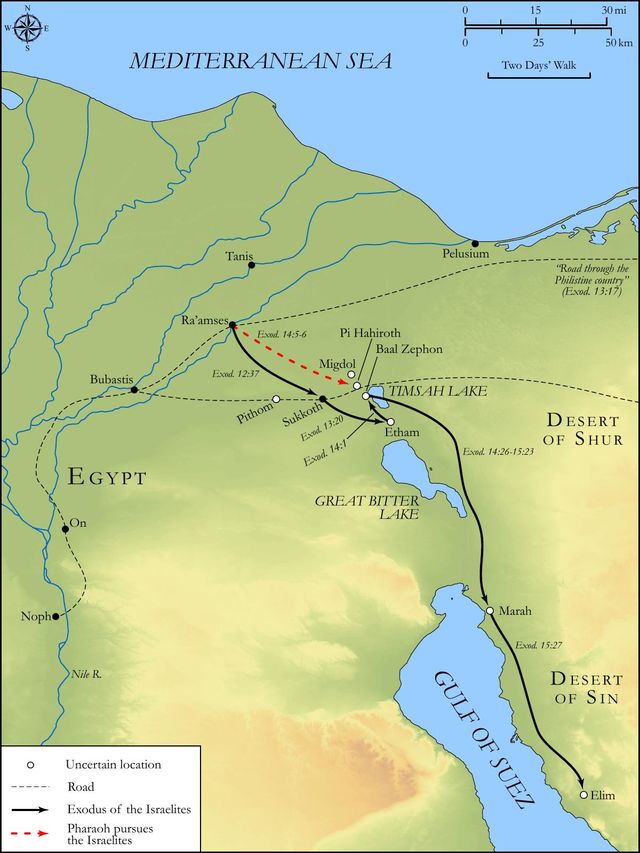
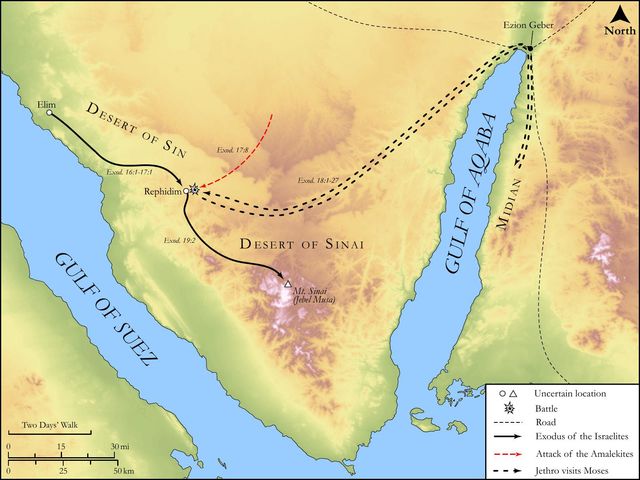
Study this verse
Public-domain commentary
Matthew Henry
From his Commentary on the Whole Bible. Henry comments on passages, not single verses — this entry covers Exodus 14:1–9. His four-level outline is real structure in the source text, so it is rendered as structure.
We have here,
I.Instructions given to Moses concerning Israel's motions and encampments, which were so very surprising that if Moses had not express orders about them before they would scarcely have been persuaded to follow the pillar of cloud and fire. That therefore there might be no scruple nor dissatisfaction about it, Moses is told before,
1.Whither they must go, Exo 14:1, Exo 14:2. They had got to the edge of the wilderness (Exo 13:20), and a stage or two more would have brought them to Horeb, the place appointed for their serving God; but, instead of going forward, they are ordered to turn short off, on the right hand from Canaan, and to march towards the Red Sea. Where they were, at Etham, there was no sea in their way to obstruct their passage: but God himself orders them into straits, which might give them an assurance that when his purposes were served he would without fail bring them out of those straits. Note, God sometimes raises difficulties in the way of the salvation of his people, that he may have the glory of subduing them, and helping his people over them.
2.What God designed in these strange orders. Moses would have yielded an implicit obedience, though God had given him no reason; but shall he hide from Moses the thing that he does? No, Moses shall know,
(1.)That Pharaoh has a design to ruin Israel, Exo 14:3.
(2.)That therefore God has a design to ruin Pharaoh, and he takes this way to effect it, Exo 14:4. Pharaoh's sagacity would conclude that Israel was entangled in the wilderness and so would become an easy prey to him; and, that he might be the more apt to think so, God orders them into yet greater entanglements; also, by turning them so much out of their road, he amazes him yet more, and gives him further occasion to suppose that they were in a state of embarrassment and danger. And thus (says God) I will be honoured upon Pharaoh. Note,
[1.]All men being made for the honour of their Maker, those whom he is not honoured by he will be honoured upon.
[2.]What seems to tend to the church's ruin is often overruled to the ruin of the church's enemies, whose pride and malice are fed by Providence, that they may be ripened for destruction.
II.Pharaoh's pursuit of Israel, in which, while he gratifies his own malice and revenge, he is furthering the accomplishment of God's counsels concerning him. It was told him that the people fled, Exo 14:5. Such a fright was he in, when he gave them leave to go, that when the fright was a little over he either forgot, or would not own, that they departed with his consent, and therefore was willing that it should be represented to him as a revolt from their allegiance. Thus what may easily be justified is easily condemned, by putting false colours upon it. Now, hereupon,
1.He reflects upon it with regret that he had connived at their departure. He and his servants, though it was with the greatest reason in the world that they had let Israel go, yet were now angry with themselves for it: Why have we done thus?
(1.)It vexed them that Israel had their liberty, that they had lost the profit of their labours, and the pleasure of chastising them. It is meat and drink to proud persecutors to trample upon the saints of the Most High, and say to their souls, Bow down, that we may go over; and therefore it vexes them to have their hands tied. Note, The liberty of God's people is a heavy grievance to their enemies, Est 5:12, Est 5:13; Act 5:17, Act 5:33.
(2.)It aggravated the vexation that they themselves had consented to it, thinking now that they might have hindered it, and that they needed not to have yielded, though they had stood it out to the last extremity. Thus God makes men's envy and rage against his people a torment to themselves, Psa 112:10. It was well done to let Israel go, and what they would have reflected on with comfort if they had done it from an honest principle; but doing it by constraint, they called themselves a thousand fools for doing it, and passionately wished it undone again. Note, It is very common, but very absurd and criminal, for people to repent of their good deeds; their justice and charity, and even their repentance, are repented of. See an instance somewhat like this, Jer 34:10, Jer 34:11.
2.He resolves, if possible, either to reduce them or to be revenged on them; in order to this, he levies an army, musters all his force of chariots and horsemen, Exo 14:17, Exo 14:18 (for, it should seem, he took no foot with him, because the king's business required haste), and thus he doubts not but he shall re-enslave them, Exo 14:6, Exo 14:7. It is easy to imagine what a rage Pharaoh was now in, roaring like a lion disappointed of his prey, how his proud heart aggravated the affront, swelled with indignation, scorned to be baffled, longed to be revenged: and now all the plagues are as if they had never been. He has quite forgotten the sorrowful funerals of his firstborn, and can think of nothing but making Israel feel his resentments; now he thinks he can be too hard for God himself; for, otherwise, could he have hoped to conquer a people so dear to him? God gave him up to these passions of his own heart, and so hardened it. It is said (Exo 14:8), The children of Israel went out with a high hand, that is, with a great deal of courage and bravery, triumphing in their release, and resolved to break through the difficulties that lay in their way. But the Egyptians (Exo 14:9) pursued after them. Note, Those that in good earnest set their faces heaven-ward, and will live godly in Christ Jesus, must expect to be set upon by Satan's temptations and terrors. He will not tamely part with any out of his service, nor go out without raging, Mar 9:26.
Continue studying Exodus 14:5 across the web’s major study libraries — every link below opens this exact verse, chapter, or book on the destination site.
Read & Compare
 BibleGatewayThis verse in more than 200 translations and 70 languages.
 Bible.comThe YouVersion reader — hundreds of translations, reading plans, and highlights.
 ESV.orgCrossway's official English Standard Version reader.
 NET BibleThe NET translation with 60,000+ translators' notes on every rendering decision.
 STEP BibleTyndale House's free study tool — original text, vocabulary, and scholarly resources.
 BibliaLogos Bible Software's free web reader.
 USCCBThe New American Bible (Revised Edition) with the U.S. bishops' study notes.
Commentaries
 BibleHub CommentariesDozens of classic commentaries on this verse, gathered on one page.
 StudyLightMore than 100 commentary sets — the largest collection on the web.
 BibleRefPlain-English commentary on what this verse means, verse by verse.
 Enduring WordDavid Guzik's free commentary on this chapter, widely used by Bible teachers.
 Bible Study ToolsVerse commentary alongside Greek and Hebrew study aids.
Original Language & Research
- BibleHub InterlinearThe verse word by word — original language, transliteration, and English.
- BibleHub LexiconEvery word's original-language definition and Strong's entry.
 Blue Letter BibleDeep-study tools — Strong's numbers, concordance, and word studies.
 SefariaThe Hebrew text with Rashi and centuries of Jewish commentary.
Sermons, Hymns & Audio


TrulyRandomVerse is not affiliated with these sites and doesn’t control their content. They’re linked because they’re genuinely useful.
Summary
Exodus 14:5 marks a pivotal moment in the Israelites' journey from Egypt, revealing Pharaoh's immediate and economically driven change of heart. Upon receiving intelligence that the people had not merely departed for a temporary religious festival but had definitively "fled," Pharaoh and his advisors were consumed by regret over releasing their massive, unpaid workforce. This sudden reversal of disposition set the stage for their ill-fated pursuit of Israel and the climactic, divinely orchestrated confrontation at the Red Sea.
Context
ShowHideLiterary Context
This verse serves as the critical turning point following the Israelites' hasty but triumphant departure from Egypt, detailed in Exodus 12 and Exodus 13. Their initial exodus was a direct result of the devastating tenth plague, which finally compelled Pharaoh to let them go (Exodus 12:31). However, God had already foretold this change of heart, explicitly instructing Moses in Exodus 14:1-4 that Pharaoh would pursue them, thereby providing an opportunity for God to display His glory. Thus, verse 5 acts as the immediate human trigger for Pharaoh's decision to pursue, seamlessly leading into the detailed description of his military preparations in Exodus 14:6-9.
Historical & Cultural Context
In ancient Egypt, the Pharaoh was revered as a divine king, whose decree was absolute law and whose authority was unquestionable. The Israelite slaves represented an immense, invaluable labor force, indispensable for the construction of Egypt's monumental infrastructure projects, such as the store cities of Pithom and Raamses (Exodus 1:11). The permanent loss of such a vast, unpaid workforce would have constituted an economic catastrophe for the empire. Pharaoh's initial "permission" for Israel to leave was likely a desperate, temporary concession to appease their God and halt the plagues, not a genuine emancipation. The news that they had "fled"—implying a permanent, defiant break—would have ignited not only profound economic panic among his advisors but also an unbearable sense of insult and a direct challenge to his absolute sovereignty and divine status. This context vividly illustrates the clash between Pharaoh's self-serving interests and God's sovereign, redemptive will, a central theme throughout the Exodus narrative.
Key Themes
ShowHideExodus 14:5 powerfully contributes to several overarching themes within the book of Exodus and the broader Pentateuch. It highlights the stubbornness and futility of human rebellion against divine will, as Pharaoh, despite overwhelming evidence of God's power, quickly reverts to his oppressive nature. This verse also underscores God's absolute sovereignty and providential control, demonstrating how even the actions of His adversaries are orchestrated to fulfill His purposes and reveal His glory (Exodus 9:16). Furthermore, it emphasizes the cost of true freedom and the clash between divine justice and human self-interest, as Pharaoh's regret is purely economic, contrasting sharply with God's unwavering commitment to the liberation of His covenant people, Israel, whom He brought out of the "house of bondage" (Exodus 20:2).
Exposition and Analysis
ShowHideKey Word Analysis
ShowHideThis verb signifies a sudden, decisive, and permanent departure, implying escape or flight rather than a temporary leave. When Pharaoh was told the people had "fled," it conveyed the finality of Israel's break from Egyptian control, triggering his realization that they were not returning. This word choice underscores the perceived defiance and the irreversible nature of Israel's exodus, which fueled Pharaoh's wrath and desire for retribution.
This powerful verb denotes a complete reversal or overturning, a dramatic shift in direction or disposition. Here, it describes the profound change in Pharaoh's and his servants' "heart" (lêbâb), transforming their grudging permission into determined hostility. While often used to describe God's transformative or judgmental actions (e.g., overturning cities), its application here to Pharaoh's heart highlights a dramatic and self-serving shift in his will, perfectly aligning with God's stated purpose to harden him.
This root carries the meaning "to work, serve, or enslave." The phrase "from serving us" reveals the core motivation behind Pharaoh's and his servants' change of heart. Their lament is not one of moral regret or fear of divine judgment, but a pragmatic concern over the immense economic loss of a vast, unpaid labor force. It lays bare their callous, utilitarian view of the Israelites as mere property, essential to their empire's prosperity, rather than as a people with inherent dignity or a divine destiny.
Verse Breakdown
ShowHide"And it was told the king of Egypt that the people fled"
This initial clause establishes the critical intelligence received by Pharaoh. The news of Israel's definitive departure, framed as "fleeing," confirms their complete and permanent break from Egyptian dominion, immediately triggering a profound reaction in the royal court.
"and the heart of Pharaoh and of his servants was turned against the people,"
This clause describes the dramatic psychological and volitional shift within the Egyptian leadership. The "heart" (lêbâb) in Hebrew thought encompasses the totality of one's inner being—intellect, will, and emotion. Their collective disposition, once reluctantly compliant, now pivoted to vengeful opposition, driven by a deep sense of loss and insult.
"and they said, Why have we done this, that we have let Israel go from serving us?"
This rhetorical question articulates the precise motivation for their reversal. It is a lament born of economic self-interest and a desire to reassert control. They regret their decision not out of any moral or spiritual conviction, but purely because of the immense material and labor loss incurred by releasing their valuable human assets, underscoring their callous disregard for the Israelites' freedom and God's command.
Literary Devices
ShowHideThe verse employs significant dramatic irony, as Pharaoh and his servants, in their shortsighted pursuit of economic gain and reassertion of power, believe they are making a strategic decision. In reality, they are unwittingly walking directly into the trap God had meticulously set for them, fulfilling His prophetic word to Moses. Their regret and subsequent pursuit are precisely the means by which God will display His ultimate power at the Red Sea. The rhetorical question ("Why have we done this, that we have let Israel go from serving us?") powerfully conveys their immediate, self-serving regret and highlights the economic rather than spiritual nature of their "repentance," thereby setting the stage for their vengeful and ultimately self-destructive pursuit.
Theological and Thematic Connections
ShowHideExodus 14:5 vividly illustrates several profound theological truths. Firstly, it exposes the stubbornness and depravity of the unregenerate human heart in its rebellion against God, even after witnessing overwhelming divine power. Despite enduring ten devastating plagues, Pharaoh's "repentance" was superficial, a coerced response to pain rather than genuine conviction. Secondly, the verse powerfully underscores God's absolute sovereignty over human will and historical events. Pharaoh's change of heart and subsequent pursuit, though seemingly an act of human defiance, was precisely what God had foretold and orchestrated to further His redemptive purposes and magnify His glory. Thirdly, it highlights the stark clash between divine justice and human self-interest. Pharaoh's lament is purely economic, revealing his callous disregard for the Israelites' freedom and God's explicit command. This stands in stark contrast to God's unwavering commitment to His covenant people and His righteous judgment against oppression. This theme of God's sovereign control over the hearts of rulers is a recurring motif throughout Scripture.
Reflection and Application
ShowHideExodus 14:5 offers enduring lessons for believers today. It serves as a potent reminder that true repentance involves a fundamental change of heart and mind, a turning to God, rather than merely a temporary cessation of sin driven by external pressure or negative consequences. Pharaoh's swift reversal, motivated purely by economic loss, stands as a stark warning against making decisions based solely on self-interest or convenience, rather than on the revealed will and principles of God. Furthermore, this passage profoundly illustrates God's magnificent ability to orchestrate even the opposition and resistance of His enemies for His greater redemptive purposes. When we encounter setbacks, face seemingly insurmountable obstacles, or experience the determined opposition of others in our lives or ministries, this verse encourages us to place our unwavering trust in God's sovereign plan. He can transform the "turning" of our adversaries into divine opportunities for His glory and our ultimate deliverance. For the Israelites, Pharaoh's terrifying pursuit paradoxically paved the way for the miraculous Red Sea deliverance, a foundational event that cemented their faith and God's eternal reputation.
Questions for Reflection
ShowHideFAQ
ShowHideWhy did Pharaoh change his mind so quickly after the devastating plagues?
ShowHidePharaoh's initial decision to let Israel go was not a genuine change of heart or an act of repentance, but rather a coerced response to the immense suffering and national devastation brought by the plagues, particularly the death of the firstborn. Once the immediate, overwhelming threat had passed and the Israelites had truly "fled" (indicating a permanent, defiant departure), his deep-seated pride, economic pragmatism, and stubborn resistance to God's will resurfaced. The immense economic loss of hundreds of thousands of slaves, coupled with the perceived insult to his absolute authority, quickly outweighed the terrifying memory of the plagues, leading him to regret his decision and seek to reclaim his "property."
Does this verse imply Pharaoh had free will, or was his heart hardened by God?
ShowHideThe Exodus narrative consistently presents a profound and complex interplay between Pharaoh's free will and God's sovereign action. In many instances, Pharaoh is explicitly described as hardening his own heart, making a conscious and defiant choice to resist God's commands (Exodus 8:15). However, God also repeatedly declares that He will harden Pharaoh's heart (Exodus 7:3) in order to demonstrate His power and glory to both Egypt and Israel. This verse (Exodus 14:5) describes Pharaoh's own internal reversal and regret, which is entirely consistent with his character and the choices he made throughout the narrative. Yet, this very act of "turning" his heart is precisely what God had foretold and orchestrated, leading Pharaoh and his army directly to their ultimate judgment at the Red Sea. Thus, Pharaoh acts freely, but his actions perfectly align with God's overarching divine plan to bring about His purposes and display His might.
Christ-Centered Fulfillment
ShowHideExodus 14:5, depicting Pharaoh's final, desperate attempt to reclaim Israel, finds its profound and ultimate fulfillment in the person and redemptive work of Jesus Christ. Pharaoh's persistent rebellion and his ultimate, decisive defeat at the Red Sea serve as a powerful Old Testament type of the defeat of sin, death, and Satan through Christ. Just as Pharaoh, the embodiment of oppressive, tyrannical power, was decisively overthrown by God's mighty hand, so too has Christ, through His sacrificial life, atoning death, and glorious resurrection, decisively triumphed over all the forces of spiritual bondage that enslave humanity. The Israelites' miraculous deliverance from Egyptian slavery through God's mighty hand prefigures the spiritual liberation offered to all who believe in Jesus. We, like ancient Israel, are born into slavery—not to an earthly Pharaoh, but to the dominion of sin and its eternal consequences. Christ's work on the cross is our ultimate "exodus," freeing us from the kingdom of darkness and transferring us into the glorious kingdom of His beloved Son (Colossians 1:13-14). Pharaoh's relentless pursuit of Israel, which ultimately led to his destruction, foreshadows the spiritual battle that Christ has already won, securing our freedom and ensuring that no enemy, no matter how powerful, can ultimately snatch us from His gracious hand (John 10:28). The "turning of the heart" in Pharaoh that leads to his judgment stands in stark contrast to the true repentance (a turning of the heart) that Jesus calls for, which leads to the forgiveness of sins, spiritual refreshing, and new life in Him (Acts 3:19).