


Exodus 14:3
Bible text: King James Version (1769 Blayney text) · Public domain
Bible text: Berean Standard Bible · Public domain
Bible text: American Standard Version (1901) · Public domain
Bible text: World English Bible, Messianic edition · Public domain
Bible text: Geneva Bible (1599) · Public domain
Bible text: Young's Literal Translation · Public domain
- וְאָמַרve·'a·Marand he will sayH559Conj-w ¦ V-Qal-ConsecPerf-3msVerb Qal Consecutive Perfect 3rd Singular Masculineוְandאָמַרhe will say
- פַּרְעֹהpar·'OhPharaohH6547N-msNoun Title Singular Masculine Absolute
- לִבְנֵיliv·Neiof [the] people ofH1121Prep-l ¦ N-mpcNoun Plural Masculine Constructלִofבְנֵי[the] people of
- יִשְׂרָאֵלYis·ra·'ElIsraelH3478N-properNoun Proper Location
- נְבֻכִיםne·vu·Khim[are] wandering in confusionH943V-Niphal-Prtcpl-mpVerb Niphal Participle Plural Masculine Absolute
- הֵםhemtheyH1992Pro-3mpPronoun Personal 3rd Plural Masculine
- בָּאָרֶץba·'A·retzin the landH776Prep-b ¦ N-fsNoun Singular Feminine Absoluteבָּin theאָרֶץland
- סָגַרsa·Garit has shutH5462V-Qal-Perf-3msVerb Qal Perfect 3rd Singular Masculine
- עֲלֵיהֶם'a·lei·Hemon themH5921Prep ¦ 3mpPrepositionעֲלֵיonהֶםthem
- הַמִּדְבָּרha·mid·Barthe wildernessH4057Art ¦ N-msNoun Singular Masculine Absoluteהַtheמִּדְבָּרwilderness
English is a literal word-by-word gloss of the Hebrew, not the KJV's wording. Why?
This is the original text the KJV's translators worked from — each Hebrew word with its own literal English meaning in this verse, prepared by scholars at Tyndale House, Cambridge. The KJV translates whole sentences, not word by word, so its wording differs: one Hebrew word can become several English words, and the KJV may choose “the LORD” where the gloss reads “Yahweh”. Both are faithful — they answer different questions. For the KJV's own rendering, switch to the KJV text.
Details
See on the biblical-era maps

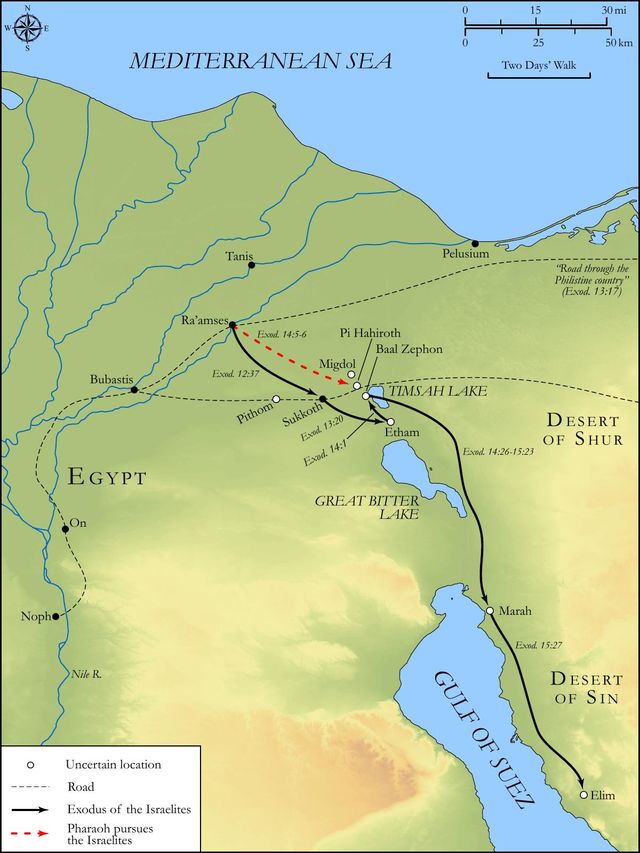
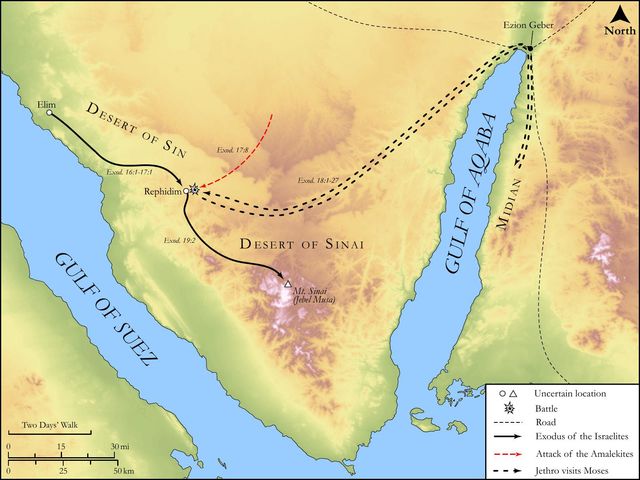
Study this verse
Public-domain commentary
Matthew Henry
From his Commentary on the Whole Bible. Henry comments on passages, not single verses — this entry covers Exodus 14:1–9. His four-level outline is real structure in the source text, so it is rendered as structure.
We have here,
I.Instructions given to Moses concerning Israel's motions and encampments, which were so very surprising that if Moses had not express orders about them before they would scarcely have been persuaded to follow the pillar of cloud and fire. That therefore there might be no scruple nor dissatisfaction about it, Moses is told before,
1.Whither they must go, Exo 14:1, Exo 14:2. They had got to the edge of the wilderness (Exo 13:20), and a stage or two more would have brought them to Horeb, the place appointed for their serving God; but, instead of going forward, they are ordered to turn short off, on the right hand from Canaan, and to march towards the Red Sea. Where they were, at Etham, there was no sea in their way to obstruct their passage: but God himself orders them into straits, which might give them an assurance that when his purposes were served he would without fail bring them out of those straits. Note, God sometimes raises difficulties in the way of the salvation of his people, that he may have the glory of subduing them, and helping his people over them.
2.What God designed in these strange orders. Moses would have yielded an implicit obedience, though God had given him no reason; but shall he hide from Moses the thing that he does? No, Moses shall know,
(1.)That Pharaoh has a design to ruin Israel, Exo 14:3.
(2.)That therefore God has a design to ruin Pharaoh, and he takes this way to effect it, Exo 14:4. Pharaoh's sagacity would conclude that Israel was entangled in the wilderness and so would become an easy prey to him; and, that he might be the more apt to think so, God orders them into yet greater entanglements; also, by turning them so much out of their road, he amazes him yet more, and gives him further occasion to suppose that they were in a state of embarrassment and danger. And thus (says God) I will be honoured upon Pharaoh. Note,
[1.]All men being made for the honour of their Maker, those whom he is not honoured by he will be honoured upon.
[2.]What seems to tend to the church's ruin is often overruled to the ruin of the church's enemies, whose pride and malice are fed by Providence, that they may be ripened for destruction.
II.Pharaoh's pursuit of Israel, in which, while he gratifies his own malice and revenge, he is furthering the accomplishment of God's counsels concerning him. It was told him that the people fled, Exo 14:5. Such a fright was he in, when he gave them leave to go, that when the fright was a little over he either forgot, or would not own, that they departed with his consent, and therefore was willing that it should be represented to him as a revolt from their allegiance. Thus what may easily be justified is easily condemned, by putting false colours upon it. Now, hereupon,
1.He reflects upon it with regret that he had connived at their departure. He and his servants, though it was with the greatest reason in the world that they had let Israel go, yet were now angry with themselves for it: Why have we done thus?
(1.)It vexed them that Israel had their liberty, that they had lost the profit of their labours, and the pleasure of chastising them. It is meat and drink to proud persecutors to trample upon the saints of the Most High, and say to their souls, Bow down, that we may go over; and therefore it vexes them to have their hands tied. Note, The liberty of God's people is a heavy grievance to their enemies, Est 5:12, Est 5:13; Act 5:17, Act 5:33.
(2.)It aggravated the vexation that they themselves had consented to it, thinking now that they might have hindered it, and that they needed not to have yielded, though they had stood it out to the last extremity. Thus God makes men's envy and rage against his people a torment to themselves, Psa 112:10. It was well done to let Israel go, and what they would have reflected on with comfort if they had done it from an honest principle; but doing it by constraint, they called themselves a thousand fools for doing it, and passionately wished it undone again. Note, It is very common, but very absurd and criminal, for people to repent of their good deeds; their justice and charity, and even their repentance, are repented of. See an instance somewhat like this, Jer 34:10, Jer 34:11.
2.He resolves, if possible, either to reduce them or to be revenged on them; in order to this, he levies an army, musters all his force of chariots and horsemen, Exo 14:17, Exo 14:18 (for, it should seem, he took no foot with him, because the king's business required haste), and thus he doubts not but he shall re-enslave them, Exo 14:6, Exo 14:7. It is easy to imagine what a rage Pharaoh was now in, roaring like a lion disappointed of his prey, how his proud heart aggravated the affront, swelled with indignation, scorned to be baffled, longed to be revenged: and now all the plagues are as if they had never been. He has quite forgotten the sorrowful funerals of his firstborn, and can think of nothing but making Israel feel his resentments; now he thinks he can be too hard for God himself; for, otherwise, could he have hoped to conquer a people so dear to him? God gave him up to these passions of his own heart, and so hardened it. It is said (Exo 14:8), The children of Israel went out with a high hand, that is, with a great deal of courage and bravery, triumphing in their release, and resolved to break through the difficulties that lay in their way. But the Egyptians (Exo 14:9) pursued after them. Note, Those that in good earnest set their faces heaven-ward, and will live godly in Christ Jesus, must expect to be set upon by Satan's temptations and terrors. He will not tamely part with any out of his service, nor go out without raging, Mar 9:26.
Continue studying Exodus 14:3 across the web’s major study libraries — every link below opens this exact verse, chapter, or book on the destination site.
Read & Compare
 BibleGatewayThis verse in more than 200 translations and 70 languages.
 Bible.comThe YouVersion reader — hundreds of translations, reading plans, and highlights.
 ESV.orgCrossway's official English Standard Version reader.
 NET BibleThe NET translation with 60,000+ translators' notes on every rendering decision.
 STEP BibleTyndale House's free study tool — original text, vocabulary, and scholarly resources.
 BibliaLogos Bible Software's free web reader.
 USCCBThe New American Bible (Revised Edition) with the U.S. bishops' study notes.
Commentaries
 BibleHub CommentariesDozens of classic commentaries on this verse, gathered on one page.
 StudyLightMore than 100 commentary sets — the largest collection on the web.
 BibleRefPlain-English commentary on what this verse means, verse by verse.
 Enduring WordDavid Guzik's free commentary on this chapter, widely used by Bible teachers.
 Bible Study ToolsVerse commentary alongside Greek and Hebrew study aids.
Original Language & Research
- BibleHub InterlinearThe verse word by word — original language, transliteration, and English.
- BibleHub LexiconEvery word's original-language definition and Strong's entry.
 Blue Letter BibleDeep-study tools — Strong's numbers, concordance, and word studies.
 SefariaThe Hebrew text with Rashi and centuries of Jewish commentary.
Sermons, Hymns & Audio


TrulyRandomVerse is not affiliated with these sites and doesn’t control their content. They’re linked because they’re genuinely useful.
Summary
Exodus 14:3 unveils God's profound strategic foresight, setting the stage for the miraculous Red Sea deliverance by revealing Pharaoh's fatal miscalculation. God deliberately guides the Israelites into a seemingly inescapable position—situated between the wilderness and the sea—knowing that Pharaoh will perceive their apparent entrapment as a golden opportunity to recapture them. This divine orchestration ensures a final, decisive confrontation that will powerfully demonstrate God's unparalleled sovereignty and secure His people's ultimate, glorious salvation.
Context
ShowHideLiterary Context
This verse is pivotal, immediately following God's precise and counter-intuitive instructions to Moses in Exodus 14:1-2 to have the Israelites "turn back and encamp before Pihahiroth, between Migdol and the sea, over against Baalzephon." What appears to human eyes as a strategic blunder—leading a vast, vulnerable population into a dead-end—is here revealed as a deliberate divine strategy. The subsequent narrative in Exodus 14:4-9 meticulously details Pharaoh's predictable and prideful reaction: his heart is hardened, leading him to pursue the Israelites with his formidable army, precisely as God foretold. This sequence of events meticulously sets the stage for the dramatic and climactic Red Sea crossing, underscoring God's absolute control over both His people's movements and His enemies' responses.
Historical & Cultural Context
The Israelites had only recently been released from over 400 years of brutal Egyptian slavery, a liberation achieved through the devastating ten plagues that culminated in the death of the firstborn throughout Egypt (Exodus 12). Pharaoh, though initially relenting under immense divine pressure, remained fundamentally opposed to the God of Israel, his heart stubbornly hardened as foretold in Exodus 4:21. Among the great kings of that day, a king's reputation, power, and control were paramount. Losing such a vast and valuable workforce was not only an economic disaster but a profound political and personal humiliation that Pharaoh could not easily tolerate. God's instruction to lead Israel to a seemingly vulnerable, dead-end location was a masterstroke, expertly exploiting Pharaoh's deeply ingrained pride and insatiable desire for control. Pharaoh, operating entirely within his worldview of military superiority and human strategy, would interpret the Israelites' detour not as divine guidance but as a sign of their confusion, disarray, and utter vulnerability—a perfect, divinely-engineered opportunity for a decisive military strike to reassert his dominance and reclaim his "property." This cultural understanding of honor, power dynamics, and the perceived weakness of a fleeing, disorganized multitude is crucial for grasping Pharaoh's rationale and the depth of his impending folly.
Key Themes
ShowHideExodus 14:3 is rich with several foundational theological and narrative themes that permeate the book of Exodus and the broader biblical narrative. Foremost among these is the theme of God's absolute sovereignty and strategic wisdom. God is not merely reacting to events; He is meticulously orchestrating them, even using the hardened heart and miscalculations of His enemies to accomplish His purposes. This verse also highlights the theme of divine deliverance, where God's power is most visibly displayed when His people are in seemingly impossible situations, emphasizing that salvation comes from Him alone. Furthermore, it underscores the persistent theme of Pharaoh's hardened heart and his ultimate defiance against God, which inevitably leads to his destruction. The "wilderness" setting itself is a recurring biblical motif, representing a place of testing, dependence on God, and divine provision, which will be further developed in the subsequent chapters of Exodus 15 and beyond.
Exposition and Analysis
ShowHideExodus 14:3 captures Pharaoh's internal monologue, revealing his self-assured, yet ultimately deluded, assessment of the Israelites' situation. He views their movements as a strategic blunder, a sign of their being "entangled" and "shut in." This perception, orchestrated by God, sets the stage for the climactic display of divine power.
Key Word Analysis
ShowHideThis Hebrew verb (H943) signifies to be perplexed, confused, or to wander aimlessly and get lost. It conveys a state of being hopelessly disoriented, ensnared, or bewildered. Pharaoh believes the Israelites have stumbled into a geographical trap, unable to find their way out due to their own incompetence or lack of direction. This word starkly contrasts with God's intentional, purposeful leading, highlighting Pharaoh's spiritual blindness to the divine hand at work.
This noun (H4057) typically refers to a pasture, an open field where cattle are driven, or, by implication, a desert. It denotes a desolate, uncultivated, and often dangerous area, distinct from fertile, settled land. For Pharaoh, the "wilderness" represents an impassable barrier, a natural, inhospitable terrain that, combined with the sea, effectively seals off any escape routes for the Israelites, making their situation seem utterly hopeless from a human perspective.
This primitive root verb (H5462) means to close up, block, or shut in. Figuratively, it can also mean to surrender or give over. In this context, it powerfully emphasizes the physical and perceived barrier that Pharaoh believes the wilderness and the sea have created. He sees the Israelites as being caught in a cul-de-sac, completely enclosed and unable to maneuver, thus ripe for recapture. This word highlights the sense of entrapment Pharaoh perceives, believing the natural environment has completed the work of his army.
Verse Breakdown
ShowHide"For Pharaoh will say of the children of Israel,"
This opening clause immediately reveals God's omniscient foreknowledge and sovereign control over all events, including the thoughts and reactions of His enemies. Before Pharaoh even conceives the thought, God knows precisely what his assessment will be, demonstrating that this entire scenario is a divinely orchestrated plan, not a mere happenstance or a human error.
"They [are] entangled in the land,"
This is Pharaoh's initial, prideful assessment of the Israelites' movements. He misinterprets their divinely guided detour as a sign of their confusion, disorganization, and inability to navigate the terrain. The "land" here refers to the specific, seemingly inhospitable wilderness area into which God has led them, which Pharaoh views as a geographical trap they have blundered into.
"the wilderness hath shut them in."
This clause further elaborates on Pharaoh's perception of the Israelites' predicament, solidifying his conviction that they are helpless. He sees the natural geographical features—the desolate wilderness and the impassable sea—as insurmountable obstacles, forming a natural prison that prevents any escape. From Pharaoh's perspective, this perceived entrapment presents a perfect, low-risk opportunity to re-enslave them without significant resistance, sealing his own fate.
Literary Devices
ShowHideThe verse employs dramatic irony with profound effect. The audience (and Moses) is fully aware that God has deliberately led Israel to this seemingly vulnerable spot, not because they are lost or incompetent, but as part of a meticulously designed divine trap for Pharaoh. Pharaoh, however, remains completely oblivious to God's strategic genius, interpreting the situation solely through his own limited, prideful, and human-centric lens. This irony not only heightens the tension and anticipation of the impending confrontation but also powerfully foreshadows Pharaoh's inevitable downfall, contrasting human arrogance with divine sovereignty.
Theological and Thematic Connections
ShowHideExodus 14:3 profoundly illustrates God's sovereign wisdom and meticulous control, extending even to the hearts and minds of His most formidable enemies. It teaches a vital theological truth: what appears to be a disadvantage, a dead end, or an insurmountable obstacle from a human perspective can, in God's hands, be a strategic maneuver to display His glory and accomplish His redemptive purposes. Pharaoh's miscalculation is not an accident but an integral part of God's overarching plan to draw him into a final, decisive confrontation, leading to the ultimate demonstration of divine power and Israel's glorious deliverance. This verse powerfully underscores that God's ways and thoughts are often counter-intuitive to human logic, yet they are always perfectly aligned with His ultimate redemptive plan and His desire to reveal His mighty hand.
This profound theme of God orchestrating events, even through the opposition and schemes of the wicked, resonates throughout the biblical narrative. Just as God hardened Pharaoh's heart to display His power and bring about His will (Exodus 4:21), He consistently uses the perceived weaknesses or entrapments of His people to manifest His strength. The apparent entrapment of Israel sets the stage for God to reveal Himself as a powerful and faithful deliverer, a truth beautifully echoed in the Psalms where God is praised as a refuge and strength for those feeling "shut in" or overwhelmed by circumstances (Psalm 18:2). Ultimately, this verse reminds us that God's thoughts are infinitely higher than human understanding, and His paths, though sometimes seemingly leading to an impasse, are always perfect (Isaiah 55:8-9).
Reflection and Application
ShowHideIn our own lives, we frequently encounter situations that feel profoundly "entangled" or "shut in"—circumstances where we perceive no viable way out, where our options seem completely blocked, or where we find ourselves caught between an impossible wilderness and an impassable sea. Exodus 14:3 serves as a powerful and enduring reminder that what appears to be a hopeless predicament from our limited human perspective can, in fact, be an integral part of God's perfect, sovereign plan to display His power, faithfulness, and glory. We are called to cultivate a deep trust in God's leading, even when His path seems illogical, uncomfortable, or leads us into seemingly vulnerable territory. Our perceived weaknesses or vulnerabilities can often be the very stage upon which God chooses to perform His greatest acts of deliverance, transforming our despair into a testimony of His might. This verse encourages us to look beyond immediate appearances and to recognize the sovereign hand of God at work, knowing with certainty that He is orchestrating all events—even the challenging ones—for His ultimate purposes and for our ultimate good.
Questions for Reflection
ShowHideFAQ
ShowHideDid God deceive Pharaoh by making Israel appear trapped?
ShowHideGod did not deceive Pharaoh in the sense of lying or misrepresenting the situation. Rather, He strategically positioned Israel in a way that Pharaoh's hardened heart would predictably misinterpret as an opportunity for recapture. God's actions were a calculated display of His sovereignty and foreknowledge, designed to expose Pharaoh's pride and bring about His own glory. Pharaoh's misjudgment stemmed from his own spiritual blindness, stubbornness, and hubris, not from any deception on God's part. God simply allowed Pharaoh's inherent character and hardened heart to lead him into a trap of his own making, demonstrating divine justice and power.
Christ-Centered Fulfillment
ShowHideExodus 14:3, by setting the stage for a miraculous deliverance from an impossible situation, powerfully foreshadows the ultimate and eternal deliverance accomplished through Jesus Christ. Just as Israel was seemingly "entangled" and "shut in" by the wilderness and the impassable sea, humanity finds itself universally entangled in the pervasive power of sin and shut in by the inescapable reality of death, with absolutely no human means of escape. The Red Sea deliverance, orchestrated by God's strategic wisdom, was a physical salvation from physical bondage, a powerful type for a greater spiritual reality. In the New Testament, Jesus Christ is presented as the ultimate Deliverer from spiritual bondage. His death on the cross, which appeared to be a defeat, a tragic end, or an "entanglement" in the power of sin and death, was in fact God's sovereign and perfect strategy to bring about the greatest victory imaginable. Through Christ's resurrection, God decisively "shut in" the power of sin and death, providing a way out of humanity's ultimate predicament. The "wilderness" of our fallen nature and the "sea" of divine judgment are overcome not by human effort or ingenuity, but by God's decisive, once-for-all intervention in Christ, leading to true freedom, reconciliation, and eternal life for all who believe (Romans 6:23). He is the ultimate Way where there was no way.