


Exodus 14:2
Bible text: King James Version (1769 Blayney text) · Public domain
Bible text: King James Version with Strong's numbers · Public domain
Bible text: Berean Standard Bible · Public domain
Bible text: American Standard Version (1901) · Public domain
Bible text: World English Bible, Messianic edition · Public domain
Bible text: Geneva Bible (1599) · Public domain
Bible text: Young's Literal Translation · Public domain
- דַּבֵּרda·BerspeakH1696V-Piel-Imp-2msVerb Piel Imperative 2nd Singular Masculine
- אֶל'eltoH413PrepPreposition
- בְּנֵיbe·Nei[the] people ofH1121N-mpcNoun Plural Masculine Construct
- יִשְׂרָאֵלYis·ra·'ElIsraelH3478N-properNoun Proper Location
- וְיָשֻׁבוּve·ya·Shu·vuso they may turn backH7725Conj-w ¦ V-Qal-ConjImperf-3mpVerb Qal Conjunction+Imperfect 3rd Plural Masculineוְsoיָשֻׁבוּthey may turn back
- וְיַחֲנוּve·ya·cha·Nuand they may encampH2583Conj-w ¦ V-Qal-ConjImperf-3mpVerb Qal Conjunction+Imperfect 3rd Plural Masculineוְandיַחֲנוּthey may encamp
- לִפְנֵיlif·Nei<to> beforeH6440Prep-l ¦ N-mpcNoun Plural Masculine Constructלִ<to>פְנֵיbefore
- פִּיpiPi-H6367N-properNoun Proper Location
- הַחִירֹתha·chi·RothahirothH6367N-properNoun Proper Location
- בֵּיןbeinbetweenH996Adj-mscAdjective Numerical Singular Masculine Construct
- מִגְדֹּלmig·DolMigdolH4024N-properNoun Proper Location
- וּבֵיןu·Veinand betweenH996Conj-w ¦ Adj-mscAdjective Numerical Singular Masculine Constructוּandבֵיןbetween
- הַיָּםhai·Yamthe seaH3220Art ¦ N-msNoun Singular Masculine Absoluteהַtheיָּםsea
- לִפְנֵיlif·Nei<to> beforeH6440Prep-l ¦ N-mpcNoun Plural Masculine Constructלִ<to>פְנֵיbefore
- בַּעַלBa·'alBaal-H1189N-properNoun Proper Location
- צְפֹןtze·FonZephonH1189N-properNoun Proper Location
- נִכְחוֹnikh·Choopposite itH5227Adj-msc ¦ 3msAdjective Numerical Singular Masculine Constructנִכְחoppositeוֹit
- תַחֲנוּta·cha·Nuyou will encampH2583V-Qal-Imperf-2mpVerb Qal Imperfect 2nd Plural Masculine
- עַל'alatH5921PrepPreposition
- הַיָּםhai·Yamthe seaH3220Art ¦ N-msNoun Singular Masculine Absoluteהַtheיָּםsea
English is a literal word-by-word gloss of the Hebrew, not the KJV's wording. Why?
This is the original text the KJV's translators worked from — each Hebrew word with its own literal English meaning in this verse, prepared by scholars at Tyndale House, Cambridge. The KJV translates whole sentences, not word by word, so its wording differs: one Hebrew word can become several English words, and the KJV may choose “the LORD” where the gloss reads “Yahweh”. Both are faithful — they answer different questions. For the KJV's own rendering, switch to the KJV text.
Details
See on the biblical-era maps

Study this verse
Public-domain commentary
Matthew Henry
From his Commentary on the Whole Bible. Henry comments on passages, not single verses — this entry covers Exodus 14:1–9. His four-level outline is real structure in the source text, so it is rendered as structure.
We have here,
I.Instructions given to Moses concerning Israel's motions and encampments, which were so very surprising that if Moses had not express orders about them before they would scarcely have been persuaded to follow the pillar of cloud and fire. That therefore there might be no scruple nor dissatisfaction about it, Moses is told before,
1.Whither they must go, Exo 14:1, Exo 14:2. They had got to the edge of the wilderness (Exo 13:20), and a stage or two more would have brought them to Horeb, the place appointed for their serving God; but, instead of going forward, they are ordered to turn short off, on the right hand from Canaan, and to march towards the Red Sea. Where they were, at Etham, there was no sea in their way to obstruct their passage: but God himself orders them into straits, which might give them an assurance that when his purposes were served he would without fail bring them out of those straits. Note, God sometimes raises difficulties in the way of the salvation of his people, that he may have the glory of subduing them, and helping his people over them.
2.What God designed in these strange orders. Moses would have yielded an implicit obedience, though God had given him no reason; but shall he hide from Moses the thing that he does? No, Moses shall know,
(1.)That Pharaoh has a design to ruin Israel, Exo 14:3.
(2.)That therefore God has a design to ruin Pharaoh, and he takes this way to effect it, Exo 14:4. Pharaoh's sagacity would conclude that Israel was entangled in the wilderness and so would become an easy prey to him; and, that he might be the more apt to think so, God orders them into yet greater entanglements; also, by turning them so much out of their road, he amazes him yet more, and gives him further occasion to suppose that they were in a state of embarrassment and danger. And thus (says God) I will be honoured upon Pharaoh. Note,
[1.]All men being made for the honour of their Maker, those whom he is not honoured by he will be honoured upon.
[2.]What seems to tend to the church's ruin is often overruled to the ruin of the church's enemies, whose pride and malice are fed by Providence, that they may be ripened for destruction.
II.Pharaoh's pursuit of Israel, in which, while he gratifies his own malice and revenge, he is furthering the accomplishment of God's counsels concerning him. It was told him that the people fled, Exo 14:5. Such a fright was he in, when he gave them leave to go, that when the fright was a little over he either forgot, or would not own, that they departed with his consent, and therefore was willing that it should be represented to him as a revolt from their allegiance. Thus what may easily be justified is easily condemned, by putting false colours upon it. Now, hereupon,
1.He reflects upon it with regret that he had connived at their departure. He and his servants, though it was with the greatest reason in the world that they had let Israel go, yet were now angry with themselves for it: Why have we done thus?
(1.)It vexed them that Israel had their liberty, that they had lost the profit of their labours, and the pleasure of chastising them. It is meat and drink to proud persecutors to trample upon the saints of the Most High, and say to their souls, Bow down, that we may go over; and therefore it vexes them to have their hands tied. Note, The liberty of God's people is a heavy grievance to their enemies, Est 5:12, Est 5:13; Act 5:17, Act 5:33.
(2.)It aggravated the vexation that they themselves had consented to it, thinking now that they might have hindered it, and that they needed not to have yielded, though they had stood it out to the last extremity. Thus God makes men's envy and rage against his people a torment to themselves, Psa 112:10. It was well done to let Israel go, and what they would have reflected on with comfort if they had done it from an honest principle; but doing it by constraint, they called themselves a thousand fools for doing it, and passionately wished it undone again. Note, It is very common, but very absurd and criminal, for people to repent of their good deeds; their justice and charity, and even their repentance, are repented of. See an instance somewhat like this, Jer 34:10, Jer 34:11.
2.He resolves, if possible, either to reduce them or to be revenged on them; in order to this, he levies an army, musters all his force of chariots and horsemen, Exo 14:17, Exo 14:18 (for, it should seem, he took no foot with him, because the king's business required haste), and thus he doubts not but he shall re-enslave them, Exo 14:6, Exo 14:7. It is easy to imagine what a rage Pharaoh was now in, roaring like a lion disappointed of his prey, how his proud heart aggravated the affront, swelled with indignation, scorned to be baffled, longed to be revenged: and now all the plagues are as if they had never been. He has quite forgotten the sorrowful funerals of his firstborn, and can think of nothing but making Israel feel his resentments; now he thinks he can be too hard for God himself; for, otherwise, could he have hoped to conquer a people so dear to him? God gave him up to these passions of his own heart, and so hardened it. It is said (Exo 14:8), The children of Israel went out with a high hand, that is, with a great deal of courage and bravery, triumphing in their release, and resolved to break through the difficulties that lay in their way. But the Egyptians (Exo 14:9) pursued after them. Note, Those that in good earnest set their faces heaven-ward, and will live godly in Christ Jesus, must expect to be set upon by Satan's temptations and terrors. He will not tamely part with any out of his service, nor go out without raging, Mar 9:26.
Continue studying Exodus 14:2 across the web’s major study libraries — every link below opens this exact verse, chapter, or book on the destination site.
Read & Compare
 BibleGatewayThis verse in more than 200 translations and 70 languages.
 Bible.comThe YouVersion reader — hundreds of translations, reading plans, and highlights.
 ESV.orgCrossway's official English Standard Version reader.
 NET BibleThe NET translation with 60,000+ translators' notes on every rendering decision.
 STEP BibleTyndale House's free study tool — original text, vocabulary, and scholarly resources.
 BibliaLogos Bible Software's free web reader.
 USCCBThe New American Bible (Revised Edition) with the U.S. bishops' study notes.
Commentaries
 BibleHub CommentariesDozens of classic commentaries on this verse, gathered on one page.
 StudyLightMore than 100 commentary sets — the largest collection on the web.
 BibleRefPlain-English commentary on what this verse means, verse by verse.
 Enduring WordDavid Guzik's free commentary on this chapter, widely used by Bible teachers.
 Bible Study ToolsVerse commentary alongside Greek and Hebrew study aids.
Original Language & Research
- BibleHub InterlinearThe verse word by word — original language, transliteration, and English.
- BibleHub LexiconEvery word's original-language definition and Strong's entry.
 Blue Letter BibleDeep-study tools — Strong's numbers, concordance, and word studies.
 SefariaThe Hebrew text with Rashi and centuries of Jewish commentary.
Sermons, Hymns & Audio


TrulyRandomVerse is not affiliated with these sites and doesn’t control their content. They’re linked because they’re genuinely useful.
Summary
Exodus 14:2 presents a pivotal and divinely orchestrated command from God to Moses, instructing the Israelites to alter their course and encamp in a seemingly vulnerable, dead-end location: before Pihahiroth, situated between Migdol and the sea, directly opposite Baalzephon. This precise geographical directive was not a mistake or a random detour, but a strategic maneuver by Yahweh, designed to entice Pharaoh into believing the Israelites were hopelessly trapped. This calculated positioning was essential to set the stage for God's magnificent display of power and judgment over Egypt and its pantheon of gods, culminating in the miraculous parting of the Red Sea and the decisive defeat of Pharaoh's army.
Context
ShowHideLiterary Context
The divine instruction in Exodus 14:2 arrives immediately after the momentous departure of the Israelites from Egypt, following the devastating tenth plague. God had already demonstrated His providential guidance, leading His people not by the direct, militarily exposed route through Philistine territory, but via a more circuitous path, marked by the visible presence of a pillar of cloud by day and fire by night. This verse marks a crucial turning point, as God deliberately directs them away from a straightforward journey to freedom toward a geographical bottleneck. This seemingly counter-intuitive command is the setup for the dramatic confrontation that defines the chapter, leading directly to Pharaoh's renewed pursuit (Exodus 14:5-9) and the climactic, miraculous Red Sea crossing (Exodus 14:21-31). It underscores God's active involvement in every step of their liberation, orchestrating events to His precise will.
Historical & Cultural Context
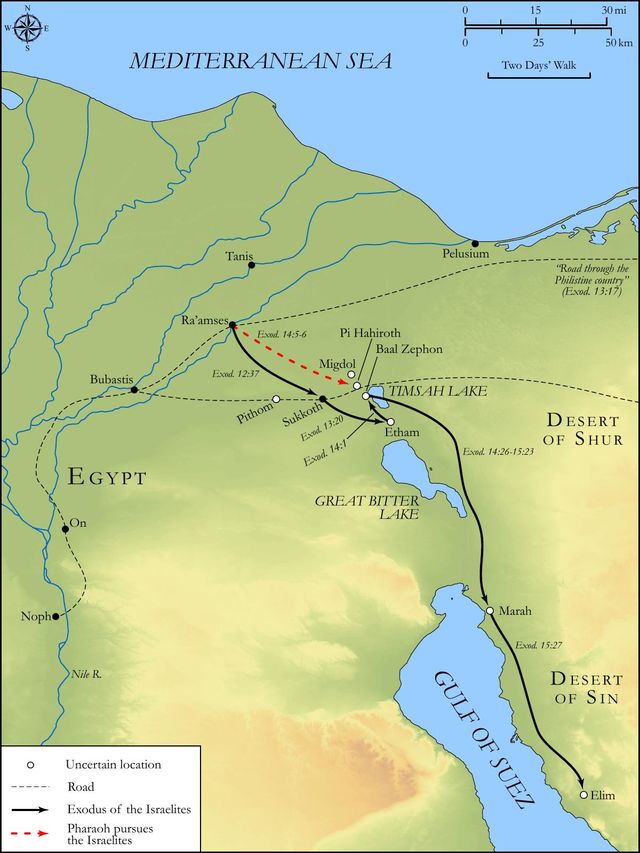
The setting of Exodus 14:2 is deeply embedded in the understanding of divine warfare held by the nations, as the Rabshakeh's boast of conquered gods shows. In this worldview, conflicts between nations were often seen as contests between their respective deities. Yahweh's confrontation with Pharaoh was not merely a political or military struggle, but the LORD's battle against the gods of Egypt, demonstrating His absolute supremacy. The specific locations mentioned—Pihahiroth, Migdol, and Baalzephon—were likely strategic points along the eastern frontier of Egypt. Migdol ("tower") suggests a fortified outpost, while Baalzephon ("Lord of the North" or "Baal of the Watchtower") points to a pagan shrine or cult center dedicated to a local deity, possibly associated with sea travel or storms. By directing Israel to encamp "over against Baalzephon," God was symbolically challenging this Egyptian deity, setting the stage for a dramatic demonstration of His power over both human armies and false gods, thereby asserting His unparalleled sovereignty.
Key Themes
ShowHideThis verse contributes significantly to several overarching themes within the book of Exodus and the broader Pentateuch. It powerfully illustrates God's sovereignty and meticulous control over history and human events, even when His plans appear illogical or dangerous from a human perspective. It highlights the theme of divine deliverance, showcasing God's commitment to rescuing His people from bondage, not through their might but through His miraculous intervention. Furthermore, the strategic positioning and subsequent events serve as a profound lesson in faith and trust, challenging Israel (and future generations) to rely on God's wisdom and power rather than human logic or perceived safety. The ultimate goal, articulated in Exodus 14:4, is the glorification of God's name among the Egyptians and the Israelites, ensuring that "the Egyptians may know that I am the LORD."
Exposition and Analysis
ShowHideKey Word Analysis
ShowHideThis primitive root signifies not merely uttering words, but often implies a deliberate arrangement or command. In this context, it emphasizes the authoritative and intentional nature of God's instruction to Moses, underscoring that this seemingly illogical maneuver is a direct divine order, not a suggestion or a human decision.
This verb denotes a decisive change of direction, a turning back or around. It implies a reversal of the previous forward movement, making the Israelites appear to be disoriented or trapped. This "turning" is a divinely orchestrated strategic maneuver, designed to create the illusion of vulnerability for Pharaoh's observation.
Meaning to pitch a tent, to settle, or to halt a journey, this word indicates a planned, deliberate stop rather than a temporary pause or mere passage. It reinforces the idea that the Israelites are to establish a camp, making their position appear fixed and inescapable to any observer, particularly Pharaoh's approaching forces.
Meaning "mouth of the gorges" or "place of canals," this name suggests a narrow, confined geographical area, possibly a valley or a pass leading to the sea. This location inherently implies a lack of escape routes, reinforcing the perception of a trap.
Translating to "Baal of winter" or "Baal of the watchtower" (though some link it to an Egyptian deity, Typhon), this was likely a significant pagan shrine or cult center. God's instruction to encamp "over against Baalzephon" is highly symbolic, placing His people directly opposite a prominent symbol of Egyptian idolatry. This sets the stage for a direct spiritual confrontation, asserting Yahweh's absolute supremacy over all false gods and demonstrating their impotence.
Verse Breakdown
ShowHide"Speak unto the children of Israel,"
This opening phrase unequivocally establishes the divine origin of the command, emphasizing that this is God's direct word, conveyed through His chosen mediator, Moses. It highlights the authority and intentionality behind the subsequent instructions.
"that they turn and encamp before Pihahiroth,"
This clause details the initial, counter-intuitive movement. The Israelites are commanded to reverse their direction and halt their journey at a specific, geographically restrictive location, designed to appear as a strategic blunder or a dead end.
"between Migdol and the sea, over against Baalzephon:"
These precise geographical markers further define the narrow, enclosed nature of the designated encampment. "Between Migdol" (a likely military outpost) and "the sea" (the Red Sea) paints a picture of being hemmed in. The addition of "over against Baalzephon" is crucial, placing God's people in direct symbolic opposition to a prominent pagan deity, setting the stage for a theological showdown.
"before it shall ye encamp by the sea."
This repetition serves to underscore the exactness and intentionality of the command. It reiterates the specific, vulnerable spot where they are to settle, facing the impassable barrier of the sea, reinforcing the appearance of an inescapable trap.
Literary Devices
ShowHideExodus 14:2 is rich in precise, almost military-like instructions, reflecting God's meticulous and strategic planning. The divine command itself creates a powerful sense of dramatic irony: what appears to human eyes as a disastrous strategic error—leading a vast multitude into a geographical cul-de-sac—is, in fact, God's perfectly orchestrated setup for a spectacular display of His power and deliverance. This also serves as foreshadowing, hinting at the extraordinary events that are about to unfold. The repetition of the command to "encamp" (Hebrew: chanah) emphasizes the definitive halt and the intentionality of their positioning, reinforcing the idea that this is a fixed, deliberate tactical move, not a temporary pause. The mention of specific, identifiable locations like Pihahiroth, Migdol, and Baalzephon grounds the narrative in a tangible reality, enhancing the sense of a real, historical event.
Theological and Thematic Connections
ShowHideExodus 14:2 is a profound illustration of God's absolute sovereignty and meticulous direction over His people's journey, even when the path appears utterly illogical, dangerous, or like an insurmountable "dead end" from a human perspective. This verse sets the stage for a foundational demonstration of God's power, not only over human adversaries like Pharaoh and his formidable army but also over the false gods of Egypt, particularly Baalzephon. It establishes Yahweh's unique identity as the supreme deliverer and the only true God. This strategic command highlights the theme of divine testing, where God intentionally places His people in a vulnerable position, not for their destruction, but to reveal His mighty power, deepen their faith, and call them to absolute trust. The entire episode underscores God's unwavering commitment to delivering His chosen people and, crucially, to glorifying His own name, as explicitly stated in Exodus 14:4. This event becomes a quintessential narrative of God's powerful deliverance, echoed and referenced throughout the biblical history of Israel.
Reflection and Application
ShowHideFor believers today, the divine directive in Exodus 14:2 offers profound encouragement and a vital challenge to our faith. It serves as a powerful reminder that God's leading in our lives may often defy human logic and conventional wisdom. What appears to be an insurmountable obstacle, a "dead end," or a situation that corners us, may in fact be God meticulously setting the stage for a spectacular display of His faithfulness, power, and deliverance. Our faith is frequently stretched and deepened not in comfortable, predictable circumstances, but precisely in challenging situations where we are compelled to relinquish self-reliance and trust solely in His sovereign wisdom and omnipotent power. Trusting God's direction, even when it directly contradicts our understanding of safety, success, or common sense, is not merely advisable but essential for experiencing His miraculous intervention and witnessing His glory revealed in ways we could never orchestrate ourselves. This passage calls us to surrender our limited perspectives and embrace the boundless possibilities of a God who specializes in making a way where there is no way.
Questions for Reflection
ShowHideFAQ
ShowHideWhy did God lead them to a "dead end" instead of a direct route to freedom?
ShowHideGod's purpose in leading the Israelites to a seemingly inescapable "dead end" was multi-layered and strategic. First, it was a deliberate tactical maneuver designed to lure Pharaoh into believing the Israelites were trapped, thereby providing a perfect opportunity for God to display His power decisively over Pharaoh, his army, and the entire pantheon of Egyptian gods (Exodus 14:4). This would ensure that both the Egyptians and the Israelites would know that Yahweh alone is the LORD. Second, it served as a profound test of faith for the Israelites, teaching them to rely entirely on God's miraculous provision and power rather than their own strength, military strategy, or logical escape routes.
What is the significance of encamping "over against Baalzephon"?
ShowHideBaalzephon was likely a significant pagan cult site, possibly dedicated to a god associated with storms, the sea, or protection. By directing Israel to encamp directly opposite this pagan deity, God was setting up a direct divine confrontation. The subsequent miraculous parting of the sea and the overwhelming destruction of Pharaoh's army would not only demonstrate Yahweh's absolute supremacy over Pharaoh and his military might but also decisively prove His triumph over the gods of Egypt, including Baalzephon. This act asserted Yahweh's unique power, authority, and identity as the one true God, putting all other supposed deities to shame.
How could the Israelites trust God after such a strange and dangerous command?
ShowHideThe biblical narrative honestly portrays the Israelites' initial reaction to this dangerous command. When Pharaoh's army appeared, they reacted with intense fear and bitter complaint, questioning Moses and even wishing they had remained in slavery (Exodus 14:10-12). This highlights the immense challenge of trusting God's seemingly illogical commands. However, God had already established His credibility through the ten plagues and His constant presence in the pillar of cloud and fire. Moses's leadership, rooted in his direct communication with God, was crucial in calming their fears. Ultimately, God's subsequent miraculous deliverance at the Red Sea served as an undeniable, foundational event that, despite their frequent wavering, deepened their understanding of and (at times) faith in Him.
Christ-Centered Fulfillment
ShowHideExodus 14:2, and the subsequent miraculous Red Sea crossing, finds profound and expansive fulfillment in the person and redemptive work of Jesus Christ. The entire narrative of the Exodus, with God leading His people through an impossible situation to miraculous deliverance from bondage, serves as a powerful type or foreshadowing of the greater salvation accomplished by Christ. Just as God delivered Israel from the physical slavery and oppression of Egypt, Jesus Christ delivers humanity from the far more pervasive and destructive spiritual bondage of sin and death (Romans 6:22 and Colossians 1:13-14). The "dead end" at the Red Sea, where Israel seemed hopelessly trapped, powerfully prefigures the seemingly impossible situation of humanity, ensnared by sin and facing certain judgment, from which only divine intervention can save. Christ's sacrificial death on the cross and His glorious resurrection are the ultimate "parting of the waters," making a way of salvation where there was no humanly conceivable way. The apostle Paul explicitly draws a parallel between the Red Sea crossing and Christian baptism, describing the Israelites as being "baptized into Moses in the cloud and in the sea" (1 Corinthians 10:1-2). In Christ, believers are spiritually "baptized into his death" (Romans 6:3-4), signifying a passage through the waters of judgment from an old life of slavery to sin into a new life of freedom, resurrection, and identification with Christ. This is the ultimate "new exodus" for all who believe. The visible manifestation of God's presence and guidance through the pillar of cloud by day and fire by night, which led Israel through the wilderness, finds its ultimate and abiding expression in Jesus Christ. He is Emmanuel, "God with us," who declared Himself to be "the way, the truth, and the life" (John 14:6), leading His people through the wilderness of this world to the promised eternal inheritance. Just as God triumphed decisively over Pharaoh and the array of Egyptian gods at the Red Sea, Christ's death and resurrection represent the ultimate and decisive victory over Satan, sin, and death (Colossians 2:15). The strategic positioning "over against Baalzephon" foreshadows Christ's ultimate and complete triumph over all spiritual forces of evil and every opposing power that seeks to enslave humanity.