


Ezekiel 38:10
“The Invasion's Timing and Motive”Ezekiel 38:8–13
Bible text: King James Version (1769 Blayney text) · Public domain
Bible text: Berean Standard Bible · Public domain
Bible text: American Standard Version (1901) · Public domain
Bible text: World English Bible, Messianic edition · Public domain
Bible text: Geneva Bible (1599) · Public domain
Bible text: Young's Literal Translation · Public domain
- כֹּהkohthusH3541AdvAdverb
- אָמַר'a·Marhe saysH559V-Qal-Perf-3msVerb Qal Perfect 3rd Singular Masculine
- אֲדֹנָי'a·do·Nai[the] LordH136N-properNoun Proper Title
- יְהוִהYah·wehYahwehH3069N-properNoun Proper Title
- וְהָיָהve·ha·Yahand it will beH1961Conj-w ¦ V-Qal-ConsecPerf-3msVerb Qal Consecutive Perfect 3rd Singular Masculineוְandהָיָהit will be
- בַּיּוֹםbai·Yomon the dayH3117Prep-b ¦ N-msNoun Singular Masculine Absoluteבַּon theיּוֹםday
- הַהוּאha·Hu'[the] thatH1931Art ¦ Pro-3msPronoun Personal 3rd Singular Masculineהַ[the]הוּאthat
- יַעֲלוּya·'a·Luthey will come upH5927V-Qal-Imperf-3mpVerb Qal Imperfect 3rd Plural Masculine
- דְבָרִיםde·va·RimwordsH1697N-mpNoun Plural Masculine Absolute
- עַל'alonH5921PrepPreposition
- לְבָבֶךָle·va·Ve·khayour heartH3824N-msc ¦ 2msNoun Singular Masculine Construct with suffixלְבָבֶheartךָyour
- וְחָשַׁבְתָּve·cha·shav·Taand you will planH2803Conj-w ¦ V-Qal-ConsecPerf-2msVerb Qal Consecutive Perfect 2nd Singular Masculineוְandחָשַׁבְתָּyou will plan
- מַחֲשֶׁבֶתma·cha·She·veta planH4284N-fscNoun Singular Feminine Construct
- רָעָהra·'AhevilH7451Adj-fsAdjective Singular Feminine Absolute
English is a literal word-by-word gloss of the Hebrew, not the KJV's wording. Why?
This is the original text the KJV's translators worked from — each Hebrew word with its own literal English meaning in this verse, prepared by scholars at Tyndale House, Cambridge. The KJV translates whole sentences, not word by word, so its wording differs: one Hebrew word can become several English words, and the KJV may choose “the LORD” where the gloss reads “Yahweh”. Both are faithful — they answer different questions. For the KJV's own rendering, switch to the KJV text.
Words in [ ] are added by the English.
Details
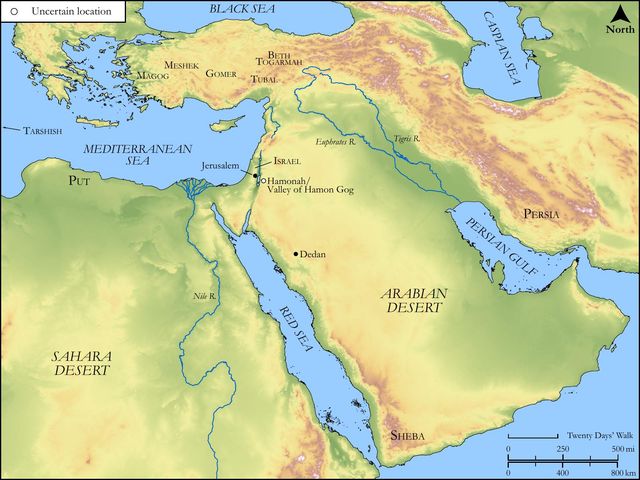
See on the biblical-era map
Study this verse
Public-domain commentary
Matthew Henry
From his Commentary on the Whole Bible. Henry wrote on whole passages, and this entry covers Ezekiel 38:1–13. He set out his notes in a two-level outline, kept here as he numbered it.
The critical expositors have enough to do here to enquire out Gog and Magog. We cannot pretend either to add to their observations or to determine their controversies. Gog seems to be the king and Magog the kingdom; so that Gog and Magog are like Pharaoh and the Egyptians. Some think they find them afar off, in Scythia, Tartary, and Russia. Others think they find them nearer the land of Israel, in Syria, and Asia the Less. Ezekiel is appointed to prophesy against Gog, and to tell him that God is against him, Ezekiel 38:2, Ezekiel 38:3. Note, God does not only see those that are now the enemies of his church and set himself against them, but he foresees those that will be so and lets them know by his word that he is against them too, and yet is pleased to make use of them to serve his own purposes, for the glory of his own name; surely their wrath shall praise him, and the remainder thereof he will restrain, Psalm 76:10. Let us observe here,
I.The confusion which God designed to put this enemy to.
It is remarkable that this is put first in the prophecy; before it is foretold that God will bring him forth against Israel it is foretold that God will put hooks into his jaws and turn him back (Ezekiel 38:4), that they might have assurance of their deliverance before they had the prospect given them of their danger. Thus tender is God of the comfort of his people, thus careful that they may not be frightened; even before the trouble begins he tells them it will end well.
II.The undertaking which he designed to engage him in, in order to this defeat and disappointment.
1.The nations that shall be confederate in this enterprise against Israel are many, and great, and mighty (Ezekiel 38:5, Ezekiel 38:6), Persia, Ethiopia, etc. Antiochus had an army made up of all the nations here named, and many others. These people had been at variance with one another, and yet in combination against Israel. How are those increased that trouble God's people!
2.They are well furnished with arms and ammunition, and bring a good train of artillery into the field - horses and horsemen (Ezekiel 38:4) bravely equipped with all sorts of armour, bucklers and shields for defence, and all handling swords for offence. Orders are given to make all imaginable preparation for this expedition (Ezekiel 38:7): "Be thou prepared, and do thou prepare. See what warlike preparations thou hast already in store, and, lest that should not suffice, make further preparation, thou and all thy company," Let Gog himself be a guard to the rest of the confederates. As commander-in-chief, let him engage to take care of them and their safety; let him pass his word for their security, and take them under his particular protection. The leaders of an army, instead of exposing their soldiers needlessly and presumptuously, and throwing away their lives upon desperate undertakings, should study to be a guard to them, and, whenever they send them forth in danger, should contrive to support and cover them. This call to prepare seems to be ironical - Do thy worst, but I will turn thee back; like that Isaiah 8:9. Gird yourselves, and you shall be broken in pieces.
3.Their design is against the mountains of Israel (Ezekiel 38:8), against the land that is brought back from the sword. It is not long since it was harassed with the sword of war, and it has been always wasted, more or less, with one judgment or other; it is but newly gathered out of many people, and brought forth out of the nations; it has enjoyed comparatively but a short breathing-time, has scarcely recovered any strength since it was brought down by war and captivity; and therefore its neighbours need not fear its being too great, nay, and therefore it is very barbarous to pick a quarrel with it so soon. It is a people that dwell safely, all of them, in unwalled villages, very secure, and having neither bars nor gates, Ezekiel 38:11. It is a certain sign that they intend no mischief to their neighbours, for they fear no mischief from them. It cannot be thought that those will offend others who do not take care to defend themselves; and this aggravates the sin of these invaders. It is base and barbarous to devise evil against thy neighbour while he dwells securely by thee, and has no distrust of thee, Proverbs 3:29. But see here how the clouds return after the rain in this world, and what little reason we have ever to be secure till we come to heaven. It is not long since Israel was brought back from the sword of one enemy, and behold the sword of another is drawn against it. Former troubles will not excuse us from further troubles; but when we think we have put off the harness, at least for some time, by a fresh and sudden alarm we may be called to gird it on again; and therefore we must never boast nor be off our guard.
4.That which the enemy has in view, in forming this project, is to enrich himself and to make himself master, not of the country, but of the wealth of it, to spoil and plunder it, and make a prey of it: At the same time that God intends to bring this matter about things shall come into the mind of this enemy, and he shall think an evil thought, Ezekiel 38:10. Note, All the mischief men do, and particularly the mischief they do to the church of God, arises from evil thoughts that come into their mind, ambitious thoughts, covetous thoughts, spiteful thoughts against those that are good, for the sake of their goodness. It came into Antiochus's mind what a singular people these religious Jews were, and how their worship witnessed against and condemned the idolatries of their neighbours, and therefore, in enmity to their religion, he would plague them. It came into his mind what a wealthy people they were, that they had gotten cattle and goods in the midst of the land (Ezekiel 38:12), and withal how weak they were, how unable to make any resistance, how easy it would be to carry off what they had, and how much glory this rapine would add to his victorious sword; these things coming into his mind, and one evil thought drawing on another, he came at last to this resolve (Ezekiel 38:11, Ezekiel 38:12): "I will go up to the land of unwalled villages; yea, that I will; it will cost me nothing to make them all my own. I will go and disturb those that are at rest, without giving them any notice, not to crush their growing greatness, or chastise their insolence, or make reprisals upon them for any wrong they have done us (they had none of these pretences to make war upon them), but purely to take a spoil and to take a prey" (Ezekiel 38:12), in open defiance to all the laws of justice and equity, as much as the highwayman's killing the traveller that he may take his money. These were the thoughts that came into the mind of this wicked prince, and God knew them; nay, he knew them before they came into his mind, for he understands our thoughts afar off, Psalm 139:2.
5.According to the project thus formed he pours in all his forces upon the land of Israel, and finds those that are ready to come in to his assistance with the same prospects (Ezekiel 38:9): "Thou shalt ascent and come like a storm, with all the force, and fury, and fierceness imaginable, and thou shalt be like a cloud to cover the land, to darken it, and to threaten it, thou and not only all thy bands, all the force thou canst bring into the field, but many people with thee" (such as are spoken of Ezekiel 38:13), "Sheba and Dedan, the Arabians and the Edomites, and the merchants of Tarshish, of Tyre and Sidon and other maritime cities, they and their young lions that are greedy of spoil and live upon it, shall say, Hast thou come to take the spoil of this land?" Yes he has; and therefore they wish him success. Or perhaps they envy him, or grudge it to him. "Hast thou come for riches who art thyself so rich already?" Or, knowing that God was on Israel's side, they thus ridicule his attempts, foreseeing that they would be baffled and that he would be disappointed of the prey he promised himself. Or, if he come to take the prey, they will come and join with him, and add to his forces. When Lysias, who was general of Antiochus's army, came against the Jews, the neighbouring nations joined with him (1 Macc. 3:41), to share in the guilt, in hopes to share in the prey. When thou sawest a thief then thou consentedst with him.
Historical interpretation
Historical reception
1 surviving comment on this verse from the historical church.
(Chapter XXXVIII.) "And the word of the Lord came to me, saying: Son of man, set your face against Gog, the land of Magog, the prince of the head (or head of) Meshech and Tubal, and prophesy against him. And you shall say to him: Thus says the Lord God: Behold, I am against you, O Gog, prince of the head (or head of) Meshech and Tubal. And I will turn you around, and put hooks into your jaws, and bring you out, and all your army, horses and horsemen, all clothed in armor, a great multitude, with bucklers and shields, wielding swords (or bucklers and helmets, and swords): Persians, Ethiopians, and Libyans, all with shields and helmets; Gomer and all his hordes; the house of Togarmah from the far north, and all his troops, and many peoples with you. Prepare and equip yourself, and your entire multitude which has gathered to you, and be a commandment to them (or you will be to me a custodian). After many days you will be visited: in the last years you will come to a land which has turned (or perverted) from the sword: and it has been gathered from many peoples to the mountain (or land) of Israel, who have been continuously deserted: this has been brought out from the peoples and they will confidently dwell (or have dwelt) in it. But when the storms come and the clouds cover the earth, you and all your armies, and many peoples (or nations) with you, will ascend. Thus says the Lord God: On that day, thoughts will arise in your heart, etc., and you will devise a wicked plan, and say: I will ascend to the land (or above the land) without a wall (or abject): I will go to those who dwell securely (or in peace): all ((Vulgate adds these)) dwell without a wall, bars and gates are not for them: to plunder spoils, and seize prey: to lay your hand upon those who were forsaken, and later restored, and upon the people who are gathered from the nations, who have begun to possess and inhabit the belly button of the earth. The people of Sheba and Dedan, and the merchants of Tarshish (or the Carthaginians and all the lion-like cities) will say to you: Have you come to gather spoils? Look, you have gathered your multitude to take silver and gold, and to take away possessions and spoil endless treasures. Therefore, prophesy, son of man, and say to Gog: Thus says the Lord God: Will you not know (or arise) on that day when my people Israel dwell confidently (or in peace)? And you will come from your place on the sides (or from the far north), you and many peoples with you, all mounted on horses, a great gathering and a mighty army. And you will come up over my people Israel like a cloud, to cover the land. In the latter days you will come (or he will come) and I will bring you against my land, so that all the nations may know me, when I shall be sanctified in you in their sight, O Gog. Thus says the Lord God: So you are the one of whom I spoke in the days of old by the hand of my servants, the prophets of Israel, who prophesied in those days and years (or times), that I would bring you against them? And it shall come to pass in that day, in the day of the coming of Gog against the land of Israel, says the Lord God, that my fury will arise in my anger. And in my zeal, in the fire of my wrath, I have spoken, because on that day there will be a great commotion over the land of Israel, and the fish of the sea, and the birds of the sky, and the beasts of the field (or the countryside), and every creeping creature that moves on the earth will be shaken. And all the men who are on the face of the earth will be overturned (or split) and the mountains will be overturned (or torn down), and the hedges (or valleys) will fall, and every wall on the land will collapse. And I will summon against him on all my mountains a sword (or every terror of the sword), says the Lord God. The sword of each (or every) man will be directed against his brother. And I will judge him with pestilence (or death), and blood, and severe rain and immense stones (or hailstones). I will rain fire and sulfur on him, and on his army (or on all those who are with him), and on many peoples who are with him. And I will be magnified, and sanctified, and I will be known in the sight (or eyes) of many nations, and they will know that I am the Lord." The foundations of the first history must be laid, and it must be known that this final discourse of the Lord is to the prophet Ezekiel. For after this we can find nothing similar, except that which is written in the twenty-fifth year of the transmigration of Jehoiachin: The hand of the Lord was upon me, and he brought me there, that is, to the land of Israel, when the building of the temple is described, and the order of its ceremonies is narrated. Then it is to be noted that the face of the prophet is set or hardened against the land of Gog, or the land of Magog. For it requires firmness and much consideration of countenance, so that we may understand the things that are spoken, according to the saying of the Apostle: But we all, with open face beholding as in a glass the glory of the Lord, are changed into the same image from glory to glory, even as by the Spirit of the Lord (1 Corinthians 3:18). Therefore, the Jews and those of us who follow Jewish customs believe that the Gentiles mentioned as Gog are the Scythians, who are savage and countless in number, stretching from beyond the Caucasus mountains and the Maeotis swamp to near the Caspian Sea and as far as India. And they believe that after a thousand years, these nations stirred up by the devil will come to the land of Israel to fight against the saints, gathering many other peoples with them. First, Mosoch, whom Josephus interprets as Cappadocians, then Tubal, whom the same interprets as Iberians, or Spaniards, Hebrews suspect to be Italians, having with them in their army Persians, Ethiopians, and Libyans: also Gomer and Thogorma, whom they interpret as Gauls and Phrygians: also the Sabaeans and Dedan, and the Carthaginians, or Tharsis, and this is what John also puts in his Apocalypse: 'And when the thousand years are finished, Satan will be released from his prison, and will come out to deceive the nations that are at the four corners of the earth, Gog and Magog, to gather them for battle; their number is like the sand of the sea. And they marched up over the broad plain of the earth and surrounded the camp of the saints and the beloved city.' And fire came down from God out of heaven, and devoured them: and the devil, that seduced them, was cast into the pool of fire and brimstone, where both the beast and the false prophet shall be tormented day and night for ever and ever (Rev. 20:9-10). They do not understand that the entire volume of John, which is titled Revelation, is mystical, and that we need revelation in order to be able to say with the prophet: Open my eyes, and I will behold wondrous things out of thy law (Ps. 119:18). But others, forsaking earthly sensibilities and harmful Judaic and elderly fables (I Tim. IV), and content with themselves, delve into the depths, ascend too high, and invent much worse things, in order to describe wars of the devil and all his host in the heavenly Jerusalem, and they interpret spiritual wickedness in celestial matters under the guise of the topologies of individual nations. We, conceding all these things to the judgment of the reader, will strive not so much to condemn foreign ideas as to affirm the ecclesiastical explanation. In the Greek language, a gift is called δόμα, and in Latin it is called tectum. Furthermore, Magog is interpreted as being uncovered. Therefore, all pride and false knowledge of name, which raises itself against the knowledge of truth, is demonstrated by these names. These are the roofs, about which Isaiah speaks in a vision against the Valley of Zion: What has happened to you now, since you have all gone up to empty roofs? (Isa. XXII, 1) And we will interpret the roofs as the leaders of heretics: and we will call those who have received their teachings from the roofs. And beautifully after many mystical prophecies in this volume, the final prophecy is against Gog and Magog. For if it is the time of judgment, according to Peter, that it begins with the house of God, and according to this same Ezekiel, who says: 'And begin with My holy ones' (above IX, 6), and the last enemy will be destroyed, death (1 Peter IV): in Isaiah also the first discourse is against Judah, in which the confession of the Lord is, and the last against the quadrupeds that are in the desert (Isaiah II): rightly here too the final discourse is against Gog and Magog, who attack the city of God, which the flow of the river delights (Psalm XLV). And what Isaiah says: 'I am the first city which is attacked' (Isaiah XXVII, 10). And concerning which it is written in the Gospel: A city that is set on a hill cannot be hid (Matthew 5:14). And more fully in the Psalm: Jerusalem is built as a city that is at unity in itself (Psalm 122:3). The mountains are round about it; and the LORD is round about his people (Psalm 125:2). Furthermore, in the army of Gog, or Magog, who according to the Septuagint, Symmachus, and Theodotion, is chief of Ros, Mosoch, and Thubal: the first nation is interpreted by Aquila as the head, which we also follow, so that the sense is: The prince of the head of Mosoch and Thubal. And indeed, neither in Genesis, nor in any other place in Scripture, nor even in Josephus, who in his first book of Antiquities explains the names of all the Hebrew nations, could we find this nation. From this it is clear that 'ros' does not mean nation, but head. It should also be briefly noted that in Ezekiel, Gog is said to be the prince of the land of Magog. And in the Apocalypse, it is mentioned that Gog and Magog are nations that come forth from the four corners of the earth. And just as Jacob, who was later called Israel, received the name of all the Hebrew people, and Aram received the name of Syria, and Mesraim received the name of Egypt, whose names are written in Genesis: so too, all those who are subject to the prince Gog are called Magog. However, Mosoch is interpreted as madness, and Thubal as everything or all. Therefore, the prince and the head of arrogant madness and of all evils are called Gog and Magog, according to what is written: The world is set in the evil one (1 John 5:19). These hostile and opposing nations of the saints come forth from the corners of the earth, deviating from the straight line and the arrangement of God's camp, as is recounted in Numbers, and not realizing this testimony: Many will come from the east and the west, from the north and the south, and will recline at the table with Abraham, Isaac, and Jacob in the kingdom of God (Matthew 8:11). And in another place: I will say to the North, give up; and to the South, do not withhold. Bring my sons from far away, and my daughters from the end of the earth, everyone who is called by my name (Isa. XLIII, 6). But not such the corners of the earth from which Gog and Magog come forth: next to these corners stands the harlot in Proverbs (Prov. XXIII), who, passing by, hastens to deceive foolish young men through the streets, that is, through the broad and spacious road that leads to death. The scribes and Pharisees also pray in the corners of the streets, so that they may be seen by men, who have received their reward (Matthew 6). So what is the curse against Gog? I will turn you around and put a bit in your jaws. First, I will make you waver from your opinion and be converted. And I will put a bit in your jaws, as it is written: 'With bit and bridle bind fast their jaws, who come not near Thee' (Psalm 32:9); so that the untamed and unruly horse, who falls down precipices, may be subject to the bridle of the Lord: to whom the prophet says: 'Ride upon thy horses, and thy riding shall be salvation' (Habakkuk 3:8). And it is said of Job, through a cloud and whirlwind: You have surrounded the horse with strength (Job. XXXIX, 19). Such were the horses and horsemen; whose multitude John saw in heaven (Apoc. VI). Therefore, he says to Gog: I will lead out, or gather you, and all the army, or your strength. He who is led out and gathered from dispersion is brought back to salvation, according to what is promised in the law: If your dispersion shall be from the top of the sky to its summit, from there I will gather you (Deut. XXX, 3). They also have horses and cavalry clad in armor, who imitate the apostle's equipment and boast of having the breastplate of righteousness (Ephesians 6): the multitude is excessive, and all seize the shield and sword against the Church, and they are the most savage and hostile nations, including the Persians, Ethiopians, and Libyans: their wars against the people of God are recounted in the Holy Scriptures. Also Gomer and the house of Thogorma, who come from the sides of the North, which is a very cold wind and is called the East wind, and the whole strength of Magog, and all the peoples who are subject to him, will come with him to battle. To whom it is said ironically: prepare yourself, make ready, and gather to yourself all your multitude that obeys your commands; and know that after many days you shall be visited, according to what is written: I will visit their iniquities with a rod and their sins with stripes (Psalm 88:33). In the last days, he says, you will come. Hence John also says: My little children, it is the last hour (1 John 2:18). And the people of the nations are hired at the eleventh hour to work in the vineyard (Matthew 20), to whose land, that is, the land of mildness, and the land of the saints, which brings forth one hundred, and sixty, and thirty fruits, Gog has come to conquer, which has turned away, or turned its back, from the sword. For it is written: Scatter, O Lord, the nations that desire war (Psalm 68:32). And it shall come to pass that, when the people and nations have been gathered together, and the error of the nations has been despised, it shall come to the mountains of Israel, namely the patriarchs and prophets, who once wandered in the desert without the law and commandments of God. To whom it is afterwards said: 'More are the children of the desolate, than of her that hath a husband.' (Isa. LIV, 1) These are the deserted and waterless places, in which the devil could not find a place, because they were called to salvation, and afterwards he, having taken seven other, more wicked spirits, returned to his house, namely to the people of Israel. (Matth. XI) These things, he says, are spoken of the people, understood as the earth; or, it is spoken of the nations, so that it may be understood as the people of believers who dwelt in peace and trusted in the Lord. But Gog, together with all his army, will come up like a storm and like a cloud, to cover the land of the believers. For what heretics, whose leader is the devil, do not come against the Church like a storm, and in a cloud of their words, they hasten to oppress and cover the simple believers? Therefore it is said to him: As much as it is within you, you will cover all things and all your armies, and many peoples with you. Gog, ascending proudly, does not have voluntary rain, nor temporary and late rain, which would rejoice the dry fields, but rather storm and darkness, so that it may confuse everything with darkness and error. Therefore, the Lord God speaks these words to him: At that time, that is, in the last days, evil thoughts will arise in your heart, and you will ponder a wicked plan, as the Scripture says: If the spirit of the one having power desires to rise against you, do not leave your place (Ecclesiastes 10:4). On the other hand, God ascends into the holy heart, about which it is written: He established his ascents in his heart (Ps. 83:6). And Gog says: I will ascend to the land without a wall, or a projecting one, that is, which is deprived of God's help, and not fortified by dialectical argumentation; I will come to those who are at rest and dwell securely, that is, in peace. For our King is peaceful, and his place is in peace (Psalm 75). All, he says, dwell without a wall, and there are no bars or gates for them. This prince of heretics speaks, having no defenses of the Church; nor secular wisdom, which is foolishness before God, in order to plunder the spoils and invade the prey of the Church, and lay his hand upon those who were deserted when they did not have knowledge of God; and then, restored through Christ, come to the Father, to whom he speaks in the Gospel: Father, I have revealed your name to men (John 17:6). And so that we may know that the people who were deserted and then restored signify the Christian people, it follows: And over the people who are gathered from the nations (Psalm 74:12). The people who began to possess the inheritance of Christ and to be inhabitants of the navel of the earth, of which it is written: He has worked salvation in the midst of the earth. For truth has risen from the earth (Ibid. LXXXIV, 1); who says in the Gospel: I am the way and the life, and the truth (John XIV, 6). While he was thinking and saying this, and eagerly trying to snatch the possession of the Church, the nations that had been converted from their ancient error to salvation, Sabah and Dedan, and the merchants of Tarshish, Carthage, or the sea, who seek merchandise in the waves of this world through good works, and all their cities, whether lions or lion cubs as it is contained in Hebrew, will speak to him what follows. But as for the cubs of lions, which are called Caphir in Hebrew (), both the Seventy and Theodotio translate as 'villas', it is a clear mistake. For if you write it with the letter chi, it is called a lion cub; but if you write it with ce, which is called Coph in Hebrew, it is called a field and a village. Hence, Capharnaum is said to be a beautiful field. Therefore, Saba and Dedan will say, and the merchants of Tharsis, and all the holy ones who are called lion cubs, or certainly the villages and dwellings of the believers: O Gog, do you come for this reason, to seize the spoils of the Church, and therefore have you gathered a multitude, so that the possession of Christ may become your inheritance? Or do you think that the silver and gold, which is understood in speech and meaning, will be possessed by the Church, so that you may take away all the furnishings and all the wealth, and plunder the countless spoils gathered by the victories of Christ? Therefore, O Prophet Ezekiel, who is called the son of man in the type of Christ, speak to Gog and say to him: Thus says the Lord God, when the error of the whole world is removed, my people Israel, who discern God with their minds, will dwell confidently in the Church, either in peace. Then you will know, whether you rise up or come from your place. However, the following discourse shows the place of heretical wickedness: From the sides of the North, which endeavors to cool down all the heat of believers. And many people will come with him, all riders on horses, of whom it is written: He threw horse and rider into the sea (Exodus 15:1): a great multitude and a powerful army, with whom he ascends, saying, 'Upon my people Israel, you shall come like a cloud and cover my land, as it is written: In the last days, you shall be, when the Gospel preaching: and I will bring you upon my land. For heresies must exist, so that those who are approved may be made manifest (1 Corinthians 11:19), and by God's will the devil, the fighter, and all perversions of doctrine have been abandoned: so that all nations may know and understand me, when I am sanctified in you in their eyes, o Gog, that is, when they understand me as their judge through your punishments. And he addresses Gog himself; Are you not the one of whom I spoke in ancient times, through the hands of my servants the prophets of Israel? Namely, Moses, who said in the book of Numbers, specifically in the Septuagint: A man will come forth from his seed, and he will rule over many nations, and his kingdom will be exalted, and his kingdom will grow (Num. 24:7). Moreover, according to the Hebrew text, I found it written as follows: Therefore, his king Agag (translated as Gog in the Latin Vulgate) will be removed, and his kingdom will be taken away, because the kingdom of Israel was destroyed by Agag, the king of Amalek, during the time of Saul. And in another place: He will cleanse the land of his people (Joel 3). Joel also describes the gathering of people in the valley of Josaphat, which is the judgement of God. And Isaiah and all the prophets, in whose hands the word of the Lord is made manifest through good works. So when my wrath and fury come upon the land of Israel, my indignation will rise against you, and my zeal for my people. In the fire of my anger, I have spoken, to consume all the wickedness of your actions. At that time, he says, there will be a great upheaval upon the land of Israel. For with the Devil unleashed, frequent persecution against the Church will occur: and when it has been suppressed and overcome by God's help, then the fish of the sea, the birds of the sky, the animals of the field, and all reptiles that move upon the land, and all the men who are upon the face of the earth will be shaken. This is clearly demonstrated concerning the inhabitants of the Church: some are like fish of the sea, others like birds of the sky, others like animals of the field and all creeping things that move on the earth, others like those who retain human dignity and dwell upon the face of the earth. And as for the diversity of character, which is designated by various names, the Apostle writes to the Corinthians that there are heavenly bodies and earthly bodies after the resurrection, and that one body is of a fish, another of a bird, another of animals, another of creeping things, and another of humans who have retained their original name. In the actions of the apostles, that linen cloth, which is shown to the third Apostle Peter with four principles (Acts X), also signifies the diversity of believers, which is also contained in the Ark of the flood. Then, indeed, the mountains will be overturned by the face of the Lord, and by the sight of His majesty, which were rising up against the knowledge of God; and the hedges or valleys, which were sunk to the lowest depths by the lowliness of their understanding, or certainly the fortifications, which promise something, in order to imitate the Church of God, of whose hedges it is said: 'He who breaks a hedge, a snake will bite him' (Sirach X, 8). And all the walls will fall to the ground. For when the strength of Ecclesiastical discourse appears, all the fortifications of the heretics will fall. And I will call, he says, him against them, that is, the leader of the heretics Gog, a sword in all his mountains, so that the leaders of his army may be defeated by the sword of the Lord. Then heresy will fight against heresy, their struggle is our victory. And I will judge him, saith the Lord, with death, or with plague, and blood, and severe rain, and immense stones, or hailstones. But Gog is judged with his own death, and with the blood which he shed, and with the severe rain, by the words of learned and perfect men, and with immense stones, which bury him with testimonies of the Scriptures, or with hailstones, which make his heat grow cold: For all who commit adultery, their hearts are like an oven. (Hosea 7:4). I will rain fire and sulfur upon him, whereby the punishment of eternal judgment is shown. And not only above him who was the author of wickedness, but even above his entire army and multitude, and above many nations who are with him. For heretics have many accomplices, indeed the devil himself, their prince, is surrounded by an infinite number. With every error removed, and with the leaders of the heretics punished and destroyed, the Lord is magnified and sanctified among the believers, and is known in the eyes of many nations who have believed in his faith; and both from the blessedness of his followers and from the punishment of his adversaries, it is understood and known that he is the Lord. We have interpreted these things as best as we could, obeying that precept: Neither shall you turn aside to the right hand, nor to the left, but shall walk in the royal way (Deut. XXVIII, 14). But if someone criticizes our work, let them either propose better things for us to follow, or if they have nothing to say, let them leave perfect knowledge of God behind; as long as they understand that we have no power, but the judgment of our mind.
Continue studying Ezekiel 38:10 across the web’s major study libraries — every link below opens this exact verse, chapter, or book on the destination site.
Read & Compare
 BibleGatewayThis verse in more than 200 translations and 70 languages.
 Bible.comThe YouVersion reader — hundreds of translations, reading plans, and highlights.
 ESV.orgCrossway's official English Standard Version reader.
 NET BibleThe NET translation with 60,000+ translators' notes on every rendering decision.
 STEP BibleTyndale House's free study tool — original text, vocabulary, and scholarly resources.
 BibliaLogos Bible Software's free web reader.
 USCCBThe New American Bible (Revised Edition) with the U.S. bishops' study notes.
Commentaries
 BibleHub CommentariesDozens of classic commentaries on this verse, gathered on one page.
 StudyLightMore than 100 commentary sets — the largest collection on the web.
 BibleRefPlain-English commentary on what this verse means, verse by verse.
 Enduring WordDavid Guzik's free commentary on this chapter, widely used by Bible teachers.
 Bible Study ToolsVerse commentary alongside Greek and Hebrew study aids.
Original Language & Research
- BibleHub InterlinearThe verse word by word — original language, transliteration, and English.
- BibleHub LexiconEvery word's original-language definition and Strong's entry.
 Blue Letter BibleDeep-study tools — Strong's numbers, concordance, and word studies.
 SefariaThe Hebrew text with Rashi and centuries of Jewish commentary.
Sermons, Hymns & Audio


TrulyRandomVerse is not affiliated with these sites and doesn’t control their content. They’re linked because they’re genuinely useful.
Written with AI assistance. Always check it against Scripture.
This verse
The Lord GOD declares that at that time plans will come into Gog’s mind and he will devise an evil scheme, so that God rules his thoughts while the evil is Gog’s own.
“Thus saith the Lord GOD;”
The usual opening of a prophetic word, marking what follows as God’s own declaration.
“It shall also come to pass, that at the same time”
The time of verse 8, when Israel dwells safely in the land.
“shall things come into thy mind,”
Plans rise in Gog’s heart, and God declares beforehand that they will.
“and thou shalt think an evil thought:”
A deliberate plot, which verses 11 and 12 go on to spell out.
Passage studyEzekiel 38:8–13
Gog’s Evil Plan Against a Land at Rest
Summary
Ezekiel has just seen the dry bones live and the scattered people of Israel brought home. Now the LORD tells him what will happen after many days, in the latter years, when that people lives safely in its own land. Gog, the prince who leads the invasion that fills Ezekiel 38–39, comes up with a vast army like a storm. A plan forms in his mind to fall on villages without walls and carry off their cattle and goods, and the great trading peoples see his greed and name it. Through all of it the LORD is speaking. He summons Gog, he knows Gog’s thought before Gog thinks it, and he means to make himself known to the nations through what follows.
The land Gog finds: gathered, restored and at rest
Verse 8 tells us when Gog comes and what he will find. “After many days thou shalt be visited” is spoken to Gog. To be visited here is to be called up by God, who steps in to act, and such a visit often carries judgment with it. The coming into the land that follows is Gog’s arrival in Israel, long after Ezekiel’s own day.
“In the latter years” is ʼachărîyth shâneh. ʼAchărîyth names the last or the end, and so the future, and shâneh is a year. Together they point to a distant time that God has fixed. Scripture speaks of “the latter days” in the same way, as when Daniel is told that his vision concerns what will befall his people in the latter days (Daniel 10:14). God keeps his own calendar, and he sets its times far ahead.
Ezekiel gave this word during the Babylonian exile, probably between about 593 and 571 BC. The land of Israel lay in ruins and its people were scattered across the Babylonian Empire, so “the mountains of Israel, which have been always waste” described what his hearers knew. The mountains, har, are the hill country at the centre of the land, the heartland of Israel, and the word grounds the prophecy in a real place. Against that ruin God promises a land “brought back from the sword”, recovered from war and desolation, and a people “gathered out of many people” and “brought forth out of the nations”.
This is the restoration Ezekiel has just announced. In Ezekiel 36 God promises to renew his people and bring them home, and Ezekiel 37 shows the valley of dry bones raised to life and the divided kingdoms of Judah and Israel joined into one. Gog comes after that return and that renewal. The same hope runs through the law and the prophets. Moses promised that God would restore Israel from its dispersion (Deuteronomy 30:3–5), Isaiah foretold a second gathering of Israel (Isaiah 11:11–12) and God gathering his people from far off (Isaiah 43:5–6), and Jeremiah said that the LORD would gather Israel (Jeremiah 31:10).
“They shall dwell safely all of them” is yâshab beṭach. Yâshab is to sit down, dwell or remain, and beṭach means safety, both the fact of being secure and the feeling of trust, often used as the adverb “safely”. For a people who had endured invasion, subjection and scattering for centuries, this is peace indeed, the safe dwelling Jeremiah promised in the days of the righteous Branch (Jeremiah 23:6). It is God’s gift, and it is also the very condition that draws Gog, as verse 11 shows.
Gog’s army comes like a storm and a cloud
Verse 9 shows how Gog comes. “Thou shalt ascend” is ʻâlâh, the plain verb to go up or ascend, used here of an army advancing into the land. He comes “like a storm”. The word shôwʼ comes from a root meaning to rush over, and it is a tempest that leaves devastation behind it. He is also “like a cloud to cover the land”. ʻÂnân is a cloud, a thunder-cloud, and the picture is of an army so large that it spreads over the land as a cloud spreads over the sky. The storm speaks of speed and destruction, and the cloud speaks of numbers.
Other prophets describe great armies with the same pictures. Joel tells of the LORD’s army coming on a day of darkness and gloom (Joel 2:2), and Isaiah tells of God summoning nations from far away who sweep in like a storm (Isaiah 5:26–30).
“Thou, and all thy bands, and many people with thee” names the force plainly. “Thou” is Gog, “the chief prince of Meshech and Tubal” (Ezekiel 38:2–3). His bands are his organised troops, an ordered army, and the many people are the allied nations listed in Ezekiel 38:5–6, from Persia and Ethiopia to Gomer and Togarmah. This is a coalition of many nations from every direction.
The one who brings this army is God. He has already said to Gog, “I will turn thee back, and put hooks into thy jaws, and I will bring thee forth, and all thine army” (Ezekiel 38:4). The storm goes where the LORD leads it.
Does God put the evil thought in Gog’s mind?
Verse 10 teaches that God rules even Gog’s thoughts, and that the evil in the plan is Gog’s own. “Thus saith the Lord GOD” opens the verse with God’s authority. The verb is ʼâmar, the ordinary word for saying, and the certainty lies in the one who speaks: ʼĂdônây, the Lord, and Yᵉhôvih, which the KJV prints as GOD. “At the same time” uses yôwm, day, here meaning a span of time, the time when Israel dwells safely in verse 8.
At that time “things”, dâbâr, will come into Gog’s mind. Dâbâr means a word or speech, and also a matter or thing, so these are definite plans, and they rise in his heart, lêbâb, the seat of thought and will. Then “thou shalt think an evil thought”. The verb châshab is to think, devise or plot, from a root Strong’s gives as to plait or weave. The noun machăshâbâh comes from it and means a contrivance, intention or plan. Such a plan can be good counsel or a wicked plot, and this one is called evil, raʻ, the common word for what is bad or evil. Gog forms a deliberate scheme against Israel, aimed at harm and plunder, and he is answerable for it.
So two things are true together. God declares that these things will come into Gog’s mind, whether by setting the opportunity before him, clearing the way, or stirring desires already in him. Gog, from his own wicked heart, takes up the evil and acts on it. Scripture holds the two together elsewhere: “A man’s heart deviseth his way: but the LORD directeth his steps” (Proverbs 16:9). God calls Assyria the rod of his anger, while Assyria pursues its own purpose: “Howbeit he meaneth not so, neither doth his heart think so; but it is in his heart to destroy and cut off nations not a few” (Isaiah 10:5–7). The LORD hardened Pharaoh’s heart (Exodus 9:12), and Pharaoh’s own stubbornness was at work too. Paul quotes God’s word to him: “Even for this same purpose have I raised thee up, that I might shew my power in thee, and that my name might be declared throughout all the earth” (Romans 9:17).
The clearest case is the cross. Wicked hands crucified Jesus, and he was delivered up by the determinate counsel and foreknowledge of God (Acts 2:23). The greatest act of human evil became the means of salvation. God takes up the schemes of the wicked into his own plan, and they end by serving his purpose.
Why Gog chooses a land without walls
In verse 11 Gog speaks his plan: “I will go up to the land of unwalled villages”. “Go up” is ʻâlâh, the same verb as “ascend” in verse 9, and “I will go” is bôw. The unwalled villages, pᵉrâzâh, are settlements in open country, lacking the walls, gates and bars that ancient cities depended on. In Ezekiel’s day strong walls, fortified gates and heavy bars were the defence against armies and raiders, and a settlement without them was an easy target.
He describes the people as “at rest”, shâqaṭ, which means to be quiet, still and at rest. They “dwell safely”, the beṭach of verse 8, secure and trusting. Then he lists what they lack: “dwelling without walls, and having neither bars nor gates”. The walls are chôwmâh, the bars bᵉrîyach and the gates deleth, the three parts of a city’s defence. Saying it three ways shows how open this people is to Gog’s eye, and how unusual their peace is in a world of fortified cities.
Gog reasons by the ordinary military logic of his time, that an undefended land is an easy conquest. He leaves the God of Israel out of his reckoning. Scripture says that the watchman wakes in vain except the LORD keep the city (Psalm 127:1), that no wisdom or counsel stands against the LORD and safety belongs to him (Proverbs 21:30–31), and through Zechariah God promises to be a wall of fire around his people (Zechariah 2:5). The safety of these open villages is the safety God gave them.
What Gog wants: spoil and prey
Verse 12 names his goal: “To take a spoil, and to take a prey”. The Hebrew uses two verbs for taking, shâlal and bâzaz, and two nouns for plunder, shâlâl, the goods taken in war, and baz, prey or booty. The doubling stresses his greed. Gog’s war is for wealth, to seize it and carry it away.
“To turn thine hand upon the desolate places that are now inhabited” is to attack places that God has made live again. The desolate places, chorbâh, are properly places of drought, and so ruins, the state of the land under judgment and exile. Now they are “inhabited”, yâshab, the same verb as “dwell” in verse 8, the word for a settled life. The people are those “gathered out of the nations”, the people God promised to gather out of all countries and bring into their own land (Ezekiel 36:24).
They “have gotten cattle and goods”. Livestock was a chief form of wealth, and goods covers the rest of what they have gained. This prosperity is God’s blessing on a restored people and a sign of his faithfulness, and that very blessing is what draws the invader’s greed.
They “dwell in the midst of the land”. The word ṭabbûwr means something heaped up, a summit, and it is often rendered “navel”, so that the phrase reads “the navel of the land”. It places this people at the centre, prominent and seen by all. Their restoration happens in full view, and it draws the attention and envy of nations near and far.
Scripture knows other days when nations gathered to plunder God’s people. A psalm sings of the stouthearted being spoiled (Psalm 76:5), and Zechariah foresees the nations gathered against Jerusalem (Zechariah 14:1–2).
Sheba, Dedan and Tarshish see through Gog
In verse 13 the great trading peoples speak. Sheba, probably in modern Yemen or perhaps Ethiopia, and Dedan, an oasis in northwest Arabia, were known in Ezekiel’s day for their trade in frankincense, spices, gold and precious stones, the kind of wealth the queen of Sheba brought when she visited Solomon (1 Kings 10). Tarshish was a distant and wealthy sea-trading centre, possibly Tartessos in Spain, in the far west, and its name could stand for any far-off commercial power. “Merchants” is çâchar, from a root meaning to travel round, as a pedlar does. These are traders who know the worth of goods.
With them come “all the young lions thereof”. Kᵉphîyr is a young male lion. Here the young lions most likely stand for the colonies, dependent states or trading partners of these powers, who share their strength and their stake in the wealth of the region.
They are outside Gog’s alliance, and they see at once what he is doing. Their questions are rhetorical, full of astonishment and accusation: “Art thou come to take a spoil? hast thou gathered thy company to take a prey?” Spoil, shâlâl, is the same word as in verse 12, the goods taken in war, and it comes twice in this verse, ending with “a great spoil”. The list of silver and gold, cattle and goods spells out what Gog means to seize. Greed on this scale is plain even to merchants far away, and God knew it before any of them spoke, since he had already revealed Gog’s thought in verses 10–12.
Proverbs warns against the haste to be rich (Proverbs 28:22), and in Revelation the merchants of the earth lament when Babylon falls (Revelation 18:11–17). The love of plunder runs through every age, and God judges it.
Who is Gog, and when will he come?
Magog appears in Genesis 10:2 as a son of Japheth, and so as a people or a land, and Gog is the chief prince of Meshech and Tubal. These names have long been linked with peoples to the north of Israel, such as the Scythians, or with lands in modern Turkey or Russia. Gog’s land lies in the uttermost north, and his army is a formidable force drawn from many nations.
Believers differ on how this prophecy is fulfilled. Some hold that it describes a literal future invasion of the regathered nation of Israel by a coalition of the nations it names. On that reading the detailed motives, numbers and targets point to a real event, and the return of the Jewish people to their land from around the world, especially since the State of Israel was founded in 1948, is the gathering of verse 8 and sets the stage for it. Among those who read it this way, some place it before the Tribulation, some during it, and some at the end of the Millennium, where Gog and Magog appear again in a final rebellion against God’s people (Revelation 20:7–9). Others hold that Gog is a representative figure and Magog his hostile domain, so that the prophecy describes the final assault of all the forces of evil against God’s people at the close of the age. Some connect this battle with Armageddon (Revelation 16:16), and many see the two as separate events, since their participants, places and outcomes differ. On every reading God is sovereign over Gog, he defeats him, he keeps his people, and he makes his glory known.
Why God brings Gog: that the nations may know him
The LORD gives his reason plainly. He brings Gog against his land “that the heathen may know me” (Ezekiel 38:16). By what he does to Gog he shows his greatness and holiness to many nations (Ezekiel 38:23), and he makes his holy name known (Ezekiel 39:7). Gog’s attack is a challenge to God’s restored people and to God’s holy name, and it brings God’s own answer. The storm of the army, the evil thought, the greed for spoil and the merchants’ questions all lead to that end, a world that sees who the LORD is.
Christ, the Shepherd who keeps his people
The God who rules Gog’s storm is the God we meet in Jesus. When a storm rose on the Sea of Galilee, Jesus commanded the wind and the waves with a word (Matthew 8:23–27). He is the Shepherd who lays down his life for the sheep, and of them he says, “neither shall any man pluck them” out of his hand (John 10:28–29). At the cross he disarmed principalities and powers and triumphed over them openly (Colossians 2:15).
The people Gog sought as prey point us to the people Christ has made his own. Those who were once strangers to the covenants of promise are brought near by his blood (Ephesians 2:12–13), Jew and Gentile gathered into one body. The cattle and goods Gog wanted are small beside the riches believers have in Christ, in whom we are enriched in everything (1 Corinthians 1:5). The treasure Christ won is people, redeemed to God by his blood out of every nation (Revelation 5:9), for he is the Lamb of God who takes away the sin of the world (John 1:29). Our safety rests in him. God is our refuge and strength (Psalm 46:1), the name of the LORD is a strong tower (Proverbs 18:10), and Christ lives for ever to make intercession for us (Hebrews 7:25).
The end of the story is his. Christ returns as the rider on the white horse and overthrows every enemy (Revelation 19:11–21). He must reign until all enemies are under his feet (1 Corinthians 15:25), and every knee will bow and every tongue confess that Jesus Christ is Lord (Philippians 2:10–11). Then God’s people will dwell safely in the fullest sense, where death and pain are gone (Revelation 21:4) and the city is lit by the glory of God and the Lamb (Revelation 21:23–27).
The God who rules the plans of nations
These six verses show us a God who sees the whole of history and fixes its times long in advance. He gathered a scattered people and gave them rest in a ruined land. He knows the thought of a proud prince before it forms, and he lays its greed bare. When a great army sets out to plunder, it still moves within his purpose, and his purpose is that the nations should know him.
For God’s people this is a word of quiet confidence. The villages of verse 11 had neither walls nor bars nor gates, and their safety came from the God who had brought them home. The same God keeps his people in Christ, and the hearts of rulers are in his hand. The storms of the world are great, and they go where he leads them.
Ezekiel 38:8
“After many days thou shalt be visited:”
Spoken to Gog. After a long time God will call him up and deal with him.
“in the latter years thou shalt come into the land”
Gog’s arrival in Israel, far beyond Ezekiel’s own day.
“that is brought back from the sword,”
A land recovered from war and the ruin it brought.
“and is gathered out of many people,”
Its people have come home from many nations.
“against the mountains of Israel, which have been always waste:”
The hill country, the heartland of Israel, lay waste through the long years of judgment and exile, and now it is lived in again.
“but it is brought forth out of the nations,”
The return is God’s own work, as he promised in Ezekiel 36 and 37.
“and they shall dwell safely all of them.”
The whole people lives at peace, the very condition Gog will count on in verse 11.
Ezekiel 38:9
“Thou shalt ascend and come like a storm,”
Two verbs of advance, then the storm’s speed and violence, an attack that leaves little time to prepare.
“thou shalt be like a cloud to cover the land,”
So many soldiers that they darken the land as a cloud darkens the sky.
“thou, and all thy bands, and many people with thee.”
Gog himself, his organised troops and the allied peoples beside them.
Ezekiel 38:10 This verse
“Thus saith the Lord GOD;”
The usual opening of a prophetic word, marking what follows as God’s own declaration.
“It shall also come to pass, that at the same time”
The time of verse 8, when Israel dwells safely in the land.
“shall things come into thy mind,”
Plans rise in Gog’s heart, and God declares beforehand that they will.
“and thou shalt think an evil thought:”
A deliberate plot, which verses 11 and 12 go on to spell out.
Ezekiel 38:11
“And thou shalt say,”
Gog’s own words, his reasoning laid open.
“I will go up to the land of unwalled villages;”
He picks his target for its lack of defences.
“I will go to them that are at rest, that dwell safely,”
A quiet people with no thought of war, which to Gog means an easy prey.
“all of them dwelling without walls, and having neither bars nor gates,”
Walls, bars and gates were a city’s whole defence, and this people has none of the three.
Ezekiel 38:12
“To take a spoil, and to take a prey;”
The motive in plain words: plunder.
“to turn thine hand upon the desolate places that are now inhabited,”
To turn the hand upon a place is to attack it. These are ruins God has made live again.
“and upon the people that are gathered out of the nations,”
The people God brought home from their dispersion.
“which have gotten cattle and goods,”
Livestock and possessions, the marks of a prosperous people blessed by God.
“that dwell in the midst of the land.”
At the “navel” of the land, central and in view of the nations.
Ezekiel 38:13
“Sheba, and Dedan, and the merchants of Tarshish,”
Rich trading peoples of Arabia and the distant west, watching from outside Gog’s alliance.
“with all the young lions thereof,”
The strong dependents or partners of these powers.
“shall say unto thee, Art thou come to take a spoil?”
A question that is really an accusation. They know what Gog is after.
“hast thou gathered thy company to take a prey?”
His great army exists for one end, and they say so.
“to carry away silver and gold, to take away cattle and goods, to take a great spoil?”
The list adds silver and gold to the cattle and goods of verse 12 and ends on the size of the haul.
Last revised