


Genesis 21:19
Bible text: King James Version (1769 Blayney text) · Public domain
Bible text: Berean Standard Bible · Public domain
Bible text: American Standard Version (1901) · Public domain
Bible text: World English Bible, Messianic edition · Public domain
Bible text: Geneva Bible (1599) · Public domain
Bible text: Young's Literal Translation · Public domain
- וַיִּפְקַחvai·yif·Kachand he openedH6491Conj-w ¦ V-Qal-ConsecImperf-3msVerb Qal Consecutive Imperfect 3rd Singular Masculineוַandיִּפְקַחhe opened
- אֱלֹהִים'E·lo·HimGodH430N-mpNoun Plural Masculine Absolute
- אֶת'et<obj.>H853DirObjMParticle Object Indicator
- עֵינֶיהָ'ei·Nei·haher eyesH5869N-fdc ¦ 3fsNoun Dual Feminine Constructעֵינֶיeyesהָher
- וַתֵּרֶאva·Te·re'and she sawH7200Conj-w ¦ V-Qal-ConsecImperf-3fsVerb Qal Consecutive Imperfect 3rd Singular Feminineוַandתֵּרֶאshe saw
- בְּאֵרbe·'Era well ofH875N-fscNoun Singular Feminine Construct
- מָיִםMa·yimwaterH4325N-mpNoun Plural Masculine Absolute
- וַתֵּלֶךְva·Te·lekhand she wentH1980Conj-w ¦ V-Qal-ConsecImperf-3fsVerb Qal Consecutive Imperfect 3rd Singular Feminineוַandתֵּלֶךְshe went
- וַתְּמַלֵּאva·te·ma·Le'and she filledH4390Conj-w ¦ V-Piel-ConsecImperf-3fsVerb Piel Consecutive Imperfect 3rd Singular Feminineוַandתְּמַלֵּאshe filled
- אֶת'et<obj.>H853DirObjMParticle Object Indicator
- הַחֵמֶתha·Che·metthe skinH2573Art ¦ N-fsNoun Singular Feminine Absoluteהַtheחֵמֶתskin
- מַיִםMa·yimwaterH4325N-mpNoun Plural Masculine Absolute
- וַתַּשְׁקְva·Tashkand she gave a drink toH8248Conj-w ¦ V-Hiphil-ConsecImperf-3fsVerb Hiphil Consecutive Imperfect 3rd Singular Feminineוַandתַּשְׁקְshe gave a drink to
- אֶת'et<obj.>H853DirObjMParticle Object Indicator
- הַנָּעַרha·Na·'arthe ladH5288Art ¦ N-msNoun Singular Masculine Absoluteהַtheנָּעַרlad
English is a literal word-by-word gloss of the Hebrew, not the KJV's wording. Why?
This is the original text the KJV's translators worked from — each Hebrew word with its own literal English meaning in this verse, prepared by scholars at Tyndale House, Cambridge. The KJV translates whole sentences, not word by word, so its wording differs: one Hebrew word can become several English words, and the KJV may choose “the LORD” where the gloss reads “Yahweh”. Both are faithful — they answer different questions. For the KJV's own rendering, switch to the KJV text.
Details
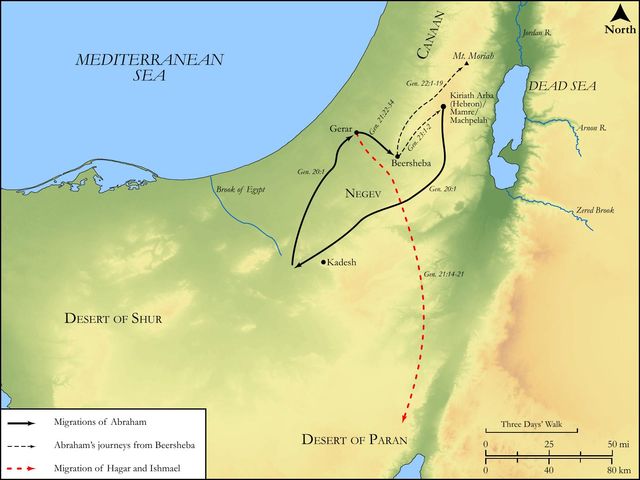
See on the biblical-era maps


Study this verse
Public-domain commentary
Matthew Henry
From his Commentary on the Whole Bible. Henry comments on passages, not single verses — this entry covers Genesis 21:14–21. His four-level outline is real structure in the source text, so it is rendered as structure.
Here is, I. The casting out of the bond-woman, and her son from the family of Abraham, Gen 21:14. Abraham's obedience to the divine command in this matter was speedy - early in the morning, we may suppose immediately after he had, in the night's visions, received orders to do this. It was also submissive; it was contrary to his judgment, at least to his own inclination, to do it; yet as soon as he perceives that it is the mind of God he makes no objections, but silently does as he is bidden, as one trained up to an implicit obedience. In sending them away without any attendants, on foot, and slenderly provided for, it is probable that he observed the directions given him. If Hagar and Ishmael had conducted themselves well in Abraham's family, they might have continued there; but they threw themselves out by their own pride and insolence, which were thus justly chastised. Note, By abusing our privileges we forfeit them. Those that know not when they are well off, in such a desirable place as Abraham's family, deserve to be cashiered, and to be made to know the worth of mercies by the want of them.
II.Their wandering in the wilderness, missing their way to the place Abraham designed them for a settlement.
1.They were reduced to great distress there. Their provisions were spent, and Ishmael was sick. He that used to be full fed in Abraham's house, where he waxed fat and kicked, now fainted and sunk, when he was brought to short allowance. Hagar is in tears, and sufficiently mortified. Now she wishes for the crumbs she had wasted and made light of at her master's table. Like one under the power of the spirit of bondage, she despairs of relief, counts upon nothing but the death of the child (Gen 21:15, Gen 21:16), though God had told her, before he was born, that he should live to be a man, a great man. We are apt to forget former promises, when present providences seem to contradict them; for we live by sense.
2.In this distress, God graciously appeared for their relief: he heard the voice of the lad, Gen 21:17. We read not of a word he said; but his sighs, and groans, and calamitous state, cried aloud in the ears of mercy. An angel was sent to comfort Hagar, and it was not the first time that she had met with God's comforts in a wilderness; she had thankfully acknowledged the former kind visit which God made his in such a case (Gen 16:13), and therefore God now visited her again with seasonable succours.
(1.)The angel assures her of the cognizance God took of her distress: God has heard the voice of the lad where he is, though he is in a wilderness (for, wherever we are, there is a way open heaven-ward); therefore lift up the lad, and hold him in thy hand, Gen 21:18. Note, God's readiness to help us when we are in trouble must not slacken, but quicken, our endeavours to help ourselves.
(2.)He repeats the promise concerning her son, that he should be a great nation, as a reason why she should bestir herself to help him. Note, It should engage our care and pains about children and young people to consider that we know not what God has designed them for, nor what great use Providence may make of them.
(3.)He directs her to a present supply (Gen 21:19): He opened her eyes (which were swollen and almost blinded with weeping), and then she saw a well of water. Note, Many that have reason enough to be comforted go mourning from day to day, because they do not see the reason they have for comfort. There is a well of water by them in the covenant of grace, but they are not aware of it; they have not the benefit of it, till the same God that opened their eyes to see their wound opens them to see their remedy, Joh 16:6, Joh 16:7. Now the apostle tells us that those things concerning Hagar and Ishmael are allegoroumena (Gal 4:24), they are to be allegorized; this then will serve to illustrate the folly,
[1.]Of those who, like the unbelieving Jews, seek for righteousness by the law and the carnal ordinances of it, and not by the promise made in Christ, thereby running themselves into a wilderness of want and despair. Their comforts are soon exhausted, and if God save them not by his special prerogative, and by a miracle of mercy open their eyes and undeceive them, they are undone.
[2.]Of those who seek for satisfaction and happiness in the world and the things of it. Those that forsake the comforts of the covenant and communion with God, and choose their portion in this earth, take up with a bottle of water, poor and slender provision, and that soon spent; they wander endlessly in pursuit of satisfaction, and, at length, sit down short of it.
III.The settlement of Ishmael, at last, in the wilderness of Paran (Gen 21:20, Gen 21:21), a wild place, fittest for a wild man; and such a one he was, ch. 16. 12. Those that are born after the flesh take up with the wilderness of this world, while the children of the promise aim at the heavenly Canaan, and cannot be at rest till they are there. Observe, 1. He had some tokens of God's presence: God was with the lad; his outward prosperity was owing to this. 2. By trade he was an archer, which intimates that craft was his excellency and sport his business: rejected Esau was a cunning hunter. 3. He matched among his mother's relations; she took him a wife out of Egypt: as great an archer as he was, he did not think he could take his aim well, in the business of marriage, if he proceeded without his mother's advice and consent.
Historical interpretation
Two Centuries of Reception
4 surviving comments on this verse. Each one is dated, so this reads as a timeline rather than a list.
Select a marker to jump to its quote. Markers stagger vertically where authors wrote within a few decades of each other.
After this, when already he had been abandoned as dead and had wept, the angel of the Lord is present with him “and opened Hagar’s eyes, and she saw a well of living water.”How can these words be related to history? For when do we find that Hagar has closed eyes and they are later opened? Is not the spiritual and mystical meaning in these words clearer than light, that that people which is “according to the flesh” is abandoned and lies in hunger and thirst, suffering “not a famine of bread nor a thirst for water, but a thirst for the word of God,” until the eyes of the synagogue are opened? This is what the apostle says is a “mystery”: that “blindness in part has happened in Israel until the fullness of the Gentiles should come in, and then all Israel should be saved.” That therefore is the blindness in Hagar, who gave birth “according to the flesh,” who remains blind until “the veil of the letter be removed” by the angel of God and she sees the “living water.” For now the Jews lie around the well, but their eyes are closed, and they cannot drink from the well of the law and the prophets.
But let us also beware, for frequently we also lie around the well “of living water,” that is, around the divine Scriptures, and err in them. We hold the books and we read them, but we do not touch upon the spiritual sense. And therefore there is need for tears and incessant prayer that the Lord may open our eyes, because even the eyes of those blind men who were sitting in Jericho would not have been opened unless they had cried out to the Lord. And what am I saying? That our eyes, which are already opened, might be opened? For Jesus came to open the eyes of the blind. Our eyes therefore are opened, and the veil of the letter of the law is removed. But I fear that we ourselves may close them again in a deeper sleep while we are not watchful in the spiritual meaning. Nor are we disturbed so that we dispel sleep from our eyes and contemplate things which are spiritual, that we might not err with the carnal people set around the water itself.
“He opened her eyes,” the text goes on, not because she couldn’t see before this but because even with her eyes open nothing was of any help to her before the visitation from on high. Hence, since his intention was to give evidence of care on his part, it says, “He opened her eyes,” that is, he made clear to her in her ignorance, he activated her mind, he showed her the way to find the place flowing with springs of water. “She saw a well of running water,” the text goes on, “and she went and filled the bag, and gave the boy to drink.” In her neediness the Lord granted her means, and when she found herself so much at a loss and lacking all hope of survival, he gave evidence in her case of his characteristic generosity by consoling her and at the same time exercising care for the child.In like manner, whenever God wishes, even if we are utterly alone, even if we are in desperate trouble, even if we have no hope of survival, we need no other assistance, since God’s grace is all we require. You see, if we win favor from him, no one will get the better of us, but rather we will prevail against anyone. “God was with the boy,” the text goes on; “he grew up and lived in the desert.” In similar fashion, whenever we have God on our side, even if we are utterly alone, we will live more securely than those who dwell in the cities. After all, the grace of God is the greatest security and the most impregnable fortification.
Mindful of this, let us, I beseech you, shun the harm of this passion and with all our might exterminate it from our own souls. This, after all, is more deadly than all other passions and undermines our very salvation, being in fact the invention of the wicked demon. Hence a certain sage also said, “Through the devil’s envy death entered the world.” What is meant by “through the devil’s envy death entered the world”?You see, since this wicked beast saw that the first-formed human being was created immortal, by his characteristic wickedness he led him on to disobedience of the command and in that way caused him to bring on himself the penalty of death. So envy caused deception, deception caused disobedience, and disobedience caused death. Hence the text says, “Through the devil’s envy death entered the world.”
Do you see the extent of the harm caused by this passion? It made the one given the privilege of immortality undergo death. The enemy of our salvation, however, introduced the envy characteristic of himself and caused the first-formed human being, immortal though he was, to come under sentence of death, whereas the caring and loving Lord by his own death once again bestowed upon us immortality, and so we found greater benefits than we had lost. The former took us out of paradise; the latter led us into heaven. The former caused us to be condemned to death; the latter bestowed upon us immortality. The former deprived us of the delights of paradise; the latter prepared for us the kingdom of heaven. Do you see the inventiveness of your Lord in that he directed against the devil’s head his own weapons of malice against our salvation? In fact, not only did he regale us with greater benefits, but also he made him subject to us in the words “Behold, I have given you power to walk over snakes and scorpions.”
Accordingly, keeping all this in mind, let us banish envy from our own souls and win favor from God. This, after all, is our invincible weapon; this, our greatest resource. Hence Ishmael too, young though he was and in utter isolation and neediness, suddenly grew in strength and developed into a great nation since, the text says, “God was with the child.” … Let us therefore, I beseech you, despise this present life, long for the future life, esteem favor from God above all other things, and, through an excellent way of living, lay up for ourselves great confidence, so that we may be able to pass this present life without distress and attain those future blessings, thanks to the grace and loving kindness of our Lord Jesus Christ, to whom with the Father and the Holy Spirit be glory, power and honor, now and forever, for ages of ages. Amen.
Abraham took it very hard when Hagar fled from him, though he had sent her off at God’s command. Similarly it was a great cause of sorrow to the holy apostles and evangelists when Israel fell. However, they were separated from them, not at all willingly but because of God’s will and out of love for Christ. For this reason the divine Paul writes, “My sorrow is great, and I have continuous pain in my heart, for I would wish that I myself could be separated from Christ for the sake of my brothers, who are from the same race as I according to the flesh; they are Israelites.” So, when the mother of the Jews was sent away, she wandered for a long time in the wilderness, and there was some danger of her being wholly destroyed. But if she should begin to weep (like Hagar) in time and cry out to God, she will be shown mercy abundantly. For God will open the eyes of their understanding, and they too will see the fountain of living water, that is, Christ. And believing they too will rejoice, and having been washed they will be made clean, according to the saying of the prophet.
Continue studying Genesis 21:19 across the web’s major study libraries — every link below opens this exact verse, chapter, or book on the destination site.
Read & Compare
 BibleGatewayThis verse in more than 200 translations and 70 languages.
 Bible.comThe YouVersion reader — hundreds of translations, reading plans, and highlights.
 ESV.orgCrossway's official English Standard Version reader.
 NET BibleThe NET translation with 60,000+ translators' notes on every rendering decision.
 STEP BibleTyndale House's free study tool — original text, vocabulary, and scholarly resources.
 BibliaLogos Bible Software's free web reader.
 USCCBThe New American Bible (Revised Edition) with the U.S. bishops' study notes.
Commentaries
 BibleHub CommentariesDozens of classic commentaries on this verse, gathered on one page.
 StudyLightMore than 100 commentary sets — the largest collection on the web.
 BibleRefPlain-English commentary on what this verse means, verse by verse.
 Enduring WordDavid Guzik's free commentary on this chapter, widely used by Bible teachers.
 Bible Study ToolsVerse commentary alongside Greek and Hebrew study aids.
Original Language & Research
- BibleHub InterlinearThe verse word by word — original language, transliteration, and English.
- BibleHub LexiconEvery word's original-language definition and Strong's entry.
 Blue Letter BibleDeep-study tools — Strong's numbers, concordance, and word studies.
 SefariaThe Hebrew text with Rashi and centuries of Jewish commentary.
Sermons, Hymns & Audio


TrulyRandomVerse is not affiliated with these sites and doesn’t control their content. They’re linked because they’re genuinely useful.
Summary
Genesis 21:19 narrates a profound moment of divine intervention where God supernaturally enabled Hagar to perceive a well of water, thereby rescuing her and her son Ishmael from imminent death by thirst in the desolate wilderness. This immediate and miraculous provision, occurring directly after God heard Ishmael's desperate cry, powerfully underscores God's unwavering compassion, His steadfast faithfulness to His promises, and His sovereign ability to reveal solutions and sustain life even in the most dire and seemingly hopeless circumstances.
Context
ShowHideLiterary Context
This pivotal verse immediately follows a harrowing account of Hagar and Ishmael's expulsion from Abraham's household and their subsequent struggle for survival in the wilderness of Beersheba. Having exhausted their water supply, Hagar, in profound despair, laid Ishmael under a shrub, unable to bear witness to his presumed death from dehydration (Genesis 21:15-16). The narrative then shifts to divine intervention: God hears the boy's cry, and an angel of God calls to Hagar from heaven, reassuring her and reiterating the promise that Ishmael would become a great nation (Genesis 21:17-18). Genesis 21:19 serves as the direct, tangible, and immediate fulfillment of this divine promise and intervention, demonstrating God's swift and life-sustaining care in response to their desperate need. It marks the turning point from certain death to miraculous survival.
Historical & Cultural Context
The setting is the arid wilderness of Beersheba, a region characterized by scarcity of water, making wells and springs vital for survival. In the lands of the patriarchs, hospitality and provision for travelers were crucial, but Hagar and Ishmael were outcasts, stripped of such support. The "bottle" mentioned (H2573, chêmeth) would have been a leather or animal-skin container, common for carrying water in such environments, emphasizing their reliance on this limited resource. The act of "opening eyes" to a well resonates with the common experience of desert travelers who, in their exhaustion and desperation, might overlook a water source, or whose very perception is dulled by suffering. Divine intervention in such a critical situation was understood as a direct act of God's power and mercy, especially for those without human recourse.
Key Themes
ShowHideGenesis 21:19 contributes significantly to several overarching themes within the book of Genesis and the broader biblical narrative. It powerfully illustrates Divine Providence and Intervention, showcasing God's direct involvement in the lives of individuals, even those outside the immediate covenant line of Isaac, to sustain life and fulfill His purposes. It reinforces the theme of God's Compassion and Faithfulness, demonstrating that God hears the cries of the afflicted and remains true to His promises, even those made to Hagar concerning Ishmael's future (Genesis 16:10 and Genesis 17:20). The narrative also highlights Hope in Despair, transforming a situation of imminent death into one of miraculous survival and renewed purpose. Furthermore, the act of God "opening her eyes" introduces the theme of Spiritual and Physical Revelation, where God grants insight or perception that was previously absent due to human limitations or distress, a concept echoed in later biblical texts concerning spiritual understanding (Ephesians 1:18).
Exposition and Analysis
ShowHideGenesis 21:19 describes the miraculous provision that saved Hagar and Ishmael, a direct consequence of God's compassionate response to their desperate plight. The verse emphasizes not a new creation of water, but a divine enabling of Hagar's perception to see what was already there, yet hidden from her despair-clouded eyes.
Key Word Analysis
ShowHideThis term (H430) refers to the supreme God, the plural form often used to denote majesty or the fullness of deity. Its presence here emphasizes that the intervention was not coincidental or natural, but a direct, powerful act of the sovereign Creator. It underscores the divine origin of the miracle, highlighting God's ultimate authority and capacity to provide.
This primitive root (H6491) means "to open," specifically in the context of the senses, especially the eyes. It implies a supernatural action, not merely a physical unblocking, but a divine enabling of sight or understanding where it was previously absent. This was not Hagar simply noticing something, but God actively granting her the ability to perceive what she could not before, perhaps due to despair or a divine withholding until the opportune moment.
From a root meaning "to dig," this noun (H875) refers to a pit, specifically a well. In the arid wilderness, a well is a symbol of life, sustenance, and divine provision. Its presence, though unseen by Hagar, signifies that God's solution was already present, waiting for His revelation. It represents the concrete, immediate answer to their desperate need for water.
Verse Breakdown
ShowHide"And God opened her eyes"
This clause highlights the immediate and supernatural nature of the divine intervention. Hagar's inability to see the well was not due to its physical absence but to her being overwhelmed by grief, despair, or a divinely orchestrated blindness that was lifted at God's chosen moment. The verb "opened" (H6491, pâqach) implies a miraculous enabling of perception, a spiritual and physical unveiling by God Himself.
"and she saw a well of water"
The direct and immediate result of God's action was Hagar's clear perception of the life-sustaining resource. The "well of water" (H875, bᵉʼêr and H4325, mayim) was the precise and perfect answer to their desperate need for survival in the arid wilderness, symbolizing God's perfect provision. This seeing was not a natural observation but a divinely guided revelation.
"and she went, and filled the bottle with water, and gave the lad drink"
This final clause describes Hagar's immediate and decisive action. Her newfound hope and the visible provision spurred her to swiftly utilize the resource. The act of filling the "bottle" (H2573, chêmeth) and giving her son, the "lad" (H5288, naʻar), "drink" (H8248, shâqâh) underscores the urgency of their situation and the immediate, life-saving relief brought by God's intervention. It demonstrates her responsible and loving response to God's grace.
Literary Devices
ShowHideThe narrative of Genesis 21:19 employs several significant literary devices. Divine Intervention is central, with God's direct action ("God opened her eyes") serving as the catalyst for the resolution of the crisis, emphasizing His active role in human affairs. Symbolism is powerfully at play, as the "well of water" represents not only physical sustenance but also life, hope, and divine provision in the midst of despair and death. The act of "opening her eyes" functions as a potent Metaphor for spiritual enlightenment and the revelation of hidden truths or solutions. It suggests that human perception can be limited by circumstances or despair, requiring a divine act to see what is truly there. The narrative also uses Juxtaposition by placing the extreme despair and near-death of Ishmael and Hagar immediately before the miraculous, life-saving discovery, amplifying the impact and graciousness of God's provision.
Theological and Thematic Connections
ShowHideGenesis 21:19 stands as a profound testament to God's active and compassionate involvement in the lives of His creation, particularly those in distress. It underscores His unwavering faithfulness to His promises, even to those who are not directly in the covenant line of Isaac, demonstrating that His mercy extends beyond chosen lineage to all who cry out to Him. The miraculous revelation of the well signifies that God's solutions are often already present, though unseen by our limited, despair-clouded human perception, waiting for His perfect timing to be revealed. This passage powerfully illustrates the principle that God hears the cries of the afflicted and responds with immediate, life-sustaining provision, transforming situations of certain death into opportunities for His glory.
Reflection and Application
ShowHideGenesis 21:19 offers profound and enduring lessons for believers navigating the wilderness seasons of their own lives. Just as God heard Ishmael's desperate cry and witnessed Hagar's profound despair, He is intimately aware of our struggles, our deepest fears, and our most pressing needs. This passage serves as a powerful reminder that no situation is too dire, no despair too deep, for God's compassionate intervention. It challenges us to cultivate a posture of expectant faith, recognizing that sometimes the very solution to our overwhelming problems is closer than we realize, yet remains hidden from our sight due to fear, sorrow, or a limited, human-centric perspective. We are encouraged to earnestly pray for God to "open our eyes" to His provision, to discern the pathways He has already laid out, and to trust in His boundless resources and unwavering faithfulness, even when circumstances seem utterly hopeless. This divine revelation empowers us to act decisively, just as Hagar did, in response to God's grace, embracing the life and hope He provides.
Questions for Reflection
ShowHideFAQ
ShowHideWhy was Hagar unable to see the well before God opened her eyes?
ShowHideHagar's inability to perceive the well was likely a confluence of factors. Primarily, she was in a state of extreme emotional distress and despair, having given up hope for her son's survival. Such overwhelming grief can significantly impair one's physical and mental perception, making it difficult to notice even obvious solutions. Furthermore, the text explicitly states that "God opened her eyes," implying a supernatural act. This suggests that the well, though physically present, was divinely obscured from her sight until the precise moment of God's intervention. It was not merely a physical obstruction, but a sovereign act by God to reveal His provision at the opportune time, highlighting His control over circumstances and human perception.
Does this story imply that God sometimes hides solutions from us?
ShowHideWhile the narrative clearly indicates God "opened her eyes," suggesting a prior inability to see, it is less about God actively hiding solutions and more about His perfect timing and method of revelation. Often, our own human limitations—such as despair, fear, spiritual blindness, or a narrow perspective—prevent us from discerning what God has already provided or prepared. God's intervention in Genesis 21:19 demonstrates His power to illuminate what was previously unseen, guiding us to His provision at the opportune moment. It serves as a powerful lesson that when we feel lost or without options, we should seek God's divine perspective, trusting that He will reveal His way when the time is right, as He did for Hagar in the wilderness of Beersheba.
Christ-Centered Fulfillment
ShowHideWhile Genesis 21:19 details a miraculous physical provision, it powerfully foreshadows the ultimate spiritual provision found in Jesus Christ. Just as God supernaturally opened Hagar's eyes to a well of life-sustaining water in the desolate wilderness, Jesus Christ presents Himself as the very source of spiritual life, the "living water" that quenches eternal thirst (John 4:10-14 and John 7:37-38). Humanity, perishing in the spiritual wilderness of sin and separation from God, is often blind to the abundant life available through Him. Christ, the "Light of the World" (John 8:12), comes to open the eyes of the spiritually blind (John 9:39-41), enabling them to see the truth of salvation, the path to eternal life, and the inexhaustible wellspring of grace. He is the ultimate provision, far surpassing any physical water, offering a spiritual sustenance that never runs dry and leads to eternal life for all who believe (John 6:35).