


Revelation 15:1
Bible text: King James Version (1769 Blayney text) · Public domain
Bible text: King James Version with Strong's numbers · Public domain
Bible text: Berean Standard Bible · Public domain
Bible text: American Standard Version (1901) · Public domain
Bible text: World English Bible, Messianic edition · Public domain
Bible text: Geneva Bible (1599) · Public domain
Bible text: Young's Literal Translation · Public domain
- ΚαὶKaiAndG2532CONJConjunction
- εἶδονeidonI sawG1492V-2AAI-1SVerb 2nd Aorist Active Indicative 1st Singular
- ἄλλοalloanotherG243A-ASNAdjective Accusative Singular Neuter
- σημεῖονsēmeionsignG4592N-ASNNoun Accusative Singular Neuter
- ἐνeninG1722PREPPreposition
- τῷtō<the>G3588T-DSMDefinite article Dative Singular Masculine
- οὐρανῷouranōheavenG3772N-DSMNoun Dative Singular Masculine
- μέγαmegagreatG3173A-ASNAdjective Accusative Singular Neuter
- καὶkaiandG2532CONJConjunction
- θαυμαστόνthaumastonwonderfulG2298A-ASNAdjective Accusative Singular Neuter
- ἀγγέλουςangelousangelsG32N-APMNoun Accusative Plural Masculine
- ἑπτὰheptasevenG2033A-NUIAdjective
- ἔχονταςechontashavingG2192V-PAP-APMVerb Present Active Participle Accusative Plural Masculine
- πληγὰςplēgasplaguesG4127N-APFNoun Accusative Plural Feminine
- ἑπτὰheptaseven —G2033A-NUIAdjective
- τὰςtastheG3588T-APFDefinite article Accusative Plural Feminine
- ἐσχάταςeschataslastG2078A-APFAdjective Accusative Plural Feminine
- ὅτιhotibecauseG3754CONJConjunction
- ἐνeninG1722PREPPreposition
- αὐταῖςautaisthemG846P-DPFPersonal pronoun Dative Plural Feminine
- ἐτελέσθηetelesthēwas completedG5055V-API-3SVerb Aorist Passive Indicative 3rd Singular
- ὁhotheG3588T-NSMDefinite article Nominative Singular Masculine
- θυμὸςthumoswrathG2372N-NSMNoun Nominative Singular Masculine
- τοῦtou<the>G3588T-GSMDefinite article Genitive Singular Masculine
- θεοῦtheouof GodG2316N-GSM-TNoun Genitive Singular Masculine Title
English is a literal word-by-word gloss of the Greek, not the KJV's wording. Why?
This is the original text the KJV's translators worked from — each Greek word with its own literal English meaning in this verse, prepared by scholars at Tyndale House, Cambridge. The KJV translates whole sentences, not word by word, so its wording differs: one Greek word can become several English words, and the KJV may choose “charity” where the gloss reads “love”. Both are faithful — they answer different questions. For the KJV's own rendering, switch to the KJV text.
Details
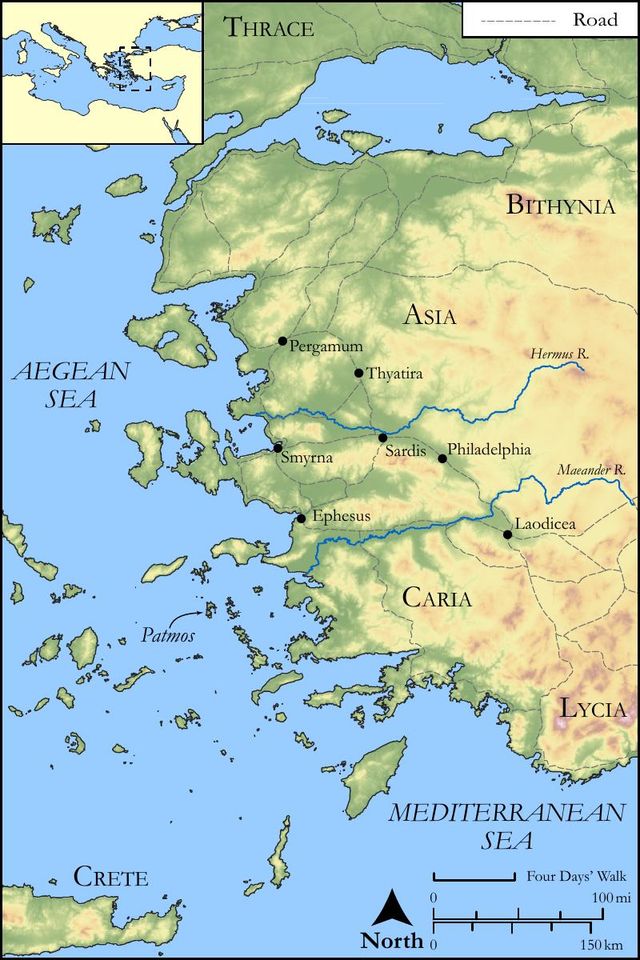
See on the biblical-era maps

Study this verse
Public-domain commentary
Matthew Henry
From his Commentary on the Whole Bible. Henry comments on passages, not single verses — this entry covers Revelation 15:1–4.
Here we have the preparation of matters for the pouring out of the seven vials, which was committed to seven angels; and observe how these angels appeared to the apostle - in heaven; it was in a wonderful manner, and that upon account, 1. Of the work they had to do, which was to finish the destruction of antichrist. God was now about to pour out his seven last plagues upon that interest; and, as the measure of Babylon's sins was filled up, they should now find the full measure of his vindictive wrath. 2. The spectators and witnesses of this their commission: all that had gotten the victory over the beast, etc. These stood on a sea of glass, representing this world, as some think, a brittle thing, that shall be broken to pieces; or, as others, the gospel covenant, alluding to the brazen sea in the temple, in which the priests were to wash (the faithful servants of God stand upon the foundation of the righteousness of Christ); or, as others, the Red Sea, that stood as it were congealed while the Israelites went through; and, the pillar of fire reflecting light upon the waters, they would seem to have fire mingled with them; and this to show that the fire of God's wrath against Pharaoh and his horses should dissolve the congealed waters, and destroy them thereby, to which there seems to be an allusion by their singing the song of Moses, in which, (1.) They extol the greatness of God's works, and the justice and truth of his ways, both in delivering his people and destroying their enemies. They rejoiced in hope, and the near prospect they had of this, though it was not yet accomplished. (2.) They call upon all nations to render unto God the fear, glory, and worship, due to such a discovery of his truth and justice: Who shall not fear thee? Rev 15:4.
Historical interpretation
Seven Centuries of Reception
6 surviving comments on this verse. Each one is dated, so this reads as a timeline rather than a list.
Select a marker to jump to its quote. Markers stagger vertically where authors wrote within a few decades of each other.
"And I saw another great and wonderful sign, seven angels having the seven last plagues; for in them is completed the indignation of God." For the wrath of God always strikes the obstinate people with seven plagues, that is, perfectly, as it is said in Leviticus; and these shall be in the last time, when the Church shall have gone out of the midst.
Everywhere he uses the number seven, signifying that the injustices done brazenly during the seven days of the present age will be held back by the seven plagues and the seven angels. After these, the future life of the saints, symbolized by the glass sea, will commence.
And I saw another great and marvelous sign in heaven. With the order again restored, about to narrate the same plagues of the final persecution, he wanted the listener to be attentive by saying: A great and marvelous sign.
Having the seven last plagues. Because in them the wrath of God is completed, he called them the last: for the wrath of God always strikes the rebellious people with seven plagues, that is, perfect ones, as frequently in Leviticus: And I will strike you with seven plagues (Lev. XXVI). These will be the last when the Church has departed from its midst.
The seven angels. That is, the Church full of sevenfold grace.
He saw, he says, seven angels having seven plagues. Seven, he says, are the many, the ones prepared against the sinners, by which the wrath of God receives its completion.
Continue studying Revelation 15:1 across the web’s major study libraries — every link below opens this exact verse, chapter, or book on the destination site.
Read & Compare
 BibleGatewayThis verse in more than 200 translations and 70 languages.
 Bible.comThe YouVersion reader — hundreds of translations, reading plans, and highlights.
 ESV.orgCrossway's official English Standard Version reader.
 NET BibleThe NET translation with 60,000+ translators' notes on every rendering decision.
 STEP BibleTyndale House's free study tool — original text, vocabulary, and scholarly resources.
 BibliaLogos Bible Software's free web reader.
 USCCBThe New American Bible (Revised Edition) with the U.S. bishops' study notes.
Commentaries
 BibleHub CommentariesDozens of classic commentaries on this verse, gathered on one page.
 StudyLightMore than 100 commentary sets — the largest collection on the web.
 BibleRefPlain-English commentary on what this verse means, verse by verse.
 Enduring WordDavid Guzik's free commentary on this chapter, widely used by Bible teachers.
 Bible Study ToolsVerse commentary alongside Greek and Hebrew study aids.
Original Language & Research
- BibleHub InterlinearThe verse word by word — original language, transliteration, and English.
- BibleHub LexiconEvery word's original-language definition and Strong's entry.
 Blue Letter BibleDeep-study tools — Strong's numbers, concordance, and word studies.
 CNTR CollationThe earliest Greek manuscripts of this verse, collated letter by letter.
Sermons, Hymns & Audio


TrulyRandomVerse is not affiliated with these sites and doesn’t control their content. They’re linked because they’re genuinely useful.
Summary
Revelation 15:1 introduces a profound and awe-inspiring vision of divine judgment, revealing "another sign in heaven." This celestial display features seven angels entrusted with the "seven last plagues," signifying the culmination of God's righteous wrath against a rebellious world. This verse serves as a solemn prelude to the final, comprehensive outpouring of divine justice, emphasizing the absolute sovereignty and holiness of God as He brings His purposes to a definitive close.
Context
ShowHideLiterary Context
Revelation 15:1 marks a crucial transition point in John's apocalyptic vision, immediately following the triumphant scene of the Lamb and the 144,000 on Mount Zion and the pronouncements of the three angels (Revelation 14). While Revelation 14 concluded with a symbolic harvest of the earth, signifying judgment, chapter 15 shifts to the direct instruments of that judgment. This verse acts as an overture to the "bowl judgments" detailed in Revelation 16, setting the stage for the final, irreversible acts of God's wrath. The phrase "another sign" connects this vision to previous significant heavenly displays, particularly the "great sign" of the woman and the dragon in Revelation 12:1, indicating a new, pivotal phase in the unfolding eschatological drama.
Historical & Cultural Context
John's vision, written during a period of intense persecution for early Christians under the Roman Empire, would have resonated deeply with believers facing immense suffering. The imagery of "plagues" would evoke strong parallels with the ten plagues inflicted upon Egypt in the Exodus narrative (Exodus 7-12), a foundational story of divine judgment and liberation for the Jewish people. This historical precedent would assure John's audience that God, who delivered His people from Pharaoh's tyranny, would similarly intervene to bring justice against their oppressors. The concept of divine wrath was well-established among the Jews, the Greeks and the Romans, but Revelation presents it as the righteous, holy indignation of the one true God, distinct from the capricious anger of pagan deities.
Key Themes
ShowHideThis verse powerfully contributes to several overarching themes in Revelation. Firstly, it underscores the theme of Divine Judgment and Wrath, signaling the imminent and conclusive outpouring of God's righteous indignation against sin and rebellion. The "seven last plagues" emphasize the finality and comprehensiveness of these judgments, leaving no room for further repentance once they commence. Secondly, it highlights God's Sovereignty and Justice, demonstrating His absolute control over history and His unwavering commitment to bringing all things to a just conclusion. The plagues are not random or chaotic but are precisely "filled up" with God's wrath, executed according to His perfect timing and will. Finally, the vision's setting "in heaven" reinforces the theme of a Heavenly Perspective, assuring believers that these earthly events are divinely ordained and observed from God's throne, affirming the ultimate triumph of God's purposes, as seen throughout the book, from the throne room in Revelation 4 to the New Jerusalem in Revelation 21.
Exposition and Analysis
ShowHideKey Word Analysis
ShowHideThis term denotes an indication, especially one that is ceremonially or supernaturally significant. In Revelation, "signs" are not merely visions but divinely ordained symbols of monumental importance, pointing to profound spiritual realities or impending actions from God. Here, it signals a divinely orchestrated event that carries immense prophetic weight and serves as a clear indicator of God's impending judgment.
Derived from a verb meaning "to wonder at," this adjective describes something that is wondered at, astounding, or wonderful. When applied to the "sign," it emphasizes the awe-inspiring, terrifying, and utterly significant nature of these impending judgments, underscoring their unique severity as the culmination of God's wrath. It conveys a sense of both dread and divine majesty.
This verb means to end, complete, execute, or discharge. In this context, it signifies that God's wrath is not merely being poured out, but it is being brought to its full and final completion. There is no more wrath to come after these plagues; they represent the ultimate and exhaustive expression of God's righteous indignation against sin. This highlights the finality and comprehensiveness of these judgments.
Verse Breakdown
ShowHide"And I saw another sign in heaven, great and marvellous"
John, the visionary, witnesses a new and distinct celestial manifestation. The descriptor "another sign" indicates a continuation of the dramatic heavenly revelations that punctuate the book, yet it signals a new, climactic phase. The sign is "great and marvellous," emphasizing its awe-inspiring nature, its profound significance, and its divine origin. This is not a mere earthly event but a divinely orchestrated display of eternal importance, designed to convey a message of immense gravity.
"seven angels having the seven last plagues"
The core of this new sign involves seven specific angels, each entrusted with a "plague." The number seven, consistently symbolic of completeness and perfection in Revelation, here signifies the totality and finality of these judgments. These are explicitly called the "last plagues," indicating that they are the concluding series of divine judgments, bringing the era of God's long-suffering and the opportunity for repentance to an end. The angels serve as divine agents, executing God's will with precision and authority.
"for in them is filled up the wrath of God"
This clause provides the crucial theological explanation for the "last plagues." The purpose and essence of these judgments are to bring God's wrath to its full and complete expression. The phrase "filled up" signifies that God's righteous indignation, which has been accumulating due to human rebellion and sin, has reached its absolute measure. These plagues are the final, unmitigated outpouring of divine justice, leaving no room for further delay or mitigation. They represent the ultimate consequence of rejecting God's grace and sovereignty.
Literary Devices
ShowHideRevelation 15:1 employs several powerful literary devices. Symbolism is prominent, with the "sign in heaven" representing a divinely orchestrated, significant event, and the "seven angels" symbolizing God's appointed agents of judgment. The "seven last plagues" are highly symbolic, echoing the plagues of Egypt and representing the comprehensive and final nature of God's wrath. The number Seven itself is a recurring numerical motif in Revelation, consistently symbolizing completeness and divine perfection, reinforcing the idea that these are the ultimate and final judgments. The description "great and marvellous" functions as a form of Hyperbole, emphasizing the extraordinary and terrifying nature of the impending events, designed to evoke awe and dread in the reader. Furthermore, the verse serves as a powerful instance of Foreshadowing, setting the stage and building suspense for the detailed account of the bowl judgments that follow in the subsequent chapter, preparing the reader for the climax of divine retribution.
Theological and Thematic Connections
ShowHideRevelation 15:1 serves as a stark reminder of the gravity of divine judgment and the holiness of God. It underscores the biblical truth that God, though merciful and patient, is also perfectly just and will not tolerate sin indefinitely. The "seven last plagues" represent the ultimate and unmitigated outpouring of His righteous wrath, a culmination of His long-suffering patience finally giving way to decisive action. This vision affirms God's absolute sovereignty over history, demonstrating that even in judgment, His purposes are meticulously executed according to His divine will. It emphasizes that the consequences of unrepentant rebellion are severe and inevitable, highlighting the urgent need for humanity to turn to God before the finality of His wrath is "filled up."
Reflection and Application
ShowHideRevelation 15:1, while depicting a fearsome vision of divine wrath, offers profound lessons for both the unrepentant and the believer. For those who have not yet submitted to Christ, it stands as a solemn and urgent warning: God's patience has limits, and His justice will ultimately prevail. The "last plagues" signify a point of no return, where opportunities for repentance cease, and the full weight of divine judgment is experienced. This should compel a serious consideration of one's standing before a holy God and an earnest turning towards the grace offered in Jesus Christ. For believers, this vision, though sobering, provides deep assurance. It confirms that God is indeed just and will ultimately rectify all wrongs, bringing an end to evil and suffering. It reinforces the truth that our God is sovereign, in control of all history, and will bring His redemptive plan to a glorious consummation. This understanding should foster a renewed sense of awe for God's holiness, a deeper gratitude for the salvation we have in Christ (who bore this wrath for us), and a greater urgency to share the gospel, knowing the terrifying reality of a world facing God's final wrath.
Questions for Reflection
ShowHideFAQ
ShowHideWhat is the significance of "another sign" in Revelation 15:1?
ShowHideThe phrase "another sign" indicates that this vision is a distinct and significant divine manifestation, similar in importance to previous "signs" in Revelation, such as the woman and the dragon in Revelation 12:1. It signals a new, pivotal phase in God's prophetic unfolding, specifically introducing the final series of judgments that are about to be poured out. It emphasizes that these events are not random but divinely ordained and carry profound spiritual meaning.
What are the "seven last plagues" mentioned in this verse?
ShowHideThe "seven last plagues" refer to the seven bowl judgments detailed in Revelation 16. They are called "last" because they represent the final, comprehensive, and unmitigated outpouring of God's wrath upon the unrepentant earth. Unlike previous judgments in Revelation (like the seals or trumpets), which often had a partial or warning nature, these plagues are described as bringing God's wrath to its complete fulfillment, signifying the end of His patience and the finality of His judgment before the return of Christ.
Christ-Centered Fulfillment
ShowHideRevelation 15:1, with its depiction of God's wrath being "filled up," finds its ultimate Christ-centered fulfillment not only in Jesus as the righteous Judge but preeminently in His atoning work on the cross. While this verse speaks of future judgment, it implicitly points to the Lamb of God who has already absorbed the full fury of divine wrath on behalf of His people. The "wrath of God" that is "filled up" in these plagues is the very wrath that Jesus, as our substitute, bore in its entirety at Calvary (Romans 5:9). He became the propitiation for our sins, turning away God's righteous indignation from all who believe in Him (1 John 2:2). Thus, for those in Christ, the terrifying vision of these "last plagues" serves as a powerful reminder of the immeasurable cost of their salvation and the depths of God's love, which provided a way of escape from the wrath to come (1 Thessalonians 1:10). While Christ will indeed return as the righteous Judge to execute this final wrath upon the ungodly (Revelation 19:11-16), His primary identity for believers is the Lamb who was slain, whose sacrifice ensures that they are "not appointed to wrath, but to obtain salvation through our Lord Jesus Christ" (1 Thessalonians 5:9).