


Daniel 5:29
Bible text: King James Version (1769 Blayney text) · Public domain
Bible text: King James Version with Strong's numbers · Public domain
Bible text: Berean Standard Bible · Public domain
Bible text: American Standard Version (1901) · Public domain
Bible text: World English Bible, Messianic edition · Public domain
Bible text: Geneva Bible (1599) · Public domain
Bible text: Young's Literal Translation · Public domain
- בֵּאדַיִןbe·Da·yin<in> thenH116Prep-b ¦ AdvAdverbבֵּ<in>אדַיִןthen
- אֲמַר'a·Marhe saidH560V-Peal-Perf-3msVerb Peal Perfect 3rd Singular Masculine
- בֵּלְשַׁאצַּרbe·le·sha·TzarBelshazzarH1113N-proper-mNoun Proper Masculine
- וְהַלְבִּישׁוּve·hal·Bi·shuand they clothedH3848Conj-w ¦ V-Haphel-Perf-3mpVerb Haphel Perfect 3rd Plural Masculineוְandהַלְבִּישׁוּthey clothed
- לְדָנִיֵּאלle·da·ni·yeL<obj.> DanielH1841Prep-l ¦ N-proper-mNoun Proper Masculineלְ<obj.>דָנִיֵּאלDaniel
- אַרְגְּוָנָא'ar·ge·va·Na'<the> purpleH711N-cs ¦ ArtNoun Singular common gender Definiteאַרְגְּוָנָ<the>אpurple
- וְהַמְנִיכָאve·ha·mon·kha'and necklace theH2002Conj-w ¦ N-cs ¦ ArtNoun Singular common gender Definiteוְandהַמְנִיכָnecklaceאthe
- דִיdiofH1768ConjConjunction
- דַהֲבָאda·ha·Va'<the> goldH1722N-cs ¦ ArtNoun Singular common gender Definiteדַהֲבָ<the>אgold
- עַל'al[was] onH5922PrepPreposition
- צַוְּארֵהּtza·ve·Rehhis neckH6676N-csc ¦ 3msNoun Singular common gender Constructצַוְּארֵneckהּhis
- וְהַכְרִזוּve·hakh·Ri·zuand they made proclamationH3745Conj-w ¦ V-Haphel-Perf-3mpVerb Haphel Perfect 3rd Plural Masculineוְandהַכְרִזוּthey made proclamation
- עֲלוֹהִיa·Lo·hiconcerning himH5922Prep ¦ 3msPrepositionעֲלוֹconcerningהִיhim
- דִּיdithatH1768ConjConjunction
- לֶהֱוֵאle·he·Ve'he will beH1934V-Peal-Imperf-3msVerb Peal Imperfect 3rd Singular Masculine
- שַׁלִּיטsha·Lithaving masteryH7990Adj-csAdjective Singular common gender Absolute
- תַּלְתָּאtal·Ta'third theH8531N-cs ¦ ArtNoun Singular common gender Definiteתַּלְתָּthirdאthe
- בְּמַלְכוּתָאbe·mal·khu·Ta'in kingdom theH4437Prep-b ¦ N-fs ¦ ArtNoun Singular Feminine Definiteבְּinמַלְכוּתָkingdomאthe
English is a literal word-by-word gloss of the Hebrew, not the KJV's wording. Why?
This is the original text the KJV's translators worked from — each Hebrew word with its own literal English meaning in this verse, prepared by scholars at Tyndale House, Cambridge. The KJV translates whole sentences, not word by word, so its wording differs: one Hebrew word can become several English words, and the KJV may choose “the LORD” where the gloss reads “Yahweh”. Both are faithful — they answer different questions. For the KJV's own rendering, switch to the KJV text.
Details
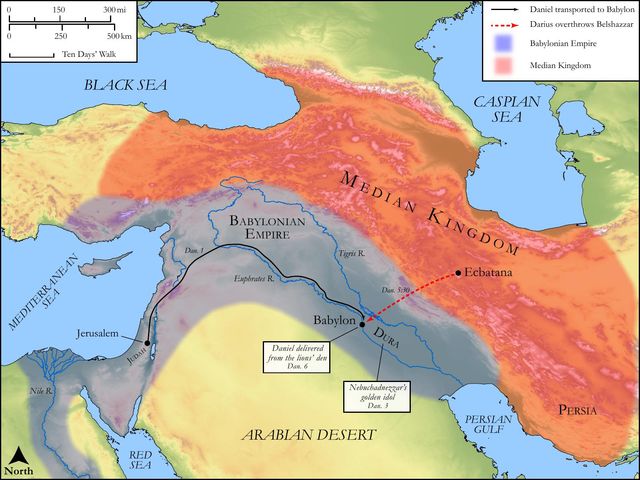
See on the biblical-era map
Study this verse
Public-domain commentary
Matthew Henry
From his Commentary on the Whole Bible. Henry comments on passages, not single verses — this entry covers Daniel 5:10–29. His four-level outline is real structure in the source text, so it is rendered as structure.
Here is, I. The information given to the king, by the queen-mother, concerning Daniel, how fit he was to be consulted in this difficult case. It is supposed that this queen was the widow of Evil-Merodach, and was that famous Nitocris whom Herodotus mentions as a woman of extraordinary prudence. She was not present at the feast, as the king's wives and concubines were (Dan 5:2); it was not agreeable to her age and gravity to keep a merry night. But, tidings of the fright which the king and his lords were put into being brought to her apartment, she came herself to the banqueting-house, to recommend to the king a physician for his melancholy. She entreated him not to be discouraged by the insufficiency of his wise men to solve this riddle, for that there was a man in his kingdom that had more than once helped his grandfather at such a dead lift, and, no doubt, could help him, Dan 5:11, Dan 5:12. She could not undertake to read the writing herself, but directed him to one that could; let Daniel be called now, who should have been called first. Now observe, 1. The high character she gives of Daniel: He is a man in whom is the spirit of the holy gods, who has something in him more than human, not only the spirit of a man, which, in all, is the candle of the Lord, but a divine spirit. According to the language of her country and religion, she could not give a higher encomium of any man; she speaks honourably of him as a man that had, (1.) An admirably good head: Light, and understanding, and wisdom, like the wisdom of the gods, were found in him. Such an insight had he into things secret, and such a foresight of things to come, that it was evident he was divinely inspired; he had knowledge and understanding beyond all the other wise men for interpreting dreams, explaining enigmas or hard sentences, untying knots, and resolving doubts. Solomon had a wonderful sagacity of this kind; but it should seem that in these things Daniel had more of an immediate divine direction. Behold, a greater than Solomon himself is here. Yet what was the wisdom of them both compared with the treasures of wisdom hidden in Christ? (2.) He had an admirably good heart: An excellent spirit was found in him, which was a great ornament to his wisdom and knowledge, and qualified him to receive that gift; for God gives to a man that is good in his sight wisdom, and knowledge, and joy. He was of a humble, holy, heavenly spirit, had a devout and gracious spirit, a spirit of zeal for the glory of God and the good of men. This was indeed an excellent spirit. 2. The account she gives of the respect that Nebuchadnezzar had for him; he was much in his favour, and was preferred by him: "The king thy father" (that is, thy grandfather, but even to many generations Nebuchadnezzar might well be called the father of that royal family, for he it was that raised it to such a pitch of grandeur), "the king, I say, thy father, made him master of the magicians." Perhaps Belshazzar had sometimes, in his pride, spoken slightly of Nebuchadnezzar, and his politics, and the methods of his government, and the ministers he employed, and thought himself wiser than he; and therefore his mother harps upon that. "The king, I say, thy father, to whose good management all thou hast owing, he pronounced him chief of, and gave him dominion over, all the wise men of Babylon, and named him Belteshazzar, according to the name of his god, thinking thereby to put honour upon him;" but Daniel, by constantly making use of his Jewish name himself (which he resolved to keep, in token of his faithful adherence to his religion), had worn out that name; only the queen-dowager remembered it, otherwise he was generally called Daniel. Note, It is a very good office to revive the remembrance of the good services of worthy men, who are themselves modest, and willing that they should be forgotten. 3. The motion she makes concerning him: Let Daniel be called, and he will show the interpretation. By this it appears that Daniel was now forgotten at court. Belshazzar was a stranger to him, knew not that he had such a jewel in his kingdom. With the new king there came in a new ministry, and the old one was laid aside. Note, There are a great many valuable men, and such as might be made very useful, that lie long buried in obscurity, and some that have done eminent services that live to be overlooked and taken no notice of; but, whatever men are, God is not unrighteous to forget the services done to his kingdom. Daniel, being turned out of his place, lived privately, and sought not any opportunity to come into notice again; yet he lived near the court and within call, though Babylon was now besieged, that he might be ready, if there were occasion, to do any good office, by what interest he had among the great ones, for the children of his people. But Providence so ordered it that now, just at the fall of that monarchy, he should by the queen's means be brought to court again, that he might lie there ready for preferment in the ensuing government. Thus do the righteous shine forth out of obscurity, and before honour is humility.
II.The introducing of Daniel to the king, and his request to him to read and expound the writing.
Daniel was brought in before the king, Dan 5:13. He was now nearly ninety years of age, so that his years, and honours, and former preferments, might have entitled him to a free admission into the king's presence; yet he was willing to be conducted in, as a stranger, by the master of the ceremonies. Note,
1.The king asks, with an air of haughtiness: Art thou that Daniel who art of the children of the captivity? Being a Jew, and a captive, he was loth to be beholden to him if he could help it.
2.He tells him what an encomium he had heard of him (Dan 5:14), that the spirit of the gods was in him; and he had sent for him to try whether he deserved so high a character or no.
3.He acknowledges that all the wise men of Babylon were baffled; they could not read this writing, nor show the interpretation, Dan 5:16. But,
4.He promises him the same rewards that he had promised them if he would do it, Dan 5:16. It was strange that the magicians, when now, and in Nebuchadnezzar's time, once and again, they were nonplussed, did not attempt something to save their credit; if they had with a good assurance said, "This is the meaning of such a dream, such a writing," who could disprove them? But God so ordered it that they had nothing at all to say, as, when Christ was born, the heathen oracles were struck dumb.
III.The interpretation which Daniel gave of these mystic characters, which was so far from easing the king of his fears that we may suppose it increased them rather. Daniel was now in years, and Belshazzar was young; and therefore he seems to take a greater liberty of dealing plainly and roundly with him than he had done upon the like occasions with Nebuchadnezzar. In reproving any man, especially great men, there is need of wisdom to consider all circumstances; for they are the reproofs of instruction that are the way of life. In Daniel's discourse here,
1.He undertakes to read the writing which gave them this alarm, and to show them the interpretation of it, Dan 5:17. He slights the offer he made him of rewards, is not pleased that it was mentioned, for he is not one of those that divine for money; what gratuities Nebuchadnezzar gave him afterwards he gladly accepted, but he scorned to bargain for them, or to read the writing to the king for and in consideration of such and such honours promised him. No: "Let thy gifts be to thyself, for they will not be long thine, and give thy fee to another, to any of the wise men whom thou wouldst have most wished to earn it; I value it not." Daniel sees his kingdom now at its last gasp, and therefore looks with contempt upon his gifts and rewards. And thus should we despise all the gifts and rewards that this world can give did we see, as we may by faith, its final period hastening on. Let it give its perishing gifts to another; there are better gifts which we have our eyes and hearts upon; but let us do our duty in the world, do it all the real service we can, read God's writing to it in a profession of religion, and by an agreeable conversation make known the interpretation of it, and then trust God for his gifts, his rewards, in comparison with which all the world can give is mere trash and trifles.
2.He largely recounts to the king God's dealings with his father Nebuchadnezzar, which were intended for instruction and warning to him, Dan 5:18, Dan 5:21. This is not intended for a flourish or an amusement, but is a necessary preliminary to the interpretation of the writing. Note, That we may understand aright what God is doing with us, it is of use to us to review what he has done with others.
(1.)He describes the great dignity and power to which the divine Providence had advanced Nebuchadnezzar, Dan 5:18, Dan 5:19. He had a kingdom, and majesty, and glory, and honour, for aught we know, above what any heathen prince ever had before him; he thought that he got his glory by his own extraordinary conduct and courage, and ascribed his successes to a projecting active genius of his own; but Daniel tells him who now enjoyed what he had laboured for that it was the most high God, the God of gods and Lord of kings (as Nebuchadnezzar himself had called him), that gave him that kingdom, that vast dominion, that majesty wherewith he presided in the affairs of it, and that glory and honour which by his prosperous management he acquired. Note, Whatever degree of outward prosperity any arrive at, they must own that it is of God's giving, not their own getting. Let it never be said, My might, and the power of my hand, have gotten me this wealth, this preferment; but let it always be remembered that it is God that gives men power to get wealth, and gives success to their endeavours. Now the power which God gave to Nebuchadnezzar is here described to be very great in respect both of ability and of authority.
[1.]His ability was so strong that it was irresistible; such was the majesty that God gave him, so numerous were the forces he had at command, and such an admirable dexterity he had at commanding them, that, which way soever his sword turned, it prospered. He could captivate and subdue nations by threatening them, without striking a stroke, for all people trembled and feared before him, and would compound with him for their lives upon any terms. See what force is, and what the fear of it does. It is that by which the brutal part of the world, even of the world of mankind, both governs and is governed.
[2.]His authority was so absolute that it was uncontrollable. The power which was allowed him, which descended upon him, or which, at least, he assumed, was without contradiction, was absolute and despotic, none shared with him either in the legislative or in the executive part of it. In dispensing punishments he condemned or acquitted at pleasure: Whom he would he slew, and whom he would he saved alive, though both were equally innocent or equally guilty. The jus vitae et necis - the power of life and death was entirely in his hand. In dispensing rewards he granted or denied preferment at pleasure: Whom he would he set up, and whom he would he put down, merely for a humour, and without giving a reason so much as to himself; but it is all ex mero motu - of his own good pleasure, and stat pro ratione voluntas - his will stands for a reason. Such was the constitution of the eastern monarchies, such the manner of their kings.
(2.)He sets before him the sins which Nebuchadnezzar had been guilty of, whereby he had provoked God against him. [1.] He behaved insultingly towards those that were under him, and grew tyrannical and oppressive. The description given of his power intimates his abuse of his power, and that he was directed in what he did by humour and passion, not by reason and equity; so that he often condemned the innocent and acquitted the guilty, both which are an abomination to the Lord. He deposed men of merit and preferred unworthy men, to the great detriment of the public, and for this he was accountable to the most high God, that gave him his power. Note, It is a very hard and rare thing for men to have an absolute arbitrary power, and not to make an ill use of it. Camden has a distich of Giraldus, wherein he speaks of it as a rare instance, concerning our king Henry II of England, that never any man had so much power and did so little hurt with it.
Glorior hoc uno, quod nunquam vidimus unum,
Nec potuisse magis, nec nocuisse minus -
Of him I can say, exulting, that with the same power
to do harm no one was ever more inoffensive.
But that was not all. [2.] He behaved insolently towards the God above him, and grew proud and haughty (Dan 5:20): His heart was lifted up, and there his sin and ruin began; his mind was hardened in pride, hardened against the commands of God and his judgments; he was willful and obstinate, and neither the word of God nor his rod made any lasting impression upon him. Note, Pride is a sin that hardens the heart in all other sin and renders the means of repentance and reformation ineffectual.
(3.)He reminds him of the judgments of God that were brought upon him for his pride and obstinacy, how he was deprived of his reason, and so deposed from his kingly throne (Dan 5:20), driven from among men, to dwell with the wild asses, Dan 5:21. He that would not govern his subjects by rules of reason had not reason sufficient for the government himself. Note, Justly does God deprive men of their reason when they become unreasonable and will not use it, and of their power when they become oppressive and use it ill. He continued like a brute till he knew and embraced that first principle of religion, That the most high God rules. And it is rather by religion than reason that man is distinguished from, and dignified above, the beasts; and it is more his honour to be a subject to the supreme Creator than to be lord of the inferior creatures. Note, Kings must know, or shall be made to know, that the most high God rules in their kingdoms (that is an imperium in imperio - an empire within an empire, not to be excepted against), and that he appoints over them whomsoever he will. As he makes heirs, so he makes princes.
3.In God's name, he exhibits articles of impeachment against Belshazzar. Before he reads him his doom, from the hand-writing on the wall, he shows him his crime, that God may be justified when he speaks, and clear when he judges. Now that which he lays to his charge is,
(1.)That he had not taken warning by the judgments of God upon his father (Dan 5:22): Thou his son, O Belshazzar! hast not humbled thy heart, though thou knewest all this. Note, It is a great offence to God if our hearts be not humbled before him to comply both with his precepts and with his providences, humbled by repentance, obedience, and patience; nay, he expects from the greatest of men that their hearts should be humbled before him, by an acknowledgment that, great as they are, to him they are accountable. And it is a great aggravation of the unhumbledness of our hearts when we know enough to humble them but do not consider and improve it, particularly when we know how others have been broken that would not bend, how others have fallen that would not stoop, and yet we continue stiff and inflexible. It makes the sin of children the more heinous if they tread in the steps of their parents' wickedness, though they have seen how dearly it has cost them, and how pernicious the consequences of it have been. Do we know this, do we know all this, and yet are we not humbled?
(2.)That he had affronted God more impudently than Nebuchadnezzar himself had done, witness the revels of this very night, in the midst of which he was seized with this horror (Dan 5:23): "Thou hast lifted up thyself against the Lord of heaven, hast swelled with rage against him, and taken up arms against his crown and dignity, in this particular instance, that thou hast profaned the vessels of his house, and made the utensils of his sanctuary instruments of thy iniquity, and, in an actual designed contempt of him, hast praised the gods of silver and gold, which see not, nor hear, nor know anything, as if they were to be preferred before the God that sees, and hears, and knows every thing." Sinners that are resolved to go on in sin are well enough pleased with gods that neither see, nor hear, nor know, for then they may sin securely; but they will find, to their confusion, that though those are the gods they choose those are not the gods they must be judged by, but one to whom all things are naked and open.
(3.)That he had not answered the end of his creation and maintenance: The God in whose hand thy breath is, and whose are all thy ways, hast thou not glorified. This is a general charge, which stands good against us all; let us consider how we shall answer it. Observe,
[1.]Our dependence upon God as our creator, preserver, benefactor, owner, and ruler; not only from his hand our breath was at first, but in his hand our breath is still; it is he that holds our souls in life, and, if he take away our breath, we die. Our times being in his hand, so is our breath, by which our times are measured. In him we live, and move, and have our being; we live by him, live upon him, and cannot live without him. The way of man is not in himself, not at his own command, at his own disposal, but his are all our ways; for our hearts are in his hand, and so are the hearts of all men, even of kings, who seem to act most as free-agents.
[2.]Our duty to God, in consideration of this dependence; we ought to glorify him, to devote ourselves to his honour and employ ourselves in his service, to make it our care to please him and our business to praise him.
[3.]Our default in this duty, notwithstanding that dependence; we have not done it; for we have all sinned, and come short of the glory of God. This is the indictment against Belshazzar; there needs no proof, it is made good by the notorious evidence of the fact, and his own conscience cannot but plead guilty to it. And therefore,
4.He now proceeds to read the sentence, as he found it written upon the wall: "Then" (says Daniel) "when thou hast come to such a height of impiety as thus to trample upon the most sacred things, then when thou wast in the midst of thy sacrilegious idolatrous feast, then was the part of the hand, the writing fingers, sent from him, from that God whom thou didst so daringly affront, and who had borne so long with thee, but would bear no longer; he sent them, and this writing, thou now seest, was written, Dan 5:24. It is he that now writes bitter things against thee, and makes thee to possess thy iniquities," Job 13:26. Note, As the sin of sinners is written in the book of God's omniscience, so the doom of sinners is written in the book of God's law; and the day is coming when those books shall be opened, and they shall be judged by them. Now the writing was, Mene, Mene, Tekel, Upharsin, Dan 5:25. It is well that we have an authentic exposition of these words annexed, else we could make little of them, so concise are they; the signification of them is, He has numbered, he has weighed, and they divide. The Chaldean wise men, because they knew not that there is but one God only, could not understand who this He should be, and for that reason (some think) the writing puzzled them. (1.) Mene; that is repeated, for the thing is certain - Mene, mene; that signifies, both in Hebrew and Chaldee, He has numbered and finished, which Daniel explains thus (Dan 5:26): "God has numbered thy kingdom, the years and days of the continuance of it; these were numbered in the counsel of God, and now they are finished; the term has expired for and during which thou wast to hold it, and now it must be surrendered. Here is an end of thy kingdom." (2.) Tekel; that signifies, in Chaldee, Thou art weighed, and, in Hebrew, Thou art too light. So Dr. Lightfoot. For this king and his actions are weighed in the just and unerring balances of divine equity. God does as perfectly know his true character as the goldsmith knows the weight of that which he has weighed in the nicest scales. God does not give judgment against him till he has first pondered his actions, and considered the merits of his case. "But thou art found wanting, unworthy to have such a trust lodged in thee, a vain, light, empty man, a man of no weight or consideration." (3.) Upharsin, which should be rendered, and Pharsin, or Peres. Parsin, in Hebrew, signifies the Persians; Paresin, in Chaldee, signifies dividing; Daniel puts both together (Dan 5:28): "Thy kingdom is divided, is rent from thee, and given to the Medes and Persians, as a prey to be divided among them." Now this may, without any force, be applied to the doom of sinners. Mene, Tekel, Peres, may easily be made to signify death, judgment, and hell. At death, the sinner's days are numbered and finished; after death the judgment, when he will be weighed in the balance and found wanting; and after judgment the sinner will be cut asunder, and given as a prey to the devil and his angels. Daniel does not here give Belshazzar such advice and encouragement to repent as he had given Nebuchadnezzar, because he saw the decree had gone forth and he would not be allowed any space to repent.
One would have thought that Belshazzar would be exasperated against Daniel, and, seeing his own case desperate, would be in a rage against him. But he was so far convicted by his own conscience of the reasonableness of all he said that he objected nothing against it; but, on the contrary, gave Daniel the reward he promised him, put on him the scarlet gown and the gold chain, and proclaimed him the third ruler in the kingdom (Dan 5:29), because he would be as good as his word, and because it was not Daniel's fault if the exposition of the hand-writing was not such as he desired. Note, Many show great respect to God's prophets who yet have no regard to his word. Daniel did not value these titles and ensigns of honour, yet would not refuse them, because they were tokens of his prince's good-will: but we have reason to think that he received them with a smile, foreseeing how soon they would all wither with him that bestowed them. They were like Jonah's gourd, which came up in a night and perished in a night, and therefore it was folly for him to be exceedingly glad of them.
Historical interpretation
Historical reception
2 surviving comments on this verse. Each one is dated, so this reads as a timeline rather than a list.
Select a marker to jump to its quote. Markers stagger vertically where authors wrote within a few decades of each other.
The vain king did not do that in order to give honor to Daniel for those sad omens, which he had announced to him by interpreting the writing, but he tried to catch his benevolence, as if he had understood that Daniel was extremely pleasing to God, and therefore he hoped that he would have dispelled his ruin, which the hand sent from above had signed, and Daniel himself had announced, through his intercession. But Belshazzar’s efforts were pointless: on that very night Belshazzar was killed and Babylon was destroyed, and was affected by every misfortune from the Medes and the Persians, as the prophets had already foretold a long time before, and the kingdom of the Chaldeans passed to the Medes, after Darius, king of the Persians and the Medes, had assumed power.
Verse 29. "Then at the kings order Daniel was clothed with purple and a golden chain was placed around his neck, and he was proclaimed to have authority as third ruler in the kingdom." Or else, it might be construed as having authority over a third part of the kingdom. At any rate he received the royal insignia of necklace and purple, with the result that he appeared more notable to Darius, who was to be the successor in the royal power, and all the more honorable because of his notability. Nor was it strange that Belshazzar should have paid the promised reward upon hearing sad tidings. For either he supposed that his predictions would take place in the distant future, or else he hoped he would obtain mercy by honoring the prophet of God. And if he did not obtain this boon, it was because his sacrilege toward God outweighed the honor he accorded to man.
Continue studying Daniel 5:29 across the web’s major study libraries — every link below opens this exact verse, chapter, or book on the destination site.
Read & Compare
 BibleGatewayThis verse in more than 200 translations and 70 languages.
 Bible.comThe YouVersion reader — hundreds of translations, reading plans, and highlights.
 ESV.orgCrossway's official English Standard Version reader.
 NET BibleThe NET translation with 60,000+ translators' notes on every rendering decision.
 STEP BibleTyndale House's free study tool — original text, vocabulary, and scholarly resources.
 BibliaLogos Bible Software's free web reader.
 USCCBThe New American Bible (Revised Edition) with the U.S. bishops' study notes.
Commentaries
 BibleHub CommentariesDozens of classic commentaries on this verse, gathered on one page.
 StudyLightMore than 100 commentary sets — the largest collection on the web.
 BibleRefPlain-English commentary on what this verse means, verse by verse.
 Enduring WordDavid Guzik's free commentary on this chapter, widely used by Bible teachers.
 Bible Study ToolsVerse commentary alongside Greek and Hebrew study aids.
Original Language & Research
- BibleHub InterlinearThe verse word by word — original language, transliteration, and English.
- BibleHub LexiconEvery word's original-language definition and Strong's entry.
 Blue Letter BibleDeep-study tools — Strong's numbers, concordance, and word studies.
 SefariaThe Hebrew text with Rashi and centuries of Jewish commentary.
Sermons, Hymns & Audio


TrulyRandomVerse is not affiliated with these sites and doesn’t control their content. They’re linked because they’re genuinely useful.
Summary
Daniel 5:29 vividly recounts King Belshazzar's immediate and dramatic fulfillment of his promise to Daniel, elevating the faithful prophet to the third highest position in the Babylonian kingdom. This act of lavish honor, involving royal scarlet clothing and a golden chain, transpired mere hours before the kingdom's catastrophic and prophesied fall, powerfully underscoring the fleeting nature of human power, the ultimate sovereignty of God, and His precise timing in history.
Context
ShowHideLiterary Context
Daniel 5:29 stands as the climactic moment of a highly dramatic and suspenseful narrative in Daniel chapter 5. The preceding verses detail King Belshazzar's audacious and sacrilegious feast, during which he defiantly profaned sacred vessels plundered from the Jerusalem temple, leading to the terrifying, miraculous appearance of a disembodied hand writing an ominous, cryptic message on the palace wall Daniel 5:5. After his own wise men proved utterly incapable of interpreting the foreboding words, Daniel, renowned for his divine wisdom, was summoned. Despite Daniel's bold, uncompromising rebuke of Belshazzar's profound pride, idolatry, and his failure to learn from the humbling downfall of Nebuchadnezzar Daniel 5:22-23, and even Daniel's initial refusal of the king's promised gifts Daniel 5:17, Belshazzar, perhaps out of desperate obligation to his royal word or a futile hope of appeasing the divine, proceeded with the promised reward immediately after Daniel delivered the terrifying interpretation of "Mene, Mene, Tekel, Upharsin." This verse thus serves as the dramatic prelude to the immediate and devastating fulfillment of that prophecy, detailed in Daniel 5:30-31.
Historical & Cultural Context
The events of Daniel chapter 5 are historically situated on the fateful night Babylon fell to the combined Medo-Persian forces, corresponding to 539 BC. Under the strategic leadership of Cyrus the Great, the invading army ingeniously diverted the Euphrates River, enabling them to march directly into the seemingly impregnable city beneath its massive walls. Historically, Belshazzar was likely a co-regent with his father, Nabonidus, who was often away from Babylon on military campaigns or religious pursuits. This co-regency explains why the "third ruler" position was the highest available honor, as Nabonidus held the first position (king) and Belshazzar (acting king or crown prince) held the second. Scarlet clothing and gold chains were universally recognized symbols of immense honor, royal favor, and elevated status in ancient Near Eastern courts. Such lavish adornments were not merely decorative but signified formal induction into the highest echelons of the kingdom's administration, granting the wearer significant authority, prestige, and access to royal power.
Key Themes
ShowHideThis verse powerfully encapsulates several profound and recurring themes prevalent throughout the entire book of Daniel. Firstly, it highlights the absolute Sovereignty of God over all human kingdoms and empires, demonstrating His unparalleled ability to raise up or cast down rulers and nations at His divine will. Belshazzar's act of honoring Daniel, though seemingly a human decision, was divinely orchestrated by God to vindicate His faithful prophet just moments before divine judgment inexorably fell upon Babylon. Secondly, it underscores the Vindication and Elevation of God's Faithful Servants. Daniel, who had consistently remained steadfast and faithful through multiple Babylonian administrations and challenging circumstances, is finally elevated to a position of immense influence, showcasing God's unwavering faithfulness to those who honor Him, even if that recognition is fleeting in human terms. Lastly, the verse vividly portrays the profound Irony of Worldly Power, as Daniel's elevation to the pinnacle of Babylonian authority occurs precisely on the very night that earthly authority is utterly annihilated. This serves as a stark and enduring reminder of the transient nature of all earthly power and the ultimate, eternal reality of God's enduring kingdom, a central and foundational message of the entire book of Daniel.
Exposition and Analysis
ShowHideKey Word Analysis
ShowHideThis name, meaning "Bel protect the king," identifies the Babylonian monarch who, in his arrogance and defiance, profaned the sacred temple vessels and was subsequently judged by God. His immediate command to honor Daniel, despite the dire prophecy of his kingdom's imminent demise, highlights his desperation and perhaps a last-ditch, futile effort to appease the divine power Daniel represented, even as his kingdom stood on the very brink of catastrophic collapse.
This term refers to a deep red or purple dye, which in the ancient Near East was historically associated with royalty, immense wealth, and the highest social status. Clothing Daniel in scarlet was a public and unmistakable declaration of his elevated position, marking him as a person of immense honor and authority within the Babylonian court, a visible and potent symbol of the king's decree.
This Aramaic term denotes someone mighty, possessing permission, or a premier. In this specific context, it signifies a person of significant authority and administrative power, specifically the "third ruler." This position was the highest possible for anyone not of the direct royal lineage, indicating Daniel's immense influence and administrative power, albeit for an extraordinarily brief period.
Verse Breakdown
ShowHide"Then commanded Belshazzar"
This phrase emphasizes the immediate and decisive nature of the king's action. Despite the terrifying and unequivocal interpretation Daniel had just delivered, Belshazzar, perhaps driven by a desperate sense of obligation to uphold his royal promise or a last, irrational hope that fulfilling it might somehow avert the prophecy, issues the command without any delay.
"and they clothed Daniel with scarlet"
This act was a public and ceremonial investiture, a highly visible sign of Daniel's newly bestowed status. Scarlet, a color universally recognized as symbolic of royalty and high honor, symbolized his formal induction into the highest echelons of the kingdom's administration, publicly marking him as a person of immense prestige and royal favor.
"and put a chain of gold about his neck"
The golden chain was another prominent and unmistakable insignia of high office and royal favor in ancient Near Eastern cultures. It signified distinction, authority, and perhaps even a form of direct investiture, further cementing Daniel's elevated position in the eyes of the entire court and the populace.
"and made a proclamation concerning him"
This indicates a formal, public declaration, ensuring that Daniel's new and exalted status was widely known and acknowledged throughout the entire kingdom. This was not a private honor but a public acknowledgment of his unique wisdom and the king's desperate gratitude, further solidifying his newfound, albeit temporary, authority.
"that he should be the third ruler in the kingdom"
This clause precisely specifies the exact nature and rank of Daniel's promotion. Given that Belshazzar was likely co-regent with his father Nabonidus (who held the first ruler position), the "third ruler" was the highest possible administrative and political position for anyone outside the direct royal line, granting Daniel immense power and influence over the kingdom's affairs, even if only for a few hours.
Literary Devices
ShowHideThe primary literary device powerfully at play in Daniel 5:29 is Irony. Daniel is paradoxically elevated to the highest possible position in the Babylonian kingdom, adorned with magnificent symbols of immense power and prestige (the Symbolism of scarlet and gold), just hours before that very kingdom is utterly and irrevocably destroyed. This dramatic and poignant juxtaposition creates a profound sense of irony, highlighting the fleeting and ephemeral nature of human power and the ultimate, unchallengeable sovereignty of God. The verse also employs Foreshadowing, as Daniel's brief moment of earthly glory immediately precedes the catastrophic divine judgment upon Babylon, setting the stage for the terrifying and swift fulfillment of the "Mene, Mene, Tekel, Upharsin" prophecy. Furthermore, a stark Contrast is drawn between Daniel's unwavering faithfulness and Belshazzar's egregious hubris, with God's humble servant being honored even as the proud and defiant king faces swift and devastating divine wrath.
Theological and Thematic Connections
ShowHideDaniel 5:29 serves as a powerful and enduring theological statement about God's absolute and unassailable sovereignty over all human affairs and His unwavering faithfulness to His devoted servants. Even in a moment of profound crisis and impending judgment for a defiant pagan empire, God meticulously orchestrates events to bring about the public vindication and honor of His prophet. This temporary, yet divinely orchestrated, elevation of Daniel, though remarkably brief, demonstrably proves that God's timing is perfect and His purposes will prevail. He will indeed honor those who honor Him, often in unexpected ways and at the most pivotal moments in history. It underscores the profound truth that true authority, lasting recognition, and ultimate promotion ultimately emanate from God alone, not from fleeting human decrees, and that worldly accolades are utterly transient in the face of immutable divine judgment.
Reflection and Application
ShowHideDaniel 5:29 offers profound and timeless lessons for believers today, serving as a powerful reminder that God remains eternally sovereign over all earthly powers and that His divine purposes will ultimately and infallibly prevail. Daniel's elevation, though remarkably short-lived, was an undeniable divine vindication of his unwavering faithfulness, integrity, and wisdom in a profoundly hostile and idolatrous environment. This passage teaches us to prioritize God's eternal approval over any form of human recognition, understanding that true honor comes solely from Him and is eternal, unlike the transient and fleeting accolades of this fallen world. We are therefore called to live faithfully, serving God with unwavering integrity and divine wisdom, trusting implicitly that He sees our devotion and will honor it in His perfect timing, whether that honor manifests in this life or in the life to come. This passage profoundly encourages us to maintain our steadfast witness for Christ even when circumstances seem futile or overwhelming, knowing with certainty that God possesses the power to turn the tide of history in a single, dramatic night.
Questions for Reflection
ShowHideFAQ
ShowHideWhy was Daniel made the "third ruler" instead of the second?
ShowHideIn the complex Babylonian hierarchy of that specific period, King Nabonidus was the reigning monarch and thus held the position of the first ruler. His son, Belshazzar, was serving as co-regent or crown prince, effectively making him the second in command. Therefore, the designation of "third ruler" was the highest possible administrative and political position available for anyone not of the direct royal line. This position still granted Daniel immense power, influence, and authority within the kingdom's administration, albeit under the king and co-regent.
What is the specific significance of the scarlet clothing and gold chain bestowed upon Daniel?
ShowHideIn ancient Near Eastern cultures, scarlet (often referring to a deep red or purple dye) was a color exclusively associated with royalty, immense wealth, and the highest social status. Similarly, a gold chain was a universally recognized mark of distinction, honor, and significant authority. These were not merely decorative items but were highly visible and potent symbols of Daniel's immediate elevation to a position of immense prestige and power within the Babylonian court, publicly acknowledging his unique divine wisdom and the king's desperate favor.
Did Daniel ultimately benefit from this promotion?
ShowHideWhile Daniel was indeed honored with a high administrative position and lavish gifts, his benefit from this promotion was extraordinarily short-lived and purely temporal. The very same night he was elevated to this esteemed position, the Babylonian kingdom fell decisively to the Medo-Persians Daniel 5:30-31. This dramatic turn of events powerfully highlights the fleeting and transient nature of all worldly power and honor, starkly contrasting it with the enduring spiritual honor and consistent divine favor Daniel received throughout his life.
Christ-Centered Fulfillment
ShowHideDaniel's dramatic, albeit temporary, elevation in Daniel 5:29 serves as a profound and multi-layered foreshadowing of Christ's ultimate and eternal kingship. Just as Daniel, a faithful servant of God, was honored and given authority in a pagan kingdom on the very eve of its judgment, so too is Jesus Christ, the ultimate faithful Son and perfect servant, eternally exalted to the highest position in the universe. While Daniel's rule was brief and limited to an earthly kingdom, Christ's reign is everlasting, universal, and cosmic, for He Himself declared, "All authority in heaven and on earth has been given to me" Matthew 28:18. The scarlet and gold bestowed upon Daniel, mere symbols of transient earthly royalty, pale in comparison to the divine glory and inherent authority with which Christ is eternally clothed, as the one "who is the image of the invisible God, the firstborn of all creation" Colossians 1:15. Daniel's public vindication before a doomed king points unmistakably to Christ's ultimate triumph over all earthly powers, all spiritual principalities, and the forces of darkness, culminating in His glorious enthronement at the right hand of God the Father Hebrews 1:3. The profound irony of Daniel's fleeting honor before Babylon's catastrophic fall underscores the eternal, unshakable, and indestructible nature of Christ's kingdom, which "will never be destroyed, nor will it be left to another people" Daniel 2:44, a glorious kingdom into which all who believe are graciously invited to share in His eternal glory and reign forever Revelation 22:5.