


Daniel 5:30
- בֵּהּbehon itPrep-b ¦ 3msSuffix Personal 3rd Singular Masculineבֵּonהּit
- בְּלֵילְיָאbe·Lei·le·Ya'on night theH3916Prep-b ¦ N-cs ¦ ArtNoun Singular common gender Definiteבְּonלֵילְיָnightאthe
- קְטִילke·Tilhe was killedH6992V-Peil-Perf-3msVerb Peil Perfect 3rd Singular Masculine
- בֵּלְאשַׁצַּרbe·le·sha·TzarBelshazzarH1113N-proper-mNoun Proper Masculine
- מַלְכָּאmal·Ka'king theH4430N-cs ¦ ArtNoun Singular common gender Definiteמַלְכָּkingאthe
- כַשְׂדָּאָהkhas·da·ya'Chaldeans theH3779N-mp ¦ ArtNoun Gentilic Plural Masculine DefiniteכַשְׂדָּאָChaldeansהthe
English is a literal word-by-word gloss of the Hebrew, not the KJV's wording. Why?
This is the original text the KJV's translators worked from — each Hebrew word with its own literal English meaning in this verse, prepared by scholars at Tyndale House, Cambridge. The KJV translates whole sentences, not word by word, so its wording differs: one Hebrew word can become several English words, and the KJV may choose “the LORD” where the gloss reads “Yahweh”. Both are faithful — they answer different questions. For the KJV's own rendering, switch to the KJV text.
Details
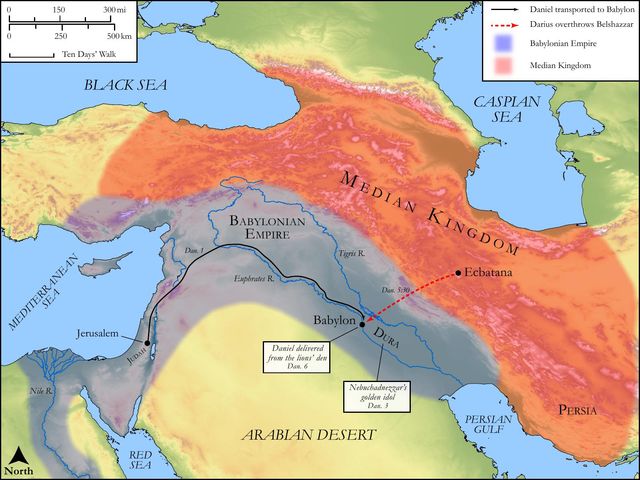
See on the biblical-era map
Study this verse
Public-domain commentary
Matthew Henry
From his Commentary on the Whole Bible. Henry comments on passages, not single verses — this entry covers Daniel 5:30–31.
Here is, 1. The death of the king. Reason enough he had to tremble, for he was just falling into the hands of the king of terrors, Dan 5:30. In that night, when his heart was merry with wine, the besiegers broke into the city, aimed at the palace; there they found the king, and gave him his death's wound. He could not find any place so secret as to conceal him, or so strong as to protect him. Heathen writers speak of Cyrus's taking Babylon by surprise, with the assistance of two deserters that showed him the best way into the city. And it was foretold what a consternation it would be to the court, Jer 51:11, Jer 51:39. Note, Death comes as a snare upon those whose hearts are overcharged with surfeiting and drunkenness. 2. The transferring of the kingdom into other hands. From the head of gold we now descend to the breast and arms of silver. Darius the Mede took the kingdom in partnership with, and by the consent of, Cyrus, who had conquered it, Dan 5:31. They were partners in war and conquest, and so they were in dominion, Dan 6:28. Notice is taken of his age, that he was now sixty-two years old, for which reason Cyrus, who was his nephew, gave him the precedency. Some observe that being now sixty-two years old, in the last year of the captivity, he was born in the eighth year of it, and that was the year when Jeconiah was carried captive and all the nobles, etc. See Kg2 24:13-15. Just at that time when the most fatal stroke was given was a prince born that in process of time should avenge Jerusalem upon Babylon, and heal the wound that was now given. Thus deep are the counsels of God concerning his people, thus kind are his designs towards them.
Historical interpretation
Historical reception
2 surviving comments on this verse. Each one is dated, so this reads as a timeline rather than a list.
Select a marker to jump to its quote. Markers stagger vertically where authors wrote within a few decades of each other.
Verses 30, 31. "On that same night Belshazzar, King of the Chaldeans, was slain, and Darius the Mede succeeded to his kingdom at the age of sixty-two." Josephus writes in his tenth book of the Jewish Antiquities that when Babylon had been laid under siege by the Medes and Persians, that is, by Darius and Cyrus, Belshazzar, King of Babylon, fell into such forgetfulness of his own situation as to put on his celebrated banquet and drink from the vessels of the Temple, and even while he was besieged he found leisure for banqueting. From this circumstance the historical account could arise, that he was captured and slaughtered on the same night, while everyone was either terrified by fear of the vision and its interpretation, or else taken up with festivity and drunken banqueting. As for the fact that while Cyrus, King of the Persians, was the victor, and Darius was only King of the Medes, it was Darius who was recorded to have succeeded to the throne of Babylon, this was an arrangement occasioned by factors of age, family relationship, and the territory ruled over. By this I mean that Darius was sixty-two years old, and that, according to what we read, the kingdom of the Medes was more sizable than that of the Persians, and being Cyrus's uncle, he naturally had a prior claim, and ought to have been accounted as successor to the rule of Babylon. Therefore also in a vision of Isaiah which was recited against Babylon, after many other matters too lengthy to mention, an account is given of these things which are to take place: "Behold I Myself will rouse up against them the Medes, a people who do not seek after silver nor desire gold, but who slay the very children with their arrows and have no compassion upon women who suckle their young" (Isaiah 13:17-18). And Jeremiah says: "Sanctify nations against her, even the kings of Media, and the governors thereof and all the magistrates thereof and all the land under the power thereof" (Jeremiah 51:28). Then follow the words: "The daughter of Babylon is like a threshing-floor during the time of its treading; yet a little while, and the time of its harvesting will come" (Jeremiah 51:33). And in testimony of the fact that Babylon was captured during a banquet, Isaiah clearly exhorts her to battle when he writes: "Babylon, my beloved, has become a strange spectacle unto me: set thou the table and behold in the mirrors those who eat and drink; rise up, ye princes, and snatch up your shields!" (Isaiah 21:4-5).
Now, it is necessary to inquire why on earth the God of all corrected Nebuchadnezzar and in turn restored him to his kingdom but forthwith deprived this man of both kingdom and life. On consideration, then, we find, first, that Nebuchadnezzar had not observed another person paying the penalty for impiety, and hence God’s just sentence granted him pardon, whereas this other man, though observing his father’s heavy penalty, gained nothing from it. The just judge was therefore within his rights in confining punishment of the former to a specified time, whereas he granted the latter no pardon. In particular, God foresees all future events and thus knows them clearly as if already in the past; so he knew ahead of time the repentance of the former and arranged for his fate accordingly, whereas he knew ahead of time the latter’s incorrigible impiety and put a stop to the increase in impiety with death.
Continue studying Daniel 5:30 across the web’s major study libraries — every link below opens this exact verse, chapter, or book on the destination site.
Read & Compare
 BibleGatewayThis verse in more than 200 translations and 70 languages.
 Bible.comThe YouVersion reader — hundreds of translations, reading plans, and highlights.
 ESV.orgCrossway's official English Standard Version reader.
 NET BibleThe NET translation with 60,000+ translators' notes on every rendering decision.
 STEP BibleTyndale House's free study tool — original text, vocabulary, and scholarly resources.
 BibliaLogos Bible Software's free web reader.
 USCCBThe New American Bible (Revised Edition) with the U.S. bishops' study notes.
Commentaries
 BibleHub CommentariesDozens of classic commentaries on this verse, gathered on one page.
 StudyLightMore than 100 commentary sets — the largest collection on the web.
 BibleRefPlain-English commentary on what this verse means, verse by verse.
 Enduring WordDavid Guzik's free commentary on this chapter, widely used by Bible teachers.
 Bible Study ToolsVerse commentary alongside Greek and Hebrew study aids.
Original Language & Research
- BibleHub InterlinearThe verse word by word — original language, transliteration, and English.
- BibleHub LexiconEvery word's original-language definition and Strong's entry.
 Blue Letter BibleDeep-study tools — Strong's numbers, concordance, and word studies.
 SefariaThe Hebrew text with Rashi and centuries of Jewish commentary.
Sermons, Hymns & Audio


TrulyRandomVerse is not affiliated with these sites and doesn’t control their content. They’re linked because they’re genuinely useful.
Summary
Daniel 5:30 delivers the abrupt and climactic fulfillment of divine judgment against King Belshazzar and the Neo-Babylonian Empire. This concise verse records the immediate demise of a defiant ruler and the swift collapse of one of history's most formidable kingdoms, all orchestrated by the sovereign hand of God in response to Belshazzar's profound sacrilege and arrogance. It marks a pivotal turning point, signifying the end of an era and the irrefutable validation of God's prophetic word.
Context
ShowHideLiterary Context
Daniel 5:30 serves as the dramatic and decisive conclusion to the fifth chapter of Daniel, a narrative meticulously crafted to highlight God's absolute sovereignty over human kingdoms. The chapter meticulously builds tension, beginning with Belshazzar's audacious and profane feast, where he desecrates the sacred vessels plundered from the Jerusalem temple. This act of hubris precipitates the terrifying appearance of the disembodied hand, writing a cryptic message on the palace wall. Daniel, empowered by divine wisdom, courageously interprets this message in Daniel 5:25-28, revealing the divine verdict: "Mene, Mene, Tekel, Upharsin," which foretold that Belshazzar's kingdom had been "weighed in the balances, and found wanting" and would be "divided and given to the Medes and Persians." Daniel 5:30 then delivers the swift, unequivocal execution of this prophecy, providing an immediate and tangible demonstration of God's authority. The verse seamlessly transitions into Daniel 6:1, which confirms the transfer of power to Darius the Mede, underscoring the absolute reliability and precision of divine prophecy.
Historical & Cultural Context
The events of Daniel 5:30 are set in the opulent and heavily fortified city of Babylon, the capital of the Neo-Babylonian Empire. Belshazzar, as depicted in the biblical account and corroborated by extra-biblical sources, was the co-regent with his father, Nabonidus, who was often away from the capital. The feast described was likely a grand celebration or a strategic gathering, but its character was defined by a profound act of defiance against the God of Israel through the desecration of sacred temple vessels. Historically, Babylon fell to the Persian forces under Cyrus the Great in 539 BC. Ancient historians such as Herodotus and Xenophon provide accounts that align remarkably with the biblical narrative, suggesting that the Persians diverted the Euphrates River, enabling them to enter the seemingly impregnable city through the dried riverbed during a night of revelry. This historical detail perfectly complements the "in that night" pronouncement of Daniel 5:30, emphasizing the sudden, unexpected, and divinely orchestrated nature of Babylon's fall and Belshazzar's demise. The Chaldeans, the dominant ethnic group within the Neo-Babylonian Empire, were renowned for their astrological and divinatory practices, yet their wisdom proved utterly futile against the direct revelation of the Almighty God.
Key Themes
ShowHideDaniel 5:30 powerfully encapsulates several foundational themes woven throughout the book of Daniel. Firstly, Divine Sovereignty is paramount, demonstrating that God is the supreme ruler over all earthly kingdoms, raising up and bringing down rulers according to His immutable will, a truth emphatically declared in Nebuchadnezzar's earlier confession in Daniel 4:34-35. Secondly, the verse starkly illustrates the Consequences of Human Pride and Defiance. Belshazzar's egregious hubris and sacrilege—his contemptuous misuse of God's holy vessels—directly precipitated his swift and decisive judgment. This serves as a potent and enduring warning against arrogance and disrespect for the divine, echoing the timeless wisdom found in Proverbs 16:18. Thirdly, the immediate and precise fulfillment of Daniel's prophecy underscores the Reliability and Authority of God's Word. What God declares, whether through His prophets or directly, comes to pass with absolute certainty and often with stunning immediacy, reinforcing the profound truth that "the word of our God will stand forever" as proclaimed in Isaiah 40:8.
Exposition and Analysis
ShowHideKey Word Analysis
ShowHideThis name, likely meaning "Bel protect the king" or "Bel is prince," carries profound irony given his sudden and violent end. As the last king of Babylon according to the biblical account, his reign culminated in defiance of God, leading to his abrupt demise. His name's connection to Bel (Marduk), the chief Babylonian deity, underscores the dramatic clash between pagan idolatry and the supreme authority of the one true God of Israel.
This term refers to the people of Chaldaea, who constituted the dominant ethnic group and ruling class of the Neo-Babylonian Empire. Renowned throughout the ancient world for their expertise in astrology, divination, and various magical arts, their collective wisdom and spiritual practices proved utterly incapable of interpreting the divine message on the wall, thereby highlighting the unparalleled superiority of God's revelation through His prophet Daniel.
This potent Aramaic verb, meaning "to kill" or "to slay," is used here with stark directness and unambiguous finality. Its application conveys the sudden, violent, and definitive end of Belshazzar's life. The passive voice ("was slain") is significant, subtly emphasizing that his death was not an accident or a mere consequence of war, but rather an act carried out by an external, divinely appointed force—the invading Medo-Persian army, acting as the instrument of God's predetermined judgment.
Verse Breakdown
ShowHide"In that night"
This phrase powerfully emphasizes the astonishing immediacy and suddenness of the divine judgment. The prophecy articulated by Daniel only hours earlier was fulfilled before the dawn, highlighting God's precise timing, unwavering resolve, and swift execution of His decrees. It stands in stark contrast to the king's earlier sense of security, revelry, and apparent invincibility.
"was Belshazzar the king of the Chaldeans"
This clause precisely identifies the specific individual and his high royal status, underscoring the profound truth that even the most powerful earthly ruler is ultimately subject to God's supreme authority. His full title, "king of the Chaldeans," further emphasizes that this was not merely the death of an individual, but the dramatic fall of an entire dynasty and the independent rule of a mighty empire.
"slain"
This single, stark word delivers the absolute finality of the judgment. It signifies a violent and definitive end to Belshazzar's life and, by direct extension, the abrupt termination of the Babylonian Empire's independent dominion. This confirms the "Upharsin" (divided) portion of the mysterious writing on the wall, demonstrating the complete and accurate fulfillment of God's prophetic word.
Literary Devices
ShowHideDaniel 5:30 is imbued with several potent literary devices that amplify its impact. Dramatic Irony is profoundly evident, as Belshazzar's lavish feast, intended as a grand display of his power, security, and revelry, becomes the precise setting for his sudden and humiliating downfall. His arrogant use of the sacred temple vessels, a blatant symbol of his defiance against God, directly precipitates the divine judgment. The entire narrative of Daniel 5 is replete with Foreshadowing, with the mysterious, disembodied hand writing on the wall serving as a direct and immediate harbinger of the cataclysmic events of verse 30. The remarkable brevity and directness of the verse itself create a powerful sense of Climax and Resolution, providing a stark, impactful, and definitive conclusion to the chapter's escalating tension. Furthermore, the deliberate use of the passive voice in "was Belshazzar... slain" subtly but powerfully emphasizes Divine Sovereignty; while human agents (the Medo-Persian army) executed the act, the ultimate agency and orchestrating force behind Belshazzar's death was God, perfectly executing His predetermined judgment.
Theological and Thematic Connections
ShowHideDaniel 5:30 stands as an enduring and profound testament to God's absolute sovereignty over human history and the inherent transience of all earthly power. It vividly illustrates that no kingdom, regardless of its might, fortifications, or perceived invincibility, can ultimately withstand the immutable decree of the Almighty, and no ruler, however proud or defiant, can escape ultimate accountability before the Creator of the heavens and the earth. Belshazzar's swift and ignominious demise serves as an enduring warning against the perils of hubris, sacrilege, and the fatal failure to acknowledge God's supreme authority, reminding all generations that "the Most High is sovereign over all kingdoms on earth and gives them to anyone he wishes" as declared in Daniel 4:17. This verse powerfully reinforces the biblical truth that God is the one who "removes kings and sets up kings" (Daniel 2:21).
Reflection and Application
ShowHideDaniel 5:30 compels us to a profound and sober reflection on the nature of authority, the necessity of humility, and the inevitability of accountability before God. Belshazzar's tragic fate serves as a stark reminder that all earthly power, immense wealth, and perceived security are ultimately fleeting and perpetually subject to the divine will. We are cautioned against the insidious perils of pride and arrogance, particularly when such attitudes manifest in disrespect for God and His sacred principles or possessions. Just as Belshazzar was judged for his desecration and defiance, we are called to live lives marked by profound reverence, continuously acknowledging God's ultimate dominion over our lives, our resources, and the nations we inhabit. The astonishing swiftness of his judgment also impresses upon us the urgent necessity of responding to God's warnings and diligently striving to live in alignment with His revealed truth. This passage encourages us to cultivate a spirit of genuine humility, recognizing that every breath we take and every blessing we receive is a gracious gift from our benevolent Creator, and that true wisdom, as the Scriptures declare, lies in fearing the Lord and diligently departing from evil.
Questions for Reflection
ShowHideFAQ
ShowHideWho was Belshazzar, and what was his significance in the fall of Babylon?
ShowHideBelshazzar was the co-regent of the Neo-Babylonian Empire, serving alongside his father, Nabonidus, during the tumultuous period leading up to Babylon's fall. The book of Daniel portrays him as the active and primary ruler during the empire's final days, particularly highlighting his infamous sacrilegious feast where he profaned the sacred vessels taken from the temple in Jerusalem (Daniel 5:2-3). His profound significance lies in being the last king of Babylon whose reign ended abruptly and violently "in that night" (Daniel 5:30) with the city's capture by the Medo-Persians, thereby fulfilling divine prophecy and marking the definitive end of Babylonian dominance in the ancient Near East.
How did Babylon, a seemingly impregnable city, fall so suddenly?
ShowHideWhile Daniel 5:30 succinctly states that Belshazzar was "slain in that night," historical accounts from ancient historians like Herodotus and Xenophon corroborate the astonishing suddenness of Babylon's fall. They describe how the Persian army under Cyrus the Great executed a brilliant strategic maneuver: they diverted the Euphrates River, which flowed directly through the heart of the city, allowing their troops to enter through the dried riverbed during a night of widespread feasting and revelry within Babylon's walls. This audacious and unexpected infiltration, combined with the internal chaos and Belshazzar's fatal arrogance, led to the city's swift and unexpected capture, perfectly fulfilling the divine judgment pronounced by Daniel (Daniel 5:26-28).
Christ-Centered Fulfillment
ShowHideDaniel 5:30, with its stark portrayal of divine judgment and the sudden, decisive fall of a proud earthly kingdom, finds its ultimate fulfillment and profoundest meaning in the person and redemptive work of Jesus Christ. Belshazzar's ignominious demise underscores the inherent transience and ultimate futility of all human empires and the absolute, unchallengeable sovereignty of God—a sovereignty perfectly embodied and fully manifested in Christ. Just as Babylon fell to a divinely appointed conqueror, so too will all earthly kingdoms, powers, and authorities ultimately bow before the King of kings and Lord of lords. Unlike Belshazzar, who defiantly desecrated holy things, Jesus is the very Holy One of God, who came not to be served by human hands, but to serve humanity and to give his life as a ransom for many. The swift and decisive judgment meted out to Belshazzar for his pride, sacrilege, and defiance powerfully foreshadows the ultimate and righteous judgment that will be executed by Christ upon all who reject God's authority and persist in unrepentant sin, as vividly described in passages such as Matthew 25:31-46. Yet, in Christ, there is also the glorious promise of a kingdom that will never be destroyed, a kingdom established not by human might or fleeting power, but by divine grace and eternal decree, a kingdom that is everlasting (Daniel 7:13-14). Belshazzar's "night" of judgment points forward to the "day of the Lord" when Christ will return in resplendent glory to judge the living and the dead and establish His righteous, eternal reign forever, offering salvation and eternal life to all who humble themselves, repent, and believe in Him, the true Lamb of God who takes away the sin of the world.