


Daniel 6:18
- אֱדַיִן'E·da·yinthenH116AdvAdverb
- אֲזַל'a·Zalhe wentH236V-Peal-Perf-3msVerb Peal Perfect 3rd Singular Masculine
- מַלְכָּאmal·Ka'king theH4430N-cs ¦ ArtNoun Singular common gender Definiteמַלְכָּkingאthe
- לְהֵיכְלֵהּle·hei·khe·Lehto his palaceH1965Prep-l ¦ N-csc ¦ 3msNoun Singular common gender Constructלְtoהֵיכְלֵpalaceהּhis
- וּבָתu·Vatand he passed [the] nightH956Conj-w ¦ V-Qal-Perf-3msVerb Qal Perfect 3rd Singular Masculineוּandבָתhe passed [the] night
- טְוָתte·VatfastingH2908AdvAdverb
- וְדַחֲוָןve·da·cha·Vanand thrusting [women]H1761Conj-w ¦ N-fpNoun Plural Feminine Absoluteוְandדַחֲוָןthrusting [women]
- לָאla'notH3809NegParticle Negative
- הַנְעֵלhan·'Elhe brought inH5954V-Haphel-Perf-3msVerb Haphel Perfect 3rd Singular Masculine
- קָדָמוֹהִיka·da·Mo·hibefore himH6925N-mpc ¦ 3msNoun Plural Masculine Constructקָדָמוֹbeforeהִיhim
- וְשִׁנְתֵּהּve·shin·Tehand his sleepH8139Conj-w ¦ N-fsc ¦ 3msNoun Singular Feminine Constructוְandשִׁנְתֵּsleepהּhis
- נַדַּתna·Datit fledH5075V-Peal-Perf-3fsVerb Peal Perfect 3rd Singular Feminine
- עֲלוֹהִיa·Lo·hion himH5922Prep ¦ 3msPrepositionעֲלוֹonהִיhim
English is a literal word-by-word gloss of the Hebrew, not the KJV's wording. Why?
This is the original text the KJV's translators worked from — each Hebrew word with its own literal English meaning in this verse, prepared by scholars at Tyndale House, Cambridge. The KJV translates whole sentences, not word by word, so its wording differs: one Hebrew word can become several English words, and the KJV may choose “the LORD” where the gloss reads “Yahweh”. Both are faithful — they answer different questions. For the KJV's own rendering, switch to the KJV text.
Details
See on the biblical-era map
Study this verse
Public-domain commentary
Matthew Henry
From his Commentary on the Whole Bible. Henry comments on passages, not single verses — this entry covers Daniel 6:18–24. His two-level outline is real structure in the source text, so it is rendered as structure.
Here is, I. The melancholy night which the king had, upon Daniel's account, Dan 6:18. He had said, indeed, that God would deliver him out of the danger, but at the same time he could not forgive himself for throwing him into the danger; and justly might God deprive him of a friend whom he had himself used so barbarously. He went to his palace, vexed at himself for what he had done, and calling himself unwise and unjust for not adhering to the law of God and nature with a non obstante - a negative to the law of the Medes and Persians. He ate no supper, but passed the night fasting; his heart was already full of grief and fear. He forbade the music; nothing is more unpleasing that songs sung to a heavy heart. He went to bed, but got no sleep, was full of tossings to and fro till the dawning of the day. Note, the best way to have a good night is to keep a good conscience, then we may lie down in peace.
II.The solicitous enquiry he made concerning Daniel the next morning, Dan 6:19, Dan 6:20.
He was up early, very early; for how could he lie in bed when he could not sleep for dreaming of Daniel, nor lie awake quietly for thinking of him? And he was no sooner up than he went in haste to the den of lions, for he could not satisfy himself to send a servant (that would not sufficiently testify his affection for Daniel), nor had he patience to stay so long as till a servant would return. When he comes to the den, not without some hopes that God had graciously undone what he had wickedly done, he cries, with a lamentable voice, as one full of concern and trouble, O Daniel! art thou alive? He longs to know, yet trembles to ask the question, fearing to be answered with the roaring of the lions after more prey: O Daniel! servant of the living God, has thy God whom thou servest made it to appear that he is able to deliver thee from the lions? If he rightly understood himself when he called him the living God, he could not doubt of his ability to keep Daniel alive, for he that has life in himself quickens whom he will; but has he thought fit in this case to exert his power? What he doubted of we are sure of, that the servants of the living God have a Master who is well able to protect them and bear them out in his service.
III.The joyful news he meets with - that Daniel is alive, is safe, and well, and unhurt in the lions' den, Dan 6:21, Dan 6:22.
Daniel knew the king's voice, though it was now a lamentable voice, and spoke to him with all the deference and respect that were due to him: O king! live for ever. He does not reproach him for his unkindness to him, and his easiness in yielding to the malice of his persecutors; but, to show that he has heartily forgiven him, he meets him with his good wishes. Note, We should not upbraid those with the diskindnesses they have done us who, we know, did them with reluctance, and are very ready to upbraid themselves with them. The account Daniel gives the king is very pleasant; it is triumphant.
1.God has preserved his life by a miracle. Darius had called him Daniel's god (thy God whom thou servest), to which Daniel does as it were echo back, Yea, he is my God, whom I own, and who owns me, for he has sent his angel. The same bright and glorious being that was seen in the form of the Son of God with the three children in the fiery furnace had visited Daniel, and, it is likely, in a visible appearance had enlightened the dark den, and kept Daniel company all night, and had shut the lions' mouths, that they had not in the least hurt him. The angel's presence made even the lions' den his strong-hold, his palace, his paradise; he had never had a better night in his life. See the power of God over the fiercest creatures, and believe his power to restrain the roaring lion that goes about continually seeking to devour from hurting those that are his. See the care God takes of his faithful worshippers, especially when he calls them out to suffer for him. If he keeps their souls from sin, comforts their souls with his peace, and receives their souls to himself, he does in effect stop the lions' mouths, that they cannot hurt them. See how ready the angels are to minister for the good of God's people, for they own themselves their fellow servants.
2.God has therein pleaded his cause. He was represented to the king as disaffected to him and his government. We do not find that he said any thing in his own vindication, but left it to God to clear up his integrity as the light; and he did it effectually, by working a miracle for his preservation. Daniel, in what he had done, had not offended either God or the king: Before him whom I prayed to innocency was found in me. He pretends not to a meritorious excellence, but the testimony of his conscience concerning his sincerity is his comfort - As also that before thee, O king! I have done no hurt, nor designed thee any affront.
IV.The discharge of Daniel from his confinement.
His prosecutors cannot but own that the law is satisfied, though they are not, or, if it be altered, it is by a power superior to that of the Medes and Persians; and therefore no cause can be shown why Daniel should not be fetched out of the den (Dan 6:23): The king was exceedingly glad to find him alive, and gave orders immediately that they should take him out of the den, as Jeremiah out of the dungeon; and, when they searched, no manner of hurt was found upon him; he was nowhere crushed nor scarred, but was kept perfectly well, because he believed in his God. Note, Those who boldly and cheerfully trust in God to protect them in the way of their duty shall never be made ashamed of their confidence in him, but shall always find him a present help.
V.The committing of his prosecutors to the same prison, or place of execution rather, Dan 6:24.
Darius is animated by this miracle wrought for Daniel, and now begins to take courage and act like himself. Those that would not suffer him to show mercy to Daniel shall, now that God has done it for him, be made to feel his resentments; and he will do justice for God who had shown mercy for him. Daniel's accusers, now that his innocency is cleared, and Heaven itself has become his compurgator, have the same punishment inflicted upon them which they designed against him, according to the law of retaliation made against false accusers, Deu 19:18, Deu 19:19. Such they were to be reckoned now that Daniel was proved innocent; for, though the fact was true, yet it was not a fault. They were cast into the den of lions, which perhaps was a punishment newly invented by themselves; however, it was what they maliciously designed for Daniel. Nec lex est justior ulla qum necis artifices arte perire su - No law can be more just than that which adjudges the devisers of barbarity to perish by it, Psa 7:15, Psa 7:16; Psa 9:15, Psa 9:16. And now Solomon's observation is verified (Pro 11:8), The righteous is delivered out of trouble, and the wicked cometh in his stead. In this execution we may observe,
1.The king's severity, in ordering their wives and children to be thrown to the lions with them. How righteous are God's statutes above those of the nations! for God commanded that the children should not die for the fathers' crimes, Deu 24:16. Yet they were put to death in extraordinary cases, as those of Achan, and Saul, and Haman.
2.The lion's fierceness. They had the mastery of them immediately, and tore them to pieces before they came to the bottom of the den. This verified and magnified the miracle of their sparing Daniel; for hereby it appeared that it was not because they had not appetite, but because they had not leave. Mastiffs that are kept muzzled are the more fierce when the muzzle is taken off; so were these lions. And the Lord is known by those judgments which he executes.
Historical interpretation
Historical reception
2 surviving comments on this verse. Each one is dated, so this reads as a timeline rather than a list.
Select a marker to jump to its quote. Markers stagger vertically where authors wrote within a few decades of each other.
Verse 18. "And the king departed to his own house, and went to bed without partaking of supper..." How sincere was the king's good will, when he would not touch food night or day or grant his eyelids sleep, but as long as the prophet was in danger he himself remained in a state of sympathetic suspense. But if a king who knew not God did such a thing for another man whose deliverance he desired, how much more ought we to implore God's mercy for our own sins with fastings and watchings.
Each of these details testifies both to his humanity and to his cowardice: a mark of his humanity was his refusing to partake of food or let his eyes rest in sleep, instead staying awake in grief for the unjust punishment of Daniel; it was a mark of cowardice that he was not so affected as to counter the accusers and invoke his royal authority and power to save the wronged.
Continue studying Daniel 6:18 across the web’s major study libraries — every link below opens this exact verse, chapter, or book on the destination site.
Read & Compare
 BibleGatewayThis verse in more than 200 translations and 70 languages.
 Bible.comThe YouVersion reader — hundreds of translations, reading plans, and highlights.
 ESV.orgCrossway's official English Standard Version reader.
 NET BibleThe NET translation with 60,000+ translators' notes on every rendering decision.
 STEP BibleTyndale House's free study tool — original text, vocabulary, and scholarly resources.
 BibliaLogos Bible Software's free web reader.
 USCCBThe New American Bible (Revised Edition) with the U.S. bishops' study notes.
Commentaries
 BibleHub CommentariesDozens of classic commentaries on this verse, gathered on one page.
 StudyLightMore than 100 commentary sets — the largest collection on the web.
 BibleRefPlain-English commentary on what this verse means, verse by verse.
 Enduring WordDavid Guzik's free commentary on this chapter, widely used by Bible teachers.
 Bible Study ToolsVerse commentary alongside Greek and Hebrew study aids.
Original Language & Research
- BibleHub InterlinearThe verse word by word — original language, transliteration, and English.
- BibleHub LexiconEvery word's original-language definition and Strong's entry.
 Blue Letter BibleDeep-study tools — Strong's numbers, concordance, and word studies.
 SefariaThe Hebrew text with Rashi and centuries of Jewish commentary.
Sermons, Hymns & Audio


TrulyRandomVerse is not affiliated with these sites and doesn’t control their content. They’re linked because they’re genuinely useful.
Summary
Daniel 6:18 vividly portrays the profound personal anguish and desperate hope of King Darius following Daniel's forced committal to the lions' den. Bound by the unalterable law of the Medes and Persians, which he had been tragically manipulated into enacting, Darius expresses his overwhelming distress through a night of complete fasting, the rejection of all royal entertainment, and a profound loss of sleep, all indicative of his fervent, albeit anxious, anticipation of divine intervention on Daniel's behalf.
Context
ShowHideLiterary Context
This verse immediately follows the dramatic and tragic events of Daniel's condemnation and subsequent casting into the lions' den. Having been ensnared by the malicious scheme of jealous satraps and administrators, King Darius was compelled to sign an irrevocable decree forbidding prayer to any god or man other than himself for thirty days. Despite his genuine affection and high regard for Daniel, the unchangeable nature of Persian law, a rigidity highlighted in Daniel 6:15, forced him to comply with the decree's penalty. Daniel 6:18 thus serves as a poignant interlude, capturing the king's personal agony and powerlessness in the face of an irreversible legal decree, effectively setting the emotional and narrative stage for the miraculous deliverance recounted in the subsequent verses. It emphasizes the human cost of the political machinations that led to Daniel's peril.
Historical & Cultural Context
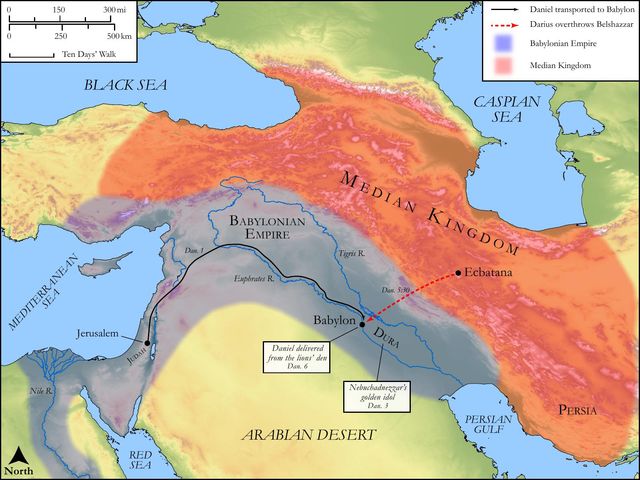
The Achaemenid Persian Empire, under which Darius ruled, was famously known for the immutability of its laws. Once a decree was signed by the king and sealed with his signet, it could not be altered or revoked, even by the monarch himself. This legal rigidity, while intended to ensure stability and justice across a vast empire, paradoxically becomes a source of immense personal torment for Darius in this instance. Culturally, fasting was a widespread practice in the ancient Near East, typically observed during times of deep mourning, national crisis, repentance, or intense supplication to a deity. Such fasting was often accompanied by the cessation of all forms of entertainment, including music and feasting. For a king, whose life was usually characterized by luxury, comfort, and constant diversion, the deliberate abstention from "instruments of musick" and the inability to sleep underscore an extraordinary level of personal grief, anxiety, and a desperate, unspoken plea, far exceeding mere political inconvenience or annoyance.
Key Themes
ShowHideDaniel 6:18 contributes powerfully to several overarching themes within the book of Daniel. It profoundly illustrates the limitation of human power, even for an absolute monarch like Darius, juxtaposed against the unlimited sovereignty of God. Darius, despite his vast royal authority, is utterly helpless to save Daniel from the consequences of the law, thereby highlighting that ultimate control and deliverance rest with a higher, divine power. The king's profound distress also underscores the theme of divine faithfulness and vindication, as his anxious night implicitly anticipates God's intervention, a hope he had expressed directly to Daniel in Daniel 6:16. Furthermore, the verse subtly points to the impact of a righteous life on those around, as Daniel's unwavering integrity and God's evident favor upon him elicit profound concern and respect even from a pagan king, ultimately leading to Darius's recognition of the Most High God in Daniel 6:26-27.
Exposition and Analysis
ShowHideKey Word Analysis
ShowHideThis Aramaic term, derived from a root corresponding to "to twist," vividly conveys the physical sensation of hunger or internal churning, here used to describe a state of complete abstinence from food. For King Darius, this was not a routine religious ritual but a profound and spontaneous expression of personal anguish, intense worry, and desperate supplication for Daniel's safety, indicating a deep level of distress that superseded all physical comforts and royal protocol. It speaks to a soul deeply troubled.
This Aramaic word, likely referring to a type of musical instrument (as being struck), symbolizes the deliberate cessation of all royal entertainment and diversion. For a king, music and festivities were customary elements of daily life and courtly pleasure, often accompanying meals and leisure. Their absence underscores Darius's profound sorrow and inability to find solace or distraction; his mind was entirely consumed by Daniel's perilous situation, signifying a complete withdrawal from the usual comforts and diversions of his position.
This Aramaic term directly translates to "sleep." The statement that "his sleep went from him" (from H5075 nᵉdad, "to depart") is a powerful idiom for extreme anxiety, mental agitation, and profound emotional turmoil. It signifies that Darius's worry was so overwhelming that he was unable to find rest or peace, his mind incessantly troubled by the fate of his esteemed servant, Daniel, and the unchangeable law that sealed his fate. This inability to sleep highlights the depth of his internal suffering.
Verse Breakdown
ShowHide"Then the king went to his palace"
This clause sets the immediate scene, depicting Darius's retreat to his private royal quarters after the traumatic event of Daniel being cast into the lions' den. His palace, typically a sanctuary of comfort and security, becomes a place of profound distress and solitary anguish, emphasizing his isolation in this personal crisis.
"and passed the night fasting"
This describes Darius's immediate and deliberate act of abstaining from food throughout the night. This was not a routine practice but an extraordinary measure, signaling his deep personal sorrow, profound regret over Daniel's plight, and perhaps an unspoken, desperate plea to whatever divine power might intervene on Daniel's behalf. It underscores his deep emotional investment in Daniel's fate.
"neither were instruments of musick brought before him"
This detail further emphasizes the king's profound grief and disquiet. Royal courts were typically vibrant with music, entertainment, and lavish banquets. The deliberate absence of these customary diversions highlights that Darius was in no mood for pleasure or distraction; his mind was entirely consumed by Daniel's fate, indicating a complete withdrawal from the usual comforts and luxuries of his position.
"and his sleep went from him"
This final clause vividly portrays the king's intense mental and emotional turmoil. His inability to sleep underscores the depth of his anxiety and preoccupation. His mind was restless and troubled, consumed by the events of the day and the desperate, anxious hope for Daniel's miraculous deliverance, reflecting a profound internal struggle.
Literary Devices
ShowHideThe verse employs several potent Literary Devices to convey King Darius's profound distress and the gravity of the situation. Hyperbole is evident in the description of his sleeplessness and complete abstinence from royal pleasures, emphasizing the extreme and overwhelming nature of his anguish. The actions of fasting and rejecting music function as powerful Symbolism, representing not just personal sorrow and regret but also a desperate, unspoken supplication in the face of an impossible human situation. Furthermore, the verse implicitly uses Juxtaposition by contrasting the king's immense temporal power and authority with his utter personal helplessness against the unchangeable law he himself enacted. This highlights the limits of human authority when confronted with an immutable decree and powerfully anticipates the potential for divine intervention that transcends all earthly limitations.
Theological and Thematic Connections
ShowHideKing Darius's night of anguish in Daniel 6:18 serves as a poignant illustration of human limitation and the profound impact of God's faithful servants on those around them, even those in positions of immense secular power. His distress, marked by fasting, the absence of music, and sleeplessness, mirrors the biblical pattern of deep lament and earnest supplication in times of crisis, often preceding divine intervention. It highlights that true peace is not found in worldly comforts or authority, but often eludes those burdened by immense responsibility and a sense of powerlessness, pointing to the ultimate peace found only in God's sovereign control. This desperate night, filled with anxiety and a glimmer of hope, foreshadows the glorious morning when God's power would be undeniably displayed, transforming the king's despair into astonished praise and a decree acknowledging the Most High God.
Reflection and Application
ShowHideDaniel 6:18 offers a powerful reminder that even those in the highest echelons of power are not immune to profound personal anguish, helplessness, and the weighty consequences of their decisions. King Darius, despite his vast empire and absolute authority, found himself utterly powerless to alter a law he had unwittingly enacted, leading to a night of torment and despair. This humanizes leadership, showing that genuine concern for others, especially the righteous, can profoundly affect even the most powerful. For believers, this verse encourages us to trust in God's unwavering sovereignty even when circumstances seem dire, irreversible, and entirely beyond human control. Darius's distress, while rooted in regret, also contained a flicker of desperate hope in Daniel's God, anticipating a miraculous outcome. It illustrates how the consistent faith, integrity, and godly character of God's people can lead even unbelievers to acknowledge, however implicitly, the reality of divine power and the profound need for divine intervention. When we face situations where our own resources and authority are insufficient, this narrative calls us to a similar posture of desperate hope and reliance on God, knowing that He is able to do far beyond what we can ask or imagine.
Questions for Reflection
ShowHideFAQ
ShowHideWhy was King Darius so distressed?
ShowHideKing Darius was profoundly distressed because he had been tragically tricked by his jealous officials into signing an irrevocable decree that led to his beloved and highly trusted servant, Daniel, being cast into the lions' den. Despite his immense royal power, the law of the Medes and Persians was unchangeable, meaning he could not reverse his own decree to save Daniel (as seen in Daniel 6:15). His distress was a complex mix of deep personal regret, profound helplessness, and genuine concern for Daniel, whom he recognized as a man of exceptional integrity and favored by God.
What is the significance of "instruments of musick" not being brought before him?
ShowHideThe absence of "instruments of musick" (or other forms of royal entertainment and diversion) is highly significant. For a king, music, festivities, and banquets were customary parts of daily life, symbolizing joy, prosperity, and the king's ease and dominion. Darius's deliberate rejection of these usual comforts and diversions underscores the depth of his anguish and preoccupation. He was too consumed by worry and sorrow over Daniel's fate to find comfort or distraction in the usual royal pleasures. This detail vividly portrays his profound personal suffering and the complete cessation of all normal courtly activities due to his overwhelming distress, revealing a king stripped of his usual comforts by a deeply troubled soul.
Does this verse show Darius's faith in Daniel's God?
ShowHideWhile Daniel 6:18 doesn't explicitly state Darius's full conversion to Daniel's God, it strongly implies a desperate hope and a nascent, albeit anxious, acknowledgment of His power. Earlier, in Daniel 6:16, Darius had told Daniel, "Your God, whom you serve continually, He will deliver you." His actions in Daniel 6:18—fasting, rejecting comfort, and sleeplessness—are not merely signs of regret but also of anxious anticipation and perhaps a form of desperate supplication to the God he hoped would intervene. His behavior reflects a recognition that Daniel's God was uniquely powerful enough to deliver him, even if Darius himself was utterly powerless. This desperate night ultimately culminates in Darius's public decree acknowledging and praising the living God of Daniel in Daniel 6:26-27, demonstrating a profound shift in his understanding and reverence.
Christ-Centered Fulfillment
ShowHideThe profound anguish of King Darius, marked by a night of fasting, the absence of comfort, and a complete loss of sleep, powerfully foreshadows the ultimate distress and divine intervention found in the person and work of Jesus Christ. Just as Darius was utterly powerless to save Daniel from the unchangeable law of the Medes and Persians, humanity was utterly helpless against the immutable law of sin and death, which demanded a penalty. However, unlike Darius, who could only hope for Daniel's deliverance, Jesus, the true King and Son of God, willingly entered the "den" of human suffering and death. His own night of profound anguish in Gethsemane, where He prayed so earnestly that His sweat became like great drops of blood (Luke 22:44), far surpassed Darius's sleepless night. There, He faced the crushing weight of humanity's sin, experiencing a spiritual "fasting" from the Father's full presence and a "sleeplessness" of soul as He wrestled with the bitter cup of divine wrath. Yet, through His perfect obedience and ultimate sacrifice on the cross, Jesus did what no human king could: He fulfilled the righteous demands of God's law, thereby delivering His people not from a den of lions, but from the eternal consequences of sin and death (Romans 6:23). His glorious resurrection from the grave (Romans 6:9) is the ultimate "morning after," transforming the despair of death into the triumph of eternal life, proving Him to be the true Deliverer, the sovereign King who reigns forever, and the one who grants true peace that surpasses all understanding ([Philippians 4:7](/ philippians/4-7 "The Peace of God")).