


Amos 6:6
Bible text: King James Version (1769 Blayney text) · Public domain
Bible text: Berean Standard Bible · Public domain
Bible text: American Standard Version (1901) · Public domain
Bible text: World English Bible, Messianic edition · Public domain
Bible text: Geneva Bible (1599) · Public domain
Bible text: Young's Literal Translation · Public domain
- הַשֹּׁתִיםha·sho·Timthose [who] drinkH8354Art ¦ V-Qal-Prtcpl-mpVerb Qal Participle Plural Masculine Absoluteהַthoseשֹּׁתִים[who] drink
- בְּמִזְרְקֵיbe·miz·re·Keiin bowls ofH4219Prep-b ¦ N-mpcNoun Plural Masculine Constructבְּinמִזְרְקֵיbowls of
- יַיִןYa·yinwineH3196N-msNoun Singular Masculine Absolute
- וְרֵאשִׁיתve·re·Shitand [the] best ofH7225Conj-w ¦ N-fscNoun Singular Feminine Constructוְandרֵאשִׁית[the] best of
- שְׁמָנִיםshe·ma·NimoilsH8081N-mpNoun Plural Masculine Absolute
- יִמְשָׁחוּyim·Sha·chuthey smearH4886V-Qal-Imperf-3mpVerb Qal Imperfect 3rd Plural Masculine
- וְלֹאve·Lo'and notH3808Conj-w ¦ NegParticle Negativeוְandלֹאnot
- נֶחְלוּnech·Luthey were sickenedH2470V-Niphal-Perf-3cpVerb Niphal Perfect 3rd Plural common gender
- עַל'alonH5921PrepPreposition
- שֵׁבֶרShe·ver[the] ruin ofH7667N-mscNoun Singular Masculine Construct
- יוֹסֵףyo·SefJosephH3130N-proper-mNoun Proper Masculine
English is a literal word-by-word gloss of the Hebrew, not the KJV's wording. Why?
This is the original text the KJV's translators worked from — each Hebrew word with its own literal English meaning in this verse, prepared by scholars at Tyndale House, Cambridge. The KJV translates whole sentences, not word by word, so its wording differs: one Hebrew word can become several English words, and the KJV may choose “the LORD” where the gloss reads “Yahweh”. Both are faithful — they answer different questions. For the KJV's own rendering, switch to the KJV text.
Details
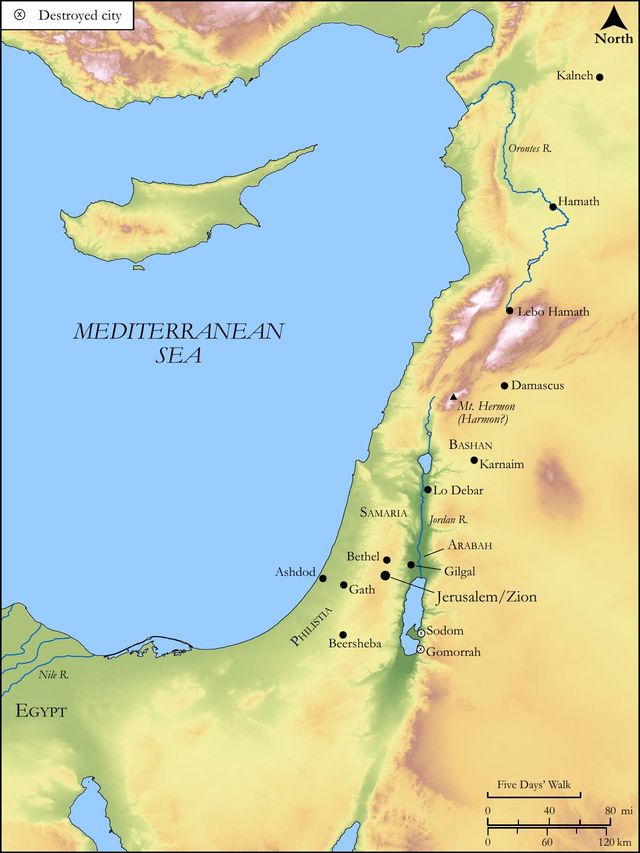
See on the biblical-era map
Study this verse
Public-domain commentary
Matthew Henry
From his Commentary on the Whole Bible. Henry comments on passages, not single verses — this entry covers Amos 6:1–7. His three-level outline is real structure in the source text, so it is rendered as structure.
The first words of the chapter are the contents of these verses; but they sound very strangely, and contrary to the sentiments of a vain world: Woe to those that are at ease! We are ready to say, Happy are those that are at ease, that neither feel any trouble nor fear any, that lie soft and warm, and lay nothing to heart; and wise we think are those that do so, that bathe themselves in the delights of sense and care not how the world goes. Those are looked upon as doing well for themselves that do well for their bodies and make much of them; but against them this woe is denounced, and we are here told what their ease is, and what the woe is.
I.Here is a description of their pride, security, and sensuality, for which God would reckon with them.
1.They were vainly conceited of their own dignities, and thought those would secure them from the judgments threatened and be their defence against the wrath both of God and man.
(1.)Those that dwelt in Zion thought that was honour and protection enough for them, and they might there be quiet from all fear of evil, because it was a strong city, well fortified both by nature and art (we read of Zion's strong-holds and her bulwarks), and because it was a royal city, where were set the thrones of the house of David (it was the head-city of Judah, and therefore truly great), and especially because it was the holy city, where the temple was, and the testimony of Israel; those that dwelt there doubted not but that God's sanctuary would be a sanctuary to them and would shelter them from his judgments. The temple of the Lord are these, Jer 7:4. They are haughty because of the holy mountain, Zep 3:11. Note, Many are puffed up with pride, and rocked asleep in carnal security, by their church-privileges, and the place they have in Zion.
(2.)Those that dwelt in the mountain of Samaria, though it was not a holy hill, like that of Zion, yet they trusted in it, because it was the metropolis of a potent kingdom, and perhaps, in imitation of Jerusalem, was the head-quarters of its religion; and by lapse of time the hill of Shemer became with them in as good repute as the hill of Zion ever was. They hoped for salvation from these hills and mountains.
(3.)Both these two kingdoms valued themselves upon their relation to Israel, that prince with God, which they looked upon as masking them the chief of the nations, more ancient and honourable than any of them; the first-fruits of the nations (so the word is), dedicated to God and sanctifying the whole harvest. The house of Israel came to them, that is, was divided into those kingdoms, of which Zion and Samaria were the mother cities. Those that were at ease were the princes and rulers, the great men, that were chief of the nations, chief of those two kingdoms, and to whom, having their residence in Zion and Samaria, the whole house of Israel applied for judgment. Note, It is hard to be great and not to be proud. Great nations and great men are apt to overvalue themselves, and to overlook their neighbours, because they think they a little overtop them. But, for a check to their pride and security, the prophet bids them take notice of those cities that were within the compass of their knowledge, that had been as illustrious in their time as ever Zion or Samaria was, and yet were destroyed, Amo 6:2. "Go to Calneh (which was an ancient city built by Nimrod, Gen 10:10), and see what has become of that, it is now in ruins; so is Hamath the great, one of the chief cities of Syria. Sennacherib boasts of destroying the gods of Hamath. Gath was likewise made desolate by Hazael, and not long ago, Kg2 12:17. Now were they better than these kingdoms of Judah and Israel? Yes, they were, and their border greater than your border, so that they had more reason than you to be confident of their own safety; yet you see what has become of them, and dare you be secure? Art thou better than populous No?" Nah 3:8. Note, The examples of others' ruin forbid us to be secure.
2.They persisted in their wicked courses upon a presumption that they should never be called to an account for them (Amo 6:3): "You put far away the evil day, the day of reckoning, as a thing that shall never come, or you look upon it as at such a distance that it makes no impression at all upon you; you put it far away, and think you can still put it yet further, and adjourn it de die in diem - from day to day, and therefore you cause the seat of violence to draw near; you venture upon all acts of injustice and oppression, and have fellowship with the throne of iniquity, which frames mischief by a law, Psa 94:20. You cause that to come near, as if that would be your protection from these judgments which really ripens you for them." Note, Therefore men take sin to be near them, because they take judgment to be far off from them; but those deceive themselves who thus mock God.
3.They indulged themselves in all manner of sensual pleasures and delights, Amo 6:4-6. These Israelites were perfect epicures and slaves to their appetites. Their dignities (in consideration of which they ought to have been examples of self-denial and mortification), they thought, would justify them in their sensuality; the gains of their oppression and violence, they thought, would bear the charge of it; and they put the evil day at a distance, that they might give them no disturbance in it. That which they are here charged with is not in itself sinful (these things might be soberly and moderately used), but they placed their happiness in the gratification of their carnal appetites; and though they were men in office, that had business to mind, they gave themselves up to their pleasures, spent their time in them, and threw away their thoughts, and cares, and estates upon them. They were in these enjoyments as in their element. Their hearts were upon them; they exceeded all bounds in them, and this at a time when God in his providence was calling them to weeping and mourning, Isa 22:12, Isa 22:13. When they were under guilt and wrath, and the judgments of God were ready to break in upon them, they called for wine and strong drink, presuming that tomorrow shall be as this day, and much more abundant (Isa 56:12), thus walking contrary to God and setting his justice at defiance.
(1.)They were extravagant in their furniture. Nothing would serve them but beds of ivory to sleep upon, or to sit on at their meat, when sackcloth and ashes would have become them better.
(2.)They were lazy, and humoured themselves in the love of ease. They did not only lie down, but stretched themselves upon their couches, when they should have stirred up themselves to their business; they were willingly slothful, and took a pride in doing nothing; they abound in superfluities (so the margin reads it), when many of their poor brethren wanted necessaries.
(3.)They were nice and curious in their diet, must have every thing of the best and abundance of it: They ate the lambs out of the flock (lambs by wholesale) and the calves out of the midst of the stall, the fattest they could lay their hand on; and these perhaps not out of their own flock and their own stall, but taken by oppression from the poor.
(4.)They were merry and jovial, and diverted themselves at their feasts with music and singing: They chant to the sound of the viol, sing and play in concert, and they invent new-fashioned instruments of music, striving herein, more than in any thing else, to excel their ancestors; they set their wits on work to contrive how to please their fancy. Some men never show their ingenuity but in their luxury; on that they bestow all their faculty of invention and contrivance. They invent instruments of music, like David, entertain themselves with that which formerly used to be the entertainment of kings only. Or it intimates their profaneness in their mirth; they mimicked the temple-music, and made a jest of that, because, it may be, it was old-fashioned, and they took a pride in bantering it as the Babylonians did when they urged the captives to sing to them the songs of Zion; such was Belshazzar's profaneness when he drank wine in temple-bowls, and such is theirs that sing vain and loose songs in psalm-tunes, on purpose to ridicule a divine institution.
(5.)They drank to excess, and never thought they could pour down enough: They drank wink in bowls, not in glasses, or cups (as Jer 35:5); they hate to be stinted, and must have large draughts, and therefore make use of vessels that they can steal a draught out of.
(6.)They affected the strongest perfumes: They anoint themselves with the chief ointments, to please the smell, and to make them more in love with their own bodies, and to guard against those presages of putrefaction which they carry about with them while they live. No ordinary ointments would serve their turn; they must have the chief, such as were far-fetched and dear-bought, when cheaper would have served as well.
4.They had no concern at all for the interests of the church of God, and of the nation, that were sinking and going to decay: They are not grieved for the affliction of Joseph; the church of God, including both the kingdoms of Judah and Israel (which are called Joseph, Psa 80:1), was in distress, invaded, insulted, and broken in upon. As to their own kingdom which they were entrusted with the government of, the affairs of which they were directors of, the peace of which they were the conservators of, great breaches were made upon it, upon its peace and welfare; and they were so besotted that they were not aware of them, so indulgent of their pleasures that they never laid them to heart, and had such an aversion to the thing called business that they were in no care or concern to get them repaired. It is all one to them whether the nation sink or swim, so that they can but lie at ease and live in pleasure. Particular persons that belonged to Joseph were in affliction, and they took no cognizance of their case of the wrongs and hardships they sustained and the troubles they were in, nor took any care to relieve them, and right them, contrary to the temper of holy Job, who, when he was in prosperity, wept with him that was in misery and his soul was grieved for the poor, Job 30:25. Some think that, in calling the afflicted church Joseph, there is an allusion to the story of Pharaoh's butler, who, when he preferred to give the cup again into his master's hand, remembered not Joseph, but forgot him, Gen 40:21, Gen 40:23. Thus they drank wine in bowls, but were not grieved for the affliction of Joseph. Note, Those are commonly careless of the troubles of others who are set upon their own pleasures; and it is a great offence to God when his church is in affliction and we are not grieved for it, nor lay it to heart.
II.Here is the doom passed upon them (Amo 6:7):
Therefore now shall they go captive with the first that go captive, and shall fall into all the miseries that attend captives; and the banquet of those that stretched themselves upon their couches shall be removed. Their plenty shall be taken from them, and they from it, because they made it the food and fuel of their lusts.
1.Those who lived in luxury shall lose even their liberty; and by being brought into servitude shall be justly punished for the abuse of their dignity and dominion.
2.Those who trusted in the delights and pleasures of their own land shall be carried away into a strange land, and so made ashamed of their pride and confidence; they shall go captive.
3.Those who placed their happiness in the pleasures of sense, and set their hearts upon them, shall be deprived of those pleasures; their banquet shall be removed, and they shall know what it is to fare hard.
4.Those who stretched themselves shall be made to contract themselves, and to come into a less compass.
5.Those who put the evil day far from them shall find it nearer to them than it is to others; those shall go captive with the first who flattered themselves with hopes that if trouble did come they should be the last who should be seized by it. Those are ripening apace for trouble themselves who lay not to heart the trouble of others and of the church of God. Those who give themselves to mirth, when God calls them to mourning, will find it a sin that shall not go unpunished, Isa 22:14.
Historical interpretation
Historical reception
3 surviving comments on this verse. Each one is dated, so this reads as a timeline rather than a list.
Select a marker to jump to its quote. Markers stagger vertically where authors wrote within a few decades of each other.
Just as it is not proper to provide ourselves with worldly trappings like a silver vessel, or a curtain edged with purple, or a downy couch, or transparent draperies, so we act unfittingly in contriving menus that deviate in any important way from our usual diet. That we should run about searching for anything not demanded by real necessity but calculated to provide a wretched delight and ruinous vainglory is not only shameful and out of keeping with our avowed purpose; it also causes harm of no mean gravity when they who spend their lives in sensual gratification and measure happiness in terms of pleasure for the appetite see us also taken up with the same preoccupations that keep them enthralled. If, indeed, sensual pleasure is evil and to be avoided, we should on no occasion indulge in it, for nothing that is condemned can at any time be beneficial. They who live riotously and are anointed with the best ointments and drink filtered wine come under the denunciation of Scripture. Because she lives in pleasure, the widow is dead while she is living. The rich man is debarred from paradise because he lived in luxury upon earth. What then have we to do with costly appointments? Has a guest arrived? If he is a brother and follows a way of life aiming at the same objective as ours, he will recognize the fare we provide as properly his own. What he has left at home, he will find with us. Suppose he is weary from his journey. We then provide as much extra nourishment as is required to relieve his weariness.
(Vers. 2 seqq.) Go through Chalane, and see: and from there go to great Emath, and descend to Geth of the Philistines: to the best of their kingdoms, if their boundary is wider than your boundary. You who are separated on the day of evil, and approach the throne of wickedness. You who sleep on ivory beds, and indulge in your own beds: you who eat lambs from the flock, and calves from the middle of the herd: you who sing to the sound of the harp. Just as David thought he had the vessels of a song, drinking wine in cups, and they were anointed with the finest oil, and they did not suffer from the sorrow of Joseph. LXX: House of Israel, all of you pass over and see in Chalane, and pass through there to Emath Rabba, and descend to the best of the foreign Geth in all these kingdoms, if their boundaries are greater than your boundaries, you who come on an evil day, who approach and touch the lies of the Sabbath. You who sleep on ivory beds, and overflow with delights in your couches, and eat young goats from the flocks, and suckle calves from the midst of the herds, who make noise at the sound of the organ: as if they considered themselves stable, and not fleeting; you who drink refined wine, and anoint yourselves with the finest ointments, and do not grieve over the ruin of Joseph. Pass over all of you to Chalane, which is now called Ctesiphon, and pass over all. Who are these people? Both of those mentioned above: the nobles, the leaders of the people, and those of you who are wealthy in Zion, and trust in the mountain of Samaria. Therefore, go to the city of Persis, and pay close attention, and from there, go to the great city of Emath, which is now called Antioch. It is called great, to distinguish it from the smaller Emath, which is called Epiphania. And to this day, for those traveling to Mesopotamia, the first stop is called Emmas, although the name has been corrupted; but it retains traces of its original name, whose region is called Reblatha, in which, in the presence of Nebuchadnezzar, the king of Judah (or Judea), the sons were killed, and his eyes were blinded. And descend, he says, into Gath of the Philistines (2 Kings 25). You who dwell on Mount Zion and Mount Samaria, descend to the Philistines who dwell in the plains, and to the best of their kingdoms, which are subject to different cities: Gaza and Ashkelon, Ashdod, Ekron, and Gath. And see if their territory is wider than yours, whether you or they possess the larger provinces. You, I say, you from the people of Israel, who are separated for the day of evil, namely the day of captivity, and approaching the throne of wickedness, going to the unjust judge, the king of Babylon. For those who are about to suffer these things, you now sleep on ivory beds and indulge in soft cushions, so that you may unite desire with sleep. For you do not eat to drive away hunger and sustain the human body, but for pleasure and luxury, so that whatever is tender and fat in herds and flocks may serve your gluttonous appetites. Your desires are not satisfied with the pleasures of sex, throat, and drink, but you must also soothe your ears with the songs of flutes, harps, and lyres, imitating what David did in the worship of God (1 Chronicles 23-26), finding the variations of the Levitical orders and instruments, you indulge in pleasure and luxury. And you drink wine from goblets, not to quench your thirst, but to intoxicate your mind. And you anoint yourselves, not to soothe the fatigue of the body, with pure oil, but with precious ointments. And when you are filled with these things, if you see any of the people perishing, you have no mercy on their suffering, but you treat them like dumb animals, and you allow them to perish in their own blood. This same sentiment is also expressed by the prophet Ezekiel in the example of the shepherds: They consume the milk of the sheep and clothe themselves with their wool, and they devour whatever is best, and they do not heal the wounded, nor mend the broken, nor seek out those who are perishing. Let us transfer all the things we have said according to the history, according to the Septuagint interpreters, to the allegory of the clouds. O house of Israel, you who have departed from me, who trust in the mountain of Samaria, who have harvested the firstfruits of the nations, go beyond and see, and proceed to many walls. For this is the interpretation of Emath Rabba: and then descend gently into the presses of those who fall while drinking. For Geth and the Philistines resound with this. And consider all things, especially the best (or all) kingdoms, or the best cities among all kingdoms; and consider if their boundaries are more numerous than yours. For if we wish to ponder with our mind, and to explore the wisdom of all nations, we will find that the boundaries of the Egyptians, Indians, and Persians are narrower than the holy boundaries of the Scriptures: Their sound has gone out into all the earth, and their words to the ends of the world. To those whom he had previously said: House of Israel, all of you pass through and see, from what vices they are commanded to pass over to better things, the following discourse describes: Those who come into an evil day, preparing for themselves their evil day according to their own vice: not that any day is inherently evil; but rather, each person prepares for themselves their own evil, according to what we read in Ecclesiastes: Do not say, 'The former days were better for me than these,' for it is not in wisdom that you ask about this (Ecclesiastes 7:11); for it is foolish to compare times, when it is within our power to either make a good day for ourselves or an evil one. These are those who approach and touch the sabbaths of falsehood. For just as the circumcision of the flesh is called, and the circumcision of the heart, and they are manifestly Jews, and in secret, one of which is rejected, and the other is approved: thus the sabbaths of the Lord are holy, and supported by truth, and the others are not holy and are falsehoods, which follow the idleness of the western letters. That which follows: those who sleep on ivory beds, we can interpret it as follows: He who is an athlete of the Lord, and exercises for the struggle, and prepares himself against opposing powers, sleeps on bare earth imitating Jacob (Gen. XXVIII); and he places a stone at his head, which the builders rejected, and it became the head cornerstone (Ps. CXVII, and Act. IV). But those who indulge in pleasures and luxury, and do everything for the sake of their stomach, sleep on ivory beds made from dead animals and cling to unclean bones; and because vices appear beautiful and delight in their present splendor, they rest on their beds and are weighed down by deep sleep. They do not eat solid and nourishing food, which strengthens the powers of those who wrestle, but rather soft and delicate food, such as young goats from the flocks and fattened calves, and tender ones, in fact still nourished by milk. For this is what μοσχάρια γαλαθηνὰ signifies. Moreover, they clap their hands to the sound of the organ and the noise, as if all their works expect pleasure: and they do nothing but provide for the belly and lust. Nor does the wise reader immediately oppose us with this, and how it is written: Let the rivers clap their hands (Ps. XCVII, 8). And: All you nations, clap your hands (Ps XLVI, 1). And: Rejoice in God our helper (Ps. LXXX, 1). For there, they are not said to clap their hands to the sound of the organ; but to have one consent in praising God. He introduced the voice of the organs: they thought it was standing still, and not fleeing. For according to Epicurus, things of the world and all bodies flow and pass away in moments, and nothing remains in its own state, but everything either grows or diminishes, and they flow down like rushing waters. Hence we read also in secular literature (Virgil, Georgics III):
But meanwhile it flies, irretrievable time flies. And in another place (Horace, Odes II, 14).
Alas, fleeting, Posthumus, Posthumus, the years slip away. For nothing is more fleeting than the century and the things of the century. While we hold onto them, we lose them, through infancy, childhood, youth, and the growing and maturing age, and the final years of old age, which Philo describes as the seven stages of human life, we are changed, and we run, and unknowingly we reach the boundaries of death. And what follows: Those who drink clarified wine can properly be referred to heretics, who approve some scriptures and reject others, desiring to drink clarified wines: since in the Holy Scriptures there is nothing turbid and muddy, but everything is most pure in the divine stream. Those who do not have the art of anointing, without any knowledge of the Scriptures, traditions, and teachings of the apostles, claim the dignity of priesthood and say that they are anointed by the Lord; and they contaminate the purest oil of their own understanding with the dregs. And when they do these things to the destruction of those whom they have deceived, they are not tormented by any pain; but they rejoice in the deaths of others and delight in the blood of the wretched. This beautiful sense in which it is said 'they thought as if things were standing, and not as if they were fleeing' is not found in Hebrew; but instead it is written: as David thought he had vessels of song. Therefore, it seems to me that the interpreters added it, who, in describing luxury, expressed a sentiment against vices and pleasures of this kind, so that they would not translate what was written, but would add or even change it, according to what seemed to them.
There is nothing else to see happening everywhere in the world except disorder, unheralded war, unrestrained wrath and savagery exceeding all barbaric inhumanity, and there is no one suffering “by the collapse of Joseph.” We bite and we devour one another, and then we have been destroyed by one another, providing pleasure to the enemies of piety.
Continue studying Amos 6:6 across the web’s major study libraries — every link below opens this exact verse, chapter, or book on the destination site.
Read & Compare
 BibleGatewayThis verse in more than 200 translations and 70 languages.
 Bible.comThe YouVersion reader — hundreds of translations, reading plans, and highlights.
 ESV.orgCrossway's official English Standard Version reader.
 NET BibleThe NET translation with 60,000+ translators' notes on every rendering decision.
 STEP BibleTyndale House's free study tool — original text, vocabulary, and scholarly resources.
 BibliaLogos Bible Software's free web reader.
 USCCBThe New American Bible (Revised Edition) with the U.S. bishops' study notes.
Commentaries
 BibleHub CommentariesDozens of classic commentaries on this verse, gathered on one page.
 StudyLightMore than 100 commentary sets — the largest collection on the web.
 BibleRefPlain-English commentary on what this verse means, verse by verse.
 Enduring WordDavid Guzik's free commentary on this chapter, widely used by Bible teachers.
 Bible Study ToolsVerse commentary alongside Greek and Hebrew study aids.
Original Language & Research
- BibleHub InterlinearThe verse word by word — original language, transliteration, and English.
- BibleHub LexiconEvery word's original-language definition and Strong's entry.
 Blue Letter BibleDeep-study tools — Strong's numbers, concordance, and word studies.
 SefariaThe Hebrew text with Rashi and centuries of Jewish commentary.
Sermons, Hymns & Audio


TrulyRandomVerse is not affiliated with these sites and doesn’t control their content. They’re linked because they’re genuinely useful.
Summary
Amos 6:6 delivers a scathing indictment of the self-indulgent elite in the northern kingdom of Israel, exposing their lavish lifestyle and, more critically, their profound apathy towards the suffering and impending judgment of their own people. The verse vividly contrasts their excessive luxury—drinking wine from grand bowls and anointing themselves with the finest oils—with their chilling indifference to the "affliction of Joseph," a poignant reference to the distress and spiritual decay afflicting the nation of Israel. This complacency, born of material comfort, blinded them to God's warnings and the imminent divine reckoning.
Context
ShowHideLiterary Context
Amos 6:6 is situated within a series of "Woe" oracles (Amos 5:18-6:14) specifically targeting the privileged and powerful in both Judah (Zion) and Israel (Samaria). The preceding verses in Amos 6 establish the false sense of security felt by these elites, who believed their wealth and status insulated them from divine judgment. Amos 6:1-7 functions as a distinct oracle, condemning those "at ease in Zion" and "secure on Mount Samaria," highlighting their pride, self-indulgence, and disregard for the covenant. Verse 6:6 serves as the climactic expression of their moral depravity, encapsulating their outward luxury and inward spiritual emptiness, setting the stage for the pronouncement of their imminent exile in Amos 6:7.
Historical & Cultural Context
The prophet Amos ministered during the prosperous reign of Jeroboam II in the northern kingdom of Israel (c. 793-753 BC), a period of significant economic growth and territorial expansion. This prosperity, however, was built upon widespread oppression, exploitation of the poor, and a superficial religiosity that masked deep moral corruption. The elite, particularly in the capital Samaria, enjoyed immense wealth, evidenced by their luxurious homes, fine furnishings, and lavish banquets. Culturally, anointing with oils was common, but "chief ointments" signified extravagance. Drinking wine was part of social life, but "drinking in bowls" (large sacrificial or communal vessels) indicated excessive, even gluttonous, consumption, contrasting sharply with the widespread poverty and oppression. This era preceded the Assyrian conquest, and Amos's prophecies served as a final warning to a society that had become morally decadent and spiritually complacent, ignoring the very covenant that defined them as God's people.
Key Themes
ShowHideAmos 6:6 powerfully contributes to several overarching themes in the book of Amos. Firstly, it underscores the theme of Injustice and Oppression, as the luxury of the elite stands in stark contrast to the suffering of the common people, a recurring motif throughout the prophet's message (e.g., Amos 2:6-8). Secondly, it highlights False Security and Complacency, revealing how material abundance led to a dangerous spiritual apathy, causing them to ignore God's warnings and the impending judgment (Amos 5:18-20). Thirdly, the verse exemplifies the theme of Divine Judgment, as their unrepentant self-indulgence and lack of compassion inevitably invite God's severe punishment, culminating in exile (as prophesied in Amos 6:7). Finally, the phrase "affliction of Joseph" points to the theme of Covenant Faithlessness, as the people, identified with their patriarchal heritage, had strayed far from the righteous demands of their covenant relationship with Yahweh.
Exposition and Analysis
ShowHideKey Word Analysis
ShowHideThis primitive root signifies being "rubbed or worn," leading figuratively to "weak, sick, afflicted." Causatively, it means "to grieve" or "make sick." It also carries the nuance of "to entreat" or "make suit," implying a deep emotional response or a plea for mercy. In Amos 6:6, the negative "not grieved" indicates a shocking absence of this profound emotional connection or empathetic concern for the suffering of their own kin. It's not merely a lack of sorrow, but a complete detachment from the pain of others, a spiritual sickness of the heart.
Derived from a root meaning "to break," sheber denotes a "fracture," "ruin," or "breach." It can refer to physical breaking, but here it is used figuratively for "affliction," "destruction," or "vexation." It captures the brokenness, distress, and impending ruin facing the northern kingdom. The elite's indifference to this sheber underscores their moral blindness to the true state of their nation, which was experiencing deep internal decay and facing external threats.
This name, meaning "let him add," refers to the patriarch Joseph, but in prophetic literature, it often serves as a poetic or tribal designation for the northern kingdom of Israel as a whole, particularly the dominant tribes of Ephraim and Manasseh (Joseph's sons). By referring to the nation as "Joseph," Amos evokes their shared covenant heritage and highlights the tragedy of their current state. It personalizes the national suffering, making the elite's apathy all the more egregious as it is directed towards their own "brother" or kinsman.
Verse Breakdown
ShowHide"That drink wine in bowls"
This clause paints a vivid picture of excessive luxury and gluttony. The term "bowls" (מִזְרָק, mizrâq) refers to large, ornate vessels, often used for sacrificial libations or communal feasting, implying a scale of consumption far beyond simple refreshment. It suggests not just drinking, but revelry and perhaps even debauchery, where wine is consumed in vast quantities, indicative of a lifestyle characterized by indulgence and disregard for moderation.
"and anoint themselves with the chief ointments"
This phrase further emphasizes the extravagant and self-centered nature of the elite's lifestyle. "Chief ointments" (רֵאשִׁית שְׁמָנִים, rêʼshîyth shemenîm) literally means "first of oils," signifying the finest, most expensive, and luxurious perfumes and anointing oils available. Anointing was a common practice, but the use of "chief" ointments points to an obsessive pursuit of comfort, pleasure, and status, where no expense was spared in their personal gratification.
"but they are not grieved for the affliction of Joseph"
This is the core indictment and the moral climax of the verse. The conjunction "but" (וְ) creates a stark contrast, highlighting the shocking disconnect between their opulent lifestyle and their complete lack of empathy. "Not grieved" (לֹא נֶחְלוּ, lo' neḥlû) signifies a profound spiritual insensitivity and emotional detachment. "The affliction of Joseph" refers to the distress, brokenness, and impending ruin of the northern kingdom of Israel. Their revelry and self-absorption had rendered them blind and indifferent to the suffering of their own people, the moral decay within their society, and the looming divine judgment.
Literary Devices
ShowHideAmos 6:6 employs several powerful literary devices to convey its condemnatory message. Irony is central, as the prophet juxtaposes the extreme comfort and lavishness of the elite with their utter indifference to the profound suffering of their own nation. Their "ease" is ironically contrasted with the "affliction" of others. Hyperbole is evident in the description of their luxury ("drink wine in bowls," "chief ointments"), emphasizing the excessive nature of their self-indulgence. The use of "Joseph" is a potent example of Personification and Synecdoche, where the patriarch's name stands for the entire northern kingdom of Israel. This choice personalizes the national suffering, making the elite's apathy a betrayal of their own familial and covenantal ties. The verse also functions as a stark Condemnation within the broader context of Amos's "Woe" oracles, directly addressing and denouncing the moral failings of the complacent.
Theological and Thematic Connections
ShowHideAmos 6:6 serves as a timeless theological warning against the spiritual dangers of affluence and complacency. It underscores the biblical principle that true prosperity is not measured by material wealth but by righteousness, justice, and compassion. The elite's failure to be "grieved for the affliction of Joseph" reveals a profound disconnect from God's heart for justice and mercy, demonstrating that outward religious observance or national prosperity is meaningless without inward empathy and moral integrity. This verse challenges the notion that material blessings are an automatic sign of divine favor, instead exposing how they can lead to spiritual blindness and a callous disregard for the suffering of others, ultimately inviting divine judgment. The prophet's message resonates with the broader prophetic tradition that consistently links justice to true worship and covenant faithfulness.
Reflection and Application
ShowHideAmos 6:6 confronts us with the enduring temptation of self-indulgence and apathy in the face of widespread suffering. In a world of increasing global connectivity, it is easy to become desensitized to the "affliction" of others, whether it be poverty, injustice, or spiritual brokenness, while we pursue our own comforts and pleasures. This verse calls us to a radical self-examination: Are we truly "grieved" by the distress around us, or are we too preoccupied with our "wine in bowls" and "chief ointments"—our own forms of luxury, entertainment, or personal advancement? It challenges us to cultivate a heart of empathy and compassion, recognizing that our well-being is intrinsically linked to the well-being of our neighbors, both near and far. Our resources, time, and attention are not merely for personal gratification but are gifts to be stewarded for the glory of God and the good of humanity.
Questions for Reflection
ShowHideFAQ
ShowHideWho is "Joseph" in Amos 6:6, and why is his "affliction" significant?
ShowHideIn Amos 6:6, "Joseph" is a poetic and tribal designation for the northern kingdom of Israel as a whole. While Joseph was a patriarch, his name here represents the collective nation, particularly the dominant tribes of Ephraim and Manasseh, who descended from Joseph's sons. The "affliction of Joseph" refers to the spiritual decay, oppression, moral corruption, and impending judgment that was plaguing the entire northern kingdom. Amos uses this term to personalize the nation's suffering, highlighting that the elite's indifference was not merely to abstract problems but to the distress of their own kinsmen, their covenant family. This lack of concern for their own people's brokenness underscored their profound spiritual and moral failure.
Why does Amos condemn luxury and self-indulgence in this verse? Is wealth inherently wrong?
ShowHideAmos does not condemn wealth itself, but rather the misuse of wealth and the attitude that often accompanies it. In Amos 6:6, the condemnation is not simply for having luxury, but for the excessive, gluttonous, and self-centered pursuit of it ("drink wine in bowls," "chief ointments") that leads to a profound apathy towards the suffering of others. The problem is that their material comfort had made them spiritually complacent and morally blind to the widespread injustice and distress around them. Their luxury was gained, in part, through oppression and exploitation, and it fostered a false sense of security that prevented them from heeding God's warnings. The issue is the heart behind the wealth—a heart that is "not grieved for the affliction of Joseph."
Christ-Centered Fulfillment
ShowHideAmos 6:6, with its stark condemnation of self-indulgent apathy, finds its ultimate contrast and fulfillment in the person and work of Jesus Christ. While the Israelite elite were consumed with their own comfort and utterly indifferent to the "affliction of Joseph," Jesus perfectly embodied divine compassion, identifying completely with suffering humanity. He did not "drink wine in bowls" or "anoint himself with chief ointments" but lived a life of humble service, having "nowhere to lay his head" (Matthew 8:20). Jesus was deeply "grieved" by the affliction of humanity, not only weeping over Jerusalem's spiritual blindness (Luke 19:41-44) but also taking on the ultimate "affliction" of sin and death on the cross (Isaiah 53:4-5). His entire ministry was a radical reversal of the self-centeredness condemned by Amos, calling His followers to deny themselves, take up their cross (Matthew 16:24), and love their neighbor as themselves (Mark 12:31). Christ's kingdom values are antithetical to the pursuit of selfish luxury, instead prioritizing radical generosity, sacrificial love, and profound empathy for the lowly and suffering, calling His disciples to be His hands and feet in alleviating the "affliction" of the world (Matthew 25:35-40).