


Daniel 6:19
Bible text: King James Version (1769 Blayney text) · Public domain
Bible text: Berean Standard Bible · Public domain
Bible text: American Standard Version (1901) · Public domain
Bible text: World English Bible, Messianic edition · Public domain
Bible text: Geneva Bible (1599) · Public domain
Bible text: Young's Literal Translation · Public domain
- בֵּאדַיִןbe·Da·yin<in> thenH116Prep-b ¦ AdvAdverbבֵּ<in>אדַיִןthen
- מַלְכָּאmal·Ka'king theH4430N-cs ¦ ArtNoun Singular common gender Definiteמַלְכָּkingאthe
- בִּשְׁפַּרְפָּרָאbish·par·pa·Ra'at <the> dawnH8238Prep-b ¦ N-cs ¦ ArtNoun Singular common gender Definiteבִּatשְׁפַּרְפָּרָ<the>אdawn
- יְקוּםye·Kumhe aroseH6966V-Peal-Imperf-3msVerb Peal Imperfect 3rd Singular Masculine
- בְּנָגְהָאbe·na·ge·Ha'at daylight theH5053Prep-b ¦ N-cs ¦ ArtNoun Singular common gender Definiteבְּatנָגְהָdaylightאthe
- וּבְהִתְבְּהָלָהu·ve·Hit·be·ha·Lahand in hasteH927Conj-w ¦ Prep-b ¦ V-Hothpaal-InfVerb Hothpaal Infinitive Constructוּandבְinהִתְבְּהָלָהhaste
- לְגֻבָּאle·gu·Ba'to den theH1358Prep-l ¦ N-cs ¦ ArtNoun Singular common gender Definiteלְtoגֻבָּdenאthe
- דִיdiofH1768ConjConjunction
- אַרְיָוָתָא'ar·ya·va·Ta'lions theH744N-fs ¦ ArtNoun Singular Feminine Definiteאַרְיָוָתָlionsאthe
- אֲזַל'a·Zalhe wentH236V-Peal-Perf-3msVerb Peal Perfect 3rd Singular Masculine
English is a literal word-by-word gloss of the Hebrew, not the KJV's wording. Why?
This is the original text the KJV's translators worked from — each Hebrew word with its own literal English meaning in this verse, prepared by scholars at Tyndale House, Cambridge. The KJV translates whole sentences, not word by word, so its wording differs: one Hebrew word can become several English words, and the KJV may choose “the LORD” where the gloss reads “Yahweh”. Both are faithful — they answer different questions. For the KJV's own rendering, switch to the KJV text.
Details
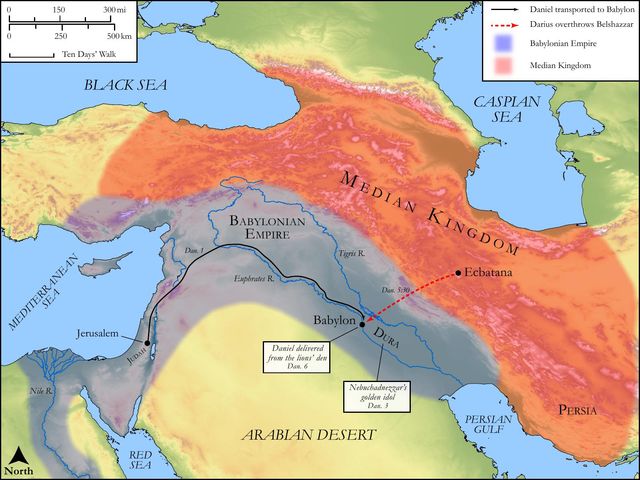
See on the biblical-era map
Study this verse
Public-domain commentary
Matthew Henry
From his Commentary on the Whole Bible. Henry comments on passages, not single verses — this entry covers Daniel 6:18–24. His two-level outline is real structure in the source text, so it is rendered as structure.
Here is, I. The melancholy night which the king had, upon Daniel's account, Dan 6:18. He had said, indeed, that God would deliver him out of the danger, but at the same time he could not forgive himself for throwing him into the danger; and justly might God deprive him of a friend whom he had himself used so barbarously. He went to his palace, vexed at himself for what he had done, and calling himself unwise and unjust for not adhering to the law of God and nature with a non obstante - a negative to the law of the Medes and Persians. He ate no supper, but passed the night fasting; his heart was already full of grief and fear. He forbade the music; nothing is more unpleasing that songs sung to a heavy heart. He went to bed, but got no sleep, was full of tossings to and fro till the dawning of the day. Note, the best way to have a good night is to keep a good conscience, then we may lie down in peace.
II.The solicitous enquiry he made concerning Daniel the next morning, Dan 6:19, Dan 6:20.
He was up early, very early; for how could he lie in bed when he could not sleep for dreaming of Daniel, nor lie awake quietly for thinking of him? And he was no sooner up than he went in haste to the den of lions, for he could not satisfy himself to send a servant (that would not sufficiently testify his affection for Daniel), nor had he patience to stay so long as till a servant would return. When he comes to the den, not without some hopes that God had graciously undone what he had wickedly done, he cries, with a lamentable voice, as one full of concern and trouble, O Daniel! art thou alive? He longs to know, yet trembles to ask the question, fearing to be answered with the roaring of the lions after more prey: O Daniel! servant of the living God, has thy God whom thou servest made it to appear that he is able to deliver thee from the lions? If he rightly understood himself when he called him the living God, he could not doubt of his ability to keep Daniel alive, for he that has life in himself quickens whom he will; but has he thought fit in this case to exert his power? What he doubted of we are sure of, that the servants of the living God have a Master who is well able to protect them and bear them out in his service.
III.The joyful news he meets with - that Daniel is alive, is safe, and well, and unhurt in the lions' den, Dan 6:21, Dan 6:22.
Daniel knew the king's voice, though it was now a lamentable voice, and spoke to him with all the deference and respect that were due to him: O king! live for ever. He does not reproach him for his unkindness to him, and his easiness in yielding to the malice of his persecutors; but, to show that he has heartily forgiven him, he meets him with his good wishes. Note, We should not upbraid those with the diskindnesses they have done us who, we know, did them with reluctance, and are very ready to upbraid themselves with them. The account Daniel gives the king is very pleasant; it is triumphant.
1.God has preserved his life by a miracle. Darius had called him Daniel's god (thy God whom thou servest), to which Daniel does as it were echo back, Yea, he is my God, whom I own, and who owns me, for he has sent his angel. The same bright and glorious being that was seen in the form of the Son of God with the three children in the fiery furnace had visited Daniel, and, it is likely, in a visible appearance had enlightened the dark den, and kept Daniel company all night, and had shut the lions' mouths, that they had not in the least hurt him. The angel's presence made even the lions' den his strong-hold, his palace, his paradise; he had never had a better night in his life. See the power of God over the fiercest creatures, and believe his power to restrain the roaring lion that goes about continually seeking to devour from hurting those that are his. See the care God takes of his faithful worshippers, especially when he calls them out to suffer for him. If he keeps their souls from sin, comforts their souls with his peace, and receives their souls to himself, he does in effect stop the lions' mouths, that they cannot hurt them. See how ready the angels are to minister for the good of God's people, for they own themselves their fellow servants.
2.God has therein pleaded his cause. He was represented to the king as disaffected to him and his government. We do not find that he said any thing in his own vindication, but left it to God to clear up his integrity as the light; and he did it effectually, by working a miracle for his preservation. Daniel, in what he had done, had not offended either God or the king: Before him whom I prayed to innocency was found in me. He pretends not to a meritorious excellence, but the testimony of his conscience concerning his sincerity is his comfort - As also that before thee, O king! I have done no hurt, nor designed thee any affront.
IV.The discharge of Daniel from his confinement.
His prosecutors cannot but own that the law is satisfied, though they are not, or, if it be altered, it is by a power superior to that of the Medes and Persians; and therefore no cause can be shown why Daniel should not be fetched out of the den (Dan 6:23): The king was exceedingly glad to find him alive, and gave orders immediately that they should take him out of the den, as Jeremiah out of the dungeon; and, when they searched, no manner of hurt was found upon him; he was nowhere crushed nor scarred, but was kept perfectly well, because he believed in his God. Note, Those who boldly and cheerfully trust in God to protect them in the way of their duty shall never be made ashamed of their confidence in him, but shall always find him a present help.
V.The committing of his prosecutors to the same prison, or place of execution rather, Dan 6:24.
Darius is animated by this miracle wrought for Daniel, and now begins to take courage and act like himself. Those that would not suffer him to show mercy to Daniel shall, now that God has done it for him, be made to feel his resentments; and he will do justice for God who had shown mercy for him. Daniel's accusers, now that his innocency is cleared, and Heaven itself has become his compurgator, have the same punishment inflicted upon them which they designed against him, according to the law of retaliation made against false accusers, Deu 19:18, Deu 19:19. Such they were to be reckoned now that Daniel was proved innocent; for, though the fact was true, yet it was not a fault. They were cast into the den of lions, which perhaps was a punishment newly invented by themselves; however, it was what they maliciously designed for Daniel. Nec lex est justior ulla qum necis artifices arte perire su - No law can be more just than that which adjudges the devisers of barbarity to perish by it, Psa 7:15, Psa 7:16; Psa 9:15, Psa 9:16. And now Solomon's observation is verified (Pro 11:8), The righteous is delivered out of trouble, and the wicked cometh in his stead. In this execution we may observe,
1.The king's severity, in ordering their wives and children to be thrown to the lions with them. How righteous are God's statutes above those of the nations! for God commanded that the children should not die for the fathers' crimes, Deu 24:16. Yet they were put to death in extraordinary cases, as those of Achan, and Saul, and Haman.
2.The lion's fierceness. They had the mastery of them immediately, and tore them to pieces before they came to the bottom of the den. This verified and magnified the miracle of their sparing Daniel; for hereby it appeared that it was not because they had not appetite, but because they had not leave. Mastiffs that are kept muzzled are the more fierce when the muzzle is taken off; so were these lions. And the Lord is known by those judgments which he executes.
Historical interpretation
Historical reception
3 surviving comments on this verse. Each one is dated, so this reads as a timeline rather than a list.
Select a marker to jump to its quote. Markers stagger vertically where authors wrote within a few decades of each other.
The same faith, which on the previous evening had led Darius to seal the entrance of the den, brought him again to that place, as if he would have seen Daniel still alive.
Verse 19. "Then the king arose at the break of dawn and proceeded with haste to the pit of lions." The term "pit" (lacus) implies a really deep depression, or dry cistern, in which the lions were fed. And so he proceeded hastily to the pit at the break of dawn, believing that Daniel was alive. But in Latin the word lacus is applied to a body of fresh water, such as Lake Benacus and Lake Larius, and the rest of them. The Greeks call it limne, that is, "a body of standing water" (stagnum).
“King Darius rose early at daybreak,” that is, while it was still dark, around dawn, so that there was even need of lamps (the meaning of “at daybreak”).
Continue studying Daniel 6:19 across the web’s major study libraries — every link below opens this exact verse, chapter, or book on the destination site.
Read & Compare
 BibleGatewayThis verse in more than 200 translations and 70 languages.
 Bible.comThe YouVersion reader — hundreds of translations, reading plans, and highlights.
 ESV.orgCrossway's official English Standard Version reader.
 NET BibleThe NET translation with 60,000+ translators' notes on every rendering decision.
 STEP BibleTyndale House's free study tool — original text, vocabulary, and scholarly resources.
 BibliaLogos Bible Software's free web reader.
 USCCBThe New American Bible (Revised Edition) with the U.S. bishops' study notes.
Commentaries
 BibleHub CommentariesDozens of classic commentaries on this verse, gathered on one page.
 StudyLightMore than 100 commentary sets — the largest collection on the web.
 BibleRefPlain-English commentary on what this verse means, verse by verse.
 Enduring WordDavid Guzik's free commentary on this chapter, widely used by Bible teachers.
 Bible Study ToolsVerse commentary alongside Greek and Hebrew study aids.
Original Language & Research
- BibleHub InterlinearThe verse word by word — original language, transliteration, and English.
- BibleHub LexiconEvery word's original-language definition and Strong's entry.
 Blue Letter BibleDeep-study tools — Strong's numbers, concordance, and word studies.
 SefariaThe Hebrew text with Rashi and centuries of Jewish commentary.
Sermons, Hymns & Audio


TrulyRandomVerse is not affiliated with these sites and doesn’t control their content. They’re linked because they’re genuinely useful.
Summary
Daniel 6:19 captures the profound dawn after Daniel's miraculous night in the lions' den, vividly portraying King Darius's desperate anxiety and urgent haste. Tormented by a sleepless night and deep regret over Daniel's unjust condemnation, the king rises at the earliest conceivable moment, driven by a fervent, albeit fragile, hope that Daniel's God may have intervened to save His faithful servant. This pivotal verse dramatically sets the stage for the miraculous revelation of divine protection, Daniel's ultimate vindication, and a pagan king's encounter with the living God.
Context
ShowHideLiterary Context
This verse immediately follows a night of profound distress for King Darius. Daniel 6:16 describes Daniel being cast into the den, sealed by the king's own signet and that of his nobles, ensuring the decree's immutability and the finality of the judgment. Daniel 6:18 vividly portrays the king's anguish: he returns to his palace, refuses food and entertainment, and spends a sleepless night, clearly burdened by the irreversible decree into which he was cunningly tricked. His actions in Daniel 6:19 are the direct, inevitable consequence of this torment, a desperate dash to confront the outcome of his terrible decision, fueled by a faint but persistent hope in Daniel's God. The narrative skillfully builds suspense, leading the reader to anticipate the dramatic revelation at the den.
Historical & Cultural Context
The setting is the Medo-Persian Empire, renowned for its strict and unchangeable laws. Once a decree was signed by the king and sealed, it could not be altered or revoked, even by the monarch himself (Daniel 6:8). This legal rigidity explains Darius's profound helplessness despite his supreme authority and his personal desire to save Daniel. The "den of lions" was a brutal and public form of execution, designed to be inescapable and serve as a deterrent. Darius's early morning haste underscores not only his deep personal concern for Daniel but also the cultural expectation that a king, though powerful, was ultimately bound by the very laws he promulgated. His actions reflect a monarch grappling with the human cost of his own unchangeable decrees and the profound impact of Daniel's character and faith.
Key Themes
ShowHideDaniel 6:19 powerfully contributes to several overarching themes in the book of Daniel. It highlights the tension between human authority and divine sovereignty, as Darius, the most powerful man in the empire, is utterly powerless to undo his own law, yet anticipates a higher power at work. It emphasizes the impact of faithful witness, as Daniel's unwavering devotion to God has clearly impressed the pagan king, leading Darius to hope in Daniel's God for deliverance, much like Nebuchadnezzar's recognition of God after the deliverance of Shadrach, Meshach, and Abednego in Daniel 3. Finally, it builds anticipation for divine deliverance, setting the scene for one of the Bible's most dramatic displays of God's ability to protect His servants in seemingly impossible circumstances, a theme consistent throughout Daniel's narrative, affirming that God is able to deliver those who trust Him (Daniel 3:17).
Exposition and Analysis
ShowHideKey Word Analysis
ShowHideThis word (H4430) refers to Darius, emphasizing his royal status and the immense power he wielded. Paradoxically, his power is shown to be limited in the face of his own immutable law. His personal anguish highlights the human side of even the most absolute ruler, burdened by the consequences of his decrees and the plight of a man he respected.
The verb (H6966) signifies a rising or standing up, but here it carries the connotation of an immediate, decisive action after a period of inactivity or distress. Coupled with the subsequent phrases, it conveys the king's inability to rest or delay, driven by an overwhelming and desperate need to ascertain Daniel's fate. It implies a forced, urgent movement from a state of troubled repose.
This idiomatic phrase, combining H8238 and H5053, literally means "the dawn's brilliance" or "the shining morning." It vividly describes the absolute earliest moment of the day, emphasizing the king's extreme impatience and desperate anticipation. He did not wait for full daylight but went at the first hint of aurora, underscoring his profound anxiety, sleepless torment, and faint hope.
Verse Breakdown
ShowHide"Then the king arose very early in the morning,"
This clause immediately follows the description of Darius's sleepless and fasting night, emphasizing the profound distress that prevented him from resting. The king's rising at the absolute earliest moment of dawn powerfully conveys his deep anguish, his inability to tolerate further delay, and his desperate urgency to know Daniel's fate. It highlights his personal investment and emotional torment over the situation, suggesting a mind consumed by the events of the previous night.
"and went in haste"
This phrase reinforces the king's extreme impatience and anxiety, moving beyond mere rising to a frantic progression. The "haste" suggests a rapid, almost frantic movement, driven by a mixture of dread over the expected outcome and a faint, desperate hope for a miracle. He is not merely proceeding, but rushing, indicating the depth of his emotional turmoil and the critical, life-or-death nature of his mission.
"unto the den of lions."
This specifies the king's grim destination, the place of certain death and the culmination of the unjust decree. The "den of lions" represents not only a brutal method of execution but also the seemingly inescapable consequence of human conspiracy and immutable law. The king's direct journey to this terrifying place underscores his confrontation with the consequences of his actions and his desperate need to witness the outcome, hoping against all odds for a divine intervention.
Literary Devices
ShowHideThe verse masterfully employs Anticipation and Suspense, building palpable tension as the narrative moves towards the climax of Daniel's story. The king's "very early" rising and his "haste" are not merely descriptive but serve to heighten the reader's expectation of what he will find, creating a sense of urgency and impending revelation. There is also a significant element of Dramatic Irony, as the reader, often familiar with the outcome of Daniel's night, is aware of Daniel's safety, while the king remains in agonizing uncertainty. This contrast between the reader's knowledge and the character's ignorance amplifies the emotional impact. Furthermore, the "den of lions" itself functions as powerful Symbolism, representing not only a place of certain death but also the ultimate test of faith, the overwhelming power of human opposition, and ultimately, the extraordinary power of God to deliver from seemingly inescapable destruction.
Theological and Thematic Connections
ShowHideDaniel 6:19 serves as a poignant illustration of God's sovereignty over human affairs, even over the most powerful rulers and the most rigid legal systems. King Darius, despite his absolute authority, is shown to be deeply affected by the consequences of his decrees and the plight of a righteous man. His desperate hope for Daniel's deliverance, born out of respect for Daniel's character and Daniel's God, underscores the profound impact of a faithful witness on those in power, even those outside the covenant community. This scene sets the stage for God to demonstrate His unmatched power, turning a humanly irreversible death sentence into a glorious testament to divine protection and justice. It reminds us that even when human systems of justice fail or are manipulated, God's ultimate justice and power to save remain supreme, often working through the very circumstances designed for destruction.
Reflection and Application
ShowHideKing Darius's urgent journey to the lions' den, driven by anguish and a sliver of hope, offers a powerful reflection on leadership, regret, and the profound influence of a life lived in integrity. His actions reveal that even those in positions of immense power are not immune to the emotional weight of their decisions, especially when those decisions inadvertently harm the innocent. For us, this verse encourages us to consider the impact of our own choices and the importance of standing firm in our convictions, as Daniel did, even when it means facing severe consequences. Just as Darius desperately sought Daniel, we are called to seek God's presence and comfort in our own "dens"—those seemingly impossible or terrifying situations where we feel trapped, vulnerable, or unjustly condemned. It is a profound reminder that our faithfulness, even in the face of grave danger, can bear powerful witness to God's character and power, potentially impacting those around us, even those in authority, and fostering a desperate hope for divine intervention in the most dire circumstances.
Questions for Reflection
ShowHideFAQ
ShowHideWhy was the king so distressed about Daniel?
ShowHideKing Darius was deeply distressed because he held Daniel in exceptionally high esteem, recognizing his unparalleled spirit and wisdom (Daniel 6:3). He had intended to set Daniel over the whole kingdom due to his outstanding qualities. However, he was cunningly tricked by jealous officials into signing an unchangeable decree that inadvertently condemned Daniel. His profound distress stemmed from his personal affection and respect for Daniel, combined with his utter helplessness to reverse a law he himself had enacted, which bound even him.
What does "very early in the morning" signify in this context?
ShowHideThe phrase "very early in the morning" (Aramaic: shᵉpharphar nôgahh) emphasizes the king's extreme impatience, profound anxiety, and sleepless torment. It indicates that he did not wait for full daylight but went at the absolute earliest possible moment, at the first hint of dawn. This highlights his restless night (as explicitly mentioned in Daniel 6:18) and his desperate, almost frantic, need to ascertain Daniel's fate, clinging to a faint hope for a miracle.
Could the king not simply change the law and save Daniel?
ShowHideNo, according to the inviolable laws of the Medes and Persians, once a decree was signed and sealed by the king, it was immutable and could not be altered or revoked (Daniel 6:8 and Daniel 6:15). This legal rigidity is a key element of the narrative, highlighting the king's powerlessness despite his supreme position and underscoring the absolute necessity of divine intervention for Daniel's deliverance. It magnifies the miracle by showing that no human authority could have saved Daniel.
Christ-Centered Fulfillment
ShowHideDaniel's experience in the lions' den, and King Darius's desperate rush to it, finds profound Christ-centered fulfillment. The "den of lions," a place of certain death from which no one was expected to emerge alive, serves as a powerful type of the grave. Just as Daniel was placed in a sealed, tomb-like chamber, only to be found miraculously alive, so too was Jesus laid in a sealed tomb. King Darius's anxious journey to the den, filled with a desperate hope for Daniel's life, mirrors humanity's deepest longing for deliverance from the power of death and sin. However, unlike Darius's fragile and uncertain hope, the resurrection of Jesus Christ provides the ultimate, assured victory over the "den" of death. Christ's emergence from the tomb on the third day, conquering sin and death, is the ultimate fulfillment of all such Old Testament deliverances. He is the true Lamb of God who takes away the sin of the world, and through His resurrection, He offers eternal life to all who believe, demonstrating that He is indeed the resurrection and the life. His victory ensures that death has no more dominion over Him, and through Him, we are freed from the fear of death, for He has destroyed him who has the power of death, that is, the devil.