


1 Samuel 17:42
Bible text: King James Version (1769 Blayney text) · Public domain
Bible text: King James Version with Strong's numbers · Public domain
Bible text: Berean Standard Bible · Public domain
Bible text: American Standard Version (1901) · Public domain
Bible text: World English Bible, Messianic edition · Public domain
Bible text: Geneva Bible (1599) · Public domain
Bible text: Young's Literal Translation · Public domain
- וַיַּבֵּטvai·ya·Betand he lookedH5027Conj-w ¦ V-Hiphil-ConsecImperf-3msVerb Hiphil Consecutive Imperfect 3rd Singular Masculineוַandיַּבֵּטhe looked
- הַפְּלִשְׁתִּיha·pe·lish·Tithe PhilistineH6430Art ¦ N-msNoun Gentilic Singular Masculine AbsoluteהַtheפְּלִשְׁתִּיPhilistine
- וַיִּרְאֶהvai·yir·'Ehand he sawH7200Conj-w ¦ V-Qal-ConsecImperf-3msVerb Qal Consecutive Imperfect 3rd Singular Masculineוַandיִּרְאֶהhe saw
- אֶת'et<obj.>H853DirObjMParticle Object Indicator
- דָּוִדda·VidDavidH1732N-proper-mNoun Proper Masculine
- וַיִּבְזֵהוּvai·yiv·Ze·huand he despised himH959Conj-w ¦ V-Qal-ConsecImperf-3ms ¦ 3msVerb Qal Consecutive Imperfect 3rd Singular Masculineוַandיִּבְזֵhe despisedהוּhim
- כִּיkiforH3588PrtParticle Conditional
- הָיָהha·Yahhe wasH1961V-Qal-Perf-3msVerb Qal Perfect 3rd Singular Masculine
- נַעַרNa·'ara youthH5288N-msNoun Singular Masculine Absolute
- וְאַדְמֹנִיve·'ad·mo·Niand redH132Conj-w ¦ Adj-msAdjective Singular Masculine Absoluteוְandאַדְמֹנִיred
- עִם'imwithH5973PrepPreposition
- יְפֵהye·Pehhandsome ofH3303Adj-mscAdjective Singular Masculine Construct
- מַרְאֶהmar·'EhappearanceH4758N-msNoun Singular Masculine Absolute
English is a literal word-by-word gloss of the Hebrew, not the KJV's wording. Why?
This is the original text the KJV's translators worked from — each Hebrew word with its own literal English meaning in this verse, prepared by scholars at Tyndale House, Cambridge. The KJV translates whole sentences, not word by word, so its wording differs: one Hebrew word can become several English words, and the KJV may choose “the LORD” where the gloss reads “Yahweh”. Both are faithful — they answer different questions. For the KJV's own rendering, switch to the KJV text.
Details
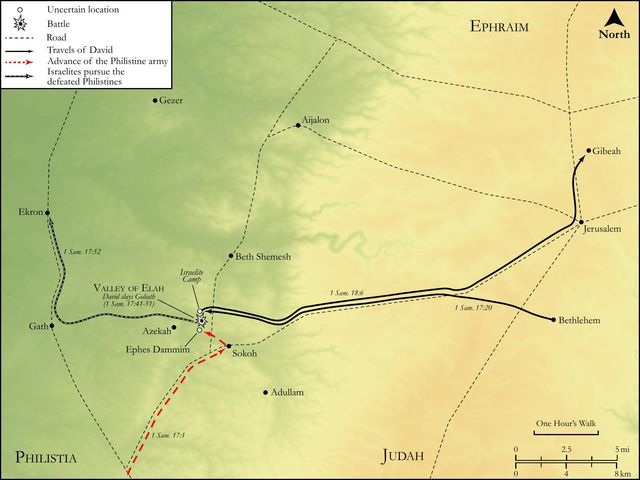
See on the biblical-era map
Study this verse
Public-domain commentary
Matthew Henry
From his Commentary on the Whole Bible. Henry comments on passages, not single verses — this entry covers 1 Samuel 17:40–47. His four-level outline is real structure in the source text, so it is rendered as structure.
We are now coming near this famous combat, and have in these verses the preparations and remonstrances made on both sides.
I.The preparations made on both sides for the encounter.
The Philistine was already fixed, as he had been daily for the last forty days. Well might he go with his armour, for he had sufficiently proved it. Only we are told (Sa1 17:41) that he came on and drew near, a signal, it is likely, being given that his challenge was accepted, and, as if he distrusted his helmet and coat of mail, a man went before him, carrying his shield, for his own hands were full with his sword and spear, Sa1 17:45. But what arms and ammunition is David furnished with? Truly none but what he brought with him as a shepherd; no breastplate, nor corselet, but his plain shepherd's coat; no spear, but his staff; no sword nor bow, but his sling; no quiver, but his scrip; nor any arrows, but, instead of them, five smooth stones picked up out of the brook, Sa1 17:40. By this it appeared that his confidence was purely in the power of God, and not in any sufficiency of his own, and that now at length he who put it into his heart to fight the Philistine put it into his head with what weapons to do it.
II.The conference which precedes the encounter, in which observe,
1.How very proud Goliath was, (1.) With what scorn he looked upon his adversary, Sa1 17:42. He looked about, expecting to meet some tall strong man, but, when he saw what a mean figure he made with whom he was to engage, he disdained him, thought it below him to enter the lists with him, fearing that the contemptibleness of the champion he contended with would lessen the glory of his victory. He took notice of his person, that he was but a youth, not come to his strength, ruddy and of a fair countenance, fitter to accompany the virgins of Israel in their dances (if mixed dancing was then in use) than to lead on the men of Israel in their battles. He took notice of his array with great indignation (Sa1 17:43): "Am I a dog, that thou comest to me with staves? Dost thou think to beat me as easily as thou dost thy shepherd's dog?" (2.) With what confidence he presumed upon his success. He cursed David by his gods, imprecating the impotent vengeance of his idols against him, thinking these fire-balls thrown about him would secure his success: and therefore, in confidence of that, he darts his grimaces, as if threatening words would kill (Sa1 17:44): "Come to me, and I will give thy flesh to the fowls of the air, it will be a tender and delicate feast for them." Thus the security and presumption of fools destroy them.
2.How very pious David was. His speech savours nothing of ostentation, but God is all in all in it, Sa1 17:45-47.
(1.)He derives his authority from God: "I come to thee by warrant and commission from heaven, in the name of the Lord, who has called me to and anointed me for this undertaking, who, by his universal providence, is the Lord of hosts, of all hosts, and therefore has power to do what he pleases, and, by the special grace of his covenant, is the God of the armies of Israel, and therefore has engaged and will employ his power for their protection, and against thee who hast impiously defied them." The name of God David relied on, as Goliath did on his sword and spear. See Psa 20:7; Psa 118:10, Psa 118:11.
(2.)He depends for success upon God, Sa1 17:46. David speaks with as much assurance as Goliath had done, but upon better ground; it is his faith that says, "This day will the Lord deliver thee into my hand, and not only thy carcase, but the carcases of the host of the Philistines, shall be given to the birds and beasts of prey." (3.) He devotes the praise and glory of all to God. He did not, like Goliath, seek his own honour, but the honour of God, not doubting but by the success of this action,
[1.]All the world should be made to know that there is a God, and that the God of Israel is the one only living and true God, and all other pretended deities are vanity and a lie.
[2.]All Israel (whom he calls not this army, but this assembly, or church, because they were now religiously attending the goings of their God and King, as they used to do in the sanctuary) shall know that the Lord saveth not with sword and spear (Sa1 17:47), but can, when he pleases, save without either and against both, Psa 46:9. David addresses himself to this combat rather as a priest that was going to offer a sacrifice to the justice of God than as a soldier that was going to engage an enemy of his country.
Historical interpretation
Historical reception
1 surviving comment on this verse from the historical church.
And when the Philistine had looked and saw David, etc. And when the devil had very shrewdly looked and saw the Son of God in the world doing and teaching things contrary to him, as if proceeding against him, since he found him humble, he, knowing nothing but pride, despised him. For he was full of new virtue and grace, reddened with the blood of passions, and beautiful in the action of great deeds.
Continue studying 1 Samuel 17:42 across the web’s major study libraries — every link below opens this exact verse, chapter, or book on the destination site.
Read & Compare
 BibleGatewayThis verse in more than 200 translations and 70 languages.
 Bible.comThe YouVersion reader — hundreds of translations, reading plans, and highlights.
 ESV.orgCrossway's official English Standard Version reader.
 NET BibleThe NET translation with 60,000+ translators' notes on every rendering decision.
 STEP BibleTyndale House's free study tool — original text, vocabulary, and scholarly resources.
 BibliaLogos Bible Software's free web reader.
 USCCBThe New American Bible (Revised Edition) with the U.S. bishops' study notes.
Commentaries
 BibleHub CommentariesDozens of classic commentaries on this verse, gathered on one page.
 StudyLightMore than 100 commentary sets — the largest collection on the web.
 BibleRefPlain-English commentary on what this verse means, verse by verse.
 Enduring WordDavid Guzik's free commentary on this chapter, widely used by Bible teachers.
 Bible Study ToolsVerse commentary alongside Greek and Hebrew study aids.
Original Language & Research
- BibleHub InterlinearThe verse word by word — original language, transliteration, and English.
- BibleHub LexiconEvery word's original-language definition and Strong's entry.
 Blue Letter BibleDeep-study tools — Strong's numbers, concordance, and word studies.
 SefariaThe Hebrew text with Rashi and centuries of Jewish commentary.
Sermons, Hymns & Audio


TrulyRandomVerse is not affiliated with these sites and doesn’t control their content. They’re linked because they’re genuinely useful.
Summary
1 Samuel 17:42 vividly portrays the initial confrontation between the Philistine champion Goliath and the young Israelite shepherd David, capturing Goliath's immediate and profound disdain. The giant's scorn stemmed from David's youthful appearance, his healthy complexion, and pleasant looks, which Goliath perceived as utterly unbefitting a warrior and certainly no match for his own formidable stature and battle experience. This pivotal verse sets the stage for a dramatic reversal, highlighting the stark contrast between human judgment based on outward appearance and God's surprising choice of the seemingly weak to accomplish His mighty purposes.
Context
ShowHideLiterary Context
This verse is situated at the dramatic climax of the prolonged standoff between the Philistine and Israelite armies in the Valley of Elah, as detailed in 1 Samuel 17. For forty days, Goliath, the Philistine champion, had issued a daily challenge for single combat, taunting Israel and paralyzing King Saul and his army with fear, as recorded in 1 Samuel 17:10-11. David, a young shepherd, arrives at the battlefield to deliver provisions to his brothers and is appalled by Goliath's blasphemous defiance of the living God, a sentiment expressed in 1 Samuel 17:26. Despite his youth and lack of military training, David courageously volunteers to fight Goliath, fueled by his unwavering faith in God's deliverance, having previously protected his flock from lions and bears, as he recounts in 1 Samuel 17:34-37. When Goliath finally sees David approaching, this verse describes his contemptuous reaction, underscoring the vast disparity in perceived strength and experience between the two combatants, a disparity that God is about to dramatically overturn.
Historical & Cultural Context
The practice of single combat between champions was a recognized, albeit less common, method of warfare among the nations, intended to minimize casualties by deciding the outcome of a larger conflict through a proxy battle. Both the Philistines and Israelites were accustomed to warfare, but the Philistines, with their superior iron weaponry and formidable warriors like Goliath, often held a military advantage. Goliath's armor and weapons, meticulously described in 1 Samuel 17:4-7, would have been culturally understood as the epitome of a fearsome warrior. In contrast, David's appearance as a shepherd, without traditional armor or weapons, would have been culturally perceived as an insult and a sign of utter disrespect for the gravity of the challenge. Goliath's disdain reflects the cultural expectation that a champion would be a seasoned, physically imposing warrior, not a mere youth. This cultural backdrop amplifies the dramatic tension and highlights the counter-cultural nature of God's intervention.
Key Themes
ShowHideThis verse powerfully contributes to several overarching themes within the book of Samuel and the broader biblical narrative. The theme of underestimation and disdain is central, as Goliath's scorn for David's youthful and non-threatening appearance directly contrasts with God's view, setting the stage for a divine reversal. This ties into the profound theme of appearance versus reality, echoing the earlier divine pronouncement to Samuel: "For the LORD seeth not as man seeth; for man looketh on the outward appearance, but the LORD looketh on the heart," found in 1 Samuel 16:7. David's perceived weakness highlights the theme of God using the unqualified, demonstrating that divine power is often most clearly displayed through human weakness, not strength. Furthermore, the narrative underscores the theme of faith over fear, as David's unwavering trust in God stands in stark contrast to the fear that gripped Saul and the entire Israelite army, as described in 1 Samuel 17:24. Goliath's disdain for David serves to magnify the miraculous nature of God's victory through His chosen instrument.
Exposition and Analysis
ShowHideKey Word Analysis
ShowHideThis verb signifies a profound contempt, scorn, or despising. It implies looking down upon someone as worthless, insignificant, or beneath one's notice. Goliath's reaction was not merely surprise or annoyance, but a deep-seated contempt for David's lack of intimidating presence and military bearing, implying a sense of insult that such an opponent would be sent against him.
This term refers to a young boy, a lad, or a servant, typically someone not yet of military age or experience. In this context, it emphasizes David's tender years and lack of warrior credentials, which would have made him seem utterly unqualified for single combat against a seasoned giant like Goliath.
This adjective describes a reddish or healthy complexion, often associated with youth, vibrancy, and sometimes beauty. It is the same word used to describe Esau in Genesis 25:25 and suggests a fresh, unweathered appearance, further contrasting with the hardened, sun-beaten look of a veteran soldier.
Verse Breakdown
ShowHide"And when the Philistine looked about, and saw David"
This clause marks the pivotal moment of direct visual confrontation. Goliath, having issued his challenge for forty days, finally turns his attention to the unexpected challenger. The act of "looking about" (from nâbaṭ) suggests a scanning, perhaps initially dismissive, glance that quickly turns into a focused assessment upon realizing the identity of his opponent.
"he disdained him"
This is the immediate and core reaction, expressing Goliath's profound and visceral contempt. His disdain is not just a passing emotion but a deep-seated conviction that David is utterly beneath him, unworthy of his time or effort. It underscores his immense pride and overconfidence, viewing David as an affront to his status and the gravity of the challenge.
"for he was [but] a youth, and ruddy, and of a fair countenance."
This final clause provides the explicit reasons for Goliath's disdain. David's perceived lack of age, military experience, and imposing physical presence — his youthful, healthy, and pleasant appearance — were, in Goliath's eyes, clear indicators of his inadequacy as a warrior. The KJV's "[but]" emphasizes the stark contrast between Goliath's expectations for a formidable opponent and David's actual, seemingly non-threatening reality, highlighting the giant's profound misjudgment.
Literary Devices
ShowHideThe verse effectively employs several literary devices to heighten the dramatic tension and underscore its theological message. Irony is paramount, as Goliath's profound disdain, based on David's seemingly insignificant appearance, directly foreshadows his own shocking defeat at the hands of this very youth. The giant's overconfidence, rooted in his physical prowess, becomes the very instrument of his downfall. Contrast is also a dominant feature, juxtaposing Goliath's immense stature, seasoned warrior status, and intimidating presence with David's youthful, "ruddy," and "fair" appearance. This visual and experiential contrast serves to magnify God's power, demonstrating that victory does not depend on human might or worldly credentials. Furthermore, the verse uses foreshadowing, as Goliath's dismissive assessment sets up the miraculous and unexpected victory that will follow, emphasizing that God's ways are not man's ways.
Theological and Thematic Connections
ShowHideGoliath's disdain for David in 1 Samuel 17:42 serves as a profound theological statement on the contrast between human perception and divine wisdom. It highlights humanity's tendency to judge based on outward appearances, strength, and worldly qualifications, often overlooking God's chosen instruments. God, however, operates on a different principle, frequently selecting the humble, the weak, and the underestimated to accomplish His most significant purposes, thereby ensuring that the glory belongs to Him alone. This narrative powerfully illustrates that true strength and effectiveness in God's kingdom are not measured by human standards of might or beauty, but by faith and divine anointing. Goliath's scorn, therefore, inadvertently sets the stage for a dramatic display of God's sovereignty and power through an unlikely champion.
Reflection and Application
ShowHideThe moment Goliath disdained David offers a powerful mirror for our own lives and perceptions. We, too, often fall into the trap of judging by outward appearances—whether it's assessing others, evaluating our own capabilities, or sizing up the challenges before us. This verse challenges us to look beyond the superficial and to recognize that God's power is not limited by human limitations or worldly expectations. When we face "giants" in our lives—overwhelming obstacles, daunting tasks, or situations where we feel utterly unqualified—Goliath's scorn for David reminds us that our perceived weaknesses can become the very canvas upon which God's strength is most gloriously displayed. It encourages us to embrace humility, trust in divine enablement, and remember that God delights in using the unlikely to accomplish the impossible, ensuring that His glory, not ours, is magnified.
Questions for Reflection
ShowHideFAQ
ShowHideWhy was Goliath's disdain so significant to the narrative?
ShowHideGoliath's disdain was crucial because it dramatically underscored the vast disparity between human perception and divine reality. His scorn, rooted in David's youthful and non-threatening appearance, highlighted his own pride and overconfidence, setting up the most profound reversal. It ensured that when David, the seemingly insignificant youth, defeated the formidable giant, the victory would unequivocally be attributed to God's power and not to David's human strength or skill. This magnified God's glory and demonstrated that His ways are far above human understanding, fulfilling the theme that God chooses the weak to confound the strong, as articulated in 1 Corinthians 1:27.
What does "ruddy, and of a fair countenance" imply about David in this context?
ShowHideThese descriptions emphasize David's youthful, healthy, and pleasant appearance. In the context of ancient warfare, these attributes were the antithesis of a fearsome, battle-hardened warrior. Goliath would have expected a scarred, rugged, and imposing figure. David's "ruddy" complexion (suggesting a vibrant, unweathered youth, perhaps from outdoor life) and "fair countenance" (meaning good-looking or pleasant) would have made him appear utterly unsuited for combat in Goliath's eyes. This contrast serves to highlight Goliath's misjudgment and to set up the powerful theological point that God's chosen instruments often defy human expectations, as seen in 1 Samuel 16:7.
Christ-Centered Fulfillment
ShowHideThe disdain Goliath showed David in 1 Samuel 17:42 powerfully foreshadows the world's rejection and underestimation of Jesus Christ. Just as David appeared as a "youth, and ruddy, and of a fair countenance"—seemingly unqualified by worldly standards to face a mighty warrior—so too did Jesus come "without form or comeliness" and with "no beauty that we should desire him," as prophesied in Isaiah 53:2. The world, expecting a conquering king or a physically imposing deliverer, disdained Him, seeing Him as merely a carpenter's son from Nazareth, unworthy of their respect or allegiance, a sentiment captured in John 1:46. Yet, it was through this seemingly weak and unimpressive appearance, through His ultimate act of humility and sacrifice on the cross, that Christ conquered the ultimate "giant" of sin and death, triumphing over the powers and authorities, as described in Colossians 2:15. His victory, like David's, was not achieved through worldly might but through divine power made perfect in apparent weakness, demonstrating that God's greatest triumphs are often accomplished through means that defy human logic and expectation, ultimately bringing glory to the Father, as beautifully articulated in Philippians 2:7-8.