


1 Samuel 17:41
Bible text: King James Version (1769 Blayney text) · Public domain
Bible text: Berean Standard Bible · Public domain
Bible text: American Standard Version (1901) · Public domain
Bible text: World English Bible, Messianic edition · Public domain
Bible text: Geneva Bible (1599) · Public domain
Bible text: Young's Literal Translation · Public domain
- וַיֵּלֶךְvai·Ye·lekhand he cameH1980Conj-w ¦ V-Qal-ConsecImperf-3msVerb Qal Consecutive Imperfect 3rd Singular Masculineוַandיֵּלֶךְhe came
- הַפְּלִשְׁתִּיha·pe·lish·Tithe PhilistineH6430Art ¦ N-msNoun Gentilic Singular Masculine AbsoluteהַtheפְּלִשְׁתִּיPhilistine
- הֹלֵךְho·LekhcomingH1980V-Qal-Prtcpl-msVerb Qal Participle Singular Masculine Absolute
- וְקָרֵבve·ka·Revand approachingH7131Conj-w ¦ Adj-msAdjective Singular Masculine Absoluteוְandקָרֵבapproaching
- אֶל'eltoH413PrepPreposition
- דָּוִדda·VidDavidH1732N-proper-mNoun Proper Masculine
- וְהָאִישׁve·ha·'Ishand the manH376Conj-w ¦ Art ¦ N-msNoun Singular Masculine Absoluteוְandהָtheאִישׁman
- נֹשֵׂאno·Se'[the] bearerH5375V-Qal-Prtcpl-msVerb Qal Participle Singular Masculine Absolute
- הַצִּנָּהha·tzi·Nahof the body shieldH6793Art ¦ N-fsNoun Singular Feminine Absoluteהַof theצִּנָּהbody shield
- לְפָנָיוle·fa·Nav[was] <to> before himH6440Prep-l ¦ N-mpc ¦ 3msNoun Plural Masculine Constructלְ[was] <to>פָנָיbeforeוhim
English is a literal word-by-word gloss of the Hebrew, not the KJV's wording. Why?
This is the original text the KJV's translators worked from — each Hebrew word with its own literal English meaning in this verse, prepared by scholars at Tyndale House, Cambridge. The KJV translates whole sentences, not word by word, so its wording differs: one Hebrew word can become several English words, and the KJV may choose “the LORD” where the gloss reads “Yahweh”. Both are faithful — they answer different questions. For the KJV's own rendering, switch to the KJV text.
Details
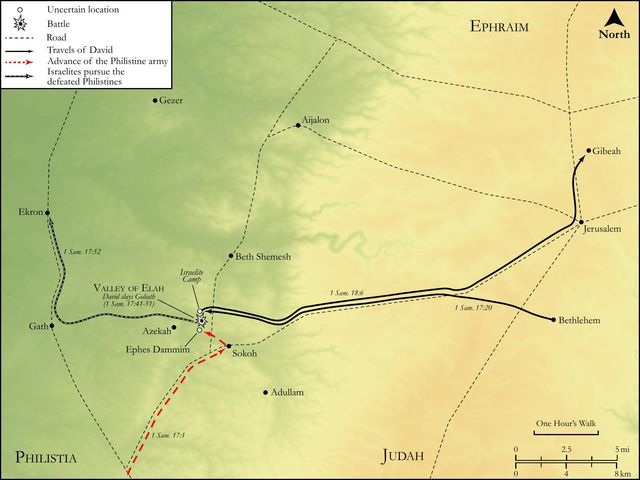
See on the biblical-era map
Study this verse
Public-domain commentary
Matthew Henry
From his Commentary on the Whole Bible. Henry comments on passages, not single verses — this entry covers 1 Samuel 17:40–47. His four-level outline is real structure in the source text, so it is rendered as structure.
We are now coming near this famous combat, and have in these verses the preparations and remonstrances made on both sides.
I.The preparations made on both sides for the encounter.
The Philistine was already fixed, as he had been daily for the last forty days. Well might he go with his armour, for he had sufficiently proved it. Only we are told (Sa1 17:41) that he came on and drew near, a signal, it is likely, being given that his challenge was accepted, and, as if he distrusted his helmet and coat of mail, a man went before him, carrying his shield, for his own hands were full with his sword and spear, Sa1 17:45. But what arms and ammunition is David furnished with? Truly none but what he brought with him as a shepherd; no breastplate, nor corselet, but his plain shepherd's coat; no spear, but his staff; no sword nor bow, but his sling; no quiver, but his scrip; nor any arrows, but, instead of them, five smooth stones picked up out of the brook, Sa1 17:40. By this it appeared that his confidence was purely in the power of God, and not in any sufficiency of his own, and that now at length he who put it into his heart to fight the Philistine put it into his head with what weapons to do it.
II.The conference which precedes the encounter, in which observe,
1.How very proud Goliath was, (1.) With what scorn he looked upon his adversary, Sa1 17:42. He looked about, expecting to meet some tall strong man, but, when he saw what a mean figure he made with whom he was to engage, he disdained him, thought it below him to enter the lists with him, fearing that the contemptibleness of the champion he contended with would lessen the glory of his victory. He took notice of his person, that he was but a youth, not come to his strength, ruddy and of a fair countenance, fitter to accompany the virgins of Israel in their dances (if mixed dancing was then in use) than to lead on the men of Israel in their battles. He took notice of his array with great indignation (Sa1 17:43): "Am I a dog, that thou comest to me with staves? Dost thou think to beat me as easily as thou dost thy shepherd's dog?" (2.) With what confidence he presumed upon his success. He cursed David by his gods, imprecating the impotent vengeance of his idols against him, thinking these fire-balls thrown about him would secure his success: and therefore, in confidence of that, he darts his grimaces, as if threatening words would kill (Sa1 17:44): "Come to me, and I will give thy flesh to the fowls of the air, it will be a tender and delicate feast for them." Thus the security and presumption of fools destroy them.
2.How very pious David was. His speech savours nothing of ostentation, but God is all in all in it, Sa1 17:45-47.
(1.)He derives his authority from God: "I come to thee by warrant and commission from heaven, in the name of the Lord, who has called me to and anointed me for this undertaking, who, by his universal providence, is the Lord of hosts, of all hosts, and therefore has power to do what he pleases, and, by the special grace of his covenant, is the God of the armies of Israel, and therefore has engaged and will employ his power for their protection, and against thee who hast impiously defied them." The name of God David relied on, as Goliath did on his sword and spear. See Psa 20:7; Psa 118:10, Psa 118:11.
(2.)He depends for success upon God, Sa1 17:46. David speaks with as much assurance as Goliath had done, but upon better ground; it is his faith that says, "This day will the Lord deliver thee into my hand, and not only thy carcase, but the carcases of the host of the Philistines, shall be given to the birds and beasts of prey." (3.) He devotes the praise and glory of all to God. He did not, like Goliath, seek his own honour, but the honour of God, not doubting but by the success of this action,
[1.]All the world should be made to know that there is a God, and that the God of Israel is the one only living and true God, and all other pretended deities are vanity and a lie.
[2.]All Israel (whom he calls not this army, but this assembly, or church, because they were now religiously attending the goings of their God and King, as they used to do in the sanctuary) shall know that the Lord saveth not with sword and spear (Sa1 17:47), but can, when he pleases, save without either and against both, Psa 46:9. David addresses himself to this combat rather as a priest that was going to offer a sacrifice to the justice of God than as a soldier that was going to engage an enemy of his country.
Continue studying 1 Samuel 17:41 across the web’s major study libraries — every link below opens this exact verse, chapter, or book on the destination site.
Read & Compare
 BibleGatewayThis verse in more than 200 translations and 70 languages.
 Bible.comThe YouVersion reader — hundreds of translations, reading plans, and highlights.
 ESV.orgCrossway's official English Standard Version reader.
 NET BibleThe NET translation with 60,000+ translators' notes on every rendering decision.
 STEP BibleTyndale House's free study tool — original text, vocabulary, and scholarly resources.
 BibliaLogos Bible Software's free web reader.
 USCCBThe New American Bible (Revised Edition) with the U.S. bishops' study notes.
Commentaries
 BibleHub CommentariesDozens of classic commentaries on this verse, gathered on one page.
 StudyLightMore than 100 commentary sets — the largest collection on the web.
 BibleRefPlain-English commentary on what this verse means, verse by verse.
 Enduring WordDavid Guzik's free commentary on this chapter, widely used by Bible teachers.
 Bible Study ToolsVerse commentary alongside Greek and Hebrew study aids.
Original Language & Research
- BibleHub InterlinearThe verse word by word — original language, transliteration, and English.
- BibleHub LexiconEvery word's original-language definition and Strong's entry.
 Blue Letter BibleDeep-study tools — Strong's numbers, concordance, and word studies.
 SefariaThe Hebrew text with Rashi and centuries of Jewish commentary.
Sermons, Hymns & Audio


TrulyRandomVerse is not affiliated with these sites and doesn’t control their content. They’re linked because they’re genuinely useful.
Summary
1 Samuel 17:41 vividly portrays the dramatic prelude to the iconic confrontation between David and Goliath. It captures the formidable Philistine champion's advance, accompanied by his shield-bearer, as he draws near to the young Israelite shepherd. This moment underscores the stark visual disparity between the two combatants, highlighting Goliath's overwhelming military might and professional support against David's apparent vulnerability, setting the stage for a divine intervention that defies all human expectations.
Context
ShowHideLiterary Context
This verse is situated at the climax of the narrative in 1 Samuel 17, immediately preceding the direct confrontation between David and Goliath. The preceding verses detail Goliath's forty-day challenge to Israel (1 Samuel 17:8-10), Saul's fear, and David's arrival in the camp. David's indignation at Goliath's defiance of God and his confident offer to fight the giant (1 Samuel 17:26-37) have just unfolded. David has also just refused Saul's armor, choosing instead his shepherd's staff, sling, and five smooth stones (1 Samuel 17:38-40). Verse 41 therefore marks the point of no return, the final approach before the battle that will determine the fate of Israel.
Historical & Cultural Context
In the warfare of that day, single combat between champions was a recognized practice, often used to decide the outcome of a larger conflict without extensive bloodshed. Goliath, a Philistine, represents a formidable military power known for its iron weaponry and martial prowess. The presence of a "man that bare the shield" (often a šālîš, or "third man") was a common feature for elite warriors, especially those wielding large, heavy shields that offered extensive protection. This shield-bearer would carry or position the shield, allowing the primary warrior greater freedom of movement for offensive actions or providing an additional layer of defense. This detail emphasizes Goliath's professional military setup, his immense size (suggesting a shield so large it required a dedicated carrier), and the Philistine's confidence in their champion's overwhelming advantage.
Key Themes
ShowHide1 Samuel 17:41 contributes significantly to several key themes within the chapter and the broader book of Samuel. Firstly, it accentuates the theme of Disparity and Contrast, highlighting the vast difference in appearance, equipment, and military backing between Goliath and David, thereby magnifying the miraculous nature of God's impending victory. Secondly, it reinforces the theme of Divine Sovereignty and Deliverance, setting the stage for God to demonstrate His power through an unlikely champion, not through human strength or conventional warfare, a concept David explicitly articulates in 1 Samuel 17:47. Finally, the verse underscores the theme of Faith versus Fear, as Goliath's confident advance, supported by his shield-bearer, stands in stark contrast to the fear that paralyzed the Israelite army, a fear that David, through his faith, transcends.
Exposition and Analysis
ShowHideKey Word Analysis
ShowHideThis term (H6430) identifies Goliath by his ethnic and national origin. The Philistines were a formidable "sea people" who settled on the southwestern coast of Canaan, becoming a persistent and powerful enemy of Israel. Their military superiority, particularly in iron technology, posed a significant threat throughout the period of the Judges and early monarchy. Naming him as "the Philistine" emphasizes not just Goliath as an individual, but also the collective threat he represents to God's people and their covenant land.
This verb (H7131) signifies a purposeful, direct approach, emphasizing the inevitability and immediacy of the confrontation. It conveys a sense of closing the distance, indicating that the moment of truth has arrived. The repetition of movement ("came on and drew near") heightens the tension and highlights Goliath's confident, aggressive posture as he advances to engage David, underscoring his intent to directly challenge Israel's champion.
This noun (H6793) refers to a large shield or buckler, often implying a formidable defensive piece of equipment. In the context of Goliath, it suggests a shield of immense size and weight, likely requiring a dedicated bearer. The presence of such a shield, designed for extensive protection, further highlights Goliath's overwhelming physical and military advantage, emphasizing the conventional strength and preparation of the Philistine champion.
Verse Breakdown
ShowHide"And the Philistine came on and drew near unto David;"
This clause establishes the direct, unyielding advance of Goliath towards David. The Philistine, representing the formidable enemy of Israel, initiates the final approach, signaling the imminent and unavoidable clash. The dual verbs "came on" and "drew near" emphasize the steady, purposeful closing of the distance, building tension and highlighting the direct confrontation. It signifies that Goliath is not merely approaching the Israelite lines but specifically targeting David, who has stepped forward as Israel's champion, setting the stage for a dramatic one-on-one encounter.
"and the man that bare the shield [went] before him."
This second clause provides a crucial detail about Goliath's military setup. The presence of a dedicated shield-bearer (the šālîš of the armies of that day) walking ahead of Goliath underscores the giant's professional military bearing, his immense size, and the formidable nature of his defensive equipment. The shield-bearer would likely carry Goliath's massive shield, allowing the giant to wield his other weapons more freely or providing a mobile, forward defense. This detail visually reinforces Goliath's overwhelming physical and military advantage, further accentuating the apparent impossibility of David's task from a human perspective.
Literary Devices
ShowHide1 Samuel 17:41 employs several powerful literary devices to heighten the drama and emphasize the theological message. Foreshadowing is prominent, as Goliath's confident advance, supported by his shield-bearer, clearly signals the impending battle and the seemingly insurmountable odds David faces. This sets up the miraculous nature of God's intervention. Contrast is also central; the verse implicitly juxtaposes Goliath's heavily armed, professionally supported approach with David's unarmored, seemingly vulnerable stance, armed only with a sling and stones (1 Samuel 17:40). This stark difference highlights the theme that victory will not come through human might but through divine power. Furthermore, the Symbolism of Goliath as representing the overwhelming worldly power and the shield-bearer as its steadfast support is evident. This setup serves to magnify the divine victory that is about to unfold, demonstrating that no human strength or preparation can stand against God's chosen instrument.
Theological and Thematic Connections
ShowHide1 Samuel 17:41, though brief, is rich in theological implications. It serves as a powerful illustration of God's method of working through apparent weakness to demonstrate His overwhelming strength. The formidable display of Goliath's military might, epitomized by his shield-bearer, represents the world's reliance on human power, prestige, and conventional wisdom. Yet, the narrative's trajectory shows that such worldly advantages are ultimately inconsequential when God chooses to act. This moment underscores the theological truth that God often chooses the humble and the seemingly unqualified to accomplish His purposes, thereby ensuring that the glory belongs to Him alone. It challenges believers to trust in God's unconventional methods and His ability to deliver, even when circumstances appear insurmountable, rather than relying on human strength or resources.
Reflection and Application
ShowHideThe scene depicted in 1 Samuel 17:41 is a timeless reminder that life's greatest challenges often present themselves with overwhelming force and seemingly insurmountable support. Like Goliath, our "giants" — whether they be personal struggles, pervasive injustices, or spiritual battles — can appear formidable, well-equipped, and confidently advancing. The presence of Goliath's shield-bearer symbolizes the layers of support, reputation, or apparent invincibility that our adversaries may possess. However, this verse, in its immediate context, serves as a powerful call to faith. It encourages us to look beyond the visible strengths of our adversaries and to remember that God's power is not limited by human logic or conventional means. Just as David faced Goliath not with armor but with faith in the living God, we are called to confront our challenges with a reliance on divine strength, knowing that God delights in demonstrating His power through the weak and the unlikely. This passage invites us to cultivate a radical trust that God is bigger than any giant we face, and His victory is assured for those who walk in faith.
Questions for Reflection
ShowHideFAQ
ShowHideWhat is the significance of the "man that bare the shield" in this verse?
ShowHideThe "man that bare the shield" is highly significant because it underscores Goliath's immense size, his status as an elite warrior, and the overwhelming military advantage he possessed. In ancient warfare, large shields were heavy and cumbersome, often requiring a dedicated attendant to carry or position them, allowing the main warrior greater freedom to wield weapons or providing an additional layer of protection. This detail visually emphasizes Goliath's professional military setup and his formidable nature, further highlighting the apparent impossibility of David's task from a human perspective and magnifying the miraculous nature of God's intervention. It shows that Goliath was not just a giant, but a fully supported, professional fighting machine, making David's simple approach even more striking.
Why does the text emphasize Goliath "came on and drew near unto David"?
ShowHideThe emphasis on Goliath "came on and drew near unto David" creates immediate tension and highlights the direct, unavoidable nature of the impending confrontation. It signifies that the challenge has been accepted, and the moment of truth has arrived. This detailed description of Goliath's advance builds dramatic suspense, portraying him as a confident, aggressive force closing in on his seemingly vulnerable opponent. It sets the stage for the ultimate display of God's power, which will manifest not in David's physical might, but in his faith, as he declares in 1 Samuel 17:45.
Christ-Centered Fulfillment
ShowHideThe confrontation between David and Goliath, culminating in Goliath's advance in 1 Samuel 17:41, finds profound Christ-centered fulfillment in the person and work of Jesus Christ. David, the unlikely champion who defeats the seemingly invincible foe, serves as a powerful type of Christ. Just as Goliath represented the overwhelming power of sin and death that held humanity captive, Christ, in His humility, confronted the ultimate enemy. The world, like Goliath, came against Jesus with all its might, its accusations, and the seemingly insurmountable power of sin and the grave. Yet, Christ, without the conventional "armor" of worldly power or military might, but armed with divine authority and perfect obedience, decisively defeated these spiritual giants. His death on the cross, seemingly a moment of weakness and defeat, was in fact the ultimate victory, where He disarmed the spiritual forces of evil and triumphed over them (Colossians 2:15). Through His resurrection, He conquered death itself, rendering its power null and void (Hebrews 2:14-15). Thus, the victory of David over Goliath foreshadows Christ's ultimate triumph over sin, death, and the devil, securing salvation and eternal life for all who trust in Him, demonstrating that true power belongs not to the mighty of this world, but to the humble Lamb of God, who takes away the sin of the world.