


Isaiah 37:11
Bible text: King James Version (1769 Blayney text) · Public domain
Bible text: Berean Standard Bible · Public domain
Bible text: American Standard Version (1901) · Public domain
Bible text: World English Bible, Messianic edition · Public domain
Bible text: Geneva Bible (1599) · Public domain
Bible text: Young's Literal Translation · Public domain
- הִנֵּהhi·Nehhere!H2009PrtParticle Interjection
- אַתָּה'a·TahyouH859Pro-2msPronoun Personal 2nd Singular Masculine
- שָׁמַעְתָּsha·Ma'·tayou have heardH8085V-Qal-Perf-2msVerb Qal Perfect 2nd Singular Masculine
- אֲשֶׁר'a·Sher[that] whichH834RelParticle Relative
- עָשׂוּ'a·Suthey have doneH6213V-Qal-Perf-3cpVerb Qal Perfect 3rd Plural common gender
- מַלְכֵיmal·Khei[the] kings ofH4428N-mpcNoun Plural Masculine Construct
- אַשּׁוּר'a·ShurAssyriaH804N-properNoun Proper Location
- לְכָלle·kholto allH3605Prep-l ¦ N-mscNoun Singular Masculine Constructלְtoכָלall
- הָאֲרָצוֹתha·'a·ra·Tzotthe landsH776Art ¦ N-fpNoun Plural Feminine Absoluteהָtheאֲרָצוֹתlands
- לְהַחֲרִימָםle·ha·cha·ri·Mamby totally destroying themH2763Prep-l ¦ V-Hiphil-Inf ¦ 3mpVerb Hiphil Infinitive Constructלְbyהַחֲרִימָtotally destroyingםthem
- וְאַתָּהve·'a·Tahand youH859Conj-w ¦ Pro-2msPronoun Personal 2nd Singular Masculineוְandאַתָּהyou
- תִּנָּצֵלti·na·Tzelwill you be delivered?H5337V-Niphal-Imperf-2msVerb Niphal Imperfect 2nd Singular Masculine
English is a literal word-by-word gloss of the Hebrew, not the KJV's wording. Why?
This is the original text the KJV's translators worked from — each Hebrew word with its own literal English meaning in this verse, prepared by scholars at Tyndale House, Cambridge. The KJV translates whole sentences, not word by word, so its wording differs: one Hebrew word can become several English words, and the KJV may choose “the LORD” where the gloss reads “Yahweh”. Both are faithful — they answer different questions. For the KJV's own rendering, switch to the KJV text.
Details
See on the biblical-era map
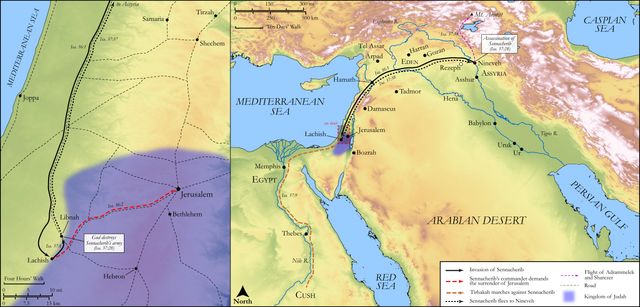
Study this verse
Public-domain commentary
Matthew Henry
From his Commentary on the Whole Bible. Henry comments on passages, not single verses — this entry covers Isaiah 37:8–20.
We may observe here, 1. That, if God give us inward satisfaction in his promise, this may confirm us in our silently bearing reproaches. God answered Hezekiah, but it does not appear that he, after deliberation, sent any answer to Rabshakeh; but, God having taken the work into his own hands, he quietly left the matter with him. So Rabshakeh returned to the king his master for fresh instructions. 2. Those that delight in war shall have enough of it. Sennacherib, without provocation given to him or warning given by him, went forth to war against Judah; and now with as little ceremony the king of Ethiopia goes forth to war against him, Isa 37:9. Those that are quarrelsome may expect to be quarrelled with; and God sometimes checks the rage of his enemies by giving it a powerful diversion. 3. It is bad to talk proudly and profanely, but it is worse to write so, for this argues more deliberation and design, and what is written spreads further, lasts longer, and does the more mischief. Atheism and irreligion, written, will certainly be reckoned for another day. 4. Great successes often harden sinners' hearts in their sinful ways and make them the more daring. Because the kings of Assyria have destroyed all lands (though, in fact, they were but a few that fell within their reach), therefore they doubt not but to destroy God's land; because the gods of the nations were unable to help they conclude the God of Israel is so; because the idolatrous kings of Hamath and Arphad became an easy prey to them therefore they doubt not but to destroy God's land; because the idolatrous kings of Hamath and Arphad became an easy prey to them therefore the religious reforming king of Judah must needs be so too. Thus is this proud man ripened for ruin by the sunshine of prosperity. 5. Liberty of access to the throne of grace, and liberty of speech there, are the unspeakable privilege of the Lord's people at all times, especially in times of distress and danger. Hezekiah took Sennacherib's letter, and spread it before the Lord, not designing to make any complaints against him but those grounded upon his own handwriting. Let the thing speak itself; here it is in black and white: Open thy eyes, O Lord! and see. God allows his praying people to be humbly free with him, to utter all their words, as Jephthah did, before him, to spread the letter, whether of a friend or an enemy, before him, and leave the contents, the concern of it, with him. 6. The great and fundamental principles of our religion, applied by faith and improved in prayer, will be of sovereign use to us in our particular exigencies and distresses, whatever they are; to them therefore we must have recourse, and abide by them; so Hezekiah did here. He encouraged himself with this, that the God of Israel is the Lord of hosts, of all hosts, of the hosts of Israel, to animate him, of the hosts of their enemies, to dispirit and restrain them, - that he is God alone, and there is none that can stand in competition with him, - that he is the God of all the kingdoms of the earth, and disposes of them all as he pleases; for he made heaven and earth, and therefore both can do any thing and does every thing. 7. When we are afraid of men that are great destroyers we may with humble boldness appeal to God as the great Saviour. They have indeed destroyed the nations, who had thrown themselves out of the protection of the true God by worshipping false gods, but the Lord, the God alone, is our God, our King, our lawgiver, and he will save us, who is the Saviour of those that believe. 8. We have enough to take hold of, in our wrestling with God by prayer, if we can but plead that his glory is interested in our case, that his name will be profaned if we are run down and glorified if we are relieved. Thence therefore will our most prevailing pleas be drawn: "Do it for thy glory's sake."
Historical interpretation
Historical reception
2 surviving comments on this verse. Each one is dated, so this reads as a timeline rather than a list.
We are hastening past the obvious, that we would remain with doubts. But Herodotus writes (as does the most prolific Berosus, historian of the Chaldeans, whose faith can be derived from their own books) that Sennacherib the king of the Assyrians fought against the Egyptians and besieged Pelusium. And with mounds already amassed in the city for conquest Tirhakah the king of Ethiopia came to their assistance, and in one night 185 thousand soldiers of Assyria fell to disease near Jerusalem.
(Verse 8 and following) But when Rabshakeh returned, he found the king of Assyria fighting against Libnah, for he had heard that the king had left Lachish. And he heard that Tirhakah, the king of Ethiopia, had come out to fight against him. When he heard this, he sent messengers to Hezekiah saying: 'Thus you shall speak to Hezekiah, king of Judah, saying: Do not let your God deceive you, in whom you trust, saying: Jerusalem will not be given into the hand of the king of Assyria.' Behold, you have heard about all that the kings of Assyria have done to all the lands they have devastated, and can you be delivered? Have the gods of the nations delivered those whom my fathers have destroyed: Gozan, Haran, Rezeph, and the sons of Eden who were in Telassar? Where is the king of Hamath, the king of Arpad, the king of the city of Sepharvaim, or of Hena, or of Ivvah? These words were written in the Book of Kings and Chronicles, that the commander Rabshekah had left the siege of Jerusalem according to the will of the Lord, and went to his master, who he had learned was besieging Lachish, having either abandoned or captured it, to attack Libnah. He also, upon hearing that Tarachamregem, the king of the Ethiopians, was preparing to make war against him, went out to meet him, and yet sent messengers to Hezekiah and letters, in order to frighten those whom he had not yet conquered by force. And just as he had said to the people, 'Do not let Hezekiah deceive you' (2 Kings 18:29), he speaks the same blasphemy to the king, saying, 'Do not let your God deceive you' (2 Kings 19:10). And he gives examples from the past, how their gods were unable to deliver other lands from their hands, and therefore Jerusalem will not be able to be delivered either. In his enumeration of the other nations, Ana () and Ava () are mentioned, which the Seventy mixed, saying, anavegava, and they called it a conjunction, that is, vau, between the two nations Ana and Ava, in the Hebrew language, so that to those unaware it seems one nation or city. We pass over what is clear, so that we may dwell on uncertainties. Herodotus relates that Sennacherib, the king of the Assyrians, fought against the Egyptians and besieged Pelusium. And when the mounds for capturing the city had been built, Taracham, the king of the Ethiopians, came to their aid, and in one night, near Jerusalem, 185,000 of the Assyrian army perished from plague. This is reported by Herodotus and most fully by Berosus, a writer of Chaldean history, whose credibility must be sought from his own books.
Continue studying Isaiah 37:11 across the web’s major study libraries — every link below opens this exact verse, chapter, or book on the destination site.
Read & Compare
 BibleGatewayThis verse in more than 200 translations and 70 languages.
 Bible.comThe YouVersion reader — hundreds of translations, reading plans, and highlights.
 ESV.orgCrossway's official English Standard Version reader.
 NET BibleThe NET translation with 60,000+ translators' notes on every rendering decision.
 STEP BibleTyndale House's free study tool — original text, vocabulary, and scholarly resources.
 BibliaLogos Bible Software's free web reader.
 USCCBThe New American Bible (Revised Edition) with the U.S. bishops' study notes.
Commentaries
 BibleHub CommentariesDozens of classic commentaries on this verse, gathered on one page.
 StudyLightMore than 100 commentary sets — the largest collection on the web.
 BibleRefPlain-English commentary on what this verse means, verse by verse.
 Enduring WordDavid Guzik's free commentary on this chapter, widely used by Bible teachers.
 Bible Study ToolsVerse commentary alongside Greek and Hebrew study aids.
Original Language & Research
- BibleHub InterlinearThe verse word by word — original language, transliteration, and English.
- BibleHub LexiconEvery word's original-language definition and Strong's entry.
 Blue Letter BibleDeep-study tools — Strong's numbers, concordance, and word studies.
 SefariaThe Hebrew text with Rashi and centuries of Jewish commentary.
Sermons, Hymns & Audio


TrulyRandomVerse is not affiliated with these sites and doesn’t control their content. They’re linked because they’re genuinely useful.
Summary
Isaiah 37:11 encapsulates the arrogant and intimidating message sent by Sennacherib, King of Assyria, to King Hezekiah of Judah. It serves as a psychological weapon, leveraging Assyria's undeniable track record of overwhelming military conquest and the utter devastation of all lands that dared to resist. The verse culminates in a rhetorical question designed to instill profound fear and despair in Judah, challenging the very possibility of their deliverance in the face of such an unstoppable force, thereby setting the stage for a dramatic confrontation between perceived human invincibility and divine sovereignty.
Context
ShowHideLiterary Context
This verse is strategically placed within the pivotal narrative of Sennacherib's invasion of Judah and his siege of Jerusalem, detailed across Isaiah 36 and Isaiah 37. It forms part of a threatening letter dispatched by Sennacherib to King Hezekiah, following the verbal taunts delivered by the Rabshakeh in the preceding chapter. The letter's calculated purpose is to shatter Hezekiah's resolve and compel Jerusalem's surrender by emphasizing the futility of any resistance. The immediate literary response to this audacious challenge is Hezekiah's profound and faithful prayer in Isaiah 37:15-20, which directly precedes God's miraculous intervention and the subsequent destruction of the Assyrian army. Thus, Isaiah 37:11 functions as the zenith of the human threat, just before the decisive divine response.
Historical & Cultural Context
The late 8th century BCE witnessed the Assyrian Empire as the undisputed superpower of that day, renowned for its formidable military machine and brutal conquest strategies. Their policy towards conquered lands was characterized by total devastation, mass deportation, and the systematic dismantling of local religious and political structures, a grim reality vividly demonstrated by their conquest of the Northern Kingdom of Israel (Samaria) in 2 Kings 17:6. Sennacherib's campaign against Judah in 701 BCE had already resulted in the capture of numerous fortified cities (as noted in Isaiah 36:1), leaving Jerusalem isolated and vulnerable. The Assyrian king's letter, therefore, was far more than a mere boast; it was a carefully crafted psychological weapon, leveraging a well-known history of overwhelming military success and implying that Judah's God was utterly powerless against Assyrian might or its pantheon of gods.
Key Themes
ShowHideIsaiah 37:11 powerfully contributes to several overarching themes within the book of Isaiah and this specific narrative. It exemplifies Intimidation and Arrogance, as Sennacherib's words drip with pride and an overt attempt to instill fear, viewing human military power as supreme and unstoppable. Yet, this very arrogance sets the stage for the Futility of Human Boasting, as the narrative immediately following this verse dramatically reveals the limits of human might when confronted with divine power. The verse also introduces the critical theme of The Question of Deliverance, directly challenging Judah's faith in God's ability to save them from an seemingly inescapable fate. Ultimately, this challenge serves to highlight God's Sovereignty, demonstrating that despite Sennacherib's boasts and formidable track record, God alone controls the destinies of nations and rulers, a truth powerfully affirmed by Jerusalem's miraculous preservation, as seen in Isaiah 37:36.
Exposition and Analysis
ShowHideKey Word Analysis
ShowHideThis term refers to a sovereign ruler, emphasizing the earthly authority and power of Sennacherib and his predecessors. In this context, it highlights the perceived absolute power of human rulers and their dominion over lands, contrasting sharply with the divine kingship that Isaiah so often proclaims.
This powerful verb signifies total destruction, often with the connotation of devotion to destruction, sometimes in a religious sense (e.g., "devoted to the ban"). Here, Sennacherib arrogantly applies this concept to his own military campaigns, boasting of his absolute and uncompromising annihilation of nations. It implies a complete and irreversible end, leaving no hope for recovery, which makes the subsequent divine deliverance all the more miraculous.
This word means "to snatch away," "rescue," or "save." In Sennacherib's rhetorical question, it challenges the very possibility of Judah being rescued from his grasp, given his history of utterly destroying all opposition. The word encapsulates the central tension of the narrative: whether Judah's God can truly snatch them from the jaws of the Assyrian lion.
Verse Breakdown
ShowHide"Behold, thou hast heard what the kings of Assyria have done to all lands"
This opening clause functions as an immediate, confrontational assertion, designed to seize Hezekiah's attention. "Behold" (or "Indeed") draws the king's focus to an undeniable and terrifying truth. Sennacherib assumes Hezekiah is fully aware of Assyria's military prowess and its consistent history of conquest. The phrase "what the kings of Assyria have done" refers not just to Sennacherib himself, but to the consistent, brutal policy and unbroken success of the entire Assyrian dynasty, establishing a track record of invincibility. "To all lands" emphasizes the universal scope of their dominion, implying no nation has been spared.
"by destroying them utterly;"
This phrase intensifies the preceding statement, specifying the brutal and absolute nature of Assyrian conquest. The Hebrew term implies total annihilation, leaving nothing behind. It underscores the Assyrian strategy of leaving no survivors or viable infrastructure, ensuring complete subjugation and eliminating any future threat. This was a well-known and terrifying reality for the nations Assyria conquered, designed to crush any hope of resistance and instill despair.
"and shalt thou be delivered?"
This is the climactic rhetorical question, the core of Sennacherib's psychological warfare. It is not a genuine inquiry but a taunt, implying a resounding "No!" The question challenges Hezekiah's faith and Judah's hope, suggesting that if no other nation could withstand Assyria's might, Judah, too, is doomed. It aims to instill despair, undermine trust in God, and force surrender by presenting deliverance as an utterly impossible outcome.
Literary Devices
ShowHideIsaiah 37:11 employs several potent literary devices to convey Sennacherib's intimidating message. The most prominent is the Rhetorical Question ("and shalt thou be delivered?"), which is not intended to elicit an answer but to make a forceful assertion – that deliverance is impossible. This question functions as a psychological weapon, designed to instill fear and despair, aiming to break Hezekiah's will. The phrase "destroying them utterly" utilizes Hyperbole to emphasize the Assyrian's perceived absolute power and the totality of their conquests, though it was often a grim reality for the conquered. There is also an underlying Irony, as Sennacherib's boastful question about Judah's deliverance will be answered by God's miraculous intervention, turning the Assyrian's confident assertion on its head and dramatically demonstrating the limits of human power. The entire message is imbued with Intimidation, aiming to overwhelm the recipient through a display of overwhelming might and an unyielding history of success.
Theological and Thematic Connections
ShowHideIsaiah 37:11 stands as a stark declaration of human arrogance and perceived invincibility, directly challenging the sovereignty and power of God. Sennacherib's boast that no nation has been delivered from Assyrian might serves as a profound theological test for Hezekiah and Judah, forcing them to confront where their ultimate trust truly lies. This verse sets up the dramatic contrast between the finite, though formidable, power of human empires and the infinite, unchallengeable power of the Almighty God. It underscores the biblical theme that human boasting is ultimately futile before the Lord, and that true deliverance comes not from military strength or political alliances, but from divine intervention. God's reputation and covenant faithfulness are at stake when His people are threatened, making His response a demonstration of His unique supremacy among the nations.
Reflection and Application
ShowHideSennacherib's taunt in Isaiah 37:11 resonates deeply with the challenges we face in contemporary life. We frequently encounter "kings of Assyria" in our own experiences – overwhelming problems, intimidating circumstances, or powerful voices that declare our situation hopeless and question the very possibility of our deliverance. These threats, whether financial ruin, relational breakdown, severe health crises, or spiritual attacks, can feel utterly destructive and leave us feeling cornered and without recourse, much like Jerusalem under siege. This verse reminds us that the enemy's strategy is often to highlight their track record of success and our perceived weakness, aiming to erode our faith and persuade us to surrender. However, like King Hezekiah, our response must be to take these formidable threats directly to the Lord in prayer, recognizing that true deliverance comes not from our own strength, ingenuity, or human alliances, but from the sovereign hand of God. The miraculous deliverance of Jerusalem serves as an eternal testament that God's power far surpasses any human boast or overwhelming obstacle, encouraging us to stand firm in faith even when the odds seem insurmountable and our hope is tested.
Questions for Reflection
ShowHideFAQ
ShowHideWhat was the ultimate outcome of Sennacherib's threat against Jerusalem?
ShowHideDespite Sennacherib's boastful threats and his history of utterly destroying nations, Jerusalem was miraculously delivered by divine intervention. King Hezekiah, instead of surrendering to despair, took Sennacherib's blasphemous letter to the temple and spread it before the Lord, praying fervently for divine intervention (Isaiah 37:14-20). In response, the prophet Isaiah delivered God's word, assuring Hezekiah that the Lord would indeed defend Jerusalem for His own name's sake. That very night, the angel of the Lord struck down 185,000 Assyrian soldiers, forcing Sennacherib to withdraw in shame. He returned to Nineveh, where he was later assassinated by his own sons while worshipping in the temple of his god Nisroch (Isaiah 37:36-38). This event stands as a powerful and enduring testament to God's absolute sovereignty and His unwavering faithfulness to His covenant people.
Christ-Centered Fulfillment
ShowHideSennacherib's arrogant question, "and shalt thou be delivered?", powerfully foreshadows the ultimate challenge posed by the universal dominion of sin and death over humanity, and the glorious, definitive deliverance accomplished by Jesus Christ. Just as Assyria boasted of utterly destroying all lands, so too do sin and death claim universal dominion, having "destroyed utterly" the hope and life of humanity apart from divine intervention (Romans 5:12). The entire world, enslaved by these spiritual "kings," had no inherent means of self-deliverance from their grip. However, the Lord Jesus Christ, the true King of kings and Lord of lords, entered this fallen world not with military might, but with redemptive love and sacrificial obedience, confronting these ultimate enemies head-on. Through His perfect life, atoning death on the cross, and triumphant resurrection, Christ utterly defeated the power of sin and death, snatching away those who believe from their dominion and delivering them into His glorious kingdom (Hebrews 2:14-15). His victory on the cross is the definitive, resounding answer to the question of deliverance, demonstrating that where human power utterly fails, God's power in Christ triumphs completely, securing eternal salvation and true freedom for all who trust in Him (Colossians 2:15).