


Isaiah 37:19
Bible text: King James Version (1769 Blayney text) · Public domain
Bible text: Berean Standard Bible · Public domain
Bible text: American Standard Version (1901) · Public domain
Bible text: World English Bible, Messianic edition · Public domain
Bible text: Geneva Bible (1599) · Public domain
Bible text: Young's Literal Translation · Public domain
- וְנָתֹןve·na·Tonand they have putH5414Conj-w ¦ V-Qal-InfAbsVerb Qal Infinitive Absoluteוְandנָתֹןthey have put
- אֶת'et<obj.>H853DirObjMParticle Object Indicator
- אֱלֹהֵיהֶם'e·lo·hei·Hemtheir godsH430N-mpc ¦ 3mpNoun Plural Masculine Constructאֱלֹהֵיgodsהֶםtheir
- בָּאֵשׁba·'Eshin the fireH784Prep-b ¦ N-csNoun Singular common gender Absoluteבָּin theאֵשׁfire
- כִּיkiforH3588PrtParticle Conditional
- לֹאlo'notH3808NegParticle Negative
- אֱלֹהִים'E·lo·Him[were] godsH430N-mpNoun Plural Masculine Absolute
- הֵמָּהHe·mahtheyH1992Pro-3mpPronoun Personal 3rd Plural Masculine
- כִּיkithatH3588PrtParticle Conditional
- אִם'imexceptH518PrtParticle Conditional
- מַעֲשֵׂהma·'a·Seh[the] work ofH4639N-mscNoun Singular Masculine Construct
- יְדֵיye·dei[the] hands ofH3027N-cdcNoun Dual common gender Construct
- אָדָם'a·Dama personH120N-msNoun Singular Masculine Absolute
- עֵץ'etzwoodH6086N-msNoun Singular Masculine Absolute
- וָאֶבֶןva·'E·venand stoneH68Conj-w ¦ N-fsNoun Singular Feminine Absoluteוָandאֶבֶןstone
- וַיְאַבְּדוּםVay·'a·be·Dumand they destroyed themH6Conj-w ¦ V-Piel-ConsecImperf-3mp ¦ 3mpVerb Piel Consecutive Imperfect 3rd Plural Masculineוַandיְאַבְּדוּthey destroyedםthem
English is a literal word-by-word gloss of the Hebrew, not the KJV's wording. Why?
This is the original text the KJV's translators worked from — each Hebrew word with its own literal English meaning in this verse, prepared by scholars at Tyndale House, Cambridge. The KJV translates whole sentences, not word by word, so its wording differs: one Hebrew word can become several English words, and the KJV may choose “the LORD” where the gloss reads “Yahweh”. Both are faithful — they answer different questions. For the KJV's own rendering, switch to the KJV text.
Details
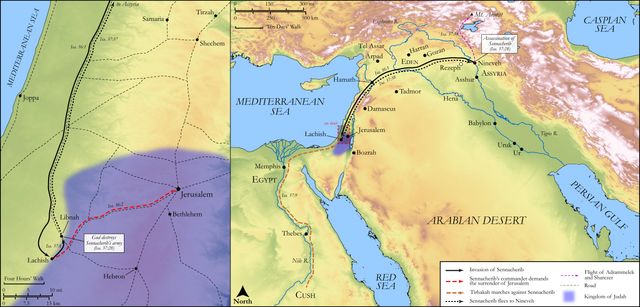
See on the biblical-era map
Study this verse
Public-domain commentary
Matthew Henry
From his Commentary on the Whole Bible. Henry comments on passages, not single verses — this entry covers Isaiah 37:8–20.
We may observe here, 1. That, if God give us inward satisfaction in his promise, this may confirm us in our silently bearing reproaches. God answered Hezekiah, but it does not appear that he, after deliberation, sent any answer to Rabshakeh; but, God having taken the work into his own hands, he quietly left the matter with him. So Rabshakeh returned to the king his master for fresh instructions. 2. Those that delight in war shall have enough of it. Sennacherib, without provocation given to him or warning given by him, went forth to war against Judah; and now with as little ceremony the king of Ethiopia goes forth to war against him, Isa 37:9. Those that are quarrelsome may expect to be quarrelled with; and God sometimes checks the rage of his enemies by giving it a powerful diversion. 3. It is bad to talk proudly and profanely, but it is worse to write so, for this argues more deliberation and design, and what is written spreads further, lasts longer, and does the more mischief. Atheism and irreligion, written, will certainly be reckoned for another day. 4. Great successes often harden sinners' hearts in their sinful ways and make them the more daring. Because the kings of Assyria have destroyed all lands (though, in fact, they were but a few that fell within their reach), therefore they doubt not but to destroy God's land; because the gods of the nations were unable to help they conclude the God of Israel is so; because the idolatrous kings of Hamath and Arphad became an easy prey to them therefore they doubt not but to destroy God's land; because the idolatrous kings of Hamath and Arphad became an easy prey to them therefore the religious reforming king of Judah must needs be so too. Thus is this proud man ripened for ruin by the sunshine of prosperity. 5. Liberty of access to the throne of grace, and liberty of speech there, are the unspeakable privilege of the Lord's people at all times, especially in times of distress and danger. Hezekiah took Sennacherib's letter, and spread it before the Lord, not designing to make any complaints against him but those grounded upon his own handwriting. Let the thing speak itself; here it is in black and white: Open thy eyes, O Lord! and see. God allows his praying people to be humbly free with him, to utter all their words, as Jephthah did, before him, to spread the letter, whether of a friend or an enemy, before him, and leave the contents, the concern of it, with him. 6. The great and fundamental principles of our religion, applied by faith and improved in prayer, will be of sovereign use to us in our particular exigencies and distresses, whatever they are; to them therefore we must have recourse, and abide by them; so Hezekiah did here. He encouraged himself with this, that the God of Israel is the Lord of hosts, of all hosts, of the hosts of Israel, to animate him, of the hosts of their enemies, to dispirit and restrain them, - that he is God alone, and there is none that can stand in competition with him, - that he is the God of all the kingdoms of the earth, and disposes of them all as he pleases; for he made heaven and earth, and therefore both can do any thing and does every thing. 7. When we are afraid of men that are great destroyers we may with humble boldness appeal to God as the great Saviour. They have indeed destroyed the nations, who had thrown themselves out of the protection of the true God by worshipping false gods, but the Lord, the God alone, is our God, our King, our lawgiver, and he will save us, who is the Saviour of those that believe. 8. We have enough to take hold of, in our wrestling with God by prayer, if we can but plead that his glory is interested in our case, that his name will be profaned if we are run down and glorified if we are relieved. Thence therefore will our most prevailing pleas be drawn: "Do it for thy glory's sake."
Historical interpretation
Historical reception
2 surviving comments on this verse. Each one is dated, so this reads as a timeline rather than a list.
Against the blasphemies of King Sennacherib, Hezekiah’s customary armory failed. So he goes back to the temple and opens his letter before the Lord. Previously he was silent, for he did not dare to open his mouth in the temple for fear of the Lord, nor to pour out extemporaneous prayers to God. Now, however, because he has already heard Isaiah saying, “Do not be afraid of the words which you hear, with which the sons of the king of the Assyrians have blasphemed me,” and so on, he beseeches the Lord boldly and claims that the Lord alone is the living God, through whom we understand idols to be images of the dead.… That these idols weakened their makers is proven by many histories that record that the kings of Persia came to Greece, and subverted and ruined the temple of the Greeks. It also postulates vengeance, that through this opportunity all kingdoms would recognize that there is only one God, who is able to deliver his own from peril.
(Verses 14ff.) And Hezekiah took the letters from the hand of the messengers, and he read them, and he went up to the house of the Lord, and he spread them out before the Lord. And Hezekiah prayed before the Lord, saying: Lord, God of hosts, God of Israel, who resides above the cherubim, you are the only God of all the kingdoms of the earth. You have made heaven and earth. Incline your ear, Lord, and hear; open your eyes, Lord, and see. And hear all the words of Sennacherib, which he sent to blaspheme the living God. Truly, O Lord, the kings of Assyria have made the lands and regions of the desert; and they have given their gods to the fire: for they were not gods, but the work of the hands of men, wood and stones; and they have destroyed them. And now, O Lord our God, save us from his hand: and let all the kingdoms of the earth know that You alone are God. Against the blasphemies of King Sennacherib, Ezechias took up his arms. And he goes again to the Temple, and spreads his letters before the Lord. Before, he had remained silent, for he did not dare to open his mouth in the Temple, terrified by the fear of the Lord, nor to offer free prayers to God. But now, because he had already heard Isaiah saying, 'Do not be afraid of the words that you have heard, with which the boys of the king of Assyria blasphemed me,' and so on, he boldly prays to the Lord and asserts that God alone is the living one, whom we understand to be idols, the images of the dead. And he brings forth this point: Truly, O Lord, the kings of Assyria have deserted the lands and regions of their gods and have given their gods to the fire. For they were not gods, but the works of human hands, wood and stone. And they shattered them, as proven in many histories, which write that the kings of Persia came to Greece and destroyed and plundered the temples of the Greeks. And he demands revenge, so that by this occasion, all kingdoms might know that God alone is able to free his own from danger.
Continue studying Isaiah 37:19 across the web’s major study libraries — every link below opens this exact verse, chapter, or book on the destination site.
Read & Compare
 BibleGatewayThis verse in more than 200 translations and 70 languages.
 Bible.comThe YouVersion reader — hundreds of translations, reading plans, and highlights.
 ESV.orgCrossway's official English Standard Version reader.
 NET BibleThe NET translation with 60,000+ translators' notes on every rendering decision.
 STEP BibleTyndale House's free study tool — original text, vocabulary, and scholarly resources.
 BibliaLogos Bible Software's free web reader.
 USCCBThe New American Bible (Revised Edition) with the U.S. bishops' study notes.
Commentaries
 BibleHub CommentariesDozens of classic commentaries on this verse, gathered on one page.
 StudyLightMore than 100 commentary sets — the largest collection on the web.
 BibleRefPlain-English commentary on what this verse means, verse by verse.
 Enduring WordDavid Guzik's free commentary on this chapter, widely used by Bible teachers.
 Bible Study ToolsVerse commentary alongside Greek and Hebrew study aids.
Original Language & Research
- BibleHub InterlinearThe verse word by word — original language, transliteration, and English.
- BibleHub LexiconEvery word's original-language definition and Strong's entry.
 Blue Letter BibleDeep-study tools — Strong's numbers, concordance, and word studies.
 SefariaThe Hebrew text with Rashi and centuries of Jewish commentary.
Sermons, Hymns & Audio


TrulyRandomVerse is not affiliated with these sites and doesn’t control their content. They’re linked because they’re genuinely useful.
Summary
Isaiah 37:19 encapsulates King Hezekiah's profound theological insight during the Assyrian siege of Jerusalem. In his fervent prayer, Hezekiah highlights the fundamental distinction between the impotent idols of conquered nations and the living God of Israel. He recounts how the Assyrians easily destroyed the "gods" of other lands because these were mere human artifacts—objects of wood and stone—devoid of any inherent divine power. This observation serves as the foundational premise for Hezekiah's earnest plea for Yahweh's intervention, setting the stage for a dramatic demonstration of the Lord's unique sovereignty and incomparable power over all false deities and earthly empires.
Context
ShowHideLiterary Context
This verse is deeply embedded within King Hezekiah's desperate and pivotal prayer found in Isaiah 37. It immediately follows the blasphemous taunts and overwhelming threats delivered by Sennacherib's Rabshakeh (chief cupbearer) in Isaiah 36. The Assyrian envoy had directly challenged Judah's trust in Yahweh, arrogantly claiming that Hezekiah's God was no different from the deities of other nations that Assyria had effortlessly crushed (Isaiah 36:18-20). In response to this existential and theological crisis, Hezekiah tears his clothes, covers himself with sackcloth, and sends messengers to the prophet Isaiah (Isaiah 37:1-2). His prayer, recorded in Isaiah 37:15-20, directly addresses the Lord, acknowledging the Assyrian conquests (Isaiah 37:18) but immediately distinguishing the true God from the vanquished idols. Verse 19 provides the crucial theological justification for this distinction, laying the groundwork for the expectation of God's unique and incomparable intervention.
Historical & Cultural Context
The late 8th century BCE was a period of profound geopolitical instability among the nations, dominated by the formidable Neo-Assyrian Empire. Under powerful kings like Tiglath-Pileser III, Sargon II, and Sennacherib, Assyria systematically conquered vast territories, employing brutal military tactics including mass deportations, the destruction of cities, and psychological warfare. A key aspect of their conquests involved demonstrating the perceived superiority of the Assyrian gods (or the Assyrian king's divinely sanctioned power) over the local deities of conquered peoples. Conquered peoples' idols were often desecrated, melted down, or carried off as trophies, symbolizing the utter defeat of their gods and the complete subjugation of their worshippers. Jerusalem, under King Hezekiah, was one of the last remaining independent kingdoms in the region, having witnessed the fall of the Northern Kingdom of Israel to Assyria decades earlier (2 Kings 17:5-6). The siege of Jerusalem by Sennacherib in 701 BCE was not merely a military threat to Judah's existence but, more profoundly, a direct challenge to the reputation and power of Yahweh among the nations.
Key Themes
ShowHideThis verse powerfully contributes to several overarching themes within the book of Isaiah and the broader biblical narrative. Firstly, it underscores the vanity and impotence of idolatry, a pervasive and critical theme throughout the Old Testament. Idols are consistently portrayed as "the work of men's hands" (Psalm 115:4) and are therefore incapable of seeing, hearing, speaking, or saving (Psalm 115:5-7; Isaiah 44:9-20). Secondly, it highlights the absolute uniqueness and sovereignty of Yahweh, the God of Israel. Unlike the gods of wood and stone, Yahweh is the living, active, and powerful Creator, who alone can deliver His people (Isaiah 40:18-26). Hezekiah's prayer, therefore, is not merely a plea for physical deliverance but a profound theological declaration, directly challenging the Assyrian worldview and affirming God's incomparable nature. Finally, the verse sets the stage for a divine demonstration of power, where God's intervention will not only save Jerusalem but also vindicate His holy name before all the nations, fulfilling Hezekiah's plea in Isaiah 37:20.
Exposition and Analysis
ShowHideKey Word Analysis
ShowHideThis term (H430) is the plural of ʼĕlôah, and while it frequently refers to the supreme God (especially when accompanied by the definite article), in this context, it is used in its ordinary sense to denote the pagan deities of the conquered nations. The subsequent phrase "no gods" explicitly denies any true divinity or inherent power to these objects. Hezekiah employs the very term for "gods" that the Assyrians would have used for their vanquished idols, only to immediately strip it of its meaning, emphasizing their complete lack of divine essence. The contrast is stark: these are "gods" in name only, not in nature or power.
The verb nâthan (H5414) is a primitive root with an exceptionally broad semantic range, including "to give," "put," "make," "appoint," "deliver," and, as used here, "cast" or "put." Its application in this verse signifies the deliberate and decisive action of the Assyrians in disposing of the idols. The simplicity and finality of the action—"cast into the fire"—underscore the ease with which these supposed deities were rendered inert and destroyed, highlighting their utter vulnerability and inherent inability to resist their fate or protect their worshippers.
This noun maʻăseh (H4639) derives from the verb ʻâsâh (to do, make) and refers to an action, a transaction, or, most pertinently here, a product or something "made." By describing the idols as "the work of men's hands," Hezekiah directly points to their human origin and craftsmanship. This phrase is a common and powerful biblical idiom used to expose the fundamental falsity of idols, emphasizing that they are not divine beings but merely artifacts, creations of humanity rather than creators of humanity. This stands in direct and absolute contrast to the true God, who is the uncreated Creator of all things.
Verse Breakdown
ShowHide"And have cast their gods into the fire:"
This initial clause vividly describes the Assyrians' common and brutal practice of destroying the deities of conquered nations. "Casting into the fire" signifies not only complete physical destruction but also profound desecration, demonstrating the perceived impotence of these "gods" in the face of Assyrian military might. It highlights the utter vulnerability of these idols, which were unable to protect themselves or their worshippers from the conqueror's wrath.
"for they [were] no gods,"
This is the crucial theological statement that immediately follows the description of destruction, providing the reason for their demise. Hezekiah clarifies why the Assyrians were able to destroy these objects: they possessed no inherent divine nature, power, or reality. The parenthetical "[were]" in the KJV accurately emphasizes that their identity as "gods" was a mere title or human designation, not a true spiritual or ontological reality. This phrase directly refutes the Assyrian boast that their gods were superior; instead, it asserts that the vanquished objects were never truly divine to begin with.
"but the work of men's hands, wood and stone:"
This phrase further elaborates on the true, mundane nature of these "no gods." They are explicitly identified as human artifacts, fashioned from common, inert materials like "wood and stone." This is a classic biblical polemic against idolatry, stripping away any mystique or perceived power from the idols by revealing their mundane origins and composition. It underscores their utter powerlessness, their inability to act, save, or even perceive.
"therefore they have destroyed them."
This concluding clause functions as a logical and inevitable consequence. Because the idols were not divine but merely human creations of wood and stone, their destruction was not only possible but easily accomplished by human hands. This statement serves as a powerful setup for Hezekiah's subsequent plea, implying that the true God, who is not the work of men's hands and is inherently divine, cannot be similarly destroyed and therefore can deliver.
Literary Devices
ShowHideIsaiah 37:19 employs several potent literary devices to convey its profound theological message and strengthen Hezekiah's appeal. The most prominent is Contrast, which forms the very foundation of Hezekiah's argument. He starkly contrasts the "gods" of the nations—defined by their material composition ("wood and stone") and their origin ("the work of men's hands")—with the implied true God of Israel, who is uncreated and living. This contrast powerfully highlights the Folly of Idolatry, a recurring theme in prophetic literature, by exposing the absurdity and futility of worshipping objects made by human hands. The phrase "no gods" is a form of Litotes or Understatement used for emphatic negation, powerfully denying any divine essence to the idols by stating what they are not. Furthermore, the verse utilizes Metonymy where "wood and stone" stand in for the idols themselves, effectively reducing them to their base, inanimate components and stripping them of any perceived sanctity or power. The logical progression from premise ("for they were no gods, but the work of men's hands, wood and stone") to conclusion ("therefore they have destroyed them") demonstrates a clear Cause and Effect relationship, reinforcing the idols' inherent weakness and the inevitability of their destruction.
Theological and Thematic Connections
ShowHideIsaiah 37:19 serves as a theological linchpin in Hezekiah's prayer, establishing a fundamental and unassailable distinction between the created and the Creator. It articulates a core biblical truth: only the true God, who is not made by human hands, possesses genuine power, sovereignty, and the ability to deliver. This verse sets the stage for God's miraculous intervention, demonstrating that while human empires can destroy human-made gods, they are utterly powerless against the living God. It is a powerful affirmation of monotheism against the polytheistic worldview of the Assyrians, asserting that Yahweh alone is God and worthy of absolute trust and worship.
Reflection and Application
ShowHideHezekiah's profound observation about the impotence of idols in Isaiah 37:19 resonates deeply with our contemporary lives, despite the absence of physical statues in many modern contexts. In a world saturated with distractions and competing allegiances, we are prone to creating "gods" of our own—whether they are material possessions, career achievements, social status, political ideologies, technological advancements, or even our own self-sufficiency and intellectual prowess. These modern idols, much like the wood and stone of ancient times, are ultimately "the work of men's hands," human constructs that are inherently powerless to provide true security, lasting meaning, or ultimate salvation in the face of life's inevitable crises. When our health fails, our financial stability crumbles, our relationships fracture, or our carefully constructed plans unravel, these human-made constructs prove to be as vulnerable and destructible as the idols cast into the fire by the Assyrians. This passage challenges us to critically examine what we truly trust in and to re-evaluate where our ultimate hope and allegiance lie. It calls us to shift our reliance from the fleeting, fallible, and finite creations of humanity to the immutable, eternal, and all-powerful Creator, who alone is capable of delivering us from genuine peril, sustaining us through every storm, and providing ultimate purpose. Our faith and worship must be directed solely to the One who is not made by hands, but who made all things and holds all things in His sovereign hand.
Questions for Reflection
ShowHideFAQ
ShowHideWhat is the significance of the phrase "work of men's hands"?
ShowHideThe phrase "work of men's hands" is a recurring and highly significant biblical idiom used to emphasize the human origin and, therefore, the inherent powerlessness and falsity of idols. Unlike the true God, who is the uncreated Creator of all things and exists independently of human effort, idols are merely artifacts fashioned by human beings from common, inert materials like wood and stone. This phrase strips away any pretense of divinity from these objects, highlighting their inability to see, hear, speak, act, or save, and underscores the profound absurdity of worshipping them. It serves as a powerful theological polemic, consistently contrasting the inertness and futility of human creations with the living, active, and omnipotent power of Yahweh, as seen in numerous passages such as Psalm 115:4-7 and Isaiah 44:9-20.
How does Hezekiah's prayer in Isaiah 37:19 relate to the broader biblical understanding of idolatry?
ShowHideHezekiah's prayer in Isaiah 37:19 perfectly encapsulates and reinforces the consistent biblical understanding of idolatry as both foolish and futile. The Old Testament consistently condemns idolatry not just as a direct violation of God's foundational command against worshipping other gods (Exodus 20:3-5), but also as a profound misdirection of trust, worship, and allegiance towards things that are inherently powerless and dependent on human creation. Prophets like Isaiah frequently mock the idol-maker who uses half a tree to cook food and the other half to carve a god (Isaiah 44:14-17). Hezekiah's astute observation that the Assyrians could easily destroy these "gods" because they were "no gods" but "the work of men's hands" aligns perfectly with this consistent biblical critique, setting the stage for God to demonstrate His unique and incomparable power against a world that trusts in created things rather than the Creator.
Christ-Centered Fulfillment
ShowHideIsaiah 37:19, with its stark declaration of the impotence of idols and the distinction between human creations and divine reality, finds its ultimate and profound fulfillment in the person and redemptive work of Jesus Christ. The "gods" of wood and stone, made by human hands and easily destroyed, stand in absolute contrast to the true God who, in the person of Jesus, became flesh and dwelt among us (John 1:14). Jesus, as the Son of God, is emphatically not "the work of men's hands" but is the very image of the invisible God, the firstborn over all creation, through whom and for whom all things were created (Colossians 1:15-16). His glorious resurrection from the dead decisively demonstrates His triumph over all earthly powers, spiritual strongholds, and false deities, proving beyond doubt that He is the living God whom death could not hold (Acts 2:24). In Christ, humanity's pervasive tendency to create idols—whether physical objects or abstract concepts like wealth, power, self-reliance, or even religious rituals—is exposed as utterly futile and spiritually bankrupt. He calls us to worship the one true God, offering Himself as the exclusive way, the absolute truth, and the eternal life, through whom alone we can approach the Father (John 14:6). The destruction of the impotent idols in Isaiah 37:19 powerfully foreshadows Christ's ultimate victory over all false gods and spiritual strongholds, liberating us from their deceptive grip to worship and serve the One who truly saves, sustains, and reigns forever (1 Corinthians 8:4-6).