


Genesis 8:4
- וַתָּנַחva·Ta·nachand it restedH5117Conj-w ¦ V-Qal-ConsecImperf-3fsVerb Qal Consecutive Imperfect 3rd Singular Feminineוַandתָּנַחit rested
- הַתֵּבָהha·te·Vahthe arkH8392Art ¦ N-fsNoun Singular Feminine Absoluteהַtheתֵּבָהark
- בַּחֹדֶשׁba·Cho·deshin the monthH2320Prep-b ¦ N-msNoun Singular Masculine Absoluteבַּin theחֹדֶשׁmonth
- הַשְּׁבִיעִיha·she·vi·'I<the> seventhH7637Art ¦ Adj-msAdjective Numerical Position Singular Masculine Absoluteהַ<the>שְּׁבִיעִיseventh
- בְּשִׁבְעָהbe·shiv·'ahon [the] seven-H7651Prep-b ¦ Adj-csAdjective Numerical Singular common gender Absoluteבְּonשִׁבְעָה[the] seven-
- עָשָׂר'a·SarteenH6240Adj-csAdjective Numerical Singular common gender Absolute
- יוֹםYomdayH3117N-msNoun Singular Masculine Absolute
- לַחֹדֶשׁla·Cho·deshof the monthH2320Prep-l ¦ N-msNoun Singular Masculine Absoluteלַof theחֹדֶשׁmonth
- עַל'alonH5921PrepPreposition
- הָרֵיha·Rei[the] mountains ofH2022N-mpcNoun Plural Masculine Construct
- אֲרָרָט'a·ra·RatAraratH780N-properNoun Proper Location
English is a literal word-by-word gloss of the Hebrew, not the KJV's wording. Why?
This is the original text the KJV's translators worked from — each Hebrew word with its own literal English meaning in this verse, prepared by scholars at Tyndale House, Cambridge. The KJV translates whole sentences, not word by word, so its wording differs: one Hebrew word can become several English words, and the KJV may choose “the LORD” where the gloss reads “Yahweh”. Both are faithful — they answer different questions. For the KJV's own rendering, switch to the KJV text.
Details
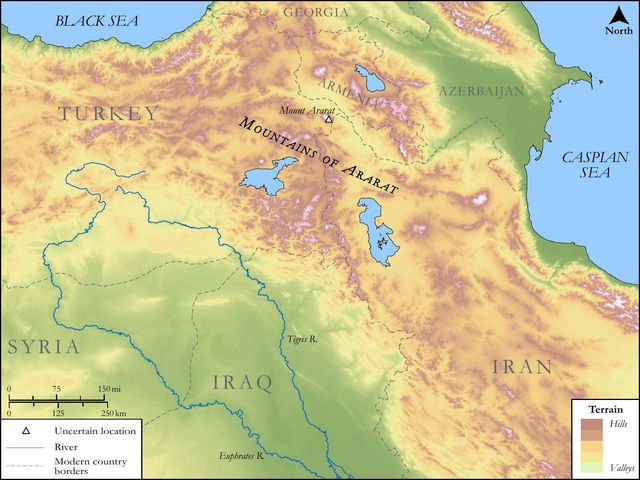
See on the biblical-era map


Study this verse
Public-domain commentary
Matthew Henry
From his Commentary on the Whole Bible. Henry comments on passages, not single verses — this entry covers Genesis 8:4–5.
Here we have the effects and evidences of the ebbing of the waters. 1. The ark rested. This was some satisfaction to Noah, to feel the house he was in upon firm ground, and no longer movable. It rested upon a mountain, whither it was directed, not by Noah's prudence (he did not steer it), but by the wise and gracious providence of God, that it might rest the sooner. Note, God has times and places of rest for his people after their tossings; and many a time he provides for their seasonable and comfortable settlement without their own contrivance and quite beyond their own foresight. The ark of the church, though sometimes tossed with tempests, and not comforted (Isa 54:11), yet has its rests, Act 9:31. 2. The tops of the mountains were seen, like little islands, appearing above the water. We must suppose that they were seen by Noah and his sons; for there were none besides to see them. It is probable that they had looked through the window of the ark every day, like the longing mariners, after a tedious voyage, to see if they could discover land, or as the prophet's servant (Kg1 18:43, Kg1 18:44), and at length they spy ground, and enter the day of the discovery in their journal. They felt ground above forty days before they saw it, according to Dr. Lightfoot's computation, whence he infers that, if the waters decreased proportionably, the ark drew eleven cubits in water.
Historical interpretation
Four Centuries of Reception
2 surviving comments on this verse. Each one is dated, so this reads as a timeline rather than a list.
Select a marker to jump to its quote. Markers stagger vertically where authors wrote within a few decades of each other.
The springs of the abyss and the floodgates of heaven were open forty days and forty nights and “the ark was afloat for one hundred fifty days.” But after one hundred fifty days the waters began to subside and the ark came to rest on Mt. Qardu. In the tenth month the tops of the mountains were seen. In the six hundred and first year, in the first month, the first day of the month, the waters were dried from off the earth. In the second month, that is, Iyor, “on the twenty-seventh day of the month, the earth was dry.” Therefore Noah and those with him had been in the ark three hundred sixty-five days, for from the seventeenth of the second month, that is, Iyor, until the twenty-seventh of the same month the following year, according to the lunar reckoning, there were three hundred sixty-five days. Notice then that even the generation of the house of Noah employed this reckoning of three hundred sixty-five days in a year. Why then should you say that it was the Chaldeans and Egyptians who invented and developed it?
And the ark rested in the seventh month, on the twenty-seventh day of the month, upon the mountains of Armenia. That the ark rested in the seventh month refers symbolically to that seventh rest about which it has often been spoken, as those who are perfect and who have the stability of a mind fixed upon God, as if squared, tend toward rest. Well did the ark come to rest on the twenty-seventh day of the same month, which number according to arithmetic reasoning is a solid squared trinity. For the number three accords with our devotion of mind due to the memory by which we recall God, the understanding by which we know Him, and the will by which we love Him. But for this very trinity to reach a squaring from a simple and straight line, multiply three by three, and make nine; and for that squaring to also take height and become solid, again multiply nine by three, and there will be twenty-seven, that is, you will complete the solid squared trinity number, in which the ark rested, because the Church in the stability of its mind and action, as if squared, both expects rest in this life and receives eternal rest in the future. Now it rested upon the mountains of Armenia, because, renouncing the summit of the world's pomp, even in this pilgrimage, leading a life, it approaches heavenly joys with the mind.
Continue studying Genesis 8:4 across the web’s major study libraries — every link below opens this exact verse, chapter, or book on the destination site.
Read & Compare
 BibleGatewayThis verse in more than 200 translations and 70 languages.
 Bible.comThe YouVersion reader — hundreds of translations, reading plans, and highlights.
 ESV.orgCrossway's official English Standard Version reader.
 NET BibleThe NET translation with 60,000+ translators' notes on every rendering decision.
 STEP BibleTyndale House's free study tool — original text, vocabulary, and scholarly resources.
 BibliaLogos Bible Software's free web reader.
 USCCBThe New American Bible (Revised Edition) with the U.S. bishops' study notes.
Commentaries
 BibleHub CommentariesDozens of classic commentaries on this verse, gathered on one page.
 StudyLightMore than 100 commentary sets — the largest collection on the web.
 BibleRefPlain-English commentary on what this verse means, verse by verse.
 Enduring WordDavid Guzik's free commentary on this chapter, widely used by Bible teachers.
 Bible Study ToolsVerse commentary alongside Greek and Hebrew study aids.
Original Language & Research
- BibleHub InterlinearThe verse word by word — original language, transliteration, and English.
- BibleHub LexiconEvery word's original-language definition and Strong's entry.
 Blue Letter BibleDeep-study tools — Strong's numbers, concordance, and word studies.
 SefariaThe Hebrew text with Rashi and centuries of Jewish commentary.
Sermons, Hymns & Audio


TrulyRandomVerse is not affiliated with these sites and doesn’t control their content. They’re linked because they’re genuinely useful.
Summary
Genesis 8:4 marks a pivotal moment in the biblical flood narrative, precisely detailing the ark's resting place and time. After 150 days of prevailing waters and an additional period of recession, the ark, the vessel of God's preservation, came to rest on the mountains of Ararat on the seventeenth day of the seventh month. This precise dating and geographical specificity underscore God's meticulous sovereignty over the entire cataclysmic event, signifying the cessation of divine judgment and the dawn of a new era of rest, renewal, and covenant for Noah, his family, and all creation.
Context
ShowHideLiterary Context
Genesis 8:4 follows the climax of the global deluge described in Genesis 7:11-24 and the subsequent turning of God's attention to Noah in Genesis 8:1. After 150 days of the waters prevailing, God "made a wind to pass over the earth, and the waters assuaged." Verses 2-3 describe the gradual recession of the waters, with the fountains of the deep and the windows of heaven being stopped, and the waters returning from the earth "continually." Genesis 8:4 provides the first concrete sign of this recession's effect on the ark, placing it firmly on land before Noah sends out the raven and the dove in Genesis 8:6-12 and before the earth is fully dried in Genesis 8:13-14. This verse thus serves as a critical turning point, transitioning from the period of judgment and confinement to one of emerging hope and preparation for a new beginning.
Historical & Cultural Context
The "mountains of Ararat" refer to the ancient kingdom of Urartu, a mountainous region located in what is modern-day eastern Turkey and parts of Armenia. This was a known geographical area in the ancient Near East, not necessarily a single peak, but a range. The mention of a specific date ("seventh month, on the seventeenth day") reflects the ancient practice of meticulous record-keeping and the significance placed on temporal markers in narratives, especially those involving divine action. In many ancient cultures, mountains were often seen as places of divine encounter or sacred ground, serving as a fitting, elevated location for the ark's landing after a global judgment, signifying a new beginning from a high, secure place. The precision of the date also hints at a divine calendar at work, paralleling other significant dates in biblical history.
Key Themes
ShowHideGenesis 8:4 powerfully contributes to several overarching themes within the book of Genesis and the broader biblical narrative. Foremost is the theme of Divine Sovereignty and Providence, demonstrating God's absolute control over natural forces and His meticulous guidance of Noah and the ark through the chaos of the flood. It highlights God's Perfect Timing, emphasizing that every phase of His redemptive plan, from judgment to restoration, unfolds according to His precise schedule, as seen throughout the flood narrative from the start in Genesis 7:11 to the ark's disembarkation in Genesis 8:18. The ark's "resting" introduces the theme of Rest and New Beginnings, foreshadowing the new covenant with Noah in Genesis 9:1-17 and pointing to ultimate spiritual rest. Finally, the verse underscores Preservation and Hope, as the ark's safe landing signifies God's faithfulness to preserve a remnant and His unwavering commitment to His creation, even after widespread destruction.
Exposition and Analysis
ShowHideKey Word Analysis
ShowHideThis primitive root means to settle down, to be quiet, or to find a resting place. It carries a broad range of applications, including to dwell, stay, let fall, place, let alone, or give comfort. The choice of this verb is highly significant, as it directly connects to the name of Noah (Hebrew: Noakh), which means "rest" or "comfort." Thus, the ark's "resting" on the mountains of Ararat symbolizes the beginning of the promised comfort and a new era for the earth, fulfilling, in part, the hope associated with Noah's name as expressed in Genesis 5:29.
Derived from a root meaning "to be new," this term refers to the new moon and, by implication, a month. The use of this word emphasizes the cyclical nature of time and the precise calendrical system by which God orchestrates events. The specific mention of the "seventh month" points to a divinely ordered progression, highlighting the passage of time and the unfolding of God's plan in a structured manner.
This term refers to a mountain or range of hills. In the context of the ark's landing, it signifies a high, elevated, and stable ground, providing a secure and prominent location for the ark after its tumultuous journey. The plural "mountains" suggests a general region rather than a single peak, conveying the vastness of the landmass upon which the ark settled, marking a definitive return to solid ground after the global flood.
Verse Breakdown
ShowHide"And the ark rested"
This phrase signifies the cessation of the ark's journey and its finding of a stable, secure place. The Hebrew verb nûwach (rested) is pregnant with meaning, indicating not just a physical stop but the beginning of a new phase of peace and security after the chaos of the flood. It marks the end of the period of prevailing waters and the commencement of the earth's drying process.
"in the seventh month, on the seventeenth day of the month"
The meticulous dating here is crucial. The specificity of the "seventh month" and "seventeenth day" underscores God's precise timing and sovereign control over every detail of the flood narrative. This is not a random event but a divinely orchestrated moment, emphasizing that God's plan unfolds according to His perfect calendar, from the flood's beginning in Genesis 7:11 to this moment of rest. Some scholars also note the potential typological significance of this date, connecting it to later redemptive events in Israel's history, such as the Passover and Resurrection.
"upon the mountains of Ararat"
This identifies the geographical location of the ark's landing. "Ararat" refers to the ancient kingdom of Urartu, a mountainous region in what is now eastern Turkey and parts of Armenia. The plural "mountains" indicates a range or region rather than a single peak, emphasizing that the ark found a secure and elevated resting place. This specific location, chosen by divine providence, serves as the starting point for humanity's new beginning and the subsequent repopulation of the earth.
Literary Devices
ShowHideThe verse employs several significant literary devices. Precision is evident in the exact dating ("seventh month, on the seventeenth day") and geographical location ("mountains of Ararat"), highlighting the meticulous nature of God's divine orchestration and control over the events. This precision contrasts with the preceding chaos of the flood, emphasizing order emerging from disorder. Symbolism is deeply embedded in the word "rested" (Hebrew: nûwach), which echoes Noah's name (Noakh), meaning "rest" or "comfort." The ark's resting thus symbolizes the beginning of a new era of peace and renewal after judgment. Furthermore, the ark itself functions as Typology, serving as a prefigurement of salvation, a divinely appointed vessel that carries its occupants through judgment to safety, pointing forward to greater spiritual salvation. The Repetition of "month" (twice) within the phrase "seventh month, on the seventeenth day of the month" adds emphasis to the calendrical precision and the passage of time.
Theological and Thematic Connections
ShowHideGenesis 8:4 profoundly illustrates God's active involvement in human history, demonstrating His sovereign control over creation and His steadfast faithfulness to His covenant purposes. The precise timing and location of the ark's resting reveal a God who is not distant or chaotic, but meticulously orchestrating events, even amidst widespread judgment. This moment signifies the turning point from judgment to grace, from chaos to order, and from confinement to the promise of a new beginning. It underscores that God's judgment is purposeful and His mercy is always extended to those He preserves.
Reflection and Application
ShowHideGenesis 8:4 offers profound encouragement and a powerful lesson in divine providence for believers navigating the storms of life. Just as the ark, buffeted by the floodwaters, eventually found its divinely appointed resting place, so too does God guide His people through trials and tribulations to a place of security and peace. This verse calls us to cultivate a deep trust in God's perfect timing, even when circumstances seem overwhelming or when the waiting period feels interminable. Noah and his family endured months of confinement and uncertainty, yet God faithfully brought them to rest. Similarly, when we face periods of chaos, loss, or uncertainty, this passage reminds us that God is actively at work, meticulously orchestrating our deliverance and leading us toward His intended purpose and ultimate rest. It challenges us to surrender our anxieties, patiently wait on His leading, and find our true refuge in His unwavering faithfulness, knowing that He will bring us through to a new season of hope and renewal.
Questions for Reflection
ShowHideFAQ
ShowHideWhy is the specific date of the ark's resting mentioned?
ShowHideThe mention of "the seventh month, on the seventeenth day of the month" is crucial for several reasons. Primarily, it highlights God's meticulous precision and sovereign timing in His unfolding plan. It emphasizes that the entire flood narrative, from its beginning in Genesis 7:11 to the ark's resting, was not a random or chaotic event but a divinely orchestrated sequence. This precision demonstrates God's active control over all circumstances, even amidst global catastrophe. Furthermore, the specific date may carry typological significance, with some scholars noting its proximity to the date of Christ's resurrection (often linked to the 17th of Nisan in the Jewish calendar), hinting at a divine calendar of redemption.
What is the significance of the "mountains of Ararat"?
ShowHideThe "mountains of Ararat" refers to the ancient kingdom of Urartu, a mountainous region in what is modern-day eastern Turkey and parts of Armenia, rather than a single, identifiable peak. Its significance lies in being the divinely appointed, safe resting place for the ark. This location, elevated and secure, symbolizes the beginning of a new era for the earth, a fresh start from a high place after widespread destruction. It underscores God's precise guidance and provision for Noah and all life preserved within the vessel, ensuring their safety and setting the stage for the repopulation of the world and the establishment of God's covenant with humanity.
Christ-Centered Fulfillment
ShowHideThe resting of the ark on the mountains of Ararat in Genesis 8:4 serves as a profound prefigurement of the ultimate rest and new creation found in Jesus Christ. Just as the ark carried Noah and his family through the waters of divine judgment to a place of safety and a new beginning, Christ is our ultimate Ark of salvation, bearing us through the judgment of sin to eternal life. His death on the cross absorbed the full wrath of God, and His resurrection, which occurred on the "first day of the week" (a new beginning, echoing the new creation), signifies the definitive end of the old order of sin and death and the ushering in of a new covenant of grace (Hebrews 8:6). In Christ, we find true spiritual rest from our labors and the burden of sin (Matthew 11:28-30), a secure refuge from the storm of God's wrath, and the promise of a new heaven and a new earth where righteousness dwells (Revelation 21:1-5). The ark's safe landing points forward to the finished work of Christ, through whom believers are brought into a lasting peace and an eternal new creation.